


A GJB military standard case is a protective packaging case designed, tested and accepted against the domestic defense standards known as the GJB series, used to protect equipment, gear and spares during storage, handling, transport and field use. Its core value is turning environmental-adaptability requirements into engineering metrics that can be designed, tested and accepted, so that tendering, supply and acceptance all follow one common basis for judgment. Compared with a civil protective case, a GJB case faces a wider temperature range, stricter vibration and shock conditions, longer storage periods and more complete documentation and traceability requirements, so it cannot be selected on tightness and waterproofing alone. This article covers the selection and compliance points of GJB protective cases, military standard cases, military protective case standards, GJB150A and military case testing, breaking down the standard system, GJB150A test items, environmental-adaptability design, sealing and protection ratings, materials and flame retardancy, electromagnetic compatibility, labeling and packaging, quality systems and inspection, acceptance and documentation, and procurement and tendering, with tables that can be used directly in a technical specification and at acceptance.
Readers who need the fundamentals of case structure should first review Plastic Protective Cases: Material and Structure and Seal Material and Seal Structure Selection. For environmental test methods see MIL-STD-810H Environmental Testing and Compliance, for water ratings see IP67 Protective Cases and Waterproof Ratings, for flame ratings see UL94 Flame Retardant Ratings and Material Selection, and for transport validation see ISTA Transport Testing Procedures.
What Is a GJB Military Standard Case
A GJB military standard case, also called a military standard case or military protective case, is the engineering realization of protective packaging for equipment, and its design and acceptance follow the clauses in the GJB series that deal with environmental testing, protective packaging and quality management. The difference from an ordinary protective case lies in the basis: an ordinary protective case is usually justified by user experience or civil standards, while a GJB case must take the standard clauses as its yardstick, turning environmental conditions such as temperature, vibration, shock, damp heat, salt fog, mold, low pressure and rain into concrete metrics for the shell, materials, sealing and liner, and then verifying them by test.
In structure, a GJB case usually consists of a shell, a sealing system, a liner and fixing structure, a labeling system and handling interfaces. The shell carries strength, sealing and stacking; the sealing system achieves dust and water protection through a continuous gasket and evenly compressing latches; the liner and fixing structure hold the equipment in a unique position and absorb vibration and shock energy; the labeling system carries the nameplate, number and traceability information; and the handling interfaces include handles, lift points, forklift slots and stacking features.
Typical users include equipment and gear manufacturers, defense research institutes and test organizations, storage and transport support departments, and private enterprises and supply-chain companies that provide defense-related components. Wherever protective packaging must be designed, tested and delivered to GJB requirements, that falls within the application boundary of a GJB military standard case.
Compliance Pain Points in Defense Transport and Storage
The first pain point is unclear standard citation. If a tender or technical agreement only says that military standard requirements are met, without naming the standard number, test items and methods, disputes arise at acceptance. The second is harsh environmental conditions. Equipment may be used in severe cold, high heat, damp heat, salt fog, mold, low pressure and strong vibration, and the case must satisfy several conditions at once rather than a single metric. The third is long storage periods. Defense items are often stored for a long time, and gasket aging, material outgassing and liner performance decay appear over time, which short-cycle testing cannot fully expose.
The fourth pain point is heavy documentation and traceability. Defense supply usually requires complete design and test documents, material certificates, inspection records and traceability information, and even a sound product may fail acceptance if the documents are missing. The fifth is the supply-chain and quality-system requirement. The manufacturer must have an appropriate quality management system and production conditions, and component suppliers must be traceable and auditable. The sixth is batch consistency and delivery certainty. Defense batches are often small but demand consistency and delivery certainty, and a good sample does not guarantee a stable batch.
The common conclusion from these pain points is that a GJB military standard case should be engineered as standard-clause-driven design with a closed evidence chain: break the standard clauses into metrics that can be designed, tested and accepted, then assemble the evidence chain from test reports, material certificates and inspection records. Talking only about robustness and durability usually cannot prove compliance at formal acceptance.
The GJB Standard System and How to Cite It (GJB150A / GJB 9001C / Packaging)
The GJB system is large, and the citations relevant to a protective case usually fall into three families. The first is environmental test methods, represented by the GJB 150A series, which defines the methods and levels for temperature, humidity, vibration, shock, salt fog, mold, low pressure, rain and sand and dust, and is the main basis for the environmental adaptability of the case. The second is quality management systems, such as GJB 9001C, which defines the quality management requirements for design, procurement, production, inspection and after-sales, and is the basis for supply qualification and process consistency. The third is packaging and transport standards, which cover protective packaging levels, packaging marks, and handling and storage requirements, and is the basis for the case labeling and packaging scheme.
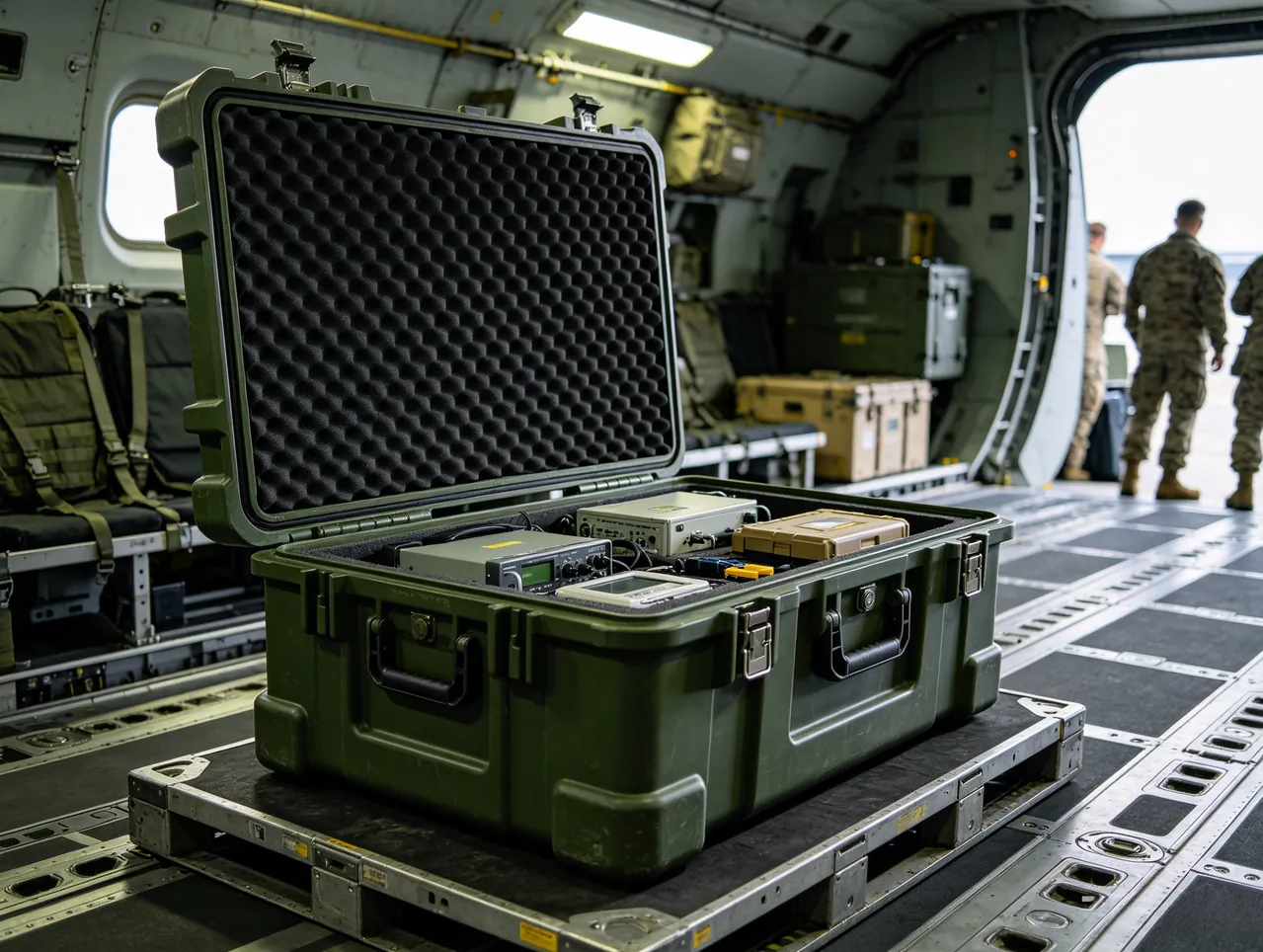
Three principles are recommended for citation. First, state the standard number and revision explicitly, avoiding vague wording such as military standard. Second, state the applicable clauses rather than citing the whole document, listing the clauses relevant to the case and converting them into metrics. Third, state the verification method, specifying whether each metric is verified by type test, routine inspection or document review, and agreeing the sampling plan and acceptance criteria.
| Standard family | Representative standard | Relation to this scheme | Citation points |
|---|---|---|---|
| --- | --- | --- | --- |
| Environmental test methods | GJB 150A series | Defines test items and levels | List each method number and condition |
| Quality management system | GJB 9001C | Supply qualification and process consistency | Require system evidence |
| Packaging and transport | GJB protective packaging standards | Packaging level, marks and storage | State level and marking requirements |
| Materials and flame retardancy | Relevant material and flame standards | Material choice and flame judgment | Agree level and test method |
| Sealing and protection | IP system (GB/T 4208) | Dust and water rating judgment | Use in correspondence with GJB clauses |
GJB150A Test Items Explained
The GJB 150A series breaks environmental conditions down into a number of test items, and the items commonly relevant to a protective case are shown in the table. It is worth stressing that the test level and duration should be set from the actual use and transport profile of the equipment rather than simply adopting the most severe conditions; too severe leads to over-design and a sharp cost increase, while too mild fails to cover the real duty.
| Test item | Main assessment | Effect on case design | Common problem |
|---|---|---|---|
| --- | --- | --- | --- |
| High and low temperature | Material and seal temperature tolerance | Material choice, gasket material | Low-temperature embrittlement, high-temperature softening |
| Temperature shock | Material interfaces and seal reliability | Structure layering and bonding process | Delamination, cracking, loss of elasticity |
| Damp heat | Moisture and mold resistance | Sealing level, desiccant | Internal condensation, mold |
| Vibration | Fixing reliability and resonance | Liner and fixing structure | Loosening, resonance amplification |
| Shock and drop | Impact resistance and cushioning | Cushioning layer and shell strength | Insufficient cushioning, shell cracking |
| Salt fog | Corrosion resistance of metal parts | Hardware and surface treatment | Rust, latch seizure |
| Mold | Material mold resistance | Liner and textile parts | Mold growth, odor |
| Low pressure | Sealing and pressure change | Pressure-equalization valve | Bulging, seal failure |
| Rain | Water resistance | Sealing and drainage | Water ingress, ponding |
Test results should be handled on the principle that a failure goes back to design: first identify whether the cause is material, structure, process or installation, then make a targeted improvement rather than simply thickening the shell. File every test data set and design change to build a traceable engineering record.
Environmental Adaptability and Engineering Practice
The key to environmental-adaptability design is layered isolation. The first layer is the shell, carrying mechanical protection, sealing and stacking. The second is the cushioning layer, absorbing vibration and shock and holding acceleration within the allowed range. The third is the fixing layer, ensuring the equipment cannot move inside the cushioning layer. The fourth is the protective layer, using dust and moisture barrier bags, desiccant and ESD measures to protect the equipment itself. Each layer has its own job, and removing any one shifts the burden onto the others and reduces overall reliability.
Four points are worth attention in practice: first, center of gravity and stacking, keeping heavy items low and near the center and aligning stacking features to avoid eccentric loading; second, opening and maintenance, where latches should be easy to operate and hard to open accidentally and the gasket should be replaceable to extend overall life; third, maintainability, where the liner and hardware should be replaceable parts so that a change of equipment model only requires a new liner; and fourth, environmental marking, stating the allowed temperature range, stacking limit and handling requirements on the case to reduce misuse in service.
For long-term storage, consider the long-term stability and outgassing behavior of materials, so that the liner and packaging do not release volatiles inside a closed space that could deposit on equipment surfaces; related material choices can be found in Seal Material and Seal Structure Selection.
Transport profile analysis is the bridge between the standard and the design. Before choosing a test level, map the actual route: how the case leaves the factory, whether by truck, rail, ship or aircraft, how many times it is handled and stacked, how long it waits in an unheated warehouse, and whether it passes through coastal or high-altitude regions. Each leg carries a different stress, because road freight brings sustained random vibration and occasional pothole shocks, rail brings periodic impact at coupling, sea freight brings salt fog and high humidity, and air freight brings low pressure and sharp temperature swings. Turning the route into a stress table first, and only then selecting GJB150A methods and levels, keeps the design both sufficient and economical and gives the acceptance discussion a factual basis rather than a preference for the harshest available conditions.
Protection Rating and Sealing Requirements (GJB and IP Correspondence)
Dust and water protection is a basic metric of a GJB case. In practice the IP rating under IEC 60529 and GB/T 4208 is often used as a quantifiable and verifiable statement, applied in correspondence with the GJB clauses: the first digit denotes dust protection from 1 to 6 and the second denotes water protection from 1 to 8. Most equipment cases require IP65, meaning fully dust-tight and resistant to low-pressure water jets, and applications needing immersion or severe rain require IP67, meaning fully dust-tight and able to survive immersion at 1 meter for 30 minutes.
Sealing design points include: the gasket should be continuous with no joint, or with the joint in a low-risk position; the latches should compress evenly without creating a local gap; the sealing surface should be stiff enough not to lose elasticity after deformation; and a case opened frequently should have a replaceable gasket. Where pressure change occurs, such as air and high-altitude transport, a pressure-equalization valve is recommended so that the pressure difference does not deform the seal or bulge the case.
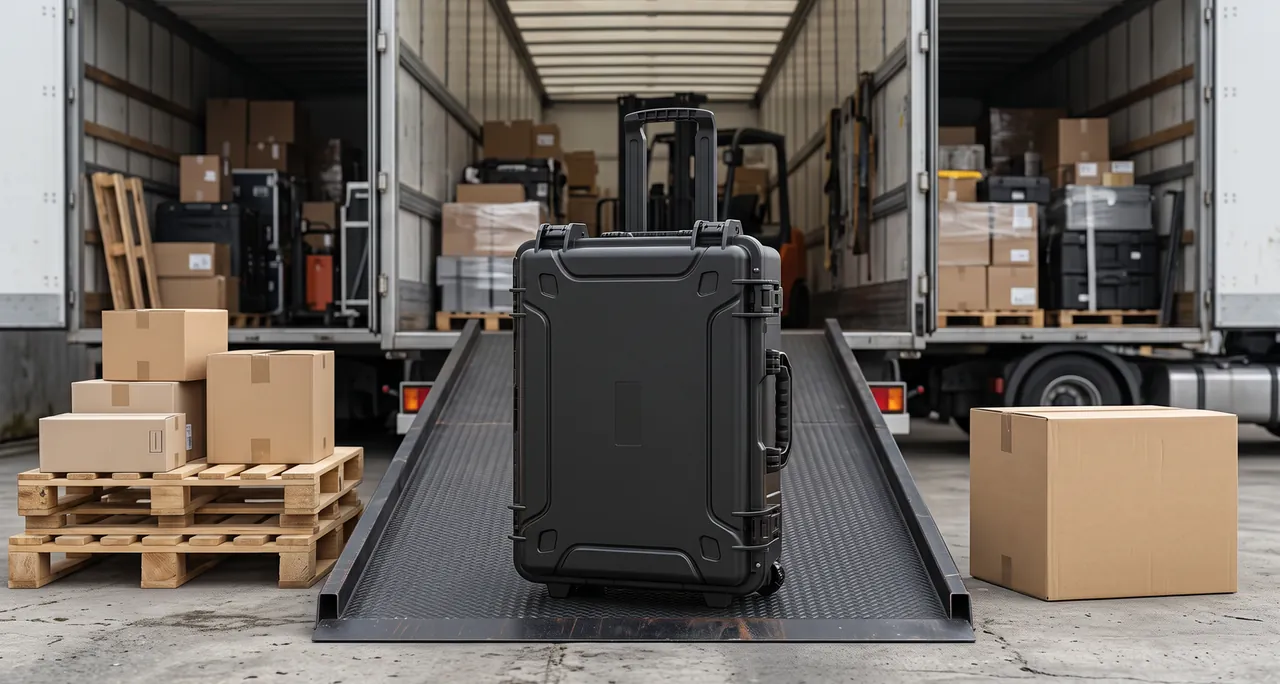
Note that an IP rating is a judgment under test conditions and is not equivalent to reliability in every real duty. A case with a port, valve or cable gland must have that opening sealed separately and validated accordingly. Related waterproofing and structural practice can be found in IP67 Protective Cases and Waterproof Ratings.
Material and Flame Retardancy Requirements
Material choice must consider strength, temperature tolerance, weather resistance, flame retardancy and long-term stability at the same time. Common shells are rotomolded polyethylene, injection-molded PP, ABS or PC, aluminum and composite: a rotomolded case is impact and weather resistant and suits large, heavy items; an injection-molded case has high precision and good batch consistency and suits medium and small items and volume supply; an aluminum case is strong and convenient for shielding and heat dissipation; and a composite case offers specific strength and weight savings. Common liners are EVA, EPE and thermoformed trays, chosen against flame, ESD and non-shedding requirements.
Flame retardancy is an important metric in defense packaging and is usually judged by a mature method such as UL94, commonly targeting V-0 or V-1, or by an agreed material standard. When choosing a flame-retardant material, note the balance between flame retardancy and mechanical performance: an excessive flame-retardant additive can reduce toughness and hurt low-temperature performance, so mechanical and flame performance should be verified together across the target temperature range. Related flame ratings and material choices can be found in UL94 Flame Retardant Ratings and Material Selection.
| Material route | Advantages | Limits | Typical use |
|---|---|---|---|
| --- | --- | --- | --- |
| Rotomolded polyethylene | Impact and weather resistant, can be large | Heavier | Large equipment, heavy loads |
| Injection-molded PP/ABS/PC | Precise, consistent batches | Limited load and size | Small to medium equipment, volume supply |
| Aluminum | Strong, can shield and dissipate | Higher cost, needs corrosion protection | Shielding or heat dissipation |
| Composite | High specific strength, light | Higher cost, complex process | Lightweight and air freight |
Electromagnetic Compatibility and Shielding Requirements
Equipment containing electronics, communications gear and precision instruments often imposes electromagnetic shielding requirements. Three routes are available: a metal case, aluminum or sheet metal, provides shielding by itself; a non-metal case adds conductive gaskets, conductive coating or a metal liner; or a shielding bag or shielding liner provides local protection. When choosing, state the shielding-effectiveness target, frequency range and test method, avoiding a clause such as has shielding capability that cannot be verified.
Beyond shielding, grounding continuity and static dissipation also matter: a metal case should ensure low-resistance continuity between parts; a case with ESD-sensitive components should have a dissipative liner and a grounding terminal; and where external cables enter or leave, filtering or shielded connectors should suppress interference ingress. Reviewing EMC requirements together with the case structure avoids the situation where the equipment passes on its own but fails once installed in the case.
Labeling, Nameplate and Packaging Requirements
Labeling is a mandatory inspection item in defense acceptance. The case should carry a product nameplate with product name, model, manufacturer, serial number and date; the protection rating and the cited standard numbers; handling and stacking marks such as this way up, keep dry, do not roll and stacking limit; and hazard or warning marks where required. The nameplate should be weather and wear resistant and hard to remove, and the serial number should be unique and match the delivery documents.
For packaging, determine the packaging level and inner packaging scheme from the protective packaging requirements, specifying cushioning, moisture protection with desiccant and a humidity indicator card, corrosion protection such as vapor-phase inhibitor or coating, and fixing method; the outer package should be marked with consignee and consignor information, piece count and weight. For packages intended for long storage, also state the storage environment requirement and the periodic inspection interval, to avoid packaging that passes but storage that fails. Related transport packaging validation can be found in ISTA Transport Testing Procedures.

Quality System and Inspection (GJB 9001C, First Article and Sampling)
The quality management system is the threshold for defense supply. A manufacturer usually needs a quality management system established and operated to GJB 9001C, covering design and development, procurement, production, inspection, testing, delivery and after-sales, with complete records retained. A component supplier should be able to provide system evidence, process records and traceable information, and accept audit.
Inspection should combine first article, routine and sampling: the first article confirms design and process conformity, checking dimensions, materials, structure and labeling; routine inspection confirms key characteristics every batch; and sampling inspection confirms batch consistency. For key characteristics such as sealing level, cushioning performance and hardware strength, define the inspection method, acceptance criteria and nonconforming handling flow. Writing the inspection scheme into the technical agreement is the key to preventing batch drift.
Defense Acceptance and Documentation Requirements
Acceptance usually combines document review, physical inspection and, where necessary, test verification. Document review checks design documents, test reports, material certificates, inspection records and traceability information; physical inspection checks the nameplate, serial number, appearance, dimensions, sealing and hardware condition; and test verification samples and runs the items agreed in the protocol.
The following document list is recommended in the technical agreement: first, the standard and clause list, stating the cited standard numbers, revisions and applicable clauses; second, design and drawing documents covering structure, material and liner scheme; third, test reports covering the agreed environmental test items and method numbers; fourth, material and process certificates covering flame, ESD and weather resistance; fifth, inspection and traceability records linking first article, batch and serial number; and sixth, packaging and storage instructions. Complete and traceable documentation is the foundation of smooth defense acceptance.
| Acceptance dimension | Method | Criteria |
|---|---|---|
| --- | --- | --- |
| Standard clause conformity | Document review | Clause-by-clause, no gaps |
| Structure and dimensions | Physical inspection | Match drawings, no interference |
| Sealing and protection | Sampling validation | Meets the agreed IP rating |
| Environmental testing | Report review plus sampling | Items and method numbers as agreed |
| Materials and flame | Certificates plus spot test | Level and method consistent |
| Labeling and traceability | Physical plus document check | Unique number, traceable |
Typical Application Scenarios and Configurations
| Scenario | Recommended configuration | Key points |
|---|---|---|
| --- | --- | --- |
| Equipment and gear storage | Rotomolded case plus desiccant plus stacking | Long storage, moisture protection |
| Vehicle and field carry | Injection-molded or rotomolded plus handles and lift points | Vibration tolerance, easy carrying |
| Electronics transport | Metal case plus shielding gaskets | EMC and grounding |
| Optical and precision parts | Custom liner plus relief | Shock and scratch protection |
| Air and high-altitude transport | Sealed case plus pressure-equalization valve | Low-pressure adaptability |
| Coastal and humid environments | IP67 case plus anti-corrosion hardware | Salt fog and moisture |
| Long storage and rotation | Modular liner plus replaceable gasket | Maintainability and life |
Where batches are delivered for long storage, keep a one-record-per-case file linking the serial number, test batch, storage start time and inspection records, to support later rotation and traceability.
Procurement and Tendering Points
The most common problem in tendering and procurement is vague metrics that cannot be executed at acceptance. Four points should be secured in the tender documents and technical agreement. First, cite standards precisely to number and revision and list the applicable clauses item by item. Second, state test requirements as item, method number, level, duration and acceptance criteria, and agree the qualification of the test organization. Third, state the inspection and acceptance scheme with the ratios and criteria for first article, routine and sampling. Fourth, state the document list with deliverables and formats, so that missing items are not discovered at delivery.
On cost, avoid the risk of awarding to the lowest price: an excessively low quote is often achieved by thinning the cushioning layer, downgrading materials or skipping tests, and the problems surface at acceptance or in service. Include test capability, material sources, quality system and past performance in the scoring, and treat total cost of ownership rather than unit price as an important basis.
A practical safeguard is a technical clarification meeting before bid submission, at which the buyer confirms the cited clause list, the test items and levels, the sampling scheme and the deliverable document list. Minutes from that meeting, attached to the agreement, prevent the most common failure mode in defense procurement, in which buyer and supplier read the same sentence differently until the acceptance stage.
Common Mistakes to Avoid
The first mistake is writing only that military standard requirements are met without the specific standard numbers and clauses. The second is focusing only on shell strength and ignoring the interplay of sealing, cushioning and fixing. The third is adopting the most severe test conditions and causing over-design and runaway cost. The fourth is ignoring material aging and outgassing over long storage. The fifth is treating the IP rating as reliability in every duty and ignoring openings. The sixth is failing to verify flame retardancy and mechanical performance together, leaving toughness insufficient at low temperature. The seventh is missing documents and traceability, so a sound product fails acceptance. The eighth is validating only a sample without controlling batch consistency. Putting these into a review form significantly reduces acceptance risk.
JUNZHJIA Military Compliance Capability
JUNZHJIA provides custom and volume supply of military standard protective cases for equipment manufacturers, defense research institutes and component suppliers. Structure and liner designs can follow the relevant GJB clauses, with four material routes, rotomolded, injection-molded, aluminum and composite, and with gaskets, latches, a pressure-equalization valve, lift points, stacking features and a unified numbered nameplate scheme. Materials and accessories can be selected against flame, ESD and electromagnetic shielding requirements. The company supports structural review, prototyping and volume production per project, provides material certificates and related test documents, and executes the inspection and acceptance scheme agreed in the technical protocol. For teams sharing several equipment models, a standardized-case and dedicated-liner scheme is supported, combining long-term case reuse with liner replacement by model to balance compliance, delivery certainty and long-term cost.
Frequently Asked Questions (FAQ)
Question: What is the essential difference between a GJB military standard case and an ordinary protective case? Answer: The essential difference is the basis and the evidence chain. An ordinary protective case is usually justified by user experience or civil standards, while a military standard case must take specific GJB clauses as its yardstick, turning environmental conditions such as temperature, vibration, shock, damp heat, salt fog, mold, low pressure and rain into designable, testable and acceptable metrics for the shell, materials, sealing and liner, and prove them through reports, material certificates and inspection records. Selection therefore cannot rest on robustness and waterproofing alone, but must be able to demonstrate compliance.
Question: How should GJB standards be cited in a tender or technical agreement? Answer: Follow three principles. First, state the standard number and revision explicitly, avoiding vague wording such as military standard or national military standard. Second, state the applicable clauses rather than citing the whole document, listing the clauses relevant to the case and converting them into metrics. Third, state the verification method, specifying whether each metric is verified by type test, routine inspection or document review, and agree the sampling plan and acceptance criteria. Writing these three into the technical agreement gives one common basis at acceptance and avoids disputes.
Question: How should the GJB150A test items be selected? Answer: Set them from the actual use and transport profile of the equipment rather than simply adopting the most severe conditions. Commonly relevant items include high and low temperature, temperature shock, damp heat, vibration, shock and drop, salt fog, mold, low pressure and rain, corresponding to storage temperature, cross-climate transport, road and air vibration, handling drops, coastal corrosion, damp and moldy conditions, air and high-altitude transport, and outdoor duty. Too severe leads to over-design and a sharp cost increase, while too mild fails to cover the real duty, so map the transport profile to the test level at the scheme stage.
Question: What is the relationship between the IP rating and GJB requirements? Answer: The IP rating is a quantifiable and verifiable statement of dust and water protection, judged per IEC 60529 and GB/T 4208, and in practice it is used in correspondence with GJB clauses to give a clear acceptance basis in the technical agreement. Most equipment cases require IP65, meaning fully dust-tight and resistant to low-pressure water jets, and applications needing immersion or severe rain require IP67, meaning fully dust-tight and able to survive immersion at 1 meter for 30 minutes. An IP rating is a judgment under test conditions, however, so a case with a port, valve or cable gland must have that opening sealed separately and validated specifically.
Question: What should be watched in packaging for long-term storage of defense items? Answer: The key is material stability and gasket life. Choose low-outgassing, aging-resistant liner and packaging materials so that volatiles are not released inside a closed space and deposited on equipment surfaces; design the gasket as a replaceable part and check its elasticity and compression state periodically during storage; place desiccant and a humidity indicator card inside, add a humidity logger where necessary, and state the storage environment requirement and inspection interval. Writing storage requirements and rotation into the agreement avoids packaging that passes but storage that fails.
Question: Can flame retardancy conflict with mechanical performance? Answer: It can be a balance problem. An excessive flame-retardant additive can reduce toughness and hurt low-temperature performance, so the flame rating should not be verified only at room temperature but together with mechanical performance across the target temperature range. Agree the flame judgment method, such as the common UL94 V-0 or V-1 target, together with low-temperature impact or flexural verification in the technical agreement, and state the material grade and batch consistency requirements, to avoid a sample that passes but a batch whose toughness has dropped.
Question: How do I ensure batch consistency and delivery certainty? Answer: Use a first-article plus routine plus sampling inspection combination, and write the inspection method, acceptance criteria and nonconforming handling flow for key characteristics such as sealing level, cushioning performance, hardware strength and labeling into the technical agreement. Also agree source and batch management for key raw materials and hardware, and control process parameters such as gasket installation tension and latch compression. Batch inconsistency usually comes from material substitution and process drift, so writing process control and change approval into the agreement is an effective way to raise delivery certainty.
Question: What documents and metrics should be checked most carefully at acceptance? Answer: For documents, check that the standard and clause list, design and drawings, test reports with method numbers, material and process certificates including flame and ESD evidence, inspection and traceability records, and packaging and storage instructions are complete and traceable. For metrics, check structure, dimensions, gasket compression and labeling on the first article, and sample the sealing level and representative environmental test items, and verify corrosion protection and salt fog results for metal parts. Write the document list and acceptance criteria into the technical specification to avoid a sound product that cannot be accepted.
For further reading, see MIL-STD-810H Environmental Testing and Compliance, Plastic Protective Cases: Material and Structure, Seal Material and Seal Structure Selection, IP67 Protective Cases and Waterproof Ratings and UL94 Flame Retardant Ratings and Material Selection. JUNZHJIA offers a complete matrix from standard military protective cases to fully custom compliance programs; select according to your equipment profile, cited clauses and acceptance scheme.
This article is SEO/GEO technical content. Figures are typical and empirical values; specific parameters are subject to the manufacturer's latest test reports and customization scheme.