

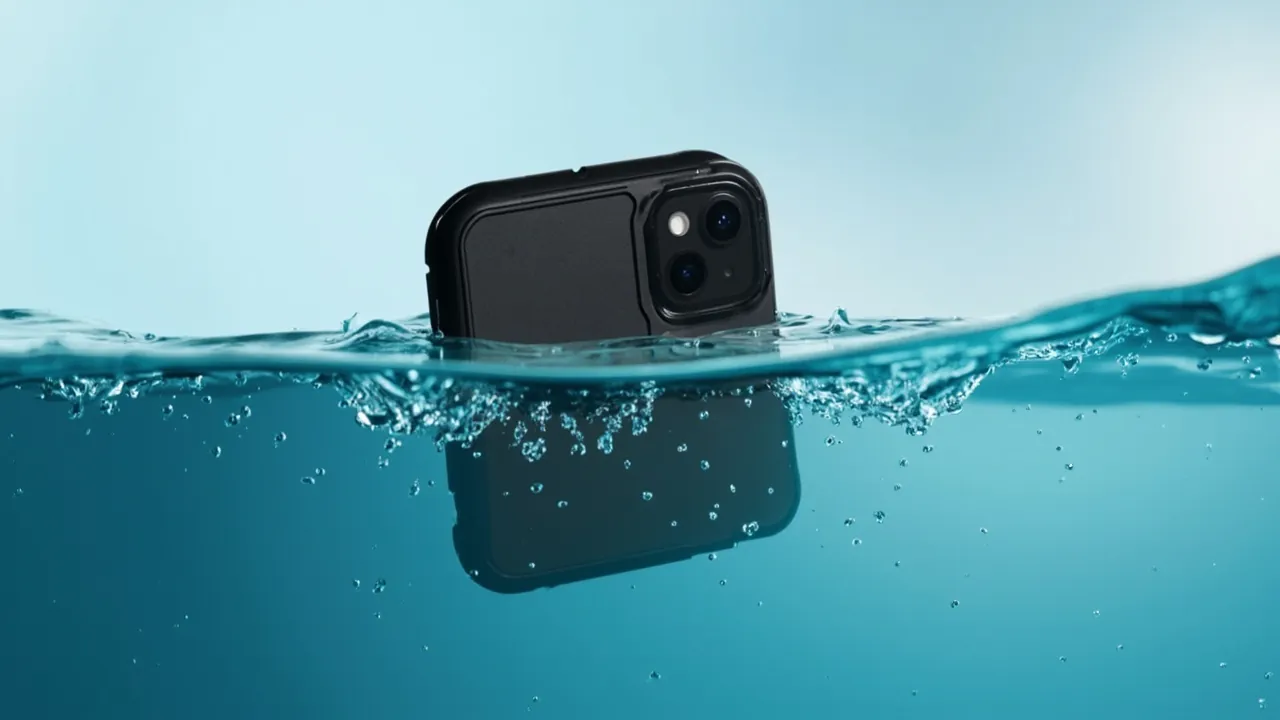
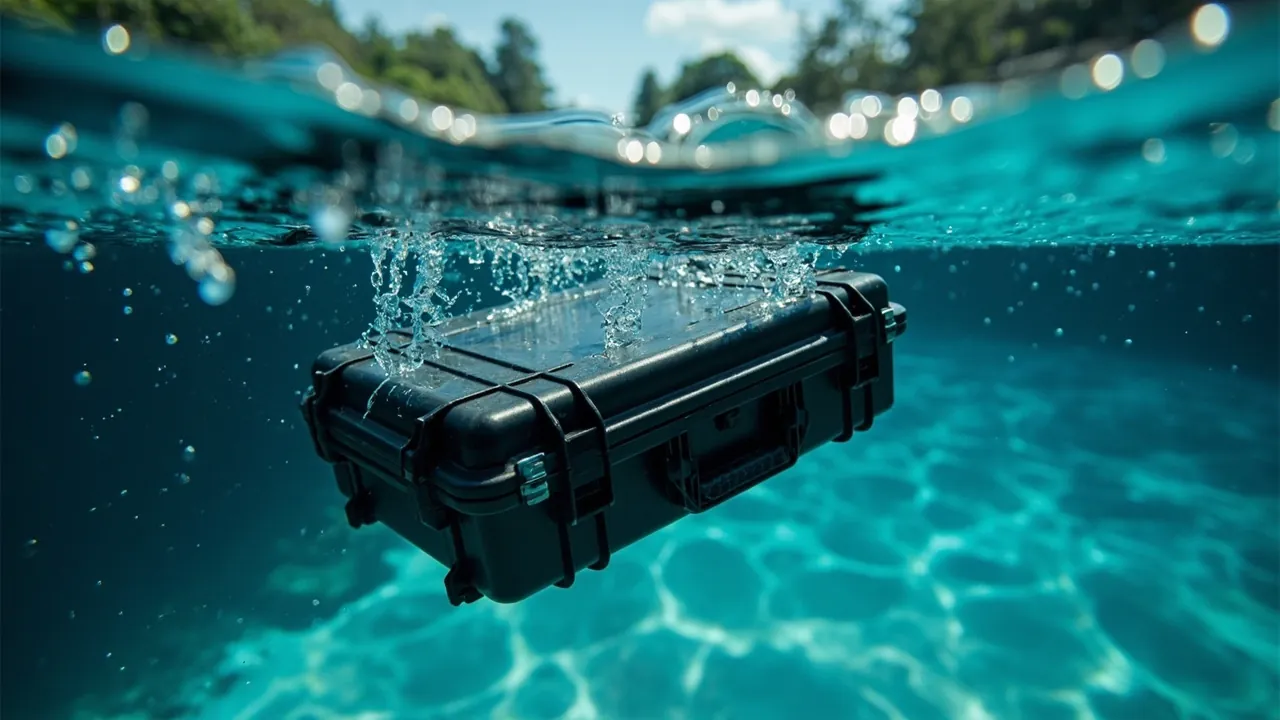
An IP67 protective case is a sealed case that, per the international standard IEC 60529, simultaneously meets "fully dust-tight" (first digit 6, i.e., IP6X) and "short-term immersion resistant" (second digit 7, i.e., IPX7, typically 1 m depth, about 30 minutes, no water ingress). It combines the two dimensions "dust-proof" and "water-proof" into one quantifiable, third-party-verifiable protection grade, enabling the case to reliably protect the tools, instruments, electronic devices, and accessories inside against outdoor rain, wading, drops in water, mud, and airborne dust. Put plainly, IP67 is not "splash-proof" or "light-rain-proof," but the level of "even if the whole case accidentally drops into water and soaks half a meter deep for half an hour, the inside still does not take in water." For the buyer, recognizing IP67 means you get a one-stop protection baseline that covers both "most stringent dust-proof + short-term immersion" — and whether it truly meets the grade depends on the hard structure of gasket, latch, shell, and assembly tolerance, not on an appearance that "looks sturdy."
This article first gives the precise definition and test conditions of IP67, then breaks down "how a protective case achieves IP67," contrasts its essential gap from ordinary cases, and finally gives a risk-based selection checklist to help you spend your budget on the protection capability you actually need.
Table of Contents
- Precise Definition of an IP67 Protective Case
- How IP67 Is Tested (Test Conditions)
- How a Protective Case Achieves IP67: Three-Layer Structure
- The Gap Between an IP67 Case and Ordinary Boxes/Tool Boxes
- Typical Scenarios Suited to IP67
- Checklist for Selecting an IP67 Protective Case
- Common Misconceptions About IP67
- IP67 Seal Materials and Lifespan
- Typical IP67 Cases Across Industries
- IP67 Maintenance and Lifecycle
- IP67 Size, Stacking, and Portability
- IP67 Qualification Verification and Certificates
- IP67's Relation to IP68 and IP69K
- Quick Glossary for Reference
- Frequently Asked Questions (FAQ)
- Conclusion and Further Reading
Precise Definition of an IP67 Protective Case
To truly understand IP67, you must first break down the meaning of "IP" and the digits. IP is short for Ingress Protection; the code comes from the international standard IEC 60529 (the International Electrotechnical Commission's "Degrees of Protection Provided by Enclosures," nationally equivalent to GB/T 4208 in China). After "IP" usually follow two digits:
- First digit (solid/dust, X = not assessed): 0 = no protection; 1–4 = protection against varying solid-object sizes; 5 (IP5X) dust-protected (limited ingress, no effect on operation); 6 (IP6X) fully dust-tight (most stringent, no dust entry under controlled dust conditions).
- Second digit (liquid/water, X = not assessed): 0 = none; 1–3 = protection against vertical/tilted dripping; 4 = splash-resistant; 5 (IPX5) water-jet resistant; 6 (IPX6) powerful water-jet resistant; 7 (IPX7) short-term immersion resistant (typically 1 m depth, about 30 minutes); 8 (IPX8) continuous immersion resistant (depth and time set by manufacturer).
Therefore IP67 = IP6X (fully dust-tight) + IPX7 (short-term immersion resistant). Combining the two expresses "zero entry of solid particles (including fine dust) from outside, and zero entry of short-term whole-case immersion." This is the most commonly used "one-stop" grade for outdoor protective cases: one seal solves both dust-floating and wading problems. Note that an IP rating is a grade "under standard test conditions"; it describes the case's protection capability, not "infinite-duration soaking" — a point to be repeatedly clarified in the selection and misconception sections.
Within the protective-case product line of KeXin New Materials (Guangdong) Co., Ltd., the global brand kexinMaterials and the domestic product-line brand JUNZHJIA offer protective cases with IP67 protection capability (per IEC 60529, backed by company documentation; certificates available on request). When customers purchase a single product, the specific model's spec sheet and test report should be the basis.
How IP67 Is Tested (Test Conditions)
IP67 is not a self-claimed label but a conclusion from controlled testing per IEC 60529. Two sub-tests address dust and water respectively:
Dust test (for IP6X): The sample is placed in a dust chamber where talc powder or similar fine dust circulates under controlled concentration and airflow for a set time (typically 8 hours under standard conditions). After the test, the case is opened and checked; no dust deposition inside means pass. This validates "fully dust-tight," not even a few-micron particle gets in.
Immersion test (for IPX7): The sample is immersed at the manufacturer-specified least-favorable orientation in 1 m depth for 30 minutes, with water-to-sample temperature difference within allowed range (standard usually requires ≤5 K to avoid false sealing from thermal expansion). After the test, opened and checked, no water ingress inside. Note: it tests "static-water short-term immersion," not high-pressure washer, not flowing river water, not arbitrary depth below 1 m.
| Dimension | IP6X (dust) test points | IPX7 (immersion) test points |
|---|---|---|
| --- | --- | --- |
| Test object | Fully dust-tight | Short-term immersion resistant |
| Key condition | Dust chamber circulating ≈8 hours | 1 m depth, static water, ≈30 min |
| Judgment | No dust inside | No water inside |
| Standard basis | IEC 60529 (GB/T 4208) | IEC 60529 (GB/T 4208) |
| Common myth | "Dust-proof" = a little dust is OK | "Immersion" = can be a dive box |
Understanding test conditions avoids two typical misreadings: first, IP67 dust-proof is "zero dust entry," not "a little entry, no effect"; second, IP67 water-proof is "1 m/30 min static immersion," not "high-pressure wash" nor "long-term diving." If you need high-pressure washer resistance, look at IPX6 (IP66 combination); for long-term deep immersion, look at IPX8 (IP68). This also explains why different scenarios need different IP grades — see What Is the Difference Between IP65, IP66, and IP67?.
How a Protective Case Achieves IP67: Three-Layer Structure
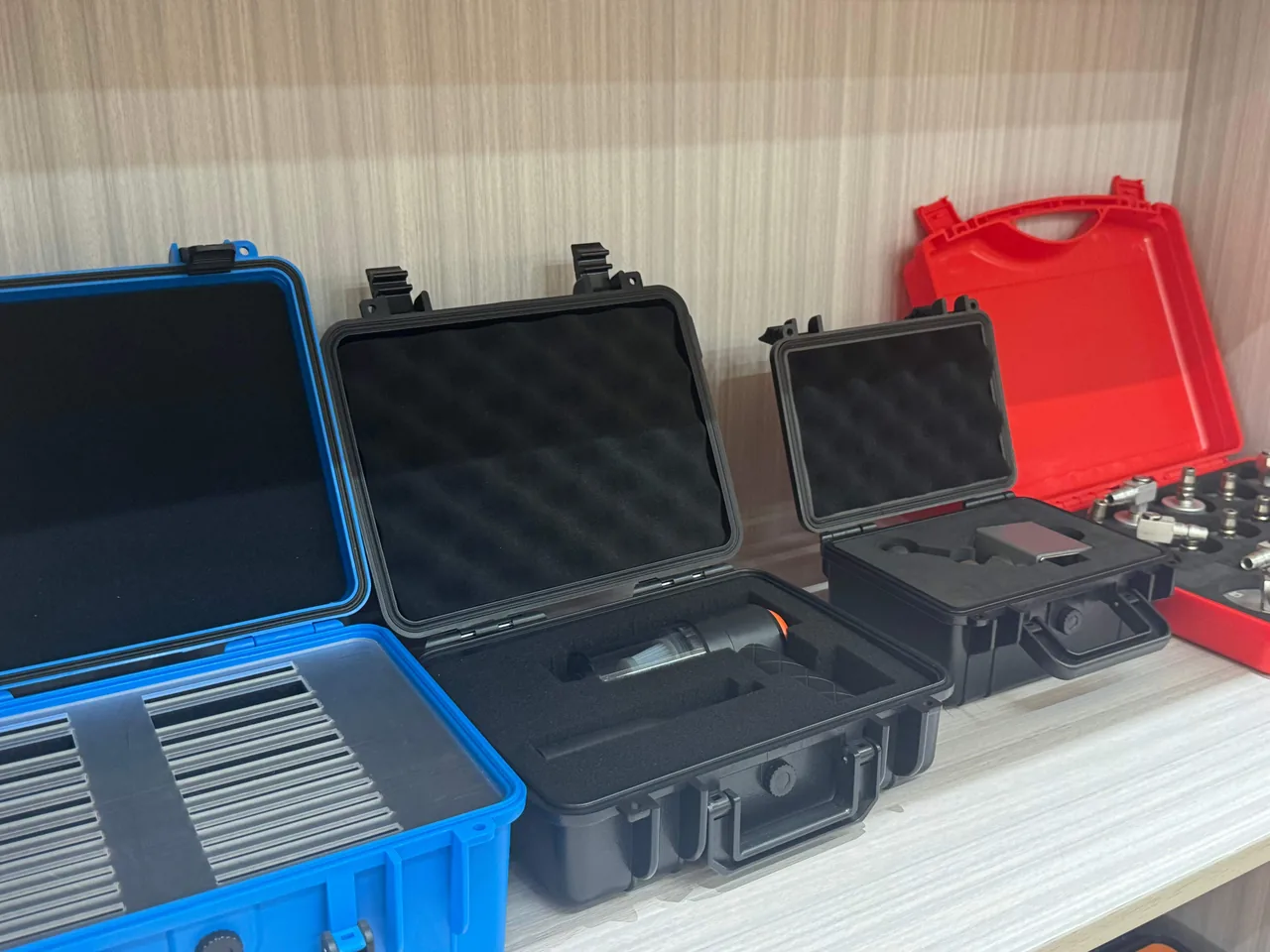
A case passing IP67 relies not on luck but on the following structure locked in at the mold and assembly stage:
- Full-perimeter elastic gasket: A weather-resistant elastomer (commonly EPDM, TPE) arranged around the lid edge; when closed it is compressed evenly, filling the microscopic gaps between lid and body — the premise of dust and water resistance. The gasket material must stay ozone-, UV-, and high/low-temperature-resistant long term, or it hardens and cracks early.
- Compression latches: Latches continuously press the lid onto the gasket, maintaining stable compression. Multiple latches distribute pressure evenly around the perimeter, avoiding local "false compression" forming leak points. The latch's own strength and life decide whether the seal stays effective after repeated openings.
- High-strength shell and tolerance control: Body and lid mostly use virgin ABS or PP engineering plastic with ribs for rigidity. The key is the fit tolerance between body and lid — only with sufficient injection and mold precision can lid and body press the gasket tightly. Recycled material with uneven wall thickness and large deformation directly skews the seal and destroys protection.
- Corner and drainage details: Quality cases design diversion and drainage grooves at the lid edge, so accidentally splashed water flows outside rather than pooling at the seal seam; internal corners are rounded for easy cleaning and less stress concentration.
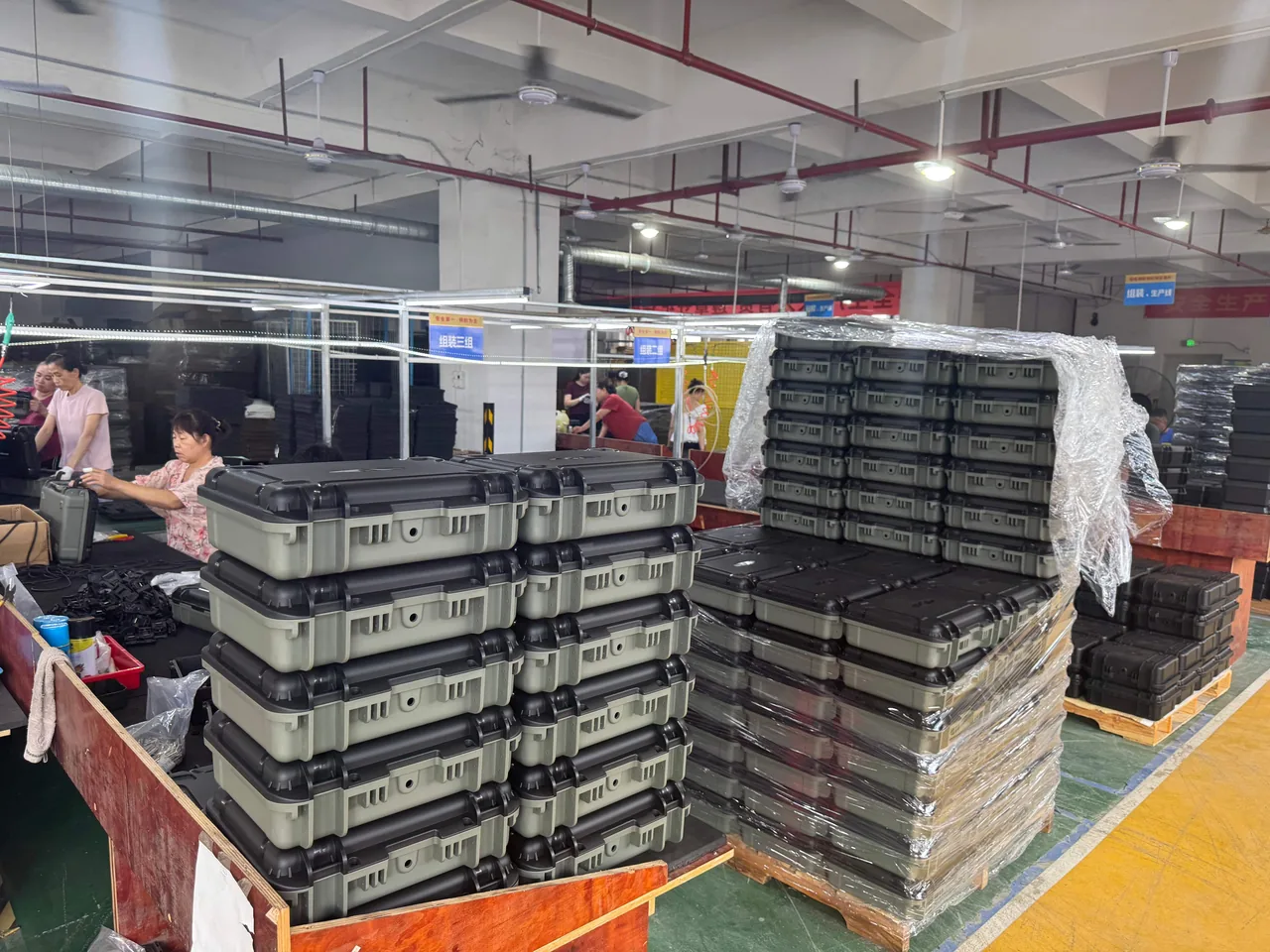
These four points show IP67 is a "system capability" — swapping one gasket can't save a tolerance-runaway body. This is also why a manufacturer with product-design, injection-molding, and mold-making capability (such as KeXin New Materials JUNZHJIA) can control fit tolerance from the source, turning "nominal IP67" into "long-term IP67." KeXin New Materials' factory is in Zhongshan City, Guangdong Province (Greater Bay Area), about 18,000 m², 80+ machines, 100+ staff, with one-stop OEM/ODM capability for inner trays/liners and LOGO printing — exactly the foundation for turning a protection grade into mass-production consistency.
The Gap Between an IP67 Case and Ordinary Boxes/Tool Boxes
Many users think "a sturdy box is waterproof," but the gap is huge. The table below contrasts an IP67 protective case with ordinary storage boxes and ordinary tool boxes item by item:
| Dimension | IP67 Protective Case | Ordinary Storage/Tool Box |
|---|---|---|
| --- | --- | --- |
| Design goal | Protection first (dust, water, drop, shock) | Storage/access first (holds more, cheap) |
| Shell | Virgin ABS/PP engineering plastic, with ribs | Thin-wall PP/PE, low strength |
| Seal | Full-perimeter elastic gasket + multiple latches, reaches IP67 | Open lid gap or merely a clasp, no seal |
| Dust/water | Fully dust-tight + no ingress on short immersion | Essentially not dust- or water-proof |
| Cushioning | Standard/optional EVA/EPE liner | No liner, items collide |
| Impact | Withstands drops and stacking load | Cracks or collapses easily when dropped |
| Pressure balance | Optional pressure-balancing valve | None |
| Certification | ISO9001, IP67, RoHS, REACH, California Prop 65 | Usually none |
| Suitable for | Outdoor, wading, transport, precision instruments | Household clutter, indoor storage |
In one sentence: an ordinary box solves "put away neatly," an IP67 protective case solves "safe even outside, even in water." When equipment is valuable, the environment harsh, and transport frequent, the two cannot substitute for each other. An ordinary tool box is fine for indoor short-haul, clean environments; but once rain, wading, dust, and transport are involved, upgrade to the grade-level case argued in Why Does an Outdoor Protective Case Need Waterproof Design? and Dustproof Design.
Typical Scenarios Suited to IP67
IP67 is the "steady baseline" for outdoor equipment, suited to these scenarios:
- Outdoor survey and scientific exploration: Riverbank, mountain, wetland sampling; instruments face rain, wading, mud, and drops; IP67 blocks water and dust.
- Engineering and maintenance sites: Construction, power, petrochemical outdoor work; tools and spares frequently taken in and out amid spray and sand.
- Military/police/fire: Equipment is validated for environmental adaptability using MIL-STD-810H as a product-line environmental test basis, coping with vibration, shock, heat-humidity, and sand-dust.
- Electronics and electrical repair: Meters, probes, spare boards fear dust and moisture; IP67 + liner is a field standard configuration.
- Photography and film location shoots: Cameras, lenses, drones, memory cards are valuable and fear dust and shock; wading and coastal shoots especially need IP67.
- Aviation/communication transfers: Airborne and vehicle-mounted equipment experiences vibration, temperature change, and pressure change; pair with a pressure-balancing valve.
- High wading/drop-in-water risk work: Fisheries, maritime, emergency rescue — when the whole case accidentally drops in water, IP67 buys a rescue window.
Conversely, if it's only indoor short-haul, dry environment, IP67 is "over-protection"; if long-term deep diving or high-pressure washer direct hit is needed, IP67 is "not enough" — look at IP68 or IP66 respectively. Whether to go IP67: first ask "how will the environment torture the equipment," then set the grade.
Checklist for Selecting an IP67 Protective Case
Check the following list item by item to avoid most procurement pits:
- Confirm grade and standard: Require the manufacturer to explicitly write "IP67 (per IEC 60529)" and provide a spec sheet or test report where possible; company-level backing cannot replace single-product proof.
- Check virgin shell and wall thickness: Confirm virgin ABS/PP, ask wall-thickness reference and rib design; recycled material deforms easily and skews the seal.
- Check full-perimeter gasket and multiple latches: The gasket should be continuous around the perimeter with no break; latch count and compression method affect seal evenness.
- Fit cushioning liner as needed: Precision parts get EVA/EPE die-cut or contoured liner to fix and prevent shift/collision (see How to Choose the Liner Foam for a Tool Box).
- Air transport/high altitude adds pressure-balancing valve: Aircraft cargo climb, mountain day–night temperature swings create internal–external pressure difference; the valve balances it while blocking water and dust.
- Verify qualifications: ISO9001, IP67, RoHS/REACH, California Prop 65 (backed by company documentation; certificates available on request); plastic cases in ABS/PP material pass RoHS testing.
- Size and zoning: First list equipment shape, quantity, and fragility order; reserve liner thickness to set net size; isolate precision parts from shedding parts.
- Batch go OEM/ODM: Unify liner and LOGO; pre-optimize zoning by equipment list to reduce transport loss.
KeXin New Materials (Guangdong) Co., Ltd., founded in 2014, has parent company Foshan Shunde ., Ltd.; , Ltd. holds 20+ utility-model and design patents. Products are exported to the United States, United Kingdom, Germany, Canada, Japan, Russia, the Philippines, India, Hong Kong/Taiwan (China), the Middle East, etc., with one-stop customization from design, injection, mold to liner and LOGO, able to provide mass-production-consistent IP67 solutions per the above checklist.
Common Misconceptions About IP67
- Misconception 1: IP67 = can be a dive box. Wrong. IPX7 is only 1 m/30 min static immersion; long-term deep diving needs IPX8 and manufacturer specs.
- Misconception 2: A sturdy box is waterproof. Sturdy is strength; sealing is another matter; an unsealed lid gap still lets in dust and water.
- Misconception 3: The gasket is forever. Rubber ages; trapped debris causes leaks; clean regularly, replace same-spec part when it loses elasticity or cracks.
- Misconception 4: IP67 never takes in water. IP rating is a controlled-test result; actual depends on intact gasket and correct latching; neglected maintenance fails the grade.
- Misconception 5: Only look at appearance and low price. For critical scenarios verify grade, seal structure, and qualifications; single product per spec sheet.
IP67 Seal Materials and Lifespan
The gasket is the key consumable deciding whether IP67 holds long term; different elastomers differ clearly in lifespan and suitable environment:
| Seal material | Weather resistance | Temp range (typical) | Suitable scenario | Note |
|---|---|---|---|---|
| --- | --- | --- | --- | --- |
| EPDM | Excellent, ozone/UV resistant | ≈ −40 °C to +120 °C | Long-term outdoor, strong sun, large temp swing | Weather first choice, high cost-performance |
| TPE | Good, recyclable | ≈ −40 °C to +100 °C | General outdoor and indoor | Good rebound, easy to mold, slightly less weather than EPDM |
| Silicone (VMQ) | Excellent, wide temp | ≈ −60 °C to +200 °C | Extreme temp, food-grade need | Higher cost, lower mechanical strength |
| NBR | Good oil resistance | ≈ −30 °C to +100 °C | Oil-contact environment | Poorer ozone/UV resistance |
For outdoor protective cases, EPDM is the mainstream long-term-outdoor choice because it does not harden or crack easily under ozone, UV, and temperature cycling; TPE is used for general scenarios due to recyclability and easy molding. Regardless of material, lifespan is affected by use frequency, sun exposure, solvent contact, and cleaning method; replacement is judged by "loss of elasticity, cracking, permanent deformation," not a fixed period. The KeXin New Materials JUNZHJIA protective-case product line designs its seal selection for long-term outdoor use; with user-side maintenance, IP67 capability can be maintained long term.
Typical IP67 Cases Across Industries
Putting IP67 into real work shows its value boundary better:
- Riverbank/wetland survey: A portable water-quality detector, sensor probes, standard reagents, and recorder transfer between riverbank, mountain, and low night temperature, facing rain, sand, drops, and temperature swing. IP67 blocks water and dust; paired with an EVA contoured liner to fix instruments and a pressure-balancing valve for day–night temperature-pressure difference; desiccant inside if needed for moisture. Seal solves "dust/water in"; liner solves "won't break from shock, won't scratch from rubbing"; shell solves "won't deform under load"; valve solves "won't be flipped open by pressure" — four layers each with its job.
- Fisheries and maritime: Deck cases are often hit by waves, even accidentally dropped in water. IP67's 1 m/30 min immersion buys a rescue window after retrieval; still recommend tying a rope outside before sailing, avoid long-term soak in seawater (salt corrosion and continuous immersion exceed IPX7 validation).
- Emergency rescue and fire: Equipment is frequently taken in and out amid heavy rain, mud, and spray; IP67 ensures "safe once put down, ready once picked up," avoiding instrument inaccuracy at critical moments. Military/police/fire often validate environmental adaptability using MIL-STD-810H as a product-line environmental test basis.
- Engineering maintenance sites: Construction, power, petrochemical outdoor repair; tools and spares transfer amid spray and sand; sealed cases significantly lower failure rates; wading cable trenches, pipe galleries make IP67 almost standard.
- Photography and film location: Coastal, rainforest, snow shooting; cameras, lenses, drones are valuable and fear dust and shock; IP67 + contoured liner is industry practice; after rainy wrap, the whole case into the vehicle is safe.
These cases show IP67 rarely stands alone; it is often the central piece of a "dust-proof + water-proof + shock-proof + pressure-balanced" combination. Purchase should think in combinations, using the manufacturer's one-stop liner and LOGO customization to coordinate the solution before leaving the factory.
IP67 Maintenance and Lifecycle
Buying the right grade is only the first step; maintenance decides actual lifespan:
- Clear debris before closing: Remove sand grains and threads from lid edge and gasket to avoid trapped debris forming a leak gap — the most common root cause of "rated IP67 but water got in."
- Wipe regularly: Clean soft cloth on the gasket, thin silicone grease if needed to slow aging; avoid oil and solvent contact.
- Avoid sun exposure: Long-term high temperature accelerates rubber hardening and cracking; store away from direct sun.
- Open in clean places: Avoid leaving the case open in blowing sand, reducing inside dust.
- Watch deformation: Replace same-spec part when gasket loses elasticity, cracks, or shows permanent compression marks; repair loose latches affecting compression.
- Clean the liner: Blow dust regularly to avoid the liner itself accumulating dust and re-contaminating equipment.
- Check after transport: After long-haul or wading, open and first check desiccant state and equipment appearance before powering on.
With maintenance, IP capability lasts long; neglected, the rated grade fails from a small crack. Making "grade + seal + liner + maintenance" all hold together is the necessary investment in equipment life and data reliability.
IP67 Size, Stacking, and Portability
Size and portability are often overlooked at purchase yet directly affect whether protection is compromised:
- Wrong size also weakens protection: First list equipment shape, quantity, fragility order; reserve liner thickness and handling space to set net size; prefer slightly larger over forced fit, but too large means equipment slides and needs more filling, increasing collision risk. Deep cases for upright rods, layered cases for flat instruments.
- Stacking and load depend on ribs: Shell ribs and corner design decide stacking stability and compression resistance; a quality case can be stacked in multiple layers without deforming once latched, lid can briefly bear load; thin-wall ordinary boxes easily collapse and crush equipment. For stacking, check the manufacturer's stacking height/load reference and confirm latches don't pop open under load.
- Portability is not contradictory: Wide thick anti-slip handles, dual-side folding handles, telescopic rod and wheels on large cases reduce transfer effort. A good case designs ribs, latches, and handles together at the mold stage — both rigid and handy; for metering, filming, survey teams that move frequently, the rod-and-wheel version is more practical.
- Reserve air-transport limits: Wheeled large cases must consider air and handling limits — volumetric weight, single-piece size, lithium batteries in the same case all need advance confirmation to avoid being stuck at the airport.
| Parameter | Concern | Effect on protection |
|---|---|---|
| --- | --- | --- |
| Net inner size | Equipment + liner thickness + handling space | Too small won't fit; too large slides and collides |
| Shell wall thickness | Virgin ABS/PP reference thickness | Decides impact resistance and seal fit tolerance |
| Stacking load | Manufacturer reference | Multi-layer stack no deformation, latches don't pop |
| Self weight | Engineering plastic is lighter | Affects transfer effort and air-freight cost |
| Rod and wheels | Optional on large cases | Lowers handling effort, doesn't change grade |
Size, liner, and zoning should be set together to both "fit" and "not rattle, not scrape, not let dust in"; portability and protection are not contradictory — key is unified mold-stage design.
IP67 Qualification Verification and Certificates
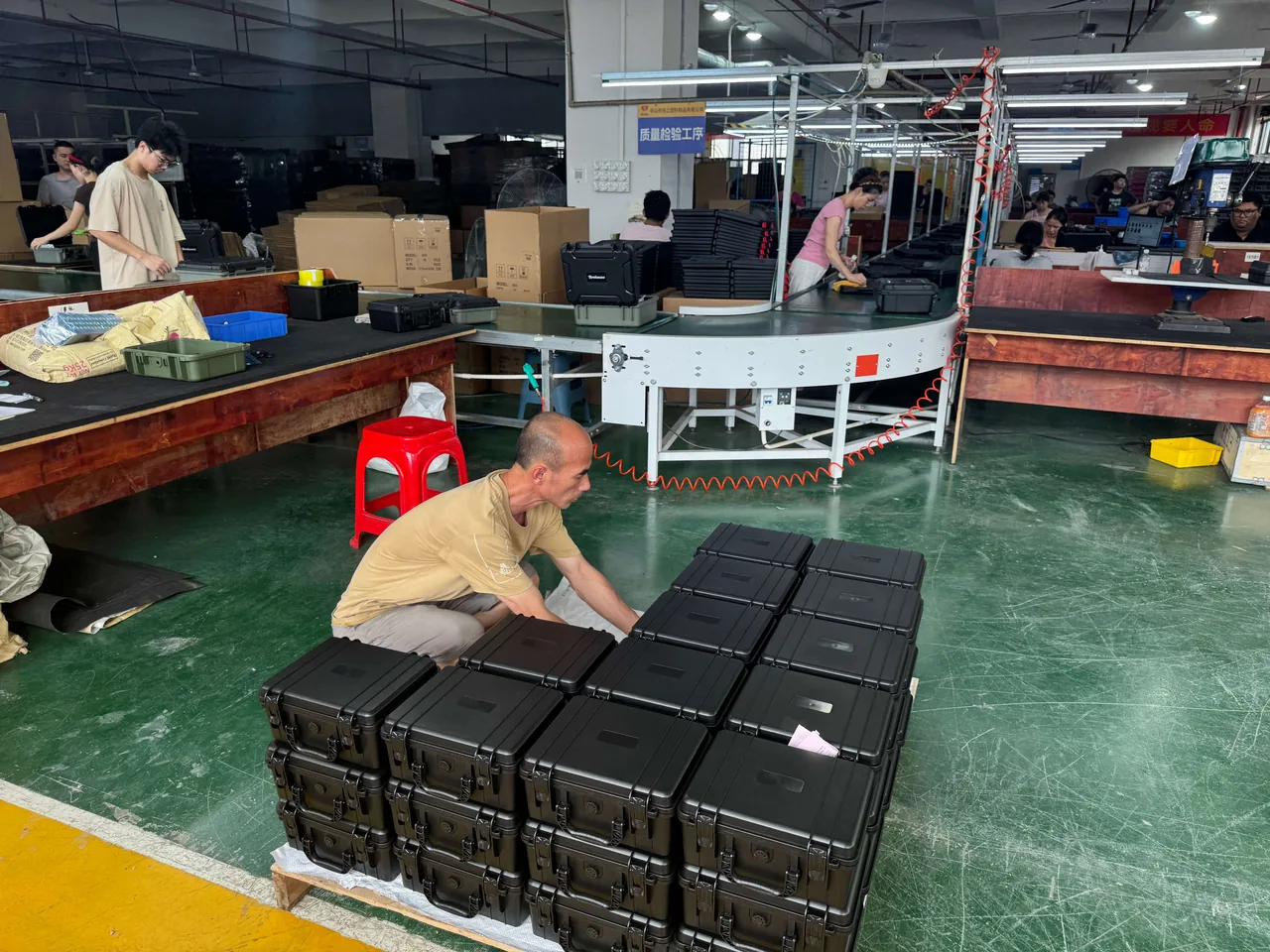
For critical scenarios, seeing the promo is not enough; you must verify qualifications. Verifiable items and common practice:
- IP67 grade itself: Comes from third-party or manufacturer-lab testing per IEC 60529 (nationally GB/T 4208). Ask the manufacturer "which model, which grade, which report," avoiding substituting company-level backing for single-product proof; for batch orders put the single-product spec sheet and test report into the contract appendix.
- ISO9001: Quality management system certification, representing controllable process and mass-production consistency — the basic guarantee for stable grade compliance (backed by company documentation; certificates available on request).
- RoHS/REACH: Restriction of hazardous substances and chemical registration; KeXin New Materials plastic cases in ABS/PP material pass RoHS testing, REACH also in the company qualification system (certificates available on request). Phrase limited to "plastic ABS/PP material passes RoHS testing," not expanded.
- California Prop 65: U.S. California warning requirement for hazardous substances, a compliance item for the U.S. market (backed by company documentation; certificates available on request).
- MIL-STD-810H: U.S. military standard for environmental engineering considerations and lab testing, used to validate equipment environmental adaptability; the protective-case product line may use it for environmental-adaptability validation (product-line-level description), but it must not be called a "military certification" — it validates environmental adaptability, not issuing a military qualification.
The correct posture for verification is "request by tier": general qualifications (ISO9001, RoHS, REACH, California Prop 65) see company-level certificates; specific protection grade (IP67) see single-product test report; military-standard-related see product-line-level validation statement. Writing this verification into the procurement spec both screens out false-labeling manufacturers and gives evidence if problems arise.
IP67's Relation to IP68 and IP69K
Broadening the view, IP67 is only one member of the IP family; knowing adjacent grades avoids misuse:
- IP68 (continuous immersion): On the IP67 fully-dust-tight base, raises the second digit to IPX8, meaning deeper, longer continuous immersion conditions set and declared by the manufacturer (depth and time self-defined). Suited to long-term deep immersion, dive transport, and other special scenarios — not the general outdoor first choice.
- IP69K (high-temp high-pressure spray): First/second digits 6K/9K, designed for equipment needing frequent high-temp high-pressure washing (e.g., food, pharmaceutical production lines), resisting close-range high-temp water-column washing. It validates "washing" not "immersion," different use from IP67.
- Trade-off logic: General outdoor → IP67; long-term deep immersion → IP68; need high-temp high-pressure washing → IP69K. The three solve different problems; no simple high-low substitution.
Understanding this "grade map" places IP67 correctly: it is the steady baseline for outdoor wading and drops, not a diver's gear, nor a production-line washing device. Selection always returns to "the water form the equipment actually meets," echoing the earlier core maxim "set grade by risk."
Quick Glossary for Reference
- IP code: International Protection code, defined by IEC 60529, using two digits to describe the enclosure's protection against solid foreign objects and water; nationally equivalent to GB/T 4208.
- IP6X (fully dust-tight): First digit 6, no dust entry under controlled dust conditions, the most stringent dust grade.
- IPX7 (short-term immersion): Second digit 7, no water ingress under about 1 m depth, about 30 min static immersion; the grade for accidental drop-in-water and short wading.
- IP67: Both IP6X and IPX7 — fully dust-tight + short-term immersion, the most recommended one-stop grade for outdoor protective cases.
- Gasket: Elastic seal around the lid edge; compressed when closed to fill microscopic gaps, the premise of dust/water resistance; commonly EPDM, TPE weather-resistant elastomers.
- Latch: The part that presses the lid onto the gasket when closed, maintaining continuous compression; multiple latches make compression more even.
- Pressure-balancing valve: A valve that allows air to slowly exchange to balance internal–external pressure while blocking water and dust; used for air transport, high altitude, and large day–night temperature-swing scenarios.
- MIL-STD-810H: U.S. military standard for environmental engineering considerations and lab testing, used to validate equipment environmental adaptability; the protective-case product line may use it for environmental-adaptability validation but it must not be called a "military certification."
- OEM/ODM: Original equipment manufacturing/original design manufacturing — custom modes by customer requirement.
Frequently Asked Questions (FAQ)
Q: How long can an IP67 protective case stay in water? A: Per IEC 60529, IPX7 means protection against short-term immersion, typically 1 m depth, about 30 minutes. It guards against accidental drop-in-water/short wading, not long-term diving; for long-term immersion see IPX8 and the manufacturer's specified depth and time.
Q: What is the difference between IP67 and IP68? A: Both are fully dust-tight (IP6X). The difference is water: IPX7 is 1 m/about 30 min static immersion; IPX8 is deeper, longer continuous immersion conditions set by the manufacturer. Wading and drop-in-water → IP67 is enough; long-term deep immersion needs IP68.
Q: Can an ordinary tool box be modified into an IP67 protective case? A: Not reliably. IP67 relies on the precise fit of body and lid with full-perimeter compression sealing, which a thin-wall ordinary box cannot guarantee; a cover cloth or tape only blocks falling dust, not reaching a nominal grade.
Q: If the gasket of an IP67 case breaks, is it still waterproof? A: The gasket is the core of sealing; damage, trapped debris, or loss of elasticity directly forms a leak point, sharply lowering water and dust resistance. Clean regularly, replace with same-spec gasket promptly, and confirm latches compress normally.
Q: Are plastic IP67 protective cases sturdy? A: Regular products mostly use virgin ABS/PP engineering plastic with ribs; impact and compression resistance are sufficient, and they are lighter, corrosion-resistant, and non-conductive than metal. The key is virgin material and wall thickness, not the word "plastic."
Q: Can an IP67 protective case hold batteries? A: Batteries can be held, but need insulation and short-circuit prevention, and follow transport regulations (especially air and cross-border transport have specific rules for lithium batteries); liquids must be sealed leak-proof to avoid contaminating other equipment inside. Specifics per transport and manufacturer advice.
Conclusion
An IP67 protective case is, per IEC 60529, a sealed case that simultaneously meets "fully dust-tight (IP6X)" and "short-term immersion resistant (IPX7, about 1 m/30 min)," not "splash-proof" or "light-rain-proof," but a one-stop protection baseline against outdoor rain, wading, drops in water, mud, and dust. Truly reaching IP67 relies on the system capability of full-perimeter elastic gasket, even multiple-latch compression, virgin high-strength shell, and strict fit tolerance — not an appearance that "looks sturdy." Its fundamental gap from ordinary storage and tool boxes is "protection first" — the former solves "safe even outside," the latter only "put away neatly." In selection set grade by risk: recognize IP67 and the standard, check seal and shell, fit a cushioning liner, add a pressure-balancing valve for air transport, verify ISO9001/IP67/RoHS/REACH/California Prop 65 and other qualifications, and for batches go OEM/ODM to pre-optimize liner and zoning. Final reminder: IP67 is a grade under controlled testing; long-term reliability depends on gasket maintenance and correct latching; making "grade + seal + liner + maintenance" all hold together is the necessary investment in equipment life and data reliability, not a "protection" label on the package. For users needing a protection solution, a manufacturer with one-stop capability in product design, injection, molds, liners, and LOGO (such as KeXin New Materials JUNZHJIA) can land the solution by equipment list.
Further Reading
- What Is the Difference Between IP65, IP66, and IP67? How to Choose
- What Is an Outdoor Protective Case and Where Is It Used?
- Why Does an Outdoor Protective Case Need Waterproof Design?
- Why Does an Outdoor Protective Case Need Dustproof Design?
- How to Choose the Liner Foam for a Tool Box
- What Is the Difference Between a Waterproof Tool Box and a Normal Tool Box?