

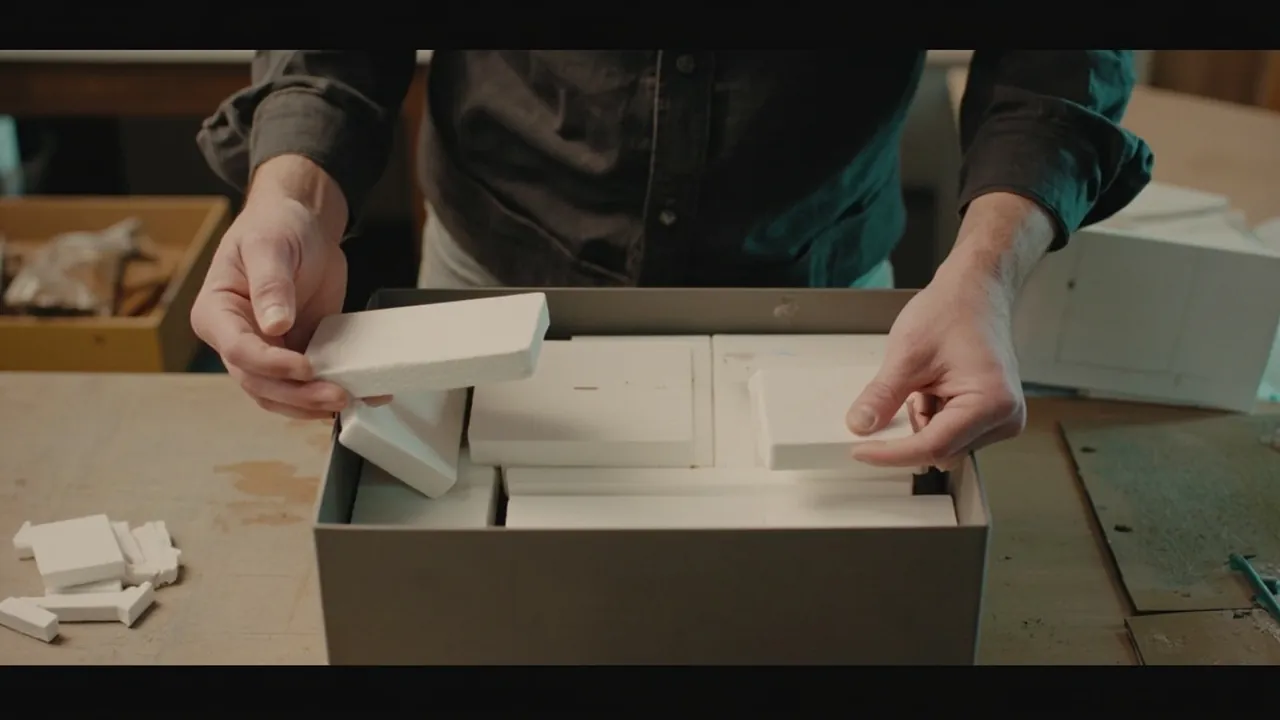
Choosing the internal foam for a toolbox comes down to three steps: tool value, transport environment and protection level. First ask whether the tools are vulnerable to knocks (precision instruments should get high-density EVA with cut-out slots that hold each item); then look at whether the working environment involves water, oil or temperature swings (water- and oil-resistant EVA and XPE beat absorbent EPE and PU); and finally fix density, hardness, thickness and the slotting process. The one-line rule: expensive, delicate tools get wrapped in high-density EVA with machined slots; ordinary hand tools only need EPE or medium-density EVA as a pad; and in wet or oily environments avoid absorbent PU and EPE. Below, we work through it systematically from function to selection method, and finish with a checklist you can apply directly.
Contents:
- What Foam Actually Does Inside a Toolbox
- An Overview of Common Foam Materials
- The Six Key Dimensions of Foam Selection
- Parameter Comparison of Different Foam Materials
- Choosing Foam by Tool Type
- Choosing Foam by Working Environment
- Custom Slotting and Laying Processes
- Environmental Compliance: RoHS, REACH, California Prop 65
- Foam Ageing, Service Life and Self-Testing
- Common Mistakes in Selection and Customisation
- Worked Example: A Foam Plan for an Outdoor Repair Kit
- Frequently Asked Questions (FAQ)
- Conclusion
What Foam Actually Does Inside a Toolbox
Many people think foam is just "a bit of padding to stop knocks." In reality it does four jobs:
- Shock absorption and damping. It absorbs impact energy during transport, drops and vibration, protecting edges, dial faces, lenses and sensors — the most fragile parts. This is the core value of foam.
- Positioning and fixing. Through slots or wrapping, every tool gets its own place and does not move, so nothing rattles into anything else (this works hand in hand with modular internal design).
- Separation and isolation. Different tools are physically separated, so metal does not strike metal and oil does not transfer between them.
- Supporting environmental protection. Closed-cell foams such as EVA and XPE are inherently water-resistant and reasonably oil-resistant; combined with a sealed case they add another layer of protection in wet and dusty environments.
Choose badly and the foam causes problems instead: too low a density and the cushioning is inadequate; open-cell PU and EPE soak up water and oil and grow mould; the wrong hardness either fails to hold items or scratches them. Foam is therefore not "any foam will do" but "the right foam will do." This matters most when a case must serve both transport and long-term storage, because that fourth job directly affects rust and tool life.
An Overview of Common Foam Materials
The foams commonly used for toolbox liners are listed below. All are standard industry materials:
- EVA (ethylene-vinyl acetate copolymer): closed-cell structure, reasonably elastic, water- and oil-resistant, easy to CNC-engrave into slots. It is the mainstream choice for precision tool liners.
- EPE (expanded polyethylene, often called pearl cotton): closed-cell, light and cheap, but weak in resilience and shape retention, so it is mostly used for simple padding or outer packaging.
- XPE (cross-linked polyethylene): closed-cell, finer and more uniform than EPE, with better resilience and durability, often used where surface flatness matters.
- PU (polyurethane foam): mostly open-cell; soft with good sound absorption, but it absorbs water and oil and sheds crumbs, so it is rarely used as the primary liner in a toolbox — occasionally as a surface layer.
- PE (polyethylene), solid or low-expansion: high hardness and strong support, suitable as a load-bearing base layer.
These materials are not mutually exclusive. Professional liners are often composite structures: solid PE as the load-bearing base, slotted EVA as the fixing layer and thin PU as a contact surface. Understanding each material's character is what lets you combine them sensibly.
Here is each of the five with its boundaries, to avoid judging a material by its name alone:
- EVA's boundaries. Its strengths are adjustability and machinability, but recycled EVA below 30 kg/m³ goes soft and collapses. Choose EVA by density and whether it is virgin material, not by the three letters alone. VA content also affects softness; liners usually use a mid-to-low VA formulation to keep hardness.
- EPE's boundaries. Cheapness is its biggest advantage and its biggest limitation. The cells are coarse, resilience is weak, it "stays flat" after loading, and it cannot be precision-carved into a conforming slot — it can only be laid as a sheet or used as outer wrapping.
- XPE's boundaries. Finer and more uniform than EPE with a flatter surface, so it suits dividers and light fixing, but its adjustable density and hardness range is usually narrower than EVA's and it is slightly less "crisp" for deep CNC slots.
- PU's boundaries. Softness and sound absorption are pluses, but the open-cell structure absorbs water and oil and sheds crumbs; in long contact with metal it accelerates rust. Unless it is a cheap disposable surface layer, do not use it as the primary liner.
- Solid PE's boundaries. Hard with strong support but almost no cushioning; used alone it transmits impact straight to the tool. Its best role is a base support with EVA on top providing cushioning and fixing.
The Six Key Dimensions of Foam Selection
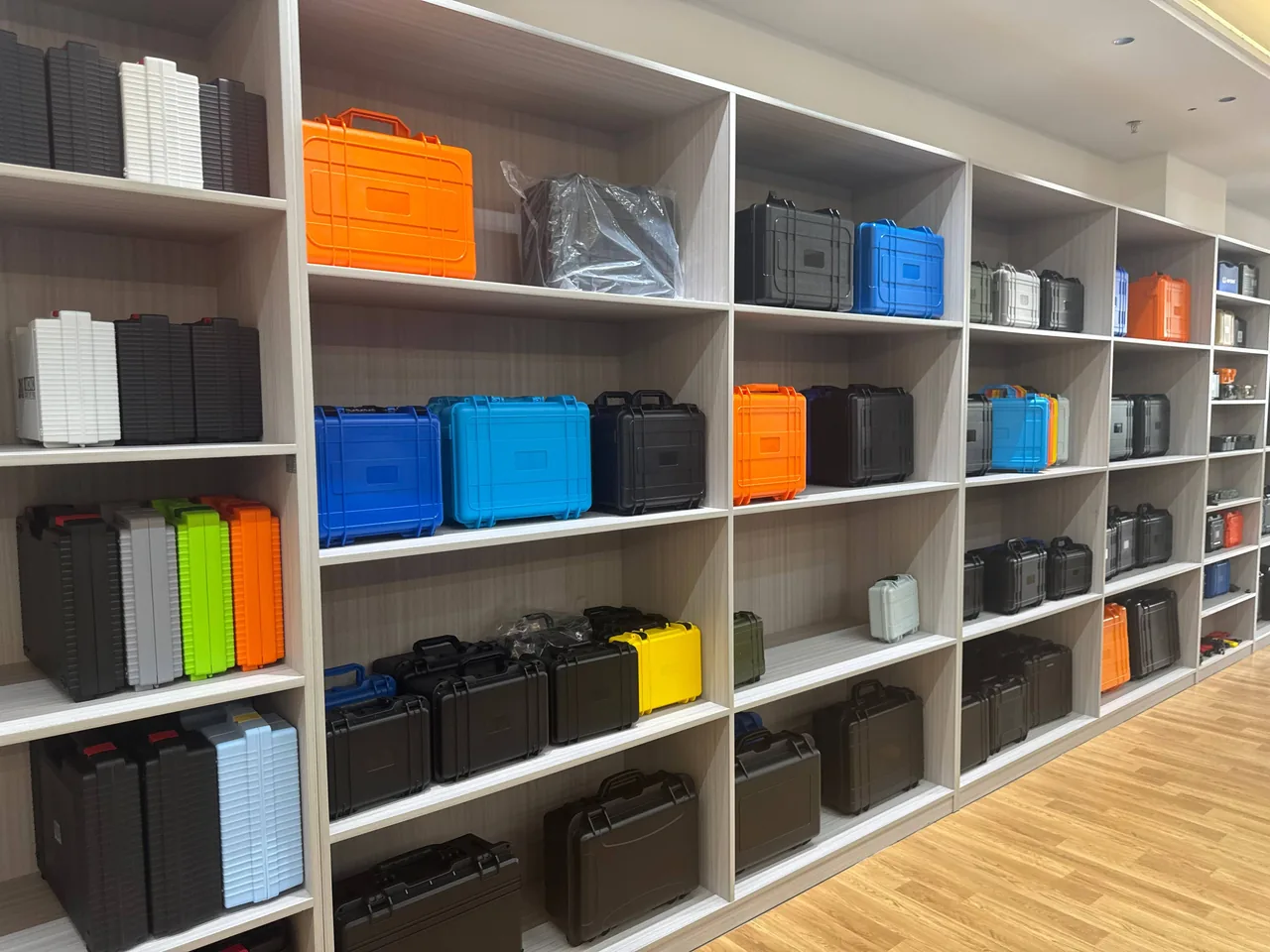
Choosing foam is not just about "soft or hard." Judge it across six dimensions:
- Density (kg/m³). Higher density usually means harder, better support and cushioning, and stronger resistance to compression set. EVA commonly runs 30–80 kg/m³, with precision instruments using 50–80. With the same 20 mm-deep slot, 30 kg/m³ EVA walls may collapse at the first press while 80 kg/m³ stays crisp — density decides whether a deep slot holds its shape.
- Hardness (Shore C). This decides "how hard you have to press." Too soft and it will not hold; too hard and it may mark precision surfaces. General tool liners use Shore C 40–60. A camera lens, for instance, can take a permanent imprint from foam that is too hard, so that contact face needs a softer transition layer.
- Thickness. This sets both the impact stroke available and how deep a slot can be cut. Precision instruments usually take 10–30 mm; ordinary padding 5–15 mm. Thickness also eats into the usable height of the case. Thicker gives better cushioning, but internal height is limited, so most designs settle between 15 and 25 mm.
- Shock absorption and resilience. Measured by rebound rate and compression set. Foam with good rebound and low permanent set can be reused many times without collapsing; EVA and XPE perform well here. For equipment that ships frequently, resilience matters more than initial softness — foam that survives a hundred drops and still springs back is real protection.
- Water absorption and chemical resistance. Wet or oily environments demand closed-cell, low-absorption, oil-resistant materials (EVA, XPE); open-cell PU and EPE should not be the primary liner. A simple test: drop water on the foam — on closed-cell material the bead rolls off, while open-cell material draws it in at once. That one drop decides whether your case is dry or mouldy a year later.
- Processability and environmental compliance. Whether it can be CNC-slotted, whether it sheds crumbs, and whether it meets environmental regulations. Standard ABS/PP bodies and EVA liners can satisfy RoHS and REACH; export products also need to consider California Prop 65. Foam that cannot be machined will never produce a conforming slot.
Memorise the six as "density, hardness, thickness — resilience, water, oil — process and compliance." The first three set protection, the middle two set environmental suitability and the last sets feasibility. Tick each against your real tool and environment conditions and you will rarely go wrong; a scoring sheet is more reliable than going by feel.
Parameter Comparison of Different Foam Materials
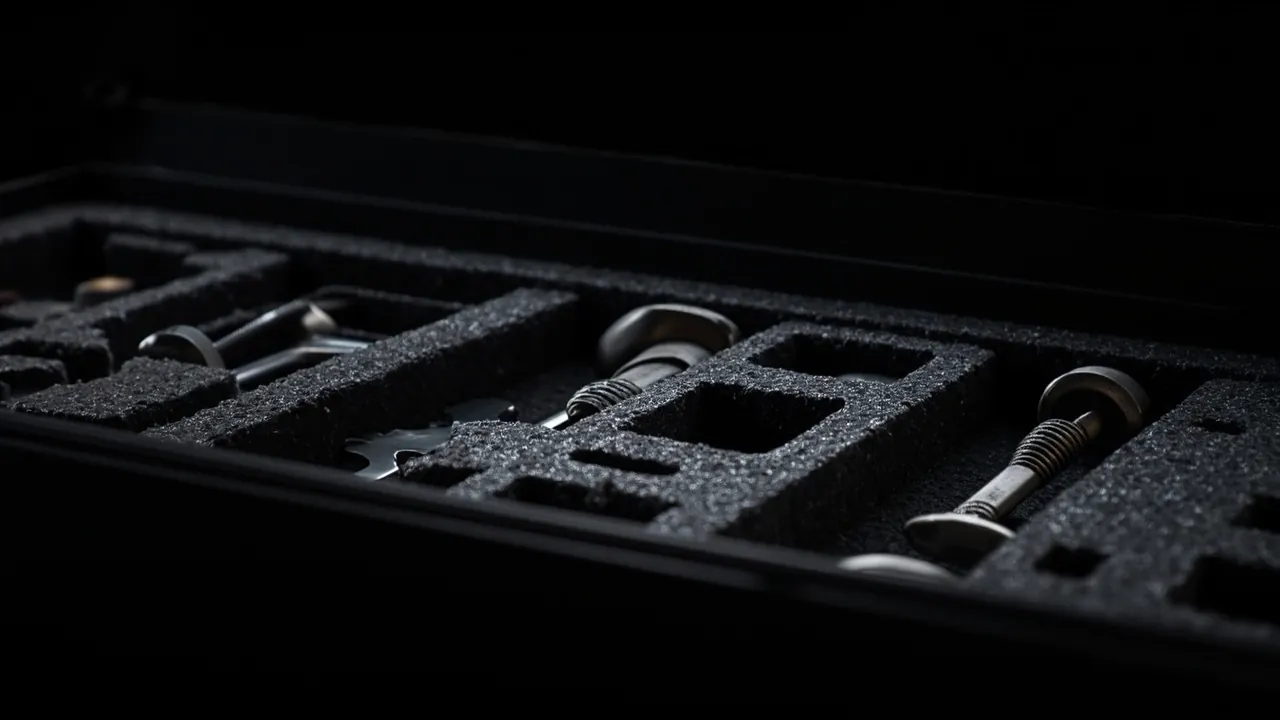
The table below compares the general characteristics of standard industry materials (specific values vary with formulation and density; treat the numbers as selection reference ranges only):
| Material | Structure | Density range (kg/m³) | Shock / rebound | Water absorption | Oil resistance | Machining / slotting | Relative cost | Typical use |
|---|---|---|---|---|---|---|---|---|
| --- | --- | --- | --- | --- | --- | --- | --- | --- |
| EVA | Closed-cell | 30–80 | Good–excellent | Low | Good | Easy to CNC slot | Medium | Precision instruments, primary liner |
| XPE | Closed-cell | 30–60 | Good | Low | Good | Can be slotted | Medium | Flat liners, dividers |
| EPE (pearl cotton) | Closed-cell | 20–40 | Medium | Low–medium | Medium | Hard to precision-carve | Low | Simple padding, outer wrap |
| PU (polyurethane) | Mostly open-cell | 20–50 | Excellent (soft) | High | Poor | Sheds crumbs easily | Low–medium | Surface layer / sound absorption, rarely primary |
| Solid PE | Solid / low-expansion | High | Weak (hard) | Very low | Excellent | Difficult | Medium | Load-bearing base |
The conclusive judgement: for precision fixing and durability, choose high-density EVA; for low-cost simple protection, EPE/XPE; where water and oil are a concern, closed-cell EVA/XPE, avoiding open-cell PU and EPE. Although EPE is closed-cell, its cells are coarse, its resilience is weak and it is hard to precision-carve — so "closed-cell" does not automatically mean "suitable as a primary liner." Use this table as the first filter, then apply the six dimensions to lock down density, hardness and thickness.
Choosing Foam by Tool Type
- Precision instruments (cameras, surveying instruments, sensors, multimeters): high-density EVA (50–80 kg/m³) with machined slots, one independent slot per item, thickness 15–30 mm, guaranteeing zero movement in transit. The protection logic of transport standards such as MIL-STD-810H (used here as a product-line environmental test basis) is a useful reference. Repair or replacement costs far exceed the foam, so over-protect rather than economise. Leave 3–5 mm of wall between adjacent slots so they do not tear.
- Cutting tools and measuring tools (knives, calipers, drills): medium-density EVA or XPE, slotted so edges do not touch; avoid softness that lets the tool slide. A thin PU contact layer inside the slot can prevent scratching. Measuring tools are sensitive to flatness, so slot bottoms must be milled flat and the tool must not be left supported in mid-air.
- Ordinary hand tools (pliers, wrenches, screwdrivers): EPE or medium-to-low density EVA padding is enough. The focus is zoning rather than deep cushioning, to keep cost down. Even so, use dividers or shallow slots to keep them apart, or metal-on-metal wear will dull the surfaces.
- Batteries and leak-prone parts: closed-cell EVA/XPE with clearance in the slot and no compression, to prevent corrosion if they leak; the case itself should offer sealing (an IP67 case is safer). With lithium cells the slot must not be so tight that the cell deforms, and they belong in a separate zone away from precision electronics.
- Long or irregular tools: combine foam with straps — foam supports, straps fix. Items such as spirit levels and crowbars are long but small in section, so slotting a whole block wastes space; supporting them along the case length and cinching with a strap is more economical.
The underlying logic is "the more delicate and valuable the tool, the more you invest in foam." That is not waste; it is matching foam cost to tool risk. A cheap caliper is fine with EPE, whereas an expensive surveying instrument makes high-density slotted EVA the minimum sensible investment. Plan the liner budget as insurance for the tools.
See also why EVA foam is used in toolboxes for a fuller material argument.
Choosing Foam by Working Environment
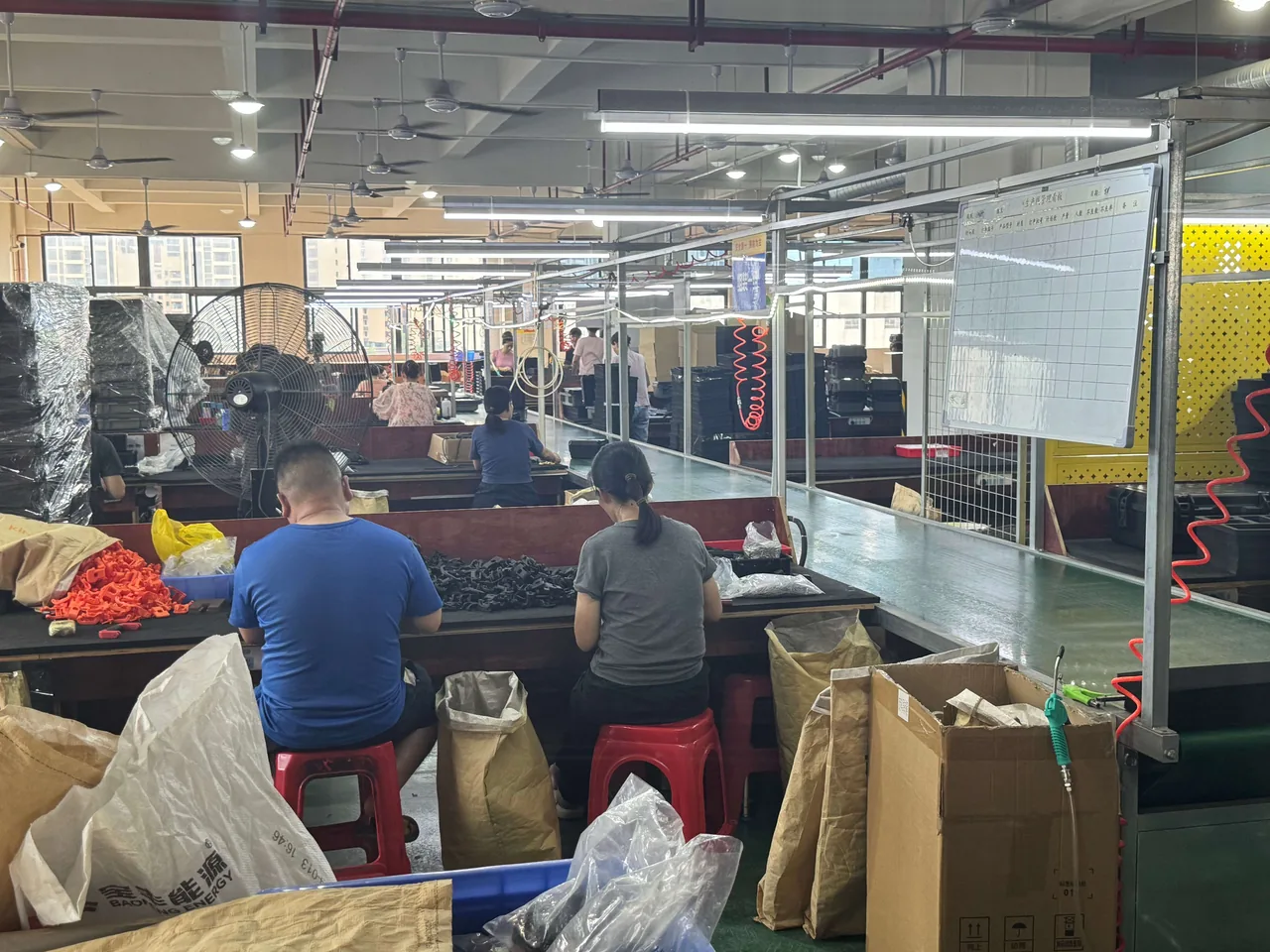
- Outdoor / wading (exploration, rescue): closed-cell and low-absorption are mandatory. EVA/XPE first, with an IP67-sealed case. Avoid EPE deforming after long soaking and PU absorbing water and growing mould.
- Oily workshops (machine repair, vehicle repair): oil-resistant EVA/XPE, optionally with an easy-clean surface treatment; never use PU, which soaks up oil. Foam that absorbs oil in an oily environment gets heavy, collects dirt and is hard to clean.
- Large temperature swings / high and low temperature: EVA and XPE have a wide temperature range and do not embrittle easily; ordinary EPE can harden and go brittle in the cold. For outdoor work in extreme cold, choose a low-temperature formulated EVA.
- Clean / dust-free (electronics, laboratories): choose EVA that does not shed crumbs and has low outgassing; avoid PU, which sheds. Clean environments are sensitive to outgassing, so both volatility and dust from the foam need controlling.
- Export / high compliance requirements: confirm that foam and case materials meet RoHS, REACH, California Prop 65 and similar regulations, and keep the certificates on file. KeXin New Materials (JUNZHJIA) plastic cases in ABS/PP have passed RoHS testing, and custom EVA liners can be supplied within the same compliance framework.
The worst case usually sets the lower bound: if the kit goes into water once a year, still specify closed-cell material, because one flood can destroy the whole case of tools.
Custom Slotting and Laying Processes
Half of a liner's performance is material and half is process:
- Flat pad lining. A single sheet laid on the case floor and up the walls, with tools placed on top. Simple and cheap, but it consumes height and fixes poorly — fine for ordinary tools.
- CNC-machined slots. Slots CNC-engraved 1:1 to the tool outline, with the tool recessed into them. Strongest fixing, best space utilisation, and almost no extra capacity consumed — the first choice for precision instruments. The custom inner trays and liners of JUNZHJIA protective cases use this approach.
- Pick-and-pluck (grid tear-out) foam. The surface carries a pre-cut grid you tear out by hand to wrap the tool. Cheap and fast, but less accurate and less tidy than CNC. See pick-and-pluck foam for protective cases.
- Layered build-up. A load-bearing PE base plus a slotted EVA upper layer, giving both support and cushioning.
Process advice: valuable plus long-term fixed → CNC slots; temporary or low-cost → pick-and-pluck; general padding → flat lay. Whichever you use, make sure the foam is not over-compressed once the lid is closed (compression should be ≤ 30%), or it will collapse over time and the lid will not seal. A simple way to judge compression: after closing, press the lid with your fingers — you should feel a clear spring-back rather than a hard stop. If it is completely solid, the foam is too thick or the slots are not deep enough.
Two further process details. First, before CNC slotting confirm the tool outline with 3D scanning or a 1:1 cardboard template, to avoid "slot 1 mm too small to fit" or "slot 5 mm too big and everything rattles." Second, flat-lay and slotting can be mixed — slot the case floor for core items and fill the rest with pick-and-pluck foam, combining accuracy with flexibility at lower cost. For batch equipment, make one or two sample sets and test-transport them before releasing volume production. A comparison with pre-cut foam options is also worth reading.
Environmental Compliance: RoHS, REACH, California Prop 65
Foam is a small item, but export and procurement compliance often gets stuck at the material level, so confirm it early:
- RoHS (EU): restricts lead, cadmium, mercury, hexavalent chromium and certain flame retardants, among others. That KeXin New Materials' ABS/PP plastic cases have passed RoHS testing is a verified fact; custom EVA liners can be supplied within the same compliance framework.
- REACH (EU): governs the registration, evaluation, authorisation and restriction of chemical substances, with attention to substances of very high concern (SVHC). A reputable supplier should be able to provide a declaration of conformity.
- California Prop 65 (US): requires a warning where a product contains substances known to cause cancer or reproductive toxicity — particularly relevant when exporting to the US market.
- Others: some industries also require flame-retardancy ratings (such as UL 94) or food-contact approval; check as needed.
Practical advice: make "compliance documents available on request" a purchase term and require the supplier to attach test reports or declarations of conformity at delivery, so you are not caught out at customs or a factory audit. "Available on request" means it can be provided when asked — not that it must ship with every order — but the supplier must genuinely have it.
Foam Ageing, Service Life and Self-Testing
Foam is not permanent; it ages with time and use. Understanding its life and how to test it yourself helps you replace it in time:
- Signs of ageing: a powdery or crumbly surface, hardening and embrittlement, failure to recover after pressing (excessive compression set), and obvious yellowing.
- Accelerating factors: UV exposure, high temperature, repeated heavy loading and oil immersion all speed up ageing. Closed-cell EVA/XPE ages far more slowly than open-cell PU.
- Life reference: in normal indoor or in-vehicle conditions, a qualified EVA liner lasts several years; prolonged sun exposure or heavy loading can shorten that to one or two years.
- Testing density yourself: cut a small piece, weigh it and measure its volume; mass ÷ volume gives density, which you can compare against the nominal value to see whether it is understated.
- Testing hardness yourself: press with a fingernail or a Shore durometer and look at the indentation; if it sinks very easily, the density is probably insufficient.
- Testing rebound yourself: press down and release; slow recovery or a remaining dent means poor rebound and high permanent set.
None of these tests need specialist equipment. Verifying with a sample before a bulk order avoids the trap of "looks like EVA but is actually low-density recycled material." CNC slotting is especially sensitive to density, because low-density EVA collapses in deep slots — sample validation is essential.
From a maintenance standpoint, set up a simple "inspect — clean — replace" routine. At every quarterly service or project close-out, open the case and check the foam for powdering, crumbs and collapse; wipe with a slightly damp cloth (closed-cell material does not absorb water, so air-drying is enough); and schedule replacement as soon as ageing appears. Managing the liner as a consumable protective part is what stops transport protection from quietly failing. For high-value instrument cases you can set a fixed service interval (two to three years) with mandatory replacement.
Common Mistakes in Selection and Customisation
- Softer means more protective. Wrong. Too soft cannot hold anything and tools still move. Match hardness to tool weight.
- Thicker is better. Wrong. Excess thickness eats internal height and may stop the lid closing, without necessarily improving protection. Choose 10–30 mm based on drop height and tool fragility.
- Using ordinary sponge or PU as a liner. Wrong. Open-cell PU absorbs water and oil and sheds crumbs, damaging tools over time.
- Ignoring environmental compliance. If export foam contains restricted substances, it can be held at the border. Confirm RoHS / REACH / Prop 65.
- Padding the floor without fixing anything. Tools still slide on the foam and collide. Valuable items must be recessed or strapped.
- Density not matched to slot depth. Low-density foam collapses in deep slots; use high-density EVA for deep slots.
- Ignoring compression set. Foam that does not spring back after repeated loading has failed; choose EVA/XPE with good rebound and low permanent set.
- Overlooking industry and customs certification. Special sectors (medical, aviation) may require flame retardancy or low smoke and low toxicity; failing to confirm this means failing to qualify.
Worked Example: A Foam Plan for an Outdoor Repair Kit
Let us tie the method together with a concrete case. Scenario: an outdoor exploration team needs a repair kit in a roughly 15 L IP67 protective case. Contents: a multimeter (delicate), an adjustable wrench and pliers, a screwdriver set, several lithium batteries (leak risk) and a notebook.
Step 1: choose material by tool
- Multimeter: delicate, knock-sensitive → high-density EVA (60 kg/m³) with an independent machined slot.
- Wrench / pliers / screwdrivers: robust, need isolation → medium-density EVA, zoned padding, enough to stop them touching.
- Lithium batteries: corrosion risk if they leak → closed-cell EVA in an independent slot with clearance, not compressed.
- Notebook: crush-sensitive → a thin flat EVA divider on the inside of the lid.
Step 2: choose resistance by environment
Outdoor wading plus temperature swings means closed-cell EVA/XPE throughout, avoiding the absorption risk of PU and EPE. With the case itself at IP67, the foam adds a second moisture barrier. In extreme cold, specify a low-temperature EVA formulation.
Step 3: fix process and thickness
CNC machine the slots for the valuable items (20 mm thick), flat-lay 10 mm for the ordinary items, and add a 5 mm thin layer inside the lid. Keep lid-closing compression within 25%.
Step 4: fix compliance
For sensitive export markets, confirm RoHS / REACH / Prop 65 for both foam and case, with certificates available on request.
Final plan: a 10 mm medium-density EVA zoned base, 20 mm high-density EVA slots for critical items and a 5 mm layer inside the lid — about 25–30 mm of height consumed, leaving margin in a 15 L case. This shows that selection is not "pick one foam" but allocating different densities, thicknesses and processes to the risk level of each tool.
Frequently Asked Questions (FAQ)
Q: EVA or EPE (pearl cotton) — which should I actually choose? A: It depends on the requirement. EVA is closed-cell with a wide adjustable range of density and hardness, easy to CNC-carve, water- and oil-resistant, and is the preferred choice for precision instruments and primary liners, at medium cost. EPE is light and cheap but weak in resilience and shape retention and hard to precision-carve, so it suits simple padding or outer packaging. Choose EVA for valuable tools; EPE is fine for ordinary moisture-proof padding. Note that although EPE is closed-cell, its cells are coarse and it holds shape poorly — being "closed-cell" does not make it equivalent to EVA as a primary liner. If you are stuck between the two, use this simple test: wherever a tool needs to be *recessed and held*, choose EVA; wherever you only need a *moisture-proof pad*, EPE will do. A fuller comparison is in EPE vs EVA foam for toolboxes.
Q: How thick should the foam generally be? A: 5–15 mm is enough for padding ordinary hand tools; 15–30 mm is recommended for precision instruments, to leave sufficient cushioning stroke and slot depth. The key is that compression after closing must not exceed 30%, or the foam collapses over time and the lid will not seal. Combine this with the internal height available (see capacity calculation) and the fragility of the tools. If there is foam inside the lid as well, control the sum of both thicknesses so the tools are not pinched. As a rule of thumb: the greater the drop height in transit and the more fragile the tool, the thicker the foam — but internal height is a hard constraint, so when thickness runs out, move to a higher-density material rather than adding thickness indefinitely.
Q: Does a waterproof case still need low-absorption foam? A: Yes. An IP67 case keeps external water out, but if the foam inside is open-cell PU or EPE, then condensation, a wet tool or a leaking battery will leave it soaked, slow to dry, mouldy and corrosive. In wet and humid environments, always use closed-cell, low-absorption EVA/XPE. In addition, air the case periodically and dry tools before putting them away, which extends the life of both foam and tools. A sealed case is not "maintenance-free" — check the foam condition regularly too.
Q: Is a custom liner expensive and slow? A: It depends on the process. CNC slotting carries up-front design and machining cost, but it significantly improves protection and professionalism and suits high-value equipment that will be reused for years; pick-and-pluck foam is cheap and can be done yourself. Brands such as JUNZHJIA offer one-stop liner and inner-tray customisation (OEM/ODM), which can be evaluated at the selection stage. For larger volumes, standardised modules can bring the unit cost down. For small and medium batches, "standard case + semi-custom liner" balances cost and lead time better than going fully custom from the start. See the factors in custom foam for what drives cost.
Q: Does foam affect toolbox capacity? A: Yes, but differently depending on the form. Flat pad lining consumes internal height directly as area × thickness; recessed slots consume almost no extra capacity, only the 1–3 cm of surface layer. Deduct accordingly when calculating usable capacity — see the article on toolbox capacity calculation. Allow for foam height when choosing the case, or you will find that "the case was just tall enough, and with foam added the lid will not close." This is also why you should plan not only for nominal capacity but also for the loss from foam and fit rate.
Q: What compliance issues apply to foam in export products? A: Confirm that the material meets the regulations of the target market — EU RoHS and REACH, US California Prop 65 and so on — and where necessary request test reports or declarations of conformity from the supplier with documents "available on request." That ABS/PP cases have passed RoHS testing is a verified fact for KeXin New Materials; check the foam against the same standard when selecting. Special sectors may also require a flame-retardancy rating, so ask early. File compliance documents systematically so they can be produced quickly during audits and customs clearance, avoiding last-minute delays.
Q: How can I test whether the EVA I bought meets specification? A: Cut a small piece, weigh it and measure its volume to calculate density (compare against the nominal 30–80 kg/m³), test hardness with a finger or durometer, and press and release to see how fast it recovers, which indicates permanent set. Also watch for crumbs and any pungent odour — an unusual smell can indicate recycled material or restricted substances. Always measure a sample before committing to volume. Self-testing does not replace third-party testing, but it is enough to screen out obvious under-specification and recycled content, and it is an effective first gate before purchase.
Q: Does foam need replacing after long use, and how do I know when? A: Yes. Replace it once the surface powders or sheds crumbs, it hardens and goes brittle, it no longer recovers after pressing, or it has visibly yellowed or collapsed. A normal EVA liner lasts several years; sun exposure or heavy loading shortens that. Check the liner whenever you do a major service, and build replacement into the equipment maintenance plan so protection does not quietly lapse. While replacing, clean the inside of the case at the same time — a good opportunity to check whether any tools have started to rust or take damage.
Q: How do EVA and XPE divide the work between them? A: Both are closed-cell and low-absorption, which is why they are often hard to choose between. XPE has a finer, flatter surface and costs about the same, so it suits dividers, light fixing and applications where appearance and flatness matter. EVA usually wins on adjustable density/hardness range and on the crispness of deep CNC slots, making it the first choice for precision-instrument primary liners. A common practical combination is XPE for flat dividers and EVA for the slotted fixing layer, taking the strength of each.
Q: Should foam be bonded in permanently? A: Usually not. Removable liners let you re-configure the case when the tool set changes and let you replace a worn layer without scrapping the whole liner. Bond only where the case will never be re-tasked and where a loose layer could shift under vibration — for example a thin lid layer. Even then, a few spots of adhesive beat a full coat.
Conclusion
Choosing toolbox internal foam is a matching process running "tool value → working environment → material parameters → process form." Keep three main lines in mind: precision and valuable tools get high-density EVA with recessed machined slots; wet and oily environments get closed-cell, low-absorption EVA/XPE and avoid open-cell PU and EPE; ordinary hand tools get EPE or medium-density EVA padding to control cost. Balance density, hardness, thickness and compression set at the same time, avoid the traps of excessive softness, excess thickness and padding without fixing, and write RoHS, REACH and California Prop 65 compliance into the purchase terms.
Operationally, this reduces to a four-step list. Step 1: write the tool list and mark each item's risk level (delicate / ordinary / leak-prone). Step 2: allocate material and density by risk (high-density EVA for delicate items, EPE for ordinary ones). Step 3: fix the process (CNC slots for valuable items, flat-lay or shallow slots for ordinary ones). Step 4: verify compliance and compression (certificates available on request; closing compression ≤ 30%). Follow these four steps and foam selection stops being "buy a sheet of padding by feel."
For cross-industry applications with high compliance requirements, the JUNZHJIA protective-case system — 150+ specifications with liner customisation — lets you plan foam selection, case and modularity together. Treat foam selection as one link in equipment protection rather than an accessory, and the transport and storage safety of your tools will rest on solid ground. When foam, case and modularity are designed together, the risks of knocks, rust and loss across the whole life cycle are systematically reduced.
For bulk quotations, specification sheets or liner customisation enquiries, please use the contact form on this site.
Further Reading
- What Are the Advantages of EVA Foam in a Toolbox?
- EPE vs EVA Foam in Toolboxes: What Is the Difference?
- Why Does a Toolbox Need Modular Internal Design?
- Why Is a Shockproof Toolbox Right for Transporting Precision Tools?
- How Should Toolbox Capacity Be Calculated?
- Types of Internal Foam for Protective Cases