

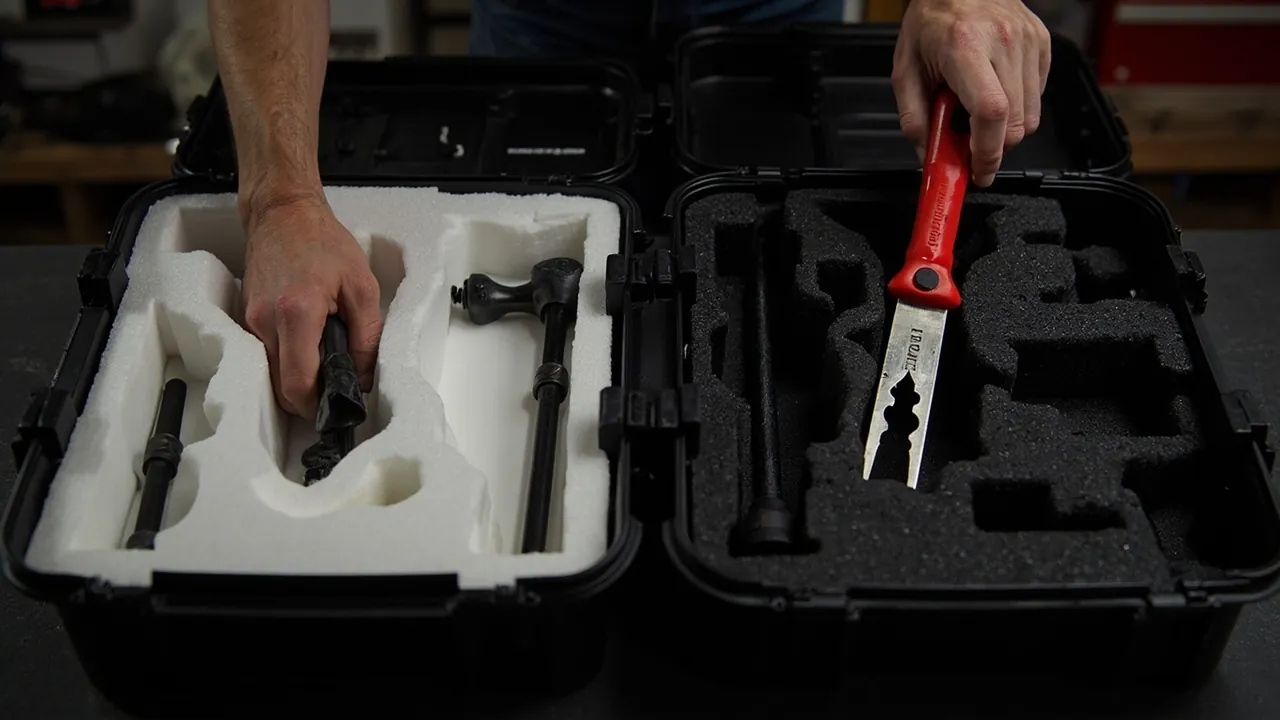
The two foams most commonly used inside a tool box are EPE foam (Expanded Polyethylene) and EVA foam (Ethylene-Vinyl Acetate). The essential difference lies in material structure and physical behaviour. EPE is a closed-cell, honeycomb-like expanded low-density polyethylene, typically around 0.03–0.04 g/cm³ — very light, low cost, with only moderate resilience, which suits basic cushioning and separation. EVA is an expanded copolymer sheet, roughly 0.93–0.95 g/cm³, denser and tougher, with better compression and recovery behaviour, which suits form-fitting liners for precision tools, gauges, and electronic devices. In short: EPE wins on lightness and price, EVA wins on durability and dimensional accuracy, and the choice depends on tool value, transport severity, and whether the foam needs to wrap each tool's exact shape.
In the tool-box and protective-case world, foam is not decoration — it is the component that decides whether a tool still works after transport and whether its accuracy survived. Many users only discover they chose the wrong liner after a gauge develops unexplained error or a lens acquires a fine scratch. This article avoids jargon for its own sake; it moves from material fundamentals and performance comparison through processing methods, industry selection, maintenance, and acceptance, and closes with combination schemes you can apply directly.
Table of Contents
- What Are EPE Foam and EVA Foam?
- Core Differences at a Glance: EPE vs EVA Comparison Table
- Why Material Structure Determines Performance
- Shock Absorption and Resilience Differences
- Water Absorption, Moisture Resistance, and Chemical Resistance
- Processing Methods and Liner Customization
- Selection Advice by Industry and Tool Type
- Cost, Service Life, and Sustainability
- How Foam Thickness and Hardness Affect Cushioning
- Routine Care and Cleaning of the Liner
- Purchase Acceptance and Qualification Checklist
- Common Mistakes and Buying Advice
- Frequently Asked Questions (FAQ)
- How to Read a Manufacturer's Foam Specification Sheet
- A Systems View: Foam and Case Working Together
- Liner Design Example: A Metrology Inspection Kit
- Mini Glossary
- Quick Reference: Common Combination Schemes
- Why Many Users End Up With a Hybrid Liner
- Colour and Surface Finish: What Actually Matters
- Final Notes for Purchasers
- Conclusion
- Further Reading
What Are EPE Foam and EVA Foam?
EPE foam is made from low-density polyethylene resin by physical foaming, producing a closed-cell flexible material with a pearl-white appearance and discrete visible bubbles; it is widely sold as "pearl cotton." Its defining traits are extreme lightness, flexibility, moderate elasticity, and almost no water uptake. Inside a tool box, EPE is usually cut into full sheets for the base, or into strips used as dividers, to separate tools, raise them, and stop them knocking together. Because the cells are independent, EPE also insulates well and does not soak water through.
EVA foam is produced by foaming a copolymer of ethylene and vinyl acetate. Colour and hardness are both customizable — black and grey are common, with hardness ranging from roughly 38 Shore C to 70 Shore C depending on VA content and expansion ratio. Its cells are finer and the material more compact; its ability to recover shape after compression is clearly better than EPE, and it can be CNC-routed or thermoformed into recesses that match a tool's outline exactly. This is why mid- to high-end protective cases and instrument cases prefer EVA liners. Within EVA, a higher vinyl acetate content generally makes the material softer and more elastic with better clarity, but lowers rigidity, so industrial liners usually specify a medium VA content to balance hardness and toughness.
Both are plastic foams, but their raw materials and structures set them apart: EPE leans toward "lightweight separator," EVA toward "precision support." That distinction underpins every comparison below. It is also why real projects frequently combine the two rather than choosing one exclusively.
Core Differences at a Glance: EPE vs EVA Comparison Table
The table below compares material parameters and practical dimensions. Density figures are common industry ranges rather than measurements of a specific product; always confirm against the manufacturer's specification sheet.
| Dimension | EPE foam | EVA foam |
|---|---|---|
| --- | --- | --- |
| Material | Expanded polyethylene (closed cell) | Ethylene-vinyl acetate copolymer (closed cell) |
| Density (typical) | approx. 0.03–0.04 g/cm³ | approx. 0.93–0.95 g/cm³ |
| Weight per volume | Extremely light | Noticeably heavier |
| Feel | Soft, pearlescent | Dense, tough, hardness customizable |
| Resilience (recovery) | Moderate; leaves marks under long load | Good; strong recovery |
| Compression set | Relatively high | Lower |
| Water absorption | Extremely low, essentially none | Low; closed cell resists moisture |
| Energy absorption | Light to medium impact | Medium to heavy impact, repeated loading |
| Shaping / routing | Can be cut, hard to form precise recesses | CNC-routable, thermoformable to tool outline |
| Temperature range (reference) | approx. -40 °C to 70 °C | approx. -40 °C to 80 °C (formulation dependent) |
| Tear resistance | Moderate | Better |
| Typical cost | Low | Medium to high |
| Typical use | Separators, base pads, simple protection | Precision instrument liners, gauge cradles, custom recesses |
The table makes the pattern clear: EPE is sufficient where light weight and low cost dominate; EVA is more reliable where repeated loading, exact fit, and long-term shape retention matter. Neither is absolutely better — the question is which matches the scenario.
Why Material Structure Determines Performance
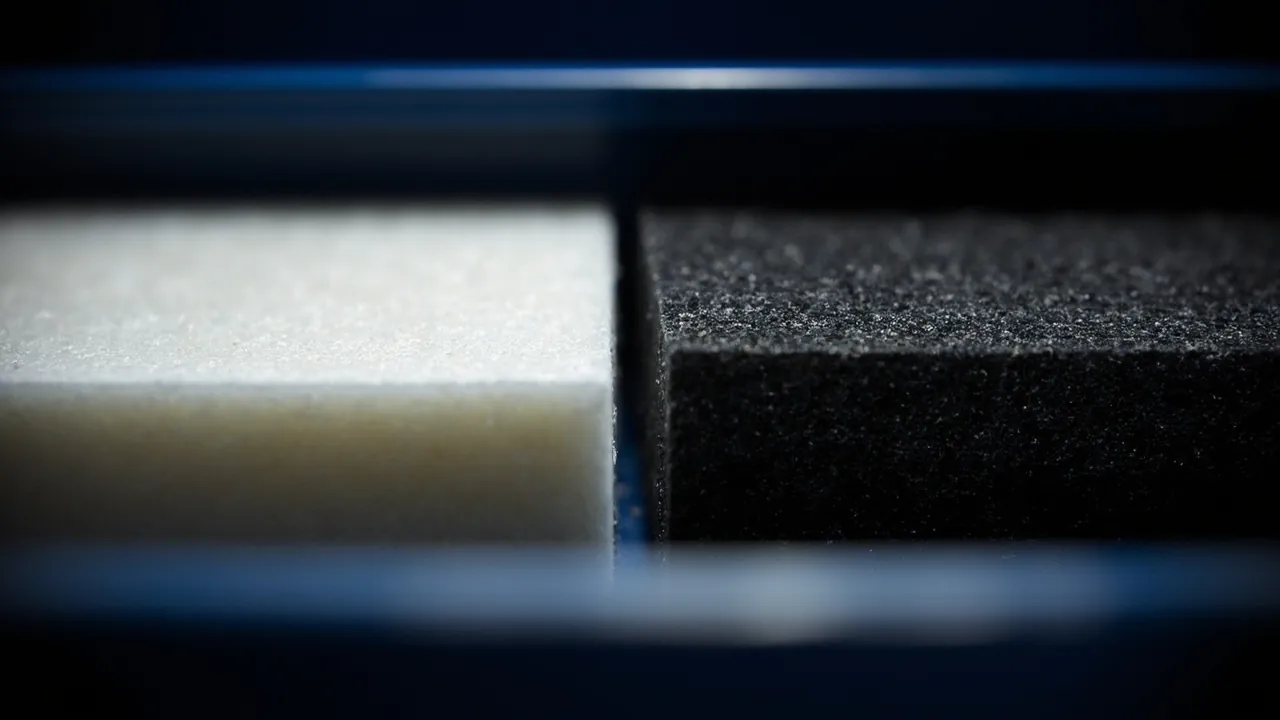
Why is EPE so light while EVA is considerably denser? The answer lies in molecular structure and foaming method.
EPE's base polymer, polyethylene, has a density of about 0.91–0.96 g/cm³, but physical foaming traps large volumes of gas in independent cells. The cells occupy such a high proportion of the volume that overall density is diluted down to 0.03–0.04 g/cm³. Those independent bubbles behave like countless small airbags: under impact the cell walls compress and the gas is squeezed, absorbing energy. The trade-off is that the walls are thin, and sustained heavy load or a sharp point load ruptures cells, leaving permanent dents — the structural reason EPE shows a larger compression set.
EVA starts by copolymerising ethylene with vinyl acetate into a resin with good elasticity, then foams it. Its cells are finer and the walls more continuous, and the crosslinked network lets molecular chains spring back after compression. As a result, under the same load EVA recovers faster and more completely. And because the base polymer itself sits near 0.93–0.95 g/cm³ with a relatively lower gas fraction, the finished sheet weighs substantially more than EPE.
In one line: EPE reduces weight through "more gas," EVA recovers through "a tougher network." If transport involves severe shock and the tools are delicate, lean toward EVA. For everyday storage and separation, EPE's lightness and price are the stronger arguments.
Shock Absorption and Resilience Differences
Cushioning is essentially "absorbing and dispersing impact energy." EPE's independent cells compress under impact and absorb energy, giving decent protection against ordinary drops and light knocks. But its cell walls are comparatively brittle: under sustained heavy load or sharp point loads, local cells rupture and collapse, leaving irreversible dents — the compression set mentioned above.
EVA's crosslinked copolymer structure behaves more like a continuous elastic network. After compression the molecular chains recover, so the material returns to shape quickly once unloaded, giving clearly better resilience and resistance to compression set. For gauges, lenses, and sensors — objects that fear hard point impacts and long-term indentation — an EVA liner holds position and attitude far more stably.
In engineering terms, cushioning is described by a compression stress-strain curve. At equal thickness, EVA keeps the stress rise gentler through the mid-to-high strain region, holding peak impact acceleration lower. EPE is more easily bottomed out in the high-compression region, where the cushioning margin shrinks. For large drop heights and fragile contents, that curve shape favours EVA. Note that foam only handles cushioning — final protection also depends on shell rigidity, liner thickness, and whether the tool is restrained.
Water Absorption, Moisture Resistance, and Chemical Resistance
For outdoor and humid transport, water absorption is a key parameter.
- EPE: The closed-cell structure absorbs almost nothing; it will not become waterlogged and heavy even if submerged, so moisture performance is excellent and mould growth is unlikely.
- EVA: Also closed-cell with low absorption, but because it is denser, once the surface is damaged and water gets in, it drains and dries somewhat more slowly than EPE.
On chemical resistance, both tolerate ordinary oils and weak acids and alkalis, but neither resists strong solvents such as certain ketones, aromatic hydrocarbons, and chlorinated hydrocarbons. If parts coated with cutting fluid or engine oil are stored long term, use a barrier bag or choose EVA, whose surface wipes more easily, and clean the liner periodically. Where contents are static-sensitive, add anti-static treatment or bags; plain EPE or EVA does not itself solve electrostatic problems.
Processing Methods and Liner Customization
- EPE processing: Mainly die-cutting, hot-knife cutting, and lamination — well suited to flat pads, corrugated dividers, and egg-crate cushioning layers. The process is simple, minimum order quantities are low, and unit price is cheap, making it the default for high-volume general-purpose liners. EPE is also extruded into tubes, rods, and profiles for corner and edge protection.
- EVA processing: Beyond die-cutting, EVA can be CNC-routed into recesses that match tools one-to-one, producing "recessed" or "layered" liners. Its surface can be laminated with velour or PU leather to improve feel and grip. Customization accuracy is high, though routing equipment and labour cost more. EVA can also be hot-embossed with texture or a logo for a more professional appearance.
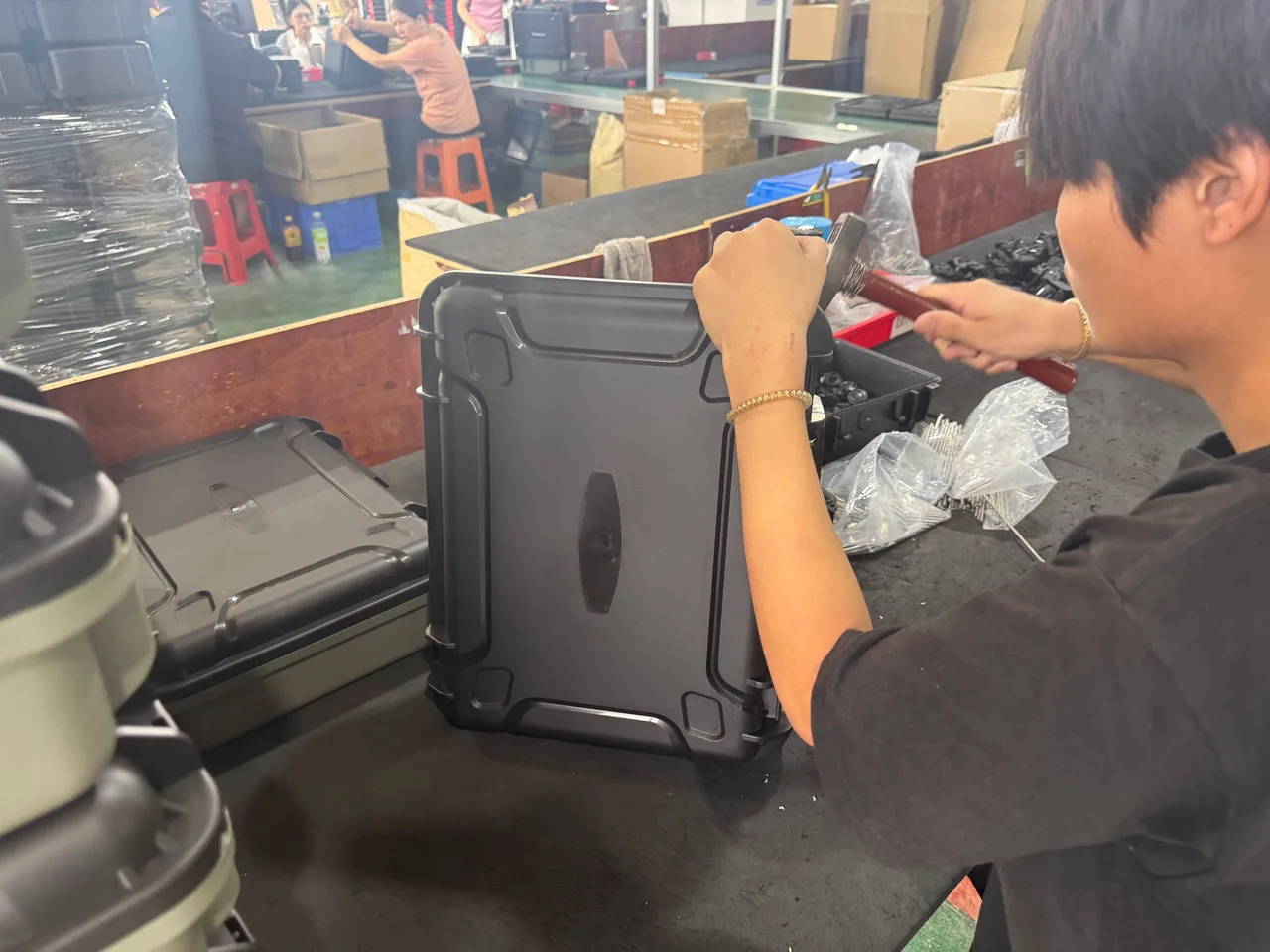
The one-stop customization capability of KeXin New Materials (JUNZHJIA) illustrates the point: its protective-case line supports inner-tray and liner making, LOGO printing, and mould manufacturing, so EVA or EPE liners can be designed against a tool list to match case and contents. For integrators with OEM/ODM needs, this "shell plus liner" co-design is far more reliable than buying foam separately and cutting it yourself, and it guarantees that liner thickness and hardness are coordinated with the case latch travel.
Selection Advice by Industry and Tool Type
Different industries want different things from foam:
- Household and quick automotive repair: Wrenches, pliers, and screwdrivers tolerate light knocks, so EPE separators suffice — low cost, low weight.
- Machining and metrology: Calipers, micrometers, and dial stands fear indentation and movement, so a routed EVA liner is preferred.
- Electronics and optics: Mainboards, lenses, and sensors fear impact and moisture, so EVA plus a moisture- and dust-resistant case is safer; add anti-static measures for static-sensitive parts.
- Military, police, fire, and field survey: Repeated transport, frequent opening, harsh environments — EVA's durability and resilience stand up better over time, paired with an IP67 protective case.
- High-volume warehousing and e-commerce shipping: A full EPE base sheet plus divider strips is the cost-effective answer, aimed mainly at stopping items knocking each other in transit.
- Sample submission and after-sales spares: Where the requirement is "delivered in as-shipped condition," routed EVA plus a rigid shell preserves it best.
If the transport environment combines drops, rain, and dust, consider foam choice and case ingress rating together: foam solves shock, the gasket and latches solve water and dust. The two are complementary, not interchangeable.
Cost, Service Life, and Sustainability
From a purchasing perspective, EPE is cheap per unit and flexible on minimum order, suiting high-volume general liners. EVA carries more process steps — formulation, routing, surface treatment — so unit cost is higher, but it survives more reuse cycles and holds shape better, so protection cost per shipment is not necessarily higher.
On life, EPE ages, embrittles, and crumbs under repeated heavy load, sunlight, and oil; EVA resists weather and compression better and lasts longer. On sustainability, both are plastics and recyclability depends on local systems. EPE's low density saves transport and storage space; EVA's durability reduces replacement frequency over the life cycle. For compliance such as RoHS and REACH, check the finished material and test reports rather than judging from the word "plastic."
How Foam Thickness and Hardness Affect Cushioning
Choosing foam is not only about type; thickness and hardness matter just as much. The general rules:
| Parameter | Effect on protection | Selection note |
|---|---|---|
| --- | --- | --- |
| Thickness | Thicker foam gives a longer impact stroke | Thicker for heavy tools or high drop risk; thinner for light tools so the lid still closes |
| Hardness (EVA Shore C) | Harder supports more; softer conforms better | Hard for heavy items, soft for delicate light items |
| Cell fineness | Finer and more uniform means more stable support | Fine-cell EVA preferred for precision items |
| Layer combination | Soft plus hard layers give both cushioning and support | EPE base for energy absorption with an EVA cradle on top is common |
As a rule of thumb, total liner thickness should let a tool sink in by about one third to one half of its depth — wrapped but not touching the case wall. When the lid closes, the liner should apply light, even preload to the tool so it cannot bounce vertically in transit. Too thick and the lid will not close properly, putting abnormal load on the latches; too thin and the cushioning stroke is insufficient, so a drop transmits straight through to the case floor. These details are normally calculated by the liner manufacturer from the tool list; an ordinary user can start by measuring the tool's largest dimension and setting a thickness range from there.
Routine Care and Cleaning of the Liner
Foam is a consumable, and proper care extends its life and protects the tools:
- Dust regularly: Use a soft brush or low-pressure air to remove surface dust so particles do not scratch tools during handling.
- Wipe oil off: Clean liners contaminated with cutting fluid or engine oil with a neutral detergent and let them dry; never use strong solvents, which dissolve the foam.
- Avoid sunlight: UV accelerates EPE ageing, making it brittle and crumbly; store in a cool place.
- Check for collapse: Replace EPE that has developed deep dents under long-term load; local damage in EVA can be patched or the whole layer replaced.
- Dry after wetting: If the case takes water, remove the foam, dry it, and refit it to prevent mildew and odour.
- Label for management: On routed liners, mark the tool name or number beside each recess to simplify inventory and return, reducing collisions from misplacement.
With good care, an EVA liner can serve for years. Neglected, even the best material fails early.
Purchase Acceptance and Qualification Checklist
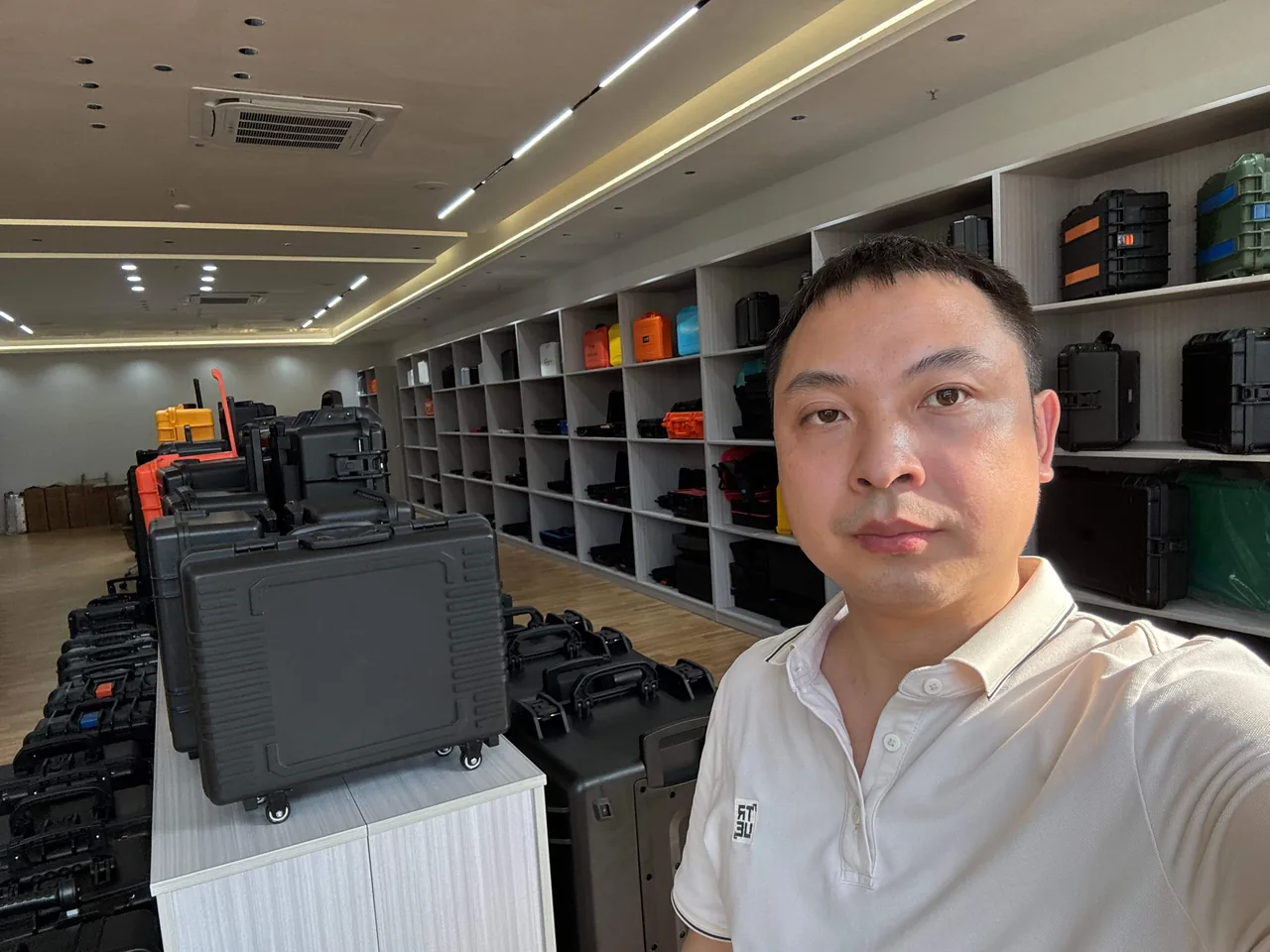
When buying EPE or EVA liners, or a protective case complete with liner, check the following:
- Material statement: Confirm whether it is EPE or EVA, the density and hardness range, and whether it is closed-cell.
- Environmental compliance: Whether plastic parts have passed RoHS, REACH, and similar testing; for example, ABS/PP cases from KeXin New Materials pass RoHS testing. Certificates are available on request.
- Dimensional match: Check routed recesses against the tool list one-to-one, leaving adequate finger clearance.
- Case compatibility: Whether shell rigidity, latches, and gasket (IP67 per IEC 60529) are coordinated with the liner.
- Customization capability: Whether moulds, LOGO printing, and inner trays are available in one place (OEM/ODM).
- Certification backing: ISO9001, IP67, California Prop 65 and similar can be verified against company documentation; for a specific model, rely on the specification sheet.
Using this list for both quotation comparison and incoming inspection avoids the trap of "looks similar, performs very differently."
Common Mistakes and Buying Advice
- Mistake 1: Thicker foam is always better. Too thick lets tools rock in their recesses and prevents the lid closing. The target is "held firmly, with light preload from the lid and no looseness."
- Mistake 2: EPE can replace EVA as a precision cradle. For precision items needing long-term shape retention and repeated handling, EPE collapses too easily — use EVA.
- Mistake 3: Judging material in isolation. Shell rigidity, latches, and gasket together determine protection; foam is only one link.
- Mistake 4: Assuming black foam is more advanced. Colour has no necessary link to performance; density, hardness, and cell quality are what matter.
- Advice: List the tools first (dimensions, weight, fragile points), then set the case protection rating, then choose foam type and liner structure. Where customization is needed, use OEM/ODM co-design and request material test reports and specification sheets.
Frequently Asked Questions (FAQ)
Q: Which is more environmentally friendly, EPE or EVA? A: Both are plastic foams, and recyclability depends on the local collection system. EPE's very low density and bulky volume make it space-efficient in transport and storage; EVA is more durable and survives more reuse cycles, so over a full life cycle it is not necessarily less green. For specific compliance such as RoHS and REACH, check the finished material and its test reports.
Q: Do precision gauges really require EVA? A: Not absolutely, but EVA's resilience and shape retention suit precision gauges far better. If you use EPE, add a rigid cradle or separate compartment and limit transport shock. For high-value gauges, a routed EVA liner is the more dependable standard choice.
Q: Does EPE foam shed crumbs, and does that affect tools? A: Qualified EPE has a stable surface and does not shed. Inferior or aged, cracked foam can generate dust. Choose foam with intact closed cells and no odour, and avoid prolonged sun exposure.
Q: Can EPE and EVA be used together? A: Yes, and it is very common. For example, an EPE base layer provides overall cushioning while an EVA layer on top carries routed recesses for precision items — balancing cost and protection. Suppliers with liner customization capability, such as KeXin New Materials, frequently use this combination.
Q: Will foam inside a waterproof case absorb water? A: Both EPE and EVA are closed-cell with extremely low absorption, so normal immersion does not saturate them. But if water enters the case, it will sit in the gaps around the foam, so dry everything promptly to avoid long-term damp, odour, or mildew.
Q: How long does an EVA liner usually last? A: With normal use, avoiding strong solvents and prolonged sunlight, an EVA liner can last for years; actual life depends on handling frequency, load, and maintenance. Replace it when deep dents, damage, or a clear loss of resilience appear.
Q: Can EPE be used outdoors without a protective case? A: EPE is light and non-absorbent, so it works for short-term wrapping and cushioning, but with no shell or seal behind it, it cannot withstand heavy loads, puncture, wind, or rain. Long-term outdoor protection still needs a rigid protective case with a sealing structure.
Q: How do I choose the hardness of an EVA liner? A: Based on tool weight and fragile points. Heavy, robust tools can use harder EVA (higher Shore C) for support; light, delicate devices do better with softer EVA that conforms and cushions. The liner manufacturer normally recommends a specific hardness from the tool list.
How to Read a Manufacturer's Foam Specification Sheet
Suppliers usually hand over a parameter table, and non-specialists can easily get lost in the terminology. Concentrate on these items to judge whether EPE or EVA is suitable:
- Density: Look for the 0.03–0.04 g/cm³ band for EPE and 0.93–0.95 g/cm³ for EVA; a large deviation suggests an unusual formulation or a foaming problem.
- Hardness: EVA is quoted in Shore C, such as 45C or 60C; choose in combination with tool weight. EPE is usually quoted as an expansion ratio rather than a hardness.
- Compression set: Under the same conditions, a lower value means better durability; this is one of the key indicators separating EPE from EVA in service life.
- Water absorption: Should be extremely low for closed-cell foam, which also serves as evidence that the cells really are closed.
- Temperature resistance: The stated upper service limit determines whether the foam can sit near a heat source or in direct sun.
- Environmental items: Whether RoHS and REACH compliant; for plastic parts ask for test reports, such as ABS/PP passing RoHS testing.
- Flammability rating: Some applications require flame-retardant foam, so state the standard and grade rather than allowing ordinary foam to be substituted.
Cross-checking the sheet against the acceptance checklist above will screen out most non-compliant suppliers. Note that the words "EVA liner" alone tell you nothing about quality — you have to get down to specific parameters and test data.
A Systems View: Foam and Case Working Together
Many users compare foams in isolation, but protection is a system problem. A complete protective case equals a rigid shell (resisting large impacts) plus a sealing structure (keeping out water and dust) plus a cushioning liner (absorbing energy and limiting movement) plus a fixing method (preventing displacement). Foam is only the liner link:
- If the shell is too soft, even the best EVA will be crushed along with it.
- Without sealing, foam that has absorbed dust and water still damages the tools.
- Without restraint, tools slide in their recesses and the liner is pointless.
So whenever you compare EPE with EVA, always carry the three questions "which case, shipping where, carrying what." The value of a supplier with one-stop shell-plus-liner capability, such as KeXin New Materials with its JUNZHJIA line, is precisely that these links are co-designed against one tool list, rather than the user buying a case and some foam separately and assembling them.
Liner Design Example: A Metrology Inspection Kit
To make the comparison concrete, suppose you are fitting out a field metrology inspection kit containing one digital micrometer, two vernier calipers, a box of gauge blocks, a dial indicator with stand, and assorted spare batteries and data cables. The environment alternates between workshop and outdoor work, with drop, vibration, and dust risk.
The design logic runs as follows. Choose an IP67 protective case (per IEC 60529) to deal with water and dust. Build the liner in two layers: a 10–15 mm full EPE sheet at the bottom for overall cushioning, and roughly 20 mm of EVA on top, routed one-to-one to the tools as the cradle. The micrometer and gauge blocks are the accuracy core, so recess depth lets them sit half-buried with light preload from the lid and no rocking. Data cables go into a separate compartment so they cannot press on the gauge blocks. Batteries are isolated separately to prevent leakage contamination. All recess edges are chamfered so handling does not scrape hands. In this arrangement EPE absorbs energy, EVA holds shape, and the case provides rigidity plus water and dust protection — three layers, each with its own job.
If the budget is extremely tight and transport is limited to short trips around an office, you could fall back to a single-layer EPE divider scheme. But as soon as road or air freight and precision gauge blocks are involved, the extra spend on routed EVA is worthwhile. The example shows that selection is not an either/or: it is combining EPE and EVA according to risk level.
Mini Glossary
- Closed-cell structure: Cells that are separate and not interconnected, so the material does not absorb water and insulates well.
- Compression set: The residual deformation a material cannot recover after unloading; a lower value means better durability.
- Resilience: The ability to return to original shape after compression; EVA is normally better than EPE.
- Shore hardness (C): A measure of how soft or firm a foam is; higher numbers are harder.
- VA content: The proportion of vinyl acetate in EVA; higher means softer and more elastic but less rigid.
- Routed liner: Recesses CNC-cut to the tool outline so each item seats precisely without moving.
With these terms, specification sheets and quotations become much easier to read — you can see what you are paying extra for and whether it is worth it.
Quick Reference: Common Combination Schemes
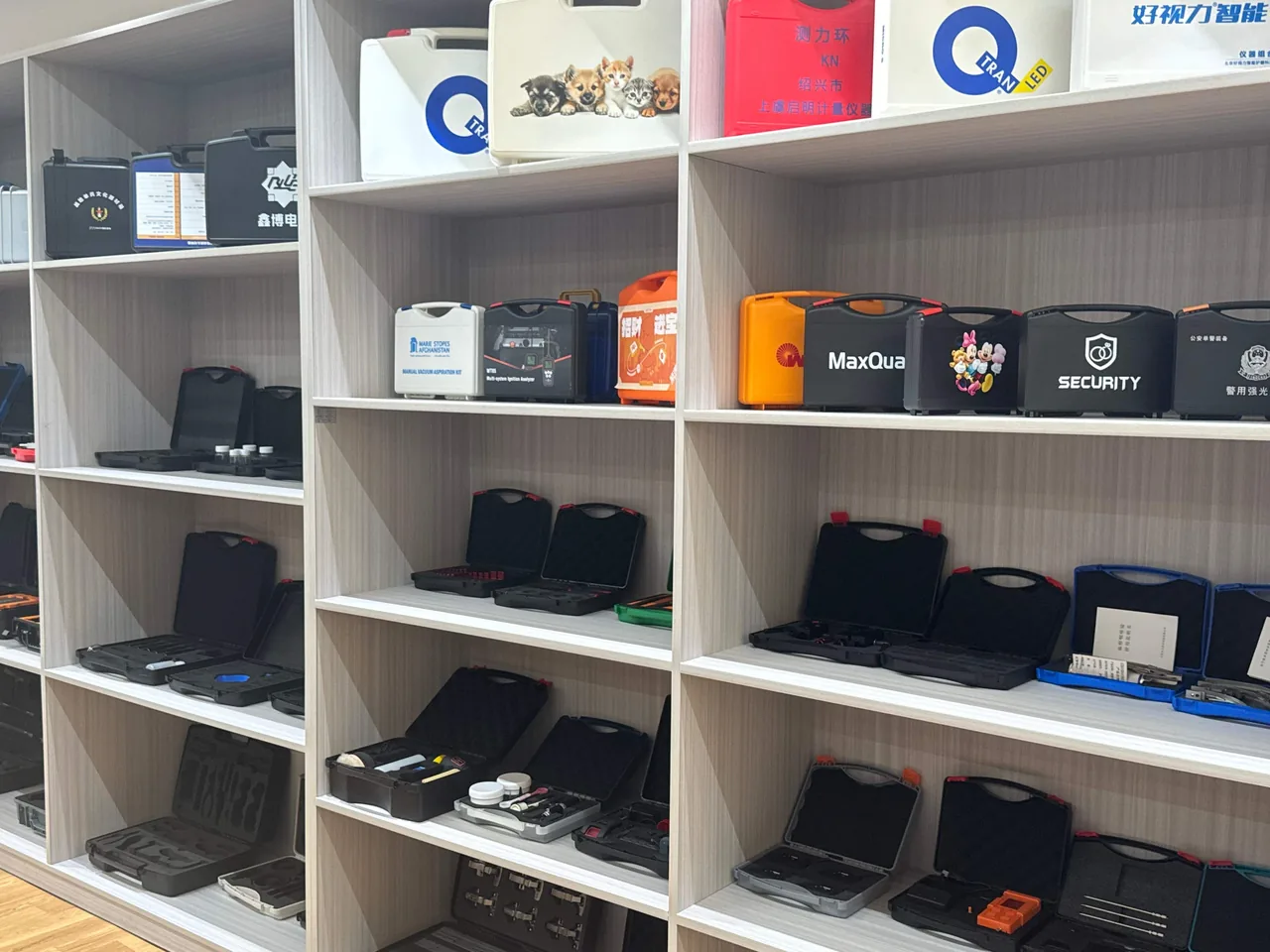
Turning the conclusions above into ready-to-use pairings:
| Scenario | Case | Liner scheme | Reason |
|---|---|---|---|
| --- | --- | --- | --- |
| Household hardware | Ordinary plastic case | EPE dividers | Light, cheap, adequate |
| Workshop gauges | IP54 or above | Routed EVA | Prevents movement and indentation |
| Electronics after-sales | IP67 protective case | Routed EVA plus anti-static bag | Water and dust plus static control |
| Field survey | IP67 protective case | EPE base plus EVA cradle | Vibration resistance plus durability |
| Military and police field use | IP67 case | Layered routed EVA | Reliable under repeated transport |
| E-commerce shipping | Carton plus pearl cotton | Full EPE sheet or profiles | Low-cost knock protection |
Reading across the table, the higher the risk, the greater the share of EVA and combined liners. The table is also a miniature of the selection process itself: set the risk first, then the case, then the foam combination.
Why Many Users End Up With a Hybrid Liner
In practice, neither pure EPE nor pure EVA is as common as a layered hybrid. The reason is straightforward: one tool kit usually contains both "heavy items that do not mind a knock," such as wrenches and sockets, and "extremely delicate precision items," such as probes and lenses. Routing everything in EVA costs more than necessary and the heavy items do not need that level of cradling; using only EPE leaves precision items without stable location. The compromise that emerges is to lay EPE at the bottom to absorb overall shock, route EVA recesses on top for precision items, and separate ordinary items with EPE strips. This "take the best of each" approach keeps per-case cost reasonable while giving every class of tool appropriate protection.
Hybrid liners are also more maintainable: worn EPE strips can be replaced individually and damaged EVA cradles patched locally, rather than scrapping a whole layer. For industrial inspection cases and after-sales spare-part cases that must serve for years, that maintainability directly lowers total cost of ownership. One caveat: hybrid schemes demand more from the liner supplier's co-design capability. Divider height, recess depth, and case latch travel must match, or you get "lid will not close" or "lid presses on the tools." If you go the custom route, hand the whole tool list to one supplier for a single design pass rather than buying parts separately and assembling them yourself.
Colour and Surface Finish: What Actually Matters
Many users agonise over whether black or white is better, but colour mostly signals intended use rather than performance. EPE is usually pearl white, though grey and black masterbatch versions exist; EVA is commonly black or grey and can be made in other colours. Black EVA looks professional and hides soiling inside an instrument case, while white EPE looks cleaner in e-commerce packaging. If the contents are sensitive to debris, a light-coloured liner actually helps, because dust and crumbs show up. On surface finish, EVA can be laminated with velour for better feel and grip, or with PU leather for oil resistance and easy wiping; EPE normally ships as raw foam, though high-density fine-cell grades are available where crumb resistance matters. None of these treatments changes the base material, but they affect user experience and cleaning difficulty — details where "right" beats "expensive."
Final Notes for Purchasers
The whole article condenses into three sentences for decision-making: choose EPE for light general use, EVA for precision and durability, and a hybrid "EPE base plus EVA cradle" for high-risk scenarios. Always treat foam, case, seal, and restraint as one system rather than comparing materials in isolation. Before ordering, request material statements and test reports and check them against the acceptance list in this article. If you are still unsure, handing the tool list to a supplier with liner customization capability usually costs less than repeated trial and error on your own.
Conclusion
EPE foam and EVA foam are not a question of "which is better" but "which fits." EPE is light and inexpensive, suiting general-purpose separators; EVA is dense, resilient, and suited to form-fitting liners for precision tools. Selection should weigh tool value, transport severity, environment (water, dust, vibration), and budget together, and where necessary adopt an integrated scheme of case protection rating plus foam type plus liner structure. For volume customization, work with a one-stop supplier that has injection moulding, tooling, and liner-making capability, and request material test reports and specification sheets for verification. If you need a design reviewed against a real tool list, or want to discuss OEM/ODM options, please use the contact form on this site.
Further Reading
- How Should You Choose the Foam Inside a Tool Box?
- What Are the Advantages of Using EVA Foam in a Tool Box?
- What Is the Difference Between a Waterproof Tool Box and an Ordinary Tool Box?
- Why Is a Shockproof Tool Box Right for Precision Tool Transport?
- What Are the Internal Foam Types Used in Protective Cases?
- What Is an IP67 Protective Case?