

Direct answer: an outdoor protective case needs dustproof design because dust is everywhere in outdoor environments and has a "chronic, cumulative, often irreversible" destructive power on precision equipment — fine particles entering moving parts of tools cause wear and jamming, entering gauge measuring faces scratch accuracy, entering lenses and circuits cause imaging spots and even short circuits. Dustproofing is not "icing on the cake" but one of the bottom lines for keeping equipment clean and usable in dusty environments (construction sites, workshops, deserts, field). It is achieved through a full-perimeter elastic gasket and compression latches, reaching IP6X (fully dust-tight) per the international standard IEC 60529. Without dustproof design, a protective case in blowing sand, dust, and muddy sites slowly accumulates dust and damages equipment just like an ordinary box. This article goes from "how dust damages equipment" to "how dustproofing is achieved, how to select, how to maintain," explaining the necessity of dustproof design thoroughly. One added note: dustproof design shares the same origin as waterproof design (the same seal), so the answer to "why dustproof" also directly supports "why waterproof" — read the two together to fully understand the "seal first" design philosophy; and its gap from an ordinary storage box is clear in the comparison article.
Table of Contents
- Direct Answer: Why Dustproofing Is Mandatory
- How Exactly Dust Damages Equipment
- Which Outdoor Scenarios Inevitably Have Dust
- How Dustproofing Is Achieved (IEC 60529)
- Dustproof Rating Reference Table (IP first digit)
- Coordination of Gasket, Latch, and Liner
- Relationship Between Dustproof, Waterproof, and Shockproof
- Consequences of No Dustproof Design
- Selection and Acceptance Checklist
- Common Misconceptions
- Daily Maintenance and Gasket Care
- Frequently Asked Questions (FAQ)
- Conclusion and Further Reading
Direct Answer: Why Dustproofing Is Mandatory
In one sentence: an outdoor protective case faces too much, too fine, too hard-to-block dust; without dustproofing it equals letting equipment be chronically worn. Outdoor equipment is often in a state of "dust coming to it" — blowing sand, cement dust, metal chips, weld slag, carbon powder, pollen — with particle sizes from visible coarse grains to a few microns and even sub-micron (PM2.5 and below). Fine particles pass through an ordinary box's millimeter-scale lid gap with air convection, slowly filling the inside, causing wear, jamming, scratches, and short circuits. Dustproof design turns "no dust in" into engineering reality with a quantifiable rating (such as IP6X fully dust-tight), so it is a core capability, not an add-on. For a protective-case product line like KeXin New Materials JUNZHJIA, IP67 is a regular capability, meaning "fully dust-tight + short-term water-proof" covering both dust and water.
How Exactly Dust Damages Equipment
To understand the need for dustproofing, first see how dust damages equipment:
- Abrasive wear: Metal chips and sand dust are hard; entering moving parts (hinges, slides, ratchets) they grind with motion, shaving the surface bit by bit, enlarging gaps and loosening feel.
- Jamming and noise: Particles stuck in gears or latches cause uneven opening or even lock-up.
- Scratched precision faces: Gauge measuring faces, lenses, and sensor surfaces are scratched by tools or airflow carrying particles, permanently damaging accuracy or imaging.
- Conduction and short circuit: Conductive dust on circuit boards (metal powder, carbon powder) forms leakage paths when damp, causing malfunction or burnout.
- Contamination and corrosion: Dust absorbs water vapor and corrosive gas, forming a galvanic cell on tool surfaces, accelerating rust.
- Clogged pores: Vent valves and heat holes blocked by dust, affecting function.
- Optical imaging defects: Dust on lenses and sensors directly causes imaging spots and vignetting, unacceptable for professional shooting.
Thus the harm of dust is "chronic, cumulative, often irreversible." Dustproof design is the first gate to break this damage chain.
Which Outdoor Scenarios Inevitably Have Dust
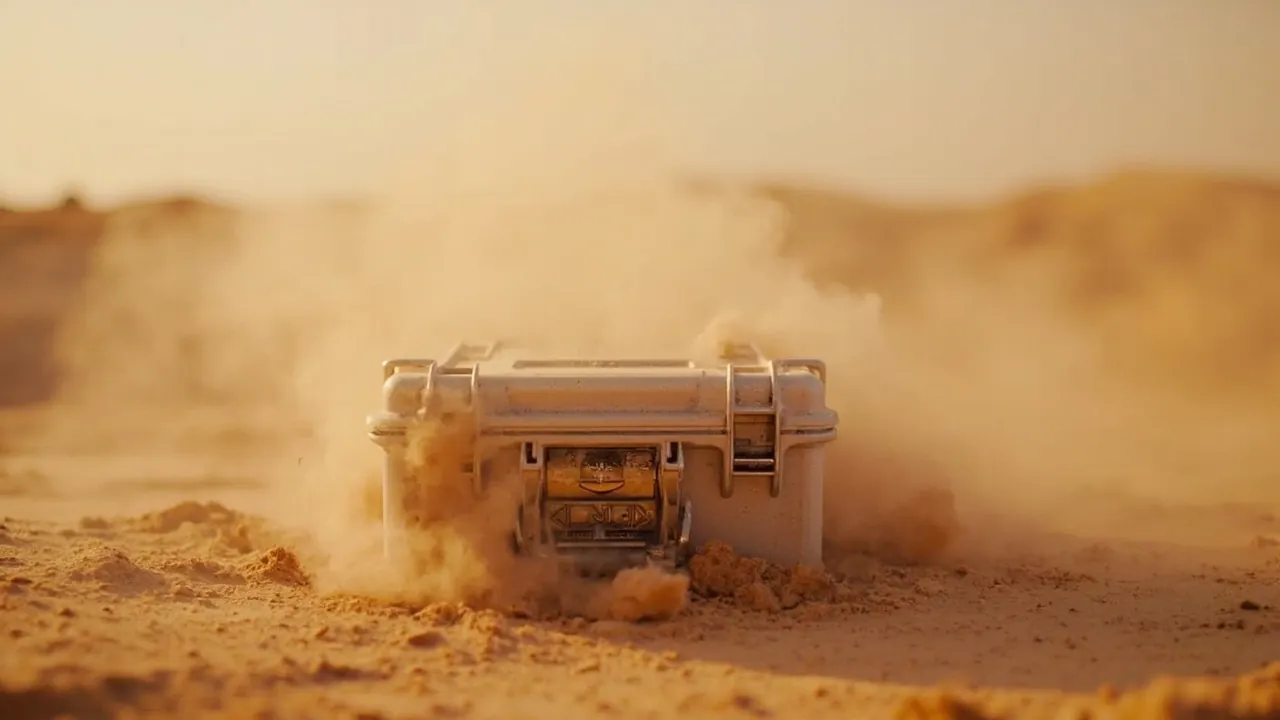
- Machining/welding workshops: High concentration of metal chips, weld slag, grinding dust — ordinary boxes accumulate dust quickly.
- Construction and outdoor engineering: Blowing sand and cement dust persist; exposed tools wear easily.
- Scientific exploration and field work: Deserts, gobi, coastal blowing sand — protective cases often combine dustproof + waterproof + anti-vibration design.
- Electronics/electrical repair: Motherboards and connectors fear conductive dust, needing dustproof + moisture control if needed.
- Optical and metrology labs: Lenses, sensors, gauges are extremely sensitive to particles.
- Automotive and aviation maintenance: Brake dust and carbon-fiber chips are unfriendly to precision instruments.
- Power and petrochemical sites: Dust + static + humidity, risks stacked.
The common thread of these scenarios is: dust is not "might come" but "will definitely come." If a protective case is not designed dustproof, it can only rely on luck, and precision equipment is not worth gambling on luck.
How Dustproofing Is Achieved (IEC 60529)
Dustproofing relies on "physical isolation." After the lid closes, the gasket along the lid edge (EPDM/TPE and other elastomers) is compressed 20%–40% by latches to fill microscopic gaps, so dust particles (even micron-scale) cannot enter with air convection; the ribs/labyrinth structure of body and lid increases the path length for dust to enter. Dustproof capability is expressed by the first digit of the IP code (per IEC 60529): IP5X dust-protected (limited ingress, no effect on operation), IP6X fully dust-tight (most stringent). The same seal usually achieves both dust and water resistance, so protective cases typically carry a combined rating such as IP67 (fully dust-tight + short-term immersion). For tool boxes, "fully dust-tight (IP6X)" is the practical upper limit, meeting heavy-dust environments like workshops, outdoors, and deserts. Note: IP testing is under controlled conditions; long-term real-world use still depends on an intact gasket and correct latching. One additional point: dustproofing is a "designed-in" capability, not something gained by "adding a ring later." Sealing depends on the precise fit of body and lid, the lid-edge knife edge, the rib labyrinth, and the latch compression force, all fixed at the mold stage; a thin-wall or non-sealed box cannot be retrofitted into reliable dustproofing. This is also why "ordinary box + cover cloth/tape" does not equal a dustproof box — the structure is not designed dustproof; temporary blocking only stops falling dust, not fine particles entering with air convection. Understanding this, you see dustproof design is the factory gene of a protective case, not an optional accessory.
Dustproof Rating Reference Table (IP first digit)
| IP first digit | Meaning | Note for outdoor protective cases |
|---|---|---|
| --- | --- | --- |
| 0 | No protection | Ordinary open box |
| 1–4 | Large particles/limited dust | Largely obsolete for protective cases |
| 5 (IP5X) | Dust-protected (limited ingress) | Usable for general dust environments |
| 6 (IP6X) | Fully dust-tight | Heavy dust, precision parts first choice |
The second digit (water) commonly combines as IP65/IP66/IP67. For example, the KeXin New Materials JUNZHJIA protective-case product line has IP67 capability, meaning "fully dust-tight + short-term immersion without water ingress," handling both dust and wading. For equipment like tool boxes that often face both dust and water, IP67 thus becomes the most recommended "all-in-one" rating. One rating step means one order of magnitude of protection difference: IP5X allows slight ingress, IP6X requires no ingress — precision scenarios should meet IP6X.
Coordination of Gasket, Latch, and Liner
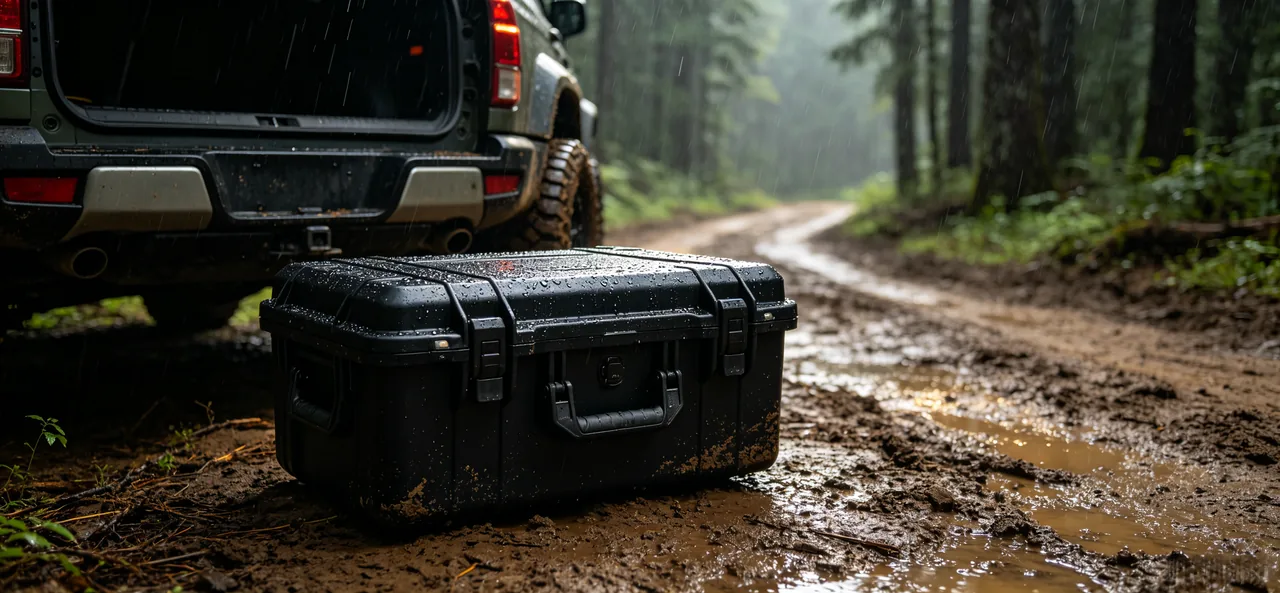
Dustproofing is not a single part but a trio working together:
- Gasket: Continuous elastic body around the lid, forming a sealing band once compressed — the main dustproof line; it must be continuous with no break.
- Latch: Provides continuous compression, keeping the gasket at compression long term; multiple latches make compression even, a single latch easily leaves a gap on one side to leak dust.
- Liner: EVA/EPE fixes equipment, avoiding equipment sliding inside and stirring up accumulated dust, and scraping faces against each other; without a liner, sliding tools instead scratch each other.
Missing any of the three may let dust in: a broken ring lets dust straight in, a loose latch opens the gap, no liner means sliding equipment stirs up accumulated dust. When selecting, check the trio as a whole, not just "is there a lid."
Relationship Between Dustproof, Waterproof, and Shockproof
The three protection layers have different duties but all fight through sealing:
| Dimension | Solves what | Relies on | Typical rating |
|---|---|---|---|
| --- | --- | --- | --- |
| Dustproof | Dust entry | Gasket + compression latch | IP6X (IEC 60529) |
| Waterproof | Water entry | Same seal + valve | IP67 |
| Shockproof | Impact/shifting | Rigid shell + cushioning liner | Structure + liner |
In reality one sealing structure achieves both dust and water resistance, so protective cases typically carry IP67; shockproof relies on shell and liner, a separate layer. Select by "what does my equipment fear" layer by layer: fears dust → dustproof case; fears dust and water → IP67; fears shock → add cushioning liner; fears all three → IP67 protective case + EVA liner combination. A reminder: dust and vibration often come together (such as desert exploration, workshop transfer); dustproof without fixation, sliding equipment instead stirs up internal dust and scratches tools; shockproof without dustproof, foam gaps still let in dust. The correct approach is an IP6X case + fixed liner, keeping equipment "immobile and clean" — this is the root reason dustproof and shockproof must coordinate. A manufacturer like KeXin New Materials JUNZHJIA with liner customization capability can coordinate dustproof, waterproof, and shockproof on the same case.
Consequences of No Dustproof Design
Using a "non-dustproof" box against outdoor dust brings predictable consequences: caliper measuring faces scratched by metal powder, readings jumping; lens with sand making noise, imaging spots; circuit board shorted by conductive dust when damp; hinge and slide worn loose and locked; gauge blocks bare in air, floating dust drifting calibration value, needing re-calibration. These are not one-time accidents but accumulation over time — dust entry starts from "a little," and by the time it is noticed accuracy is lost and equipment damaged. The investment in dustproof design buys the certainty of "no fear even when dust comes," a hard requirement for precision equipment. Conversely, any scenario where equipment "may meet dust the moment it leaves the room" — however low you subjectively think the concentration — should default to a dustproof case configuration, because dust often causes irreversible accuracy loss, while the dustproof case price difference is one-time and amortizable. Putting "damaged by dust" and "unaffected by dust" side by side, the necessity of dustproof design is self-evident.
Selection and Acceptance Checklist
Check item by item when purchasing a dustproof protective case:
- Dustproof rating: Define IP6X (IEC 60529); reject vague "dustproof."
- Gasket: Full-perimeter continuous, elastic, individually replaceable.
- Latch: Firm compression, even lid gap with no gap after latching, prefer multiple latches.
- Shell material: Virgin ABS/PP preferred; request RoHS and other tests.
- Liner compatibility: Whether EVA/EPE customization is supported to prevent equipment sliding and stirring dust.
- Certification backing: ISO9001, IP67, California Prop 65 verified per company documentation; individual product by specification sheet.
Use the checklist as a price-comparison basis to avoid the pit of "labeled dustproof but not dustproof."
Common Misconceptions
- Misconception 1: A lid means dustproof. Ordinary lid gaps can reach millimeter scale, dust still gets in; look for IP6X and the sealing structure.
- Misconception 2: Dustproof equals waterproof. A dustproof case may not be waterproof; check the second IP digit; for wading choose IP67 or higher.
- Misconception 3: The gasket lasts forever. Rubber rings age, and trapped debris causes dust leaks; clean and replace regularly.
- Misconception 4: A dustproof case needs no liner. Without a liner, sliding equipment instead stirs up internal dust and scratches tools; fit a fixed liner.
- Misconception 5: Clean indoors means no dustproof needed. Airborne floating dust accumulating long term still contaminates measuring faces; precision parts still suggest dustproof storage.
Daily Maintenance and Gasket Care
Dustproof capability is maintained by maintenance:
- Before closing, clear sand and threads from the lid edge and gasket to avoid trapped debris forming a dust-leak gap.
- Wipe regularly the gasket with a clean soft cloth; thin silicone grease if needed to slow aging.
- Avoid prolonged sun — long-term high temperature accelerates rubber hardening and cracking.
- Open in clean places — try not to leave the case open in blowing sand, reducing dust inside.
- Watch for deformation — replace the same-spec part promptly when the gasket loses elasticity or cracks.
- Clean the liner by blowing dust regularly, to avoid the liner itself accumulating dust and re-contaminating equipment.
- Long-term storage — leave the lid slightly open for ventilation to avoid gasket sticking, in a cool dry place to slow aging.
With proper maintenance, IP dustproofing stays effective long term; without it, even a nominal rating fails from a small crack. Worth reminding: the gasket is a consumable, not a permanent part — even if no dust ever enters, rubber naturally ages over time, so writing "regularly inspect and replace the gasket" into the equipment custody spec is easier than waiting for a dust leak to repair. For batch equipment, prepare spare parts by service life uniformly to avoid having no ring when needed.
Real Cases of Dustproof Failure
A few vivid examples show the cost of "no dustproof." A machining workshop caliper casually placed in an ordinary box had its measuring face covered with metal-powder scratches within a week, readings jumping; a wind-power tower-top maintenance laptop and probe in an open box let carbon-brush dust into the interface, causing poor contact; a desert-exploration lens in an ordinary bag let fine sand into the focus ring, causing grinding noise; a lab gauge block bare, floating dust drifting its calibration value, needing re-calibration; an electronics-repair motherboard in an ordinary box, conductive dust shorting when damp. These losses are not one-time accidents but accumulation over time — dust entry starts from "a little," and by the time it is noticed accuracy is lost and equipment damaged. After switching to an IP6X dustproof case + fixed liner, equipment life and accuracy stability visibly improve in the same environment. The cases show: dustproof design buys the certainty of "no fear even when dust comes," not probabilistic luck.
Seal-Structure Details: Dustproofing Hides Within Millimeters
Dustproof capability hides in details. The gasket cross-section is mostly solid or hollow rectangular/round; after closing it is compressed 20%–40% to form a sealing band; the lid edge is designed as a "knife edge" pressing into the gasket to raise line-seal pressure; the ribs of body and lid interlock to form a multi-stage labyrinth, so even a first micro-leak is blocked by the second. The number and position of latches determine whether compression is even — a single latch easily leaves a gap on one side; multiple latches are steadier. These structures are fixed at the mold stage; recycled material or uneven wall thickness destroys the fit. So choosing a dustproof case is not just "is there a ring," but whether the ring is continuous, compression even, and shell virgin — a manufacturer with injection-molding and mold capability guarantees tolerance at the mold end, the underlying guarantee of long-term dustproofing. KeXin New Materials plastic cases in ABS/PP material pass RoHS testing; the factory is about 18,000 square meters in Zhongshan, Guangdong (Greater Bay Area), with more than 80 machines and over 100 employees.
Shell Material: How to Choose Between ABS and PP
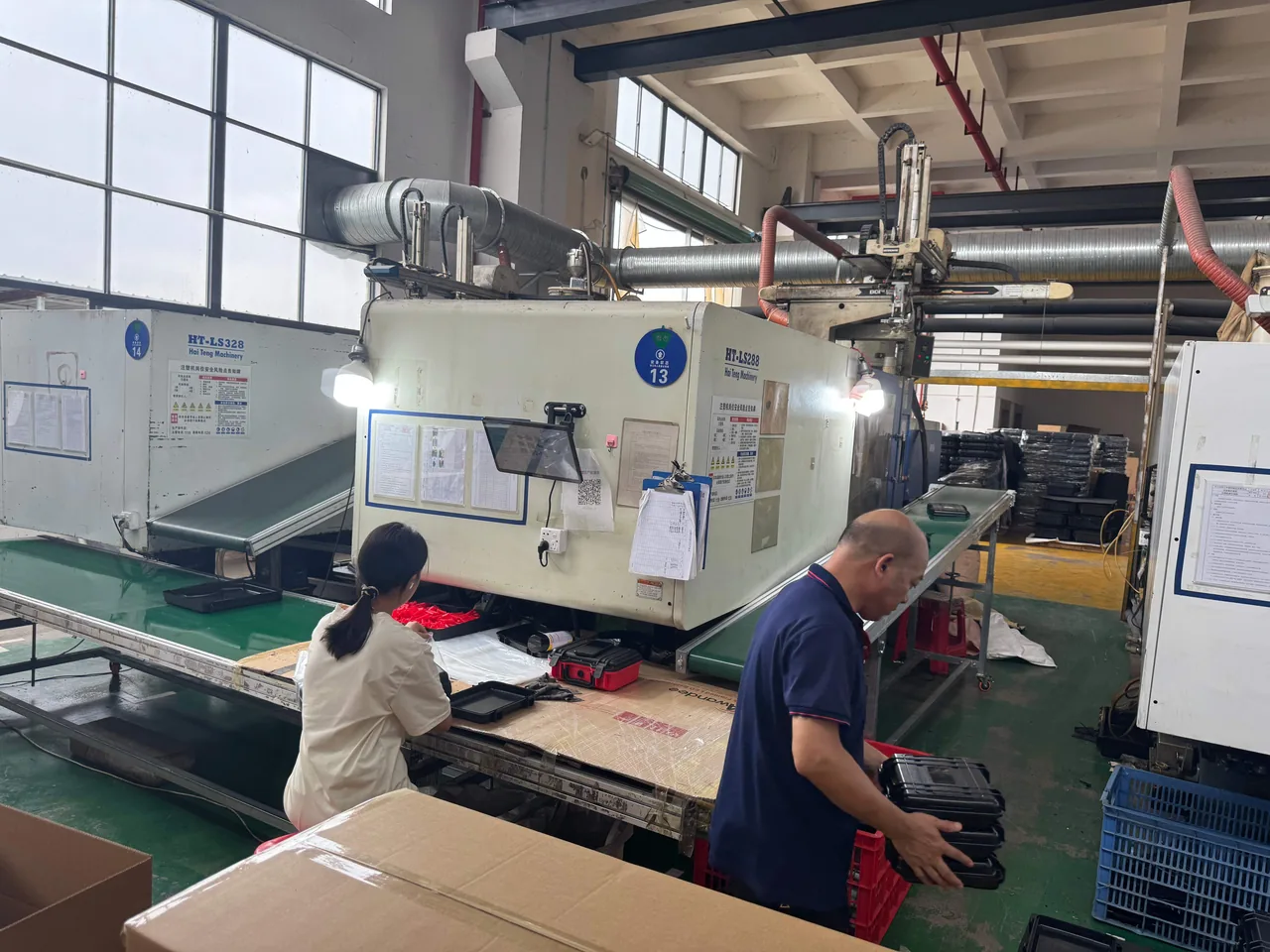
A dustproof case shell comes down to two engineering plastics, ABS and PP. ABS has high rigidity, easy surface treatment and printing, stable dimensions, suited to a stiff shape; PP has better low-temperature impact resistance, lower density, fatigue resistance, suited to cold and frequent opening. Neither is "better" but "fit for scenario." Regular manufacturers use virgin material, because recycled material has uneven wall thickness and deforms easily under load, directly skewing the seal and destroying dustproofing. When purchasing, confirm "is it virgin" and "wall-thickness reference" rather than just color and weight. For export orders, RoHS, REACH, California Prop 65 compliance are hard indicators at the material level.
Dust Particle Size and Hazard Grading
Dust is not one thing but differs in hazard by particle size. Coarse particles (visible sand, chips) mainly cause jamming and scratches; fine particles (PM10 scale, tens of microns) can drift into an ordinary box gap; inhalable and sub-micron (PM2.5 and below) can go deep into gaps with airflow, attaching to measuring faces and circuits. The finer, the harder to block, and the more dangerous to precision parts. IP6X testing uses specific dust (such as quartz powder) to verify "no ingress," setting defense even against sub-micron. After understanding the grading, you know an ordinary box's millimeter-scale lid gap cannot even block coarse dust, let alone fine dust; only full-perimeter compression sealing covers all particle sizes. This is why precision scenarios must go to IP6X, not "roughly dustproof."
Certification and Qualification Verification Points
For critical scenarios, beyond the nominal rating, verify qualifications. Verifiable items: IP6X/IP67 protection (per IEC 60529, backed by company documentation; certificates available on request); ISO9001 quality management system; RoHS/REACH (plastic ABS/PP passes RoHS testing); California Prop 65 restriction; and MIL-STD-810H (product-line environmental adaptability validation). Taking KeXin New Materials (Guangdong) Co., Ltd. as an example, the protective-case product line holds several of the above certifications/tests, holds more than 20 utility-model and design patents, and products are exported to the United States, Germany, Japan, and other regions. When requesting certificates, clarify "which model, which level" to avoid substituting company-level backing for an individual product's proof; for batch orders, putting the individual product's specification sheet and test report into the contract appendix is safer.
Size, Compartments, and Liner Selection
Wrong size also weakens dustproofing. Principle: first list equipment shape, quantity, and fragility order, reserve liner thickness and handling space to set the net size; prefer slightly larger over forced fit, but too large means equipment slides and needs more filling, stirring dust. For compartments, give precision parts their own slots, shedding parts isolation bags, standard parts separate soft packs. Use deep cases for upright rods, layered cases for flat instruments. Wheeled large cases consider air-transport limits. Liners commonly use EVA (good rebound, good cut shaping) and EPE (light, even cushioning). Size, liner, and compartments set together so the case holds everything yet does not rattle, scrape, or let dust in.
Stacking, Load Capacity, and Portability of Outdoor Dustproof Cases
Dustproof cases often need stacking or carrying. The shell's ribs and corners determine stacking stability and compression resistance: a quality dustproof case can be stacked in multiple layers without deforming once latched, and the lid can briefly bear load; thin-wall boxes easily collapse and crush equipment. If stacking is involved, check the manufacturer's stacking height/load reference and confirm latches do not pop open under load. For portability, wide thick anti-slip handles, dual-side folding handles, telescopic rod and wheeled large cases reduce transfer effort. Portability and protection are not contradictory: a good dustproof case designs ribs, latches, and handles together at the mold stage, being both rigid and handy.
Outdoor Dust Risk Map
Comparing dust risks row by row shows the value of dustproofing intuitively:
| Risk | Result with no dustproof case | IP6X dustproof case response |
|---|---|---|
| --- | --- | --- |
| Blowing sand/cement dust | Continuous dust in through lid gap | Full-perimeter seal blocks dust |
| Metal chips/weld slag | Moving parts worn and locked | IP6X fully dust-tight |
| Conductive carbon powder | Short circuit when damp | Seal + moisture control |
| Optical dust fall | Imaging spots | Seal + fixed liner |
| Gauge floating dust | Measuring face contaminated, inaccurate | Dustproof storage |
| Vent pore clog | Function drops | Seal protects pores |
This table shows dust appears in many forms, and a dustproof case responds one by one with combined design, while a non-dustproof case is "zero defense" on every row.
Who Should Buy a Dustproof Protective Case: Quick Lookup
Match yourself: occasional use in a home garage → ordinary box is fine. Property indoor short-haul repair → ordinary tool box is enough. Machining/welding workshop with high dust → choose IP6X. Electronics/electrical repair fearing conductive dust → dustproof + moisture control. Metrology/QC/lab extremely sensitive to particles → must choose a dustproof case. Outdoor exploration/desert → choose IP67 combination. Military/police/fire → select a protective case validated against MIL-STD-810H as a product-line environmental test basis. In one sentence: the more precision the equipment, the higher the environmental dust, the more you need a dustproof case. If hesitant, recall a lesson of "gauge mysteriously went out of spec, lens mysteriously got black spots," and the answer is clear.
Mini Glossary
- IEC 60529: International protection rating standard defining the IP code and dust/water tests.
- IP6X: Fully dust-tight, no dust entry under standard conditions.
- IP5X: Dust-protected (limited ingress), no effect on normal operation.
- Gasket: Elastic seal around the lid edge; blocks dust once compressed.
- Compression latch: A latch that presses the lid when closed, maintaining gasket compression.
- Labyrinth structure: Ribs interlocking to increase dust path length, a multi-stage seal.
- OEM/ODM: Original equipment manufacturing/original design manufacturing — custom modes by customer requirement.
Selection Decision Tree
Ask yourself: Is there obvious dust in the environment? No → ordinary box. Slight floating dust → IP5X. Heavy dust/outdoor → IP6X. Also wading? → IP67. Contains precision electronics/optics? → IP6X + liner + moisture control if needed. Long-term high humidity? → add desiccant or IP67. Batch? → go OEM/ODM optimization. Put the decision tree into the purchasing spec so even a beginner selects correctly, reducing equipment damage from buying by feel.
The Accessory Ecosystem of Dustproof Cases
A dustproof case's value is not only the box but also expandable accessories: customizable EVA/EPE liner keeps equipment in place and reduces shift-stirred dust; movable dividers and soft bags isolate shedding parts; name cards and sealed document pouches carry the checklist with the case; wheels and rod turn a large case into a drag-along. These accessories upgrade the dustproof case from "a box holding equipment" to a "mobile clean station." Being able to customize shell + liner + accessories at once gives higher coordination — KeXin New Materials JUNZHJIA supports one-stop OEM/ODM for product design, injection molding, molds, liners, and LOGO, suited to batches. For precision scenarios especially, fit a fixed liner, being both dustproof and shockproof, avoiding equipment sliding and scraping inside.
Maintenance and Life Account: Is Dustproofing Worth the Investment
Looking only at the box, a dustproof protective case is more expensive than an ordinary box; but the full account is often cheaper. One gauge re-calibration, one lens cleaning, one circuit board scrapped by dust short — any often exceeds the cost of several dustproof cases. A dustproof case with replaceable gasket and locally replaceable liner can be used for years, with controllable maintenance cost. For metering, repair, and research scenarios where "equipment is an asset," a dustproof case is closer to a necessary custody investment. When purchasing, compare "loss avoided" with "box price difference" side by side, and the conclusion usually leans to the dustproof case. Batch OEM/ODM can also optimize liner and compartments by equipment list, further reducing handling wear and internal dust.
A Metrology Inspection Kit Shows the Dustproof Plan
A complete example ties together all the concepts above: a metrology inspection kit contains a digital caliper, micrometer, gauge block, and dial indicator on a stand; the environment is workshop and outdoors, with dust and vibration coexisting. The plan is an IP6X dustproof case (IEC 60529) to block dust, an ABS/PP shell for rigidity, an EVA cut liner to fix gauges against shift and scrape-stirred dust, and desiccant if needed for moisture. The seal solves "dust in or not," the liner solves "broken by shock, scraped by rubbing," the shell solves "deformed by load" — three layers each with its own job. This example also shows a dustproof case rarely stands alone; it is often the central piece of a "dustproof + waterproof + shockproof" combination, so purchasing should think in combinations rather than single items. A manufacturer with one-stop liner and LOGO customization capability (such as KeXin New Materials JUNZHJIA) can coordinate this combination before leaving the factory, so the user receives a complete solution.
The Boundary of Dustproof Design: What It Cannot Do
Having explained the necessity, also explain the boundary to avoid misunderstanding. Dustproof design does not mean "the box can be a vacuum tank": IP6X is no dust entry under standard conditions, actually depending on an intact gasket and correct latching; once the gasket ages, traps debris, or the latch is not closed, dustproofing fails, so maintenance and correct use are equally important; dustproof is not moisture-proof — conductive dust only shorts when damp, long-term high humidity still needs desiccant; dustproof also does not replace shockproof, equipment still knocks if it slides. Understanding the boundary lets you use it right: dustproofing is the "outdoor clean bottom line," not a "universal shield"; stack waterproof, shockproof, and moisture-proof by scenario for a complete plan.
Frequently Asked Questions (FAQ)
Q: Can a dustproof protective case completely isolate dust? A: A case labeled IP6X (fully dust-tight) has no dust entry under the standard's requirements; the actual effect depends on an intact gasket and correct latching, and aging or trapped debris weakens dustproofing.
Q: Are dustproof and waterproof the same structure? A: Usually yes. The same gasket and compression latch achieve both dustproof and waterproof, so protective cases typically carry a combined rating such as IP67 (fully dust-tight + short-term water-proof).
Q: Does an ordinary tool box with a cover cloth count as dustproof? A: Not reliably. A cover cloth only blocks falling dust, cannot block fine particles entering with air convection, and does not reach a nominal rating.
Q: Do electronic tools in a dustproof case still need moisture-proofing? A: If the environment is humid, dustproofing alone is not enough; choose an IP67 waterproof case or put desiccant inside, combining dustproof and moisture-proof for completeness.
Q: How to maintain the gasket of a dustproof case? A: Regularly wipe the gasket and lid edge with a clean soft cloth, avoiding trapped sand; when cracking or loss of elasticity is found, replace with the same-spec part promptly.
Q: Must gauges be put in a dustproof case? A: For gauges with high accuracy requirements (calipers, micrometers, dial indicators), dustproof storage is standard practice to maintain accuracy; even if the environment seems clean, airborne floating dust accumulating long term still contaminates measuring faces.
Conclusion
An outdoor protective case needs dustproof design because dust is everywhere outdoors and has a chronic, cumulative, often irreversible destructive power on precision equipment — wear and jamming, scratched accuracy, short circuits and imaging defects, almost all starting from "dirty." Dustproofing is achieved through a full-perimeter gasket and compression latches, reaching IP6X (fully dust-tight) per IEC 60529. It is a survival bottom line, not an add-on: without dustproofing, a protective case in blowing sand, dust, and muddy sites slowly accumulates dust and damages equipment just like an ordinary box. Select the IP5X/IP6X by dust concentration, prefer IP67 for heavy dust or wading, fit an EVA liner to reduce internal dust, and maintain the gasket, so that "no fear even when dust comes" becomes a stable reality. Think of dustproof, waterproof, and shockproof as a combination rather than single items, so equipment truly "is clean when out, safe when in." To emphasize once more: every investment in dustproof design buys a verifiable layer of protection — the gasket buys "no dust in," the latch buys "gap does not open," the liner buys "not broken by shock, not scraped by rubbing, not stirring dust." These are not icing on the cake in outdoor dusty environments but the bottom line of whether equipment can "be clean when out." Save this article's rating table, risk map, decision tree, and acceptance checklist for later; next time you will not be led astray by appearance and low price, and your equipment can truly "be clean when out, safe when in." Dustproofing is not making a mountain out of a molehill, but the most plain respect for accuracy and life.
Further Reading
- What Is an Outdoor Protective Case and Where Is It Used?
- Why Does an Outdoor Protective Case Need Waterproof Design?
- What Is the Difference Between an Outdoor Protective Case and an Ordinary Storage Box?
- IP67 Protective Case: Fully Dust-Tight and Short-Term Immersion
- Difference Between IP65, IP66, and IP67
- The Seal Ring of Outdoor Protective Cases
- Inner Cushion of Outdoor Protective Cases