

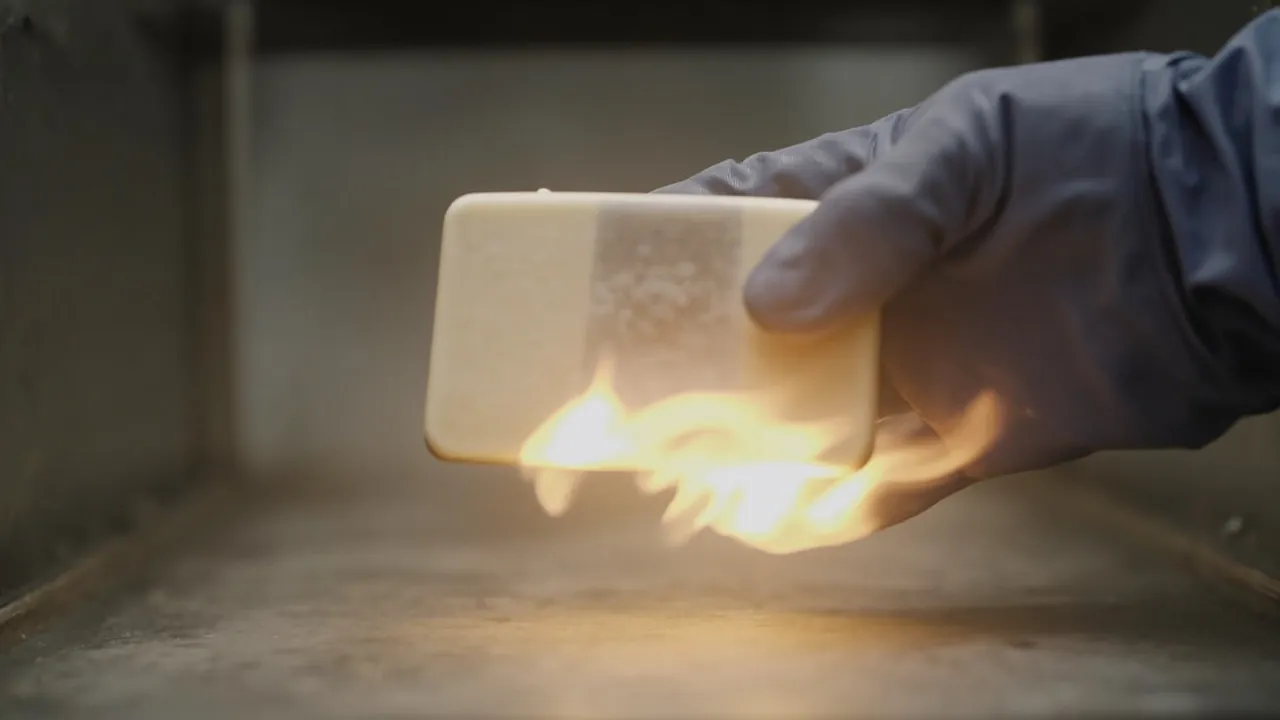
The short answer: UL94 V-0 and V-2 come from the same vertical burning test, using a 50 W flame applied twice for ten seconds each. The decisive difference is a single criterion, namely whether material dripping from the specimen ignites the dry cotton placed below it. V-0 requires each specimen to stop flaming within ten seconds, limits the total across five specimens to fifty seconds, and permits no dripping that ignites the cotton. V-2 allows up to thirty seconds per specimen, a total of two hundred and fifty seconds, and explicitly permits flaming drips that ignite the cotton. Put simply, V-0 means "no dripping and no extended flame", while V-2 means "dripping permitted, ignition of cotton permitted". In real applications that gap is far wider than the two characters in the rating suggest.
When a protective case, tool box or waterproof junction box is purchased, the phrase "material rated UL94 V-0" turns up regularly in specifications. Yet many projects never establish what that phrase actually commits the supplier to, how the report should be checked, or why the same material grade can carry V-0, V-1, V-2 and HB ratings all at once. The root of the confusion is this: a UL94 rating is bound to specimen thickness, not to a material grade alone. The same flame-retardant PC/ABS blend may reach only V-2 at 1.5 mm and V-0 at 3.0 mm. Without a stated thickness, the three characters "V-0" are technically incomplete.
This article is written for procurement, structural design, materials engineering and compliance staff working with protective cases. It covers the positioning of UL94, the standard family and how UL94 maps to IEC 60695-11-10 and the corresponding national standards, the criteria for V-0, V-1 and V-2 in detail, the full ladder from horizontal burning HB up to 5VA and 5VB, the thickness binding rule, the practical details of the test, how UL94 relates to glow wire testing and limiting oxygen index, why protective case buyers should care about flame ratings at all, the trade-offs between ABS, PC, PP and PC/ABS, and how to read a UL94 report and a UL yellow card. Flame application times and afterflame limits quoted here are the typical conditions defined in the standards; binding verdicts must follow the current text of the standard and the specific report being cited.
Contents
- What UL94 Is: Positioning and Scope
- The Standard Family: UL94, IEC 60695-11-10 and National Equivalents
- The Criteria for V-0, V-1 and V-2
- Horizontal Burning HB, 5VA and 5VB: The Full Ladder
- Specimen Thickness and the Material-to-Thickness Binding Rule
- Test Conditions and Practical Details
- The Real Difference Between V-0 and V-2: Igniting the Cotton
- Beyond UL94: Glow Wire, Limiting Oxygen Index and UL 746
- Why Protective Cases Need a Flame Rating
- Material Systems and Flame Retardants: ABS, PC, PP and PC/ABS
- How to Read a UL94 Report and a Yellow Card
- Common Misconceptions and Traps
- Frequently Asked Questions
- Conclusion and Related Reading
What UL94 Is: Positioning and Scope
UL94 is titled "Tests for Flammability of Plastic Materials for Parts in Devices and Appliances". It is published by Underwriters Laboratories and is one of the most widely applied flammability evaluation methods for plastics internationally. Three points capture its positioning.
First, it is a material-level test method, not a product-level certification. The object under evaluation is a specimen of a given material at a given thickness, not a finished case. A protective case built from material rated V-0 is not automatically a V-0 product, because the finished part has ribs, holes, inserts and assembly gaps, and its burning behaviour differs from that of a standard bar.
Second, it evaluates flammability, not fire resistance. UL94 measures whether a material self-extinguishes after ignition and whether it drips in a way that ignites material below. It does not answer how much heat a material can withstand, nor how long a component survives a fire. Fire resistance and thermal endurance belong to other families, such as the glow wire tests in IEC 60695-2 and the heat deflection and long-term service temperature figures reported for materials.
Third, the rating is a ladder, not a single score. From the lowest level HB up through V-2, V-1, V-0 and on to 5VB and 5VA, the system forms a progressively stricter sequence. Deciding whether a design is safe enough must return to the standard applicable to the specific application, rather than reflexively chasing the highest rating available.
In the protective case industry, UL94 is cited in three typical situations. The first is export to North America for cases that carry electrical or electronic equipment, where the customer specifies V-0 or V-1 for the case material. The second is as part of end-product certification, where the certification body for the finished device requires a UL94 report for the enclosure material. The third is as a screening threshold in a procurement technical agreement, used to separate suppliers whose formulations are more mature from those that are not.
The Standard Family: UL94, IEC 60695-11-10 and National Equivalents
UL94 does not stand alone. It maps onto standards from the International Electrotechnical Commission and onto national equivalents, and understanding that family tree prevents duplicated testing and mis-cited standards in cross-border projects.
| Standard | Title and scope | Tests covered | Relationship to UL94 |
|---|---|---|---|
| --- | --- | --- | --- |
| UL94 | Flammability of plastic materials for parts in devices and appliances | Horizontal HB, vertical V-0/V-1/V-2, 500 W vertical 5VA/5VB, film and foam variants | Most complete system; its rating names dominate the market |
| IEC 60695-11-10 | Fire hazard testing, part 11-10: test flames, 50 W horizontal and vertical flame test methods | HB (horizontal), V-0/V-1/V-2 (vertical) | Closely corresponding method and criteria for the 50 W tests |
| IEC 60695-11-20 | Fire hazard testing, part 11-20: 500 W flame test methods | 5VA/5VB | Corresponds to the UL94 500 W vertical test |
| GB/T 2408 | Determination of burning behaviour of plastics, horizontal and vertical methods | HB, V-0/V-1/V-2 | The most common domestic report format in China |
| GB/T 2409 | Vertical burning test at 500 W | 5VA/5VB | Corresponds to the 500 W test |
| GB/T 5169 series | Fire hazard testing for electrotechnical products | Glow wire, glow wire flammability index and related | Used alongside UL94, discussed later |
The key conclusion from that table is that the UL94 V ratings, the vertical method of IEC 60695-11-10 and the vertical method of the national equivalents share essentially the same criteria, so they can be cross-referenced provided the standard number and edition are stated. In export projects the usual practice is to supply both a UL yellow card and a domestic report, the former for North American customers and end-product certification, the latter for domestic acceptance and tendering.
One caution: "essentially the same" is not the same as "identical". Specimen dimensions, conditioning (for example 168 hours at 70 degrees C versus 168 hours at 40 degrees C and controlled humidity), conditioning atmosphere and cotton specifications can vary between editions. A technical agreement that states "per this standard, this edition" is far more defensible than one that states "flame retardant as required".
The Criteria for V-0, V-1 and V-2
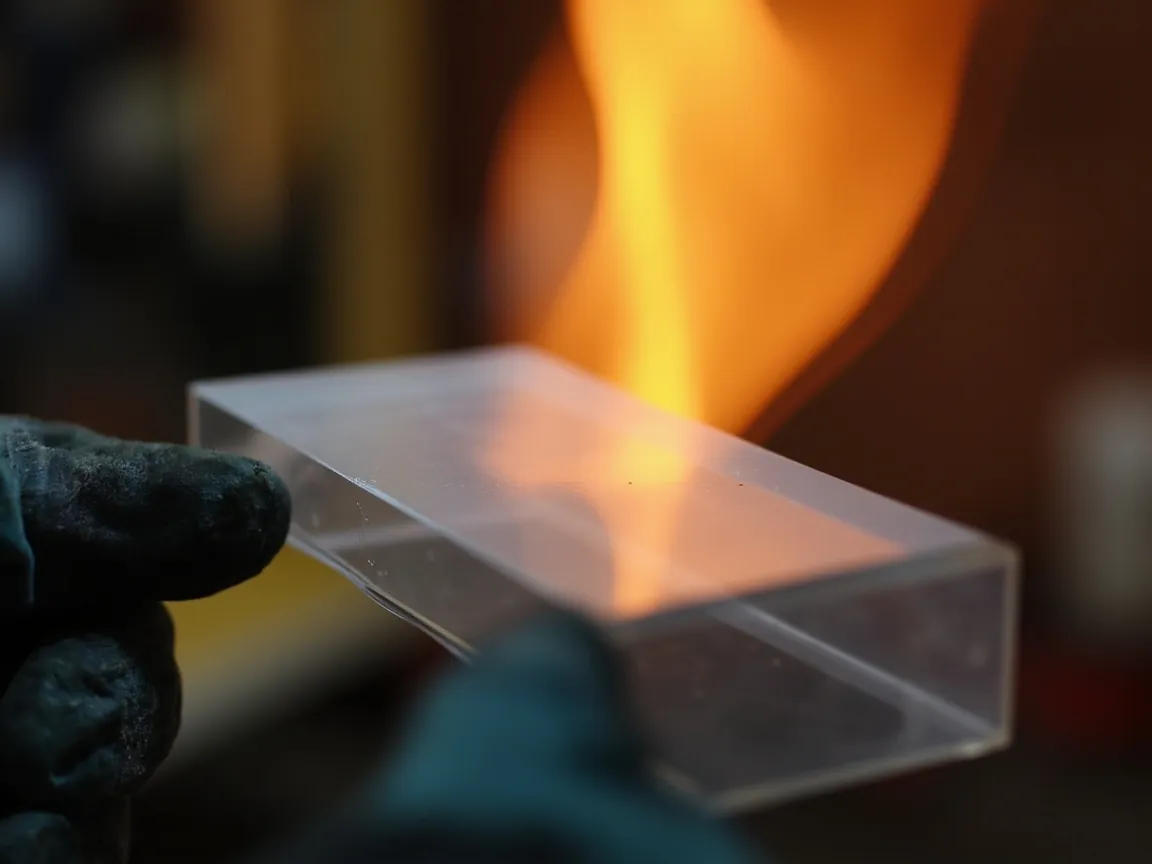
The V rating test uses five bar specimens clamped vertically. A standard 50 W flame is applied to the lower end twice, for ten seconds each time, with the second application made once the afterflame from the first has stopped. Dry absorbent cotton is placed a defined distance below the specimen throughout, to catch any drips. The criteria can be summarised as follows.
| Criterion | V-0 | V-1 | V-2 |
|---|---|---|---|
| --- | --- | --- | --- |
| Afterflame after first application, per specimen | 10 s or less | 30 s or less | 30 s or less |
| Afterflame plus afterglow after second application, per specimen | 30 s or less | 60 s or less | 60 s or less |
| Total afterflame across five specimens | 50 s or less | 250 s or less | 250 s or less |
| Burning up to the holding clamp | Not permitted | Not permitted | Not permitted |
| Dripping that ignites the cotton | Not permitted | Not permitted | Permitted |
| Complete consumption of the specimen | Not permitted | Not permitted | Not permitted |
Two conclusions follow immediately from that table. V-1 and V-2 share identical burning-time criteria; the only difference is whether drips ignite the cotton. V-0, by contrast, tightens both dimensions at once: it cuts the permissible afterflame to roughly a tenth (ten seconds versus thirty, fifty seconds total versus two hundred and fifty) while also banning igniting drips. The formulation demand that V-0 places on a material is therefore a step change, not a small increment over V-1 and V-2.
A useful way to remember it: V-0 and V-2 are two acceptance lines drawn on the same test. V-2 only asks that the drips do not set the cotton alight; V-0 also asks that the material stop burning quickly.
Horizontal Burning HB, 5VA and 5VB: The Full Ladder
The UL94 ladder does not begin at V-2. HB is the lowest rung, and above V-0 sit the far harsher 500 W vertical tests.
HB, horizontal burning. The specimen is clamped horizontally and a flame is applied to one end, typically for thirty seconds. The test measures how fast the flame front travels along the specimen. The usual criteria are that a specimen between 3 mm and 13 mm thick must not exceed a burning rate of 40 mm per minute, a specimen thinner than 3 mm must not exceed 75 mm per minute, and the flame must stop before the 100 mm mark. HB is the easiest rating to obtain and generally serves as a baseline indicating that the material can be ignited but that flame spread is controlled.
5VA and 5VB, 500 W vertical burning. These are the top of the UL94 ladder. A 500 W flame, roughly 125 mm in height, is used, and the test covers both bar specimens and plaque specimens, evaluating resistance to a more severe ignition source. Both require an afterflame time of no more than sixty seconds, and they differ in whether the plaque is burned through:
- 5VB permits a hole to form in the plaque specimen.
- 5VA forbids a hole in the plaque specimen and is the strictest rating in the UL94 system.
The full ladder can be written as HB below V-2 below V-1 below V-0 below 5VB below 5VA. It must be stressed, however, that this ordering should not be read as "higher is always better" in engineering terms. Higher ratings generally require more flame retardant, which in turn tends to reduce impact toughness, raise cost, narrow the processing window and complicate colour matching. The right basis for selecting a rating is the applicable standard and the genuine ignition risk, not the pursuit of the highest available number.
| Rating | Test flame power | Specimen form | Key criteria | Typical application threshold |
|---|---|---|---|---|
| --- | --- | --- | --- | --- |
| HB | About 50 W, horizontal | Bar | Burning rate limit | Baseline, non-critical parts |
| V-2 | 50 W, vertical | Bar | Afterflame 30 s or less; igniting drips permitted | General electrical enclosures |
| V-1 | 50 W, vertical | Bar | Afterflame 30 s or less; igniting drips not permitted | Appliance and IT enclosures |
| V-0 | 50 W, vertical | Bar | Afterflame 10 s or less, total 50 s or less, no igniting drips | Most electrical enclosure requirements |
| 5VB | 500 W | Bar and plaque | Afterflame 60 s or less; plaque hole permitted | Large equipment enclosures |
| 5VA | 500 W | Bar and plaque | Afterflame 60 s or less; plaque hole not permitted | Highest-demand applications |
Specimen Thickness and the Material-to-Thickness Binding Rule
This is the most frequently misread aspect of UL94 and the most common source of procurement disputes. A UL94 result states that a given material reached a given rating at a given thickness. The thickness is part of the result. Strictly speaking, "the material passes UL94 V-0" is an incomplete statement. The correct form is "the material passes UL94 V-0 at 3.0 mm".
The underlying physics is not complicated. A thin specimen heats through faster, has a shorter path for heat to escape, and conducts the flame more readily, so thin walls sustain burning more easily. A thicker specimen absorbs more heat and builds a thicker char layer, which favours self-extinguishing. That is why the same flame-retardant material often rates higher as thickness increases and may drop a level as it gets thinner.
This has a direct practical consequence for protective case design. If the main wall of a case is 2.5 mm and the material report was obtained at 3.0 mm, you cannot simply claim that the case material meets V-0. There are three compliant routes:
- Test at the actual wall thickness. Ask the material supplier for a report covering 2.5 mm, or commission the test independently.
- Choose a grade whose report covers the thinnest wall. Select a material whose card already demonstrates the target rating at or below the thinnest wall in the design.
- Adjust the design. Where weight and structure allow, increase the critical wall thickness to at least the thickness the report covers.
| Design minimum wall | Material report thickness | Can the claim be made directly | Recommended action |
|---|---|---|---|
| --- | --- | --- | --- |
| 3.0 mm | 3.0 mm | Yes | Keep the report and state the thickness |
| 2.5 mm | 3.0 mm | No | Retest at 2.5 mm or change material |
| 3.0 mm | 1.5 mm | Yes, with margin | State that the report thickness is below design |
| 2.0 mm | 1.5 mm and 3.0 mm steps | Needs checking | Confirm the thickness steps cover the design value |
It is also important to understand the thickness steps published on a UL card. A yellow card typically lists several thickness steps with the corresponding ratings, for example V-2 at 1.5 mm and V-0 at 3.0 mm. Interpolation between steps is not automatic. If you need a 2.0 mm verdict and the card offers only 1.5 mm and 3.0 mm, then whether 2.0 mm qualifies must be confirmed separately. The safe rule of thumb is that ratings improve monotonically with thickness, so a card showing V-0 at a given thickness implies that thicker specimens will not do worse, but thinner specimens cannot be inferred backwards.
Test Conditions and Practical Details
Understanding the test details helps when judging whether a report is credible. The key conditions of the UL94 50 W vertical burning test are as follows.
- Flame power and height. A standard 50 W flame is used, typically about 20 mm in height, with the flame energy calibrated by a standardised thermocouple method. The flame must be verified before use; otherwise afterflame times from different sessions are not comparable.
- Application sequence. Two applications of ten seconds each. After the first application the flame is withdrawn, and the second application is made as soon as the afterflame stops. If the afterflame does not stop, the standard specifies how to proceed and record.
- The cotton. Untreated dry absorbent cotton is placed at a specified distance below the specimen to catch drips. Whether the cotton ignites is the dividing line between V-0 and V-1 on one side and V-2 on the other, so the state of the cotton, including dryness, depth and looseness, genuinely affects the outcome and is specified in the standard.
- Conditioning. Specimens are normally conditioned before testing. Two common regimes are 168 hours at 70 degrees C, or 168 hours at 40 degrees C with controlled humidity. Different conditioning corresponds to different reported conclusions, and the report should state which was used.
- Number of specimens. The V test normally uses five specimens, and if any single specimen fails a criterion the whole set fails. That gives UL94 a weakest-link character: the verdict is set by the worst bar, not the average.
- Ambient interference. Air movement in the chamber materially affects afterflame time. Standard testing is performed without forced draught, and the laboratory conditions should be traceable.
Three practical checkpoints when reviewing a report: the conditioning regime, the specimen thickness, and the per-specimen data. A V-0 report that states a conclusion without the individual afterflame times conveys limited information.
The Real Difference Between V-0 and V-2: Igniting the Cotton
Back to the question in the title. Placing V-0 and V-2 side by side, the difference splits into two dimensions, time and dripping.
The time dimension. V-0 caps afterflame at ten seconds per specimen and fifty seconds across five specimens. V-2 permits thirty seconds per specimen and two hundred and fifty seconds in total. A V-2 material can therefore keep burning for a considerable period after the ignition source is removed, whereas a V-0 material must self-extinguish quickly.
The dripping dimension. V-0 forbids any drip that ignites the cotton. V-2 explicitly allows it. This is the substantive difference and the point where engineering risk concentrates: a flaming drip is a direct path to igniting combustible material below. In a case holding equipment, cables or paper documents, molten flaming material falling from an upper component can set light to the contents beneath, producing a chain reaction in which a local ignition becomes a general fire. The reason V-0 is so widely specified is that it severs that chain.
So when is V-2 acceptable? The answer depends on ignition risk and surroundings.
- No sustained ignition source and no mains power. Purely mechanical tool boxes and storage cases, with no high-power electrical components inside and no component capable of sustained arcing, are the classic case.
- No combustible material below. Where the internal layout guarantees that nothing combustible sits beneath a hot or potentially igniting component, the drip path is physically interrupted and the V-2 risk drops sharply.
- Where additional protection exists. A metal divider, a flame-retardant liner or a separate fire compartment can block drip propagation.
Conversely, the following situations justify insisting on V-0: cases containing battery packs or power modules; cases with permanently energised equipment; outdoor charging cabinets, energy storage units and telecommunications enclosures; and any application where the customer's industry regulations, such as parts of the building, rail transit or medical electrical standards, mandate V-0.
| Scenario | Ignition risk | Suggested minimum | Rationale |
|---|---|---|---|
| --- | --- | --- | --- |
| Mechanical tool storage | Low | HB or V-2 | No sustained ignition source |
| General industrial equipment enclosure | Medium | V-1 | Balances cost and drip resistance |
| Battery or power module inside | High | V-0 | Must sever the drip ignition chain |
| Outdoor charging cabinet, energy storage | High | V-0, possibly 5VB | Mains power plus outdoor environment |
| Medical and rail transit enclosures | High | V-0 per industry standard | Regulation and personal safety |
Beyond UL94: Glow Wire, Limiting Oxygen Index and UL 746
UL94 is the starting point for flammability evaluation, not the end. Real product certification brings three further families of metrics into play.
Glow wire testing. Based on IEC 60695-2-10 through 60695-2-13 and the corresponding national series, an electrically heated wire at a specified temperature is brought into contact with a specimen or a finished product. The evaluation targets ignition caused by contact with a hot source, complementing the open-flame ignition that UL94 measures. The glow wire flammability index (IEC 60695-2-12) and the glow wire ignition temperature (IEC 60695-2-13) are material-level figures, while the glow wire test for end products (IEC 60695-2-11) applies to assembled equipment. In appliance and electrical safety standards, glow wire requirements are often more decisive than UL94.
Limiting oxygen index. Based on ASTM D2863, ISO 4589-2 and the corresponding national standards, this measures the minimum oxygen concentration in a nitrogen-oxygen mixture that sustains combustion. A higher index means the material struggles more to burn in air. It is widely used for formulation screening during materials development, but there is no strict one-to-one mapping to UL94 ratings. A high oxygen index does not imply V-0, and V-0 does not imply a particularly high oxygen index.
The UL 746 series. This is the UL framework for electrical, mechanical and long-term performance of polymeric materials, covering dielectric strength, tracking resistance, thermal ageing and relative thermal index among other properties. Together with UL94 it forms a complete evidence chain for an enclosure material: UL94 answers whether it will ignite and spread flame, while UL 746 answers whether its electrical and long-term performance is dependable.
| Metric | Standard family | Question it answers | Typical user |
|---|---|---|---|
| --- | --- | --- | --- |
| UL94 | UL94, IEC 60695-11-10, GB/T 2408 | Does it self-extinguish after open-flame ignition, and do drips ignite material below | Enclosure material selection |
| Glow wire | IEC 60695-2-10 to 13, GB/T 5169 | Can a hot source ignite it | Appliance and electrical safety certification |
| Limiting oxygen index | ASTM D2863, ISO 4589-2, GB/T 2406 | Minimum oxygen concentration that sustains burning | Material formulation development |
| UL 746 | UL 746A, 746C and related | Electrical, mechanical and long-term thermal performance | End-product safety certification |
Note that a UL94 report and a glow wire report cannot substitute for each other. A V-0 report does not demonstrate that a product passes a 750 degree C glow wire test, and the reverse is equally true. In projects serving the appliance or electrical industries, the technical agreement should list both classes of requirement separately. Market-specific access requirements are covered in CE and RoHS for cases and US import certifications for cases.
Why Protective Cases Need a Flame Rating
This is the buyer's real question. Why should anyone care whether a box that holds tools can set cotton alight?
The first reason is regulation and end-product certification. When a protective case ships as part of a device, the safety certification for the finished product, whether North American certification for electrical equipment or safety standards for rail transit and medical devices, imposes flammability requirements on the enclosure material. The UL94 rating of that material is then not a bonus but a mandatory gate. Without a valid report, the whole certification can stall.
The second reason is insurance and liability. Insurance terms for warehousing and transport, and fire codes in some industries, impose requirements on stored combustible materials. Being able to produce a flame retardant material report frequently helps a supplier pass customer audits and helps the end user satisfy compliance review.
The third reason is genuine risk. The use of protective cases has expanded from carrying tools to carrying batteries, power supplies, communication equipment and test instruments. The consequences of lithium battery thermal runaway are well documented publicly. Where the case material is V-2 or even HB, the risk of dripping and flame spread is materially higher than with V-0. For these applications the flame rating is part of the safety design.
The fourth reason is supplier screening. The flame retardant system directly affects both material cost and property balance. Suppliers willing to carry the cost of V-0 and able to provide a complete report generally have more mature formulation capability and quality systems. Writing a flame rating into the technical requirement is a low-cost, verifiable screening mechanism.
It should be said plainly that a material's flame rating is only one dimension of case safety. It does not conflict with water resistance, impact resistance or temperature performance, but neither does it replace them. The complete logic of material selection is set out in how to choose materials for outdoor cases and how to choose plastics for protective cases.
Material Systems and Flame Retardants: ABS, PC, PP and PC/ABS
Different base polymers differ greatly in how readily they reach a given flame rating, and that shapes material selection for protective cases.
ABS. Good processability, high surface quality and moderate cost, but inherently flammable. Reaching V-0 requires a high flame retardant loading, which costs impact toughness and thermal stability. ABS suits cases with moderate requirements and interior components.
PC, polycarbonate. Its relatively high limiting oxygen index gives it a degree of intrinsic flame resistance, and with additives it reaches V-0 fairly readily while retaining transparency and strength. The price is higher cost, sensitivity to stress cracking and a narrow processing window. Premium cases and transparent windows use PC.
PP, polypropylene. Excellent chemical resistance, good low-temperature behaviour, low density and low cost, but flammable with pronounced dripping. Reaching V-0 is difficult and typically requires a specialised flame retardant system that may compromise weatherability and toughness. Cost-sensitive cases often use PP, but flame rating projects need careful evaluation.
PC/ABS blends. Combining the strength of PC with the processability of ABS, this is the most common compromise in both protective cases and electrical enclosures. A large share of the yellow cards showing UL94 V-0 in this market belong to PC/ABS systems, whose ratings across the 1.5 mm to 3.0 mm range typically exceed those of plain ABS. When choosing, verify that the thickness steps on the card cover the design wall thickness.
| Base polymer | Difficulty reaching V-0 | Main property penalty | Typical positioning |
|---|---|---|---|
| --- | --- | --- | --- |
| ABS | Medium to high | Lower toughness, poorer thermal stability | Moderate cases and interiors |
| PC | Relatively low | Higher cost, stress cracking sensitivity | Premium cases and transparent parts |
| PP | High | Possible loss of weatherability and toughness | Cost-sensitive cases |
| PC/ABS | Medium to low | Costlier than ABS | Electrical enclosures, mid to high end cases |
For a more detailed comparison of the three and the boundaries between them, see the differences between PP, ABS and PC.
There is also an interaction that engineering teams frequently overlook: flame retardants affect sealing and appearance as well. Some additive systems can migrate under hot and humid conditions, spoiling the surface appearance and potentially affecting compatibility with the gasket. When introducing a new material, it is therefore sensible to run damp heat ageing and seal compatibility checks alongside the flame test, not instead of it.
How to Read a UL94 Report and a Yellow Card
In the UL system, material flammability conclusions are published as yellow cards, searchable through UL Product iQ, and used together with the underlying test report. The following checkpoints are worth going through.
- Consistency of grade designation and supplier. A yellow card applies to a specific grade, not to a generic category. "Flame retardant PC/ABS" is not a grade; a manufacturer's specific model number is. The purchase contract should name the grade.
- Thickness steps and their corresponding ratings. Check each step and confirm that the thinnest wall in the design is covered. This is the checkpoint emphasised most throughout this article.
- Colour and formulation suffix. Some cards distinguish colours, and the rating may differ between them because pigments interfere with the flame retardant system. If the case is black and the report covers natural, confirm the coverage.
- Standard edition and method number. Confirm which edition of UL94 applies and the corresponding test method number.
- Per-specimen data in the report. Afterflame time, afterglow time and drip behaviour should be recorded specimen by specimen. A report with only a conclusion carries limited credibility.
- Validity and change history. If the formulation changes, the original report may no longer apply. The contract can require notification of formulation changes and the provision of a new report.
- Separate third-party reports from in-house data. An authorised report from a qualified third-party laboratory carries different weight from a supplier's internal test data. Guidance on judging laboratory credentials is in how to read a third-party test report.
One practical recommendation for procurement: write four items into the technical agreement together, namely material grade, thickness step, rating and report number. A clause that says only "UL94 V-0" is nearly impossible to enforce when a dispute arises.
Common Misconceptions and Traps
Misconception one: treating a material rating as a product rating. A V-0 material does not make a finished case V-0. Ribs, holes, inserts and assembly gaps change the burning behaviour. If a customer requires a product-level rating, point explicitly to a product-level test method such as the glow wire test for end products, or to the applicable end-product safety standard.
Misconception two: looking at V-0 without looking at thickness. This is the most widespread problem. A V-0 conclusion with no thickness attached is incomplete.
Misconception three: assuming higher is always better. Higher ratings usually mean more flame retardant, lower toughness and higher cost. Select against the application standard rather than chasing 5VA.
Misconception four: confusing UL94 with glow wire. The ignition sources differ and neither substitutes for the other.
Misconception five: ignoring colour and formulation changes. A black compound's rating is not automatically the same as the natural version, and a supplier that changes its flame retardant system may invalidate the original report.
Misconception six: ignoring the temperature of dripping material. V-2 permits igniting drips, and in some assembly layouts the drips can also collect inside the case and continue burning. Assess the risk against the internal layout rather than against the rating letter alone.
Frequently Asked Questions
Q: What exactly is the difference between UL94 V-0 and V-2 in testing? A: Reduce it to two lines, one about time and one about dripping. Both use the same vertical burning test: a 50 W standard flame applied twice for ten seconds, with specimens clamped vertically and dry cotton beneath. On the time line, V-0 requires the afterflame after the first application to be no more than ten seconds per specimen, the total across five specimens to be no more than fifty seconds, and the afterflame plus afterglow after the second application to be no more than thirty seconds. V-2 permits up to thirty seconds per specimen, a total of up to two hundred and fifty seconds, and up to sixty seconds for afterflame plus afterglow after the second application. On the dripping line, V-0 forbids any drip that ignites the cotton, while V-2 explicitly permits it. V-1 and V-2 therefore share identical time criteria and differ only in dripping, whereas V-0 tightens both. Understanding those two lines is what determines whether a given application genuinely needs V-0.
Q: Why does the same material carry V-0, V-2 and HB ratings at the same time? A: Because a UL94 rating is bound to specimen thickness. Thin specimens heat through faster and have a shorter thermal escape path, so burning is more easily sustained, while thick specimens absorb more heat and form a thicker char layer, which favours self-extinguishing. The same formulation may therefore reach only V-2 at 1.5 mm, V-0 at 3.0 mm, and only HB under thinner or horizontal conditions. It follows that the sentence "the material passes UL94 V-0" is technically incomplete, and the correct form includes the thickness, for example "passes UL94 V-0 at 3.0 mm". When signing a technical agreement, check the thinnest design wall against the thickness steps on the card, and retest at the actual thickness where necessary.
Q: My case wall is 2.5 mm and the supplier's report shows V-0 at 3.0 mm. Can I use it? A: Strictly, you cannot directly claim the case material meets V-0. At 2.5 mm the specimen is thinner than the tested 3.0 mm, and because ratings generally fall with thickness, the conclusion is uncertain without data at 2.5 mm. There are three compliant routes. First, ask the supplier for a test report at 2.5 mm or for a card step covering that thickness. Second, commission a third-party test on 2.5 mm specimens. Third, change the design so the minimum wall in critical areas is at least 3.0 mm. In practice the first check is normally whether the card already lists a thinner step such as 1.5 mm or 2.0 mm; if the card clearly covers below the design wall, it can be cited directly, and if V-0 appears only at 3.0 mm, retesting is the right answer.
Q: Is V-2 always unacceptable? When can it be used? A: V-2 is not a failing grade. It is a legitimate rating in the UL94 system that permits flaming drips to ignite the cotton. Whether it is acceptable depends on ignition risk and surroundings. In purely mechanical applications with no sustained ignition source and no mains power, such as cases holding hand tools, hardware or non-energised equipment, V-2 is normally acceptable. Where the layout guarantees no combustible material below, the physical drip path is interrupted and the risk drops substantially. But where the case contains battery packs, power modules or permanently energised equipment, or is used in outdoor charging cabinets, energy storage units or telecommunications sites, insist on V-0 and consider 5VB or above. Where the customer's industry safety standard specifies a minimum rating, follow the standard rather than substituting a subjective risk assessment.
Q: Can a UL94 report and a glow wire report substitute for each other? A: No. The ignition sources are entirely different. UL94 ignites the specimen with a standard open flame and evaluates whether the material self-extinguishes and whether it produces igniting drips. Glow wire testing, based on IEC 60695-2-10 through 60695-2-13 and the corresponding national series, brings an electrically heated wire at a specified temperature into contact with a specimen or finished product, evaluating ignition caused by contact with a hot source, which is closer to the real scenario of an internal electrical fault generating heat. A UL94 V-0 report therefore does not demonstrate that the product passes a 750 or 850 degree C glow wire test, and the reverse is equally true. For appliance, electrical enclosure and electronically controlled case projects, state both classes of requirement in the technical agreement, together with the test temperature, the specimen form, whether material-level or product-level, and the acceptance criteria.
Q: Can UL94 results be cross-referenced with IEC 60695-11-10 and national equivalents? A: The method principles and criteria correspond closely and can be cross-referenced, but not unconditionally accepted. The UL94 50 W vertical test and the vertical method of IEC 60695-11-10 are essentially aligned in flame application, flame power and afterflame criteria, and the vertical method of the national standards corresponds to both. Differences typically appear in the standard edition, specimen dimensional tolerances, conditioning regime, such as 168 hours at 70 degrees C versus 168 hours at 40 degrees C and controlled humidity, the conditioning atmosphere, and cotton specifications. The prudent approach in cross-border projects is to specify in the technical agreement which standard, which edition, which conditioning regime and which thickness apply, and to state the standard number and edition in the report. Where a customer accepts only one system, commission the report directly under that standard from a suitably accredited laboratory rather than attempting conversion.
Q: Does a higher flame rating compromise other case performance? A: Usually there is a trade-off. The main routes to a higher rating are increasing the flame retardant loading or changing the additive system, and both bring three common penalties. First, impact toughness falls and the material becomes more brittle, which can degrade drop and low-temperature impact performance. Second, the processing window narrows, making injection moulding more sensitive to temperature and speed and increasing the risk of appearance defects and dimensional variation. Third, cost rises, because some flame retardant systems are expensive. In addition, certain systems can migrate under hot and humid conditions, affecting appearance and possibly sealing compatibility, and can influence the adhesion of welding and printing. Select the rating from the application standard and the genuine ignition risk, and validate flame performance together with mechanical, weathering and seal compatibility during material introduction, rather than pursuing the highest available level.
Q: How can I confirm that a supplier's UL94 claim is genuine? A: Verify at three levels. First, check the yellow card by searching UL Product iQ for the grade, and compare the grade name, supplier, thickness steps and ratings against the report, noting whether colour and formulation suffixes cover the version you are buying. Second, examine the report itself, looking at the laboratory name and credentials, the standard number and edition, specimen thickness, conditioning regime, number of specimens, and the per-specimen afterflame and afterglow data; a report with only a conclusion offers limited information. Third, check consistency, confirming that the grade, colour and thickness described in the report match the production supply, and requiring notification and a new report if the formulation changes. Guidance on checking laboratory credentials and report fields is in how to read a third-party test report.
Conclusion and Related Reading
Back to the question in the title: how do you read a UL94 flame retardant rating? The core is to hold on to two lines, the binding between rating and thickness, and the dividing line between V-0 and V-2, which is whether a drip ignites the cotton. V-0 requires an afterflame of no more than ten seconds per specimen, fifty seconds across five specimens, and no igniting drips. V-2 permits up to thirty seconds per specimen, two hundred and fifty seconds in total, and flaming drips that ignite the cotton. When selecting, start from the application standard and the genuine ignition risk, then confirm that the material's thickness steps cover the design wall, and only then discuss cost and rating level.
Three actions you can take immediately. First, rewrite the technical clause from "UL94 V-0" to "material grade plus thickness step plus rating plus report number", so it becomes enforceable and verifiable. Second, validate flame performance alongside mechanical, weathering and seal compatibility in a single material qualification round, so the case does not lose its core protective performance in exchange for a rating letter. Third, insist on V-0 or above for any case carrying batteries or electronic control units, because a flaming drip is a direct route to igniting material below and should not be relaxed on cost grounds.
JUNZHJIA, manufactured by KeXin New Materials (Guangdong) Co., Ltd., produces protective cases, tool boxes, military-spec storage cases and waterproof junction boxes for wholesale, distribution, OEM and ODM programmes and global supply. The company can match material grades and thickness specifications to a customer's application standard, supply material data alongside flame retardant and weathering test reports, and support technical coordination from structural design through to test documentation.
Related Reading