

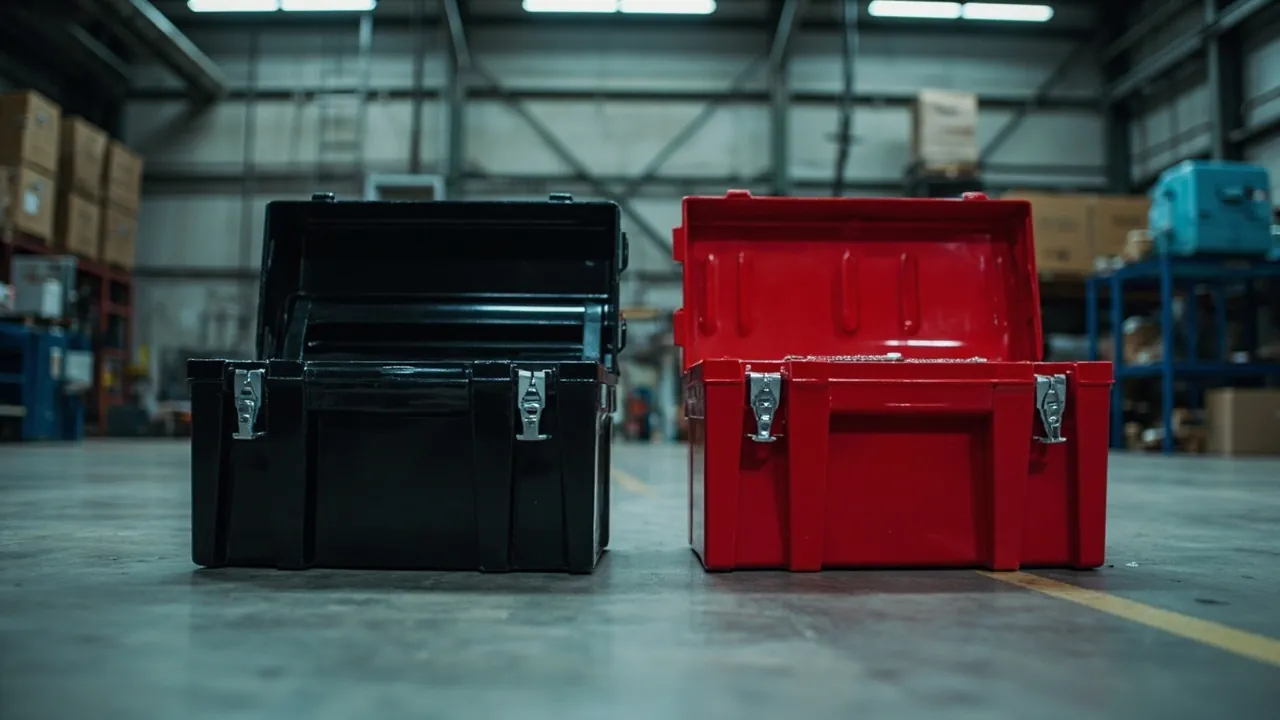
The key point first: the difference between an industrial toolbox and a household toolbox is not how much material goes into it. It is a difference in design assumptions. A household box is designed around occasional use, one person, light loads, a dry indoor shelf, and a simple rule that it gets replaced if it breaks. An industrial box is designed around daily use, multiple people, heavy or fully loaded conditions, a hostile environment, and a rule that failure means downtime, damaged tools and a safety incident. Once those assumptions are written into the design input, they propagate through load capacity, structural form, hinge life, sealing class and acceptance criteria, and they end up as a measurable gap. So the fastest way to tell whether a box is genuinely industrial is not to look at wall thickness or appearance. Ask three questions: what is its rated load, under what conditions was that load measured, and how does it fail when overloaded — does it deform, or does it break?
The most common misjudgement is equating thickness with strength. Load capacity has never been a function of wall thickness alone; it is the combined result of material, structural form, load path and jointing method. A box with generous wall thickness but a large unsupported base panel, no ribs, and a hinge held by two small screws can carry far less than a box with slightly thinner walls, a continuous rib pattern, a load-bearing base rim, and a hinge boss moulded integrally with the body. Industrial design is essentially about making load travel along a defined path to the ground or to the carrier's hand, instead of letting one panel carry it alone.
This article is written for procurement and equipment engineers specifying toolboxes in quantity for workshops, construction sites, vehicle fleets, maintenance operations and warehouses. It also serves as a technical reference for distributors and OEM/ODM customers. It runs along two tracks. The first is load: how load should be defined, how it should be verified, and what the acceptance criteria should say. The second is structure: wall and rib design, hinges and latches, handles and wheels, sealing and IP class, and material choice. After that comes a twelve-dimension comparison table, a decision path for when industrial specification is genuinely required, and eight FAQ entries. The practical goal is that you can take two product catalogues and work out, in a defensible way, which one is closer to the industrial end.
Contents
- The key point: two different sets of design assumptions
- Drawing the boundaries: household, professional and industrial
- Difference one: the three dimensions of load — static, stacking and point load
- How to verify load capacity, and how to write the criteria
- Difference two: structure — walls, ribs and load paths
- Difference three: hinges and latches — cycle life and retention
- Difference four: handles and wheels — human load and fatigue
- Difference five: ingress protection and sealing structure
- Difference six: materials and processes — PP, ABS, metal and composites
- Difference seven: environmental tolerance — temperature, UV and chemicals
- A twelve-dimension quantitative comparison
- Procurement decisions: when to specify industrial, and when household is enough
- Frequently asked questions
- Conclusion and related reading
The key point: two different sets of design assumptions
Put the two products side by side and you see a chain of differences: thickness, ribs, hinge size, gasket profile. But these are consequences. The cause is that the design input was different.
A household toolbox is typically designed against these assumptions: use a few times a month; loading dominated by hand tools, usually under 5 kg total; a single user, indoors or in a garage, at normal temperature and low humidity; short carrying distances on level ground or with a lift; a service life expectation of three to five years; failure consequences limited to inconvenience rather than safety; and a purchasing decision driven mainly by price and appearance.
An industrial toolbox is typically designed against these assumptions: use every shift or continuously; loading that includes power tools, hydraulic tools, spares and consumables, with total weight reaching 20 to 40 kg or more; multiple rotating users, possibly wearing gloves, possibly carrying while fatigued; an environment with dust, oil, washdown, vibration, ultraviolet light and temperatures from minus 20 to plus 60 degrees Celsius; carrying that includes stairs, vehicle loading and unpaved surfaces; a service life expectation of five to ten years or more with maintainability built in; failure consequences that include downtime, damaged tools and dropped loads causing injury; and a purchasing decision driven by whole-life cost, maintainability and documentation.
The engineering meaning of that gap has three layers.
Layer one: different load assumptions lead to different safety factors. A household product can be designed with a smaller margin on peak conditions because the probability of occasional overload is low. An industrial product must assume overload happens routinely, so it needs a higher margin above the rated value and, critically, a predictable failure mode — visible deformation first, not sudden fracture.
Layer two: maintainability is a hidden dividing line. Household products are replaced whole when they break, so there is no reason to design a replaceable hinge. Industrial products must allow hinges, latches, wheels and gaskets to be replaced, because scrapping a whole box costs far more than repairing it. The ability to supply spare parts and a repair route is itself a marker of the industrial category.
Layer three: documentation and traceability. A household product usually needs only appearance and basic function descriptions. An industrial product should supply load data, test reports, material grades, and where applicable verification documentation such as IP class evidence under IEC 60529 and GB/T 4208, or salt spray data under ISO 9227 and GB/T 10125. An industrial label without verifiable documents is just a label.
Drawing the boundaries: household, professional and industrial
The market tends to split products into household and industrial, but there is a real middle tier — professional — and understanding all three is more useful than forcing a binary choice.
Household. Aimed at home storage, DIY enthusiasts and light repair. Characteristics: light unit loading, predominantly single-wall construction, a moulded plastic living hinge, no sealing or only dust shielding, and no spare part supply. Sold mainly through retail and e-commerce.
Professional. Aimed at electricians, plumbers, carpenters and similar trades, plus light industrial use. Characteristics: key areas are reinforced — a thicker hinge boss or a moulded-in metal pin, a handle moulded integrally with the body, basic base reinforcement, metal components in the latch, and a degree of water and dust resistance. This tier offers the best value and covers a large share of real trade use.
Industrial. Aimed at heavy loads, frequent handling, hostile environments and long service life. Characteristics: whole-structure reinforcement and a systems approach — double-wall or ribbed construction, metal or composite hinge pins, a dedicated load-bearing structure such as a base rim, base frame or wheel frame, an explicit rated load with test data, replaceable spare parts, and mounting interfaces for vehicles or racking.
| Tier | Typical unit load | Frequency of use | Environment | Expected life | Spares and documents |
|---|---|---|---|---|---|
| --- | --- | --- | --- | --- | --- |
| Household | 3–8 kg | A few times a month | Indoor, dry | 3–5 years | Usually none |
| Professional | 8–20 kg | Several times a week to daily | Indoor and outdoor | 5–8 years | Partly available |
| Industrial | 20–40 kg and above | Every shift | Dust, damp, wide temperature range | 8–15 years | Spares plus test documents |
These tiers are not rigid walls. An electrician may carry only 12 kg, yet the frequency, handling intensity and environmental exposure are all close to industrial conditions, so the correct answer is upper-professional or light industrial. Conversely, a box used once a day in a workshop and never moved, even at 30 kg, does not need handling-strength design. What it needs is static and stacking capability. The first step in selection is always to define the usage profile, not to pick a product tier. This is the same logic set out in our article on the key features of a professional toolbox: define the duty, then match the structure, and only then compare price.
Difference one: the three dimensions of load — static, stacking and point load
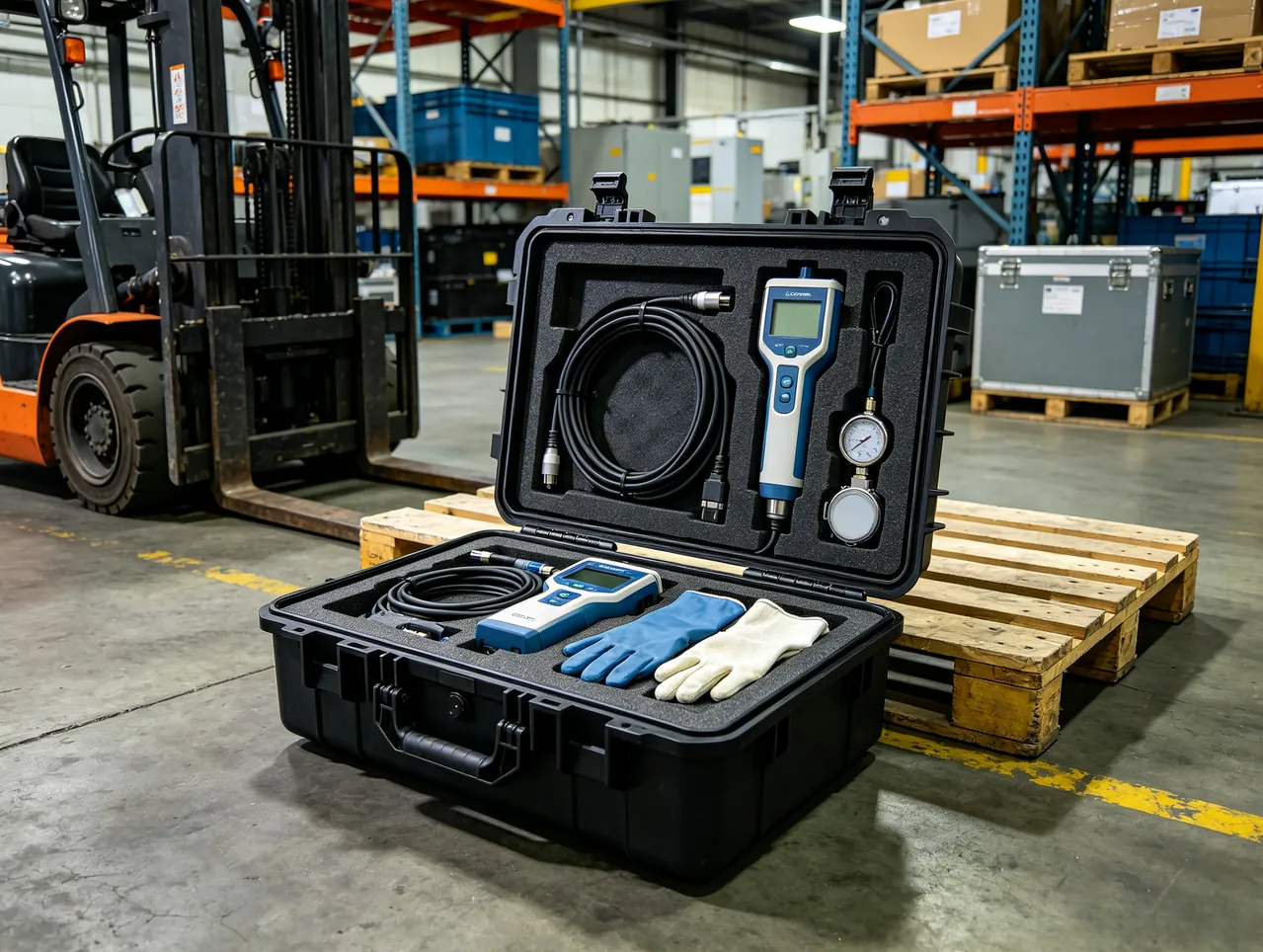
The biggest difference between industrial and household products on the question of "how much can it carry" is whether the definition is clear at all. Most household products state a suggested load with no test conditions. An industrial product should provide a verifiable definition. There are at least three separate dimensions, and they must be discussed separately.
Dimension one: static load. The rated value for internal load carried by the structure when the box is at rest. The critical variable is load distribution. A load spread evenly across the base is a completely different structural problem from the same mass concentrated in a small central area. A proper specification therefore reads "uniformly distributed load of X kg, concentrated load of Y kg acting over an area of Z square centimetres." A single number without distribution is incomplete.
Dimension two: stacking load. The ability of the lowest box to carry the weight of boxes above it. This matters far more in industrial settings than at home, because warehouses and vehicles inevitably stack. A stacking rating must include temperature and duration, because the long-term load capacity of plastics falls significantly at elevated temperature. The calculation approach is discussed in our article on stackable box design and stacking strength.
Dimension three: point load and local strength. The ability to resist a tool tip, a power tool base plate or a metal corner pressing into the base or a divider. This is the most overlooked and most consequential difference between tiers. The classic household failure mode is a tool tip punching through the base, or a heavy wrench leaving a permanent depression. Industrial design addresses it by thickening the load-bearing base, adding a metal or high-hardness wear plate, and moulding ribs into the underside.
| Load dimension | Definition | Typical industrial requirement | Typical household treatment |
|---|---|---|---|
| --- | --- | --- | --- |
| Static, distributed | Load spread across the base | Rated value plus temperature condition | "Suggested load" only |
| Static, concentrated | Load applied over a small area | Rated value plus contact area | Usually not provided |
| Stacking | Weight carried by the lowest box | Rating plus temperature and duration | Usually not provided |
| Impact | Structural tolerance to drop or collision | Drop verification following MIL-STD-810H principles | Usually visual inspection only |
A useful test at the sample stage: check whether the load figure comes with conditions. A number like "carries 30 kg" with no distribution, temperature, duration or criterion is probably measured in the most favourable way possible. A statement like "30 kg uniformly distributed, held for 24 hours at 40 degrees Celsius, residual deformation not exceeding X millimetres" is engineering. Only the second one is usable.
How to verify load capacity, and how to write the criteria
The other dividing line is whether anything is verified, and whether the acceptance criteria are actually written down. There is no single widely adopted international product standard for toolboxes. In practice the framework is a combination of customer technical agreement, internal company standard, and referenced general test methods. The following verification structure is workable.
Test one: static load test. Load the box to the rated value plus a safety factor, hold for a defined time at a defined temperature, then unload and measure residual deformation. The criteria must state three things: the maximum permitted residual deformation, whether the lid still opens and closes normally, and whether any permanent damage occurred in the structure or joints. A statement that a static test was passed, without a criterion, means nothing.
Test two: stacking test. Stack to the maximum permitted number of layers and load accordingly, conducted at both normal and elevated temperature. Criteria as above. The elevated condition is typically taken at 40 to 50 degrees Celsius, an experience-based figure that should follow the actual service environment.
Test three: drop test. Following the transport drop logic of MIL-STD-810H, with drop height, orientation and number of drops set by product weight and expected handling method, verify that after a drop in the loaded or agreed condition the body does not crack, the latch stays closed, and the contents do not shift. The requirement that the latch remains closed after a drop is a key industrial criterion, because a latch that springs open scatters tools, which is a safety event on a work platform or a staircase.
Test four: transport vibration and shock. For volume deliveries, transport simulation following the ISTA series or ASTM D4169 approach verifies integrity after palletised or cartoned shipment. This is used mainly on OEM/ODM export projects.
Test five: repeated opening and closing. Simulate hinge and latch life against a target cycle count derived from use frequency — for example 20 cycles a day over eight years, roughly 50,000 cycles as a representative estimate — and verify retention, play and latch function afterwards.
| Test | Purpose | Key criterion | Reference basis |
|---|---|---|---|
| --- | --- | --- | --- |
| Static load | Verify static capacity and stiffness | Residual deformation limit, lid operates normally | Customer agreement or company standard |
| Stacking | Verify lowest box under stack | No collapse or permanent set at elevated temperature | Customer agreement or company standard |
| Drop | Verify handling accidents | No cracking, latch stays closed | MIL-STD-810H principles |
| Transport vibration | Verify delivery integrity | No loosening, no load shift | ISTA series or ASTM D4169 principles |
| Repeated cycling | Verify hinge and latch life | Retention maintained, play within limit | Company standard |
Three specific procurement actions follow. First, require reports that contain test conditions, sample condition and criteria — all three. Second, for volume projects require a sampling plan, which can follow the counting sampling approach of GB/T 2828.1 with an agreed AQL. Third, write the overload failure mode into the contract: under overload the product should deform visibly before it fractures. Those three clauses in a technical agreement are worth more than any verbal assurance.
Difference two: structure — walls, ribs and load paths
This is the most visible and the most fundamental gap between the tiers.
Walls: single and double. Household boxes are usually single-wall mouldings with uniform thickness and limited stiffness; under load the wall bulges and distorts. Industrial boxes take one of two routes. The first is a thickened single wall with reinforcement in critical zones, which is simple to mould and cost-effective. The second is a double-wall or hollow construction, where the inner and outer skins form a closed cavity, giving markedly better stiffness and impact performance and providing an insulating layer as a bonus. The price of double-wall construction is mould complexity and added weight, so it is used where stiffness and protection both matter.
Ribs: position matters more than quantity. Ribs exist to channel load toward the walls and the base frame. Poorly placed ribs cause two problems. Sink marks appear on the visible face when a rib is too thick. And stress concentrations form at the sharp junction between rib and wall, becoming crack initiation points. Industrial design generally uses thinner ribs with generous root radii in a grid pattern, balancing stiffness against mouldability.
Load path: the load should have a defined route to the ground. This is the central engineering concept of the article. Picture a box carrying 30 kg sitting on a shelf or floor. The load travels from the contact point of the tools, through the base, into the walls or base frame, and into the supporting surface. If any segment of that route is an unsupported panel — a base with no support in the middle, or a wall connected to the base frame by a few clips — the load concentrates at those few connections and produces local overload. Industrial design typically moulds the base frame as a single piece extending into all four corners, moulds the wall and base frame together, and avoids relying on screws or clips to carry structural load.
Base rim and stacking interface. Industrial boxes usually include a load-bearing rim or a stepped base so that when stacked, the upper box's weight passes through its walls into the lower box's walls, rather than pressing on the centre of the lower lid. This connects directly to the stacking test criteria described earlier.
Tolerances and fit. Warpage control in large mouldings is difficult, and flatness and fit directly affect stacking stability and sealing. Industrial products set tighter tolerances on critical dimensions — base flatness, lid-to-body fit, latch mounting positions — and apply first-article plus in-process sampling inspection during production.
| Structural element | Typical household | Typical industrial | Direct benefit |
|---|---|---|---|
| --- | --- | --- | --- |
| Wall form | Uniform single wall | Thickened with ribs, or double wall | Resists bulging and impact |
| Ribbing | Minimal or none | Grid pattern with root radii | Higher stiffness, fewer cracks |
| Load path | Relies on local clips | Integral base frame, wall and base moulded together | Removes local overload |
| Stacking interface | Not specifically designed | Load-bearing rim or step | Upper load passes through walls |
| Tolerance control | Standard | Tightened on critical dimensions | Stable stacking, reliable sealing |
| Jointing | Screws and clips | Integral moulding plus replaceable parts | Maintainable, longer life |
A useful thirty-second field test: turn an empty box upside down and press the centre of the base with your palm. A properly structured box sinks slightly as a whole and springs back cleanly. A weak one gives a local soft spot, and you may even feel the internal clips shift relative to each other. That tells you more than a catalogue.
Difference three: hinges and latches — cycle life and retention
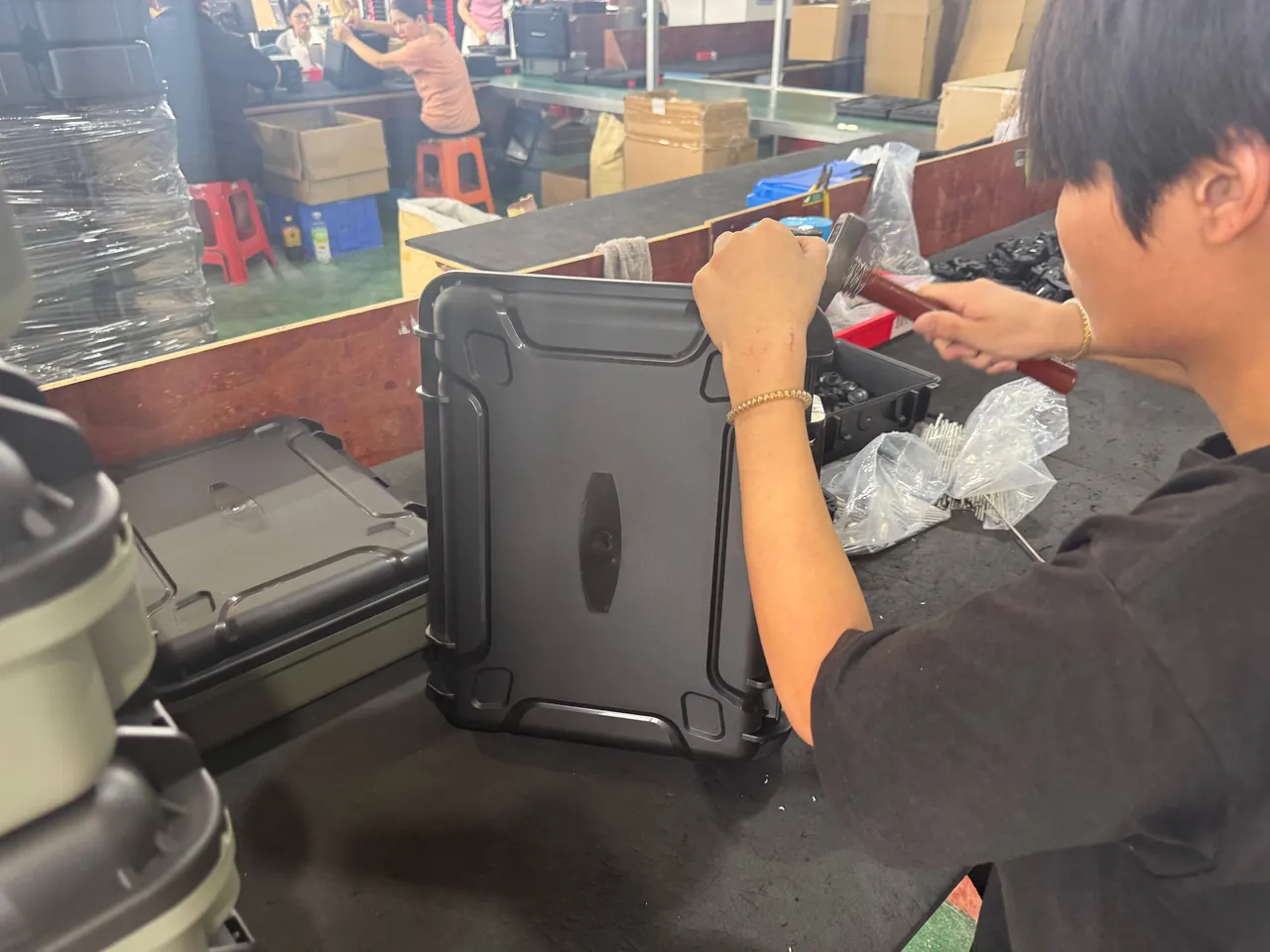
Hinges and latches carry the most complex loads on a toolbox and fail most often. Their construction is a strong indicator of tier.
The three hinge types, mapped to tier. The first is the moulded living hinge, which relies on the material flexing repeatedly. It is simple and cheapest, and common on household products. Its weakness is fatigue life, and it becomes brittle at low temperature, so repeated opening in cold conditions is a classic failure mode. The second is the pin hinge, in which a metal or engineering plastic pin passes through two hinge ears. The variables that matter are pin material, pin diameter, and how the ears are reinforced. Household products often use a small plastic pin. Industrial products typically use a metal pin in stainless or plated steel, thicker ears, and a boss moulded integrally with the body, often with ribs on the outside of the ears. Some designs make the pin removable, which enables hinge replacement. The third type is the multi-axis or detented hinge, which lets the lid hold position, useful in professional applications where the lid must stay open.
Three things to look at in a latch. First, retention force: the ability of a closed latch to resist accidental opening. This is one of the key drop-test criteria and one where the tiers differ noticeably. Industrial products usually state the closing and opening force range, avoiding the twin problems of a latch that is too stiff to open and one that opens by itself. Second, the over-centre and two-stage designs used industrially: an over-centre geometry that generates closing force once past the pivot, plus a secondary action such as requiring a simultaneous press and lift, which guards against accidental release. That design has real value for handling safety, because a box that springs open on a staircase is a genuine hazard. Third, replaceability: latches are wear items. Industrial products should offer spares and replacement instructions, and if the latch is removable via screws or clips, replacement cost is trivial. Household products are usually not serviceable, so a failed latch scraps the whole box.
How hinges interact with sealing. Hinge bosses often sit near the sealing line, and the way they are mounted affects how evenly the lid compresses the gasket. Good design ensures that closing the hinge neither over-compresses nor lifts the gasket locally. That coupling is discussed in our article on hinge and latch sealing design.
| Component | Household | Professional | Industrial |
|---|---|---|---|
| --- | --- | --- | --- |
| Hinge type | Moulded living hinge | Plastic pin with reinforced ears | Metal pin with integral boss |
| Replaceability | Usually not possible | Partly possible | Replaceable with spares |
| Latch type | Simple catch | Over-centre catch | Over-centre plus secondary lock |
| Retention data | Not provided | Partly provided | Closing and opening force range stated |
| Low-temperature behaviour | Prone to brittle fracture | Acceptable | Verified or material matched |
Difference four: handles and wheels — human load and fatigue
Load ultimately passes to the user through the handle and wheels, which makes these parts the real bottleneck of the system.
Three design points for handles. First, load versus ergonomics. The weight carried in one hand is generally advised not to exceed 20 to 25 kg as an experience-based figure that also depends on distance and posture. Above that, consider a two-handle arrangement, a shoulder strap or wheels. Industrial design tends to use a full-width or dual handle with a larger grip area and textured surface to reduce local pressure. Second, handle-to-body connection strength, which is the most common failure location. Low-end products use a handle held by two small screws. Industrial products mould the handle boss integrally with the body or embed a load-bearing metal insert. The test is simple: with the box loaded, lift it and bounce it gently, watching the handle boss for visible relative movement or stress whitening. Third, fatigue life. A handle sees alternating load every time the box is lifted, so industrial design considers a folding handle that stows and a stop at the fully upright position so the handle cannot flop backwards during a lift and cause a dropped load.
Wheels and telescopic handles. First, wheel diameter and material. Small wheels drag badly on rough ground, cables and thresholds and jam more easily. Industrial products use larger wheels, which markedly improves obstacle clearance, in abrasion-resistant polyurethane or nylon, running on bearings rather than plain sliding surfaces. Household products commonly use small moulded wheels without bearings, which wear and develop play. Second, wheel frame and load structure. Wheel load passes through the frame into the base, so how the frame is fixed determines whether the wheel can actually carry load. Industrial designs use a separate wheel frame with a thickened load zone and an internal reinforcing plate. Third, telescopic handle stiffness. A handle carries bending under full load, and insufficient stiffness shows up as wobble and rattle. Industrial products use multi-section metal tubes with guide sleeves and reinforcement where the handle meets the body. Fourth, compatibility with stacking, because a wheeled box is often the base unit of a stack, so its top interface and wheel-frame load path need to be designed together with the stacking scheme. The relationship is covered in our comparison of wheeled and non-wheeled toolboxes.
Difference five: ingress protection and sealing structure
The IP rating is the most quantifiable and the most loosely quoted item of the whole comparison.
Step one is separating dust protection from water protection. IP codes are defined by IEC 60529 and GB/T 4208, in the form IP followed by two digits. The first digit covers solid objects, from 0 to 6, and the second covers water, from 0 to 8. The common combinations read as follows.
| IP code | Dust meaning | Water meaning | Typical application |
|---|---|---|---|
| --- | --- | --- | --- |
| IP54 | Dust protected, limited ingress without affecting function | Protected against splashing water | Indoor, light outdoor |
| IP55 | Dust protected | Protected against water jets | Workshop, limited rain exposure |
| IP65 | Dust tight | Protected against water jets | Outdoor, washdown |
| IP67 | Dust tight | Temporary immersion, typically 1 m for 30 minutes | Harsh outdoor, crossing water |
Step two is the sealing implementation. There are three common routes. A solid rubber or silicone gasket compressed against the flange is low cost, replaceable and the mainstream choice. A foam gasket offers greater compression and tolerates tolerance variation, but may take a permanent set after long compression. Double sealing, using a primary gasket plus a secondary gasket or a labyrinth, is used for IP67 and above. Industrial products typically add a locating feature in the gasket groove so the gasket cannot shift through repeated cycling, a very low-cost detail that strongly affects long-term reliability.
Step three is the verification condition. IP67 immersion is a conditional claim with a defined time and depth, not permanent waterproofing. And an IP rating is a type test result for a single unit at normal temperature in a static state. When a box is compressed in a stack, cinched with a strap, or exposed to high or low temperature, real sealing performance can differ from the report. Where the application is critical, ask the supplier what evidence exists for protection in the intended service condition, not only a single-unit report. Field verification approaches are covered in our article on field testing an IP65 waterproof toolbox.
Step four is the other side of sealing: breathing and condensation. A fully sealed box breathes under day-night temperature swings, letting internal humidity accumulate and tools rust. Industrial solutions commonly use a waterproof breathable membrane such as expanded PTFE to equalise pressure while keeping water out, or recommend desiccant packs. That is a fundamentally different approach from the household assumption that keeping rain off is enough.
Difference six: materials and processes — PP, ABS, metal and composites
Material choice is a function of environment, load and cost, not a simple mapping to tier.
PP, polypropylene. Good toughness, excellent chemical resistance and very low water absorption, which makes it the most common toolbox body material. Its weaknesses are relatively low stiffness and surface hardness and high mould shrinkage, which places demands on structural and tooling design. It suits large bodies and chemical exposure.
ABS. Good stiffness, high surface hardness, good appearance and better dimensional stability than PP. Its weaknesses are moderate weather resistance and solvent resistance, with outdoor exposure causing ageing and discolouration. It is common in professional products where appearance and stiffness both matter. The trade-off between the two is essentially toughness and chemical resistance against stiffness and appearance, covered in our comparison of PP and ABS materials.
Engineering plastic alloys and glass-filled grades. Adding glass fibre to PP or ABS, or using a PC/ABS alloy, raises stiffness and dimensional stability significantly while controlling weight. This route is increasingly common in industrial and lightweight products. The cost is higher raw material price and, in some cases, reduced impact toughness, so it should be weighed against the application.
Metal. A steel body offers high strength and allows welded or riveted construction for very rigid structures, suiting heavy loads and fixed installations. An aluminium body is lighter and more corrosion resistant than steel, but lower in stiffness and hardness. The trade-offs across corrosion, weight, cost and appearance are set out in our comparison of metal and plastic toolboxes.
Composites. Resin systems reinforced with glass or carbon fibre offer a high stiffness-to-weight ratio, but at high cost and with complex processing, so they appear mainly in premium or specialist applications.
| Material | Stiffness | Toughness | Weathering | Chemical resistance | Cost | Typical use |
|---|---|---|---|---|---|---|
| --- | --- | --- | --- | --- | --- | --- |
| PP | Medium | High | Medium | Excellent | Low | Large bodies, chemical environments |
| ABS | High | Medium | Medium | Medium | Medium | Appearance-critical bodies |
| Glass-filled or alloy | High | Medium | Medium to high | Medium | Medium to high | Industrial, lightweight |
| Steel | Very high | Medium | Coating dependent | Medium | Medium | Heavy duty, fixed installations |
| Aluminium | Medium to high | Medium | Excellent | Medium | High | Portable heavy duty |
At the process level, industrial products tend to be more careful about wall thickness uniformity, rib root radii, the quality of embedded metal thread inserts, and the integrity of welded or bonded seals. Whether metal threaded inserts are used is a particularly practical tier indicator, because a body with inserts can be disassembled and reassembled repeatedly without the threads stripping. That is the material basis of maintainability.
Difference seven: environmental tolerance — temperature, UV and chemicals
The third dividing line is how well performance is retained under environmental stress.
Three temperature effects. Low temperature embrittles most plastics, reducing impact toughness; a living hinge cycled repeatedly in the cold is a classic failure mode. High temperature reduces modulus and, under sustained load, produces creep, which directly erodes stacking capacity and elevated-temperature load capability. Thermal expansion and contraction change fits on large bodies, potentially affecting sealing and latch engagement. Industrial design matches material and structure to the temperature range and verifies at both extremes.
UV ageing. Long-term outdoor exposure causes chalking, discolouration and loss of mechanical properties in plastics. Outdoor products should use UV-stabilised grades or inherently weather-resistant materials, verified against the ageing test logic of the ISO 4892 and GB/T 16422 series.
Chemical media. The engine oil, cutting fluid, hydraulic oil, cleaners and solvents found in workshops affect materials very differently. Industrial selection should be based on an explicit list of contact media, which then drives both the body material and the gasket compound, since some synthetic rubbers are unsuitable for particular oils.
Flammability. In enclosed workshops, vehicles and warehouses, material flammability has real significance. UL 94 is the common method for evaluating the burning behaviour of plastics, and industrial or sector-specific projects can specify against it.
| Environmental stress | Effect on plastics | Industrial response | Reference method |
|---|---|---|---|
| --- | --- | --- | --- |
| Low temperature | Lower impact toughness, brittle hinges | Material match plus structure avoiding thin-wall stress raisers | Low-temperature drop or cycling verification |
| High temperature | Lower modulus, long-term creep | Higher safety factor plus reinforced structure | Elevated-temperature stacking test |
| UV | Chalking, discolouration, embrittlement | Weather-resistant material or UV stabilisers | ISO 4892 or GB/T 16422 |
| Chemical media | Swelling, cracking, discolouration | Material selection after listing contact media | Immersion testing |
| Fire | Combustion risk | Flame-retardant material | UL 94 |
One practical suggestion that is often overlooked: supply an environment profile at the quotation stage — temperature range, humidity, indoor or outdoor, contact with oils or solvents, whether washdown occurs, and proximity to welding sparks. Only then can the supplier make a targeted material and structure recommendation. Without an environment profile, selection degenerates into buying the most expensive option to avoid risk, which is rarely the best answer.
A twelve-dimension quantitative comparison
| No. | Dimension | Household | Industrial | What to request |
|---|---|---|---|---|
| --- | --- | --- | --- | --- |
| 1 | Rated static load, distributed | 3–8 kg | 20–40 kg and above | Rating plus temperature condition |
| 2 | Concentrated load | Usually not stated | Stated with contact area | Defined contact area |
| 3 | Stacking capability | Usually not stated | Stated with temperature and duration | Stacking test criteria |
| 4 | Wall construction | Uniform single wall | Thickened with ribs, or double wall | Section drawing or description |
| 5 | Load path | Local clips | Integral base frame | Structure drawing or section |
| 6 | Hinge | Moulded living hinge | Metal pin, replaceable | Pin material and diameter |
| 7 | Latch | Simple catch | Over-centre plus secondary lock | Retention force range |
| 8 | Handle fixing | Screwed | Integral or embedded insert | Fixing method description |
| 9 | Wheels | Small, no bearings | Large with bearings, separate frame | Diameter, material, bearings |
| 10 | Sealing | Dust shield or none | Solid or double gasket with locating groove | IP class and reference standard |
| 11 | Environmental tolerance | Normal indoor | Wide temperature, weathering, chemicals | Temperature range and material grade |
| 12 | Spares and documents | Usually none | Spares plus test documents | Spare list and supply period |
Use it by filling in both candidates and treating missing entries as deductions. In practice, a product that fills ten or more rows is upper-professional or industrial. A product that fills only three or four is household in substance regardless of how substantial it looks, and should be priced and positioned accordingly.
Procurement decisions: when to specify industrial, and when household is enough
Selection should aim for fit, not for maximum capability. The following three-step path works well.
Step one: define the usage profile. Answer six questions: typical and peak total weight per box, number of moves per day, carrying distance and route including stairs, environment including indoor or outdoor, dust, water and oil, whether users are fixed or rotating, and what failure would cost in safety and downtime.
Step two: identify where the bottleneck sits. Different profiles have different bottlenecks.
- Heavy but almost never moved, such as a fixed workstation or warehouse rack: the bottleneck is static and stacking capability, so focus on base structure and the load-bearing rim. Top-tier hinges and wheels are unnecessary.
- Moderate weight moved frequently, such as maintenance inspection rounds: the bottleneck is the handle and wheels, so focus on connection strength, wheel diameter and handle stiffness.
- Hostile environment with modest load, such as damp outdoor or chemical plant use: the bottleneck is sealing and chemical or weather resistance, so focus on IP class, gasket compound and material selection.
- High cycle counts with high reliability demand, such as electrical distribution maintenance: the bottleneck is hinge and latch life and retention.
- Frequent issue and return, such as rental or shared tool programmes: the bottleneck is maintainability and spare part supply, so specify replaceable components.
Step three: write the bottleneck requirements into the technical agreement. This is the real difference between industrial and household purchasing. Industrial purchasing buys a verifiable capability; household purchasing buys a product.
A few practical rules. Do not over-specify for the sake of robustness, because the cost is weight, price and lost portability with little benefit. Do not save twenty percent by compromising on the bottleneck item either, because over the whole life of the toolbox the cost of downtime and damaged tools usually dwarfs the price difference of the box. Prefer suppliers who have data on the bottleneck item, because the data itself demonstrates engineering capability. And for volume projects, run a small trial first, in real conditions, for one to two months before releasing the order. In volume supply JUNZHJIA typically works through duty assessment, sample validation and volume delivery in sequence, advising on structure, liner and sealing combinations for the application, and supporting distribution, OEM/ODM and global supply.
Frequently asked questions
Q: Is an industrial toolbox simply thicker, heavier and more expensive? How do I tell quickly? A: No. Thicker and heavier are common consequences, not criteria, and thickness alone is easily misleading. Four verifiable angles give a quick answer. First, does the load figure come with conditions? An industrial product states the distributed load, the contact area for concentrated load, the temperature, the duration and the permitted residual deformation. A household product states a number, or nothing. Second, maintainability: can hinges, latches, wheels and gaskets be replaced individually, and are spares available? An industrial product must be repairable because scrapping a whole box is expensive; a household product is replaced whole, so it is often made non-serviceable. Third, how the critical joints are made: is the handle boss moulded integrally with the body, are metal threaded inserts embedded, is the base frame a single moulding that channels load into all four corners? Fourth, documentation: can the supplier provide material grades, the standard behind the IP claim such as IEC 60529 or GB/T 4208, salt spray data such as ISO 9227 or GB/T 10125, and load and drop test conditions with criteria? A very practical field test is to turn an empty box upside down and press the centre of the base with your palm. A properly structured box sinks slightly as a whole and springs back cleanly; a weak one gives a local soft spot and you may feel the internal clips shift. That is more reliable than any catalogue. In one sentence: industrial is a difference in design input, not in material quantity, and the criteria are verifiable and maintainable, not heavier.
Q: My toolbox carries about 25 kg but sits on a workstation and rarely moves. Do I need industrial specification? A: Not necessarily a handling-grade industrial box, but you do need a load-bearing-grade design, and these are two different directions of reinforcement that procurement often conflates. Your profile is heavy load with very low movement frequency. That means the bottleneck is not the handle or the wheels, which barely see load, but static load, point load and stacking. Selection should therefore focus on three things. First, base load structure: is there an integral base frame or ribbing, is there a load-bearing rim, and will a concentrated load such as a tool tip punch through or leave a permanent depression? Second, stacking capability: if anything will be stacked on top, confirm the long-term load capacity of the lower box at normal and elevated temperature, because plastic creep means a box that looks fine can sink over several months. Third, lid and latch stability: under sustained load, does the lid bow outward, and can the latch be forced open? Conversely, you should not pay a premium for top-tier hinge life or large bearings, because those capabilities will not be used. The right action is to tell the supplier that the box sits loaded at 25 kg, may have a load stacked above, and will operate within a stated temperature range, and to ask for a structural description and verification data against those three points. If the contents include spanners, drill bits or other sharp items, a liner with foam cut-outs or dividers is strongly recommended, because it converts point load into distributed load. That single step often affects base life more than thickening the body. Liner approaches are covered in our article on modular internal design for toolboxes.
Q: Are industrial toolboxes always more waterproof? Should I choose IP65 or IP67? A: Not necessarily. Ingress protection and product tier are independent axes and must be assessed separately. There are genuinely heavy-duty boxes without sealing and lightweight outdoor storage boxes rated to IP67, serving different needs. Selection should start from the environment, not from the tier. On the specific comparison, IP65 means dust tight plus protection against water jets, suiting outdoor rain, workshop washdown and dusty conditions. IP67 means dust tight plus protection against temporary immersion, typically one metre for thirty minutes subject to the standard and the manufacturer's declaration, suiting the possibility of a brief drop into water, crossing water, or long placement on a flooded floor. If the requirement is only rain, dust and occasional splashing, IP65 is sufficient and usually offers better cost and easier opening. Choose IP67 only where immersion or prolonged standing water is genuinely possible. Three cautions. First, an IP rating is a type test result for a single unit at normal temperature in a static state, and real sealing can differ when the box is compressed in a stack, cinched with a strap, or exposed to temperature extremes. Second, waterproof is not the same as moisture-proof: a fully sealed box breathes under temperature swings, and accumulated internal moisture causes tools to rust, which is why industrial solutions use breathable membranes or desiccant. Third, the gasket is a wear item and degrades with time, so replaceability tends to matter more to long-term performance than the headline rating. Request the IP class and the standard behind it, the sealing implementation, whether solid, foam or double, and the gasket compound and its replaceability. For a comparable scale check, see our article on IP54 versus IP65 ratings.
Q: Two boxes both claim 30 kg. One costs three times the other. Where does the difference go? A: Usually four places: how the load is defined, how the structure is realised, how deeply it was verified, and how maintainable it is. First, definition. The cheap version tends to say "suggested load 30 kg" with no distribution, temperature, duration or deformation limit. The professional version separates distributed and concentrated load, states the contact area, and gives a temperature condition and a residual deformation criterion. The same number can hide a real margin that is a third of the other. Second, structure, and this is where the money usually goes, in places you cannot see: whether the base frame is a single moulding channelling load into all four corners, whether the wall and base frame are moulded together, whether the ribs form a grid with generous root radii, whether the handle boss is integral, whether metal threaded inserts are embedded, and whether the hinge is a moulded living hinge or a metal pin in a reinforced boss. Each of those choices carries different tooling and material cost, and each corresponds to a different service life. Third, verification depth: whether static, stacking including elevated temperature, drop and repeated cycling tests were done, whether reports contain conditions, sample condition and criteria, and whether sampling inspection follows a scheme such as GB/T 2828.1 with an agreed AQL. Verified products necessarily carry verification cost. Fourth, maintainability: whether hinges, latches, wheels and gaskets can be replaced, and how long spares will be available. A practical way to put it is that the expensive box buys the ability to still be repairable in ten years, while the cheap box buys replacement of the whole unit. So the correct comparison is whole-life cost: unit price plus expected replacements times replacement cost plus downtime and tool losses from failure. Run that calculation and a three-times price difference usually stops being a question.
Q: For a workshop purchase, how do I state the requirements at the quotation stage so I do not end up with the wrong box? A: The most effective approach is to supply a duty and technical conditions sheet rather than just a quantity and a budget. Include the following. Load: typical and peak total weight per box, the type of contents and whether they include sharp or heavy items, and whether stacking is required and to how many layers. Handling: moves per day, distance, whether stairs or vehicles are involved, and whether users rotate. Environment: indoor or outdoor, temperature range including any heat source or cold store, humidity, dust, exposure to oils, solvents or washdown, and proximity to welding sparks. Protection: whether rain, water jets or brief immersion must be resisted, mapping to an IP class, and whether dust protection is needed. Life and maintainability: expected service life, whether spares and replaceable components are required, and whether numbering or colour coding is needed. Compliance and documentation: whether material grade certificates, test reports, flame retardancy requirements, or export compliance documents are needed. Hand that sheet to the supplier and the response can be a targeted structure, material and sealing proposal instead of a generic product. At the same time, put three items into the technical agreement: the acceptance metrics for the bottleneck, such as handle connection strength, elevated-temperature stacking criteria or latch retention; the failure mode under overload, which should be visible deformation before fracture; and the spare parts supply period. Finally, for volume projects, run a small trial batch in real conditions for one to two months before releasing the order. In volume projects JUNZHJIA typically works through duty assessment, sample validation and volume delivery in sequence, advising on structure, liner and sealing combinations based on the customer's usage profile.
Q: Can a household toolbox be upgraded for industrial use, for example with a liner or a metal hinge? A: Some improvements are practical, but it is important to separate what can be changed from what is structurally fixed. What can be improved: first, lining, since foam cut-outs or dividers convert point load into distributed load and markedly reduce the risk of a tool tip punching through the base, which is the highest-value change available; second, sealing, since a gasket of suitable section and hardness can be added to the flange if none exists, although it changes the closing resistance and may affect latch retention; third, wear items, since some products have removable latches, wheels and handles that can be replaced with stronger parts. What cannot be changed, or cannot be changed economically: first, the load path, because if the base centre is unsupported, the base frame is not a single moulding, or the wall connects to the base frame by clips, local overload cannot be engineered out with a liner and can only be managed by limiting individual item weight; second, the hinge structure, because a moulded living hinge cannot be converted into a metal pin hinge from the outside, and its low-temperature brittleness and fatigue limit are properties of the material; third, the material's environmental limits, because a non-weather-resistant material will not become wide-temperature weather resistant through coatings. The practical guidance is that if the situation is only somewhat heavier loading with infrequent movement, a liner and replacement of removable parts is worthwhile. If it involves frequent handling, a hostile environment or safety sensitivity such as stairs or working at height, structural shortcomings cannot be compensated and a product from the right tier should be chosen directly. A useful test is to add the upgrade cost to the original price: if that approaches the price of a professional product, buy the professional product instead, because it also comes with warranty, spares and verification data.
Q: For volume purchases, what sampling should I use, and what do I do when I find defects? A: Use a combination of full inspection on critical items and sampling on general items, with criteria and disposition agreed in the contract in advance. Critical items should be fully inspected or sampled at a high rate: lid-to-body fit and smoothness of opening, latch closure and retention, handle-to-body fixing security, and appearance defects such as cracks, obvious sink marks, flash and colour variation. General items can be sampled: dimensions, wall thickness, assembly gaps, liner fit and printing. The sampling plan can follow the counting approach of GB/T 2828.1 with three parameters defined: inspection level, AQL, and the classification of defects as critical, major or minor. The item most often mishandled is functional performance. Load capacity and IP rating usually cannot be reproduced in full at goods-in, so the correct approach is to require type test reports with conditions, sample condition and criteria, and to agree periodic re-testing or witnessed testing in the contract, rather than repeating the whole test on every delivery. When defects are found, first separate critical, major and minor. Anything touching safety, such as a handle detaching, a latch self-opening or a structural crack, should be rejected at batch level with a root cause analysis and corrective action required. Second, preserve evidence: photographs, video, batch numbers and sampling records. Third, require an 8D or equivalent problem analysis with defined corrective action and verification. Fourth, trace the issue back to the technical agreement: if the agreement never stated the criterion, the gap is shared and the clause should be added. One final point of experience: for volume projects, complete a first-article approval and a small trial run before releasing full production, so structural, assembly and usability issues surface early. That is far cheaper than reworking after volume delivery. In volume supply JUNZHJIA typically supports customers through sample approval and first-article inspection, submitting documents and inspection records as agreed in the technical protocol.
Q: How long does an industrial toolbox actually last, and how do I decide when to replace it? A: Expected life is typically in the range of eight to fifteen years as an experience-based figure depending on duty intensity, environment and maintenance, but the real trigger for replacement is not the calendar. It is whether key functions have deteriorated. Assess five dimensions, and treat any one of them as a reason to replace or overhaul. First, structural integrity: are there cracks, has the base sagged through creep, is the base frame or load-bearing rim distorted? Structural sag and cracking cannot be repaired and will continue to develop. Second, hinges and latches: is there noticeable play on opening, is the latch showing a tendency to self-open, has retention dropped noticeably? A self-opening latch is a safety event and must be addressed immediately in any handling or work-at-height application, and if hinges and latches are replaceable, replace them rather than scrapping the box. Third, sealing performance: is the gasket aged, cracked, permanently compressed or displaced, and is the flange distorted? If the box needs protection and the seal has failed, then dust and water protection is already gone. Fourth, load capacity: is there permanent deformation that does not recover after unloading, and has the base been punched through or dented? Permanent deformation means the structure has yielded and load capacity will continue to decline. Fifth, maintenance cost: add up the parts that need replacing, such as hinges, latches, wheels and gaskets, and if the total approaches or exceeds the price of a new box, replacement is the more economical route. A few practical habits help. Keep a record per box of use and repairs, so the replacement decision rests on evidence. Distinguish cosmetic ageing from functional deterioration, since surface dulling and slight discolouration are not reasons to replace. And shorten the inspection interval for safety-related items such as latches and handle fixings, for example quarterly, while structural items can be checked annually. Combined with the maintenance frequency table described earlier, this logic lets an industrial toolbox deliver the long service life it was bought for, instead of being scrapped in year three because of one replaceable small part.
Conclusion and related reading
To return to the question: what is the difference between an industrial toolbox and a household toolbox? The most concise answer is that the difference lies not in material quantity but in design assumptions, and it resolves into quantifiable load capacity and verifiable structural design. Load capacity must be defined across three separate dimensions — static, point and stacking — each with temperature, duration and residual deformation criteria attached. Structural design must ensure load travels along a path from base to base frame or walls to the supporting surface, without any segment relying on an unsupported panel or a local clip. Around those two themes, hinges and latches govern cycle life and handling safety, handles and wheels determine whether human load can be transferred reliably, sealing and material choice determine environmental tolerance, and maintainability and documentation determine whether that capability can be verified and sustained.
Five practical recommendations for procurement and equipment managers. First, write the usage profile before discussing tiers, because load, handling, environment and life are the four inputs that decide everything. Second, identify where the bottleneck sits — load, handling, protection, life or maintainability — and concentrate budget there instead of thickening everything. Third, put the acceptance metrics for the bottleneck into the technical agreement at the quotation stage, and state explicitly that the overload failure mode should be visible deformation before fracture. Fourth, require test reports with conditions, sample condition and criteria, plus a spare parts list, and treat maintainability as a hard requirement. Fifth, run a small trial batch before volume release. Choosing the right tier controls whole-life cost far better than choosing the most expensive product. For more on material and structural trade-offs, see our comparison of PP and ABS and of metal and plastic toolboxes; for verification methods on load and life, see toolbox durability and load testing. JUNZHJIA can advise on structure, material, liner and sealing combinations based on the customer's duty profile, and supports volume supply, distribution, OEM/ODM and global delivery.
Related reading