

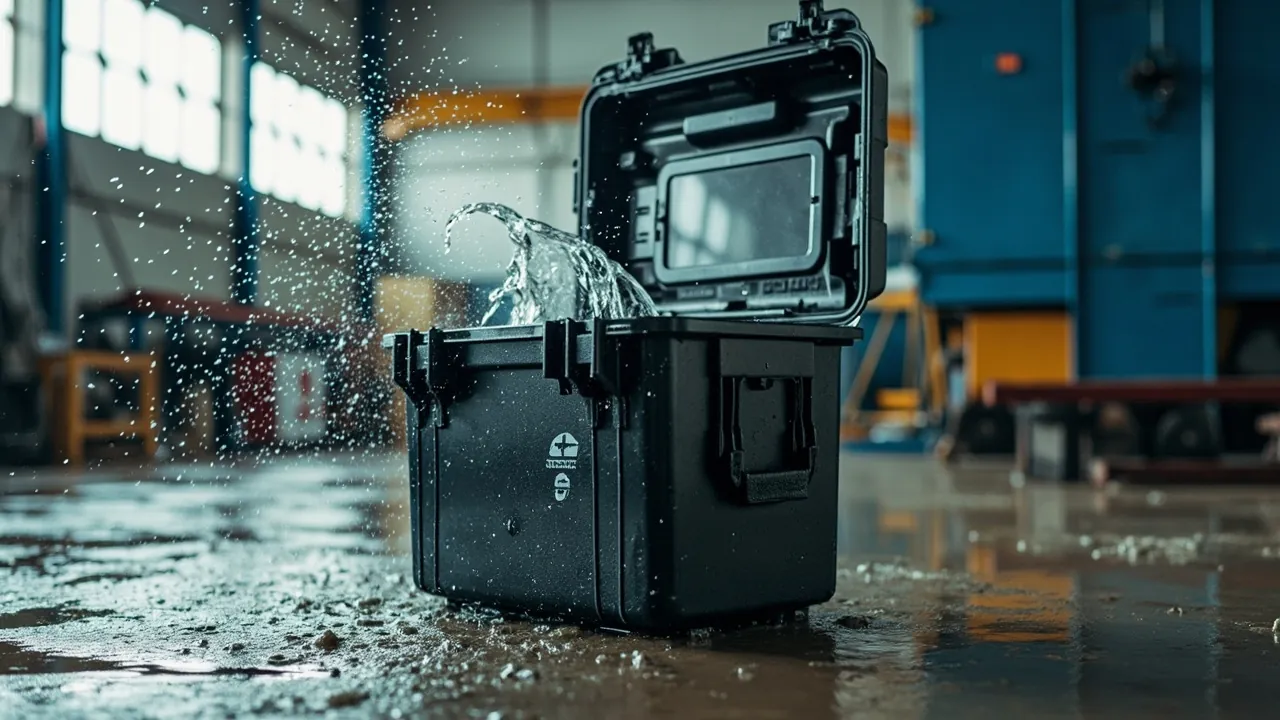
Short answer: yes, an IP65 toolbox resists water — but only water in the form of jets, not immersion. Under IEC 60529 (mirrored in China by GB/T 4208-2017, *Degrees of protection provided by enclosures (IP Code)*), the first digit 6 means dust-tight and the second digit 5 means the enclosure withstands water jets from any direction without harmful ingress. Drop that same case into a pond, or leave it overnight in a pickup bed holding three centimetres of standing water, and it will probably leak. That is not a defect; it is you leaving the tested envelope. What actually decides whether a toolbox keeps water out is not the two digits printed on the label but four things working together at once: the stated test method, the geometry of the sealing system, the age and condition of the materials, and how the box was closed and maintained on site. For B2B buyers equipping field crews, service fleets or instrument transport operations, learning to verify those four things is far more useful than arguing about the word "waterproof".
Two IP65 boxes that look nearly identical can differ several-fold in price, and the difference hides in four places a photograph never shows: whether the gasket is solid rubber or open-cell foam, whether the compression actually reaches its design window, whether the lid deflects more than a few tenths of a millimetre once the latches close, and whether penetrations such as handles, vents or cable glands were qualified to the same level as the shell. This article walks from standard interpretation to hands-on verification. It gives you a repeatable spray test you can run in a warehouse, a materials comparison table for sealing elements, a five-path failure analysis, a document checklist for purchasing, and a scenario-based grading table. Whether you are buying three hundred units for a maintenance contractor, specifying transport cases for calibration instruments, or developing an OEM/ODM program, the goal is the same: turn "waterproof" from an adjective into a clause you can inspect against.
Table of Contents
- Start with the conclusion: what IP65 covers and what it does not
- How to read the IP code: IEC 60529, GB/T 4208 and the common labelling traps
- IP65 versus IP66, IP67 and IP68: where the boundaries actually sit
- Why a box labelled IP65 still leaks: five recurring failure paths
- Designing a field test you can repeat in your own warehouse
- Reading the spray test: why latches, handles and corners fail first
- Choosing gasket material: EPDM, silicone and foamed PU compared
- Shell material and wall thickness: PP, ABS, PC and their effect on sealing
- Pressure equalisation: should there be a breather hole
- Latch count, clamping force and lid stiffness: why four beats two
- A procurement document checklist: what evidence to demand
- Scenario-based selection and cost trade-offs
- FAQ
- Closing remarks and related reading
Start with the conclusion: what IP65 covers and what it does not
To keep later discussion honest, IP65 should be read in three parts: what was tested, under what conditions, and against which acceptance criterion.
What was tested must be the complete enclosure as shipped — shell, lid, latches, hinges, gasket, handle, and any drain or breather element. If a model family has both a plain version and a version with a cable gland, vent or external bracket, the version with the feature needs its own test and its own report. A recurring problem in procurement is a supplier quoting the plain-body certificate to justify the modified configuration; that reasoning does not survive technical review.
Under what conditions is quantified precisely in IEC 60529 for the IPX5 test: a nozzle of 6.3 mm internal diameter delivering roughly 12.5 L/min from a specified distance (commonly stated as 2.5 m to 3 m) directed at all practicable angles, with a duration of not less than one minute per square metre of enclosure surface and a minimum of three minutes. This is closer to being hosed down with a pressure washer than to standing in a rainstorm. A case that genuinely passes IPX5 will survive ordinary storms. That is exactly why IP65 is accepted as the baseline for outdoor tool storage, vehicle-mounted kits and site instrument cases.
The acceptance criterion is "no harmful ingress", not "zero water molecules admitted". The standard permits minuscule amounts of moisture provided it does not accumulate, does not reach live parts or insulation, and does not create a tracking path. This distinction matters at goods-in inspection: a faint water line inside the flange is not automatically a rejection, whereas a droplet that can be poured off the seal face or a soaked foam insert is a clear failure.
So what does IP65 not cover? It does not cover sustained immersion. In IEC 60529 the IPX5 and IPX6 levels belong to the "jetting" family, while IPX7 addresses "temporary immersion" (conventionally expressed as 1 m for 30 minutes), and the standard explicitly notes that the various water levels do not form a simple ladder. Passing IPX7 does not automatically certify performance under the aggressive directed jets of IPX5 or IPX6. The practical rule for engineering: if your site has both driving rain and low-lying standing water, write IPX6 and IPX7 into the specification separately, rather than a single ambiguous "IP67".
How to read the IP code: IEC 60529, GB/T 4208 and the common labelling traps
IP stands for Ingress Protection, followed by two characteristic numerals and, where applicable, supplementary letters. IEC 60529 *Degrees of protection provided by enclosures (IP Code)* is the governing international document; the current consolidated edition is IEC 60529:1989 merged with AMD1:1999 and AMD2:2013. China publishes the corresponding national standard as GB/T 4208-2017, whose technical content broadly tracks the IEC text. Rotating machines have a parallel family (GB/T 4942), which is not normally relevant to toolboxes.
| Position | Digit | Meaning | Test essentials |
|---|---|---|---|
| --- | --- | --- | --- |
| First (solids) | 0–4 | Objects of decreasing diameter excluded | Rigid test probes or wires applied with specified force |
| First (solids) | 5 | Dust-protected, limited ingress | Talcum chamber; limited dust allowed if operation unaffected |
| First (solids) | 6 | Dust-tight | Same talcum chamber with zero visible ingress |
| Second (water) | 0–4 | Vertical drips through multi-directional splashing | Drip rig, oscillating tube or spray head |
| Second (water) | 5 | Water jets | 6.3 mm nozzle, defined distance and flow, all directions |
| Second (water) | 6 | Powerful water jets | 12.5 mm nozzle at substantially higher flow |
| Second (water) | 7 | Temporary immersion | Defined depth and time, conventionally 1 m / 30 min |
| Second (water) | 8 | Continuous immersion | Conditions agreed between maker and user, stricter than 7 |
Four traps show up in almost every tender review.
Treating X as "not applicable". IPX5 declares only the water level; nothing has been tested for dust. On construction sites, mines and unpaved access roads, dust is frequently the earlier failure mode — grit contaminates instruments, wears threads and jams latches, which in turn degrades the seal. Always require both digits written explicitly and refuse X.
Assuming bigger numbers mean broader coverage. As noted, water levels are not fully cumulative. A case relying on gentle low-pressure contact sealing can pass immersion and still struggle under directed high-pressure jets. Your question should be: what physical form does water take at my site?
Assuming one component's rating applies to the assembly. Gaskets age out first, and hinge pins, rivet holes and adhesive nameplates generally sit outside the IP definition altogether. System-level thinking is explored further in IP67 protective case design; treat single-part certificates as evidence about that part only.
Confusing IP with IK. The IK code (IEC 62262, nationally GB/T 20138) measures resistance to mechanical impact; it is independent of dust and water ingress. A very dust-tight case can shatter on impact, and a near-indestructible IK10 case can hold no water at all. Toolboxes need both dimensions specified, and failure to do so is one of the most common gaps in technical specifications we see.
IP65 versus IP66, IP67 and IP68: where the boundaries actually sit
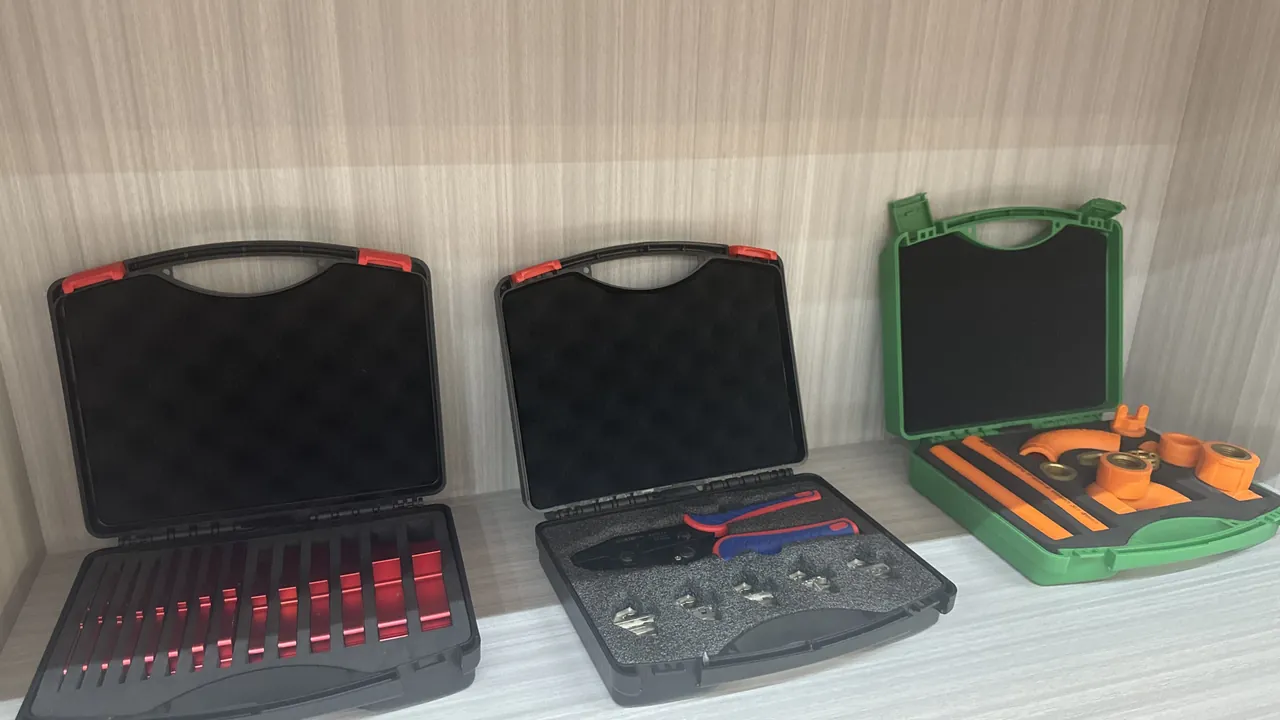
Most purchasing arguments stall on the question of IP65 versus IP67. The table below sets them against each other on four axes: test form, typical duty, relative cost impact and the failure mode most often observed in the field.
| Rating | Test form | Typical duty | Relative cost impact | Most common field failure |
|---|---|---|---|---|
| --- | --- | --- | --- | --- |
| IP54 | Splashing plus limited dust | Indoor workshops, dry stores | Baseline | Linings damp after unexpected rain |
| IP65 | Low-pressure jets plus dust-tight | General outdoor work, vehicles, daily site use | Baseline plus roughly 10–25% (typical) | Seepage after pressure washing or prolonged soaking rain |
| IP66 | Powerful jets plus dust-tight | Fleet vehicles washed often, decks, food plants | Baseline plus roughly 20–40% (typical) | Permanent gasket set after long compression |
| IP67 | Temporary immersion plus dust-tight | Risk of dropping in water, wading, flooded beds | Baseline plus roughly 30–60% (typical) | Mould in inserts because contents were wet and never dried |
| IP68 | Continuous immersion, conditions agreed | Submerged or semi-submerged equipment | Substantially higher | Unserviceable gasket ageing after the fact |
Two things stand out. Stepping from IP65 to IP67 usually costs less than buyers expect while moving you across a decisive boundary — from "withstands washing" to "survives being drowned briefly". Where cases ride in open pickup beds, off-road vehicles or flooding job sites, standing water is an immersion condition, not a jetting condition, so specify IP67 directly. Conversely, if cases normally live inside a closed van, a workshop or a dry store, IP65 is sufficient and the saved budget is better spent on better latches and thicker inserts.
Also note that an IP68 claim without stated parameters (depth, duration, water temperature) cannot be verified. IEC 60529 requires IPX8 conditions to be negotiated between manufacturer and user, so a credible document reads something like "IP68 (2 m / 60 min)" rather than a bare code.
Why a box labelled IP65 still leaks: five recurring failure paths
Field returns cluster into five mechanisms, and most are specification or maintenance problems rather than manufacturing faults.
One: foreign matter bridging the seal face. Site boxes meet swarf, sawdust, weld spatter and grit. Once a particle sits on the flange, even a fully closed latch leaves a capillary path. The relevance of dust control here is explained in more detail in what dust protection really means for toolboxes. Mitigation is procedural: wipe the flange before closing and clean the seal groove with a damp cloth at the end of each shift.
Two: latches not driven to the locked position. Most over-centre latches have a distinct half-engaged position that still develops some clamping force but nowhere near design compression. Train crews to listen for the click and look for the latch body sitting flush with the shell; include a one-card closure check inside every carton for bulk deliveries.
Three: permanent compression set in the gasket. Rubber held under sustained compression, especially hot, loses resilience. Once the recoverable compression falls below the value needed to fill surface irregularities — typically somewhere near sixty per cent of the original designed deflection as a rule of thumb — no amount of extra latch force restores the seal. This is the number-one cause of the "it stopped being waterproof after a year" complaint. Store cases unlatched or half-latched during long storage so the seal can relax, and latch fully only for transport.
Four: insufficient lid stiffness. Mid-span of the long edge deflects first. With only two latches and no reinforcing rib, combined loads from payload inertia, external water pressure and impact can open the parting line by fractions of a millimetre to a full millimetre. Field check: press the lid centre after closing and watch for movement or creaking. Reinforcement concepts are covered in high-strength enclosure structures.
Five: de-rated penetrations. Every added vent, gland or drilled hole pulls the assembly down to the weakest element's level. Treat any post-production opening as a revision of the original IP rating, with verification resting on whoever makes the change. In OEM/ODM programs this must be written into the contract explicitly, otherwise the supplier ends up defending a rating that no longer applies to the delivered configuration.
Designing a field test you can repeat in your own warehouse
Rather than debating labels, run a check. The procedure below needs nothing more than a hose and a patch of floor; it suits goods-in sampling and batch acceptance. Understand its status clearly: this is a screening test, not a substitute for third-party type testing, but it removes the majority of non-conforming units.
Step one, sampling. Draw at least three units at random from each batch (five when a batch exceeds roughly two hundred), in factory condition, with no supplementary sealing applied. Line the interior with dry white tissue or absorbent paper as an indicator, covering all four walls and the floor, and add a humidity indicator card where available.
Step two, conditioning. Before spraying, allow samples to stabilise at ambient temperature so that a cold box does not generate condensation and confuse the reading. When you want a harsher screen, hold units at around 40 °C for several hours, let them return to ambient, and then spray — this reproduces summer heat soak in a vehicle followed by rain.
Step three, spraying. Use a household garden sprayer or the widest fan setting of a pressure washer. A nozzle around 6.3 mm approximates the IPX5 condition reasonably well, although typical washer flow exceeds the standard value and therefore errs on the strict side. Hold roughly 2.5 m and spray each of the following zones for at least one minute: lid parting line, four corners, directly above the latches, handle roots, hinge side and the base, accumulating to no less than six minutes per square metre.
Step four, reading the result. Open the case and inspect for discoloured paper, running water traces or a tripped indicator card. Write the pass criterion onto the acceptance form: any visible moisture trace or any indicator colour change is a fail.
| Stage | Method summary | Pass criterion | Common source of misjudgement |
|---|---|---|---|
| --- | --- | --- | --- |
| Sampling | Random units, minimum three, factory condition | No shipping damage | Using previously opened samples |
| Conditioning | Ambient stabilisation, or heat soak then return | No condensation inside or out | Cold units sprayed immediately produce internal dew |
| Top surface spray | Fan spray for one minute or more | Underside of top remains dry | Run-off down a tilted face masks side leaks |
| Side and corner sweep | Rotate through four directions | Corner tissue unchanged | Corners are transition zones and leak first |
| Latch zone spray | Close-range aim at latch bodies | No trace beneath latch feet | Water enters through mounting holes, not the seal line |
| Short immersion (optional) | Full cover with water, thirty minutes | No ingress | Case not fully latched before immersion |
Step five, retest and records. Failed units should be dried, have their flange cleaned and be retested once, which separates assembly problems from design problems. Passing on retest points to transport or handling; failing again justifies rejecting the whole lot and requesting that lot's type test report and traceability records.
One caveat deserves emphasis: spray testing and immersion testing do not substitute for each other. If you need evidence of IP67 behaviour, run an immersion test separately; the principles are set out in how the IP67 rating is defined and tested. The spray procedure above addresses the IPX5 and IPX6 domain only.
Reading the spray test: why latches, handles and corners fail first
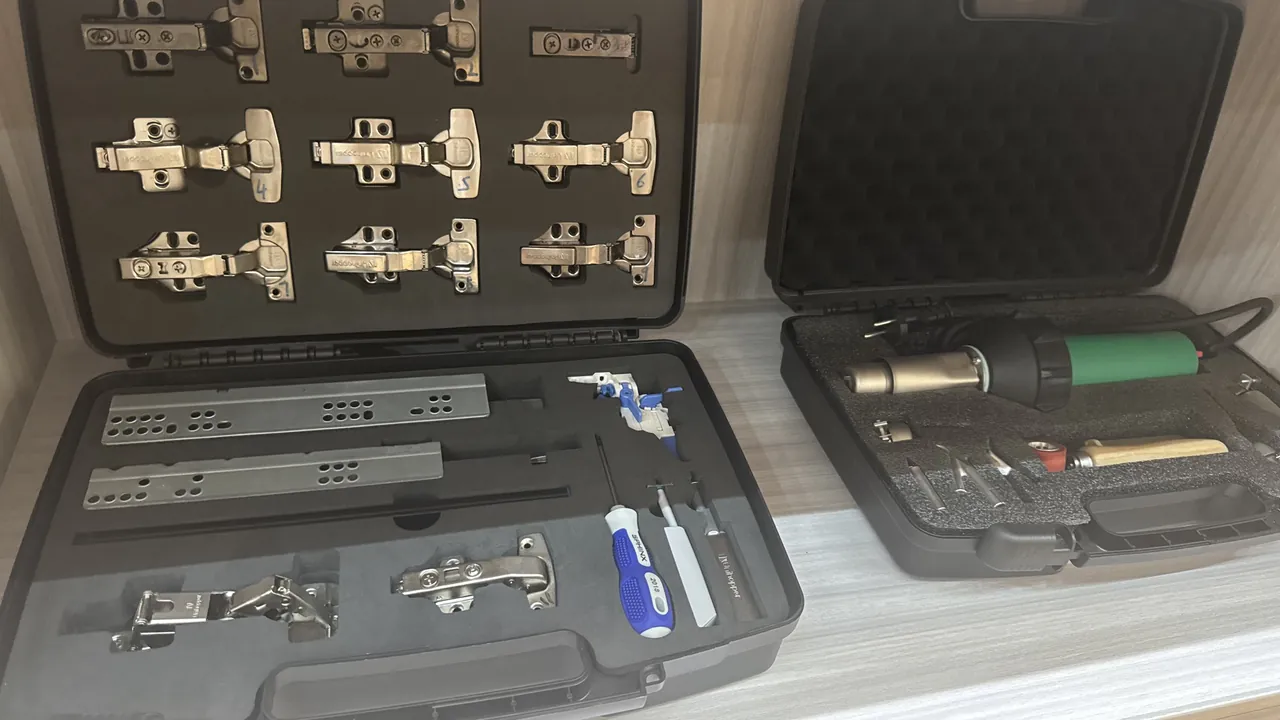
Run enough units and you notice that leaks are not randomly distributed. They concentrate at a handful of structural weak points, which is useful both when deciding where to aim during goods-in inspection and when reviewing a design before tooling.
Priority one: latch mounting faces. Latches are usually riveted or screwed to side walls, which creates through-holes in the shell. Even sealed rivets can develop micro-gaps after repeated side loading. To isolate this failure, remove the latch body after spraying and inspect the mounting face for a water line. If it recurs, ask the supplier for stainless rivets with sealing washers, or better, redesign so the latch boss sits on a raised boss rather than passing through thin wall.
Priority two: handle roots and pivots. Side handles and telescoping trolley frames attach at the most heavily loaded points, where repeated lifting causes fretting. There is a subtler effect too: lifting a loaded case by the handle lets gravity twist the lid relative to the base, shifting the parting line out of register. Test return units by filling them, carrying them, shaking them in the air, and only then spraying — static boxes hide this mode completely.
Priority three: the four corners. Seal path curvature is highest at corners, and corner regions are also where injection-moulded parts show uneven wall thickness and warp. Equally important, corners are classic locations for weld lines, where flow fronts meet; material density and strength there are lower than in the bulk, and micro-cracks can initiate over time. Large cases benefit from generous radii plus local thickening, and each corner deserves extra spray time at inspection.
Priority four: the hinge line. Full-length rod hinges require a through structure, and without end caps those cavities collect grit that jams the pin and pries the joint open. Run a finger along the hinge gap; any step should be visible immediately. If you want the deeper argument on hinging hardware, hinge, latch and seal construction covers the selection logic.
Priority five: drain and vent holes. Some designs add a bottom drain for wash-down convenience, which directly conflicts with dust protection — a hole cannot be dust-tight. Where it is unavoidable, fit a removable plug and state in the specification that the IP65 claim applies with the plug seated.
Finally, a warning: much "leakage" is actually condensation. Move a case from an air-conditioned room to humid outdoors in summer, or from freezing outdoors into a heated workshop in winter, and the inner surfaces will dew. That water beads, slides down the walls and pools in the base, and looks exactly like ingress. Distinguish them by pattern: leakage leaves a defined flow path concentrated on one side, whereas condensation produces uniform fine droplets across every internal surface. When in doubt, open the lid, ventilate for twenty-four hours and retest.
Choosing gasket material: EPDM, silicone and foamed PU compared
The seal is the heart of the system and the only functional part that certainly needs replacing. Pick wrong and good structural design is wasted.
| Material | Typical hardness (Shore A) | Compression set behaviour | Weather and ozone resistance | Service temperature band (typical) | Where it fits |
|---|---|---|---|---|---|
| --- | --- | --- | --- | --- | --- |
| EPDM | 50–70 | Good at ambient | Excellent, strong ozone resistance | -40 °C to +120 °C | Default choice for outdoor toolboxes |
| Silicone (VMQ) | 40–70 | Better than most rubbers at high temperature | Good, though tear strength is modest | -60 °C to +200 °C | Extreme temperature duties, food-grade needs |
| Chloroprene (CR) | 50–70 | Moderate | Moderate, better oil resistance than EPDM | -30 °C to +100 °C | Automotive workshops with heavy oil contact |
| Foamed PU (microcellular) | Soft, hardness not applicable | Collapses under long compression | Poor against UV | -20 °C to +80 °C | Low differential pressure light duties, not structural sealing |
| TPE / TPV co-extruded | 55–75 | Good | Good | -40 °C to +110 °C | Where co-extrusion with the body lowers assembly cost |
Three practical rules follow.
First, judge compression, not just compound. A widely used design window is 20 to 30 per cent cross-section deflection (typical value). Below it the seal cannot fill microscopic surface irregularity; above it, rebound force grows, the lid is pushed open, and permanent set accelerates. Ask suppliers what deflection they designed to; inability to answer usually means a copied tool.
Second, prefer solid sections. Foam is soft, cheap and conforms beautifully at low differential pressure, but closed cells collapse under repeated compression and powder under ultraviolet exposure. Toolboxes claiming a water rating should use solid extruded profiles, joined by vulcanised or mitred bonding — never a simple butt joint, which leaks almost every time.
Third, plan for replacement. Field teams rarely ship a case back to the factory, so the seal should be a tool-free push-in tongue-and-groove profile that someone can pull out and press in by hand. That decision belongs in the OEM specification, not after tooling. On custom programmes JUNZHJIA supplies each model with a serviceable gasket specification and the corresponding groove width and depth tolerance band, so maintenance teams can reorder by part number instead of guessing.
Shell material and wall thickness: PP, ABS, PC and their effect on sealing
Every discussion about sealing resolves into one question about the shell: how long will the dimensions stay put?
| Material | Weight | Ambient stiffness | Low-temperature behaviour | Weathering | Relevance to IP65 |
|---|---|---|---|---|---|
| --- | --- | --- | --- | --- | --- |
| PP | Lightest | Modest, prone to creep | Good with copolymer grades | Needs UV stabiliser | Large cases hold a flat seal face when walls are adequate |
| PP plus glass fibre | Light | Clearly improved | Good | Needs UV stabiliser | Suited to large lids needing high stiffness to limit deflection |
| ABS | Medium | Good, dimensionally stable | Watch for low-temperature brittleness | Fair, prone to yellowing | Common in small instrument cases; excellent seal face accuracy |
| PC | Medium-heavy | Excellent | Excellent | Usually needs a UV coating | Clear lids and high-strength duties at higher cost |
| PC/ABS blend | Medium | Good | Better than plain ABS | Fair | Balanced choice for OEM programmes |
Worth highlighting is the field contrast between ABS and PP. ABS gives higher stiffness and better moulding precision, which makes beautifully flat small-case seal faces; but its weathering and UV resistance trails properly stabilised PP, which is why material selection guides such as choosing plastics for protective cases put temperature and solar load first. For tropical islands, open yards and pickup beds that never see shade, UV-stabilised or glass-filled PP usually outlasts ABS; for indoor machine rooms, repair benches and underground parking, ABS's dimensional stability wins.
On wall thickness, a useful working rule: mean wall not below roughly 2.5 mm, with the sealing flange locally stepped to at least 1.2 times that value, so the flange does not collapse where the latch pulls it down. Thin shells often show a tell-tale dimple under each latch — hard to see, but it interrupts the continuity of the seal line.
One more dimension buyers overlook: flame behaviour. Where cases hold batteries, power tools or anything near ignition sources, request UL94 classification (V-2 and the stricter V-0 are the common grades) and glow-wire data from the IEC 60695-2 family, nationally GB/T 5169. Flame retardance does not conflict with sealing, but it does change the compound, so it must be raised during customisation rather than added later.
Pressure equalisation: should there be a breather hole
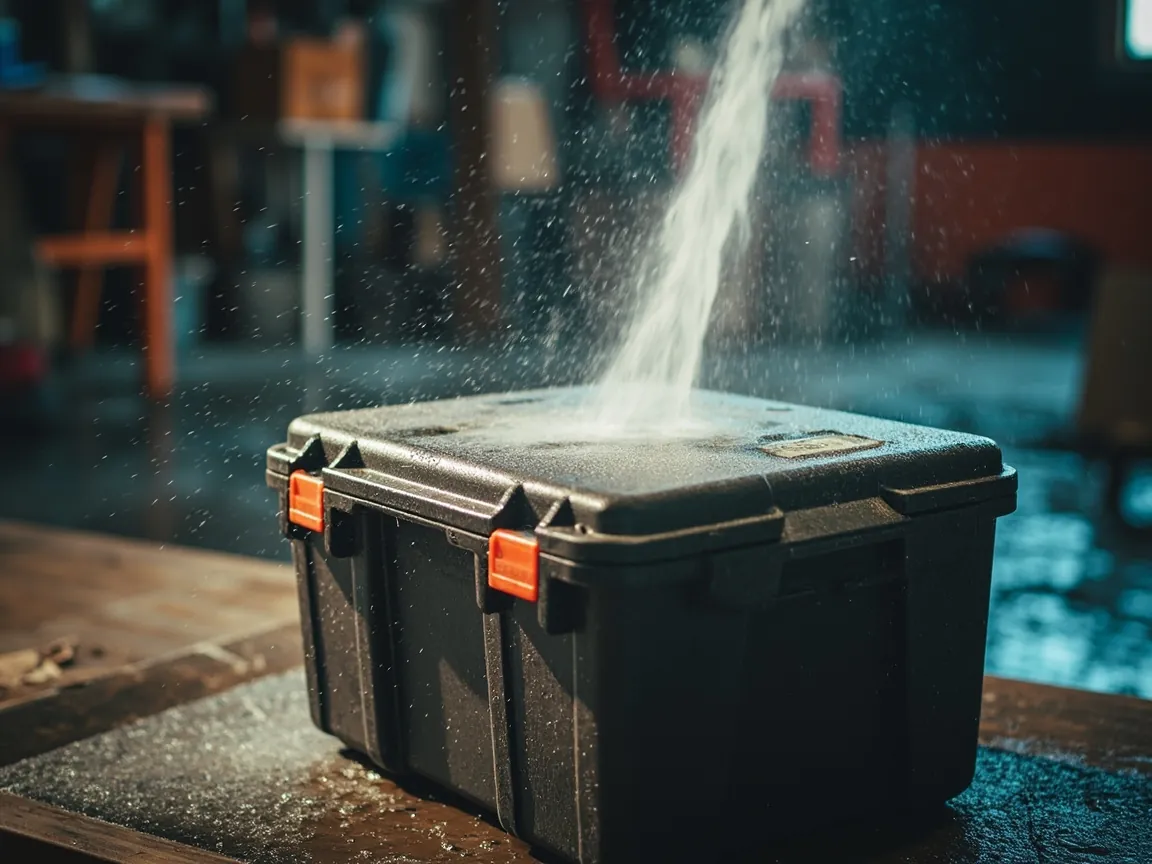
This is the classic compromise of case design. The better the seal, the harder it is to equalise pressure, and unresolved differential causes two real problems.
The first is obvious: cases become hard to open. After altitude changes or after moving from cold to warm air, internal pressure drops below ambient and atmospheric load pins the lid shut. Operators lever with tools and damage latches.
The second is less obvious but more damaging: negative-pressure water suction. A case that has been baking in a truck bed and then gets doused by a shower cools rapidly, internal pressure falls, and if any microscopic discontinuity exists in the seal, water is actively drawn in rather than merely seeping. This failure mode rarely appears in specification discussions and yet explains a great many mysterious wet boxes.
There are two ways forward.
Option one: a waterproof vent, sometimes called a breather or membrane vent. Inside is a microporous membrane whose pores pass gas but not liquid droplets, maintaining pressure equalisation while keeping the IP rating. Specify three things: airflow rate, which governs how quickly equalisation happens; the vent's own rating, which should be at least IPX7; and orientation and location, which should avoid direct jetting and any risk of being blocked by contents. Accept that the membrane is a service item — oil mist and fine dust clog it, and typical replacement planning runs one to two years depending on duty.
Option two: full sealing plus procedure. No vent at all, relying on trained operators to crack a corner first and relieve pressure gradually. This is the cheapest and simplest construction with no part to fail, but it depends entirely on discipline and it does nothing about negative-pressure suction. Notably, for cases that fly regularly or cross altitude frequently, full sealing may be mandatory, since sustained cabin-pressure differentials keep a vent permanently working and age it prematurely.
A one-line decision rule: short ground-level cycling in temperate conditions — fit a vent; air freight or long sealed storage — stay fully sealed. Where both apply, specify a threaded vent boss that takes either a membrane vent or a solid plug, swapped before loading. Further structural context is available in outdoor protective case waterproof design.
Latch count, clamping force and lid stiffness: why four beats two
Sealing is not about having some compression; it is about distributing compression evenly along the whole seal line. A simple beam model explains why latch count dominates.
Treat the lid as a beam, latches as supports and the gasket as a distributed elastic reaction. The force each latch must develop is roughly proportional to the length of seal line it shares multiplied by the force required per unit length. With only two latches, both cantilever ends are long, and four superimposed loads act there: lid self-weight recovery, payload inertia, external water pressure and impact shock. The ends open first. Ends are also where the seal path turns most sharply and is hardest to inspect, so the gap that forms is also the gap nobody notices until water has already found the shortest route in.
With four latches, one per corner, spacing halves. Since beam deflection scales with the fourth power of span, the mid-span opening drops to roughly one sixteenth of the two-latch value under equivalent load — a theoretical estimate, moderated in practice by ribs and material. That is the engineering basis for "four beats two", not marketing.
Translating this into purchasing rules by case length:
- Up to 400 mm: two latches plus an integral hinge-side structure usually suffice, provided the seal has effective land at both ends.
- 400 to 700 mm: specify at least three latches (two ends plus centre), or two latches with a full-length hinge and transverse lid ribs.
- Above 700 mm: four latches minimum, with explicit clamping or positive location on the hinge side so that side does not become the weak link.
- At any size where payload exceeds roughly 15 kg: add latches or move to metal latch bodies.
Also watch latch fatigue. After several thousand cycles nylon claws show stress whitening and can fracture; low-carbon steel bodies rust and seize. Prefer stainless steel pins with glass-filled nylon bodies, and ask for reciprocating cycle data, which commonly lands in the several-thousand to tens-of-thousands range as a typical value. The wider picture on hardware is developed in key features of professional toolboxes.
A procurement document checklist: what evidence to demand
Writing "IP65" into a contract is easy; making it verifiable takes effort. Put these deliverables into the technical agreement.
| Document | Key content required | Risk if missing |
|---|---|---|
| --- | --- | --- |
| Third-party type test report | Traceable report number, tested model identical to purchased model, standard cited as IEC 60529 or GB/T 4208-2017, test parameters included | Claimed rating cannot be evidenced |
| Internal outgoing inspection records | Sampling rate per lot, air-tightness or rain records, acceptance criteria | Lot-to-lot variation is untraceable |
| Gasket material certificate | Grade, hardness, service temperature, replaceability | No like-for-like replacement later |
| Safety and compliance files | UL94 class, RoHS and REACH conformity, glow-wire data where relevant | Export compliance and product safety exposure |
| Drawings and tolerances | Groove dimensions and tolerances, flange flatness, latch clamping specs | Custom parts become non-interchangeable |
| Change history | Declaration of any added hole or component | Rating invalidated with no record |
Before placing the order, ask these specific questions: what are the nominal groove width and depth plus tolerances? How is the seal joined at its ends? What flatness tolerance applies to the flange? What clamping force or compression displacement does each latch deliver? Suppliers who answer from drawings usually know their product; those who say only "ours never leak" usually have not measured.
One more point deserves attention: prototype-to-production consistency. It is common for carefully tuned prototypes to pass while production drifts through tool wear, resin lot variation or compressed cycle times. Reduce exposure by contracting goods-in sampling rules and whole-lot rejection terms, and by running the spray validation described earlier on first delivery. For long-running programmes JUNZHJIA recommends customers manage quality in three layers — type test, per-lot sampling, annual retest — rather than relying on a single certificate issued years ago.
Scenario-based selection and cost trade-offs
The final technical section converts the above into specification decisions.
| Duty | Dominant water form | Recommended rating | Key supporting requirements | Priority order |
|---|---|---|---|---|
| --- | --- | --- | --- | --- |
| Indoor bench or tool room | Occasional splash | IP54 is adequate | Organisation, load capacity | Organisation first |
| General construction site rotation | Rain plus dust | IP65 | Solid EPDM gasket, four latches | Protection above load, above weight |
| Open yard long-term storage | Sun, storms, diurnal swing | IP65 plus UV stabilised | UV-stabilised resin, breather vent | Weathering above sealing above structure |
| Pickup bed or off-road cargo | Washing plus bed ponding | IP67 | Solid gasket, drainage-aware layout | Immersion protection first |
| Marine, wading, monsoon regions | Spray plus brief submersion | IP66 and IP67 | Stainless hardware, EPDM or silicone | Corrosion, immersion, weathering |
| Instrument and metrology transport | Humidity, vibration, occasional rain | IP65 or IP67 plus damping inserts | Custom EVA or EPE inserts, humidity card | Damping above sealing above organisation |
| Air freight or altitude changes | Low pressure, no liquid exposure | IP65 plus sealed or plugged vent | Ergonomic handles, stacking strength | Pressure management above sealing |
One budgeting principle is worth memorising: spend the saving on maintainability. Rather than paying extra for an IP68 badge, make sure the gasket is replaceable, the resin is UV stabilised and the hardware is stainless. The reasoning is direct — IP68 assumes a gasket forever young, while real gaskets age every summer. A disciplined IP65 programme with scheduled seal replacement will generally outperform a neglected IP68 claim.
If you want the underlying comparison of cost structure and service intervals, waterproof versus ordinary toolboxes breaks it down further, and what the IP67 rating means explains where the immersion envelope ends.
FAQ
Q: Can an IP65 toolbox be left out in the rain all night? A: Usually yes, provided "rain" means rain and not standing water. The IPX5 test itself directs higher-intensity water at the case than almost any natural storm delivers, so a full night of rainfall rarely produces harmful ingress while water drains freely. Two risks remain. First, ponding: if the case sits on ground, a truck bed tray or any surface where water pools, the duty silently converts from jetting to immersion, outside IP65 territory, and you should specify IP67 instead. Second, directed persistent flow: a hose or runoff stream hitting the same seam for hours creates a wear effect that can breach an otherwise compliant seal. In practice, raise cases on a simple rack so the base clears accumulated water, and clean the seal face before the rainy season. In permanently wet regions with no maintenance regime, treat IP65 as the minimum rather than the target.
Q: Why does a box rated IP65 stop resisting water after about a year? A: The dominant mechanism is compression set plus contamination. Rubber held permanently compressed deforms irreversibly and loses rebound year on year; once recoverable deflection falls near sixty per cent of the original design value, even a fully closed latch cannot fill surface irregularities. Contamination runs a close second: grit, swarf and spatter sitting on the flange create capillary paths and abrade the seal surface every time the case opens. A third contributor is structural fatigue — lids, hinges and latches accumulate small plastic deformations from repeated handling and shock, so the seal line is no longer continuous. Finally there is ultraviolet ageing, especially on ABS, which chalks and micro-cracks at exposed edges. Useful countermeasures: store cases unlatched or half-latched rather than permanently clamped; clean grooves quarterly with water and wipe on a thin silicone-based film — never petroleum grease, which swells some compounds; inspect annually for visible indentation and cracking; and plan replacement inserts on a two-to-three-year cycle.
Q: How can I judge a case's water resistance quickly with no laboratory equipment? A: Run a three-step physical check. Step one, inspect the gasket: open the lid and confirm a solid cross-section, a continuous loop with no joint, and obvious rebound when pressed. Slow recovery of a fingernail indentation means it has aged. Step two, inspect the flange and closure: run a finger around the mouth looking for steps or flash, then close the lid and press each corner and the centre watching for visible movement. Step three, run a simple spray: using a garden sprayer or the fan setting of a car-wash gun, aim at the lid parting line, the four corners and above the latches for one minute each, with white tissue inside as an indicator. All three passing removes most structural defects from consideration. Be clear that this is screening, not certification — it cannot replace a third-party type test report, but for goods-in sampling and periodic checks it delivers excellent value per minute.
Q: IP65 or IP67, and how much does the upgrade cost? A: Decide based on whether the dominant water form at your site is jets or immersion. IP65 covers rain, wash-down and splash; IP67 covers deliberate short-term immersion, which is what actually happens in a flooded truck bed or a case dropped into shallow water. Moving from IP65 to IP67 typically adds somewhere in the thirty to sixty per cent band of cost (typical value, depending on whether the structure has to move to a double-seal arrangement), which is far short of doubling. Three recommendations follow. First, if the case can conceivably sit in water — even a puddle after a storm — specify IP67, because IP65 cannot prove itself under that condition. Second, remember that IP67 does not automatically include IPX6 strong-jet performance; where both occur, write both levels explicitly. Third, reserve part of the budget for replaceable seals and stainless hardware, which lowers whole-life cost far more effectively than chasing the highest code.
Q: Does adding wheels compromise the rating? A: Not automatically, but it needs separate attention. Wheel housings sit outside the enclosure and are not themselves part of the IP-tested shell; what matters is the fixing holes through the base. Wheel brackets bolted through the floor create potential paths, so they need sealing washers and thread-sealing compound, and that region should be spray-verified as its own zone. The next consideration is service conditions: wheels rolling through mud spray it around the bracket, so specify shrouded designs where possible. Third, add wheel-bracket torque to the periodic inspection list, because vibration loosens fasteners and a loosened gap destroys local sealing. Where wheels are retrofitted after purchase, insist the modifier takes responsibility for re-verifying the assembly. The wider trade-offs between rolling and static designs are discussed in wheeled versus conventional toolboxes.
Q: I put damp tools back in the case after rain and the foam insert grew mould. What should be done? A: This is the classic mistake of treating a waterproof case as a drying cabinet. IP65 keeps external water out, and by exactly the same mechanism it keeps internal humidity in. Sealed around wet tools, the interior becomes a high-humidity microclimate where tools rust, EVA foam moulds and spores spread onto every surface. Four controls apply. First, dry tools before stowing, ideally with compressed air, paying attention to ratchet heads and screwdriver shafts where water hides. Second, add desiccant management: small silica sachets replaced monthly, or a reusable drying box with a humidity indicator card. Third, where working patterns allow, leave the lid open for thirty minutes after every shift before locking up. Fourth, specify removable or quick-drying insert constructions rather than bonded-in-place linings; selection logic for insert materials is set out in choosing internal foam. Where instruments are humidity-sensitive, permanently mount a small temperature and humidity logger and read it at quarterly inspections as objective evidence.
Q: We added a cable gland for an OEM build. Is IP65 retained? A: Only if the added component matches the rating and the finished assembly is retested. Drilling an inevitably breaches whatever rating existed. To retain it, select cable entry hardware carrying its own IP rating — nylon or metal glands and sealed connectors rated at least as high as the target — and respect the gland datasheet on torque, cable outside diameter and sealing range. Once assembled, run type testing on the finished product rather than reusing the pre-modification report. Contracts should state that responsibility for re-verifying IP performance after any machining, drilling or component addition rests with whoever performs the modification. On custom programmes JUNZHJIA requires sign-off on the drilling layout, face treatment and gasket specification together, followed by a full spray verification on first articles before production release.
Q: How should the purchase contract be written so we do not receive a different box from the certified one? A: Lock together four things: model, photographs, report and sealed reference sample. Put these clauses in. One, a complete configuration description, including whether wheels, vents or panel cut-outs are present, plus colour and material detail, avoiding vague phrases such as "same series". Two, the report number itself, with wording along the lines of "type test report number X to IEC 60529 or GB/T 4208-2017, tested model identical to the delivered model". Three, a sealed-sample regime: send two units before first delivery, sign both, retain one each as the physical acceptance baseline. Four, a duty to notify change — any modification of tooling, resin grade, gasket supplier or hardware supplier requires advance written notice with re-verification data. Five, agreed goods-in sampling rules and whole-lot rejection terms, attaching the spray procedure above as an acceptance appendix. With those five, "waterproof" finally becomes an enforceable criterion rather than a claim.
Closing remarks and related reading
Returning to the opening question: are waterproof toolboxes genuinely waterproof? The honest answer is that a compliant IP65 toolbox has passed the jetting verification defined by IEC 60529 and GB/T 4208-2017, and is dependable in rain, wash-down and dust; it does not promise immersion, and it does not promise anything at all about its condition five years later. What governs long-term behaviour is gasket compound and management, latch and lid stiffness matched correctly, the rating consistency of every added component, and a maintenance system somebody actually follows.
Three recommendations for engineering and procurement teams. First, grade against the harshest water form actually present: standing water in a truck bed calls for IP67, driving rain for IP65, and both together should be written both ways. Second, inspect on arrival, using the spray method with tissue indicators, sampling a minimum of three units per lot. Third, manage the gasket as a consumable, with a defined replacement interval and part number, so that a good case never dies because of a tired rubber strip. On custom and volume supply programmes JUNZHJIA provides matched gaskets, vents and hardware per model and can help customers write these requirements directly into their technical agreements.
Related reading