

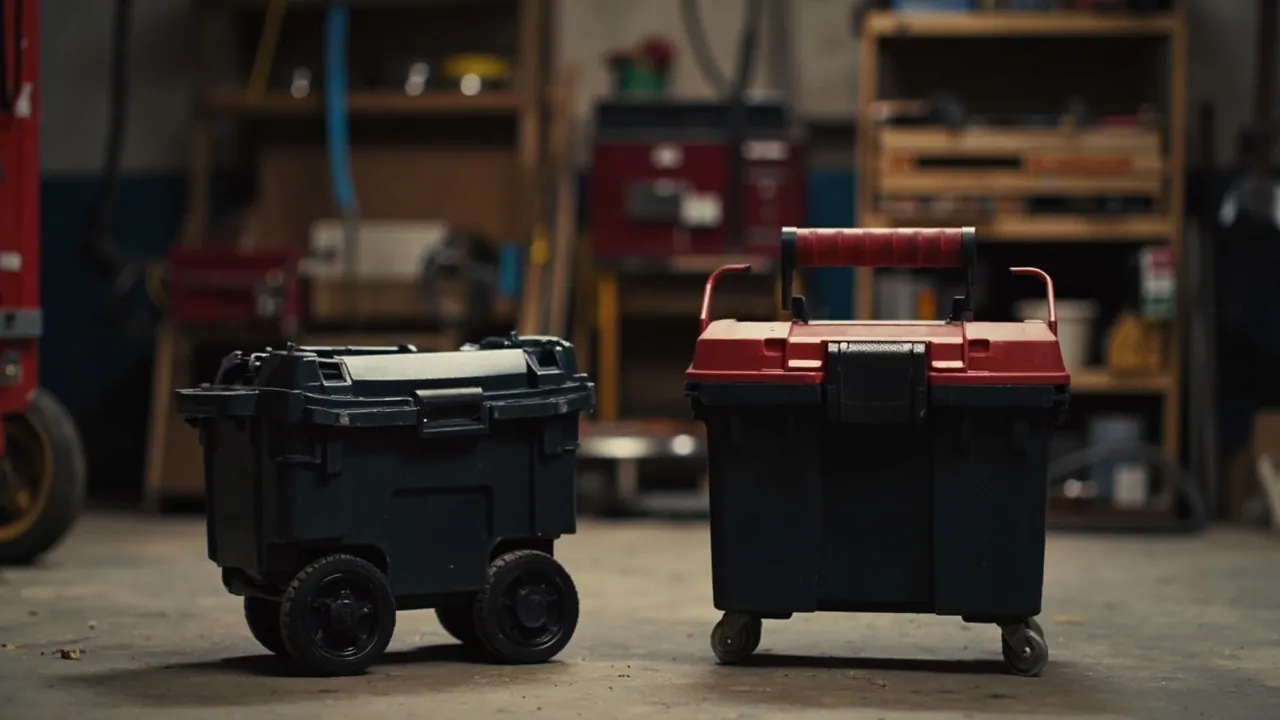
Direct answer: The core difference between a wheeled toolbox (rolling toolbox / trolley toolbox) and a standard hand-carried toolbox is whether the weight is transferred onto a wheel set on the ground. A standard toolbox is lifted, shouldered, or carried in the arms and suits bench-top work with loads under about 8 kg over short distances; a wheeled toolbox uses a telescopic handle plus wheels to put the weight on the ground and suits heavy loads of 10–30 kg that move between bays or floors. The difference shows up in six dimensions: moving method, load capacity and effort, internal structure, protection and sealing, price and cost, and applicable scenarios. One caveat: the wheeled design consumes some internal usable space and adds to empty weight, so it is not "better in every way" — chosen wrongly, it becomes a burden.
Table of Contents
- Conclusion First: When to Choose Wheeled, When Standard
- Moving Method and Effort Saved: The Most Fundamental Difference
- Load Capacity and Structural Differences
- Internal Space Utilisation and Layering
- Protection, Sealing, and Wheel Maintenance
- Price, Cost, and Whole-Life Accounting
- Scenario Selection Table
- Common Mistakes and How to Avoid Them
- Frequently Asked Questions (FAQ)
- Maintenance and Life Management of a Wheeled Toolbox
- Conclusion
- Materials, Wheels, and Load Capacity in Depth
- Size, Accessories, and Matching Advice
- Fault Self-Check and Matching the Ground Surface
- Combination Strategies in Real Scenarios
- Further Reading
Conclusion First: When to Choose Wheeled, When Standard
In one sentence: look at "carrying weight × carrying distance."
- If your tools weigh under 8 kg in total and you basically work within 5 metres of a fixed bench → choose a standard hand-carried toolbox or tool bag: light, flexible, low cost.
- If your tools weigh 10–15 kg or more and you move tens of metres every day between workshop, site, or building floors → choose a wheeled toolbox: it saves effort over the long run and reduces the risk of lower-back strain.
The two are not substitutes but complements: professional technicians often own both — "a standard box for the small high-frequency tools carried on the person, plus a wheeled box for the heavy main tools that move."
Moving Method and Effort Saved: The Most Fundamental Difference
Carrying a standard toolbox depends entirely on human effort:
- By hand: One or two hands on the grip; the weight falls on the arms and lower back.
- On the shoulder / across the body: Tool-bag style; both shoulders share the load, but it is still carried on the person.
- In the arms: Used for large boxes with no handle, and the worst option for the back.
A wheeled toolbox turns "lifting" into "towing":
- The telescopic handle extends the lever arm to the ground, and the wheel set carries the box weight.
- The user only has to overcome the rolling resistance of the wheels and a small steering force, so the effort saved is substantial.
- Swivel casters (which rotate 360°) or fixed wheels adapt to different surfaces.
Key point: how much effort is saved depends on the quality of the wheel set. Hard PU wheels are quiet and wear-resistant on concrete but can leave light marks on epoxy flooring; TPE soft-rubber wheels are gentler on floors but slightly less wear-resistant; on oily floors, choose treaded polyurethane wheels to avoid slipping. Ordinary rubber wheels slip very easily on oily surfaces, which is something warehouse safety inspections regularly flag.
Load Capacity and Structural Differences
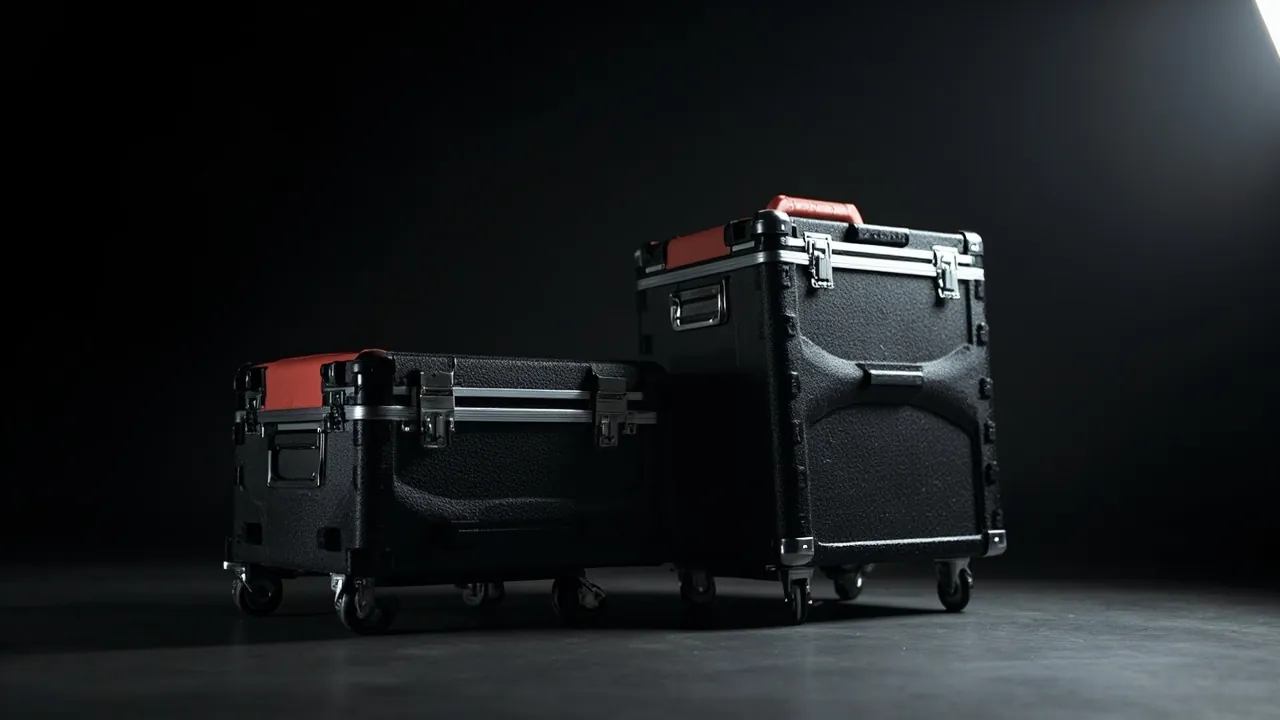
| Comparison dimension | Standard toolbox | Wheeled toolbox |
|---|---|---|
| --- | --- | --- |
| Typical empty weight | Light | Heavier (including wheels and handle) |
| Recommended load | Under about 8–10 kg | 10–50 kg (industrial grades higher) |
| Main case material | PP/ABS plastic, thin steel sheet, aluminium alloy | PP/ABS composite, thickened stainless, aluminium frame |
| Structural reinforcement | Handle-to-body connection points | Wheel mounts, handle rails, reinforced base |
| Stacking in storage | Average | Only stable with anti-slip bosses plus a top locating recess |
A standard box only needs enough strength for the handle not to pull off and the lid not to crack. A wheeled box must additionally keep the wheel mounts from loosening when pushed fully loaded, and the handle from deforming under repeated extension. Industrial buyers commonly ask the manufacturer to state the wheel-set load rating, the compressive strength of the case body, and hinge durability in open/close cycles as hard acceptance criteria.
Internal Space Utilisation and Layering
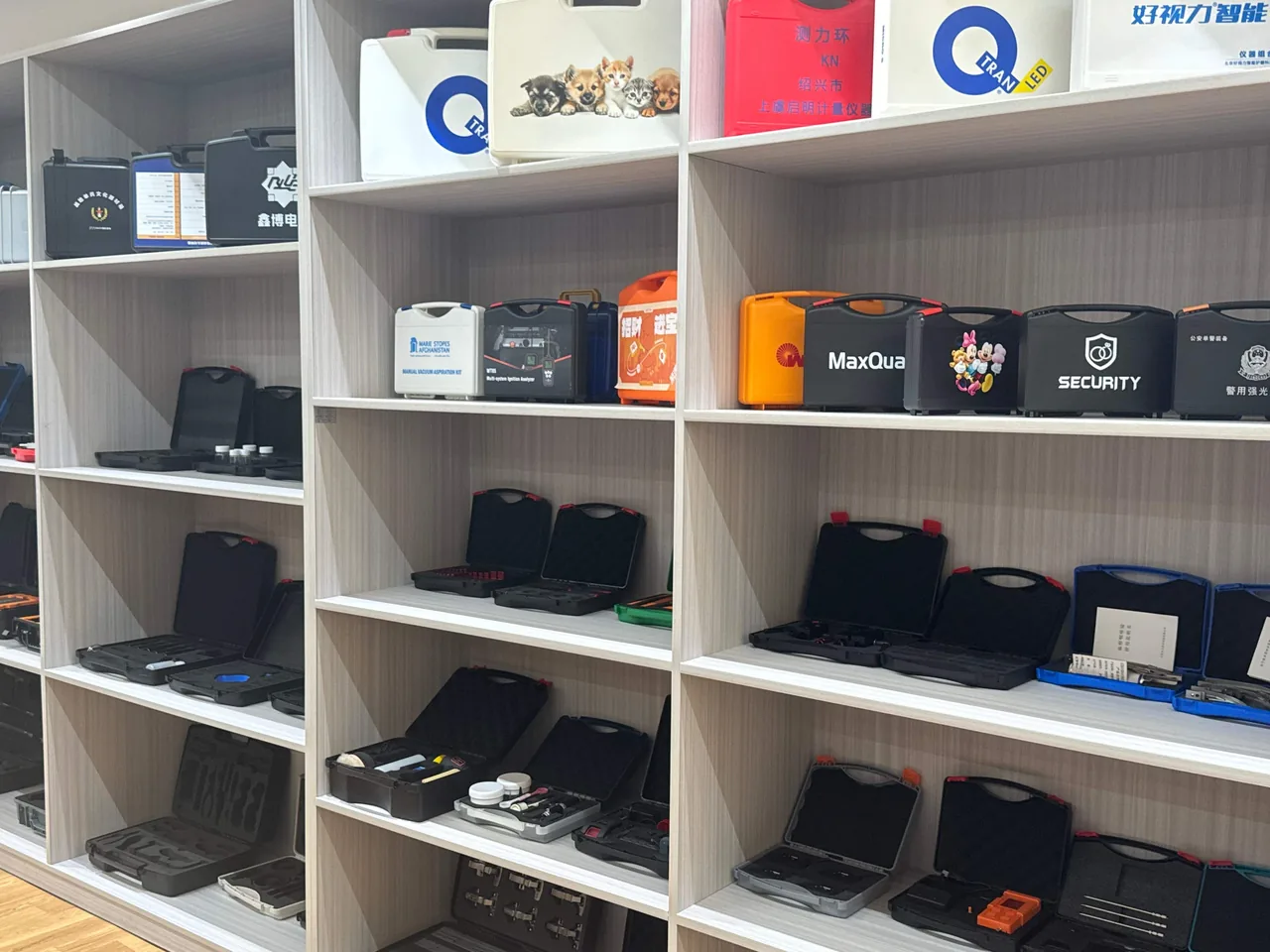
This is the "hidden difference" most easily overlooked:
- Standard box: The interior is mostly a single layer or simply divided; space utilisation is high (no wheels or handle rails taking volume), which suits fine sorting of a small number of tools.
- Wheeled box: The base and handle rails occupy a slice of internal volume, though the exact proportion varies by model and size; in exchange you get a layered system — commonly three to five adjustable compartments — so every tool has a defined place. Professional models can also be fitted with anti-static lining, a laptop/tablet bay, and a pressure equalisation valve.
The trade-off: if you have few but expensive tools (precision instruments, for example), the higher space utilisation of a standard box is the better deal; if you have many mixed tools (a full automotive set, for example), the efficiency gain from layering in a wheeled box far outweighs the loss of volume.
A divider board does not carry unlimited load: it tends to sag and deform beyond light loads, so pack on the principle of "light on top, heavy below, long items centred, pointed ends outward." That is a general storage principle, independent of box type.
Protection, Sealing, and Wheel Maintenance
Standard toolboxes are also available in waterproof and dustproof versions (an IP67 protective case, for instance), but they differ from wheeled models on "not opening while moving":
- Wheeled models usually come with press-type or three-point latches plus a padlock hole, which prevents accidental opening on a bumpy journey and can take a padlock or combination lock.
- High-end wheeled protective cases (such as the JUNZHJIA line from KeXin New Materials) can reach IP67 dust and water protection and are verified against environmental test methods in MIL-STD-810H (drop, vibration, temperature, and humidity). Their plastic shells (ABS/PP) have passed RoHS testing and comply with REACH and California Proposition 65, and are exported to the US, Germany, Japan, the Middle East, and other markets.
Maintenance difference: A standard box is almost maintenance-free. On a wheeled box, the swivel-caster bearings need a little lithium-based grease periodically — quarterly, for example — or accumulated dust will reduce how smoothly they turn. Prefer models whose wheel set can be replaced individually (a standard M6 interface), so a failure means buying a spare rather than returning the whole case.
Price, Cost, and Whole-Life Accounting
A wheeled toolbox usually carries a higher unit price than a standard box of the same material; the premium comes from the wheel set, handle, reinforced base, and more complex internal layering. But the decision should be made on whole-life cost:
- If a standard box is hand-carried overloaded for a long time, the handle breaks and the shell deforms, and it is scrapped early.
- A wheeled box uses higher standards in material, structure, and fittings, and a good one can last several times longer than an ordinary product.
- For professional users who move frequently, the physical effort saved and the tool retrieval time saved, converted into money, often exceed the price difference.
Price varies widely by material, capacity, wheel specification, and lining, so ask for a quotation against your actual configuration rather than comparing headline figures. Certification and compliance testing (RoHS, REACH) add to the unit cost but carry corresponding export compliance value.
Scenario Selection Table
| Use scenario | Recommended type | Reason |
|---|---|---|
| --- | --- | --- |
| Occasional household repair, light DIY | Standard hand-carried box (20–30 L) | Light, cheap, sufficient |
| Fixed bench-top work | Standard box / drawer-type tool cabinet | No movement needed; space utilisation first |
| Automotive dealership, moving between bays | Wheeled box (oil-resistant model) | Heavy tools, scattered bays |
| Rough ground on construction sites | Wheeled box (impact-resistant plus dust seal) | Heavy load plus difficult ground |
| Factory precision instrument transport | Wheeled protective case (EVA lining plus IP67) | Shock and moisture protection, compliance |
| On-site plumbing and electrical installation | Wheeled box (insulated bays plus waterproof labels) | Mobility plus professional zoning |
| Photography / drone location work | Wheeled box (cuttable foam lining) | Heavy gear needing protection |
| Pure bench-top electronics soldering | Standard anti-static box | Light tools, fixed work |
Common Mistakes and How to Avoid Them
- Mistake: more wheels means more stable. Four wheels are already balanced; a fifth adds redundancy and another failure point. Focus on wheel material and bearings.
- Mistake: wheels suit every surface. Match the wheel to the floor: PU or hard wheels for concrete, TPE soft-rubber for epoxy flooring, treaded polyurethane for oil.
- Mistake: wheels mean maintenance-free. Bearings need periodic lubrication, and the wheel set should be replaceable on its own.
- Mistake: judging by shell thickness and wheel count while skipping the loaded push test. Push the empty case in a small circle on site and feel the steering damping.
- Mistake: parking a braked model on a slope for a long time. The brake is only an aid to positioning; it does not replace a wedge chock.
- Mistake: assuming all toolboxes can be stacked. Stacking requires anti-slip feet plus a top locating recess, and should follow the applicable warehouse stacking requirements, or there is a tipping risk.
Purchasing checklist: (1) identify the ground type you work on most often and confirm the wheel material; (2) check the largest dimension of your common tools against the deepest internal compartment and leave at least 2 cm of margin; (3) check whether the side zip or latch rails have dust protection; (4) confirm the wheel set uses a standard interface and can be replaced individually; (5) do not pay a premium for non-essential features such as "all-metal wheels."
Frequently Asked Questions (FAQ)
Q: How much more can a wheeled toolbox hold than a standard one? A: Wheeled boxes are usually larger in volume (large models of 50 L and above are common), but the wheels and handle occupy a slice of the interior. Net usable space depends on the specific model, so you cannot simply say "twice as much." Shop on internal net dimensions rather than external ones.
Q: Can I add wheels to a standard toolbox later? A: Some models have M6 threaded holes or conversion interfaces reserved, so standard wheel sets can be fitted. But a standard box without a reinforced base will loosen at the wheel mounts, and is not suitable for heavy loads. Choosing the right type from the start is safer.
Q: Can the wheels on a wheeled toolbox be replaced? A: Models with a standardised axle interface (M6, for example) accept compatible replacement wheel sets bought separately; match the bearing specification to the original or the wheel may turn eccentrically. Confirm individual replaceability when buying.
Q: What is the difference between a plumber's/electrician's toolbox and a standard one? A: The core difference is zoning logic. Plumbing and electrical models strengthen the insulated-tool bay, cable winding posts, and waterproof label slots; standard models focus on generic compartments and lack cavities shaped for pipe wrenches, test pens, and similar specialised tools. A wheeled model adds mobility on top of that zoning.
Q: Which material suits a wheeled toolbox better? A: Plastic (PP/ABS) is lighter and rust-free and suits most scenarios, with high-end plastic now approaching metal in strength; metal (thickened stainless, aluminium alloy) is tougher and more impact-resistant but heavier, suiting extreme environments. Decide by the pain point of your industry.
Q: Is a wheeled toolbox harder to carry up stairs? A: Yes, on stairs and escalators the wheels are a hindrance. Many cases include strap attachment points so you can switch to shoulder carrying across floors for short distances; when going downhill, stand behind the case and hold the handle to control the speed.
Q: How do I stop a wheeled box rolling away on a slope? A: Use the brake only for brief positioning and add a wedge chock for anything longer. Never rely on the brake alone on a slope, and avoid leaving a loaded case parked on an incline.
Maintenance and Life Management of a Wheeled Toolbox
A wheeled toolbox is not a buy-once-and-forget item; its service life depends heavily on maintenance habits. Many complaints of "the wheels seized within six months" turn out to be missing maintenance rather than a product defect.
The wheel set is the main focus. Swivel-caster bearings gradually silt up in dust and muddy water, reducing how smoothly they turn; apply a little lithium-based grease at regular intervals. If one wheel hangs in the air or turns eccentrically, first check whether the axle is loose; most standard-interface (M6) wheel sets can be bought and replaced individually rather than returning the whole case. Before first use, also do a "wheel preload check": press the four corners lightly to confirm all wheels touch the ground together, and if one is off the ground, adjust the levelling screw at the base to calibrate it, so one wheel is not left carrying the load and wearing its axle prematurely.
The handle and latches also need attention. A two-section telescopic handle should lock firmly and extend smoothly without wobble. Before every trip, confirm the latches are fully closed and you hear the click; on models with a padlock hole, add a padlock against accidental opening. If a latch tongue sticks, clean it with a neutral cleaner and never with corrosive solvents, which would damage the surface coating or the gasket.
Caring for the case itself is relatively simple: store it somewhere dry and ventilated, avoiding prolonged sun or high temperature that ages the material; clean with a soft cloth and a neutral cleaner, avoiding corrosive chemicals; check the elasticity of the lid gasket periodically and replace it when it hardens; and if the case will not be used for a long time, leave the lid half open so the gasket does not stick.
Loading also affects service life. Follow "light on top, heavy below, long items centred, pointed ends outward," and do not overload a single divider board. Keep heavy tools near the centre of the case, since an unbalanced load puts extra strain on hinges and wheel mounts. Never exceed the stated maximum load of the case: overloading is the most common cause of wheel mounts pulling loose and shells deforming.
From a whole-life cost view, a well-maintained wheeled box lasts for years, and its cost per year is often lower than repeatedly replacing cheap standard boxes. Making "lubricate the wheels, check the latches, load sensibly" a habit earns back the extra purchase price several times over in life and efficiency.
Conclusion
The difference between a wheeled and a standard toolbox is essentially trading "a slice of internal space plus a higher unit price" for "effort saved, order, and protection when moving heavy loads." There is only one test: has carrying weight × carrying distance reached the threshold at which professional tools must be moved? Below the threshold, a standard box is more economical and flexible; at or above it, a wheeled box directly raises efficiency and protects occupational health.
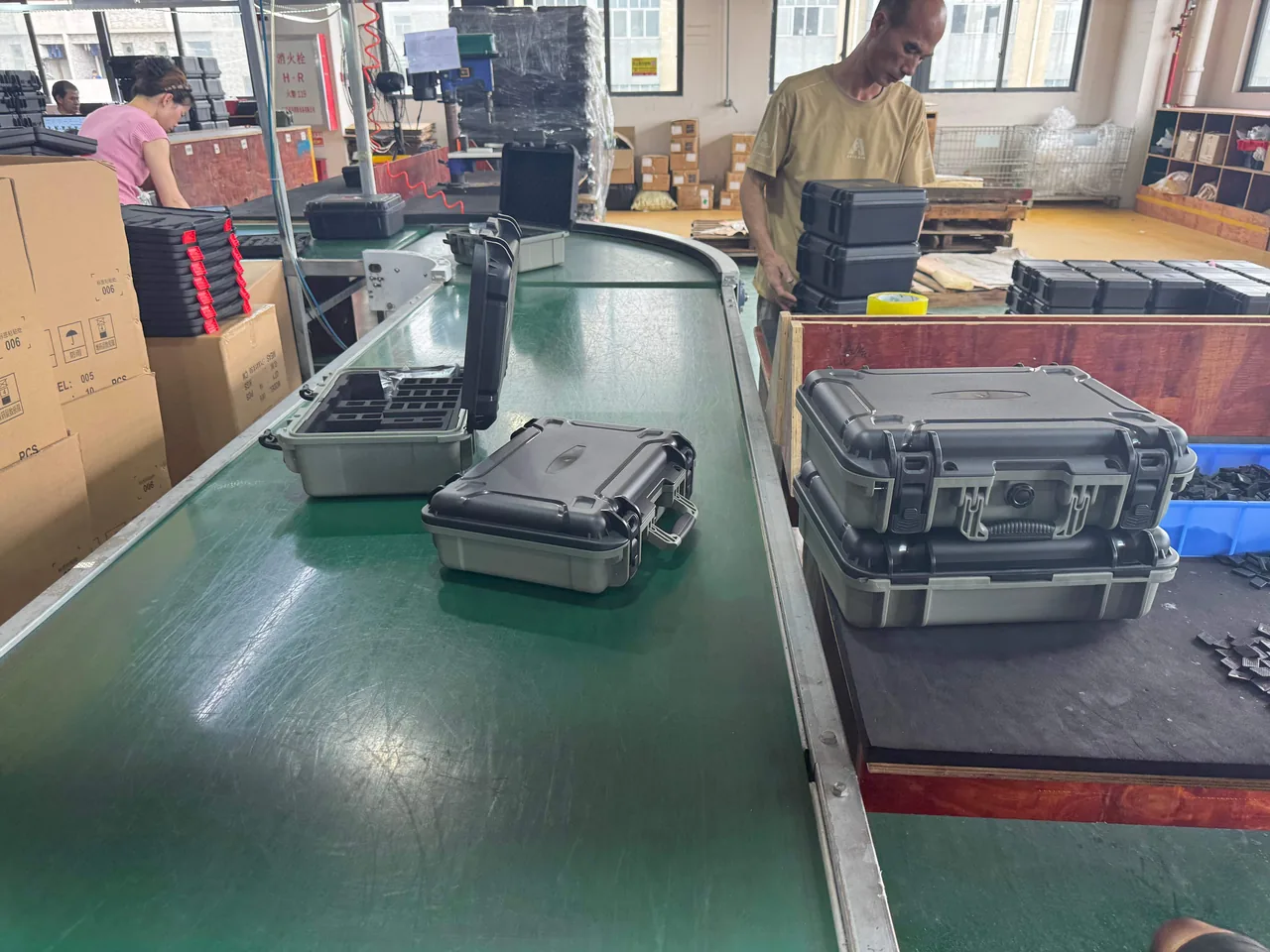
Professional users with compliance and customisation needs should look for manufacturers with a complete production chain. The JUNZHJIA protective-case line from KeXin New Materials (Guangdong) Co., Ltd., for example, is built at a Zhongshan factory of about 18,000 m², holds more than 20 utility-model and design patents, covers 150+ specifications, holds ISO9001, RoHS, REACH, IP67, and California Prop 65 credentials, and supports one-stop OEM/ODM customisation. Choosing the right type matters more than simply chasing "bigger and more expensive." For specifications or custom enquiries, please use the contact form on this site.
Materials, Wheels, and Load Capacity in Depth
When buying a wheeled toolbox, the three things most easily misread from surface parameters are material, wheel set, and load capacity. Let us take them apart so you can judge independently.
Start with the main case material. Three types are common: engineering plastic, aluminium alloy, and thickened stainless steel. Engineering plastics are mainly polypropylene and ABS; they are light, rust-free, and chemically resistant, and high-end plastic cases now approach metal in impact strength, making them the mainstream choice in most professional scenarios. Aluminium-frame models balance light weight with natural corrosion resistance, suiting mobile service work and coastal environments where weight matters. Thickened stainless offers the highest compression and impact resistance but is noticeably heavier, suiting extreme environments and long-term heavy loads, at the cost of more effort to move and a higher price. The core of material selection is matching the pain point of the industry, not blindly assuming "metal beats plastic."
Next, the wheel set — the soul of a wheeled box. Performance comes from wheel material, bearings, diameter, and steering method together. On material: hard polyurethane wheels are quiet and wear-resistant on concrete but can leave light marks on epoxy flooring; TPE soft-rubber wheels are gentler on floors but slightly less wear-resistant; ordinary rubber wheels slip very easily on oily floors and should be avoided in warehouses and automotive workshops. Bearings determine smoothness and life, with double-bearing construction outlasting single-bearing, and industrial buyers commonly ask for a stated wheel-set load rating. A larger diameter crosses gaps and bumps more easily, so 100 mm or more is advisable on rough ground. On steering, swivel casters are manoeuvrable and fixed wheels stable, while braked swivel casters allow temporary parking on slopes and at lift entrances. Confirm the recommended wheel material for your actual floor with the manufacturer rather than accepting vague descriptions like "universally wear-resistant."
Load figures need to be separated into "static load" and "rolling load." The compressive strength of the case body is the weight it can bear when stacked at rest; the wheel-set rating is the total weight the wheels can carry while moving; and the maximum load of the whole case combines both. Many low-cost boxes only state capacity and never a maximum load, and such products deform or shed wheel mounts very easily when overloaded — professional buyers should write the load figures into the acceptance terms.
Storage and stacking matter too. If a wheeled box is to be stacked in a warehouse, it must have anti-slip bosses underneath plus a load ring or locating recess on top, and stacking should follow the applicable warehouse requirements, or there is a tipping risk. For everyday storage, choose a dry, ventilated place and avoid prolonged sun or high temperature that ages the plastic and hardens the wheel rubber.
One last, easily missed indicator: repairability. Wheels and handles are wearing parts, so prefer models with a standard interface that allows individual replacement; a failure then means buying a spare part rather than returning the whole case. That has more long-term meaning than simply comparing the initial price. Put material, wheel set, load capacity, and repairability together and you can pick the wheeled toolbox that genuinely fits your working conditions from a crowded field.
Size, Accessories, and Matching Advice
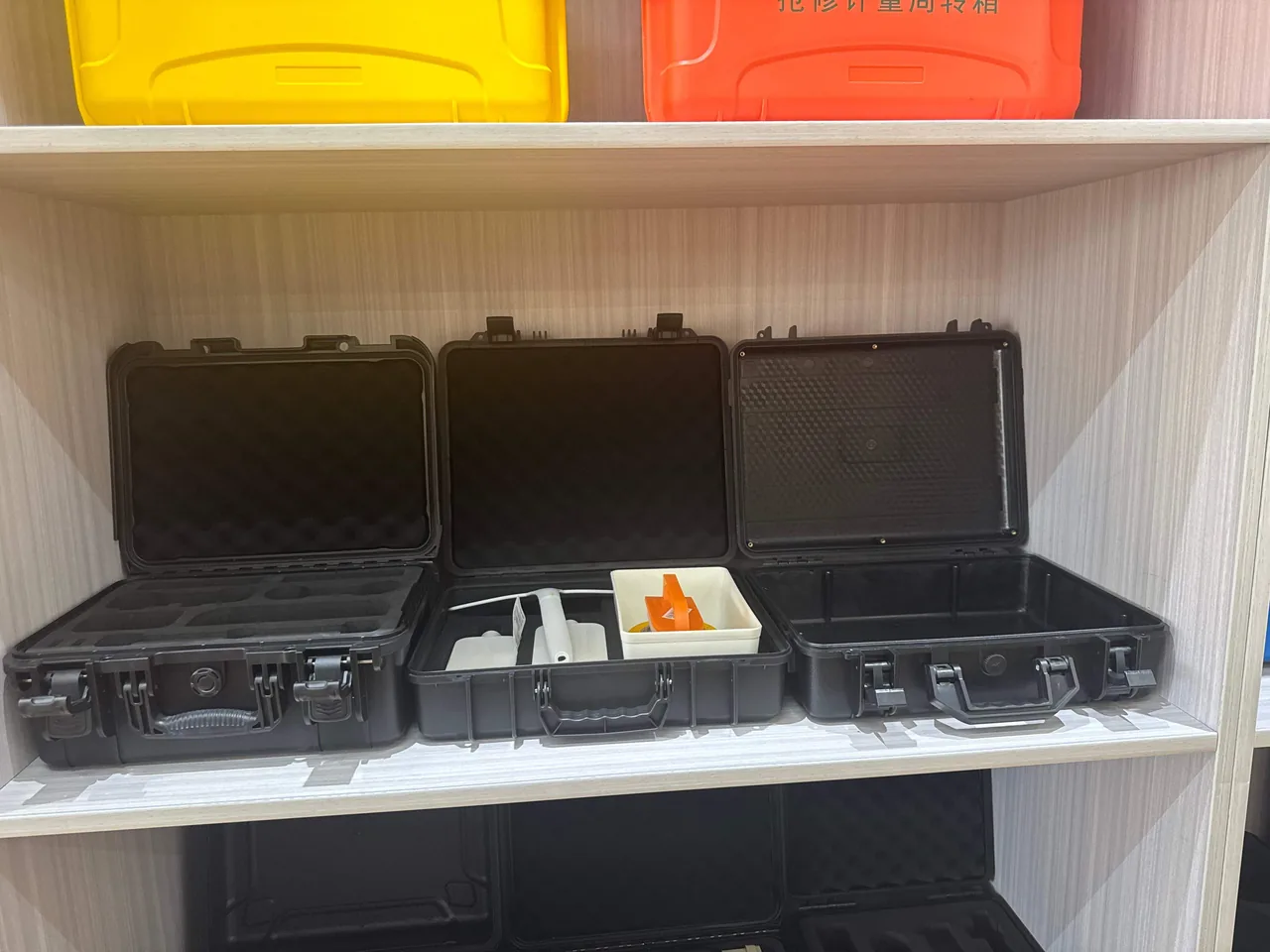
Size is the first hurdle in buying a wheeled box. Too small and nothing fits; too large and it is clumsy to tow and takes up space. The practical approach is to list the dimensions of the largest tools you carry regularly, compare them with the stated internal net dimensions, and leave at least 2 cm of margin on length, width, and height so the lid can still close. On capacity, 50–80 L is a balanced choice for one-person everyday service work; construction and equipment installation may need 100 L and above; home and light users are fine with 20–40 L. Always look at internal net dimensions rather than external ones, because the shell, wheel mounts, and handle rails consume a good deal of volume — a box that looks large on the outside may hold less than you expect.
On accessories, several often-overlooked items are genuinely useful: elastic straps and pouches for gathering small parts such as screws, washers, and batteries; adjustable dividers to separate space by tool height; a spare wheel set with a standard interface, so one broken wheel does not take the whole case out of service; and a padlock or combination lock to work with the padlock hole against theft and accidental opening. Some models also provide a laptop/tablet bay and a pressure equalisation valve, suiting the modern way of measuring and recording at the same time.
Pairing with a tool bag is also worth mentioning. A wheeled box solves "heavy and far"; a tool bag solves "light and near." Many technicians carry a belt or shoulder bag with high-frequency small items, take what they need from the bag on arrival, and only open the wheeled box for the big items, avoiding constant opening of the large case. This "big box as base, small bag on the person" combination is more efficient than relying on one box alone, and reduces wear from opening and closing the large case.
There are also patterns in size by industry. Automotive work commonly uses 50–80 L, with enough internal net height to stand socket sets upright; plumbing and electrical installation prefers 60 L and above with an insulated bay and winding posts; factory instrument transfer often uses 40–60 L with a cut-foam lining; photography and drones depend on the longest dimension of the gear, usually needing 60 L and above with a close-fitting lining. Before ordering, measure the maximum length, width, and height of your own tools with a tape measure — far more reliable than choosing a capacity by feel.
Finally, channels and after-sales. For professional purchasing, choose a manufacturer that can supply certificates on request and supports customisation and spare-part supply; confirm whether wheels and linings can be bought separately, and ask about the term and scope of the warranty. Think through size, accessories, combination, and after-sales in advance, and a wheeled toolbox becomes a genuinely labour-saving productivity tool rather than one more thing taking up space.
Fault Self-Check and Matching the Ground Surface
In daily use, several faults are typical of wheeled boxes, and knowing how to self-check them stops small problems becoming big ones. Wheel turning stiffly or making noise usually means bearings clogged with dust or short of grease: remove the wheel set, clean it, and add a little lithium-based grease to restore smoothness. If one wheel hangs in the air and the box tilts when pushed, do the wheel preload check — press the four corners to confirm all wheels touch together and adjust the levelling screw at the base if needed. A handle that sticks or wobbles means checking the rails for foreign objects and the locking mechanism for wear. A latch that will not close or gives no click may have a deformed tongue or a failed spring, so replace the lock core or the whole latch assembly. Most of these faults can be handled on site, provided you chose a model with individually replaceable parts; otherwise one small fault grounds the whole case.
Matching the ground surface is another skill. On rough hard surfaces such as concrete and asphalt, choose hard polyurethane or rubber wheels, which are wear-resistant and push smoothly. On smooth surfaces such as epoxy flooring and tile, hard wheels can leave light marks, so switch to TPE soft-rubber wheels that are kinder to floors. In oily or wet workshops, ordinary rubber wheels slip very easily and treaded polyurethane is essential. On gravel and construction ground, use a large diameter and preferably double brakes, to stop stones jamming the wheels and the case running away on a slope. Many complaints about "wheels that do not last" come not from poor wheel quality but from a wheel material that does not match the ground underfoot. Telling the manufacturer your real working surface before buying is more reliable than guessing yourself.
Long-term use also calls for good storage habits. When not in use, stand the case upright with the wheels off the ground so the wheel set is not under constant load; dry it promptly after use in damp conditions so axles and screws do not rust; and avoid wiping wheels and latches with corrosive solvents. Build these habits and a wheeled toolbox will reach its design life. It is essentially a small piece of mobile equipment and needs the same periodic lubrication, part replacement, and ground-appropriate wheels as any other. Professional users usually win on habits rather than equipment. One more point: although a wheeled box saves effort, do not load it beyond its stated maximum — overloading damages the wheels and hinges and can deform the shell on rough ground, costing more than it saves. Remember three rules — "choose wheels for the ground, load to the rating, maintain on a schedule" — and a wheeled toolbox will carry the heavy work on site for a long time. When you meet a long staircase or a lift outage, switch to shoulder carrying using the strap points on the case rather than dragging it; going downhill, stand behind the case and grip the handle to control the speed. These small operating habits are exactly what makes a wheeled box safe and long-lasting. In the end, a wheeled toolbox is a tool that serves a person; its value is not that it has a few more wheels, but that it lets you move your attention from "how do I carry this" to "how do I do the job."
Combination Strategies in Real Scenarios
Professional technicians rarely own just one box; they use combinations to cover different tasks. Understanding this logic helps you spend money where it counts and avoid duplicate purchases.
Combination 1: small carry box plus mobile main box (automotive / on-site service). High-frequency small tools (screwdrivers, spanners, circlip pliers, test pens) go in a standard hand-carried box on the person; on arrival, heavy items come from the mobile main box (wheeled, holding heavy sockets and power tools). This way the person walks with only the light box, and the heavy box stays by the vehicle or at the bay — less effort and less loss. A standard box of 20–40 L is enough; the main box should be 50 L or more in an oil-resistant model.
Combination 2: bench drawer cabinet plus wheeled transfer case (factory / workshop). A fixed workstation uses a drawer-type tool cabinet to raise space utilisation and access speed; when work crosses lines or goes up to the equipment level, a wheeled protective case carries the precision instruments needed that day for a short transfer. The cabinet stays put and the transfer case moves — separating duties is the most economical arrangement.
Combination 3: pure large wheeled box (construction / installation). With no fixed position on site, go straight to a large impact-resistant wheeled model with a dust seal and insulated bay; a standard box is unsuitable because it would have to be carried long distances frequently. Focus here on how well the wheel set copes with rough ground and on the impact-resistant thickness of the shell.
Combination 4: custom-lined protective case (instruments / photography / military/police). Where tools are valuable and oddly shaped, choose a wheeled protective case and have EVA or pearl cotton cut to the equipment, getting both easy movement and shock protection in transit. KeXin New Materials (JUNZHJIA) offers one-stop OEM/ODM from injection moulding and mould making through to inner trays and linings, so dividers can be made for specific tool dimensions and the cost of later modification avoided.
For a more concrete view, here is a decision reference based on budget and frequency: if you move tools fewer than five times a month and they weigh under 8 kg, a standard box is enough; if you move them several times a week at 10–30 kg across floors or bays, a wheeled box is a necessity; if you move heavy loads at high frequency every day, go straight to an industrial-grade wheeled protective case and look at the wheel-set rating, hinge life, and individually replaceable wheels.
One hidden cost is also worth flagging: if a standard box is hand-carried overloaded over a long period, the handle breaks and the shell deforms, and it is scrapped early. A wheeled box costs more but uses higher standards in material, structure, and fittings, and a good one can last several times longer, so for professional users the whole-life cost is often lower. Using "carrying weight × carrying distance × frequency" as the core calculation is more scientific than simply comparing price tags.