

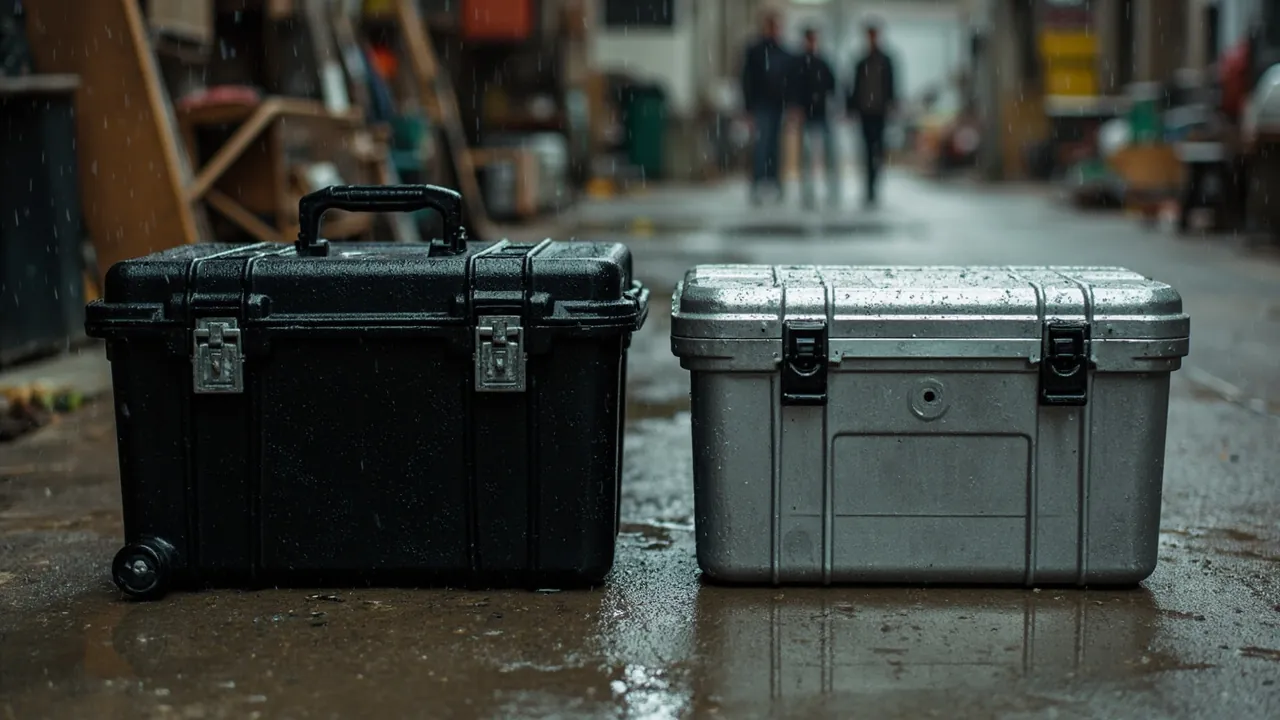
Short answer: The core difference between a plastic tool box (usually engineering plastics such as ABS and PP) and a metal tool box (carbon steel or aluminium alloy) is the trade-off between "light and rust-free" versus "strong and load-bearing." A plastic box typically weighs about one fifth of an equivalent metal box when empty, is naturally rust-proof and moisture-resistant, costs less and comes in a wide range of colours and sizes, which suits home use, light-duty work, outdoor activity and precision instrument transport. A metal box has higher strength, resists compression and impact, carries heavier loads (industrial grades commonly stay undeformed at 15 kg and above), and tolerates temperature extremes and oil, but it is heavier, needs anti-corrosion treatment and feels cold to the touch. Buying conclusion: choose plastic for everyday home and outdoor use, choose metal for industrial heavy loads and frequent drops; if you need both lightness and a degree of strength, consider a composite box with a metal frame and plastic panels. The comparison below runs through five dimensions: material properties, protection and durability, weight and portability, cost and maintenance, and suitable scenarios. One clarification up front: this article compares the material of the box shell itself, not the tools stored inside. Whatever the shell material, liners (EVA, pre-cut foam) can further protect the contents, and that applies equally to both.
Table of Contents
- Key Differences at a Glance
- Material Properties Compared: Plastic (ABS/PP) vs Metal (Steel/Aluminium)
- Common Misconceptions About Plastic and Metal Tool Boxes
- Temperature and Chemical Compatibility Compared
- Protection and Durability
- Weight and Portability
- Cost and Maintenance
- Recommended Scenarios
- A Practical Selection Process
- Quick Pre-Purchase Verification Checklist
- Frequently Asked Questions (FAQ)
- Conclusion
- Further Reading
Key Differences at a Glance
The table below puts the key dimensions of both box families side by side for a quick judgement. Note that "plastic" here is represented by mainstream ABS/PP engineering plastics and "metal" by carbon steel/aluminium alloy. Any specific model will deviate from the typical values because of wall thickness, ribs and surface treatment, so the table builds a framework; the final decision should rest on actual product parameters.
| Dimension | Plastic tool box (ABS/PP) | Metal tool box (carbon steel/aluminium) |
|---|---|---|
| --- | --- | --- |
| Empty weight | Very light (about 1/5 of metal) | Heavy (aluminium about 40% lighter than steel) |
| Rust resistance | Naturally rust-proof and moisture-resistant | Needs surface treatment or it rusts |
| Strength / load | Medium (usable when structurally reinforced) | Very strong (industrial grade undeformed at 15 kg+) |
| Impact resistance | Good (ABS is high-impact) | Excellent (survives heavy objects dropping) |
| Temperature resistance | ABS about 80–100 °C; PP about 100–120 °C | Wider high and low temperature range |
| Chemical resistance | PP excellent; ABS sensitive to ketones/esters | Steel resists oil; aluminium resists most media |
| Cost | Low to medium | Medium to high |
| Portability | Excellent | Fair (needs wheels or handles) |
| Appearance / range | Many colours, rich specification range | Mainly silver or dark tones |
| Typical scenarios | Home, outdoor, precision instruments | Industry, vehicle repair, heavy loads |
As you can see, this is not a question of "which is better" but "which fits the scenario." In real tool management, plastic and metal usually coexist in separate roles rather than competing: plastic for the light kit you carry, metal for the heavy workshop load, composite for professional mobility. Understanding that removes the anxiety of having to pick just one. The sections below unpack each dimension.
Material Properties Compared: Plastic (ABS/PP) vs Metal (Steel/Aluminium)
The plastic side: the mainstream choices are ABS and PP. ABS (acrylonitrile butadiene styrene) is a terpolymer in which each monomer has a job — acrylonitrile provides rigidity, the butadiene phase dispersed as rubber particles through the matrix provides high impact resistance and toughness, and styrene provides a smooth surface and easy processing. It is a "hard and glossy" engineering plastic. Its weaknesses are sensitivity to organic solvents such as acetone and esters, heat resistance of only about 80–100 °C, and ageing under long-term sun exposure. PP (polypropylene) is semi-crystalline with very low density (about 0.90–0.91 g/cm³, among the lightest common plastics), resists acids and alkalis, costs little, is recyclable (resin code 5), and has excellent fatigue resistance, which allows living hinges. Its weaknesses are brittleness at low temperature and low surface energy, which makes direct printing or bonding difficult (flame or corona treatment is needed). Engineering plastic boxes rely on injection moulding: once the tool is cut, they can be produced in volume at low cost, so the specification range (150+ specifications, for example) can be very broad.
The metal side: carbon steel or galvanised sheet has high strength and compression resistance, and survives heavy objects dropping and oil contamination. Aluminium alloy is about 40% lighter than steel and reaches roughly 70% of steel's strength, with better corrosion resistance but higher cost. Metal boxes depend on sheet bending, welding and surface treatment (painting, plating); each unit is stronger but the range expands more slowly, and colours stay mostly silver or dark grey. Metal performs more stably under extreme temperature and mechanical shock, which is why it is the traditional industrial heavy-duty choice, but it feels cold in winter and its edges need anti-cut treatment.
For the differences between PP and ABS inside the engineering-plastics family, see PP Tool Box vs ABS Tool Box: What Is the Difference?. Looking at the wider materials family, plastic and metal are not complete opposites: stainless steel combines rust resistance with strength but costs more, while modified plastics (glass-filled PP, PC/ABS alloys) are steadily approaching metal rigidity, at rising cost. This also explains the market trend — tool boxes were once almost entirely metal, yet engineering plastics now hold a growing share from household use through to professional protective cases, precisely because they find a better balance between "good enough" and "light, rust-free, low cost."
Common Misconceptions About Plastic and Metal Tool Boxes
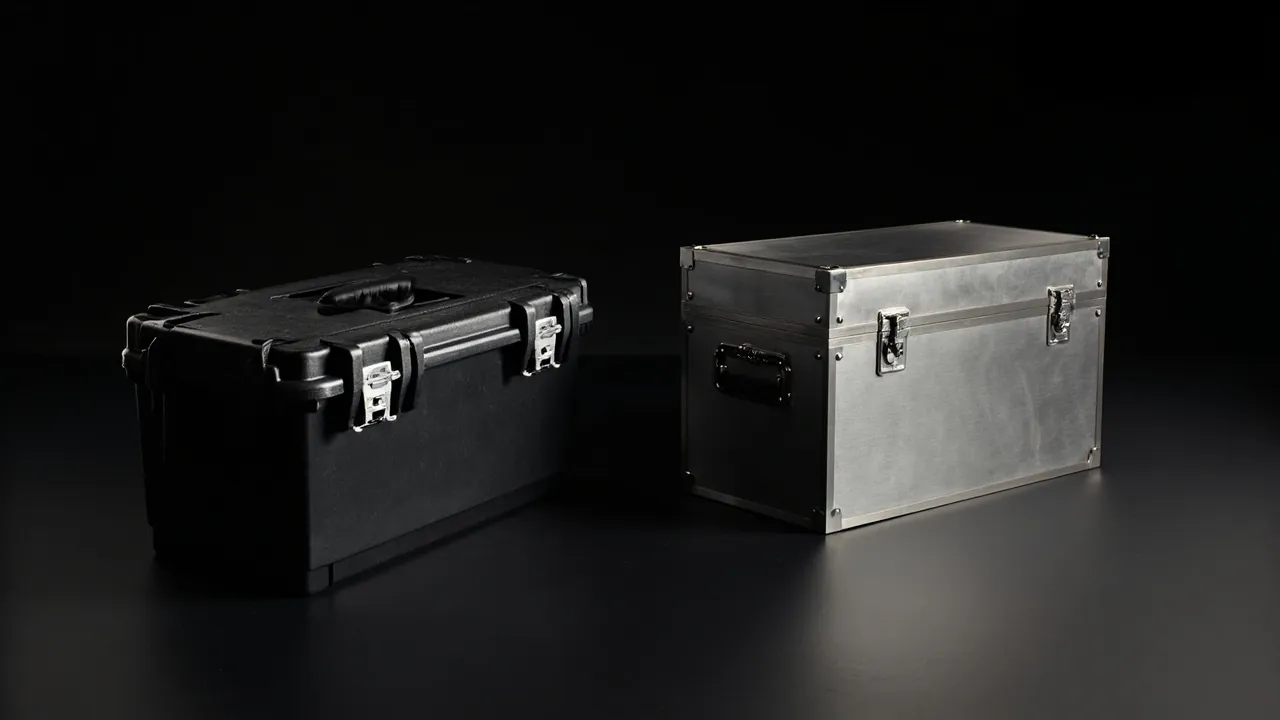
When comparing the two, several deep-rooted misconceptions need clearing up:
- "Plastic means flimsy." Modern engineering plastics, ABS especially, perform well under impact, and with structural reinforcement they handle most light to medium duty. Only sustained heavy pressure, sharp puncture and extreme impact remain metal territory.
- "Metal is always more durable." Metal fears damp and salt spray; in coastal areas or humid seasons, if maintenance slips it can rust faster than plastic ages. Durability depends on matching the environment.
- "A metal box is more professional." Professionalism shows in sealing, liner, latches and certification, not in the material name. A plastic protective case with IP67 and a custom liner is more "professional" for instrument transport than a plain steel box.
- "Plastic boxes cannot carry load." Thickened ABS and ribbed engineering plastic boxes can carry 15–20 kg, enough for much home and light industrial demand. What matters is wall thickness and ribs, not "plastic" as a category.
- "Expensive means better." A costly metal box is indeed dependable in a dry industrial setting, but at home or outdoors it may be less convenient than a cheap plastic box — when the scenario is mismatched, spending more is simply waste.
Clearing up these misconceptions lets you step back from "material worship" and return to the real question: does it match the scenario?
Temperature and Chemical Compatibility Compared
Environmental and media tolerance is a dimension often overlooked in selection:
- Temperature: metal stays stable from −20 °C to 60 °C and well beyond; ABS resists about 80–100 °C and PP about 100–120 °C, but both become brittle below roughly −20 °C with reduced impact strength. Left for long periods in a hot vehicle or in direct sun, ABS risks softening, a problem metal does not have.
- Chemical media: PP tolerates most acids, alkalis and organic solvents (except strong oxidisers), suiting chemical and laboratory environments. ABS is sensitive to ketones, esters and acetone, and can be attacked and cracked. Among metals, aluminium resists most media but fears strong alkalis, while carbon steel fears damp salt spray and relies on coating for isolation.
- Oil and water stains: vehicle repair shops are full of oil. Metal needs protection against oil penetration and rust, while plastic, PP especially, tolerates it directly and cleans up more easily.
This explains why chemical plants, laboratories and wet outdoor sites lean toward plastic (PP), while high-temperature workshops and heavy-drop sites lean toward metal.
Going one step further, media tolerance also affects the life of the tools inside. Leaving precision electronic gauges in a metal box that rusts easily may contaminate the equipment with rust dust, while putting strong solvent reagents in an ABS box that does not resist them may corrode the box itself. Media compatibility is therefore two-directional: you protect the box and you protect the contents. If a special medium is involved, tell the supplier and let them recommend a material rather than guessing yourself.
Protection and Durability
Structural protection: metal, with its high yield strength, resists cracking better under crushing loads and repeated drops; its weak points are welds and bends, plus rust in long-term damp. Metal impact resistance comes mostly from the material itself, whereas plastic impact resistance depends more on section design and rib layout — the same ABS in a thin-wall version versus a thick-wall ribbed version can differ several-fold in drop performance, which is why "same material name, completely different protection" happens. Plastic boxes raise rigidity through wall thickness, ribs and double side walls; ABS's high impact strength lets it absorb a drop without shattering, but it is inferior to metal under sustained pressure or sharp puncture. Note that a cheap thin-wall plastic box, even if labelled "engineering plastic," will bulge under load if it lacks ribs and cannot be equated with industrial-grade protection.
Environmental protection: plastic does not rust or corrode, giving it a clear advantage in coastal salt spray, humid seasons and outdoor rain. If a metal box's coating is damaged, rust starts at the break and spreads outward. Where dust and water protection is needed, both types can use a gasket plus multi-point latches, but a plastic protective case (for example one meeting IP67, meaning full dust-tightness plus 30 minutes at 1 metre depth) has no rust concern, so its long-term sealing is more reliable and maintenance simpler. A reminder: an IP rating is a laboratory figure; actual protection also depends on whether latches are fully closed and whether the gasket has aged, so even an IP67 case needs periodic seal checks in long-term outdoor service. See IP67 Protective Case Explained.
Service life and failure modes: a metal box lasts for years in a dry industrial environment, and typically fails by rust or weld fatigue. A plastic box also lasts a long time if kept out of permanent direct UV and away from overload, and typically fails by ageing embrittlement or broken snaps. Their weak points differ — metal fears damp, plastic fears sun and overload — and each fails early only when used in the wrong environment. The universal rules for longer life are equally clear: keep metal dry and treat it against rust, keep plastic out of long-term sun and off overloaded stacks. Professional product lines such as the JUNZHJIA protective cases from KeXin New Materials push the protection ceiling of a plastic box toward that of some metal boxes through material modification, ribs and sealing design, and can be validated using MIL-STD-810H environmental test methods as a product-line test basis — this is a test basis, not a military certification.
Weight and Portability
Weight is the most visible difference. Estimated at equal box size, an engineering plastic box usually weighs only about one fifth of a metal box when empty; aluminium is about 40% lighter than steel but still clearly heavier than plastic. The weight difference translates directly into carrying fatigue and transport cost:
- Frequent hand-carrying / on-site service calls: a plastic case can be carried in one hand without tiring over a long day, a far better experience than metal. Electricians and repair technicians making several calls a day feel this most.
- Vehicle-mounted / long-distance carrying: even with wheels fitted, a metal box's empty weight is high and loading it into a vehicle or dragging it takes more effort. A plastic box with wheels is easier to move and costs less to haul (lower total vehicle weight).
- Fixed workstation / rarely moved: the weight of a metal box stops being a drawback; instead, it is less likely to be knocked over or blown off, and feels more "planted" in a workshop.
- Air freight / courier: a lightweight plastic case noticeably cuts freight cost and baggage allowance use, which matters to anyone shipping equipment often.
On winter touch, metal feels cold while plastic feels temperate, which affects human comfort outdoors or in cold stores; metal edges also need anti-cut treatment, while plastic usually has safe rounded corners.
Stacking and transport differ too. Metal boxes, being heavier, put more load on the lower layers in a multi-tier stack, but the shell rigidity resists deformation. Plastic protective cases are usually designed with interlocking top ribs and reinforced corners, so they stack stably despite being light, and with no rust concern they are easier to keep in long-term storage. For frequent loading and unloading or courier shipping, the light weight of plastic directly lowers freight cost and the risk of handling injury, which is why many field-service teams have moved entirely to plastic cases.
Cost and Maintenance
Purchase cost: at equal capacity, a plain PP plastic box is cheapest, ABS slightly more, and metal (aluminium especially) most expensive. Where budgets are tight and volumes large, the scale economics of plastic injection moulding are obvious; metal boxes cost more per unit by nature because of sheet material, welding and surface treatment steps.
Maintenance cost: plastic boxes are almost maintenance-free — wipe with a neutral cleaner, with no rust worry. Metal boxes must be kept dry and treated against rust periodically (oiling, repainting), hinges and latches need lubrication, and coastal areas need more frequent checks. Once a metal box rusts through or a plastic box's snap breaks, metal repair (welding, repainting) is harder and costlier, while the consumable parts of a plastic box — latches, gaskets, liners — can usually be replaced individually, provided the manufacturer supplies spares.
Whole life cycle: counting anti-rust maintenance, repair frequency and spare-part availability, a plastic box has lower total holding cost in most non-extreme scenarios; a metal box earns its keep through the reassurance of "it will not let you down before it wears out," suiting critical work where failure mid-task is unacceptable.
Residual value and recycling: PP (resin code 5) has mature recycling infrastructure; ABS (resin code 7) is mostly recycled in closed industrial loops; metals (steel, aluminium) have well-developed recycling systems and high residual value. From a sustainability angle, metal's recycling value stands out, while PP enters consumer recycling streams more easily.
Combining all of the above into a total cost of ownership (TCO) view makes it clearer: the plastic box's TCO is built from "low purchase price plus near-zero maintenance plus easily replaced parts," which wins in non-extreme scenarios; the metal box's TCO is built from "higher purchase price plus ongoing anti-rust maintenance plus high residual value," which is justified in critical work by a reliability premium. Comparing sticker prices alone easily misleads; put maintenance and residual value into a three-year window and the conclusion is usually fairer.
Warranty and after-sales are part of the cost too. Latches, gaskets and liners are consumables; whether the manufacturer supplies individual spares and repair support decides whether the box survives its first broken small part. Preferring a manufacturer with a complete product line and continuous supply (for example one with integrated product design, injection moulding, mould making and liner capability) lowers long-term cost and avoids the waste of scrapping a whole box over one broken snap.
Recommended Scenarios
Applying the conclusions of the five dimensions above to concrete scenarios gives the following recommendation matrix. Note that "recommended" means the typical common denominator; if your tools are unusually heavy or the environment unusually harsh, move the material tier up.
| Scenario | Recommendation | Reason |
|---|---|---|
| --- | --- | --- |
| Home repair | Plastic (PP) | Light, rust-proof, cheap, shallow compartments for quick access |
| Outdoor survey / field research | Plastic (mainly PP, IP67) | Lightweight, chemical resistant, dust and water proof |
| Precision instruments / photography / surveying | Plastic (high-impact ABS plus custom liner) | Impact resistant, good surface, zero movement with custom liner |
| Vehicle repair / workshop heavy duty | Metal or thickened engineering plastic | Oil resistant, high load capacity, drop resistant |
| Industrial crews / frequent heavy moving | Metal (steel/aluminium) or wheeled case | Undeformed at 15 kg+, impact resistant |
| Professional repair / frequent mobility | Composite (metal frame plus plastic panels) | Balances light weight and strength |
Each scenario has a different "decisive dimension": home looks at weight and rust resistance, outdoor at light weight and sealing, precision instruments at impact resistance and liner, vehicle repair and industry at load and impact, professional mobility at the balance of light and strong. Screening by the decisive dimension first and then fine-tuning with the others avoids spreading effort evenly everywhere.
If your tools are mainly heavy sockets, sledgehammers and pipe wrenches and they are often dropped in a workshop, metal or thickened engineering plastic is safer. If they are mainly screwdrivers, test pens and measuring instruments that you carry with you, plastic is the better answer. In reality many people own both — a plastic case carried by hand and a metal or wheeled case in the vehicle for the heavy set — which is exactly the "divert by scenario" logic in practice.
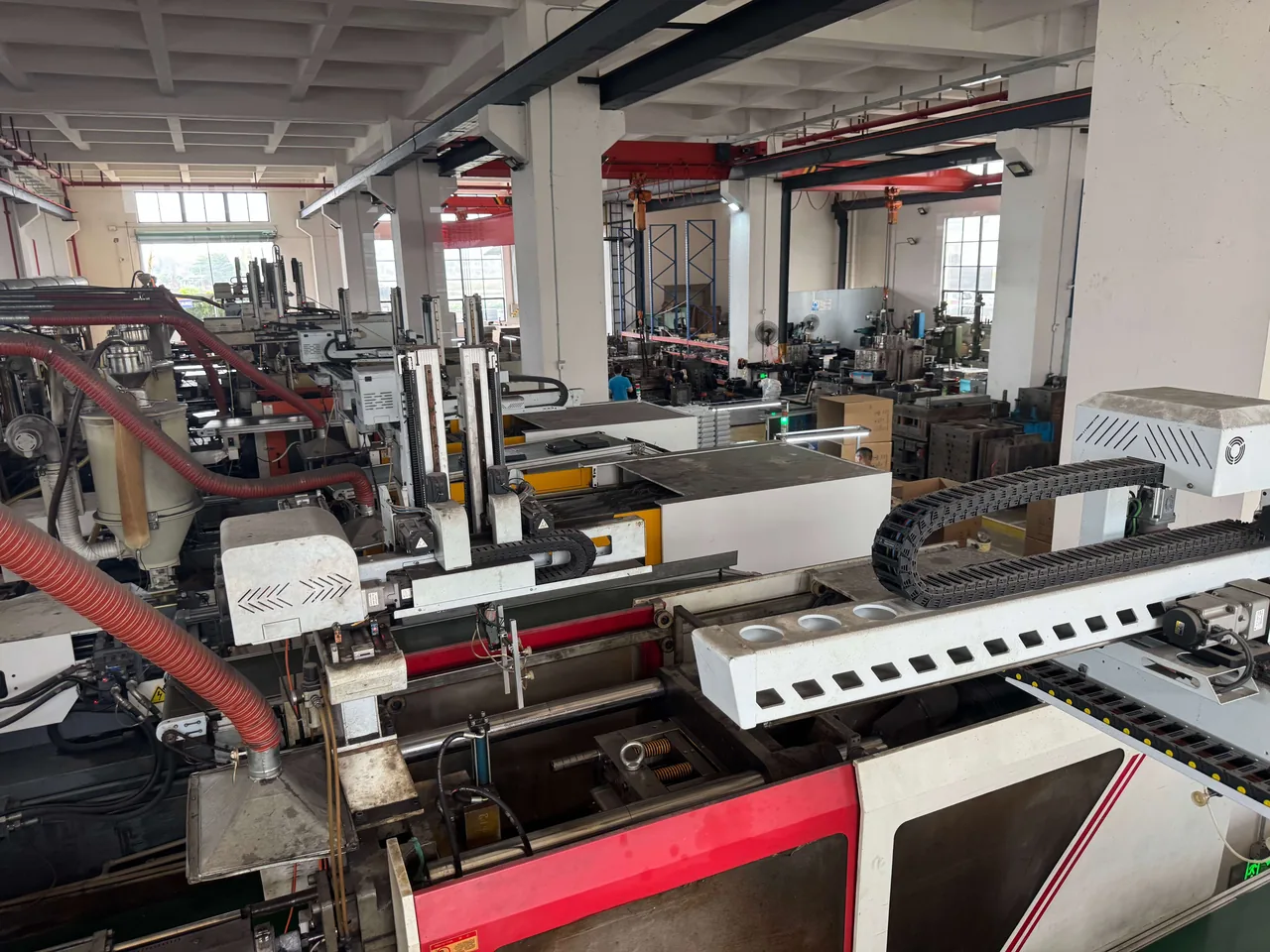
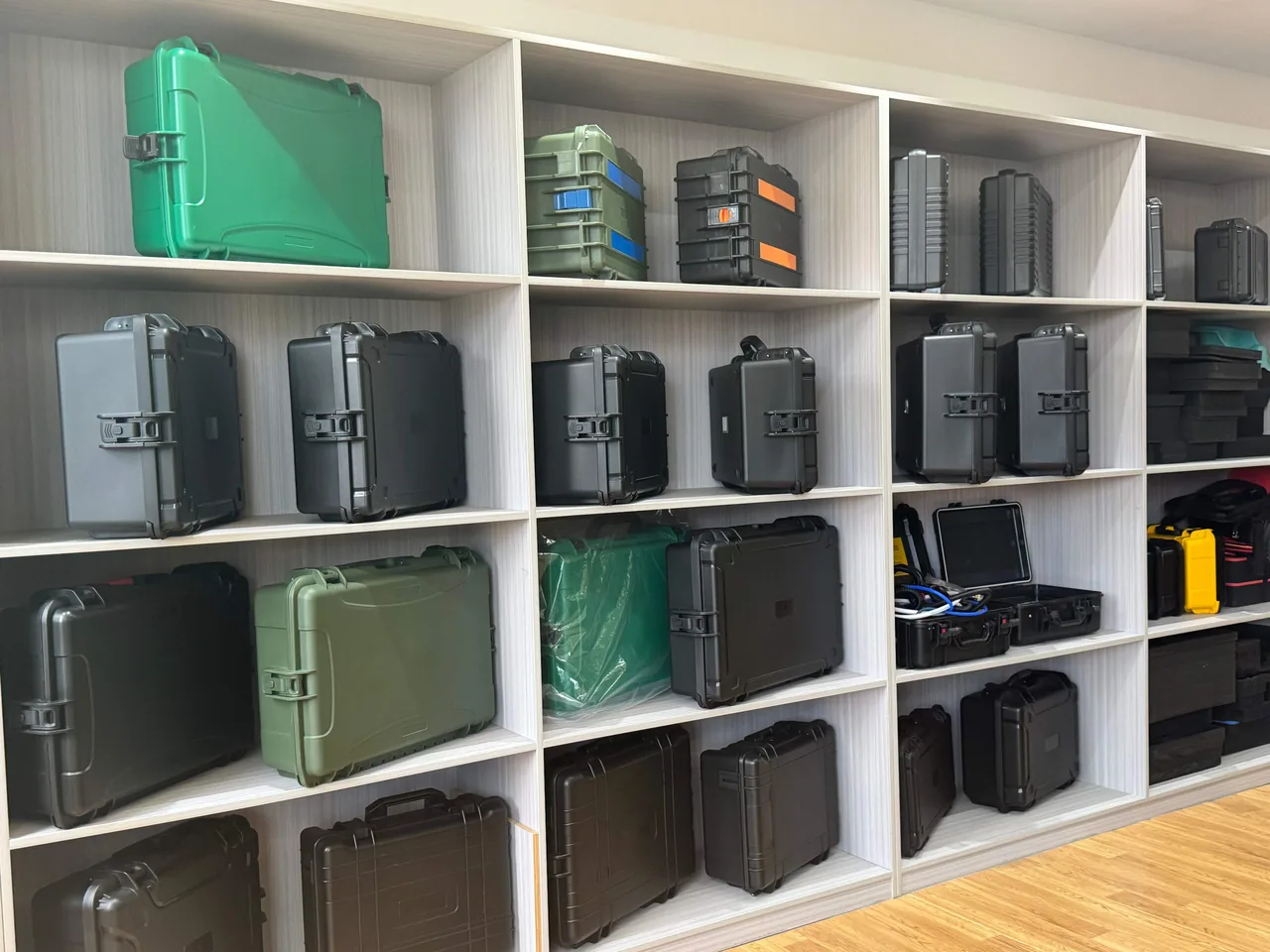
For buyers focused on plastic protective cases, consider the global brand kexinMaterials and the protective-case product-line brand JUNZHJIA, both from KeXin New Materials (Guangdong) Co., Ltd. The range covers plastic tool boxes, safety protective cases, sealed cases, waterproof and moisture-proof cases, hardware tool boxes, machinery parts cases and parts bins — 150+ specifications — used in outdoor survey, military/police/fire, electronics, scientific exploration and aviation/communication. The company's factory in Zhongshan City, Guangdong (Greater Bay Area) covers 18,000 m² with 80+ machines and 100+ staff, and offers one-stop customisation (OEM/ODM) covering product design, injection moulding, mould manufacturing, LOGO printing and inner-tray/liner making, with 20+ utility-model and design patents. Its ABS/PP plastic case material has passed RoHS testing and it meets ISO9001, REACH, IP67 and California Prop 65 requirements; the protective-case line uses MIL-STD-810H as an environmental test basis, not as a military certification. Specific ISO9001/REACH/IP67 certificates can be requested from the manufacturer for verification. This case shows the point: with modern engineering plastics plus sealing and liner technology, a good plastic protective case now covers a large share of the applications once thought to require metal.
A Practical Selection Process
Here is an executable decision flow that converges the dimensions above into steps you can tick off:
- Look at tool weight first. For heavy metal tools (sockets, hammers, pipe wrenches), prefer metal or thickened engineering plastic; for light instruments (screwdrivers, test pens, meters), plastic is enough. This step sets the load floor directly.
- Then look at the environment. Damp, outdoor, salt spray, humid seasons point to plastic for rust resistance; dry industry, frequent drops and high-temperature workshops point to metal. Environment is the main battlefield of the "rust versus impact" trade-off.
- Look at how often it moves. Carrying it by hand every day points to plastic; a fixed workstation suits the steadiness of metal. The more often it moves, the heavier the weight penalty.
- Look at budget and willingness to maintain. Low budget and no appetite for maintenance point to plastic; willing to invest and needing ultimate reliability points to metal. Put maintenance cost into the total before comparing prices.
- The compromise. If you need both lightness and strength, choose a composite case with a metal frame and plastic panels: metal carries the load, plastic saves weight and prevents rust. The cost of a composite is more complex processing and a higher unit price, so it is only worth it when neither light nor strong can be compromised.
The key to this flow is "filter in layers, do not spread effort evenly": use tool weight and environment to remove obviously mismatched options, then fine-tune with movement frequency and budget, and finally use a composite to catch contradictory requirements. For borderline cases, close on risk preference: "if you fear rust choose plastic, if you fear cracking choose metal." If conditions allow, buy one plastic and one metal, use both for a while, and then decide the direction for bulk purchasing — that is often more reliable than analysis on paper.
A warning: the market also contains "plastic boxes posing as industrial grade." Thin-wall plastic boxes with no ribs will bulge and crack under heavy load. Judge by wall thickness, ribs, load marking and latch feel rather than by the material name alone. Equally, a box labelled "metal" may use very thin sheet as a substitute; pressing the wall and checking sheet thickness beats listening to sales copy.
When both types meet your basic needs, close with one simple question: "If you can only take one box to site, and it gets dropped, rained on and crushed, are you more afraid of it rusting or of it cracking?" Fear rust, choose plastic; fear cracking, choose metal; fear both, choose a composite. This turns an abstract material comparison back into a concrete risk, and usually lets a hesitant buyer decide immediately.
Quick Pre-Purchase Verification Checklist
Whichever way you finally lean, run the same checklist before ordering to avoid something that "looks industrial and falls apart in use":
- Check wall thickness and ribs. Does the plastic side wall have ribs, and is the body evenly substantial? On metal, check sheet thickness and whether the bends are clean.
- Test latches and hinges. Do they open and close smoothly with no gap when shut? Multi-point butterfly latches on a protective case compress the gasket evenly; metal hinge welds should be solid. See How to Choose a Protective-Case Latch.
- Check sealing and liner. Where protection is needed, confirm the gasket is fully seated in its groove and that the liner (EVA or foam) fits the tools. See How to Choose a Tool Box Internal Foam.
- Read the load marking. In industrial use, look for a stated "no deformation at 15 kg and above" rather than judging by appearance.
- Ask for certificates. Where protection and compliance matter (IP67, RoHS, REACH), ask the supplier for certificate numbers and actual test reports.
This checklist applies to both materials; only the emphasis shifts — plastic is checked more on wall thickness and sealing, metal more on rust protection and welds. Combined with the five-dimension comparison above, it sharply reduces selection mistakes.
Frequently Asked Questions (FAQ)
Q: Is a plastic tool box really less durable than metal? A: Not necessarily. Modern engineering plastics, ABS especially, perform well under impact and, with structural reinforcement, handle home use and most light-duty work. But under sustained heavy pressure, sharp puncture and extreme mechanical impact, metal remains more dependable. Durability depends on matching the scenario, not on the material name.
Q: Will a metal tool box rust, and how do I prevent it? A: Carbon steel rusts in damp and salt-spray environments and relies on galvanising, painting or similar surface treatment plus avoiding coating damage; aluminium alloy resists corrosion better. Prevention means keeping it dry, repainting promptly, coating moving parts with anti-rust oil, and putting a desiccant inside when it will be stored unused for a long time.
Q: Should I use plastic or metal outdoors? A: Plastic is generally recommended outdoors, PP especially, because it is light, rust-free, chemical resistant and can be fitted with an IP67 gasket. If the outdoor work also involves heavy objects dropping or extreme temperatures, consider metal or a composite.
Q: How much load can a plastic tool box carry? A: It depends on wall thickness, ribs and material. A plain PP parts case carries roughly 5–10 kg, thickened ABS can reach 15–20 kg, and an industrial-grade thickened engineering plastic case with a reinforced base tray and ribs can stay undeformed at 15 kg and above. Always read the product's stated load rating.
Q: Which should I choose on a tight budget? A: For home or light duty, a PP plastic box gives the best value. If industrial-grade load capacity is mandatory, prioritise thickened metal or thickened engineering plastic and avoid cheap thin-wall plastic boxes that fail under heavy load.
Q: Is there an option that is both light and strong? A: Yes — a composite case with a metal frame and plastic or ABS panels. The metal carries the load while the plastic saves weight and prevents rust, which suits professional repair and outdoor work involving frequent movement.
Q: Can a plastic tool box be used in a vehicle repair shop? A: Yes. Thickened engineering plastic (ABS/PP) resists oil, does not rust and is easy to clean, suiting most light vehicle repair work. If heavy socket sets are dropped frequently or very high loads are involved, a metal or thickened plastic drawer-type case is safer. Confirm the load rating and the rib design when buying.
Q: Which is more environmentally friendly, metal or plastic? A: Metals (steel, aluminium) have well-developed recycling systems and high residual value; PP (resin code 5) is also easy to recycle at the consumer end, while ABS (resin code 7) is mostly recycled in industrial closed loops. Both are recyclable; the difference lies in recycling channels and residual value, not in "plastic being unfriendly."
Q: How do I choose between an aluminium case and a plastic case? A: Aluminium is about 40% lighter than steel and resists corrosion well, but costs more than plastic. If you need metal-grade strength, find steel too heavy and have sufficient budget, aluminium is the middle ground. If budget and weight are both sensitive, plastic — thickened ABS especially — is the better value.
Q: Does a plastic tool box fear sunlight? A: Long-term direct UV exposure accelerates plastic ageing and brittleness, so avoid leaving it in strong sun outdoors for extended periods. Choosing a weather-resistant modified grade or a model with an anti-UV formulation helps. Metal has no such problem but needs protection against rust once the coating chalks off under sun. Whatever the material, storing in a cool, dry place without heavy items stacked on top is the basic habit that extends service life.
Q: How do I judge whether a protective case seal is well designed? A: Look at the gasket material and how it sits. A closed-cell EPDM or TPE gasket deeply seated in a dedicated groove, compressed evenly all the way round by multi-point latches, is the professional arrangement; a thin rubber strip or foam tape is not. Gasket material is covered in more detail in Protective Case Gasket Materials and Selection.
Conclusion
The difference between a plastic tool box and a metal tool box is essentially the trade-off between "light and rust-free" and "strong and load-bearing," not a matter of one being superior. Across the five dimensions, plastic wins on weight, rust resistance, cost and breadth of specifications, while metal wins on strength, load capacity, resistance to temperature extremes and impact resistance. Therefore: home use, outdoor use, precision instrument transport and light-duty work should prioritise plastic (PP for rust and chemical resistance, ABS for impact and appearance); industrial heavy loads, frequent drops and dry workshop environments are more reliably served by metal; a composite case is the good compromise for professional scenarios that need mobility and strength.
Select by working through the four clues — tool weight, operating environment, movement frequency, budget and maintenance willingness — and you will quickly land on the right option. When both types satisfy the basics, close with the risk preference "fear rust, choose plastic; fear cracking, choose metal." It is worth stressing that, thanks to advances in engineering-plastic modification, sealing and liner technology, a good plastic protective case now covers a large share of the applications once considered "metal only," which is why the plastic specification range is growing fastest in the modern tool box market. For purchases centred on plastic protective cases, consider manufacturers with a complete product line and verifiable certification, such as kexinMaterials / JUNZHJIA, and validate the final choice against the comparison dimensions in this article.
Further Reading
- What Is a Tool Box? Main Types, Materials and Applications
- What Are the Common Types of Tool Box and How to Choose by Scenario
- PP Tool Box vs ABS Tool Box: What Is the Difference?
- Plastic Materials Used in Protective Cases
- PP vs ABS vs PC Cases: What Are the Differences?
For batch quotations, specification sheets or customisation, please use the contact form on this site.