

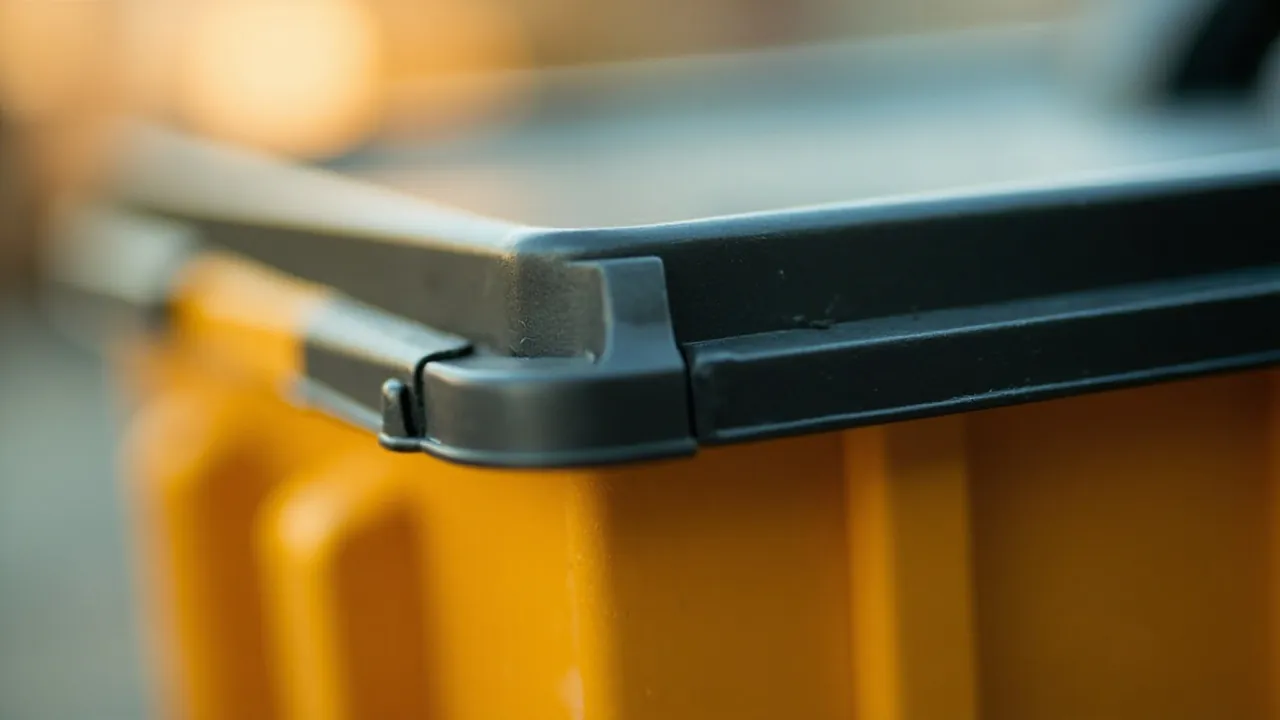
Short answer: PP (polypropylene) and ABS (acrylonitrile butadiene styrene) are the two engineering plastics most used for tool boxes, and they differ in performance orientation. PP has lower density (about 0.90–0.91 g/cm³, among the lightest common plastics), better chemical resistance, lower cost, is recyclable (resin code 5) and resists fatigue well enough for living hinges, suiting outdoor, damp, chemical and value-driven applications. ABS has higher impact strength, a glossier surface, is easier to colour, paint and plate, and has better dimensional stability (mould shrinkage 0.4–0.7%), suiting applications where appearance, strength and precision protection matter. Neither is "better"; each is "better matched." Choose PP for protection-per-cost and chemical resistance, choose ABS for appearance and impact resistance. The comparison below runs through five dimensions: material properties, protection and load, environmental adaptability, cost and processing, and scenario selection. If you only want one line to memorise: PP equals light plus chemical resistant plus cheap; ABS equals tough plus glossy plus dimensionally stable. When you need both, look at modified grades or a combined PP plus ABS solution.
Table of Contents
- Key Differences at a Glance
- PP Material Properties in Detail
- ABS Material Properties in Detail
- Protection and Load Performance Compared
- Environmental Adaptability: Low Temperature, High Temperature, Chemicals
- Cost, Processing and Appearance Compared
- How to Identify PP and ABS by Eye
- Real-World Scenario Cases
- Common Misconceptions About PP and ABS
- How to Choose PP or ABS by Scenario
- Frequently Asked Questions (FAQ)
- Conclusion
- Further Reading
Key Differences at a Glance
The table below puts the key indicators of PP and ABS side by side for a quick judgement (figures are typical ranges for the two general-purpose engineering plastics; specific grades will deviate).
| Dimension | PP (polypropylene) | ABS (acrylonitrile butadiene styrene) |
|---|---|---|
| --- | --- | --- |
| Density | About 0.90–0.91 g/cm³ (among the lightest) | About 1.04–1.06 g/cm³ |
| Impact resistance | Medium (embrittles at low temperature) | High (butadiene provides toughness) |
| Heat resistance | About 100–120 °C | About 80–100 °C |
| Chemical resistance | Excellent (acids, alkalis, most solvents except strong oxidisers) | Medium (fears ketones, esters, acetone) |
| Surface and appearance | Waxy feel, hard to print directly | High gloss, easy to paint or plate |
| Dimensional stability | Fair (mould shrinkage 1.0–2.5%) | Good (mould shrinkage 0.4–0.7%) |
| Cost | Low (resin roughly $1.10–1.30/kg) | Medium-high (resin roughly $1.80–2.20/kg) |
| Resin code | 5 (mature recycling stream) | 7 (mostly industrial closed-loop) |
| Typical use | Outdoor, chemical resistance, value | Appearance, impact, precision protection |
You can see that PP wins on lightness, chemical resistance and price, while ABS wins on toughness, gloss and dimensional stability. Note that the figures are typical ranges for the two general-purpose engineering plastics; different grades (glass-filled PP, flame-retardant ABS, weather-resistant ABS) will depart from the baseline, and modified compounds make the two overlap on the performance-cost curve. The table therefore builds a framework, and the final decision should rest on the specific grade and the product structure. Each dimension is unpacked below.
PP Material Properties in Detail
PP (polypropylene) is a semi-crystalline polyolefin with a regular molecular chain and very low density, which gives it several distinctive properties. Since it was commercialised in the 1950s, its low price, light weight and chemical resistance have made it a mainstream plastic in packaging, automotive, chemical and household goods, and it is also the preferred base material for lightweight tool box solutions:
- Light weight: density of about 0.90–0.91 g/cm³, among the lightest of the common general-purpose plastics. For the same box volume, PP is roughly 13% lighter than ABS, an advantage wherever total weight matters, such as air freight or long-distance hand carrying.
- Chemical resistance: excellent resistance to most acids, alkalis and organic solvents (except strong oxidisers), which is why laboratories, chemical work and cleaner storage lean toward PP, and why PP is widely used for food containers and chemical tanks.
- Fatigue resistance and living hinges: PP can be flexed repeatedly without breaking, making it the material of choice for a "living hinge" in one-piece moulded flip-top cases.
- Cost and recyclability: low resin price and fast injection cycles give strong economies in volume; resin code 5 has a relatively mature consumer recycling stream.
- Weaknesses: below about −20 °C the chains lose mobility, the material embrittles and impact strength drops. Surface energy is low (about 31 mN/m), so printing needs flame or corona treatment. Rigidity is relatively weak, so it is not ideal for high-load structural parts; shrinkage of 1.0–2.5% tends to produce sink marks, suiting thin-wall high-volume parts.
Looking at molecular structure, the semi-crystalline nature of PP brings both fatigue and chemical resistance on the one hand, and low-temperature brittleness and low surface energy on the other — two sides of the same characteristic. That stops you equating PP's "softness" with inferiority and helps you place it where it is strongest.
ABS Material Properties in Detail
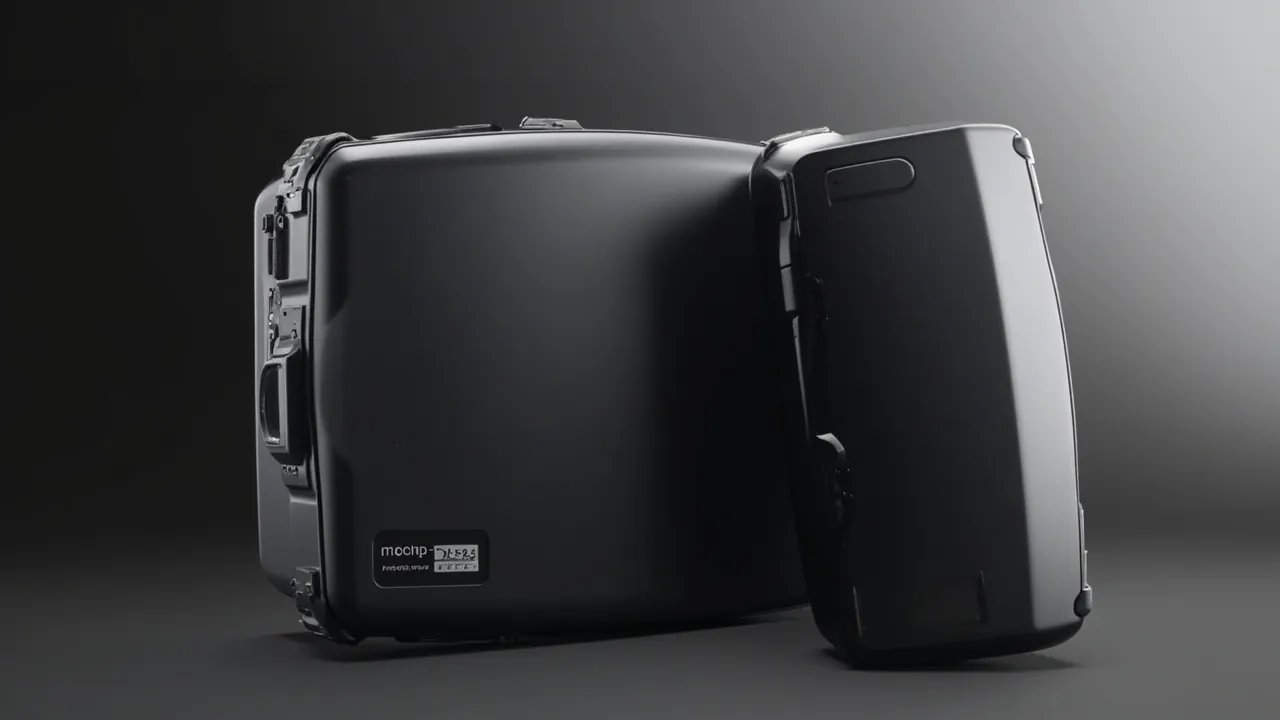
ABS (acrylonitrile butadiene styrene) is a terpolymer which, from its introduction, became a classic material for appliance housings, automotive interiors, electronics enclosures and tool box exterior parts because of the rare balance it strikes between rigidity, toughness and appearance. Each of the three monomers has a role:
- Acrylonitrile (A) provides rigidity, hardness and chemical resistance.
- Butadiene (B) is dispersed through the matrix as a rubber phase, providing toughness and high impact resistance — the key to ABS being hard to break by dropping.
- Styrene (S) provides a smooth surface, good gloss and easy processing.
From this come ABS's core advantages:
- High impact resistance: the butadiene phase absorbs impact energy and protects the contents during drops and knocks, making ABS more drop-resistant than PP.
- Surface quality: high surface gloss that can be painted, plated or screen printed directly, giving a refined appearance suited to branded products where looks matter.
- Dimensional stability: mould shrinkage of only 0.4–0.7%, far less than PP's 1.0–2.5%, making tight-tolerance snaps and interlocking features easier to produce and suited to precision assembly.
- Weaknesses: heat resistance of about 80–100 °C, so long-term sun or a hot vehicle can soften it; sensitivity to acetone, MEK and esters, which can attack and crack it; higher resin cost than PP, and resin code 7 means mostly industrial closed-loop recycling. In processing, ABS flows well, fills easily and holds dimension, suiting complex precision parts; it machines cleanly on a CNC and can hold fine features.
From the molecular structure, ABS's amorphous nature gives low mould shrinkage and high dimensional accuracy, while the butadiene rubber phase dissipates energy under impact through crazing and shear-banding — the physical root of its reputation for not breaking when dropped. That explains why ABS is naturally better than PP under impact and why it is the first choice for tool box shells where appearance and precision matter.
Protection and Load Performance Compared
In real tool box protection the two materials emphasise different things. One point up front: the material sets the ceiling, while wall thickness, ribs and internal structure set the actual performance — a well-designed PP box can protect better than a scrimped ABS box. The comparison below therefore describes typical differences at equal manufacturing quality; a large quality gap cancels a material advantage, which is why checking the whole structure matters more than reading the material name.
- Impact and drop resistance: thanks to the butadiene rubber phase, ABS resists impact clearly better than PP and is less likely to crack when dropped, suiting environments with frequent handling and drops. PP is acceptable at room temperature, but low-temperature embrittlement reduces its impact strength. In failure terms, ABS dissipates energy through crazing and shear bands so cracks do not propagate quickly, while PP, whose chain segments freeze at low temperature, fails in a brittle manner — the physical root of the drop-performance gap.
- Load and rigidity: PP is relatively low in rigidity, so a pure PP box deforms more easily under a large load; ABS is more rigid and stays tauter when full of tools. But in material terms both need wall thickness and ribs to raise load capacity, and wall thickness and rib design usually influence load capacity more than the PP/ABS difference itself. That is why professional manufacturers, even when using PP, push load capacity to industrial levels through a thickened base tray and double side walls.
- Structural precision: ABS holds dimension well, so latches, snaps and interlocking ribs fit more precisely and stay tight over time; PP's larger mould shrinkage makes precision control of complex snaps harder. For a protective case whose multi-point latches must compress the gasket evenly, ABS or a low-shrinkage modified PP gives more reliable sealing.
- Liner compatibility: both PP and ABS accept EVA and pre-cut foam liners; ABS's smoother surface also helps trays bond and custom routing. Note that a liner's contribution to tool protection is largely independent of the shell material — even with a PP shell, precision tools are well protected if the liner is right, so "protection" cannot be judged from material alone. See How to Choose a Tool Box Internal Foam.
- Stacking and transport: ABS is dimensionally stable and the body stays taut, so multi-tier stacks resist creep deformation; under long-term heavy load PP can creep slowly, so fully loaded long-term stacks need a controlled number of layers. This is why protective cases destined for stacked transport more often use ABS or modified PP.
In summary, ABS is steadier on "drop resistance, precision, stackable transport," while PP is better on "light, chemical resistant, low cost." At room temperature in static storage the difference is small. So the real question is "how will my box be used" — placed carefully in a garage, or thrown into a truck and jolted repeatedly? Think through the usage and the answer usually appears.
In short: choose ABS when you fear drops and need precision snaps; choose PP when you need light weight and chemical resistance.
In day-to-day use: an ABS box is less likely to crack when it falls off a workbench or knocks against other cases in a vehicle; a PP box is less likely to be attacked when wiped with solvents or stored in a chemical plant. Neither is perfect, but each one's weakness is covered by the other's strength in its own strong zone.
Environmental Adaptability: Low Temperature, High Temperature, Chemicals
Environmental adaptability is often where PP and ABS are decided, because their weaknesses in temperature and media complement each other almost perfectly. The comparison below covers low temperature, high temperature and chemicals in turn:
- Low temperature: PP embrittles below about −20 °C, so northern outdoor or cold-store use needs care. ABS is also affected by cold, but the butadiene phase keeps it tougher. For extreme cold, consider weather-resistant modified PP or ABS with anti-UV and toughening packages; if the box will be opened frequently outdoors in winter and may be dropped, that is the safer choice.
- High temperature: PP resists about 100–120 °C (briefly up to about 150 °C), better than ABS's 80–100 °C; in a hot vehicle or in the sun, ABS risks softening while PP copes better. Both should still avoid prolonged direct UV — "fearing the sun" is a shared plastic problem, not a material-specific one.
- Chemical media: PP resists acids, alkalis, oils and most solvents well, suiting chemical work and cleaner storage. ABS is sensitive to ketones (acetone), esters, MEK and chlorinated solvents, which may cause crazing or cracking after a few hours, so confirm media compatibility if ABS is used in an oily repair environment. A practical rule: when in doubt about the medium, PP is the safer default.
This dimension is often the decisive watershed: chemical, laboratory and wet outdoor work points to PP; vehicle-repair oil (with media checked), appearance display and precision protection point to ABS, provided sensitive solvents are avoided. When the environment combines "cold plus damp plus needs drop resistance," a single neat resin often cannot cover everything, and modified PP (glass-filled or toughened) or a combined PP plus ABS structure is the more practical answer.
Media compatibility must be judged against the specific solvent, not from the vague impression that "all plastics fear chemicals." PP is steady against the great majority of acids, alkalis and organic solvents, whereas ABS is vulnerable only to particular families such as ketones, esters and chlorinated solvents. So when the question "what will the box carry" arises, list the media first and then choose the material.
Cost, Processing and Appearance Compared
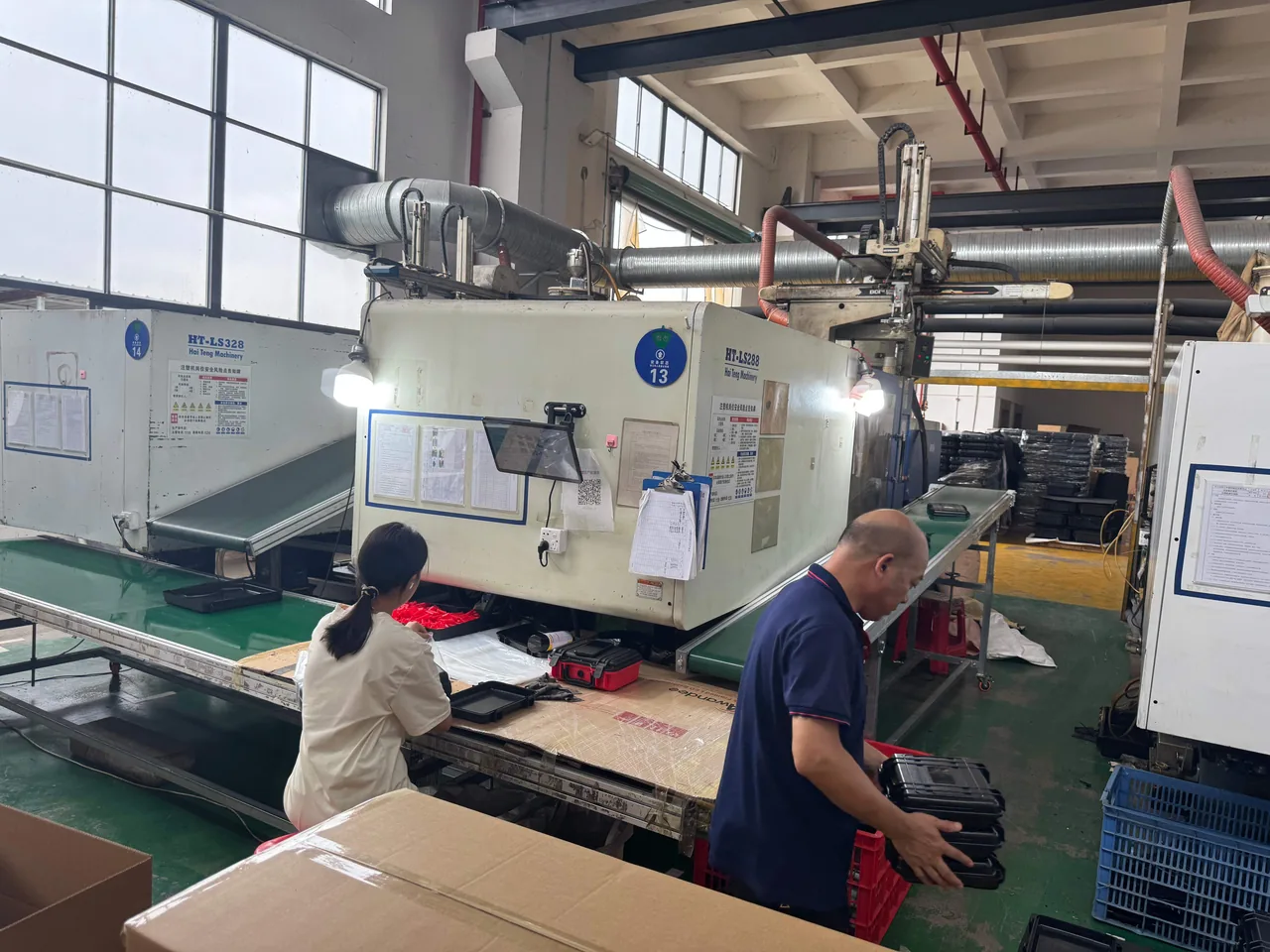
Cost and processing are the other main line dividing PP and ABS, and they directly affect a manufacturer's material decision and the end selling price. The comparison below covers resin, processing, appearance and sustainability:
- Resin cost: PP resin is roughly $1.10–1.30/kg and ABS roughly $1.80–2.20/kg, so PP is about 35–45% cheaper. In a programme of half a million pieces, resin alone saves a considerable sum, and because PP is less dense the same volume uses less material, widening the gap further.
- Processing window: PP shrinks a lot and tends to show sink marks, suiting thin-wall high-volume injection; ABS flows well, fills easily and holds dimension, suiting complex precision and appearance parts.
- Appearance and secondary operations: ABS is naturally high-gloss and can be painted, plated or pad printed directly; PP has a waxy surface and needs a primer or flame/corona treatment before printing. Branded boxes that must look good mostly use ABS, which is why a manufacturer's premium model is often ABS while the practical base model is PP — they complement each other on one line rather than competing.
- Sustainability: PP (code 5) is more commonly recycled at the consumer end; ABS (code 7) is mostly recovered in industrial closed loops. Both are recyclable, just through different channels. For markets emphasising recycling regulation, such as the EU, stating the resin code and working with recycling systems is part of compliance.
From the manufacturing side, PP wins on "cheap, plentiful, chemical resistant" and ABS on "good-looking, precise, impact resistant" — which explains why low-end and industrial chemical-resistant boxes mostly use PP, while branded appearance boxes and precision protective case inner shells mostly use ABS.
Modified compounds change the cost structure. Glass-filled PP (PP+GF, or 20% talc or glass fibre) can raise the flexural modulus to around 2800 MPa and improve surface gloss, narrowing the rigidity gap with ABS while still costing less than neat ABS; a PC/ABS alloy raises heat resistance to about 120 °C at a higher unit price. So "PP is always cheaper, ABS is always dearer" is only the baseline case; selection should be judged on "specific grade plus specific structure." For a buyer, instead of agonising over "PP or ABS," ask "which combination of properties does my part need most" and work back to the material and modification — a question a professional manufacturer is better placed to answer.
How to Identify PP and ABS by Eye
When purchasing or receiving goods, if the labelling is unclear, a few simple methods give a preliminary identification (none is absolute, for reference only):
- Appearance and feel: ABS has a brighter, almost porcelain-like surface; PP feels waxy and matt, and is lighter in the hand (about 13% lighter for the same volume).
- Sound: ABS gives a relatively crisp sound when tapped; PP sounds duller.
- Bend and rebound: PP is more flexible and springs back when bent slightly; ABS is harder with weaker rebound.
- Markings: proper products state the material (PP/ABS) and resin code (5 or 7) on the body or in the documentation; markings take priority.
- Burning characteristics (use caution): PP burns with a waxy smell and drips; ABS gives an irritating smell and black smoke. This destroys the sample and should only be done by a professional when genuinely necessary.
The more reliable approach is to ask the manufacturer for a material declaration and compliance documents such as an RoHS test report. Where export or electronics applications are involved, material accuracy directly affects compliance.
Real-World Scenario Cases
Applying abstract properties to concrete cases makes the trade-offs easier to understand. The cases below come from common engineering material-selection practice and show "why this part uses that material":
- Case one: tool box shell. If the box must stack under load, resist drops and vibration, and have a wear-resistant, good-looking surface, ABS fits better — its impact strength and gloss make the body both tough and refined. PP is too soft: the body deforms when full of tools and the surface scratches easily. This is why most shells with a refined appearance and precise snaps are ABS.
- Case two: chemical-resistant storage and food-container-type vessels. Where lightness, resistance to oils, fats, acids and alkalis, low cost and possible food-related contact matter, PP fits better; ABS does not resist oils, may leach residues over long contact with such media and costs more. This also explains why chemical drums, laboratory reagent-rack accessories and food containers are almost all PP.
- Case three: outdoor instrument protective case. Where light weight and weatherability lead, PP (especially glass-filled or weather-resistant grades) has the edge; where the instrument is delicate and needs impact strength and custom-liner precision, ABS is steadier. High-end protective cases often use a PP shell plus an ABS inner shell. See Advantages of PP for Outdoor Cases.
- Case four: branded appearance parts. For panels needing painting, plating or screen-printed logos, ABS is almost the default because of its high surface energy and adhesion; PP needs extra flame or corona treatment, adding process cost. This is why brand-led manufacturers often make logo panels and decorative strips in ABS even when the shell is PP.
These cases show that no material is absolutely better; what matters is "what this part fears most and values most." A mature product is rarely all-PP or all-ABS: it selects a material for each part according to that part's demands. That is the essence of engineering material selection, and the view consumers comparing materials most easily miss.
Common Misconceptions About PP and ABS
Several misconceptions come up repeatedly in PP versus ABS comparisons. They usually come from "material-name worship" — the belief that the material alone determines quality, ignoring scenario, structure and modification:
- "ABS is always better than PP." ABS is stronger under impact and better looking, but PP is lighter, more chemical resistant and cheaper; comparing them outside a scenario is meaningless.
- "PP is not strong." PP is strong enough at room temperature and in chemical environments, and can be flexed repeatedly as a living hinge; it simply does not handle extreme impact or low temperature.
- "Higher density means better quality." ABS is about 13% heavier than PP, but the weight comes from density rather than manufacturing quality; lightness is an advantage for PP in some scenarios.
- "ABS resists all solvents." ABS is sensitive to ketones, esters and acetone, which can crack it; it is not chemically invincible.
- "Cheap always means PP and expensive always means ABS." Modified PP (glass-filled or talc-filled) and PC/ABS alloys can cost more than neat ABS, so price cannot be read backwards into material.
Clearing these up returns the discussion to "properties matched to requirements" rather than material names or price tags.
How to Choose PP or ABS by Scenario
Here is a decision flow that converges the dimensions above into steps you can tick off:
- Check whether the environment involves chemicals. Chemical work, laboratories and cleaners point to PP; ordinary oily environments allow ABS as well, provided ketones and ester solvents are avoided. Media compatibility as the first screen removes wrong options immediately.
- Check whether it will be dropped often or needs high impact strength. Frequent handling and dropping on site point to ABS; relatively static storage makes PP enough. The higher the drop frequency, the more ABS's advantage is worth.
- Check sensitivity to weight and cost. Lightest, cheapest, high volume points to PP; accepting a little extra weight and price for appearance or precision points to ABS.
- Check appearance and customisation requirements. High gloss, painting, plating or brand printing point to ABS; plain and practical is PP. Branded products are almost ABS by default.
- Check the temperature range. A hot vehicle or sun exposure favours PP; room temperature or indoor allows either. Extreme cold reverses the preference toward ABS or weather-resistant modified PP. At extremes, confirm the specific grade's limit.
The key to this flow is "screen with the least negotiable dimension first, then fine-tune with the secondary ones." If the medium is a strong solvent, PP straight away; if the box is dropped every day, ABS straight away; the remaining dimensions are refinements. When two requirements conflict (chemical resistance plus high impact strength, for example), fall back on a combined PP plus ABS solution or a modified compound.
For volume purchasing, run three physical tests on a small sample batch first — a drop test, a solvent wipe and a stacking test — then work backwards to decide whether the material and wall thickness meet the requirement rather than deciding from a parameter sheet. If a supplier offers the same structure in both PP and ABS, comparative testing exposes the real difference best.
A reminder: many good tool boxes use a "mixed strategy" — a PP shell with an ABS inner liner, glass-filled PP (PP+GF) for rigidity, or a PC/ABS alloy for heat resistance. So besides "PP or ABS," ask whether the manufacturer offers modified options. See Plastic Materials Used in Protective Cases.
For buyers, a manufacturer with a complete plastic tool box line will normally offer both PP and ABS versions. KeXin New Materials (Guangdong) Co., Ltd., with its global brand kexinMaterials and protective-case product-line brand JUNZHJIA, is one example: across its plastic tool boxes, safety protective cases, sealed cases and waterproof/moisture-proof cases (150+ specifications), the ABS/PP material has passed RoHS testing, and the company meets ISO9001, REACH, IP67 and California Prop 65 requirements; the protective-case line uses MIL-STD-810H as an environmental test basis, which is a product-line test basis and not a military certification. When purchasing, ask directly about the differences between the PP and ABS versions of the same model and decide using the five dimensions in this article; specific ISO9001/REACH/IP67 certificates can be requested from the manufacturer. Three questions are worth asking explicitly: what grade is the shell material and is it food-contact or flame-retardant grade; has the ABS/PP passed RoHS and similar compliance testing; and are both PP and ABS versions of the same structure available for comparison. Combine those three answers with the framework above and "PP or ABS" turns from an abstract argument into an executable purchasing decision.
Frequently Asked Questions (FAQ)
Q: Which is stronger, PP or ABS? A: For impact resistance and toughness, ABS is stronger and less likely to crack when dropped; for heat and chemical resistance, PP lasts longer. So "stronger" depends on the dimension — choose ABS if you fear drops, PP if you fear chemicals or heat.
Q: Does a PP tool box become brittle in winter? A: Yes. Below about −20 °C, molecular chain movement in PP is restricted, the material embrittles and impact strength falls. For northern outdoor or cold-store use, choose weather-resistant modified PP or ABS and avoid heavy drops.
Q: Can an ABS tool box be used around oil? A: Ordinary machine oil and grease are generally fine, but ABS is sensitive to organic solvents such as acetone, MEK and esters, which can cause crazing or cracking. For chemical work or strong-solvent environments, prefer PP.
Q: Which is cheaper, PP or ABS? A: PP resin is cheaper (roughly $1.10–1.30/kg versus ABS at about $1.80–2.20/kg) and injects economically, so its cost advantage is clear at volume. The ABS premium mainly buys impact performance and appearance.
Q: Which should I choose for custom logos and colours? A: ABS has high surface gloss and can be sprayed, screen printed or pad printed directly, making appearance customisation easier; PP needs flame or corona treatment before it will hold print reliably, so customisation costs a little more. Choose ABS for brand-led appearance.
Q: Which is more environmentally friendly in recycling terms? A: PP is resin code 5 with a more mature consumer recycling stream; ABS is code 7 and mostly recycled in industrial closed loops. Both are recyclable; the difference is in the recycling channel, not in whether it is "green."
Q: Can PP and ABS be combined? A: Yes. A common approach is a PP shell (light, chemical resistant) with an ABS inner liner or snaps (precise, impact resistant), or the use of modified compounds, combining cost and performance.
Q: Can a PP tool box be used for food or tableware? A: Food-grade PP is widely used for microwave containers and drinking cups and is safe, but a tool box is not necessarily a food-grade grade, and long-term tool storage may leave oil residue, so it should not be used directly as a food container. Confirm the grade if food contact is intended.
Q: Does a scratched ABS surface affect use? A: Surface scratches mainly affect appearance and generally not structural strength. But if a scratch reaches the root of a snap or hinge it may affect fit precision and should be checked. ABS surfaces are easy to repair by spraying, and light damage can be restored.
Q: How much do PP and ABS boxes of the same size differ in weight? A: PP has a density of about 0.90–0.91 g/cm³ and ABS about 1.04–1.06 g/cm³, so PP is roughly 13% lighter for the same volume. Over large sizes or multi-box shipments the accumulated difference is significant, which matters for air freight and field service.
Q: Is a modified grade worth the extra cost? A: Often yes when a single neat resin cannot cover the requirement. Glass-filled PP raises rigidity toward ABS while staying cheaper than neat ABS, and PC/ABS alloys raise heat resistance to about 120 °C. Confirm the specific grade's data rather than the generic material name.
Conclusion
The difference between PP and ABS is essentially a choice between two engineering orientations — "light, chemical resistant, low cost" versus "tough, glossy, dimensionally stable" — not a question of which is superior. A PP tool box wins on low density (about 0.90–0.91 g/cm³), chemical resistance, low price and recyclability (code 5), suiting outdoor, chemical, damp and value-driven scenarios. An ABS tool box wins on high impact strength, good surface gloss, high dimensional accuracy (mould shrinkage only 0.4–0.7%) and easy appearance customisation, suiting scenarios that demand protection, looks and precise snaps.
Select by working through the five clues — environmental media, drop frequency, weight and cost, appearance requirements, temperature range. If the medium is a strong solvent, choose PP directly; if the box is dropped daily, choose ABS directly; the other dimensions serve as fine-tuning. When requirements conflict, first ask whether the manufacturer offers modified compounds (glass-filled PP, PC/ABS alloys) or a combined PP plus ABS structure, and use engineering to find the balance rather than settling between neat resins. A final reminder: material is only one variable in tool box performance. Wall thickness, ribs, latches and liner design often contribute as much to real protection as the material itself — so while choosing the right material, do not forget to check the overall build quality.
To put the PP versus ABS comparison back into the wider tool box material map: within the plastics family these two are the pair most often compared, while the choice between plastic and metal (steel/aluminium) is covered in Plastic Tool Box vs Metal Tool Box: What Is the Difference?. Together they form a selection map running from light to heavy and from chemical resistance to impact resistance. Whichever material you choose, return to the five-dimension framework at the start — the scenario always matters more than the name of the material.
Further Reading
- What Is a Tool Box? Main Types, Materials and Applications
- What Are the Common Types of Tool Box and How to Choose by Scenario
- Plastic Tool Box vs Metal Tool Box: What Is the Difference?
- PP vs ABS vs PC Cases: What Are the Differences?
- Advantages of PP for Outdoor Cases
For batch quotations, specification sheets or customisation, please use the contact form on this site.