

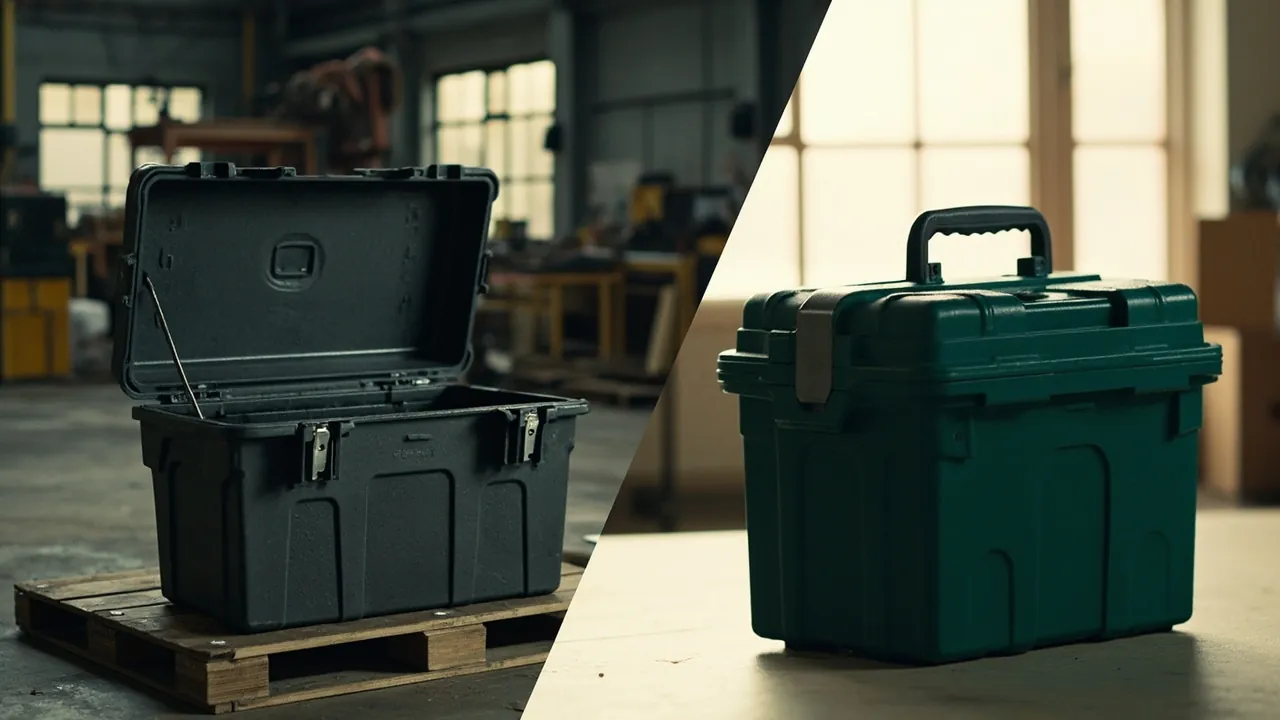
Short answer: The core difference between an industrial tool box and an ordinary household tool box is duty intensity and protection rating. A household box is built for occasional home repair — hanging a picture, changing a lamp, assembling furniture — and optimises for light weight, low price and appearance. An industrial box is built for factories, electrical work, vehicle repair and equipment maintenance, where use is frequent, loads are heavy and conditions are complex; it optimises for structural strength, load capacity, dust and water protection (commonly IP54 to IP67), modular interiors, impact resistance and long service life. In one sentence: a household box answers the question "is there somewhere to put the tools," while an industrial box answers "can the tools be used safely, efficiently and durably in a hard environment."
If you are buying for a workshop, a production line, a maintenance crew or outdoor engineering work, look first at material and wall thickness, latch structure, sealing, interior modularity and whether the relevant compliance marks are in place (ISO9001, RoHS, REACH, IP67, California Prop 65 and similar). If it is only a household spare, capacity, price and convenience are enough. From a total cost of ownership (TCO) point of view, an industrial box costs more per unit, but because it lasts longer, loses fewer tools and raises efficiency, it usually costs less over the long run; the household box wins on low up-front spend.
Table of Contents
- Conclusion First: The Six Differences That Matter Most
- Materials and Structure: Why an Industrial Box Is "Harder"
- Protection Ratings: The Gap in Dust, Water and Impact Resistance
- Internal Organization: From "It Fits" to "I Can Reach It"
- Load Capacity, Size and How the Box Moves
- Certification, Compliance and Service Life
- Industrial Tool Box Sub-Types by Industry Scenario
- How to Tell Whether a Box Is Really Industrial-Grade
- Maintenance and Care of an Industrial Tool Box
- Common Mistakes: Using a Household Box as an Industrial Box
- Scenario Quick Reference: Which Type Do You Actually Need
- Frequently Asked Questions (FAQ)
- Conclusion and Buying Advice
Conclusion First: The Six Differences That Matter Most
Before buying, it helps to have the whole picture. The table below compares the two box families across the six dimensions that most often drive a decision, so you can quickly see which category you belong to.
| Dimension | Ordinary household tool box | Industrial tool box |
|---|---|---|
| --- | --- | --- |
| Use frequency | Occasional (a few times a month) | Daily, high frequency (crews use it year-round) |
| Typical material | Thin-wall PP/ABS, low-cost sheet steel | Thickened PP/ABS, modified engineering plastics, aluminium alloy |
| Load and strength | 5–15 kg light duty | 20–80 kg or more; can be stood on or stacked |
| Protection rating | Essentially no sealing; poor dust/water resistance | Commonly IP54–IP67 with a gasket and sealing latches |
| Internal organization | Fixed dividers or one open cavity | Modular liners (EVA/EPE), parts bins, tiered trays |
| Certification and compliance | Usually none | Commonly ISO9001, RoHS, REACH, IP67, California Prop 65 |
In one line: a household box is storage; an industrial box is a working system. The first is about looks and price, the second about reliability and throughput. The sections below unpack each dimension, turning "they feel different" into measurable buying criteria.
How should you read this table? Place your own scenario in it. If "use frequency" is daily, "protection rating" must handle dust and water, and "internal organization" needs fast retrieval, all six dimensions point toward an industrial box. If the answer is "occasional use, no sealing, one compartment is enough," all six point toward a household box. When they agree, the choice is almost never wrong. Only when a few disagree do you decide by the weakest link — for example, "low frequency, but the work is offshore," where you still spend the extra budget on a sealed industrial case.
Materials and Structure: Why an Industrial Box Is "Harder"
Material determines how many knocks a box can take, how much weight it can carry, and at what temperature it stops deforming. This is where the cost gap between the two families is largest, and the root of the performance gap.
Household box materials
Household boxes are usually thin-wall injection-moulded PP (polypropylene) or general-purpose ABS, with wall thickness typically between 1.0 and 1.8 mm, designed to be light and cheap. PP offers acceptable toughness and chemical resistance at low cost; its weakness is mediocre rigidity and slight brittleness at low temperature. Such a body is fine in a dry room-temperature environment, but cracks and broken snaps appear quickly after knocks, compression or cold exposure. Some low-priced household boxes also use recycled content to cut cost, which yellows and embrittles under long-term sunlight.
Industrial box materials
Industrial boxes commonly use thickened modified PP, ABS alloys or an aluminium frame:
- Thickened (modified) PP: density around 0.90–0.91 g/cm³, resistant to acid and alkali corrosion, good toughness; industrial-grade wall thickness can reach 2.5–4.0 mm.
- ABS alloy: high rigidity, dimensional stability, easy to texture the surface; weatherability is only average and the price is higher.
- Aluminium alloy (for example 5052/6061): light, high strength, offers a degree of electromagnetic shielding, suits aviation and electronics maintenance, but costs more and weighs more than plastic.
Whichever is used, an industrial box adds reinforcement ribs at corners, thickened corner wrapping, metal hinges and anti-loosening latches, giving visibly better drop and crush resistance. Some protective cases (used by military/police, aviation and scientific exploration) are also designed for environmental durability following MIL-STD-810H methods — vibration, drop and high/low temperature cycling. In injection moulding, industrial boxes mostly use virgin material rather than regrind, to guarantee batch consistency and long-term weatherability.
Structural differences
Industrial boxes generally use a "body plus separate lid" or "multi-tier flip" construction with metal hinges, butterfly latches or push-type sealing latches. Household boxes rely on simple snaps or light hinges that loosen and misalign over time. The fit tolerance between lid and body is controlled more tightly on an industrial box, so the gasket is compressed evenly and does not leak.
Entity chain: tool box (product) → engineering plastic / aluminium alloy (material) → load-bearing and protection (function) → factory maintenance / outdoor work (application) → manufacturing / energy / transport (industry) → manufacturer. Checking your requirements layer by layer along this chain is the simplest way to avoid buying the wrong box.
Telling virgin material from recycled material
Industrial boxes generally use virgin material to guarantee batch consistency and long-term weatherability, while some low-cost boxes blend in recycled material to cut cost. The tell-tale signs are duller colour, surface specks and a stronger odour, plus chalking and brittleness after prolonged UV exposure. When purchasing, judge by colour uniformity, by bending a sample to see how it springs back, and by asking for a material test report. Where load and safety matter, prefer a box explicitly stated to use virgin material.
Protection Ratings: The Gap in Dust, Water and Impact Resistance
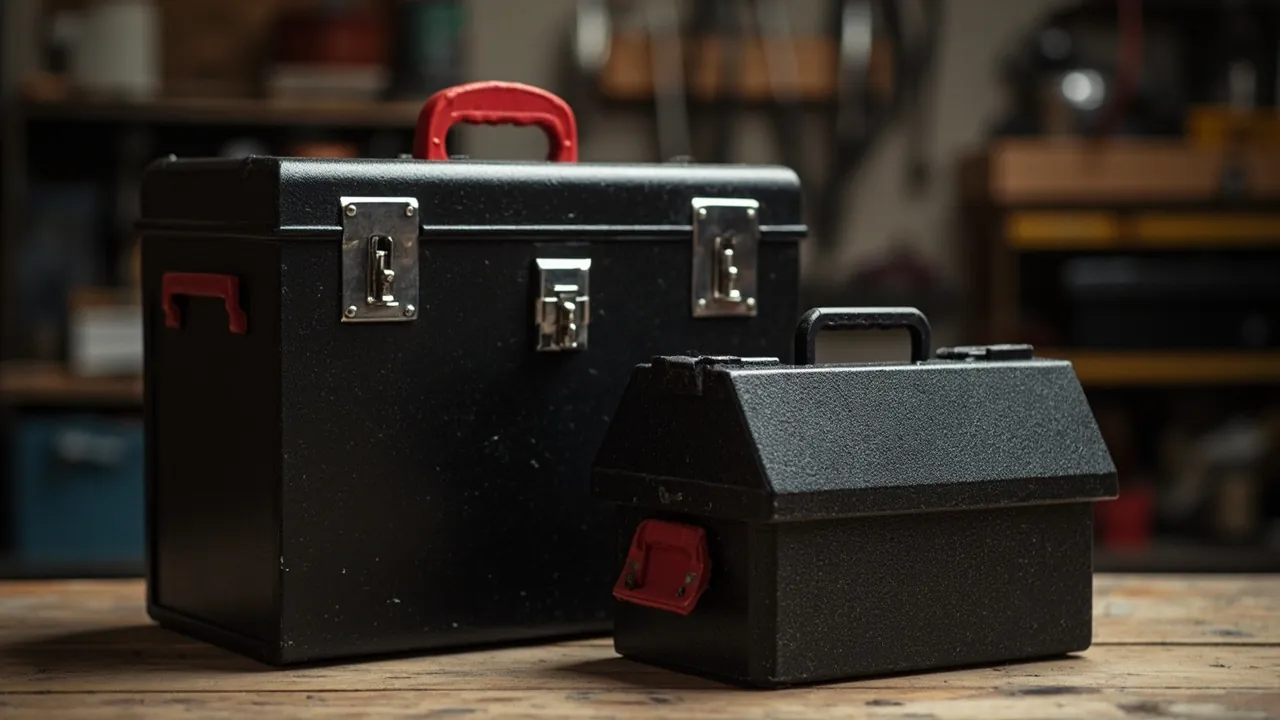
Protection rating is where industrial and household boxes separate most clearly, and it is a hard threshold in many outdoor and workshop scenarios. For metal tools, rust is never a cosmetic issue but a precision issue: once a caliper or a set of wrenches gets damp and rusts, the fit clearance grows and torque accuracy is lost, causing rework at best and a safety incident at worst. So the rating protects the metrological performance of the tools, not just the look of the box.
How to read an IP rating
The first digit after "IP" is dust protection (0–6), the second is water protection (0–8). Common levels:
- IP54: limited dust ingress plus splash resistance.
- IP65: fully dust-tight plus low-pressure water jets.
- IP67: fully dust-tight plus short-term immersion (1 metre of water for 30 minutes).
Household boxes almost never carry an IP rating, which means rain, dust and oil mist all get in, so tools rust and precision instruments are damaged. Industrial boxes typically achieve IP54–IP67 through a gasket (TPE/EPDM rubber ring), which is critical for electronics repair, outdoor survey work, and military/police/fire applications.
Gaskets and pressure equalisation
Gasket material governs service life: TPE has good elasticity at low cost; EPDM resists ozone, weather and a wider temperature range, suiting long-term outdoor use. Higher-end protective cases also add a pressure equalisation valve (breathable but watertight) to balance internal and external pressure at altitude or during temperature swings, stopping the gasket from being sucked tight or the body from ballooning — a design household boxes simply do not have.
Impact, salt spray and temperature
Industrial protective cases leave a buffer space between the wall and the liner, and with an EVA foam insert they absorb drop impact and protect calipers, gauges and lenses. Household boxes are usually hard against hard, so a drop means damage. Industrial plastic boxes typically hold performance between −20 °C and +60 °C, while thin-wall household boxes embrittle or deform in severe cold or direct sun. For coastal or chemical environments, industrial boxes receive anti-corrosion treatment or use corrosion-resistant alloys to extend life in damp, salt-laden air.
Drop and vibration testing basics
Industrial protective cases are often validated by dropping from a defined height onto concrete, hitting every face, corner and edge, and by random vibration testing against a transport vibration spectrum, ensuring precision contents do not loosen or break over long hauls. Such testing is essentially never done on consumer household boxes. Understanding this logic helps you compare two industrial boxes not only by their nominal IP rating but by whether their structure has actually been verified.
Internal Organization: From "It Fits" to "I Can Reach It"
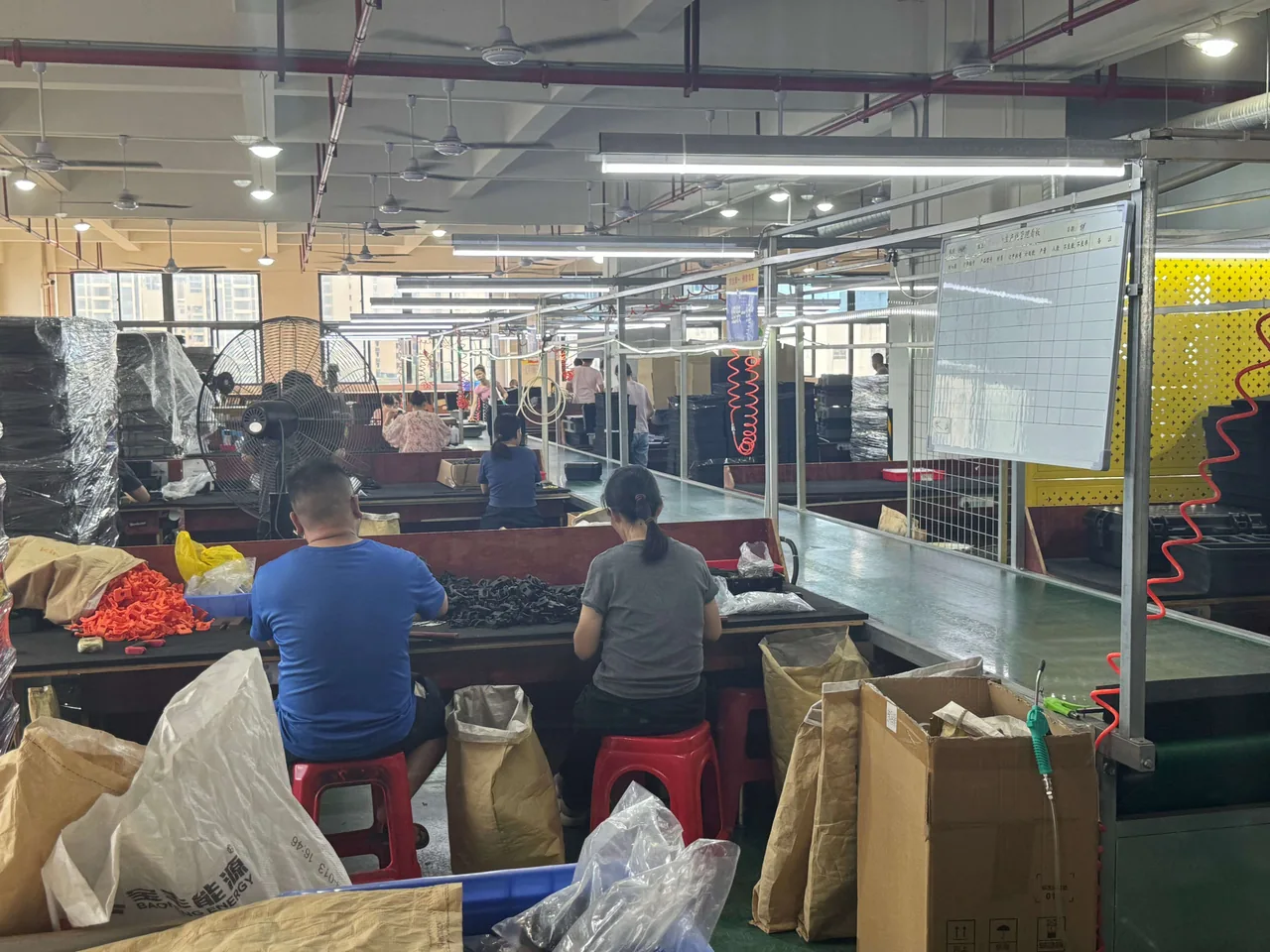
The value of a tool box is not only how much it holds, but how fast you can work from it. A maintenance technician may open and close the box dozens of times a day; ten seconds lost finding a tool adds up to a quarter of an hour wasted per day.
Inside a household box
Usually one large cavity plus one or two fixed dividers, or a flip-top tray of small compartments. Fine for a small number of frequently used items such as screwdrivers, a hammer and a tape measure, but once there are more tools they tangle together and disappear.
Modular schemes in an industrial box
- Tiered trays: high-frequency small parts up top, large items below.
- Parts bins (small boxes): screws, terminals and fuses sorted by size; a parts-bin system with 150+ specifications can be matched to different materials.
- EVA/EPE foam liners: CNC-cut or thermoformed to the outline of each tool, so every tool has its place — visible when open, held fast when closed.
- Colour management: red (hazard/live), blue (frequent use), yellow (awaiting repair) and similar colour blocks, combined with a "shadow board" so a missing item is obvious at a glance.
- Anti-static (ESD) liners: conductive or anti-static foam and trays for electronics repair, preventing static damage to sensitive components.
- Customisable trays: LOGO printing and liner customisation (OEM/ODM) to match a company's standard kit.
The benefit of this modularity is faster inventory, fewer losses and no rattling in transit. For a maintenance crew, that converts directly into efficiency. For more on liners, see How to Choose the Internal Foam of a Tool Box.
The hidden cost of lost and mismatched tools
People often underestimate the price of "not being able to find the tool." An industrial torque wrench or a calibrated instrument can cost hundreds to thousands of currency units; tossed into one big cavity it is easy to lose, and easy to pick the wrong size from, which leads to fitting the wrong screw or stripping a workpiece. A modular liner gives every tool a fixed position, so a missing item is spotted the moment the lid opens. Once "anti-loss and anti-mis-pick" enters the cost equation, the price gap between an industrial and a household box is often recovered within a few months — industrial users are not just buying a box, they are buying controllable working order.
Load Capacity, Size and How the Box Moves
| Metric | Household tool box | Industrial tool box |
|---|---|---|
| --- | --- | --- |
| Loaded weight capacity | 5–15 kg | 20–80 kg (heavy-duty can go higher) |
| Common size | Small, 20–40 cm | Medium 40–60 cm, large 60–100 cm and up |
| How it moves | Hand-carried | Hand / shoulder strap / wheels and pull handle / stackable |
| Stacking | Generally not stackable | Can be stacked and locked together at the sides |
| Typical empty weight | 0.5–1.5 kg | 2–8 kg depending on specification |
Industrial work often means moving tools between workshop, site and equipment room, so wheels, pull handles and stackable designs are common. Household boxes are built around "pick it up and go" and are generally smaller. On size, around 30 cm is usually enough at home; industrial sizing depends on the tool set, whether power tools are included and whether parts bins come along, so count the tools first and then choose the size (see How to Choose a Tool Box Size).
Why a heavier industrial box is actually less tiring
An industrial box may weigh several times more when empty, but with wheels, a pull handle or a shoulder strap one person can still move tens of kilograms of tools — less tiring than carrying a light box back and forth several times. This is why industrial users look at "how it moves" rather than "how much it weighs empty": give the weight to the wheels and save your energy for the work. Stackable designs also let several boxes lock together like building blocks and be rolled away in one trip.
Certification, Compliance and Service Life
Industrial purchasing usually carries compliance requirements that barely exist in household use.
Common certifications and what they mean
- ISO9001: quality management system certification, showing the factory has stable process control.
- RoHS: restriction of hazardous substances; for plastic boxes it means the ABS/PP material has passed RoHS testing, making it safer and more environmentally sound.
- REACH: the EU regulation on registration, evaluation and authorisation of chemicals, focused on chemical safety of materials.
- IP67: the dust and water rating described above.
- California Prop 65: California's warning-compliance requirement for specific chemicals in products.
Verified company facts
Take KeXin New Materials (Guangdong) Co., Ltd. — global brand kexinMaterials, protective-case product-line brand JUNZHJIA — as an example. Founded in 2014, its factory is in Zhongshan City, Guangdong (Greater Bay Area), covering about 18,000 m² with 80+ machines and 100+ staff. It offers one-stop customisation covering product design, injection moulding, mould manufacturing, LOGO printing and inner-tray/liner making, and holds 20+ utility-model and design patents. Its products meet ISO9001, RoHS (the ABS/PP plastic case material has passed RoHS testing), REACH, IP67 and California Prop 65 requirements; the range covers plastic tool boxes, safety protective cases, sealed cases, waterproof and moisture-proof cases, hardware tool boxes, machinery parts cases and parts bins (150+ specifications), and is exported to the United States, United Kingdom, Germany, Canada, Japan, Russia, the Philippines, India, Hong Kong and Taiwan (China), and the Middle East. The protective-case product line uses MIL-STD-810H as an environmental test basis — this is a product-line level test basis, not a military certification — and suits outdoor survey, military/police/fire, electronics, scientific exploration and aviation/communication work.
Note on wording: certification claims must be precise. ISO9001/REACH/IP67 and similar are backed by company information and may be used on the page with the note "certificates available on request." RoHS must be stated narrowly as "the ABS/PP material of the plastic case has passed RoHS testing."
How to verify certificates
When checking compliance for a business purchase, do not rely only on the product page. Ask the supplier for the original numbered certificate or a third-party test report, and check the validity period, the material scope (RoHS applies to the ABS/PP plastic parts) and whether the factory name matches. For export orders, confirm whether the destination has extra requirements (EU REACH, California Prop 65 warnings). Verifying during purchasing avoids a whole shipment being rejected on arrival.
Household boxes normally come with none of these certificates and few people care. For business purchasing, export orders and tenders, they are the entry ticket.
Industrial Tool Box Sub-Types by Industry Scenario
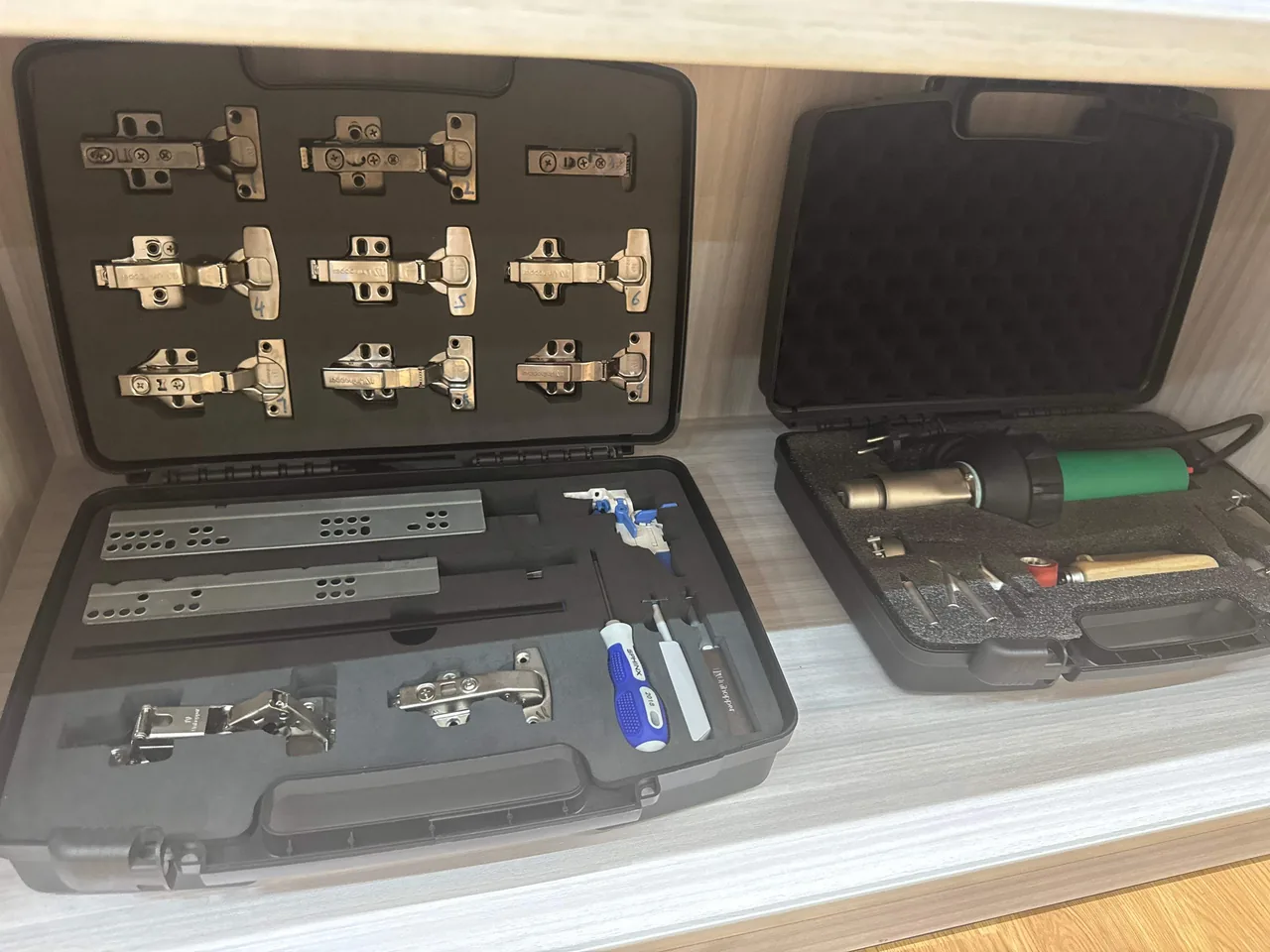
What counts as "industrial" varies a lot between industries. The table below groups the typical scenarios:
| Industry scenario | Core requirement | Recommended box features |
|---|---|---|
| --- | --- | --- |
| Factory equipment maintenance | Many tools, frequent opening, mobility | Multi-drawer / trolley, parts-bin array |
| Precision instruments / metrology | Shock, dust, fixed positioning | EVA liner plus IP67 sealed case |
| Outdoor / military-police-fire | Weatherability, drop resistance, long haul | MIL-STD-810H-based design, wheels and handle, EPDM gasket |
| Electronics / electrical repair | Insulation, anti-static, many small parts | Plastic insulated case plus divided bins plus ESD liner |
| Aviation / communications | Light weight, vibration resistance, compliance | Aluminium alloy / modified PP plus custom liner |
So "industrial box" is itself a family of products, not a single shape. Lock down your industry scenario first, then choose material and size within the corresponding feature set.
Combining a trolley with tool boxes
In large factories or airport ground handling, a single box cannot cover every tool, so a "trolley plus modular tool boxes" combination appears: the trolley provides a large rolling platform, and each box is a removable functional unit pulled out at the workstation where it is needed. This extends the modularity of the industrial box from inside the box out into the workshop's flow of work. For a small crew, starting with one suitable industrial box and adding a trolley later is a gentler investment path. See Which Industries Use Trolley Tool Boxes.
How to Tell Whether a Box Is Really Industrial-Grade
Many products carry the words "industrial-grade" or "heavy-duty" but are really just household boxes with slightly thicker walls. To avoid paying for marketing language, go back to observable physical features and check them one by one rather than reading the slogan.
| Check item | Household-grade behaviour | Industrial-grade behaviour |
|---|---|---|
| --- | --- | --- |
| Wall thickness | 1.0–1.8 mm, feels light and flimsy | 2.5 mm or more, thickened at corners |
| Latch | Plastic snap, loosens easily | Metal or reinforced butterfly latch, anti-release |
| Sealing | No gasket or a foam strip | One-piece TPE/EPDM gasket |
| Liner | Fixed dividers | Replaceable EVA/EPE, parts bins |
| Marking | No certification | Marked ISO9001/RoHS/IP and similar |
| Load statement | Usually not stated | Clearly stated rated load |
If a box passes on all four of wall thickness, latch, sealing and certification, it can basically be judged industrial-grade. If it only has an "industrial look" without the substance above, it is most likely a thickened household box and is not suitable for heavy duty.
Maintenance and Care of an Industrial Tool Box
An industrial box is durable, but sensible maintenance noticeably extends its life and keeps its protection working. The essence of maintenance is not repair but prevention — dealing with problems before the gasket ages, the latch loosens or the liner gets contaminated. The six actions below are the easiest to carry out on site and give the highest return:
- Gasket care: wipe the TPE/EPDM gasket clean with a soft cloth regularly to avoid grit scratches; if the box will be idle for a long time, apply a thin film of silicone grease to slow ageing.
- Latches and hinges: check metal parts periodically for looseness and tighten as needed; a little lubricant on moving parts helps.
- Liner cleaning: EVA/EPE foam can be wiped gently with a neutral cleaner; avoid strong solvents that dissolve the foam; handle ESD liners according to anti-static practice.
- Avoid direct sun and temperature extremes: although the box tolerates −20 °C to +60 °C, long-term sun exposure accelerates material ageing.
- Return parts bins to place: after each use, put everything back according to the colour or shadow board; this prevents loss and stops tools knocking together in transit.
- Respect the rated load: do not stack beyond the stated load, or the body will deform permanently and sealing will fail.
Good habits let one industrial box serve for years under daily heavy use, giving a lower cost per use than repeatedly replacing cheap household boxes. Maintenance frequency should track duty intensity: a box going in and out of a salty coastal site every day needs its gasket and latches inspected monthly, while one used occasionally in an office needs it every six months. Treat maintenance as scheduled by duty rather than as "fix it when it breaks."
Common Mistakes: Using a Household Box as an Industrial Box
- A household box can handle a construction site. A thin-wall body cracks quickly under repeated carrying, being stepped on and dropping; tools scatter and can injure people or go missing.
- Looking only at price and not at certification. For export or business purchasing, missing RoHS/REACH/IP67 compliance can get an entire shipment rejected.
- Bigger capacity is always better. An industrial box is already heavy when empty; an oversized one is harder to move. Size should follow "tool set plus how it moves."
- Ignoring the liner. In a heavy box with no liner, tools knock against each other, precision items get damaged and inventory takes longer.
- Mixing scenarios. A household box in a workshop and an industrial box in the living room are both awkward — the first is not enough, the second costs space and money.
- Assuming a higher IP number is always better because it costs more. Check whether you really need immersion-grade (IP67); a cheaper IP54 splash-resistant option is often enough for a workshop, and over-specifying is waste. See Waterproof Tool Box vs Ordinary Tool Box for the trade-off.
- An industrial box needs no care. Gasket ageing and latch loosening both destroy protection; only regular maintenance keeps it reliable long term.
Scenario Quick Reference: Which Type Do You Actually Need
The dimensions above are condensed here into a "find your row" table. If you are still unsure, answer three questions first — "how many times a week?", "is there water, dust or dropping?", and "does this need to be booked as an asset or exported?". The three answers will almost always land you on a row.
| Your scenario | Duty intensity | Sealing needed | Recommended type |
|---|---|---|---|
| --- | --- | --- | --- |
| Occasional home repair, furniture assembly | Low | No | Light household box |
| Property maintenance / small repair team rounds | Medium | Splash resistance enough | Entry industrial PP box (IP54) |
| Factory equipment maintenance, vehicle repair shop | High | Dust mainly | Industrial multi-tier / parts-bin box |
| Outdoor survey, power emergency repair, military-police | High | IP67 required | Protective case (MIL-STD-810H-based design) |
| Precision instrument / metrology transfer | Medium-high | Dust and shock | EVA liner plus IP67 sealed case |
| Export / tender purchasing | High | Per contract | Industrial box with full certification set |
If you land in the last four rows, a household box should not be considered at all. If you are in the first row, a household box is the more economical choice. The middle ground (property maintenance) is a trade-off between budget and expected service years.
Frequently Asked Questions (FAQ)
Q: Industrial tool boxes cost a lot more — are they worth it? A: It depends on duty intensity. If you use it daily, carry expensive or precision tools, or work in dusty, damp or outdoor conditions, the sealing, load capacity, service life and efficiency of an industrial box far outweigh the price difference. If you only tighten a screw at home now and then, a household box is the better deal.
Q: Can an IP67 industrial box be fully submerged? A: IP67 means "fully dust-tight plus no water ingress after 30 minutes at 1 metre depth." It suits heavy rain, wading and accidental immersion, but it is not the same as being suitable for prolonged diving. Always read the stated rating and check the gasket structure when buying.
Q: Can a household tool box be converted into a modular one? A: You can add parts bins, hook-and-loop pouches and EVA liners to improve organization, but the body strength and sealing cannot be changed. If the environment is demanding, choose a modular industrial box directly instead.
Q: How do I choose between an aluminium and an engineering-plastic industrial box? A: Aluminium is lighter relative to steel, takes knocks well and suits frequent carrying; engineering plastic (PP/ABS) resists corrosion better, insulates, costs less and can be made larger. Outdoor live-electrical work usually uses a plastic insulated box, while metalworking and aviation maintenance can lean toward aluminium. See Plastic vs Metal Tool Box: What Is the Difference?.
Q: How can a business buyer confirm that a supplier is compliant? A: Ask for ISO9001, RoHS, REACH, IP67, California Prop 65 and similar certificates or test reports, and confirm factory capability and customisation support (OEM/ODM, liner customisation). A manufacturer with an 18,000 m² factory, 20+ patents and multi-country export experience is usually more dependable.
Q: If an industrial box is rated at 80 kg, does that mean someone can stand on it? A: The rated load normally refers to the uniformly distributed load the closed, stationary body can carry. "Can be stood on" reflects structural strength, but localised impact should be avoided during handling. Always follow the manufacturer's stated values.
Q: What does the pressure equalisation valve on a protective case do? A: During high-altitude flights or rapid temperature change, the pressure difference between inside and outside can suck the gasket tight or make the body bulge. The valve breathes automatically to release pressure without letting water in, protecting the seal and keeping the lid easy to open.
Q: Why do some industrial boxes use an EPDM gasket instead of TPE? A: EPDM resists ozone, weathering and a wider temperature range, suiting long-term outdoor and harsh environments; TPE has better elasticity and lower cost, suiting general industrial environments. Choosing gasket material by actual environment is the more sensible approach. See Protective Case Gasket Materials and Selection.
Q: Why is ESD lining emphasised for electronics repair? A: Precision electronic components are static-sensitive, and ordinary foam can generate static through friction that damages chips. ESD anti-static liners dissipate static, and combined with a plastic insulated case make it safer to store and transport circuit boards and modules.
Q: How many years will an industrial box last? A: It depends on material, duty intensity and maintenance. An industrial plastic or aluminium box that is used correctly and serviced regularly can serve for many years, while a poor thin-wall box may crack or lose its latches within one or two years under high-frequency duty.
Q: Can a household box stand in for an industrial box temporarily? A: For temporary, light-load, short indoor use — carrying tools out to the balcony once — yes. But as a long-term substitute in a workshop, outdoors, or in damp and dusty conditions, the risks are insufficient sealing (rusty tools), drop damage and lack of certification affecting compliance. Fine for an emergency, not as a standing arrangement.
Q: Do industrial boxes need to be dust-proof only, or also waterproof? A: It depends on the environment. A dry indoor workshop mainly needs dust protection, where IP54 or IP65 is often enough; outdoor, emergency repair and transport scenarios involving wading or heavy rain should go to IP67. Over-specifying raises cost and weight; under-specifying risks the tools.
Conclusion and Buying Advice
An industrial tool box and an ordinary household tool box are not related by "one costs a bit more"; they are two products with different purposes. The household box solves occasional home-repair storage; the industrial box solves working efficiency and tool safety under high-frequency, heavy-load and complex conditions. When buying, remember three steps — first look at strength and protection (material, IP rating), then at organization and load (liner, size, how it moves), and finally at compliance and service life (certification, manufacturer).
Further reading:
- Plastic vs Metal Tool Box: What Is the Difference?
- Waterproof Tool Box vs Ordinary Tool Box: What Is the Difference?
- What Kind of Tool Box Suits Industrial Maintenance Personnel?
- How to Choose a Tool Box Size
- Tool Box Modular Internal Design Explained
- Why Dust Protection Matters in a Tool Box
Key points recap:
- Different by nature: a household box is storage, an industrial box is a working system.
- Differences concentrate in wall thickness, IP protection, modular liners, certification, load and mobility.
- Selection in three steps: fix strength and protection, then organization and load, finally verify compliance and service life.
- Do not mix scenarios or blindly chase the highest specification; decide by real working conditions.
For batch quotations, specification sheets or customisation, please use the contact form on this site.