

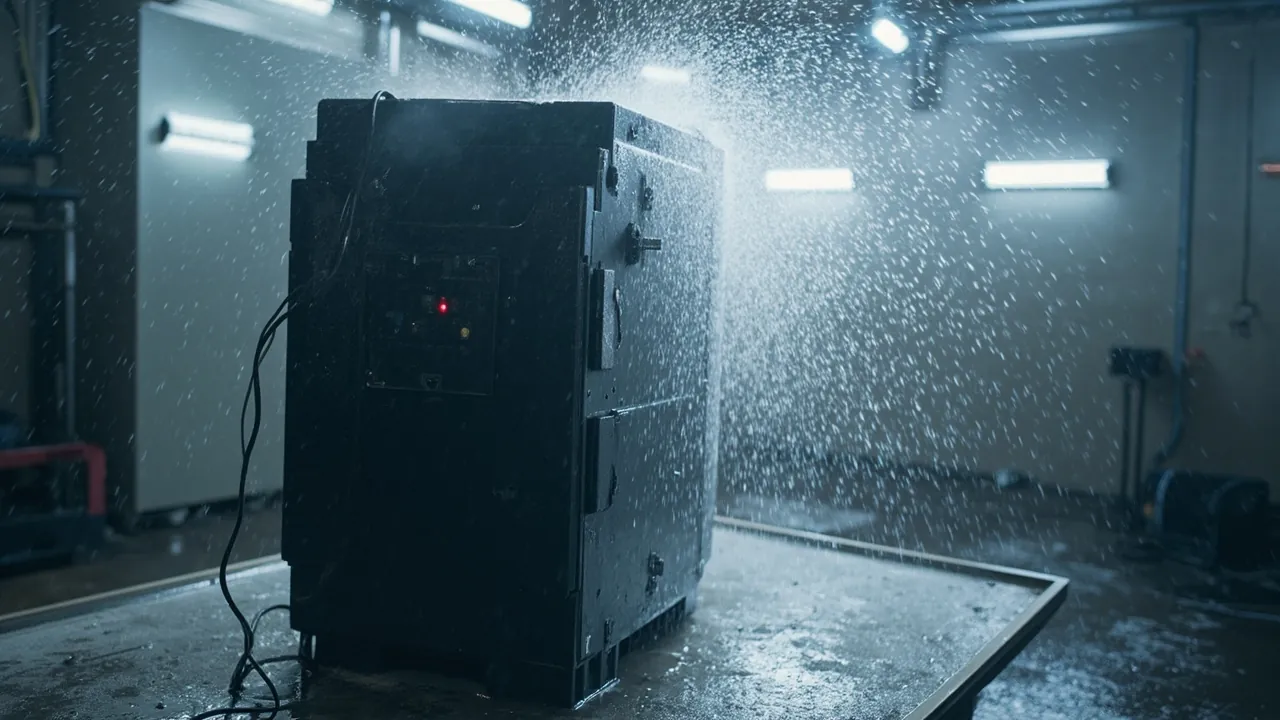
IP67 is an ingress protection classification defined by IEC 60529, the international standard titled Degrees of protection provided by enclosures (IP Code). The first digit, 6, means the enclosure is dust-tight. The second digit, 7, means it can withstand temporary immersion in water under specified conditions - normally one metre of depth for thirty minutes - without ingress in a quantity that would impair safety or operation. For low-voltage equipment deployed outdoors - power supplies for surveillance cameras, fibre termination boxes, remote radio unit feed points on 5G sites, branch joints in street-lighting circuits, temporary distribution nodes on construction sites - IP67 is not a premium upgrade. It is the cheapest way to make sure the installation survives its first rainy season.
Buyers are frequently misled by the label itself. Two enclosures both printed with IP67 can behave completely differently in the field: one stays bone dry for three years, the other corrodes out in six months. The difference almost never lies in the printed code. It lies in whether a genuine type test to IEC 60529 was ever performed, whether the gasket material and its compression are actually matched to the housing, whether the cable entry devices carry the same rating as the box, and whether the plastic can still resist impact and ultraviolet exposure after five winters. This article walks through IP67 from code semantics to field practice: full rating tables, exact test conditions, structural requirements, material trade-offs, a specification workflow, and installation and maintenance checklists written for engineers and procurement staff who need equipment to stay online.
Contents
- What the Two Digits of the IP Code Actually Mean
- Scope and Key Definitions of IEC 60529
- First Digit: Solid Object Protection, Levels 0 to 6
- Second Digit: Water Protection, Levels 0 to 9
- The Exact IP67 Test Method and Pass Criteria
- What IP67 Does Not Mean: Five Costly Misconceptions
- Why Outdoor Low-Voltage Installations Treat IP67 as a Hard Requirement
- The Five Structural Elements Behind a Real IP67 Enclosure
- Cable Glands: The Step Most Installations Skip
- Enclosure Materials: Choosing Between ABS, PP and PC
- A Six-Step Specification Workflow
- Eight Installation Rules That Decide Whether IP67 Holds
- Inspection and Maintenance Schedule
- Frequently Asked Questions (FAQ)
- Closing Notes and Further Reading
What the Two Digits of the IP Code Actually Mean
IP stands for Ingress Protection. Two characteristic numerals follow it. The first numeral expresses protection against access to hazardous parts and against solid foreign objects, ranging from 0 to 6. The second numeral expresses protection against water, ranging from 0 to 9 (often written 9K in automotive and road-vehicle contexts). Where a level has not been tested or is not claimed, the letter X replaces the numeral, so IPX7 declares a verified water rating of 7 with no dust claim at all.
Reading IP67 correctly means taking it apart. The 6 addresses dust; the 7 addresses short-term immersion. In physical terms these two capabilities are delivered by different parts of the design. Dust tightness depends on joint precision, sealing ribs, groove geometry and any membrane fitted to breather vents. Water tightness depends almost entirely on an elastomeric gasket being compressed into a gap. A box whose lid and base meet on a beautifully flat, tightly toleranced face may be dust-tight while leaking like a sieve. A box relying on a thick squishy gasket may pass immersion while its assembly tolerances let fine dust in. Because the two are independent, the standard tests them independently, and a purchase order should do the same.
One more rule deserves attention because it causes endless argument in tender meetings. IP ratings are widely assumed to be automatically cumulative, so that passing level 7 is taken to imply passing levels 5 and 6 as well. IEC 60529 does not support that assumption in general. In particular there is no automatic equivalence between code 7, which is a static immersion test, and codes 5 or 6, which are dynamic jet tests. If a site is exposed to both driven rain and standing floodwater, specify explicit test data for IPX5 or IPX6 alongside IPX7 rather than writing the single word IP67 and hoping it covers everything.
The practical consequence is straightforward. IP67 is a useful shorthand, but it is a shorthand. Every serious specification should be backed by the actual test parameters, and the design review should ask which structure delivers which digit.
Scope and Key Definitions of IEC 60529
IEC 60529, Degrees of protection provided by enclosures (IP Code), is published by the International Electrotechnical Commission. The consolidated version in common use is IEC 60529:1989 together with Amendment 1:1999 and Amendment 2:2013, adopted nationally as GB/T 4208-2017 in China and as equivalent national standards elsewhere. The standard establishes a classification system and the associated test methods for enclosures of electrical equipment rated up to 72.5 kV, covering protection of persons against access to hazardous live or moving parts, protection of equipment against ingress of solid foreign objects, and protection against ingress of water.
Four definitions in the standard matter for everyday work.
The first is enclosure. An enclosure is the part providing protection of equipment against certain external influences and, in any direction, the specified degree of protection. For a junction box this includes the base, the lid, and the seals and fasteners supplied with the product. It may also include cable entry devices where these are declared part of the assembly.
The second concerns the nature of the test. IP verification is a type test. The rating applies to a product type in its as-manufactured, correctly assembled condition. It says nothing about the same model after five years of service, and nothing about the condition created by careless installation on site. This single point explains most of the failures discussed later in this article and in guides covering seal degradation.
The third is the acceptance criterion. Ingress of water is only considered harmful if it reaches live parts or wet insulation such that it could cause tracking, reduce creepage distances, or otherwise impair safe operation. The standard does allow minimal quantities of water in certain cases provided they do not accumulate in a harmful way. A technician opening a box after a test and finding a faint trace of moisture does not automatically have a failed product; what matters is whether any water reached a place where it could create a conductive path.
The fourth is quantification. Water temperature, flow rate, nozzle diameter, standoff distance, test duration, powder concentration, negative pressure, sample orientation and the number of specimens are all specified numerically. Any competent test report for the same code should therefore list the same family of parameters regardless of which laboratory issued it. A certificate that says only passed IP67, with no reference to test method, water temperature, dwell time, sample attitude or standard edition, should be treated as unverified rather than as evidence.
First Digit: Solid Object Protection, Levels 0 to 6
| Code | Object protected against | Summary of test condition | Relevance to outdoor enclosures |
|---|---|---|---|
| --- | --- | --- | --- |
| 0 | No protection | None | Not acceptable outdoors |
| 1 | Solid objects of 50 mm and greater | 50 mm probe must not fully penetrate | Keeps hands out; too weak for low-voltage gear |
| 2 | Solid objects of 12.5 mm and greater | 12.5 mm test sphere | Prevents finger contact with live parts |
| 3 | Solid objects of 2.5 mm and greater | 2.5 mm test rod | Keeps out tools and cable ends |
| 4 | Solid objects of 1.0 mm and greater | 1.0 mm test wire | Excludes most insects and coarse grit |
| 5 | Dust-protected | Talcum chamber, 8 hours, limited dust permitted | Minimum for dusty regions |
| 6 | Dust-tight | Talcum chamber, 8 hours, no dust permitted | Default for outdoor low-voltage |
The test for code 6 suspends two kilograms of talcum powder per cubic metre of chamber volume and draws air from inside the enclosure so that a reduced pressure exists within it. The standard limits the depression to no more than 2 kPa and requires that no visible dust has entered when the enclosure is opened after eight hours. That sub-atmospheric condition is the single most important feature of the test. It reproduces the pumping effect an enclosure experiences every day as it warms and cools: cool air is drawn in through whatever microscopic path exists, carrying whatever dust happens to be suspended near it. Boxes that merely look tight in a static inspection routinely fail here.
For low-voltage installations, dust rarely kills equipment outright. It kills it slowly, through three mechanisms. The first is conductive filming: dust absorbs moisture and forms a weakly conducting layer across terminals and printed circuit tracks, raising leakage current until a controller browns out or a data link starts throwing errors. The second is optical contamination: a single particle resting on a fibre adapter end-face can lift insertion loss enough to drop a link margin. The third is bridging: conductive swarf from grinding or machining creates a genuine short between terminals.
None of these three modes shows up at commissioning. All of them show up in year two. Specifying the first digit honestly as 6 is therefore one of the cheapest reliability decisions available, costing essentially nothing at purchase time and saving repeated truck rolls later.
Second Digit: Water Protection, Levels 0 to 9
| Code | Short name | Summary of test condition | Typical field equivalent |
|---|---|---|---|
| --- | --- | --- | --- |
| 0 | Non-protected | None | Dry indoor locations |
| 1 | Vertically dripping water | 10 minutes at 3 mm per minute | Condensation under a roof |
| 2 | Dripping water at 15 degrees | Shell tilted 15 degrees, 2.5 minutes per position | Water running off a surface |
| 3 | Spraying water | Oscillating tube plus or minus 60 degrees, 10 minutes | Light rain, process spray |
| 4 | Splashing water | Oscillating tube plus or minus 180 degrees, 10 minutes | Splashing from any direction |
| 5 | Water jets | 6.3 mm nozzle, 12.5 litres per minute, 3 metres | Vehicle washing, low-pressure rinsing |
| 6 | Powerful water jets | 12.5 mm nozzle, 100 litres per minute, 3 metres | Deck washdown, high-pressure spraying |
| 7 | Temporary immersion | One metre for 30 minutes under stated conditions | Flash flooding, short-term submersion |
| 8 | Continuous immersion | Deeper than one metre; depth and duration agreed between supplier and user, stricter than code 7 | Vault boxes, permanently submerged joints |
| 9 | High-pressure hot water | 80 degrees Celsius, 8 to 10 megapascals, multiple angles | Food processing and vehicle cleaning bays |
The precise wording for code 7 deserves quoting carefully. The lowest point of an enclosure with a height less than 850 mm is to be located 1000 mm below the surface of the water; the top of the enclosure is to be located at least 150 mm below the surface. The duration is 30 minutes. Where the manufacturer declares a different immersion depth, that figure must appear in the report. The water temperature must not differ from the temperature of the equipment under test by more than 5 kelvin, and the sample is normally expected to be at a temperature close to the water before immersion begins. This temperature requirement exists to suppress a false failure mode: dropping a hot enclosure into cold water creates a sharp internal pressure drop that can suck water past a gasket which would happily have held under normal conditions.
The table also makes visible something many specifications get wrong. Code 6 and code 7 evaluate different physics. A labyrinth-style drainage design can be superb against jets and hopeless in immersion. A deeply compressed face gasket can hold immersion for an hour and yet be levered open by a focused jet striking the lid seam at three metres. Sites that see both typhoon-driven rain and urban flooding need evidence for both. This complementarity is explored further in our comparison of enclosure ratings for wet climates.
The Exact IP67 Test Method and Pass Criteria
Anyone who reviews supplier documentation should be able to check a report against the following sequence.
Step one, sample preparation. The test specimen must be a production item manufactured by the normal process, complete with gasket, fasteners and any cable glands or blanking plugs supplied. It is assembled in the condition defined by the manufacturer's instructions. Where several outlet configurations exist for the same model, either the least favourable configuration is tested or each variant is tested separately. Where no other rule applies, three specimens are usual.
Step two, preconditioning and order. Where both digits are claimed on the same specimen, the dust test for the first numeral should be performed before the water test for the second, because powder exposure can alter the condition of sealing surfaces. The report should state the order used.
Step three, immersion. A tank large enough to keep the water level stable for the whole dwell is required. Maintain at least the specified cover: the lowest point of the enclosure 1000 mm beneath the surface and the top of the enclosure at least 150 mm beneath it. Hold for 30 minutes. Record water temperature and specimen temperature at the start, with a difference no greater than 5 kelvin.
Step four, assessment. IEC 60529 permits assessment by one or more methods: opening the enclosure and visually checking for accumulated water; performing a dielectric strength test and insulation resistance measurement on any internal circuits; or verifying that no water has reached live parts or formed a path along insulation that would compromise safety. The chosen method should be named in the report.
Step five, reporting. A competent type test report names the applicant and manufacturer, shows the model designation, includes a photograph, cites the edition of the standard, identifies the laboratory and its accreditation scope such as CNAS or CMA recognition, records depth, duration, water temperature and sample attitude, and states the result unambiguously.
A rough field screen can be run at goods-in without a laboratory. Fit all unused entries with genuine blanks, close and latch the lid, place a dry tissue inside, lower the empty enclosure on a cord to one metre of depth in a tank, and hold it there for thirty minutes. Lift it out, dry the outside thoroughly, then open it and inspect the tissue. This is not a substitute for type testing: there is no temperature control, no standardised criterion and no accreditation. It is nonetheless extremely effective at rejecting obvious seal defects, a wrong batch of gaskets or a distorted lid before hundreds of units go into the ground. Do not perform this check on energised equipment, and never on a unit with visible cracks, since a crack yields a false result either way.
What IP67 Does Not Mean: Five Costly Misconceptions
Misconception one: IP67 means permanent submersion is acceptable. Code 7 is defined as temporary immersion and tested for thirty minutes. Anything continuously underwater, such as a joint in a pumping station wet well or underwater lighting feeder, needs IP68, and the specific depth and duration must be promised by the manufacturer in writing, because the standard itself fixes no numbers for level 8. Our companion article on the one-metre immersion test is covered in detail in our immersion test analysis.
Misconception two: IP67 covers high-pressure jetting. The immersion rating describes behaviour under static head. It says nothing about performance under a directed jet. Coastal installations in typhoon belts need both attributes verified. The practical differences between codes are set out in our IP67 versus IP65 comparison.
Misconception three: IP67 lasts forever. Type tests are verdicts on new products. Ultraviolet radiation, ozone, compression set, thermal cycling and simple age all degrade elastomers. Latches loosen. Transparent lids develop stress cracks. Service life is a function of compound formulation and maintenance, not of what happened in a tank one afternoon.
Misconception four: IP67 prevents condensation. Keeping water out and preventing internal dew are different problems. When the daily swing cools the shell below the dew point of the trapped air, water condenses on internal surfaces, sometimes to the point of dripping. This breathing condensation appears even in a perfectly sealed box. Mitigation is a combination of fewer penetrations, hydrophobic breather membranes, desiccant packs changed on a schedule, and in stubborn cases a small heater or hygrostat. The mechanism is analysed at length in our article on why outdoor enclosures take water.
Misconception five: printed IP67 implies tested IP67. Claims are sometimes inferred from appearance or borrowed from a similar model. Insist on four things: the referenced standard edition, a traceable test report number, photographs showing the actual configuration including glands, and confirmation that the specimen was a production unit rather than a hand-built prototype. JUNZHIJIA builds its sealed enclosure range at the kexinMaterials plant in Zhongshan, Guangdong, and supplies corresponding IEC 60529 documentation, dimensional drawings and gasket specifications for OEM and ODM customers to file for traceability.
Why Outdoor Low-Voltage Installations Treat IP67 as a Hard Requirement
Low-voltage equipment carries little power but high consequence. Its vulnerability comes precisely from operating at low voltage. A twelve-volt surveillance front end can be knocked offline by leakage across terminals bridged by damp salt-laden dust, whereas a mains circuit in the same location would hardly notice. A fifty-dollar box protecting a five-thousand-dollar radio unit, camera or controller is the worst possible place to economise.
Field conditions attack sealing systems in four distinct ways.
The first is direct and wind-driven rain. In storm season, rain arrives near horizontally and dwells on vertical faces for hours. Any unpreloaded vertical seam becomes a water gallery.
The second is standing water and short flooding. Basement ramps, excavation edges, smart poles along canal banks: water levels can rise tens of centimetres or more within half an hour. One metre for thirty minutes maps exactly onto the most common failure event, which is a box submerged to roughly half its height for part of an afternoon.
The third is sustained humidity and dew. In monsoon and coastal regions, relative humidity sits above ninety per cent for weeks, with ten to fifteen kelvin of diurnal swing depositing moisture nightly on cold terminals and plastic walls. This is a corrosion mechanism independent of immersion.
The fourth is snowmelt and freeze-thaw. Runoff enters the termination chamber along the cable, freezes overnight, expands, and prises the sealing faces apart by a measurable amount. The spring thaw then delivers the second round. This regime demands not only IP67 but also base materials that stay ductile at minus thirty or even minus forty degrees.
IP67 earns its place in tender documents not because it is extreme, but because it is the smallest single code that covers the two most destructive and most common of these four mechanisms at once: brief flooding and dust-assisted tracking. It is also cheap, repeatable and universally recognised, which is why security, telecommunications, lighting and renewable-energy specifications have converged on it.
The Five Structural Elements Behind a Real IP67 Enclosure
A genuine IP67 electrical enclosure is not the product of one magic gasket. It is the result of five links holding together as a chain.
First, a continuous sealing interface. There must be an unbroken groove and mating face around the full perimeter. Typical faults occur where a factory-punched cable entry breaks through the sealing land, or where an internal mounting boss sits directly above the groove and locally lifts the lid. Good design places every internal fixing inboard of the dry zone.
Second, an elastomer whose material and compression match the application. The gasket must recover from minus thirty to plus seventy degrees, usually sits in the range of 40 to 60 Shore A hardness, and is normally compressed to between twenty and thirty per cent of its free section height. Below about fifteen per cent compression, low-temperature shrinkage and vibration break contact. Above roughly forty per cent, the compound loses its ability to recover and ages prematurely. JUNZHIJIA samples every gasket batch for compression set before release.
Third, a fastening system delivering stable closing force. Fastener count matters less than fastener spacing and proximity to the seal. A practical rule is to keep the pitch along the gasket under 120 to 150 millimetres and to place additional points near every corner, because corners are where the lid wants to lift first.
Fourth, housing stiffness and flatness. Injection-moulded shells warp during cooling. If warpage exceeds what the gasket can absorb, a gap remains no matter how hard you tighten the screws. Rib patterns, wall thickness control and mould compensation all serve this single goal, and the topic is expanded in our article on waterproof structural design.
Fifth, cable entries of equal rating. This is the element most often omitted and deserves its own section.
Taken together, these five elements show why IP67 is a property of the assembly rather than of a component. Asking only whether a box is IP67 tends to purchase a collection of individually adequate parts forming an inadequate system.
Cable Glands: The Step Most Installations Skip
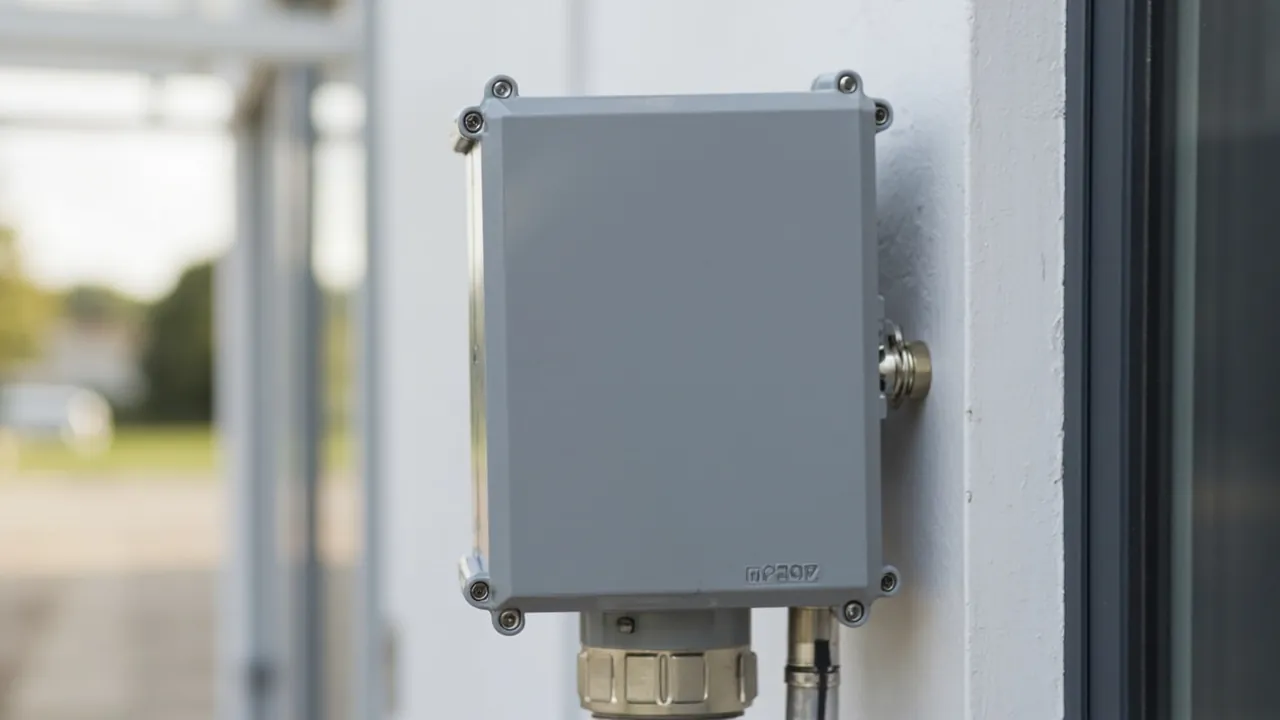
More than half of all returned units never failed through the lid. They failed where the cable enters. The recurring defects are these.
The first is using a fitting with no sealing function at all. A plain rubber grommet protects against abrasion and nothing else; it has negligible resistance to hydrostatic head. What is needed is a compression gland with a sealing insert and a locknut, carrying the same IP code as the enclosure.
The second is mismatching gland and cable diameter. Inserts are dimensioned for a nominal clamping range, for example 4 to 8 millimetres or 6 to 12 millimetres. A cable much thinner than the range will never seal however far the nut is turned. A cable above the range splits the insert and loads the thread.
The third is forgetting the drip loop. Even a correctly torqued gland will allow water to track along the cable jacket under gravity. Bottom entry with a U-shaped drip loop below the gland solves it.
The fourth is leaving unused knockouts open. Multi-entry enclosures are often wired through only two of six positions. Openings that are not plugged are openings in the wall, and they must be closed with a blanking plug of equivalent rating, preferably with an O-ring and thread sealant.
The fifth is wicking along stranded conductors. Some cable constructions leave longitudinal gaps beneath the jacket that carry water to the far end. In critical work this requires a potted break or a water-blocked cable; it is a higher-tier construction measure, but it exists and should be specified when the consequence is severe.
The procurement fix is simple. Request IP67 evidence for the complete assembly rather than for the box alone, with the number and type of entries matching the intended configuration. JUNZHIJIA can pre-machine entries to customer drawings, fit specified gland brands at the factory, and run whole-enclosure verification, removing the uncertainty introduced by field assembly.
Enclosure Materials: Choosing Between ABS, PP and PC
Materials set the second ceiling on how long IP67 can be sustained. The three workhorse thermoplastics compare as follows.
| Property | ABS | Polypropylene | Polycarbonate |
|---|---|---|---|
| --- | --- | --- | --- |
| Density, grams per cubic centimetre | 1.05 to 1.08 | 0.90 to 0.91 | 1.20 |
| Room-temperature stiffness | Good | Moderate, creeps under load | Excellent |
| Low-temperature embrittlement | Around minus 20 degrees Celsius | Below minus 30 in copolymer grades | Still tough near minus 40 |
| Upper service temperature | About 80 degrees, 60 to 70 continuous | Around 100 degrees | Around 120 to 130 |
| Ultraviolet resistance | Moderate, needs stabiliser or coating | Moderate, needs stabiliser | Moderate, careful of stress cracking |
| Dimensional stability | Good | High shrinkage, warp risk | Good |
| Relative cost | Medium | Low | High |
ABS offers stiffness, dimensional stability and an excellent finish for printing and labelling. It suits small and medium enclosures with complex geometry where appearance matters. Its limitation is weathering: unstabilised grades chalk and fade under sustained sun, so specify UV grades or a coating.
Polypropylene brings chemical resistance, low-temperature toughness, low cost and high impact strength, which suits large outdoor housings and rough construction-site duty. The drawback is high mould shrinkage, meaning warp control and seal-face flatness depend heavily on mould compensation; heavy ribbing or glass filling is often needed where stiffness is critical. A deeper comparison sits in our guide to material grades used outdoors.
Polycarbonate delivers exceptional impact strength, better weathering and - uniquely here - transparency, which matters whenever an indicator, meter or display must be read without opening the lid. Its weaknesses are sensitivity to stress cracking under over-torqued fasteners or solvent contact, and the highest material price.
The selection heuristic is: establish the temperature window first, decide whether transparency is needed second, and let cost arbitrate last. Severe cold or frequent thermal shock favours PC or copolymer PP. Mild urban surveillance cabinets in temperate regions are usually best served by UV-stabilised ABS on value. Observation windows, or any location requiring impact resistance at low temperature, point to PC or a PC/ABS blend. The kexinMaterials facility in Zhongshan moulds all three families plus glass-filled variants, and will propose wall thickness, rib layout and grade against the project's stated temperature range and budget.
A Six-Step Specification Workflow
The technical material above condenses into a sequence usable in a design meeting or a purchasing call.
Step one, characterise the worst realistic water event. Continuous submersion calls for IP68. Temporary ponding is adequately served by IP67. Directed high-pressure washing calls for IPX6 data in addition. Most projects blur all three and end up either over-buying or under-protecting.
Step two, identify what is being protected. Passive terminal blocks tolerate an incursion: dry them out and service continues. Active electronics such as a PoE switch or driver does not; one wetting event is terminal, and secondary measures such as internal potting or a water shed shelf become worth considering.
Step three, size the enclosure with genuine margin. Add thirty to forty per cent to the occupied volume. That margin buys working room for terminations and cable dressing, air volume for dissipation, and space for a later surge protective device without replacing the box. A tight fit is hard to work in and traps moisture.
Step four, fix the cable entry plan. Determine the number, size and face of entries from the actual routing. Preference runs strictly bottom, then side, then top. Specify all openings at the order stage so nothing is drilled on site.
Step five, check environmental extras. Ultraviolet exposure on sun-facing elevations, flammability class such as UL94 V-0 or V-2, salt mist where coastal or marine, operating limits beyond the usual minus twenty to plus sixty window, and impact class such as IK07 or IK08. Each of these can change material choice and wall thickness.
Step six, demand evidence and inspect on arrival. Obtain the third-party report referencing IEC 60529 or GB/T 4208, material data sheets including UV and low-temperature figures, and drawings showing gasket material and fastener pitch. On delivery, sample-check for flash and short shots, verify the gasket has no breaks or bubbles and sits continuously, and run the one-metre screen described earlier on a sample.
Completing six steps produces a specification that is neither wasteful nor exposed, and it typically saves several years of callouts.
Eight Installation Rules That Decide Whether IP67 Holds
Even a certified enclosure will be let down by installation. These are the eight failures seen most often.
One, mount on a flat surface. Fixing a box to a twisted pole flange or an uneven wall deforms the housing when the bolts are tensioned and destroys seal-face parallelism. Shim difficult walls, or fit a rigid backing plate.
Two, tighten progressively and diagonally. Taking one screw to final torque immediately tilts the lid. Work in two or three passes across diagonals, finishing at the manufacturer's stated torque, commonly 1.2 to 2.5 newton-metres depending on size.
Three, enter from below with a drip loop. Even a rated gland performs poorly sitting in standing water at the top face. If top entry is unavoidable, add a weather hood or a downturned conduit.
Four, match gland to measured cable diameter. After assembly, a gentle pull should neither rotate nor withdraw the cable.
Five, plug every unused opening. A knockout, once removed, cannot be reinstated. Fit a blank of equal rating with thread sealant or an O-ring version.
Six, never drive screws near the sealing land. Mount rails and terminal boards on the factory bosses, which are structurally within the dry zone. A hole through an external wall is a deliberate water path.
Seven, avoid dissimilar metal contact. Stainless fasteners into an aluminium or galvanised backing plate corrode galvanically in damp conditions; the swelling oxide layer can lift the sealing face. Use insulating washers or matched fastener material.
Eight, leave service slack. Keep the equivalent of at least one spare entry way at the terminal rail and 150 to 200 millimetres of folded conductor length, so a later modification does not require dismantling the whole installation.
Installation is a small share of total project cost and a large share of total outcomes. Nearly every case of we bought a good box and it still leaked traces back to one of these eight lines.
Inspection and Maintenance Schedule
IP67 requires a minimum maintenance routine, not a fit-and-forget attitude. The following schedule is a reasonable default.
| Interval | Item | Acceptable condition | Action if failed |
|---|---|---|---|
| --- | --- | --- | --- |
| Every opening | Gasket position | Seated in groove, no twisting | Reseat, replace if damaged |
| Quarterly | Latch and screw torque | At specified value, no slack | Retighten diagonally |
| Quarterly | Lid distortion, shell cracks | No visible cracking or whitening | Replace cracked parts at once |
| Semi-annual | Internal condensation or water marks | Dry inner walls, no water line | Check breather, add desiccant |
| Semi-annual | Gland tightness and ageing | No cracks or movement of insert | Replace insert or complete gland |
| Annual | Gasket compression recovery | Springs back when pressed | Replace if permanently flattened |
| Annual | Dirt and salt deposits | No grit or salt bloom on the seal face | Rinse and dry-wipe |
| Biennial | Repeat the immersion screen | No ingress | Replace or add secondary protection |
Always replace a gasket with the original equivalent part. A substitute of different hardness or cross-section changes the designed compression and tends to leak sooner, not later. JUNZHIJIA supplies matched spares by model, and bulk orders should always include a spares allowance so that replacements are available years later.
Two everyday practices should be avoided. Do not clean enclosures with a pressure washer: that is an IPX6-level assault outside an IP67 promise. Do not mount a dark-coloured enclosure holding heat-dissipating components in full sun without shading, because internal temperatures can exceed seventy degrees and accelerate gasket ageing dramatically.
Frequently Asked Questions (FAQ)
Q: How much difference is there between IP67 and IP68, and which should I buy? A: IP67 corresponds to temporary immersion, standardised at one metre for thirty minutes. IP68 corresponds to continuous immersion, but the standard assigns no fixed numbers: the depth and duration are whatever the manufacturer declares and the contract records, ranging from two metres for two hours to ten metres for a day. Choose IP67 where the exposure is ponding, flash flooding or brief submersion, since it costs less and covers the realistic event. Choose IP68 only when equipment lives permanently underwater or in a flooded vault, and then insist on a written depth-and-duration commitment supported by a test report rather than accepting the label alone.
Q: Can I pressure-wash an IP67 enclosure? A: Not if you expect the rating to protect you. Code 7 evaluates behaviour under static head, where water is pressed uniformly against the seal. A pressure washer behaves like the code 6 jet test: a twelve-and-a-half-millimetre nozzle delivering around one hundred litres per minute from three metres, which attacks seams mechanically and can lever a lip open. Clean with a damp cloth or low-pressure running water instead. If high-pressure washing is part of routine site maintenance, specify a product verified against both IPX6 and IPX7, or fit an external shield over the enclosure face.
Q: There are water droplets inside my sealed box. Does that mean it leaked? A: In most cases no: it is condensation rather than ingress. A sealed enclosure traps air containing moisture, and when the shell cools below the dew point of that trapped air, water condenses on the coldest internal surfaces. It is most common during humid seasons, in monsoon climates, and at sites with a large day-night temperature swing. Diagnose it by looking at the distribution: droplets spread evenly over the inner walls, concentrated near the lid or near metal parts, with no trail leading to the gasket line, usually indicate condensation rather than leakage. Remedies include reducing the number of cable entries, fitting a breather with a hydrophobic membrane, installing desiccant packs replaced on a schedule, and avoiding frequent opening in humid weather.
Q: How many years does IP67 protection really last? A: The type test verdict applies only to new, correctly assembled products, so field life depends entirely on material quality and environment. With good EPDM or silicone seals and a stabilised housing, five to eight years of effective sealing is realistic in ordinary outdoor service, and the shell itself can exceed ten years. Under intense ultraviolet exposure, coastal salt mist, frequent opening, or sustained high internal temperature, that window shortens to two or three years. Inspect quarterly, test gasket recovery annually, and treat seals as scheduled consumables rather than permanent components. Replacing a twenty-yuan gasket prevents the loss of equipment worth hundreds of times as much.
Q: If I seal the box permanently with silicone, will it finally stop leaking? A: Please do not. Adhesive sealing introduces three problems that outweigh any benefit. It bonds lid to base so that future inspection means destructive opening and often a cracked housing. Silicone adheres poorly to many engineering plastics, polypropylene in particular, and after repeated thermal cycling it peels in strips, leaving irregular gaps that trap water against the joint. Worst of all, it hides the fact that the mechanical seal was never compressed correctly, so the underlying assembly defect continues to grow unnoticed. Use the designed gasket and latch instead, and use removable rated fittings wherever additional protection is needed.
Q: How can I tell whether a supplier's IP67 claim is genuine? A: Ask for four things and read them carefully. First, the exact standard edition cited, which should be IEC 60529:1989 with its 1999 and 2013 amendments or the national equivalent such as GB/T 4208-2017, rather than a bare phrase such as compliant with IP67. Second, a test report from an accredited laboratory carrying the model designation, photographs, immersion depth, duration, water temperature, sample orientation and an explicit pass conclusion. Third, confirmation that the tested configuration matches what you are buying, especially the number of glands and whether blanks were fitted. Fourth, assurance that the specimen was a production unit. JUNZHIJIA provides this complete documentation package for OEM and ODM programmes.
Q: Will an ABS enclosure deform in strong summer sun? A: That is a material question rather than an IP question. ABS typically has a heat deflection temperature near eighty degrees and a continuous service limit around sixty to seventy. A dark enclosure mounted on an unshaded south or west facing wall can indeed exceed seventy internally, softening the shell and allowing the sealing faces to distort, after which the gasket can no longer be compressed evenly. Four mitigations help: choose a light colour or reflective finish; avoid unshaded west-facing positions; move to polycarbonate or glass-filled polypropylene; and add a shading plate or ventilated rain hood. Material selection should always be made against the measured worst-case ambient, not averaged climate data.
Q: Does enclosure stiffness really affect whether IP67 holds? A: Yes, and substantially. IP67 depends on the gasket being compressed evenly around its whole length, which in turn requires that neither lid nor base deflects measurably under closing force. When the housing lacks bending stiffness, the midpoint between two fasteners bows inward, local compression falls below the fifteen per cent threshold, and that spot becomes the leak path. This is exactly why large enclosures carry heavy rib patterns, why fastener pitch is limited to roughly 120 to 150 millimetres, and why corners need extra fixing points. Stiffness design is not cosmetic; it is what turns a nominal IP67 into a working one.
Closing Notes and Further Reading
IP67 is not marketing language. It is a pair of repeatable, verifiable quantities defined by IEC 60529: a first digit of 6 meaning complete dust exclusion under reduced pressure, and a second digit of 7 meaning thirty minutes at one metre without harmful ingress. Knowing which structures deliver each digit, and which installation or maintenance shortcuts destroy them, is what converts a printed code into field reliability.
For outdoor low-voltage work, the junction enclosure is simultaneously the cheapest component in the chain and the one most likely to destroy the rest of it. Shift the procurement question from is it IP67 to was it verified to IEC 60529, is the compression and fastening design complete, do the glands match the enclosure rating, and do chosen materials suit the temperature window. Answer those four well and the code on the label becomes meaningful.
Related Products
- 8 Series — Gun Cases; Military Equipment Cases; Camera Equipment Cases; Drone Cases; Watch Cases; Knife Cases; First Aid Cases; Electronics Equipment Cases
- WL8-2812 PP Gun Case — model WL8-2812
- All protective cases and toolboxes: 7 series, 158 models