

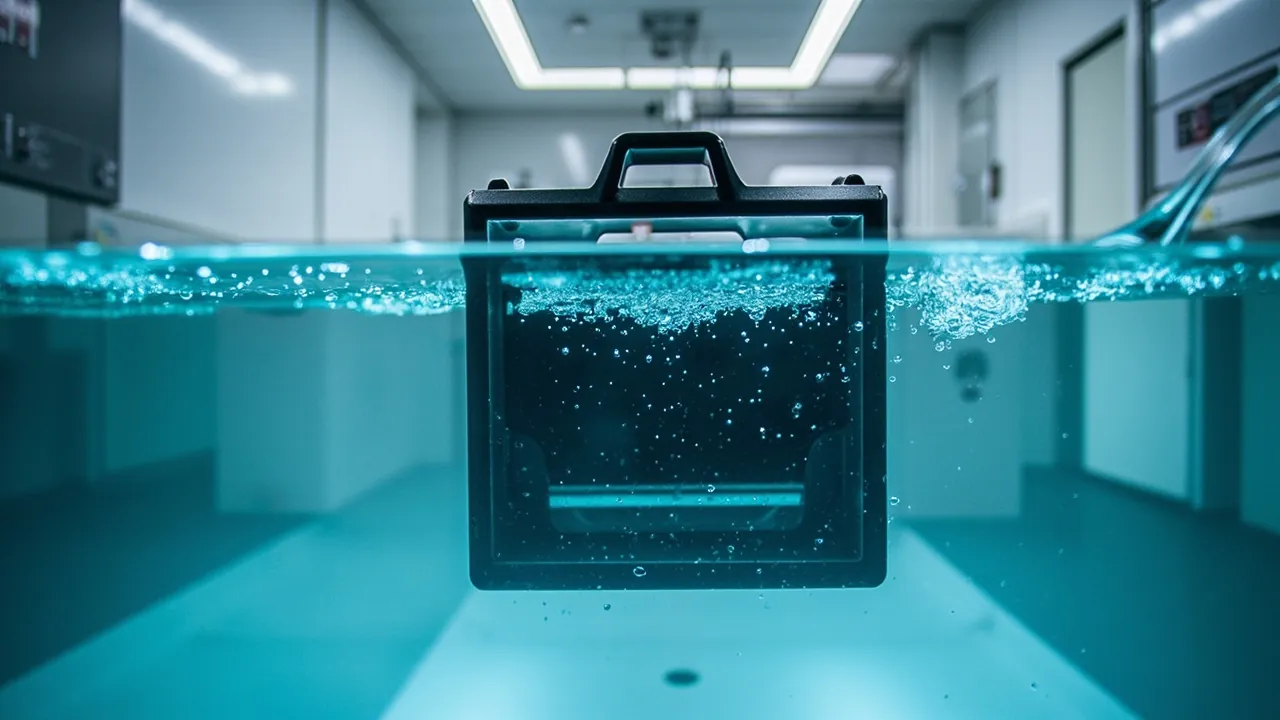
Can this box be put under water? It is the question asked most often in waterproof enclosure sales and answered most evasively. A proper answer has three layers. Yes, it can be immersed, but only in one very specific condition: one metre of water, thirty minutes, fresh and still, at ordinary temperature, in the attitude specified by the manufacturer. No, it is not designed for continuous underwater service. And there is a third point most people never raise: whether the enclosure is still sound after it has been submerged once. Collapsing those three layers into one word is how situations arise which look contradictory but are entirely consistent with the standard, such as a rated IP67 enclosure taking water after a week underwater.
This article sets out the IPX7 method completely: the numbers in the standard, the physics behind them, six variables that change the result, a rough verification routine you can run yourself on site, and nine items that must appear in any credible report. Everything is based on IEC 60529, Degrees of protection provided by enclosures (IP Code), adopted in China as GB/T 4208-2017, combined with what return analysis actually shows in the field. Afterwards you should be able to run a meaningful acceptance check on your own, and to tell within a minute whether a report is substantive or evasive.
Contents
- The Three Numbers in the Standard
- What Pressure One Metre Actually Means
- Why the Standard Limits Temperature Difference to 5 Kelvin
- Complete Test Procedure from Sample to Verdict
- Six Variables That Change the Result
- How IP67, IPX7 and IP68 Differ on Paper
- Where Being Immersable Ends and Being Submersible Begins
- After Immersion: Latent Failure
- Testing It Yourself: What Works and What Does Not
- Nine Items Every Report Must Carry
- Fresh, Salt and Dirty Water
- Five Common Misconceptions
- Frequently Asked Questions (FAQ)
- Closing Notes and Further Reading
The Three Numbers in the Standard
The requirement for characteristic numeral 7 rests on three sentences.
First, position. The enclosure is fully immersed in its service state as declared by the manufacturer, with its lowest point at least 1000 millimetres below the surface of the water and its highest point at least 150 millimetres below it.
Second, duration. Thirty minutes.
Third, temperature. The water temperature must not differ from that of the equipment under test by more than 5 kelvin.
Those three sentences bound everything. Any use beyond them falls outside what IP67 promises, and once understood, most disputes resolve themselves. Someone who says the enclosure sat under water for a week and took water has not shown a defective product: a week exceeds thirty minutes. Someone who sank it to two metres and found leakage after forty minutes has not shown a defect either: only one metre is promised. And someone who threw a sun-heated enclosure into cold water at midday cannot use the result as evidence, because the temperature difference may have exceeded twenty kelvin, far outside the precondition.
One qualification matters. The standard permits the manufacturer to determine certain additional conditions and record them in the report, such as sample attitude, where a product can only be mounted one way, or a greater depth. The first thing to check in a report is therefore how the specimen was put into the water, not merely whether the conclusion says pass. That point is developed in the nine-item checklist below.
What Pressure One Metre Actually Means
Converting depth to pressure helps make sense of the load on the seal.
Hydrostatic pressure follows P equals rho g h. With water at 1000 kilograms per cubic metre and gravity at 9.8 metres per second squared, one metre gives 9800 pascals, approximately 9.8 kilopascals, which is close to one tenth of a bar.
That is a small number, and one metre intuitively sounds unimpressive. Two things make it matter.
The first is persistence. Unlike an instantaneous splash, static head does not go away; it presses on every discontinuity continuously for the whole thirty minutes, giving the medium ample time to penetrate. Seals rarely fail because they cannot withstand the pressure. They fail because they held it for twenty-nine minutes and not for thirty.
The second is that other pressures routinely add to it. Take a real scenario: an enclosure sitting at sixty degrees on a summer afternoon, then drenched by a storm with water at twenty-five degrees. The internal air cools and contracts, developing a pressure below ambient, in the same direction as the external head. For ideal gas behaviour, cooling from 333 kelvin to 298 kelvin contracts the volume by roughly ten per cent, corresponding to close to ten kilopascals. Total differential acting across the seal is therefore around twenty kilopascals, double the figure for one metre alone.
That is precisely why the standard requires the water and specimen temperatures to agree within five kelvin. It is not a convenience. It excludes this confounder so that the result reflects joint geometry and seal quality alone.
A quick reference for field estimates.
| Depth | Static pressure | Roughly equivalent | Relevant code |
|---|---|---|---|
| --- | --- | --- | --- |
| 0.15 m | 1.5 kPa | Minimum specified cover | Lower bound for IPX7 |
| 1.0 m | 9.8 kPa | 0.1 bar | IPX7 standard condition |
| 2.0 m | 19.6 kPa | 0.2 bar | Requires separate commitment, often IP68 |
| 5.0 m | 49 kPa | 0.5 bar | IP68 with stated values only |
| 10.0 m | 98 kPa | 1 bar | Diving grade, needs dedicated design |
Why the Standard Limits Temperature Difference to 5 Kelvin
This is the most elegant clause in IPX7 and the least noticed.
It prevents false failure through thermal shock. Consider a plastic housing at fifty degrees entering water at twenty. The shell cools and shrinks quickly, and the air inside cools too. Although internal air lags the shell somewhat, the overall effect is contraction: internal pressure falls below ambient, producing suction in the same direction as the head. If the differential is large enough, water can be drawn past a gasket that would have performed perfectly well under ordinary conditions.
That failure is physically real, but it is not a product defect. It is an artefact of a particular set of conditions and says nothing about performance in normal service. By restricting the difference to five kelvin, the standard is separating two questions: can the enclosure exclude water under ordinary conditions, and can it survive extreme thermal shock. Each deserves its own test.
The clause also carries direct instruction for site work. An enclosure left baking in the sun and then struck by a squall undergoes exactly this uncontrolled test, which is one reason summer failure rates climb. Practical responses include avoiding closing enclosures immediately after peak sun exposure, preferring light colours or adding a sun shield, not scheduling open-box work immediately ahead of forecast storms, and prioritising recently cooled enclosures for post-rain inspection.
The same principle governs homemade checks: never drop a sun-heated enclosure straight into cold water. Stand it in the water at room temperature for thirty minutes or more first, let temperatures converge, and only then start timing.
Complete Test Procedure from Sample to Verdict
A proper IPX7 test comprises the following, and buyers can hold a supplier's report against this list.
Step one, specimen selection. Use production items made by the normal process, complete with gasket, fasteners and the cable glands or blanking plugs supplied as standard. Where several outlet configurations exist, take the least favourable or test each.
Step two, condition. Assemble as stated in the manufacturer's instructions: latches closed to the working position, screws at nominal torque, plugs seated. Record the auxiliary parts fitted and their quantities.
Step three, preconditioning. Where dust and water are tested on the same specimen, the dust test for the first numeral normally comes first, since talcum can alter sealing surfaces. Report the sequence. Condition the specimen at test temperature for sufficient time.
Step four, immersion. Lower the specimen with a sling or weight so that its attitude is stable and it does not touch the vessel wall in a way that interferes. Maintain the water level throughout the thirty minutes, which requires adequate vessel volume or make-up water.
Step five, dwell. Time thirty minutes, recording water temperature at start and finish plus the specimen temperature beforehand.
Step six, removal. Dry the outside of the enclosure before opening it, so that surface water is not carried inside and mistaken for ingress. Simple as it sounds, this is where most self-administered tests go wrong.
Step seven, assessment. IEC 60529 permits one or a combination of: opening and visually checking for water; dielectric strength and insulation resistance testing of any internal circuits; verifying that no water reached live parts or created a tracking risk across insulation.
Step eight, report. Record every parameter and the conclusion.
Note carefully that the criterion admits ingress which does not impair safety or operation. In strict terms, finding a trace of moisture on opening does not automatically constitute failure. The question is whether water reached live parts or could form a conductive path over insulation. Understanding that avoids pointless argument with suppliers.
Six Variables That Change the Result
The same product in the same rig can produce opposite conclusions if any of these six shift, which explains how one model can be tested differently by different laboratories without anyone inventing anything.
| Variable | Direction of effect | Control recommended |
|---|---|---|
| --- | --- | --- |
| Water versus specimen temperature | Larger difference means more suction and easier ingress | Keep within 5 kelvin |
| Sample attitude | Lid-down and side-down load the joint differently | Test in service attitude, state it in the report |
| Glands and blanks fitted | A bare shell passing does not clear the assembly | Test in the actual configuration |
| Load applied to cables | Tension induces micro-movement at the gland | Secure cables, no imposed pull |
| Gasket batch and assembly | Batch hardness can vary by five Shore A points | Record batch, assemble to torque |
| Ageing or prior service | Aged seals recover less | State whether new type test or post-ageing |
Attitude is the neglected one. A shallow wall box always operates with its back against masonry and its face upward. Tested face-down, the weakest face may escape the greatest head and the result flatters the product. Establish the true mounting attitude before buying and ask for the report in that attitude. Where a site also sees large altitude or temperature excursions, consider how pressure equalisation valves compensate differential pressure.
Cable loading is the other. Installations routinely leave cables taut, sometimes carrying part of the enclosure weight. Sustained tension transmits through the gland to the sealing face and over time produces displacement and wear. Tests should state whether cables were restrained, and site practice should insist that cables carry no imposed load.
How IP67, IPX7 and IP68 Differ on Paper
| Marking | Meaning | Dust evidence | Reliability in purchasing |
|---|---|---|---|
| --- | --- | --- | --- |
| IP67 | Dust 6 plus water 7 | Verified | High, given full paperwork |
| IPX7 | Water 7 only, dust not tested | None | Medium, dust must be established separately |
| IP68 | Dust 6 plus water 8 | Verified | Valid only with depth and duration stated |
| IP66 and IP67 dual | Powerful jets plus temporary immersion | Verified | Highest, covers both regimes |
| Compliant with IP67 wording | Non-standard phrase | Unclear | Low, demand a formal report |
The IP68 trap deserves emphasis. The standard defines level 8 as continuous immersion but assigns no fixed depth or duration; those parameters are agreed between manufacturer and user provided they are more severe than IPX7. Consequently an enclosure declared IP68 at two metres for two hours and another at ten metres for twenty-four hours carry identical labels despite differing by orders of magnitude. Every IP68 purchase must therefore record specific values in the contract or technical agreement, supported by a report at those parameters. Three characters alone are close to unenforceable in a dispute.
By the same reasoning, phrases such as IP67 compatible, achieves IP67 level or better than IP67 are not standard terms. When they appear, ask for a report using standard wording. A supplier who persists with hedged language usually has never run the test properly, which our comparison of the three water codes develops further.
Where Being Immersable Ends and Being Submersible Begins
The boundary is best drawn in a table.
| Usage | Covered by the IP67 promise | What to specify |
|---|---|---|
| --- | --- | --- |
| Brief ponding during heavy rain, a few hours | Yes, thirty minutes is the reference | IP67 is appropriate |
| Urban flooding to one metre, tens of minutes to hours | Substantially yes, beyond that unpromised | IP67 plus raised mounting |
| Typhoon event leaving it soaked for one to two days | Beyond the promise | Consider upgrading to IP68 |
| Permanently below the water table in a well or pit | Clearly beyond | IP68 with depth and duration stated |
| Continuously submerged equipment such as pumps or level transmitters | Clearly beyond | IP68 plus dedicated design, including water-blocked cable |
The positioning of IP67 is therefore clear: it is engineered for occasional, short-lived inundation, not for life under water. The overwhelming majority of real applications - storms, flash flooding, temporary ponding, seasonal water in low spots - occupy the first two rows, which is why IP67 usually offers the best value. Only genuine continuous submersion justifies a higher code, and then cost rises steeply while additional measures such as potting and water-blocked cable become necessary.
A useful purchasing test: ask how many days per year this enclosure will be under water. If comfortably under three, IP67 suffices. If it sits submerged for weeks at a time, negotiate IP68 and pin the numbers down.
After Immersion: Latent Failure
Even an immersion that does not admit water immediately can plant the seeds of failure later.
First, contamination of the sealing faces. Silt, salt and dirt settle on the joint during immersion and remain when the water retreats. Next time the enclosure closes, those residues act like shims, holding the faces apart by a small amount and degrading the seal thereafter.
Second, hidden corrosion of metal parts. Fasteners other than corrosion-resistant stainless - plain zinc-plated steel or aluminium - begin corroding out of sight. Rust products occupy more volume than the metal they replace, and the expansion lifts adjacent plastic and sealing faces. Damage is slow and typically surfaces months later as leakage.
Third, residual moisture inside. Even if no liquid entered, the temperature excursion can drive condensation internally, particularly where hygroscopic materials such as labels, paper documents or wooden sub-panels are present, since they release absorbed moisture slowly for months afterwards.
Equipment that has been flooded should therefore be inspected comprehensively once water levels fall: open it, clean it, dry it, examine fasteners and seals, replace gaskets where needed and make a record. The task costs little and can lift equipment from a trajectory ending in six months back onto one lasting years. Our diagnostic troubleshooting guide covers the same ground from the other side.
Testing It Yourself: What Works and What Does Not
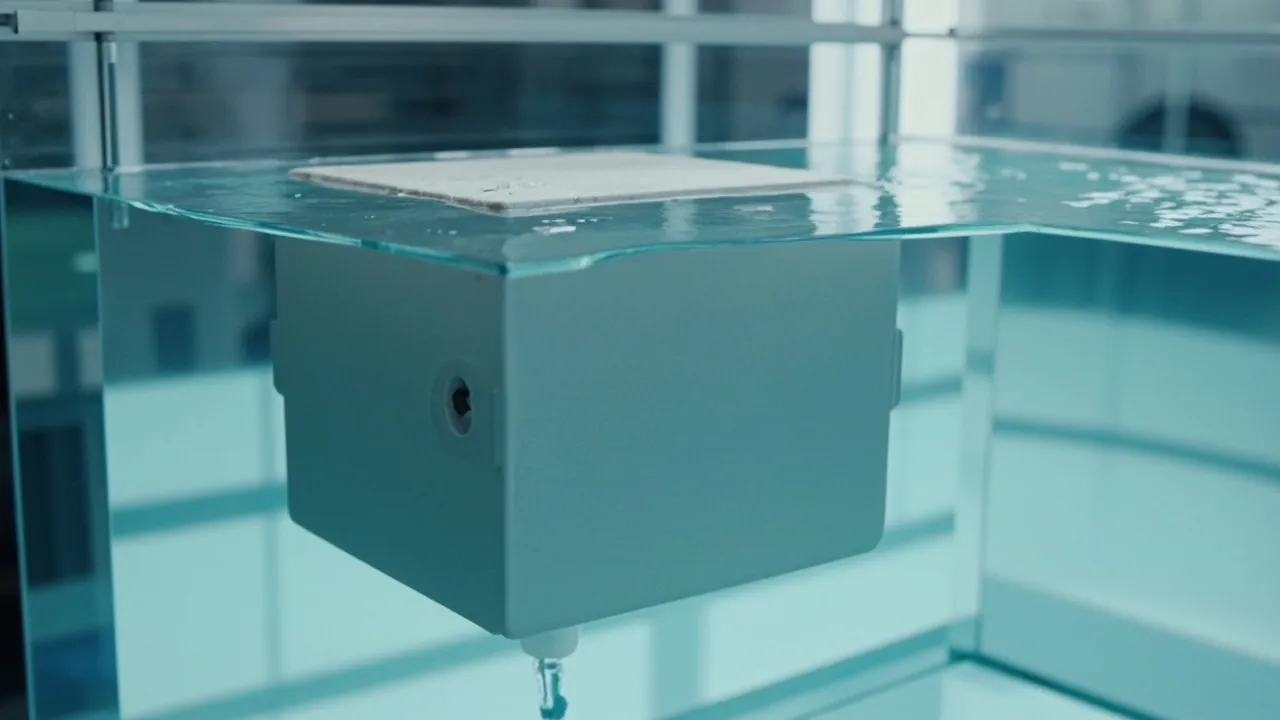
What works, goods-in screening. The dry-tissue and cord method described earlier is effective for rejecting obvious defects. Sample units are prepared to the real configuration with glands and blanks fitted, closed to the working position, conditioned to temperature, lowered with a dry tissue inside, held thirty minutes, withdrawn, wiped dry externally and then opened. Practical points: the water body should exceed ten times the specimen volume to avoid a falling level; restrain flotation safely; and add ballast inside if necessary to hold attitude.
What works, low-pressure spray from several angles. Corresponding roughly to IPX3 and IPX4 levels, five to ten minutes of ordinary mains water from several directions, then dry the outside and open. This is valuable at handover and appears as item eleven in the installation checklist published with our diagnostics guide.
What works, pressure decay as a qualitative screen. Apply a small positive pressure, usually no more than ten to twenty kilopascals and never more than the product can tolerate, then watch for decay or use a bubble test. Falling pressure indicates a leak path. Advantages are speed and absence of water residue, which suits line-side inspection; the caveat is that air tightness is not identical to water tightness, since gas molecules are smaller and can pass where water cannot, so thresholds must be calibrated first.
What does not work, improvised vessels. Buckets or basins giving partial and too-shallow coverage, weighting the sample into a tilt that matches nothing real, testing straight off a delivery vehicle before temperature equalisation, and - most common - leaving it submerged overnight on the assumption that longer is stricter. That last one changes the nature of the test entirely, and the resulting failure means nothing.
What does not work, testing live equipment. Unless a product is explicitly designed to be protected while energised, the subject must be an empty enclosure or a de-energised assembly. Never conduct immersion testing with mains connections present.
Nine Items Every Report Must Carry
Check any IPX7 report against these nine points and request whatever is missing.
- Standard edition: IEC 60529 including amendment years, or GB/T 4208-2017, cited specifically.
- Applicant and manufacturer names, matching your supplier or its contract factory.
- Model designation and photographs clear enough to show configuration and gland count.
- Test parameters: lowest point 1000 millimetres below surface, top 150 millimetres, thirty minutes, water temperature, specimen preconditioning temperature.
- Sample attitude: how it was positioned, and whether cables were attached.
- Configuration list: number of glands and plugs, and whether they were the manufacturer's own parts.
- Assessment method and result: visual, dielectric or insulation measurement, with the actual data.
- Laboratory accreditation: CNAS, CMA or other recognised number and scope.
- Origin of the specimen: an explicit statement whether it was production output or a prototype.
JUNZHJIA products are built by kexinMaterials at its Zhongshan plant in Guangdong. The waterproof range retains complete water and dust test records by model, and supports customer requests to review them or to witness testing. OEM and ODM customers can have whole-enclosure verification repeated against their actual configuration, including specified gland brands and final fastener torque, which closes the gap between a compliant shell and a compliant assembly.
Fresh, Salt and Dirty Water
The standard test uses fresh water, and that choice matters.
Fresh water has the lowest density and the least chemical activity of the three media encountered in service, so for penetration driven purely by head it is the mildest case. Salt water is roughly two to three per cent denser, raising pressure marginally, but its real danger is chemical: chlorides attack stainless steel, aluminium and even some coatings, so an enclosure that passes the fresh-water test may corrode its fasteners long before any water actually gets inside.
Dirty water and muddy floodwater are denser still and carry suspended solids. Those solids lodge at sealing faces, exactly the contamination mechanism described above, and abrade gasket surfaces as the enclosure flexes. Silt also holds moisture against metal parts long after standing water has gone.
Two practical conclusions follow. For coastal, estuarine or flood-prone installations, treat the IP code as necessary but insufficient: add material requirements such as 480 hours neutral salt spray and grade 304 or 316 fasteners, and define a post-flood cleaning procedure. And whenever an enclosure has been through dirty water, rinse the sealing faces with fresh water and dry them before re-closing, regarding the gasket as expendable. Guidance tailored to persistently wet regions appears in our humid climate reference.
Five Common Misconceptions
One, the longer the immersion the stricter the test, so overnight proves quality. Wrong. IPX7 is defined at thirty minutes; failure beyond that demonstrates only that the limit was exceeded, not that the product is deficient, and it cannot be used to rank one product against another. Reproduce the standard condition and read the result at thirty minutes. Where more capability is needed, negotiate IP68 with numbers.
Two, an enclosure that has been submerged can carry on in service. See latent failure above. Even without immediate ingress, immersion can leave deposits on the sealing face, start hidden corrosion, and trap internal moisture. Open, clean, dry and retorque afterwards, and write that step into contingency plans.
Three, seeing IP67 tells you it can work at two metres. The standard promises one metre from the lowest point. Two metres is about 19.6 kilopascals, double the reference value and outside the promise. Either upgrade to IP68 with stated figures or change the mounting position.
Four, immersion is static so it must be easier than being sprayed. Not necessarily. Jetting evaluates how kinetic energy levers at joints and how well geometry sheds water; immersion evaluates long-duration seepage under static head. Plenty of products look immaculate under a spray yet are slowly penetrated through micro-voids when submerged, and plenty behave the other way round. Sites that see both must evidence both.
Five, third-party reports are all equally good, so one suffices. On the contrary, quality varies enormously. What matters is whether the boundary conditions are stated - see the nine items - and whether the specimen equals what you are actually buying. Using a bare-shell report to certify a gland-fitted assembly is a common form of self-deception.
Frequently Asked Questions (FAQ)
Q: Can an IP67 enclosure really be submerged, and for how long? A: Yes, and the condition is precise: lowest point one metre below the surface, top 150 millimetres below surface, water and specimen temperatures within five kelvin, thirty minutes, static fresh water. Exceeding any one of those five parameters falls outside what IP67 promises. Strictly, the answer to how long is thirty minutes. Simple structures often survive longer in practice, but that margin is unguaranteed and must not be designed to. For permanent or deeper underwater duty, move to IP68 and have the manufacturer write the numbers into the contract, for example IP68 at five metres for twenty-four hours, supported by a report at those parameters.
Q: I left an IP67 enclosure submerged overnight and it took water. Can I claim? A: Ordinarily not. Thirty minutes is guaranteed; a full night is far beyond it, and leakage under those circumstances does not demonstrate that the product failed to meet IP67. The correct route is to take an unused unit from the same batch and repeat the standard test under controlled conditions - one metre, thirty minutes, temperature difference within five kelvin, configured as delivered. If it still takes water, pursue remedy or return on the strength of that result. Better still, agree in the purchase contract that acceptance is based on the thirty-minute immersion test to IEC 60529, so the criterion is fixed before any disagreement arises.
Q: Can I run an IP67 check myself with a bucket? A: You can run a meaningful screen, subject to conditions. The vessel must be deep enough to put the lowest point a full metre below the surface, which rules out most buckets and points to a pool, tank or cistern. Condition the enclosure in room-temperature water for at least thirty minutes first; never put a sun-heated box into cold water. Fit it as delivered with glands and plugs, and torque it properly. Place a dry tissue inside as the indicator, then dry the exterior before opening. This will not substitute for accredited type testing, since temperature control, standardised criteria and accreditation are absent, but it reliably catches missing seals, obvious assembly faults and distorted shells. By contrast, half-burying in a basin, weighting the unit into a tilt, or leaving it overnight produce conclusions with no standing at all.
Q: Why does the standard restrict the temperature difference to five kelvin? A: To exclude false failures from thermal shock. Drop a fifty-degree enclosure into twenty-degree water and the internal air contracts, creating suction in the same direction as the external head, which can pull water past a gasket that performs perfectly in ordinary service. That is a genuine physical effect, but it is an artefact of the test conditions rather than a defect. Limiting the difference keeps the two questions separate: sealing capability versus resistance to thermal shock. It also instructs site practice directly: do not drench or seal up an enclosure that has been baking in the sun, and never take a hot enclosure straight into a verification test.
Q: Do I need IP67 for pumps or underwater luminaires that live below water permanently? A: No, that is beyond it. Code 7 covers temporary immersion; permanent service belongs to IP68, and since the standard assigns level 8 no fixed numbers, the manufacturer must commit to concrete depth and duration. Beyond the code itself, permanently submerged equipment needs three further provisions. Cabling must resist longitudinal water travel, otherwise water migrates along conductor interstices straight into the equipment. Internals generally require potting or wholly sealed construction. And housing creep under sustained hydrostatic load must be considered, because even a perfect seal will not help if the shell slowly deforms. Treat these applications as a dedicated discussion with the manufacturer rather than a matter of reading a label.
Q: Is IP68 always better than IP67? A: Not without knowing the numbers. The standard requires level 8 to be agreed between the parties and to be more severe than level 7, but it does not say by how much. Products rated two metres for two hours and ten metres for twenty-four hours share the same IP68 label while differing enormously. Conversely, a properly verified IP67 product carrying a third-party thirty-minute report is frequently more trustworthy than a vague IP68 claim. Compare promised depth-and-duration figures and their supporting data, never the two codes alone.
Q: How does being submerged in transit differ from the standard test? A: In two main respects: time and attitude. Flooding in a truck bed can last hours, well beyond thirty minutes, and during transit the enclosure may be inverted, tilted, vibrating and loaded by whatever sits on top of it, none of which the test reproduces. For logistics, relying on the rating is less effective than managing the exposure: choose covered transport, avoid stowing enclosures at the lowest point of a vehicle, add a waterproof liner or inner bag as secondary protection, and carry out an opening check on arrival. Treating transit water protection as its own problem is more realistic than expecting the outdoor code to cover it.
Q: What should I do after a junction enclosure has been flooded? A: Work through four steps. Safety first: isolate, lock off, tag, and confirm no live hazard before touching anything, using a licensed electrician where required. Then clean: remove standing water and silt, rinse away salt with fresh water, wipe terminals and boards with anhydrous alcohol, and dry for at least twenty-four hours with compressed air as an aid. Then inspect: look for grit left on sealing faces, corrosion on fasteners, fine shell cracks, and degraded insulation - ideally measure insulation resistance. Finally restore: replace the gasket, which should be treated as spent after immersion, retighten to nominal torque, fit fresh desiccant, and record the event in the maintenance log. Doing this turns a unit heading for scrap within six months back into serviceable equipment.
Closing Notes and Further Reading
To answer the opening question directly: can an IP67 enclosure be submerged? Yes - in one quite specific condition: one metre, thirty minutes, static fresh water, temperature difference within five kelvin, in the manufacturer's stated attitude. Every qualifier maps onto a variable that is commonly overlooked and onto disputes that recur on every project.
The practical checklist is this. Verify reports against the nine items and require evidence for the assembled product rather than the shell. Screen incoming batches with the tissue method. Insist on bottom entry and proper torque at installation. After any flooding event, clean, dry and replace seals. And wherever continuous underwater service is required, move to IP68 with depth and duration written into the contract. Understand IP67 as a verifiable short-term immersion capability rather than a waterproofing guarantee, and it represents excellent value, because in most real service conditions water stands against an enclosure for far less than thirty minutes at a time.
JUNZHJIA, made by kexinMaterials in Zhongshan, Guangdong, offers waterproof junction boxes, sealed electrical enclosures and protective cases from IP65 to IP68. We can supply immersion test footage, third-party reports and batch records project by project, with OEM and ODM support and global volume supply.
- Further reading: What the IP67 rating really means
- Further reading: Choosing between IP67 and IP65 for junction boxes
- Further reading: Performance limits of IP67 protective cases