

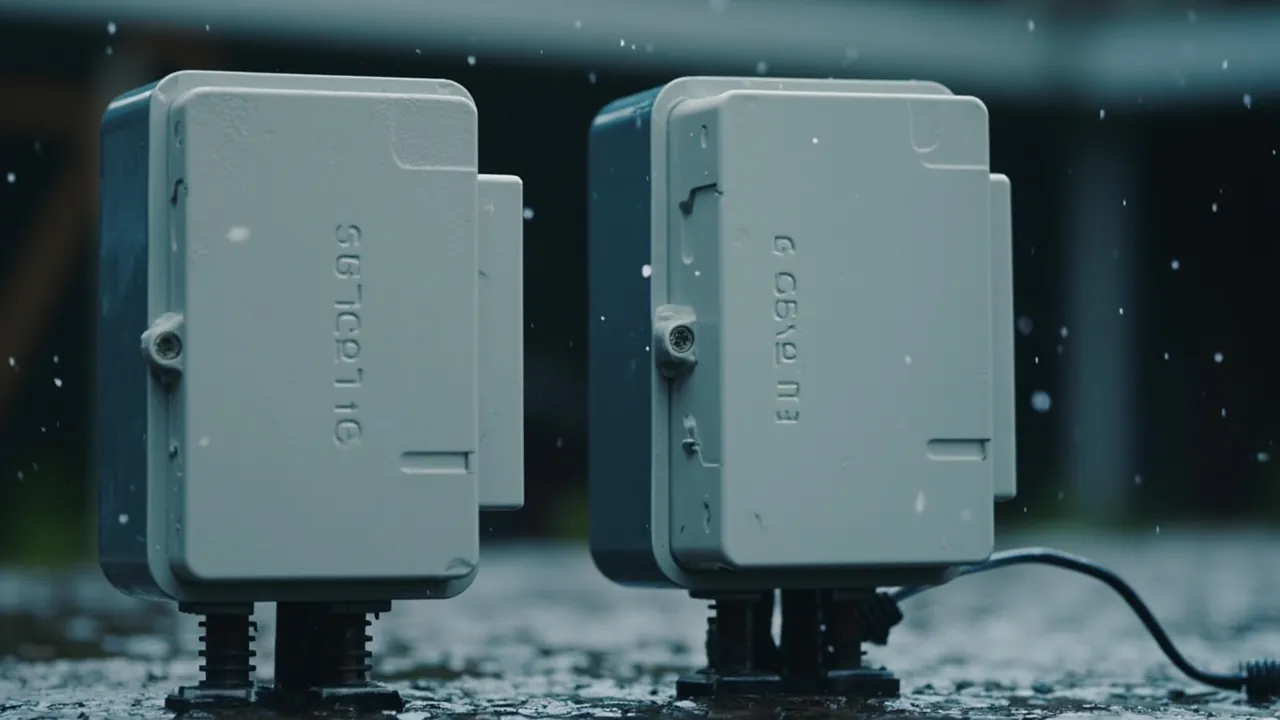
Every enclosure project eventually reaches the same question: is IP65 enough, or should we specify IP67? The answer depends on one thing - how the water arrives. IP65 describes protection against water jets: a 6.3 millimetre nozzle delivering 12.5 litres per minute from roughly three metres. IP67 describes protection against temporary immersion: the whole enclosure submerged so its lowest point sits a metre below the surface, held there for thirty minutes. The first defends against moving water; the second defends against standing water pressing on every joint. Roof mounted, roadside and below-grade positions may look similar on a drawing, yet they face completely different kinds of attack. Choosing the wrong code does not simply waste money. It selects the wrong failure mode.
This article works from IEC 60529, Degrees of protection provided by enclosures (IP Code), adopted in China as GB/T 4208-2017. It sets out the two test specifications side by side, explains the physics each one targets, compares structures and costs, and finishes with a decision method you can use directly in a drawing review or a purchase order. All figures quoted are either taken from the standard itself or are widely accepted engineering values, so they can be checked rather than trusted.
Contents
- What Each Code Actually Covers
- Test Conditions Compared Line by Line
- Three Kinds of Water Attack
- Why One Structure Rarely Optimises Both
- Five Sites Where IP65 Is Enough
- Five Sites Requiring IP67
- Where the Extra Cost Goes
- Structural Differences from Lid to Gland
- A Three-Question Decision Method and Selection Table
- Five Frequent Specification Mistakes
- Drawing Notes and Documentation Checklist
- How Installation Changes the Final Result
- Frequently Asked Questions (FAQ)
- Closing Notes and Further Reading
What Each Code Actually Covers
The second numeral of the IP code describes protection against water. Both IP65 and IP67 begin with 6, which means dust-tight: in the talcum chamber specified by IEC 60529, with two kilograms of powder per cubic metre and a reduced internal pressure not exceeding 2 kilopascals, no visible dust may enter after eight hours. In other words, the two ratings impose identical dust requirements. Every difference between them lives in that second digit.
Code 5 covers water jets. Its physical meaning is that water arrives with kinetic energy, strikes the surface, tries to drive along any seam, and then drains away. Nothing lingers. As long as the joint geometry prevents the jet from being forced into a gap, the enclosure survives.
Code 7 covers temporary immersion. The meaning reverses: water barely moves, yet it presses steadily against every discontinuity for half an hour, and any temperature difference between enclosure interior and the water adds a persistent pressure differential that actively pumps moisture inward. Under those conditions even a very fine connected path can deliver water inside given sufficient dwell time.
So the relationship between the two codes is not higher versus lower. It is qualification in two different directions. IEC 60529 says this explicitly: passing one level does not automatically imply passing all lower levels, and a manufacturer cannot infer IPX5 or IPX6 compliance simply from an IPX7 result. That single sentence resolves most arguments in tender meetings, provided someone has actually read it.
Test Conditions Compared Line by Line
The table below sets out what each rating actually requires, so a report can be checked clause by clause.
| Item | IP65 (second digit 5) | IP67 (second digit 7) |
|---|---|---|
| --- | --- | --- |
| Test name | Protection against water jets | Protection against temporary immersion |
| Principal apparatus | 6.3 mm nozzle test device | Immersion tank |
| Key parameters | Flow 12.5 litres per minute, plus or minus 5 per cent | Top at least 0.15 m below surface; lowest point at least 1 m below surface |
| Distance or depth | Nozzle 2.5 to 3 metres from specimen | Submerged 30 minutes |
| Duration | One minute per square metre of surface area, minimum 3 minutes | 30 minutes |
| Water temperature | Ambient | Difference from specimen not greater than 5 kelvin |
| Sample attitude | Normal service attitude, all faces tested | Attitude declared by the manufacturer, often suspended |
| What is really being tested | Kinetic impact and drainage along seams | Hydrostatic penetration over time |
| Acceptance | No harmful ingress affecting safety or operation | No harmful ingress affecting safety or operation |
Two details deserve particular attention.
First, the duration of the water jet test scales with surface area: one minute per square metre, with a three-minute floor. A large junction enclosure is therefore sprayed for several times as long as a small one. When reviewing a report, look for the stated area and confirm the corresponding dwell time rather than assuming three minutes applied.
Second, note the wording for immersion carefully. The requirement is that the lowest point lies at least 1000 millimetres below the surface, not that the enclosure sits in a metre of water. For a shallow wall-mounted box that difference is academic. For a tall floor-standing cabinet it means one metre may submerge only the lower half. The question to ask is what height the water reached, not whether the nameplate says IP67.
Three Kinds of Water Attack
Sorting site conditions into three categories makes selection much easier.
The first category is jetting and driving rain, corresponding to IPX5 and IPX6. Typical situations include spray thrown up by vehicles on roadsides, overspray from curing water on construction sites, run-off cascading down a facade, and low-pressure washdown. What these share is velocity: water arrives with energy and leaves quickly. Designing against them means no ledges that trap water, no upward-facing seams, and enough latches to keep faces closed against impulse loads.
The second category is splash and spray, corresponding to IPX3 and IPX4. Sheltered elevations, well-drained facades and covered walkways sit here. The subtle risk in this category is that rain running down a wall collects at the top face of whatever it lands on. A poorly set fixing angle or a flat top surface turns a mild exposure into a standing pond over the most critical joint in the box. For this reason even a sheltered position rarely justifies going below IP65.
The third category is hydrostatic penetration, corresponding to IPX7. Typical situations include a drainage channel beside a basement ramp, a riverside temporary feeder box during a flood, any excavation-adjacent cabinet where a modest rise in level reaches the base, and handholes at the foot of street-lighting columns set into low ground. This category is systematically underestimated because it is invisible until the day it is not.
One further observation matters for specification. The same location can change category between seasons. A smart-pole cabinet in southern China sees driving typhoon rain in summer and standing road water in the monsoon. Drawings should record the worst case and take the stricter of the two requirements rather than the average of the year.
Why One Structure Rarely Optimises Both
If both codes simply mean no water inside, why not build one enclosure that does everything? Because the two best-practice designs pull in opposite directions.
Resisting jets is mostly about avoiding water traps. If a joint creates a step or a groove, the impact builds up a local head that presses water into the seam. Good practice therefore uses shedding slopes, hides latches behind the facade line, and adds a drip edge to the top. These features follow a semi-open, drain-away logic: allow water to pass over quickly and leave nothing behind.
Resisting immersion is mostly about compression continuity. Holding thirty minutes at roughly ten kilopascals of gauge pressure requires a gasket of adequate thickness, low compression set, and closely spaced fasteners. That is fully enclosed pressurised logic.
Reconciling them is possible and is exactly what dual-rated products do. The usual method is to secure IPX7 with a fully closed, well-loaded gasket and then to improve jet performance indirectly through external form: a sloping top face, a drip lip, a tilted mounting plane, an external shield. This is why enclosures labelled for both codes almost always show a pronounced top chamfer and drainage channels. Simply fitting a thicker strip of rubber adds nothing to jet resistance.
The practical rule for purchasing follows directly. If the exposure is dominated by driving rain without any risk of standing water, ask specifically for IPX5 or IPX6 data. If the exposure includes ponding or brief submersion, ask for IPX7 data. If both apply, demand both. Do not expect one label to cover everything.
Five Sites Where IP65 Is Enough
One, sheltered semi-outdoor elevations. Under eaves, beneath canopies, on the back wall of an open parking deck, or at high level in an arcade, there is no sustained driven rain. The only moisture source is occasional splash and persistent humidity. IP65 covers it comfortably, and the enclosure can be lighter with better heat dissipation.
Two, damp indoor areas that never flood. Low-voltage risers in basements, standby terminal boxes in pump rooms, distribution spurs in food processing halls. These locations see high humidity and light splash but never submersion. IP65 satisfies the applicable rules without consuming budget that belongs elsewhere.
Three, temporary site power mounted above any possible water level. Distribution boxes on upper floors during construction, lighting spurs fixed to scaffolding above standing water, provided there is overhead protection and no continuous exposure to curing sprinklers. The caveat matters: when curing water is sprayed at close range, the exposure moves into jet territory.
Four, short-duration event power. Stage lighting splits, temporary feeder boxes for a week-long outdoor show. Priorities here are fast stripping, dust protection, light rain resistance and reuse across many jobs. Life cycle is short, so IP65 gives the better return.
Five, locations where contents are cheap and replaceable. A simple lighting spur joint box loses nothing irreplaceable to a wetting incident. In such cases money is better spent relocating the box higher or adding a drip loop than upgrading the rating.
What unites these five is absence of sustained hydrostatic head. The moment water can stand against the enclosure rather than run past it, the conclusion flips.
Five Sites Requiring IP67
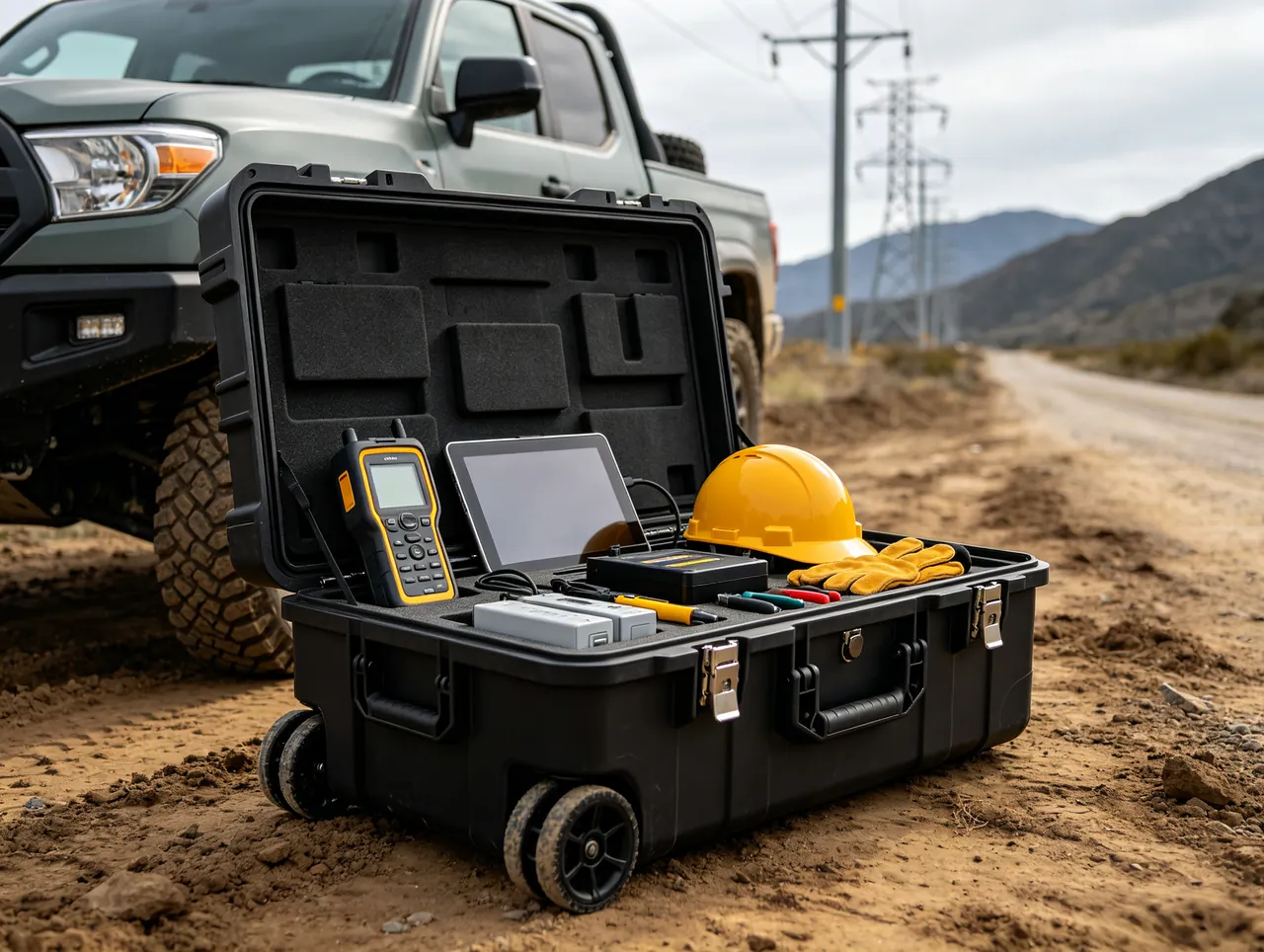
One, low-lying urban road sections and known flood points. Bases of smart lighting poles, fibre termination boxes beside traffic signal controllers, power compartments in enforcement posts. During cloudburst events these can sit under tens of centimetres or more for an hour, which is exactly what one metre for thirty minutes models. Request the full IPX7 report.
Two, basement entrances, sunken plazas and garage ramps. Water rises fast during backflow and carries grit, so even after the water retreats, silt remains inside the enclosure. Beyond IP67, plan for cleanability and access.
Three, riverfront, coastal and quayside installations. Standing water is only part of the problem; salt mist drives corrosion of both housing and fasteners. Specify IP67 together with verified material performance in humid coastal conditions, neutral salt spray resistance of 480 hours or better, and fasteners in grade 304 stainless or above.
Four, irrigation, aquaculture and wastewater sites. Fields under centre-pivot irrigation, pond-side control boxes, instrument enclosures beside treatment tanks combine permanent humidity with periodic level rise and routine washdown. Many of these need IPX6 alongside IPX7.
Five, cold climates with snowmelt ponding and freeze-thaw cycling. Meltwater freezes at the base, expands by roughly nine per cent, and pries the sealing interface apart; spring thaw delivers the second round. IP67 is necessary, but so is choosing materials according to the guidance for extreme temperature applications: copolymer polypropylene or polycarbonate rather than general purpose ABS, which becomes brittle below about minus twenty degrees.
One sentence captures all five: wherever an enclosure can be surrounded by water that stays, require IP67. Standing water is categorically different from water that flows by, and preventing it in advance costs far less than repairing it afterwards.
Where the Extra Cost Goes
Moving from IP65 to IP67 typically raises unit price by fifteen to forty per cent depending on size and construction. That premium buys four things.
First, sealing elements. An IP67 gasket usually needs a heavier cross-section, commonly three to five millimetres solid or a hollow tubular profile, in a better compound. EPDM performs well to about 120 degrees and offers the better value at normal temperatures. Silicone costs one and a half to two times as much but stays stable from minus forty to plus two hundred degrees, which matters where either extreme is real.
Second, tooling and dimensional accuracy. Where moulded flatness is marginal, expecting a soft gasket to absorb the error does not work for thirty minutes at a metre. IP67 products therefore demand tighter tolerances, stricter warp control, thicker walls and denser ribbing. This is a one-off tooling cost, but it is very visible in short runs.
Third, the fastening system. More closing points and stronger ones are needed. Realistic designs use stainless inserts with screws rather than plain plastic clips, tightening the pitch to 120 to 150 millimetres. Every additional insert adds parts cost and assembly time.
Fourth, verification. Third-party type testing to IPX7, plus cold, salt spray and ageing programmes, costs real money. Cutting this line is exactly how some suppliers reach an attractive price, and it is the root cause of the same label, different quality phenomenon in the market. JUNZHJIA products are built at the kexinMaterials plant in Zhongshan, Guangdong, with wateringress and dust test records retained by model along with batch sampling data so that OEM and ODM customers have something traceable to audit.
Conversely, if there is no hydrostatic scenario at the site, that premium buys nothing. The rational approach is to write the worst-case condition down honestly and then match a code to it, rather than defaulting to the highest number available.
Structural Differences from Lid to Gland
The table below compares typical construction for each rating and doubles as a goods-in checklist.
| Feature | Typical IP65 construction | Typical IP67 construction |
|---|---|---|
| --- | --- | --- |
| Seal cross-section | Foam strip or 2 to 3 mm solid cord | Hollow tube or 3 to 5 mm solid silicone or EPDM |
| Designed compression | 15 to 25 per cent | 20 to 30 per cent, tightly controlled |
| Closure method | Clips or few screws | Multi-point stainless screws or high-load latches |
| Fastener pitch | 150 to 200 mm | 120 to 150 mm, denser at corners |
| Lid stiffness | Standard wall, simple ribs | Heavier wall, dense rib grid |
| Cable entry | Grommet with optional gland | Rated cable gland as standard |
| Unused openings | Removable cap acceptable | O-ring blank of equal rating required |
| Breathing | Plain vent hole or simple plug | Membrane breather with hydrophobic film |
| Top geometry | Flat or slight slope | Pronounced drip edge with drainage channel |
The most commonly overlooked row is cable entry. An enclosure designed for IP67 but wired through ordinary rubber grommets rather than compression glands immediately degrades to splash resistance, because the entry is usually lower than the lid, sees a higher head, and is the least carefully assembled part of the installation.
Breathers come second. Many installers fear vents, seal everything completely, and thereby guarantee that diurnal pressure cycling loads the seals continuously. The correct answer is a hydrophobic membrane vent, usually expanded PTFE with a pore size around 0.1 to one micrometre, which passes air while blocking liquid water, balancing pressure and reducing condensation at the same time.
A Three-Question Decision Method and Selection Table
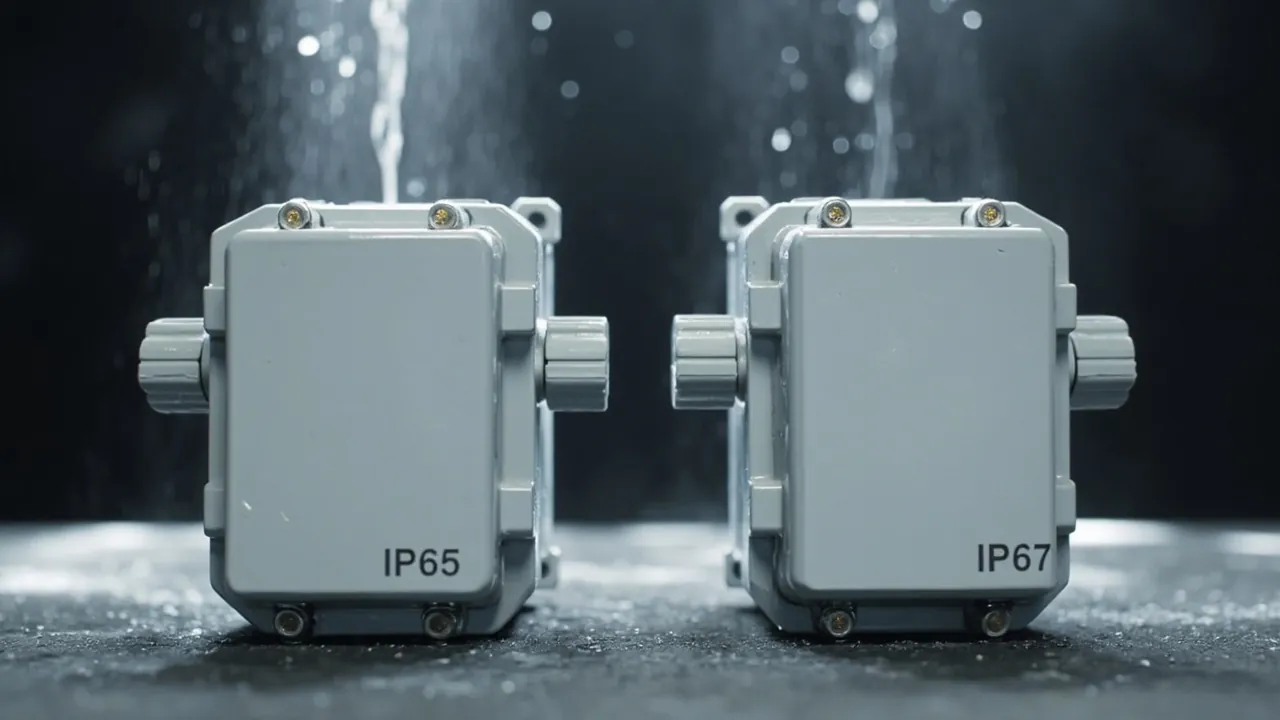
Everything above compresses into three questions that a design meeting can settle in minutes.
Question one: could this enclosure ever be submerged, even once? Not on an average day - once. Basement ramp, dip in the road, river bank, excavation edge, drainage pump station. Unless the answer is an absolute no, go to IP67.
Question two: is there any high-pressure washdown? If so, request IPX6 data. Food plants, vehicle washing, municipal cleaning deliver around a hundred litres per minute, eight times the IP65 test flow, using the enquiry about IP65 versus IP66 versus IP67 differences as the background for the jump.
Question three: what is inside? Bare terminal blocks mean an incursion costs labour and consumables. A controller, switch or driver means total loss plus service interruption. Where contents are valuable, buy IP67 regardless, because the premium is trivial against the equipment cost.
Then match the answer to this table.
| Site condition | Minimum requirement | Recommended action |
|---|---|---|
| --- | --- | --- |
| Under eaves, arcade, sheltered facade | IP65 | Bottom entry with drip loop |
| Semi-exposed, well drained, no ponding | IP65 | Add top drip edge, avoid flat-upper mounting |
| Fully exposed weather, no ponding risk | IP65 plus IPX6 data | Specify UV grade and shedding geometry |
| High-pressure washdown present | IPX6 | Retain drainage form and washdown-tolerant materials |
| Low road, semi-basement, garage entry | IP67 | Raise mounting height, glands to match |
| Coastal, river, quayside salt exposure | IP67 plus 480 hour salt spray | Grade 304 or 316 fasteners minimum |
| Snowmelt and freeze-thaw | IP67 plus low-temperature material | Copolymer PP or PC, avoid standard ABS |
| Permanently submerged | IP68 with stated depth and duration | Obtain a written depth-and-time commitment |
Experience with this table favours one rule: take the strictest of the applicable conditions, never the average. A site that is both beside an estuary and subject to washdown should be specified as evidence required for IPX6 and IPX7 both, not abbreviated to IP67.
Five Frequent Specification Mistakes
Mistake one: treating a higher rating as a guarantee that water will never enter. A code describes behaviour under defined conditions, not an insurance policy. Field outcome is determined jointly by product quality, installation quality and maintenance. Nearly every instance of we bought IP67 and it leaked within six months ends up traced to an uneven mounting face or an unfilled unused knockout.
Mistake two: checking the enclosure but not the cable entries. The written requirement should say including matching glands and blanking plugs of equivalent rating, so that the declared level covers the assembled product rather than a bare shell. This is the single most productive sentence you can add to a specification.
Mistake three: ignoring the first digit. IP65 and IP67 both begin with 6, but products labelled only IPX7 exist, and they carry no dust result at all. On construction sites, mines and desert margins, always confirm the first character is a numeral and not an X. A full discussion of dust behaviour sits in our article on why dust exclusion matters for outdoor cases.
Mistake four: using IP67 where IP68 belongs. Permanent submersion is not a bigger version of temporary immersion. Underwater luminaires, joints inside pump wet wells, level transmitter junction chambers: these need IP68 with a numerical commitment, which our analysis of the one-metre immersion test explains in detail.
Mistake five: over-specifying. Buying the highest code for a dry riser cupboard diverts money from things that actually move the needle, such as conductor sizing, terminal quality, labelling and serviceability. Protection level must be proportional to risk; expensive is not automatically correct.
Drawing Notes and Documentation Checklist
Rather than writing protection level IP67 and stopping, put six specific clauses on the drawing or in the enquiry.
One, cited standard. State the edition: IEC 60529:1989 with Amendment 1:1999 and Amendment 2:2013, or the national equivalent GB/T 4208-2017, and reference the test clause.
Two, explicit test parameters. For example: second digit 7, condition lowest point 1000 mm below surface, top 150 mm below surface, 30 minutes, water temperature differing from the specimen by no more than 5 kelvin.
Three, configuration description. Record what was tested: production model, fitted with four side glands, two blanking plugs of equal rating, one breather fitted with a hydrophobic membrane.
Four, document package. Request the accredited report including photographs and specimen identification, seal material certificate with hardness value, housing data sheet covering low-temperature impact and ultraviolet performance, and fastener material certificates.
Five, acceptance method. Agree the incoming sampling plan: for example three pieces per batch for visual and seal continuity checks, plus one piece in every five hundred through a thirty-minute immersion screen at one metre.
Six, spares commitment. Agree availability of replacement gaskets for five years or more, with part numbers, so that a worn seal does not force full replacement of the enclosure later.
Writing clauses to this level removes any room for vague claims, and it protects both sides: the buyer states what is wanted, and the supplier knows exactly what will be checked. JUNZHJIA supports this documentation package per project and can attend witness testing where a client requires it.
How Installation Changes the Final Result
The same enclosure can deliver very different outcomes depending on the crew. Five controls matter most.
Mounting height. Where flooding is conceivable, raising the box is always the first move. Moving a cabinet centreline from half a metre to 1.2 metres often outperforms switching from IP65 to IP67, and costs far less. Solving water problems with geometry should always be considered before solving them with hardware.
Entry direction. Insist on bottom entry, permit side entry where that is genuinely impractical, and treat top entry as last resort requiring a downturned conduit or hood. This rule is routinely bypassed on the argument that glands are fitted anyway, yet field statistics show top-entry boxes failing several times as often as bottom-entry ones.
Surface flatness. Check the mounting plane with a straightedge; where it is out, shim or fit a backing plate rather than forcing compliance by tightening screws. A moulded shell pulled flat carries residual stress that eventually shows itself as fine cracking around bosses.
Torque control. Use a torque driver at the manufacturer's stated value, typically between 1.2 and 2.5 newton-metres for small and medium plastic enclosures, working in passes across diagonals. Feel-based tightening produces enormous scatter across a batch.
Handover self-check. Run a simple five-minute low-pressure spray from several directions and then open the enclosure and look inside. It costs ten minutes and catches the great majority of assembly faults before handover. Where the location is high-risk, run the simplified immersion screen described in our IP67 test guide as part of commissioning.
Frequently Asked Questions (FAQ)
Q: How much more does IP67 cost than IP65, and is it worth it? A: For the same size and configuration, expect fifteen to forty per cent more. That premium buys a heavier and better gasket, usually solid silicone or EPDM rather than foam, tighter moulding tolerances with thicker walls and denser ribbing, more stainless fastening points at a pitch of 120 to 150 millimetres instead of 150 to 200, and third-party IPX7 type testing. It is worth it precisely when hydrostatic conditions exist, because one callout plus one destroyed controller vastly exceeds the difference. Where the site merely sees rain and drains well, the money is better directed to raising the mounting height and improving drainage.
Q: Does an IP67 enclosure automatically pass the IP65 jet test? A: No, and IEC 60529 says so explicitly. An enclosure achieving IPX7 through deep gasket compression can have its joint levered open by a focused jet delivering 12.5 litres per minute from three metres. Conversely, a box that survives jets through labyrinth drainage may take water immediately on immersion. If a site sees both driven rain and standing water, write evidence required for IPX5 or IPX6 and for IPX7 into the specification rather than relying on a single label.
Q: Can one project mix IP65 and IP67 for different locations? A: Yes, and it is good practice to do so. Boxes in a dry riser can be IP65 while those at ground level in low positions are IP67. Three management points follow: mark each position individually on the drawing rather than writing a global note; keep spares separate, because fitting an IP65 gasket into an IP67 housing changes designed compression through differences in section and hardness; and record each location's rating in the maintenance register so that investigation priority can be set from it later.
Q: Can an IP65 box be upgraded to IP67 with an aftermarket seal kit? A: Realistically no. Achieving IP67 requires seal cross-section, compression ratio, housing flatness and fastener pitch to have been designed together from the outset. Adding tape, coating or a thicker cord afterwards cannot recreate those conditions and often makes things worse, since an oversized cord generates lateral force that distorts a moulded shell when the lid is tightened. The only sound options are replacing the unit with a model verified to IPX7, or fitting a separately verified outer enclosure of higher rating.
Q: What else matters for coastal installations besides the IP code? A: Three additional items. First, housing material: require neutral salt spray performance of 480 hours or better with a UV-stabilised grade, because sun and salt together age a shell far faster than either alone. Second, fasteners: ordinary zinc-plated screws rust within months in salt air, and the expanding oxide layer can lift the sealing face, so specify 304 or 316 stainless and pay attention to galvanic compatibility between dissimilar metals, adding insulating washers where needed. Third, condensation management: coastal sites combine wide daily temperature swings with high humidity, so fit a hydrophobic breather and maintain a desiccant replacement schedule.
Q: Will snowmelt and freeze-thaw damage the enclosure in cold regions? A: The mechanism is real and destructive. Meltwater enters along the cable or through any micro-gap, freezes overnight, and expands by roughly nine per cent, generating enough force to separate the sealing interface or initiate fine cracks in the shell. Spring thaw delivers a second penetration event. Four mitigations apply: mount above the maximum likely snow-packed water level; avoid upward-facing surfaces that hold water; select materials verified for low-temperature service, favouring copolymer polypropylene or polycarbonate over general purpose ABS; and recheck fastener torque and gasket condition after winter, because freeze-thaw cycling measurably changes compression.
Q: The report says the lowest point is one metre below the surface. Is that the same as being under a metre of water? A: Not necessarily. The requirement is that the lowest point is at least 1000 millimetres below the surface and the top at least 150 millimetres below it. For a shallow wall box this effectively means complete submersion at one metre. For a tall floor cabinet, one metre of water may only reach the lower half. Always establish what height the water reached, particularly when internal equipment is mounted low in the enclosure, and recompute the required depth from the deepest point rather than assuming the label covers the whole product.
Q: Why fit a breather if I can simply seal everything completely? A: Because a perfectly sealed enclosure still breathes. As temperature falls, internal pressure drops and moist air is drawn in through whatever micro-path exists; as it rises, the internal pressure pushes outwards and fatigue-loads every seal. A hydrophobic membrane vent, typically expanded PTFE with pore sizes around 0.1 to one micrometre, lets air through while blocking liquid water. It equalises pressure, protects against ingress, and appreciably reduces condensation. Mount it facing down or sideways so that soil, insects and moss cannot block it.
Closing Notes and Further Reading
The difference between IP65 and IP67 is not one of quality but of direction: one addresses moving water, the other standing water. Code 5 is assessed with a 12.5 litre per minute nozzle and suits sheltered, well-drained elevations without ponding risk. Code 7 is assessed at one metre for thirty minutes and suits low-lying, riverside and entrance locations where water can surround the box. Specifications should never stop at the three characters of a code. They should name the standard edition, the test parameters, the sample configuration, the document package and the acceptance method, and extend the declared level to the glands rather than the shell alone.
If a single sentence is needed: check whether water can stand against the enclosure, then whether it can strike the joints at speed, then what the contents are worth. Those three answers set the code, the structure and the budget. JUNZHJIA, manufactured by kexinMaterials in Zhongshan, Guangdong, supplies waterproof junction boxes and electrical sealed enclosures from IP65 to IP68 with OEM and ODM support and global volume supply, and issues matching test documentation for each project environment.
- Further reading: What the IP67 rating really means
- Further reading: Can an IP67 enclosure really be submerged
- Further reading: Why outdoor enclosures take water
- Further reading: How IP65, IP66 and IP67 differ