

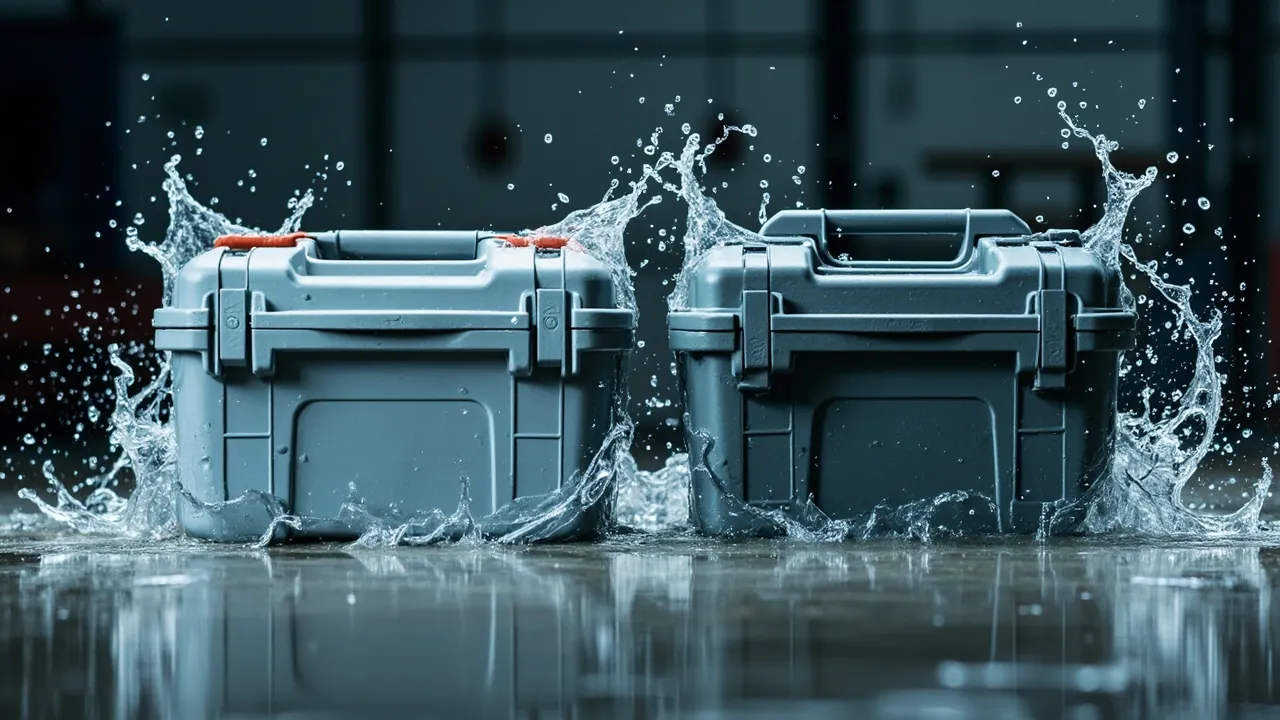
Short answer: IP54 and IP65 are not two points on the same scale. They are two different operating boundaries. Under IEC 60529 (mirrored in China by GB/T 4208-2017, *Degrees of protection provided by enclosures (IP Code)*), moving the first digit from 5 to 6 shifts the requirement from "a limited amount of dust may enter provided it does not interfere with operation" to "no dust may enter at all". Moving the second digit from 4 to 5 shifts it from "splashing water from any direction shall have no harmful effect" to "water jets from any direction shall not cause harmful ingress". IP54 suits sheltered, occasionally splashed, dust-controlled indoor or semi-outdoor storage. IP65 suits open-air sites, wash-down duty, dusty construction yards and vehicle mounting. If the kit contains gauges, power tools or instruments, or if the case will live in a pickup bed, on a site yard, or near the coast, IP65 is the starting line. If it sits on a workshop wall, in a home garage or in a maintenance cupboard, IP54 is usually more than adequate, and the money saved is better spent on interior foam and organisation.
The point most often missed is this: an IP rating describes the enclosure, not the condition of the tools inside. An IP65 case filled with open-cell sponge, loaded with muddy tools and left with an uninspected gasket for three years will still be damp and rusty inside. Conversely, an IP54 case kept in a dry workshop with VCI paper and a maintenance routine can protect its contents better than a neglected IP65 one. This article takes the IP code apart digit by digit, sets out the quantified test conditions for both levels, explains why dust matters more than most buyers assume, maps the scenarios where each level is correct, traces where the cost difference actually goes, lists the labelling traps, gives three tiers of incoming inspection you can run on site, and closes with a scenario-based decision table.
Table of Contents
- Start with the conclusion: where exactly IP54 and IP65 diverge
- How to read the IP code: IEC 60529 and its GB/T 4208 counterpart
- First digit: the test difference between dust-protected and dust-tight
- Second digit: quantifying IPX4 splashing versus IPX5 jetting
- Why dust matters: four ways it damages tools and instruments
- Scenario mapping: when IP54 is genuinely enough
- Five situations where IP65 is not optional
- The IP54 to IP65 cost gap: where the money actually goes
- What IP does not cover: IK impact and UL94 flammability
- Labelling traps: IPX, dual ratings, reference testing and stale reports
- Incoming inspection: three tiers you can actually run
- Matching interiors and accessories: managing the weakest link
- FAQ
- Closing remarks and related reading
Start with the conclusion: where exactly IP54 and IP65 diverge
Set the two codes side by side. Two of the four characters change, and each change represents a step change rather than a fine adjustment.
First digit: 5 to 6. IP5X is "dust-protected". The standard's wording is that ingress of dust is not entirely prevented, but the quantity that enters must not interfere with satisfactory operation or impair safety. Testing takes place in a sealed chamber using talcum powder of a specified sieve size, held in suspension for a specified period, after which the interior is examined. The judgement is functional: a little dust is acceptable as long as nothing stops working. IP6X is "dust-tight". The test conditions are the same, but the acceptance criterion becomes no visible dust inside the enclosure. From "some is allowed" to "none at all" is a change in the criterion itself, not a tightening of a tolerance.
Second digit: 4 to 5. IPX4 is protection against splashing water. An oscillating tube or a spray nozzle directs water at the enclosure from all practicable directions; duration scales with surface area, with a stated minimum. The physical picture is standing outdoors in moderate to heavy rain, or being splashed by somebody hosing a floor nearby. IPX5 is protection against water jets. A nozzle of 6.3 mm internal diameter delivers roughly 12.5 L/min from a specified distance (commonly stated as 2.5 m to 3 m) at all practicable angles, for not less than one minute per square metre of surface with a minimum of three minutes. The picture now is a pressure washer working at close range, far beyond anything natural rainfall produces.
| Compared item | IP54 | IP65 |
|---|---|---|
| --- | --- | --- |
| First digit meaning | Dust-protected (limited ingress) | Dust-tight |
| Dust acceptance | Deposit must not affect operation | No dust inside the enclosure |
| Second digit meaning | Splashing water from any direction | Water jets from any direction |
| Water test | Oscillating tube or spray nozzle | 6.3 mm nozzle, specified flow and distance |
| Typical environment | Workshop, garage, sheltered balcony | Open site, vehicle-mounted, wash-down |
| Submersible | No | No (IPX7 must be requested separately) |
| Relative cost | Baseline | Typically somewhat higher |
One point deserves emphasis: neither IP54 nor IP65 permits immersion. If standing water or wading is a possibility, IPX7 or IPX8 has to be called out as a separate requirement. IEC 60529 states explicitly that the water levels do not form a simple ladder; a sample that passes IPX7 has not automatically passed IPX5 or IPX6.
How to read the IP code: IEC 60529 and its GB/T 4208 counterpart
IP stands for Ingress Protection. The standard notation is IP + two characteristic numerals + an optional supplementary letter + an optional additional letter.
- First characteristic numeral (0 to 6, or X if not tested): protection against solid foreign objects, ranging from parts of the human body and tools through to dust.
- Second characteristic numeral (0 to 9, or X if not tested): protection against water.
- Supplementary letter (A, B, C, D): protection of persons against access to hazardous parts; rarely relevant to toolboxes.
- Additional letter (H, M, S, W): supplementary information such as high-voltage apparatus, moving or stationary during the water test, or suitability for specified weather conditions.
IEC 60529, *Degrees of protection provided by enclosures (IP Code)*, is the governing international document; the current consolidated edition is IEC 60529:1989 merged with AMD1:1999 and AMD2:2013. China publishes the corresponding national standard as GB/T 4208-2017, whose technical content broadly tracks the IEC text and which is the citation most Chinese purchase contracts use. A parallel family, GB/T 4942, addresses rotating electrical machines and is not normally relevant here.
The following table condenses the numerals you will meet most often:
| Position | Numeral | Meaning | Test essentials |
|---|---|---|---|
| --- | --- | --- | --- |
| First | 4 | Solid objects 1.0 mm and larger | 1.0 mm rigid test wire, specified force |
| First | 5 | Dust-protected | Talcum chamber, limited deposit allowed |
| First | 6 | Dust-tight | Talcum chamber, no dust admitted |
| Second | 3 | Spraying water | Oscillating tube or nozzle within 60 degrees of vertical |
| Second | 4 | Splashing water | Oscillating tube or nozzle, all directions |
| Second | 5 | Water jets | 6.3 mm nozzle, specified flow and distance |
| Second | 6 | Powerful water jets | 12.5 mm nozzle, markedly higher flow |
| Second | 7 | Temporary immersion | Specified depth and duration, usually stated as 1 m for 30 min |
| Second | 8 | Continuous immersion | Conditions agreed between manufacturer and user, normally severer than 7 |
One more item is easy to overlook: the post-test functional check. IEC 60529 does not judge only whether water got in; it also looks at insulation, creepage distances and whether the specimen still works. For a purely mechanical toolbox this usually translates into observable criteria — no pooled water inside, no significant absorption by the liner, no rust staining on metal parts. Write those criteria into the technical agreement so that acceptance is not argued after delivery.
First digit: the test difference between dust-protected and dust-tight
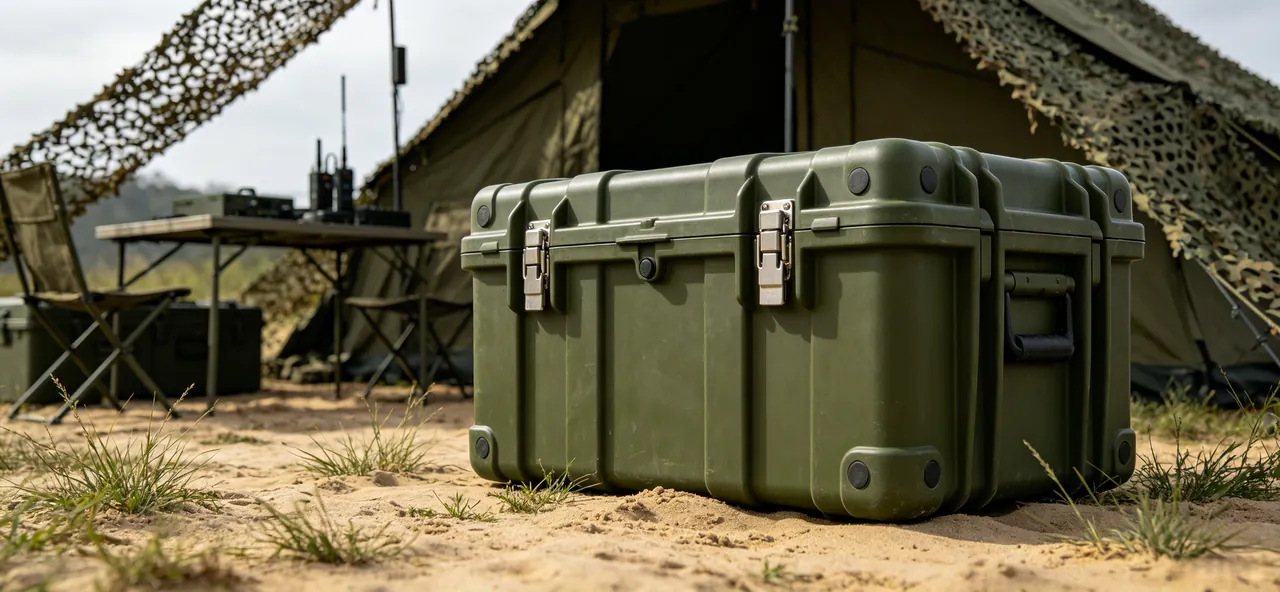
Dust protection is chronically undervalued in tool storage. Attention goes to water, yet on dusty sites, in mines and on sand-blown roads, dust causes losses long before water does.
The IP5X method: the specimen goes into a sealed chamber containing talcum powder of a specified sieve size, in a quantity typically stated per cubic metre of chamber volume. Airflow or mechanical agitation keeps the powder in suspension for a specified period, usually measured in hours. The enclosure is then opened and inspected: a limited deposit is permitted provided it does not interfere with operation or safety.
The IP6X method: identical conditions, but the acceptance criterion is no visible dust inside. Achieving it requires genuinely dust-tight construction, which normally means:
- A continuous sealing loop. The gasket must be continuous around the whole closure, with even compression. Skipped sections, poor joints at corners and thinning of the section at corners are classic failure points.
- Adequate clamp load and latch count. A two-latch box is usually under-clamped at mid-span on the long side; four or more latches are far more reliable.
- Every penetration treated equally. Breather vents, handle fixings, hinge bores and nameplate holes all need their own provision. Microporous membrane vents generally perform well against dust, but they must be re-checked after any blockage or damage.
- Flange stiffness. Once closed and clamped, the flange must not visibly deflect; any local gap is an open door for powder.
| Damage type | What it looks like | Consequence |
|---|---|---|
| --- | --- | --- |
| Abrasive wear | Dust in threads, slides, bearings, gauge faces | Lost accuracy, gritty feel, seizure |
| Moisture caking | Dust absorbs humidity and forms a muddy film on metal | Localised corrosion, hard to clean |
| Insulation and contact failure | Dust in power-tool switches, battery contacts, sockets | Rising contact resistance, arcing, malfunction |
| Contamination | Optical surfaces, painted finishes, food and pharma settings | Direct scrap or rework |
The second row is the one people forget. Dust is not merely dirty; at elevated humidity it absorbs moisture and forms an electrolyte-bearing film on metal, and that film is the real corrosion driver. In dusty and humid environments, IP6X buys more than cleanliness — it cuts a corrosion pathway. That is why the purpose and selection of dustproof toolboxes deserves separate treatment: dust and water are two axes, and neither substitutes for the other.
Second digit: quantifying IPX4 splashing versus IPX5 jetting
Water ratings are where purchasing judgements get made on feel, but the standard is in fact quite specific.
IPX4 (splashing): an oscillating tube or spray nozzle directs water at all practicable directions. In the tube method the tube swings through a specified arc while the specimen rotates at a specified rate so that every face is wetted; duration scales with surface area, not less than one minute per square metre with a minimum of five minutes. The picture is standing outside in moderate to heavy rain.
IPX5 (jetting): a 6.3 mm nozzle delivers roughly 12.5 L/min from a specified distance (stated as 2.5 m to 3 m) at all practicable angles, for not less than one minute per square metre with a minimum of three minutes. The picture is a pressure washer at close range.
The gap is not simply flow rate. The decisive difference is dynamic pressure and the form of the impact. IPX4 delivers dispersed droplets with low energy density; it tests whether the seal lets water run down the outside and away. IPX5 delivers a concentrated stream with real dynamic pressure that tries to lever the seal face open or squeeze past the latch gap. That is precisely why a box that stays bone dry in light rain can flood the moment somebody brings a washer near it.
Three engineering implications follow:
- Where wash-down happens — construction plant cleaning, hygiene rinsing in food plants, vehicle washing — IP54 is simply inadequate. Specify IP65, or IP66.
- Where only rainfall occurs, IP54 usually copes, but remember that wind-driven rain arrives with horizontal velocity and therefore more impact than vertical rainfall. IP65 is the safer call.
- The rating follows the sealing architecture. IPX4 can often be achieved with labyrinth features, drip lips and drainage paths. IPX5 almost always requires a solid elastomeric gasket under even compression. This is why the cost of moving from IP54 to IP65 lands in the sealing system and the latches rather than in the moulding.
Higher levels are covered in more depth in the full explanation of the IP67 rating and the field test method for IP65 waterproof toolboxes.
Why dust matters: four ways it damages tools and instruments
The previous section listed four damage mechanisms. Here is how to convert them into purchasing language.
First, state the dust digit explicitly. Quotations frequently say "IP54" or "IP65", but some say "IPX5", which means dust was never tested. In a dusty environment that X is unacceptable. Write into the specification: "X is not accepted; the first digit shall be 5 or 6."
Second, separate in-service dust protection from storage dust protection. A toolbox in daily use is opened repeatedly, and every opening is an opportunity for dust to get in. A case holding spare parts tests long-term sealing instead. For long-term storage, IP6X is worth more. For a kit opened twenty times a day, habits matter as much as the rating: close it promptly, avoid opening it while dust is being raised.
Third, consider what dust does to the interior. Open-cell sponge absorbs dust and is near impossible to clean; closed-cell EVA has a dense surface that wipes down. In dusty service, prefer a dense, wipeable liner and consider a removable, washable design. This is set out further in how to select toolbox interior foam.
Fourth, watch the interaction between dust and the seal. Particles embedded in the gasket surface create local stress concentrations and score the seal face under clamp load, producing a permanent leak path. In dusty service the maintenance list must include cleaning the gasket and flange face, using a soft cloth and clean water — not a compressed-air line, which drives particles deeper into recesses.
Scenario mapping: when IP54 is genuinely enough
IP54 is not "the cheap option". In the right setting it is the best value available. Six situations where it is normally sufficient:
- Fixed workshop stations — the case sits under a bench or on a tool wall, under a roof, with dust from machining controlled by local extraction.
- Home garages and household maintenance rooms — occasional splashes from washing or mopping, no persistent damp, no pressure washing.
- Equipment carry cases in offices and laboratories — conditioned environment; the requirement is dust protection and accidental spill resistance.
- Sheltered semi-outdoor spots — balconies and carports with a roof overhead, where rain may drive in from the side but cannot pool.
- Spare-part boxes in indoor warehouses — the building handles humidity; the case only needs to keep dust out.
- Retail display and sample cases — tidiness and appearance dominate; protection demands are low.
In these settings, redirecting budget from IP65 toward these three things usually pays better:
- Better interior and organisation — EVA custom cavities reduce tool-to-tool damage and losses.
- Better size and capacity — see how to choose a toolbox size and the approach to capacity calculation.
- Better handling design — handles, wheels, stackable geometry; see wheeled versus conventional toolboxes.
A practical rule: specify the protection level against the worst single event, not against the average day. If the case spends ninety per cent of its life in a workshop but rides to a site in the rain three times a year, specify for the site, or at least keep one IP65 outer case for field trips.
Five situations where IP65 is not optional
Conversely, five conditions will defeat IP54 almost every time:
- Long-term stacking in the open on site yards. Sun, rain and airborne dust together. The risk is water plus dust plus UV superimposed, and within weeks an IP54 case will have a film of grey paste inside.
- Vehicle mounting and pickup beds. Raindrops at road speed carry significant horizontal velocity, and road spray and car washes add more; real impact far exceeds IPX4. Vibration also cycles the seal face continuously.
- Environments with wash-down. Plant washing, hygiene rinsing in food and pharmaceutical facilities, municipal cleaning. If the toolbox sits inside the wash zone, it must survive a directed jet.
- Humid and coastal environments. High humidity plus salt aerosol raises the bar on long-term seal stability. Here IP65 should be paired with weathering and ISO 9227 salt spray requirements.
- Transport and storage of precision instruments. Calipers, micrometers, laser distance meters, inspection probes, communications gear. Their value and sensitivity far exceed ordinary hand tools, and one ingress event can cost several times the price of the case. When the contents are valuable, choose the level according to the contents, not according to the price of the box.
Two further judgement points are less obvious:
- Will the case see large temperature swings? Day-night cycling drives the breathing effect, discussed in why waterproof toolboxes suit outdoor storage. A better-sealed IP65 case fitted with a waterproof vent cuts moisture pumping substantially.
- Will it be stacked and moved often? Stacking and handling raise the risk of distortion, and distortion destroys sealing. IP65 cases typically have stiffer structures, which shows up over a long service life.
The IP54 to IP65 cost gap: where the money actually goes
Understanding the cost structure lets you judge whether a quotation is fair and where to compromise when the budget is tight. The increase from IP54 to IP65 comes from four places:
| Cost item | Typical IP54 approach | What IP65 requires | Cost impact |
|---|---|---|---|
| --- | --- | --- | --- |
| Seal | Labyrinth, drip lip or low-compression foam strip | Solid EPDM or silicone gasket, section matched to groove | Medium |
| Clamping | Two latches, limited load | Four to six latches, even load, self-locking | Medium |
| Shell stiffness | Standard wall and ribbing | Increased wall, ribs, flange stiffness design | Medium to high |
| Penetration sealing | Handle and hinge holes usually unsealed | O-ring or gasket at every penetration | Low to medium |
| Testing and certification | In-house sampling | Report to the standard, possibly third-party | Medium |
Note that the increase sits in the sealing system and the clamping mechanism, not in thicker plastic. When a supplier says "our IP65 version is just a thicker shell", ask about gasket material, design compression, latch count and load distribution — those are where the rating actually comes from.
A useful selection principle is to work backwards from the value of the contents:
- Contents worth only a few times the case price and easily replaced: IP54 is reasonable.
- Contents include precision gauges, electronic instruments or special-purpose tools: start at IP65.
- Contents whose failure would stop work or cascade into other losses — breakdown vans, emergency response: IP65 or better, with a full documentation package.
For volume buyers there is one more cost line that is routinely missed: spares and maintenance. The gasket on an IP65 case is a consumable. Confirm spare-part lead times and prices at purchase and include them in whole-life cost, rather than comparing first prices alone.
What IP does not cover: IK impact and UL94 flammability
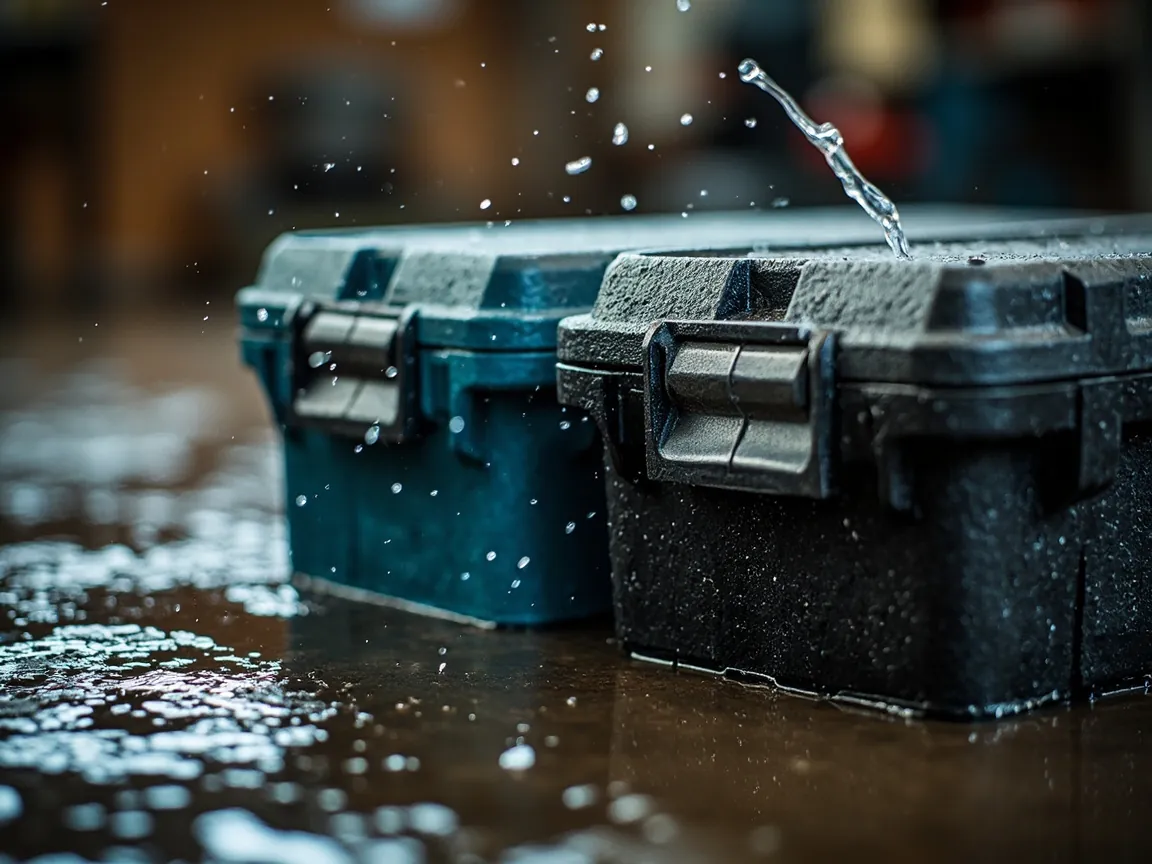
IP covers exactly two things: ingress of solids and ingress of liquids. Engineering selection needs three more axes.
IK impact rating. Defined by **IEC 62262 (corresponding in China to GB/T 20138, *Protection of enclosures against external mechanical impacts (IK code)*)**, expressed as IK plus two digits from IK00 (no protection) up to IK10 (20 joules). A hammer of specified mass and geometry is dropped from a specified height, or an equivalent pendulum is used, and the impact energy is quoted in joules. For a toolbox, IK answers the question "will it crack when knocked, dropped or hit by something heavy" — orthogonal to what IP answers. Site, vehicle and high-handling duty should look at IK07 and above; instrument transport cases should be assessed alongside drop testing, for example against the ISTA series of transit test procedures.
Flammability. The common reference is UL94, with horizontal and vertical classifications HB, V-2, V-1, V-0 and the more severe 5VA and 5VB. Not mandatory for an ordinary toolbox, but it should be stated explicitly where fire performance is regulated — power utilities, rail, marine, mining — and wherever lithium batteries travel with the tools. When power-tool battery packs are stored in the case, consider both the flammability class and the venting design, because pressure release in a sealed volume is a genuine safety question during thermal runaway.
Material and environmental suitability. Minimum service temperature for northern winters, UV stabilisation for long outdoor service, resistance to oils, solvents and de-icing salt. These are treated in the systematic introduction to protective-case plastics.
| Axis | Standard | When it matters | Common requirement |
|---|---|---|---|
| --- | --- | --- | --- |
| Dust and water | IEC 60529 / GB/T 4208 | Always | IP54, IP65 and similar |
| Mechanical impact | IEC 62262 / GB/T 20138 | Site, vehicle, handling | IK07 and above |
| Flammability | UL94 | Utilities, rail, marine, batteries | V-2 and above |
| Weathering | GB/T 16422 / ISO 4892 | Long-term outdoor | UV-stabilised grade |
| Salt spray | ISO 9227 | Coastal, chemical | NSS for a stated duration |
| Transit drop | ISTA series | Logistics | Graded by mass |
Labelling traps: IPX, dual ratings, reference testing and stale reports
Six labelling problems recur constantly in purchasing:
- Using X to hide an untested axis. "IPX5" claims only water level 5; dust was never tested. In dusty service this is unacceptable. Equally, "IP6X" means water was not tested.
- Misreading dual markings. "IP54/IP65" normally indicates that different configurations or mounting states achieve different levels — for example with and without a breather vent — not that both are satisfied simultaneously. Ask which state achieves which rating, and demand separate reports.
- "Reference testing" and "based on a similar model". Using the base model's report to justify a customised variant is the most common audit failure. Any change to structure, penetrations or sealing requires its own test.
- Expired reports or mismatched models. Reports usually carry validity limits or apply only to the submitted sample. At goods-in, check that model number and photographs match the delivered goods, and note the report date.
- Mixing in-house and third-party evidence. In-house reports are useful process evidence, but as acceptance criteria they should ideally be backed by an accredited third-party report or by a re-test clause witnessed by both parties.
- Treating the IP rating as applying to every component. Gaskets, hinges, vents and nameplate adhesive are separate parts whose failure modes lie outside the IP definition. Long-term protection depends on their materials and on maintenance.
Avoiding these traps is straightforward: require scanned original reports plus a model cross-reference table plus a key-configuration statement at quotation stage, and verify against the delivered goods. For volume and framework agreements, write in an annual sample test on the same model.
Incoming inspection: three tiers you can actually run
Not every organisation owns a spray rig, but three tiers cover the range from quick to rigorous.
Tier one: visual and tactile checks, every delivery
- Gasket: continuous, free of breaks and flash, even cross-section, good recovery when pressed.
- Flange: close the lid without latching and check clearance all round with a feeler gauge or a strip of paper. Marked unevenness means warp or poor latch layout.
- Latches: close them one at a time; force should be consistent, with a clear detent and no slipping.
- Penetrations: handles, hinges, vents and nameplates should show sealing provision.
- Accessories: documentation, spares and interior should match the contract.
Tier two: a simple spray check, for first articles and periodic sampling
- Use an ordinary garden spray gun or adjustable nozzle at roughly 2 to 3 m, wetting every face for at least a minute, concentrating on latches, hinges, handle roots and corners.
- Place dry tissue and a humidity indicator card inside beforehand, and open immediately afterwards.
- Acceptance: dry tissue and an unchanged card pass; local wet marks require root-cause analysis.
- Caveat: this is not a standard test and cannot serve as a conformity judgement. As a batch consistency screen it is excellent, and it catches missing gaskets, failed latches and cracked mouldings.
Tier three: third-party retesting to the standard, for first batches, major projects and disputes
- Obtain dust and water reports to IEC 60529 / GB/T 4208-2017 stating test conditions and acceptance.
- Add IK impact (IEC 62262 / GB/T 20138), salt spray (ISO 9227) and flammability (UL94) as needed.
- Agree in the contract who bears retest cost, so that a dispute does not stall for want of a willing payer.
Combining the three gives a sensible balance: visual on every batch, spray sampling each quarter, formal testing annually or per new project.
Matching interiors and accessories: managing the weakest link
A case performs at the level of its weakest element. Fit an IP65 shell with mismatched accessories and you give the rating back. Four common mismatches:
- Open-cell sponge interiors, which absorb water and become a continuous moisture source, accelerating rust in humid service, and which hold dust and resist cleaning in dusty service. Switch to closed-cell EVA or a dense wipeable surface; see the advantages of EVA liners and the EPE versus EVA comparison.
- Unsealed penetrations added later. Fitting a cable gland, an external bracket or a nameplate screw can breach the original sealing system. Any secondary machining should be done under the supplier's guidance and followed by re-verification.
- Non-matching latches and hinges. Non-genuine latches may change clamp load distribution and destroy sealing; fasteners of a different material can introduce galvanic corrosion.
- Absent maintenance. Gaskets are consumables. Without inspection and periodic replacement, the rating decays with time.
Managing the weakest link is simple: build a critical-parts list covering gasket, latches, hinge pins, vent and interior, each with material, specification, replacement interval and spare part number, folded into routine maintenance and spares stocking. When JUNZHJIA supplies protective cases and toolboxes, this kind of list normally ships with the product, with matched gasket and interior spares by model, so that customers can set replacement intervals by duty rather than waiting for something to fail.
FAQ
Q: Will an IP54 toolbox keep rain out? A: It resists splashing, but it should not be relied upon against rain. IPX4 testing uses an oscillating tube or spray nozzle delivering splashing water from all directions, roughly equivalent to standing outdoors in moderate to heavy rain, and only for a limited duration (not less than one minute per square metre, minimum five minutes). Real rainfall includes variables the test does not fully cover. Wind gives raindrops significant horizontal velocity, so impact exceeds vertical rainfall. Duration is longer: a test runs minutes, a storm may run hours, and prolonged wetting magnifies any minor seal defect. Then there is standing water, which IPX4 cannot address at all and which needs IPX7. Rain also brings a humidity spike that drives breathing, drawing moist air inside. A reasonable verdict: IP54 is acceptable for the occasional soaking provided you dry and ventilate the case promptly; choose IP65 for prolonged exposure in the open or for an uncovered vehicle bed, and IP66 if wash-down is involved.
Q: Can an IP65 case be submerged? A: No, or at least not on the assumption that the rating covers it. The second digit 5 addresses water jets — a dynamic, short-duration, surface-level form of water attack. Submersion belongs to IPX7 (temporary immersion, conventionally expressed as 1 m for 30 minutes) or IPX8 (continuous immersion, with conditions agreed between manufacturer and user). IEC 60529 points out that the water levels are not a simple progression: passing IPX7 does not automatically mean passing IPX5 or IPX6, and vice versa. So if your site faces both driving rain and low-lying standing water, state IPX6 and IPX7 as separate requirements — for example "IP6X plus IPX6 plus IPX7" — rather than a single vague "IP67". Demand separate test reports confirming that each level was actually measured.
Q: How much more does IP65 cost than IP54, and is it worth it? A: There is no universal figure; the difference depends on the sealing system, latch count, shell stiffness and testing effort, and varies widely between manufacturers. In general the step up carries a moderate cost increase, and the money goes into a solid gasket, multiple latches, flange stiffness design and testing to the standard rather than into thicker plastic. The practical way to judge value is to work backwards from what is inside. Ordinary hand tools that are easily replaced, in a sheltered environment, are well served by IP54, and the saving is better spent on a good interior. Precision gauges, electronic instruments, special tools, or a case that rides to sites and gets washed down, justify IP65 the first time an ingress event is avoided. One more factor is easy to overlook: downtime. When a breakdown van's tools are unusable because the case leaked, the consequential cost dwarfs the purchase difference. Ask suppliers to quote both levels and compare the delta before deciding.
Q: Why do some products say IPX5 rather than IP65? A: Because the first digit has been replaced with X, meaning the dust level was not tested or not claimed. IEC 60529 permits X where a characteristic numeral is not required or not applicable. Suppliers do this for two usual reasons: they genuinely only ran the water test, or the construction leaves dust performance uncertain and they prefer not to commit. For tool storage that X should not be waved through, because dust shows up earlier than water. It accelerates wear in threads and slides, causes contact failure in power-tool switches and battery terminals, and after absorbing moisture forms an electrolyte-bearing film on metal that initiates corrosion. Write into the specification that X is not accepted and the first digit shall be 5 or 6, and require the corresponding dust test report. If only IPX5 is available, treat the product as "water level 5, dust unknown", design protection for the worst dusty case, or find a supplier who can quote both digits.
Q: In practice, how much difference is there between dust level 5 and level 6? A: A great deal, and the difference is in the criterion rather than the apparatus. IP5X requires that any dust entering shall not interfere with satisfactory operation or impair safety, so a limited deposit is allowed. IP6X requires no dust inside the enclosure at all. The test chamber is the same; only the acceptance rule changes. In service the difference shows up over time. In a typical workshop, an IP5X case looks fine for months but accumulates a fine film within a year or so; on a dusty site, in a mine or on sand-blown roads, that shortens to weeks. Worse, the dust that gets in absorbs moisture and cakes onto metal, forming a hard-to-remove film that triggers localised corrosion, while particles embedded in the gasket score the sealing face under clamp load and create a lasting leak path. For long-term storage, precision tools or high-dust environments, ask for IP6X outright. For a kit opened many times a day, IP5X is acceptable provided the team latches it promptly and the gasket is cleaned regularly.
Q: Are IK and IP ratings the same thing? A: No. They describe entirely different failure modes and rest on different standards. IP, under IEC 60529 (GB/T 4208), addresses ingress of solids and water. IK, under IEC 62262 (in China GB/T 20138, *Protection of enclosures against external mechanical impacts*), addresses resistance to mechanical impact, expressed as IK plus two digits from IK00 to IK10 with increasing impact energy in joules. A case can be IP65 with modest IK performance, or very tough with mediocre sealing. Both matter for toolboxes: IP decides whether the contents get damp or dirty, IK decides whether the shell cracks when knocked, dropped or struck. Site, vehicle and high-handling duty should look at IK07 or better; instrument transport cases should be assessed alongside drop testing, for example against ISTA transit procedures. Where fire performance is regulated or lithium batteries travel inside, add a UL94 classification. The three axes are independent; none replaces another.
Q: How can I verify a supplier's IP65 claim myself? A: Work in three tiers. Tier one is visual and tactile, on every delivery: check that the gasket is continuous, free of breaks and flash, with good recovery when pressed; close the lid without latching and check clearance all round with a feeler gauge or paper strip; close each latch in turn and confirm consistent force and a positive detent; check that handles, hinges, vents and nameplates have sealing provision. Tier two is a simple spray check for first articles and periodic sampling: use a conventional spray gun at 2 to 3 m on every face for at least a minute, concentrating on latches, hinges, handle roots and corners, with dry tissue and a humidity indicator card inside beforehand. It is not a conformity judgement, but as a batch consistency screen it is very effective. Tier three is third-party retesting to IEC 60529 / GB/T 4208-2017 for first batches, major projects and disputes, optionally adding IK, salt spray and flammability. In all cases check that model number and photographs in the report match the delivered goods, and confirm the evidence is not a reference test on a similar model.
Q: How often should the gasket be replaced, and what happens if it is not? A: Replace on condition, not on a fixed calendar. Five signals indicate replacement: cracking, cuts, tackiness, chalking or clear discolouration; a fingerprint that lingers after pressing, meaning compression set has exceeded its limit; a visibly flattened section compared with a new part that no longer recovers; a discontinuous or unevenly deep impression on the seal face; and failure in a spray or airtightness check. Intervals depend on material and environment: assess every one to two years indoors, and every six to twelve months outdoors, in coastal or high-temperature service, or where the case is opened frequently. Neglect is progressive. As the seal hardens, compression falls and contact pressure drops; the first symptom is only slight dampness, then heavy rain or washing produces visible ingress, and finally the tools begin to rust. A degrading gasket may also shed particles or become tacky and contaminate the interior and the tools. When replacing, clean the groove, use the same specification and material, avoid petroleum-based lubricants, and confirm the latches clamp evenly. Buy spares up front and confirm lead times at the purchasing stage.
Q: Can a case with a breather vent still be rated IP65? A: Yes, provided the vent itself has been qualified to the same or a higher level and the vented configuration was tested on its own. Waterproof vents typically use a microporous membrane such as ePTFE whose pores are far smaller than a water droplet and far larger than a water molecule, so air passes and differential pressure equalises while liquid water is excluded. Correctly selected and installed, such a component is compatible with dust-tight and jet-resistant performance. Three conditions must be confirmed. First, the report must cover the vented build, not a plain-body variant of the same model number — the single most common audit failure. Second, the membrane needs maintenance: blocked by oil or dust it stops breathing, and if torn it becomes a direct leak path, so vent inspection and replacement belong on the checklist. Third, installation must be sound, with its own sealing at the thread or press fit. State in the specification that the case with the waterproof vent fitted shall still meet IP6X and IPX5, and require the matching report.
Closing remarks and related reading
To return to the original question: the practical meaning of IP54 and IP65 in tool storage is two different operating boundaries, not two gradations on one line. IP54 resists splashing and tolerates a little dust; it belongs in sheltered, controlled workshops, garages and indoor warehouses. IP65 resists jets and excludes dust entirely; it belongs on open sites, in vehicle mounting, in wash-down duty and wherever precision gauges or electronics ride inside. The test is not which number is larger, but which form of water and what concentration of dust your site produces, and what it costs you if the contents are damaged.
Three actionable recommendations. First, write the requirement as a combination — "IP6X plus IPX5 plus IPX7" for instance — with both digits explicit, no X, and no reference to similar models. Second, complete the axes IP leaves out: IK impact, UL94 flammability, weathering, salt spray and minimum service temperature, selected by duty. Third, set up three tiers of acceptance — visual on every batch, spray sampling each quarter, formal testing annually — and put gasket, latches, hinges and vent on a critical-parts list with defined replacement intervals and spares stock. Across wholesale, distribution and OEM/ODM programmes, JUNZHJIA can issue technical documentation and test data against each of those items and configure sealing and interiors by duty, which is how two digits on a label become a verifiable, traceable commitment.
Related reading