

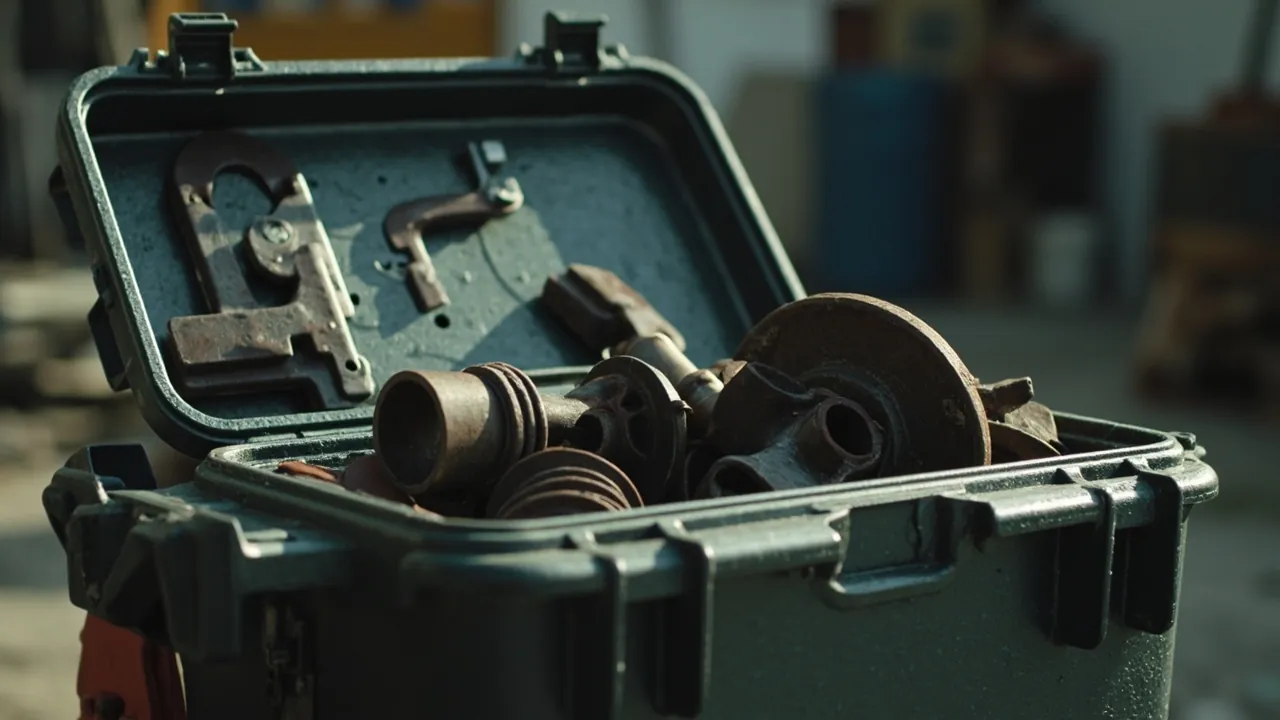
Short answer: a waterproof toolbox earns its place outdoors not because rain cannot touch it, but because it solves three problems an ordinary box cannot solve at once — it keeps liquid water out, it keeps water vapour out, and it keeps out the salt, ultraviolet radiation and temperature cycling that accelerate every other failure. Hand tools and hardware (spanners, screwdrivers, drill bits, circlips, measuring instruments, and the box's own hinges and latches) are rarely destroyed by a single storm. They are destroyed by long exposure above the critical humidity threshold where electrochemical corrosion becomes self-sustaining. A case built to IEC 60529 (mirrored in China by GB/T 4208-2017, *Degrees of protection provided by enclosures (IP Code)*) at IP65 or better, with a properly engineered sealing system and a sensible interior, holds the internal relative humidity well below ambient. Add desiccant and disciplined opening habits, and "every spanner rusts after three months outdoors" becomes "the kit is still serviceable six months later".
The common mistake is to reduce outdoor storage to a single task: keeping the rain off. That produces a plastic tub under a tarpaulin, or a stack of tools in a sheet-steel cabinet. Rain stays out; humidity does not. The case survives; the tools do not. This article starts from the corrosion mechanism and works outward, covering how sealing geometry cuts the vapour path, why the breathing effect lets a dry box pump moisture into itself, how to choose materials with ISO 9227 salt spray evidence, how interior foam and desiccant work together, which stainless grades and coatings actually hold up, and how thermal cycling and UV decide service life. It also gives a placement standard, a quarterly maintenance checklist, and a concrete way to write "suitable for outdoor storage" as an inspectable purchasing clause.
Table of Contents
- Start with the conclusion: the three jobs outdoor storage actually demands
- The corrosion mechanism: why hardware fails first
- Humidity, condensation and the breathing effect: the invisible water paths
- Salt and industrial atmospheres: material selection through the lens of ISO 9227
- Sealing systems and IP ratings: which level outdoor storage really needs
- Interior foam and moisture control: EVA, EPE and desiccant strategies
- Protecting the box's own hardware: coatings, stainless grades and galvanic corrosion
- Thermal cycling and UV ageing: how case materials degrade
- Pressure equalisation and draining: should there be a breather hole
- Placement and site discipline: six rules for elevation, shade and airflow
- Maintenance intervals and inspection checklist: what to do each quarter
- Procurement and customisation: writing outdoor storage as an acceptance clause
- FAQ
- Closing remarks and related reading
Start with the conclusion: the three jobs outdoor storage actually demands
"Outdoor storage" means very different things to different people. To one buyer it is a household kit on a balcony. To another it is a batch of cases sitting unsheltered on a construction yard for three months. To a third it is cargo in a ship's hold in a hot, humid, salt-laden atmosphere. The severity differs enormously, but the underlying logic is identical: failure is never caused by one factor alone. It is water, oxygen, an electrolyte and temperature acting together.
The first job is blocking liquid water: rain, wash-down, standing water on the ground, spray during transport. This is the straightforward part, and it is what the second IP digit addresses — IPX5 for water jets, IPX6 for powerful jets, IPX7 for temporary immersion. For most outdoor situations IP65 is sufficient; where standing water is possible, IPX7 should be added as a separate requirement.
The second job is blocking water vapour, and this is the real dividing line between an ordinary toolbox and a waterproof one. Ambient relative humidity swings widely across the day. Inside a case exposed to sun, air temperature can rise tens of degrees above ambient and then fall back overnight; the trapped air expands and contracts, producing the breathing effect. Every breath draws moist outside air in. A box that is not genuinely sealed can exchange many times its own volume over a single rainy season, and the cumulative moisture load is large. This is why plenty of cases that visibly "never leaked" still contain a rusty mess.
The third job is blocking the accelerators: salt aerosol (coastal sites, winter de-icing salt), industrial sulphur and nitrogen oxides, ultraviolet radiation, and repeated thermal shock. These do not add water. They attack the gasket, the coating and the shell, degrading the first two defences while the box is in service. Whether a case that passed IP67 in the lab still performs after two years on a seafront depends on its material system, not on the certificate it shipped with.
Once those three jobs are clear, selection becomes simple. The value of a waterproof case outdoors equals: sealing geometry (stops liquid water) + airtightness and pressure management (stops breathing) + weathering-resistant materials (slows degradation) + interior and desiccant (mops up the remainder). Miss any one of the four and the result is discounted accordingly.
The corrosion mechanism: why hardware fails first
Atmospheric corrosion of steel is an electrochemical process requiring four things simultaneously: an anode, a cathode, an electrolyte and a metallic path. On an ordinary carbon-steel spanner, microstructural inhomogeneity, residual stress and surface scratches create countless microscopic anode-cathode pairs. Lay down a thin film of water containing dissolved ions — chlorides, sulphates, carbon dioxide — and the cell is complete.
The corrosion rate does not rise linearly with humidity. There is a critical humidity inflection point. Industry practice commonly cites relative humidity around 60% as the level above which atmospheric corrosion of clean carbon steel accelerates sharply: below it the adsorbed film is too thin to support ion transport, above it the film thickens, resistance collapses and the rate jumps by roughly an order of magnitude. Salt deposits or dust contamination push the inflection lower still, which is precisely why a toolbox kept near the sea can be written off in one monsoon season — chloride ions supply electrolyte *and* defeat the self-healing of the passive film.
Hardware fails first for three compounding reasons:
- High surface area and complex geometry. Screwdriver shafts, drill flutes, circlip gaps and the inside faces of open-end spanners trap liquid and dry slowly, creating persistent local micro-environments.
- Thin protective layers. Chromium plating, zinc plating and black oxide finishes are typically only microns thick. Once breached, the exposed carbon steel sits in an unfavourable small-anode/large-cathode ratio and perforates quickly.
- Precision surfaces are least tolerant. On measuring faces, tap cutting edges and reamer lands, corrosion measured in microns is enough to scrap the tool. The real loss is far greater than the purchase price, because a drifted gauge can scrap an entire production batch.
| Tool category | Dominant failure mode | Humidity sensitivity | Protection priority |
|---|---|---|---|
| --- | --- | --- | --- |
| Spanners, sockets | Uniform surface rust, seized threads | Medium | Dry storage plus thin oil film |
| Screwdrivers, hex keys | Shaft pitting, crevice corrosion at the handle joint | Medium-high | Isolated slots, avoid loose piling |
| Drills, taps, reamers | Edge pitting degrading cutting performance | High | Dedicated slots, VCI paper |
| Gauges (calipers, micrometers) | Measuring-face rust causing out-of-tolerance | Very high | Desiccant plus periodic calibration |
| Power tools | Winding moisture, contact oxidation, seized bearings | High | Dry storage plus periodic run-up |
| Case hinges, latches, screws | Seized fasteners, failed springs | Medium-high | Stainless hardware or Dacromet finish |
One very practical corollary follows: lowering internal relative humidity is more effective and more economical than trying to keep every drop of water out. Exclusion only prevents extreme events; humidity control suppresses the reaction continuously. That is why later sections spend so much space on sealing, interiors and desiccant.
Humidity, condensation and the breathing effect: the invisible water paths
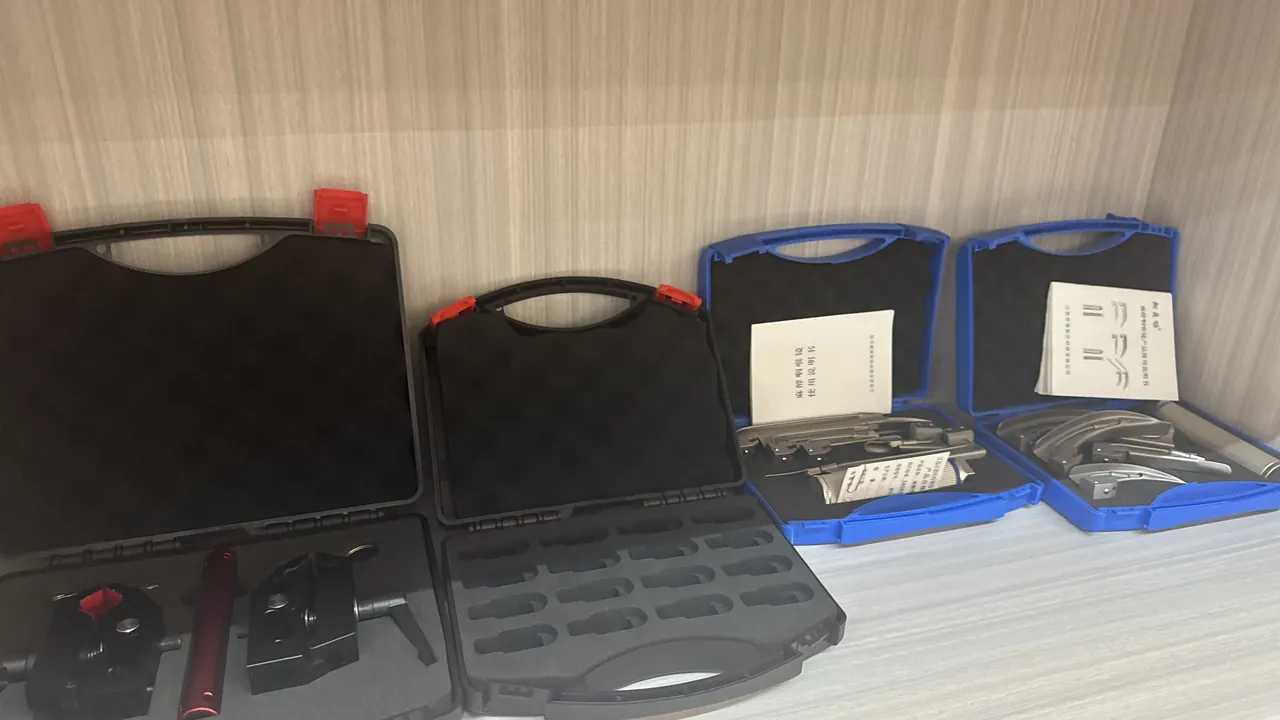
Most water that reaches the inside of an outdoor toolbox does not pour through a visible gap. It arrives along three hidden paths, and until you understand them, the observation "my IP67 case is wet inside" looks like a contradiction.
Path one: breathing pump. No case is perfectly rigid or perfectly airtight. Under direct sun the internal air may run 10 to 20 degrees above ambient; pressure rises and air is expelled through micro-channels at the seal face, around latches and through any vent. Overnight the process reverses and moist air is drawn in. The cycle completes at least once per day, more often when summer showers cause rapid cooling. Each individual gulp is tiny; the accumulation is not. Rough estimate: a 40-litre case exchanging 10% of its volume per day in air at 30 degrees and 80% relative humidity — roughly 24 g of water per cubic metre — takes in about 0.1 g per day. Over three months that is around 9 g, comfortably enough to lay a continuous water film over every metal surface inside.
Path two: condensation. When the wall temperature falls below the dew point of the internal air, vapour condenses on the inside surface. Outdoors this is close to unavoidable. Metal walls radiate heat away quickly and can sit several degrees below air temperature overnight; plastic walls follow the air down more slowly but still get there. Condensation is dangerous because it delivers liquid water to the lowest point of the case, which is exactly where the tools sit. Users who report "the box never leaked but there is water in the bottom" are almost always looking at condensate, not ingress.
Path three: carried in on the contents. Wet gloves, a mud-caked wrench, a cable that sat in the rain — each becomes an evaporating source inside a sealed volume. This has nothing to do with case performance, yet it accounts for a large share of real-world complaints.
The engineering countermeasures map one to one:
- Breathing pump: raise the airtightness class (solid rubber gasket, adequate compression, multi-point latches for uniform clamp load), or, where venting is genuinely needed, fit a waterproof breather valve using a microporous ePTFE membrane — air passes, liquid water does not, and convective pumping is largely neutralised.
- Condensation: use closed-cell interior material (EVA, EPE) as a thermal break to slow wall temperature swings; keep desiccant in place to hold the dew point below ambient; keep the case off cold ground.
- Carried-in moisture: enforce a dry-before-stowing rule and provide an absorbent mat or replaceable desiccant cartridge.
| Moisture source | Typical contribution (field estimate) | Detectability | Primary countermeasure |
|---|---|---|---|
| --- | --- | --- | --- |
| Breathing pump | Medium to high | Very low, discovered after the fact | Airtightness, waterproof vent |
| Internal condensation | Medium | Low, appears as bottom water | Insulating liner, desiccant, elevate |
| Carried in on contents | Medium to high | High, but routinely ignored | Dry before stowing, wet-item zone |
| Seal failure leakage | Low to medium | High, visible tracking | Gasket replacement, clamp check |
| Absorption by the liner itself | Low | Very low | Specify closed-cell material |
Control these three paths and outdoor storage is mostly solved. Staring only at the IP digits while ignoring airtightness and humidity control is the shared root cause behind most outdoor toolbox failures.
Salt and industrial atmospheres: material selection through the lens of ISO 9227
If the storage location is coastal, on an island, in a port, or alongside roads treated with de-icing salt, chloride ions deserve separate consideration. **ISO 9227, *Corrosion tests in artificial atmospheres — Salt spray tests***, defines three commonly used methods: neutral salt spray (NSS), acetic acid salt spray (AASS) and copper-accelerated acetic acid salt spray (CASS), in increasing order of aggressiveness. NSS is used for general comparison; CASS is typically a rapid screen for decorative coatings.
Three points matter when reading a supplier's report:
- Salt spray is a comparative test, not a life predictor. ISO 9227 itself cautions against extrapolating results to service life. "Passed 500 hours NSS" means the sample outperformed a non-compliant one under identical conditions; it does not mean "usable outdoors for X years".
- Specimen condition must match production. Coated, plated and bare samples give wildly different results. Stainless latches, hinges and screws should carry their own salt spray report, because they are the parts that show red rust first and that most directly affect how the case feels to open.
- Distinguish white rust from red rust. White corrosion products on zinc plating do not necessarily indicate base-metal attack; red rust means the coating has been penetrated. The acceptance criterion should say which one governs.
For outdoor case hardware, materials fall into roughly three tiers:
| Material or finish | Relative corrosion resistance | Suitable environment | Cost | Notes |
|---|---|---|---|---|
| --- | --- | --- | --- | --- |
| Carbon steel, electro-zinc plated | Low | Dry indoor | Low | Not recommended outdoors |
| Carbon steel, Dacromet / zinc-aluminium flake | Medium-high | General outdoor, industrial air | Medium | No hydrogen embrittlement, good salt spray |
| 304 stainless (06Cr19Ni10) | High | General outdoor, mild coastal | Medium-high | Still pitting-sensitive to chlorides |
| 316 stainless (06Cr17Ni12Mo2) | Very high | Coastal, high-salt, chemical | High | Molybdenum markedly raises pitting resistance |
| Engineering plastics (PP / ABS / PC blends) | Very high (no electrochemical attack) | All environments | Low to medium | Watch UV and low-temperature embrittlement |
Two warnings are worth emphasising. First, 304 is not "rust-proof". In warm, chloride-bearing atmospheres it will pit and crevice-corrode; 316, with its molybdenum content and correspondingly higher pitting resistance equivalent number (PREN), is the safer specification for coastal and chemical sites. Insist on a material certificate to the relevant grade (GB/T 20878 or ASTM A240 as applicable) rather than accepting the bare word "stainless".
Second, galvanic corrosion is the classic trap in mixed assemblies. Stainless screws into an aluminium body, or a copper washer against steel in a damp environment, will accelerate attack on the less noble metal. Mitigations include choosing materials close together in the galvanic series, using insulating washers or coatings, and sealing the joint to exclude electrolyte.
Sealing systems and IP ratings: which level outdoor storage really needs
The sealing system of a waterproof case has four elements: the flange face, the elastomeric gasket, the clamping mechanism, and secondary sealing at hinges and penetrations. Any one of them failing drops the whole assembly to the level of the weakest link.
The flange face needs adequate flatness and stiffness. Injection mouldings warp as they cool; a flange that is not flat leaves local gaps no matter how good the gasket is. A quick check is to close the lid without latching and feel for even clearance around the perimeter, or to apply a thin film of engineer's blue to the seal face, close under clamp load, and inspect whether the transferred mark is continuous.
Gasket selection has to satisfy three conditions at once: weathering resistance (EPDM and silicone outperform general-purpose PVC and natural rubber), low compression set (ability to recover after long compression), and a cross-section matched to its groove. A common design window puts compression at roughly 20% to 30% of the original section height — too little and the sealing contact pressure is inadequate, too much and permanent set accelerates while latches are overloaded. The groove itself matters just as much: it must leave room for the material to expand laterally under load, otherwise the lid gets jacked up.
The clamping mechanism determines whether the load is uniform. A two-latch box is usually under-clamped at mid-span; four or six latches give visibly better consistency. Latches need a positive over-centre action and enough strength not to pop open under transport vibration.
Secondary sealing is the most frequently overlooked item. Hinge pin bores, handle mounting holes, breather valves and nameplate screws are all potential leak paths. The correct approach is an O-ring or gasket at each penetration, or assembly from the inside.
Recommended levels for outdoor storage:
| Scenario | Recommended rating | Comment |
|---|---|---|
| --- | --- | --- |
| Sheltered semi-outdoor (balcony, carport) | IP54 | Splash protection is enough; dust matters more |
| Unsheltered, exposed to rain | IP65 | Baseline for outdoor storage |
| Unsheltered plus periodic pressure washing | IP66 | Must survive stronger jets |
| Unsheltered plus possible standing water | IP65/IP66 plus IPX7 | State both requirements separately |
| Coastal, high-salt, high-humidity long term | IP66 plus weathering requirements | Sealing plus 316 hardware |
| Ocean freight, deck stowage | IP67 plus salt spray evidence | Full documentation package |
One detail of IEC 60529 deserves repeating: the water levels are not a simple ladder. A sample that passes IPX7 (temporary immersion) has not automatically passed IPX5 or IPX6 (powerful jets), because the failure modes differ — immersion tests static-pressure retention, jetting tests whether a moving stream can lever the seal open. List the water forms you actually face rather than writing a single ambiguous number. The field test and acceptance method for IP65 toolboxes develops this point in more detail.
Interior foam and moisture control: EVA, EPE and desiccant strategies
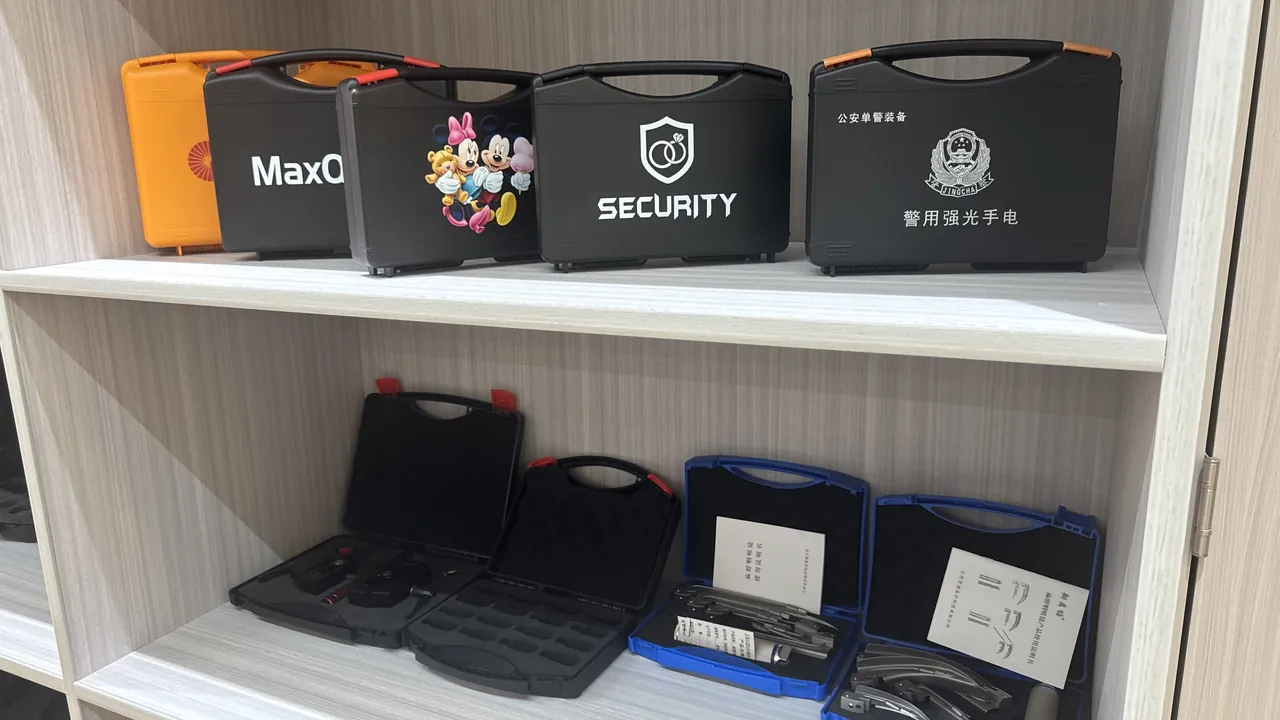
Interior material plays three roles outdoors: cushioning, organisation, and moisture assistance. The first two are widely understood; the third usually is not.
EVA (ethylene-vinyl acetate) foam is relatively dense, closed-cell, resilient, and can be finished with a flocked surface. It is the first choice for precision tools and instruments. Water absorption is low, and it machines cleanly by CNC or die-cutting into accurate custom cavities. The trade-off is higher cost.
EPE (expanded polyethylene) is light, low-cost and an excellent cushion, but its open-cell tendency is greater than EVA's, so it picks up more moisture over long humid storage, and its surface frets and pills. It suits general cushioning and separators for bulky items.
PU sponge has a high open-cell content and absorbs noticeably more water; it is generally a poor choice for long-term outdoor interiors unless sealed or backed with a waterproof layer.
Desiccant is the backstop. Common types are silica gel (regenerable, and indicating grades change colour at saturation), montmorillonite clay (cheap, non-regenerable) and calcium chloride (high capacity but can liquefy once saturated, so handle with care). Sizing is empirical: for a well-sealed case, a few hundred grams of silica gel per cubic metre of volume is a reasonable starting point, adjusted for storage duration and ambient humidity. More important than the exact mass is that the desiccant be observable and replaceable — a saturated sachet left in place becomes a slow moisture source.
Useful companions:
- VCI (vapour corrosion inhibitor) paper or emitters, which build a protective atmosphere inside the sealed volume and work well on carbon steel;
- an absorbent mat on the floor of the case, locking condensate away from the tools;
- a humidity indicator card, so a glance at opening time tells you whether to change the desiccant, with no guesswork.
The selection and layout logic is covered in more depth in how to choose toolbox interior foam and the comparison of EPE and EVA liners. Those conclusions hold outdoors; you simply add water absorption as an extra evaluation axis.
Protecting the box's own hardware: coatings, stainless grades and galvanic corrosion
So far we have discussed how the case protects the tools. But the case's own hardware — hinges, latches, screws, handle pivots — corrodes just as readily, and when it seizes, the protection level of the entire box goes to zero.
Ranked by failure frequency:
- Hinge pins. Static for long periods, crevice geometry, rarely lubricated: a textbook crevice-corrosion site. It shows up as stiff, noisy opening and ends in seizure. Use stainless pins, add self-lubricating bushes, and apply grease at assembly.
- Latch springs and pivots. Springs carry concentrated stress and are prone to stress-corrosion cracking. Specify 304 or better and ask for fatigue-life data.
- Assembly screws. The most overlooked item. A PP shell with 316 latches is undermined by ordinary zinc-plated self-tappers: the screws rust first and stain the surrounding plastic. Standardise fastener grade across the box, or use snap-fit features to reduce metal count.
- Nameplates and markings. An aluminium nameplate on a stainless body forms a galvanic couple; use insulating adhesive or switch to laser marking.
The systematic breakdown of hinges, latches and sealing structures goes further. For outdoor storage specifically, three rules matter: standardise material grade, avoid direct contact between dissimilar metals, and apply lubrication and sealant at the assembly stage.
When JUNZHJIA handles OEM/ODM projects for outdoor or coastal duty, the technical review pulls out a "complete metal parts list" and confirms grade and finish item by item, with test reports and material certificates issued against whatever salt spray duration the customer specifies. It looks pedantic. It is also what prevents the single most common after-sales argument: the body is fine, the screws are seized.
Thermal cycling and UV ageing: how case materials degrade
The second great enemy outdoors is the combination of thermal cycling and ultraviolet radiation, and what it attacks is the case rather than the contents.
UV ageing affects polymers. The tertiary carbon-hydrogen bonds in PP are UV-sensitive and photo-oxidise readily, producing chalking, fading and embrittlement. The butadiene phase in ABS is likewise vulnerable. Standard countermeasures are carbon black (by far the most cost-effective UV screen), hindered amine light stabilisers (HALS) and UV absorbers. Assessment methods are given in the GB/T 16422 series (plastics — methods of exposure to laboratory light sources, corresponding to ISO 4892), using xenon-arc or fluorescent UV lamps, or by natural weathering. Ask the supplier to state the UV stabilisation level of the specific grade used.
Thermal cycling acts on two levels:
- On the shell: repeated expansion and contraction initiates micro-cracks at stress concentrators such as flanges, weld lines and screw bosses. Dissimilar coefficients of expansion between shell and metal inserts loosen the interface over time. PP expands roughly twice as much as ABS, and the design has to absorb that difference.
- On the seal: rubber ages faster at sustained high temperature through compression set and hardening, and loses elasticity in the cold. EPDM covers a wide temperature range, silicone stays flexible at lower temperatures, and general-purpose PVC stiffens noticeably in the cold.
Low-temperature embrittlement is a real constraint in northern winters. Homopolymer PP becomes brittle near freezing; copolymer and impact-modified grades improve this substantially. ABS retains better low-temperature toughness. Where site temperatures can fall below minus 10 degrees, confirm the stated minimum service temperature and ask for cold-drop or cold-impact data.
Internal temperature in summer sun deserves attention too. A dark case in direct sun can reach internal temperatures far above ambient, which is unfriendly to lithium batteries in power tools, to plastic grips and to lubricants. That risk is analysed in summer heat and toolbox deformation in vehicles, and the conclusion transfers directly to open-air exposure: shading buys more than insulation.
| Material | UV stability | Low-temperature toughness | Heat distortion | Overall outdoor verdict |
|---|---|---|---|---|
| --- | --- | --- | --- | --- |
| PP homopolymer | Poor | Poor | Medium | Requires modification |
| PP copolymer / impact modified | Fair | Fair | Medium | Economy outdoor option |
| ABS | Fair | Good | Good | Needs UV-stabilised grade |
| PC/ABS blend | Good | Excellent | Good | Mid-to-high-end outdoor option |
| Glass-filled PP | Good | Fair | Good | Strength plus weathering |
| Stainless steel | Excellent | Excellent | Excellent | Best weathering, heavy |
Pressure equalisation and draining: should there be a breather hole
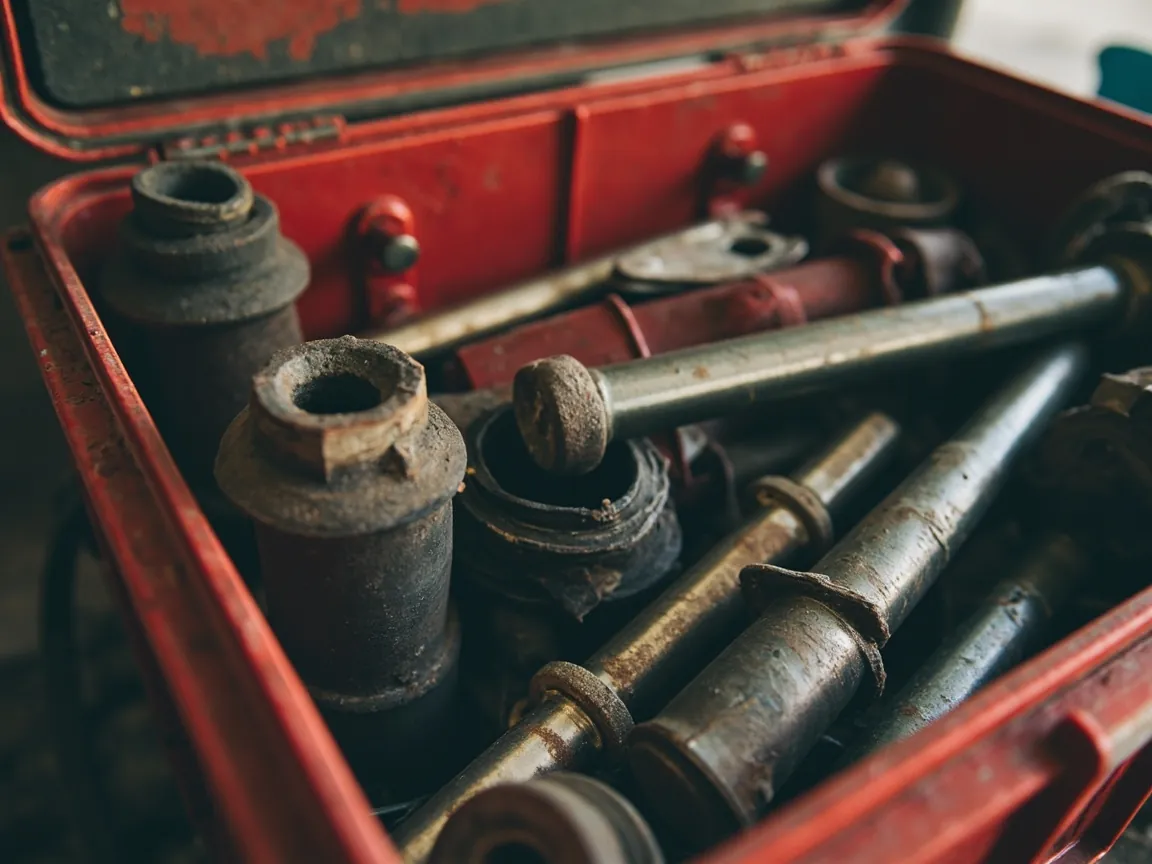
This design choice generates argument, but the answer is not ambiguous: for long-term outdoor storage, prefer a waterproof vent; where immersion is possible, the vent must be a membrane type (microporous ePTFE); for extreme dryness or where full airtightness is required, you may omit it, but accept that the lid can become hard to open under differential pressure.
Running without a vent creates problems. High-altitude or air transport, or simply large day-night temperature swings, leave the interior at negative pressure. The lid becomes difficult to open and the gasket can be sucked out of shape. The accepted solution is a waterproof vent whose membrane pores are far smaller than a water droplet and far larger than a water molecule: pressure equalises, liquid water stays out, and the breathing pump is largely neutralised.
The vent is itself a maintenance item. The membrane blocks with oil and dust and stops breathing; if it tears, it becomes a direct leak path. Vent inspection and replacement belong on the checklist.
On draining: outdoor storage generally does not want a drain hole, since an open passage admits humidity and insects. Handle condensate with an absorbent floor mat and periodic inspection instead. Where a drain is genuinely provided, it must have a closable plug, kept closed during storage.
Placement and site discipline: six rules for elevation, shade and airflow
Even the best case is undermined by bad placement. Six field-proven rules:
- Elevate at least 100 mm. The ground is the main source of moisture and cold; a case sitting directly on it stays permanently damp underneath. Use pallets, stands or racking, and keep it clear of standing water.
- Shade before waterproofing. Solar gain and UV damage the case and its contents more than rain does. Cases under a roof routinely outlast fully exposed ones. Where shading is impossible, avoid prolonged exposure of dark shells, or use a reflective cover — but leave an air gap beneath it, or you build a humid oven.
- Stack stably and not too high. Align load paths so upper cases bear on the walls or dedicated stacking features of the one below, not on the centre of the lid or the handle. Follow the supplier's declared stacking limit, and for long-term storage stay below the transport allowance. The benefits of stackable toolbox design cover this in depth.
- Leave air gaps between cases. Tightly packed rows create a humid microclimate. A few tens of millimetres of clearance costs nothing and pays back clearly.
- Keep chemicals, fertiliser and de-icing salt in a different area. Volatile corrosive gases (chlorinated or sulphurous) permeate seals and attack metal surfaces.
- Label and rotate. Cases that never move are the ones everyone forgets. Tag each with the sealing date and next inspection date, and apply first-in-first-out rotation so nothing sits in a corner for two years unexamined.
Maintenance intervals and inspection checklist: what to do each quarter
Outdoor storage is not "stow it and forget it". A ten-minute quarterly check catches the great majority of problems.
Every quarter, or after each opening:
- Gasket: look for cracks, permanent flattening, tackiness or chalking; press it and watch for recovery; clean and treat with a silicone-based conditioner. Avoid petroleum-based grease, which accelerates ageing in most rubbers.
- Latches and hinges: check for smooth action, noise, play or rust; re-grease pivots.
- Desiccant: read the indicator card; replace or regenerate when saturated (indicating silica gel can be dried at the specified temperature and reused).
- Inside and out: look for condensation traces and bottom water; wash salt and mud off the flange with clean water and dry it.
- Tools: spot-check corrosion-prone items (drills, gauges) and re-apply a thin oil film where needed.
- Vent: confirm it is not blocked and the membrane is intact.
Every six to twelve months:
- Run a simple seal verification: place dry tissue or an indicator card inside, latch the case, expose it to a rain shower or a controlled spray, then open and inspect.
- Check for UV degradation (chalking, fading, cracking) and structural damage (weld-line cracking, broken screw bosses).
- Survey metal parts for rust and pre-emptively replace any fastener showing red rust.
- For cases supporting critical equipment, have the sealing condition inspected annually, or replace gaskets wholesale at the supplier's recommended interval.
Pre-storage checklist: clean and dry the tools → apply a thin oil film or wrap corrosion-prone items in VCI paper → dry the interior → place adequate desiccant and an indicator card → confirm the gasket is clean and undamaged → close latches evenly → record the sealing date. Done properly, these steps lift outdoor reliability by a clear margin.
Procurement and customisation: writing outdoor storage as an acceptance clause
The final step is turning all of the above into purchasing language. The following skeleton is directly reusable:
- Ingress rating: require a report to IEC 60529 / GB/T 4208-2017 from a third party or the factory, with both digits stated (no X), listing each water form separately — for example "IP6X dust-tight plus IPX5 jets plus IPX7 temporary immersion".
- Gasket: state material (EPDM or silicone), hardness range, design compression, and compression-set performance (referencing the GB/T 7759 series), plus replacement interval and spare-part availability.
- Metal parts: list grade and finish for hinges, latches, pins and screws item by item. Coastal projects should call up 316 or an equivalent corrosion class, with material certificates and salt spray reports stating the method (NSS/AASS/CASS) and the acceptance criterion.
- Shell material: specify the grade or an equivalent performance requirement, including UV stabilisation and minimum service temperature. Northern projects should require cold-drop or cold-impact data.
- Interior: state material (EVA/EPE), density, closed-cell content, whether flame retardance is required (referencing a UL94 classification) and whether it is replaceable.
- Accessories: specify whether a waterproof vent, humidity indicator, desiccant holder and VCI package are included.
- Verification: agree the incoming-inspection method — nozzle size, distance and duration for a spray check, or the acceptance criterion for a simple airtightness check — and the remedy for non-conforming goods.
- Documentation: test report list, material certificates, RoHS/REACH declarations, spare-parts list and replacement instructions.
Write those eight items into a technical agreement and "outdoor storage" stops being marketing and becomes something measurable, inspectable and enforceable. On wholesale, distribution and OEM/ODM programmes, JUNZHJIA can issue the corresponding technical documentation and test data against each item, and configure gaskets, interiors and hardware grades by model so that inland sites, coastal yards and ocean freight are specified differently rather than served by one compromise product.
FAQ
Q: For outdoor storage, is a higher IP rating always better? A: Not necessarily. An IP rating describes performance under a specific test, and higher ratings generally cost more without automatically being more "suitable". IEC 60529 makes clear that the water levels do not form a simple ladder: a sample passing IPX7 (temporary immersion) has not necessarily passed IPX5 or IPX6, because the failure mechanisms differ. Immersion tests whether the seal holds under static pressure; jetting tests whether a moving stream can lever the seal face open. The right method is to analyse the water forms at your site first. Rain and dust alone are covered by IP65; add IPX6 if there is pressure washing; add IPX7 if the case may sit in standing water. Writing "IP6X plus IPX5 plus IPX7" is far more rigorous than a bare "IP67". Note also that the real difficulty in long-term outdoor storage is usually not liquid water at all but moisture accumulation through breathing, which has nothing to do with the digits and everything to do with airtightness, interior material and desiccant. Evaluate rating, weathering resistance and moisture control together.
Q: Does desiccant inside the case really help, and how often should it be changed? A: It helps, provided the case has basic airtightness to begin with. In a box that obviously leaks air, desiccant saturates quickly and then becomes a slow moisture source rather than a sink. Given reasonable sealing, its job is to hold the internal dew point low enough to suppress condensation and electrochemical corrosion. Sizing is empirical: for a well-sealed case, a few hundred grams of silica gel per cubic metre is a sensible starting point, increased for wetter environments and longer storage. In practice it is better to use indicating silica gel together with a humidity indicator card and judge by colour rather than by calendar. Typical intervals are three to six months inland and one to three months in coastal humidity. Indicating silica gel can be regenerated by drying at the specified temperature; clay-based desiccants generally cannot. Two cautions: position the sachet so it cannot spill powder onto tools, and never treat desiccant as a fix for failed sealing — if it saturates repeatedly, find the root cause in the seal or in operating habits.
Q: Does specifying a stainless steel case for a coastal project solve the problem permanently? A: No. Stainless steel resists corrosion through a chromium-rich passive film, and that film is locally destroyed by chloride ions, producing pitting and crevice corrosion. Grade 304 (06Cr19Ni10) performs well inland but carries real pitting risk in coastal salt aerosol, especially in unventilated crevices such as flange faces and screw holes. Grade 316 (06Cr17Ni12Mo2) contains molybdenum, giving a markedly higher pitting resistance equivalent number, and is the safer choice for coastal and chemical duty, at higher cost. Three further points are routinely missed. Surface condition matters: a rough surface traps salt and initiates pitting more readily than a polished or passivated one. Dissimilar-metal contact matters: stainless against aluminium or carbon steel drives galvanic attack, so use insulating washers or standardise the grade. And maintenance matters: stainless is not maintenance-free, and periodically rinsing salt deposits off with clean water extends life substantially. See the comparison of stainless and aluminium toolboxes for a full treatment.
Q: My case is rated IP67, so why is there water inside after a spell outdoors? A: The usual cause is condensation or breathing rather than leakage. IP67 certifies that the enclosure survives temporary immersion at a stated depth and duration without harmful ingress; it says nothing about long-term airtightness and nothing about internal humidity. Day-night temperature swings make the case breathe: pressure rises during the day and expels air, falls at night and draws moist air in, and each cycle carries in a little vapour. When the wall temperature drops below the internal dew point, vapour condenses on the inside surface and runs down to the bottom, which looks exactly like a leak. Stowing wet gloves or muddy tools adds an evaporating source. To diagnose, dry the interior, place dry tissue and an indicator card inside, latch it, leave it through one day-night cycle and check. Dry tissue with a changed card points to breathing; a locally soaked tissue with a run mark points to leakage. The respective fixes are a waterproof vent plus better moisture control, and genuine ingress repair.
Q: Will sunlight destroy a plastic case stored outdoors? A: It will degrade it, but material choice and siting keep the effect within acceptable bounds. Ultraviolet radiation drives photo-oxidation of the polymer chain, showing up first as chalking, fading and loss of gloss, and later as reduced mechanical performance: lower impact strength and surface micro-cracking. The tertiary C-H structure of PP is relatively UV-sensitive, as is the butadiene phase of ABS, so outdoor products must use UV-stabilised grades. Carbon black is the most cost-effective screen, which is why black cases usually weather best; HALS and UV absorbers are commonly added alongside. Assessment follows the GB/T 16422 series (corresponding to ISO 4892) using xenon-arc or fluorescent UV exposure. In the field, prioritise a shaded location — shade buys more than any material upgrade — avoid prolonged exposure of dark shells in high-insolation regions, clean salt and dirt off regularly since both accelerate ageing and hold moisture, and replace cases once chalking or cracking is visible. UV ageing is gradual and typically becomes obvious only after several years, so long-term outdoor programmes should include cases in periodic inspection and planned replacement.
Q: Do the tools inside need separate rust protection? A: Yes. Case protection and tool protection are two different lines of defence and neither substitutes for the other. The case creates a low-humidity environment, but the initial condition of the tool surface governs how easily corrosion starts. A three-layer approach works well. First, clean and dry before stowing: remove mud, salt and fingerprints, which contain chlorides and lactic acid — this is the cheapest and most effective step. Second, protect the surface: a thin oil film or rust-preventive grease on carbon steel, or VCI paper wrapping, since VCI emitters continuously release inhibitor molecules inside a sealed volume and reach complex shapes and crevices. Third, separate by material to avoid contact corrosion between dissimilar metals and to stop hard tools chipping each other's finish. Store precision gauges separately and calibrate them periodically; rust-induced drift often occurs before the rust is visible. Note that oil films attract dust in dirty environments, so balance the two, and check that VCI products are compatible with any non-ferrous metals present before use.
Q: What should I watch for when stacking cases for outdoor storage? A: Bad stacking is a leading cause of distortion and seal failure. Four points matter. First, align load paths: weight from the case above should pass through the walls or dedicated stacking features of the one below, not through the centre of the lid or the handle. Many stackable models use a recessed lid and a matching base boss to locate and transfer load, which also prevents sliding. Second, limit the number of layers: sustained static load accelerates creep in plastics, so long-term storage should stay below the transport allowance and follow the supplier's declared stacking limit. Third, keep the load even: the stacking surface must be flat, because a twisted case no longer has a coplanar flange and sealing degrades immediately. Fourth, leave air gaps so a humid microclimate cannot form between cases and so inspection remains possible. Beyond that, rotate the stack periodically to let lower cases unload and recover, and check for permanent set. Where stacking and moving are frequent, prefer models with dedicated stacking geometry or use racking.
Q: How do I know when the gasket needs replacing? A: A gasket is a consumable and should be replaced on condition, judged on five signals. Appearance: cracks, cuts, tackiness, chalking, blisters or clear discolouration all indicate ageing. Recovery: press it with a finger and see whether it springs back; a fingerprint that lingers means compression set has exceeded its limit. Section: compare the height against a new part; if it is visibly flattened and does not recover, sealing ability is gone. Contact mark: a discontinuous or unevenly deep impression on the seal face means uneven clamping or a deformed gasket. Function: run a spray or airtightness check, or leave an indicator card inside through one rainfall. Replacement interval depends on material and environment: assess every one to two years in general outdoor service, more often in coastal, high-temperature or frequently opened duty. When replacing, clean the groove, use the same specification and material, avoid petroleum-based lubricants, and confirm the latches clamp evenly afterwards. At the purchasing stage, confirm spare-part lead times and stock consumables in advance.
Q: Can a waterproof case be sealed completely, and will it become impossible to open? A: It can, but understand two side effects. The first is differential pressure. When ambient temperature or barometric pressure changes, a sealed case develops a pressure difference between inside and out. In air freight, at altitude, or simply across a large day-night swing, the interior can go sufficiently negative to make the lid hard to open, requiring a tool to lever it and risking damage to the latch or flange. The second is the sustained stress on the gasket, which can accelerate compression set. The standard engineering answer is a waterproof breather valve, usually built on a microporous ePTFE membrane whose pores are far smaller than a droplet and far larger than a vapour molecule: pressure equalises, liquid water is excluded, and the breathing pump is largely cancelled. For fixed storage in a temperature-stable environment with no transport, a vent can be omitted, but it is wise to seal the case under dry conditions — dry weather, thoroughly dried tools — and not to over-compress the latches. Either way, if a case that has been stored for a while resists opening unusually strongly, suspect pressure differential before forcing it.
Closing remarks and related reading
A waterproof toolbox earns its place outdoors because it upgrades "waterproof" from a single physical barrier into a system: sealing to stop liquid water, airtightness and pressure management to stop breathing, weathering-resistant materials to resist salt and UV, and interior plus desiccant to control what is left. Hardware does not rust because of one storm; it rusts because it sat above the critical humidity threshold for weeks with chlorides and warmth available. The most effective technical route is therefore not a thicker wall but holding internal relative humidity below the threshold continuously, and keeping that ability from decaying over the service life.
For buyers and engineers there are three actionable conclusions. First, write the requirement as a combination — a dust digit, explicit water forms, weathering performance and a salt spray duration — rather than as one isolated IP number. Second, specify metal parts, gaskets and interiors separately and demand separate evidence, because the life of the assembly is set by its weakest element. Third, put placement rules and a quarterly inspection routine in place, so that outdoor storage becomes a managed process rather than a one-off purchase decision. On coastal and outdoor programmes JUNZHJIA typically grades gasket, hardware and interior specification by duty, and supplies the test documentation and spares to match, which is how the clauses above turn into a concrete model configuration.
Related reading