

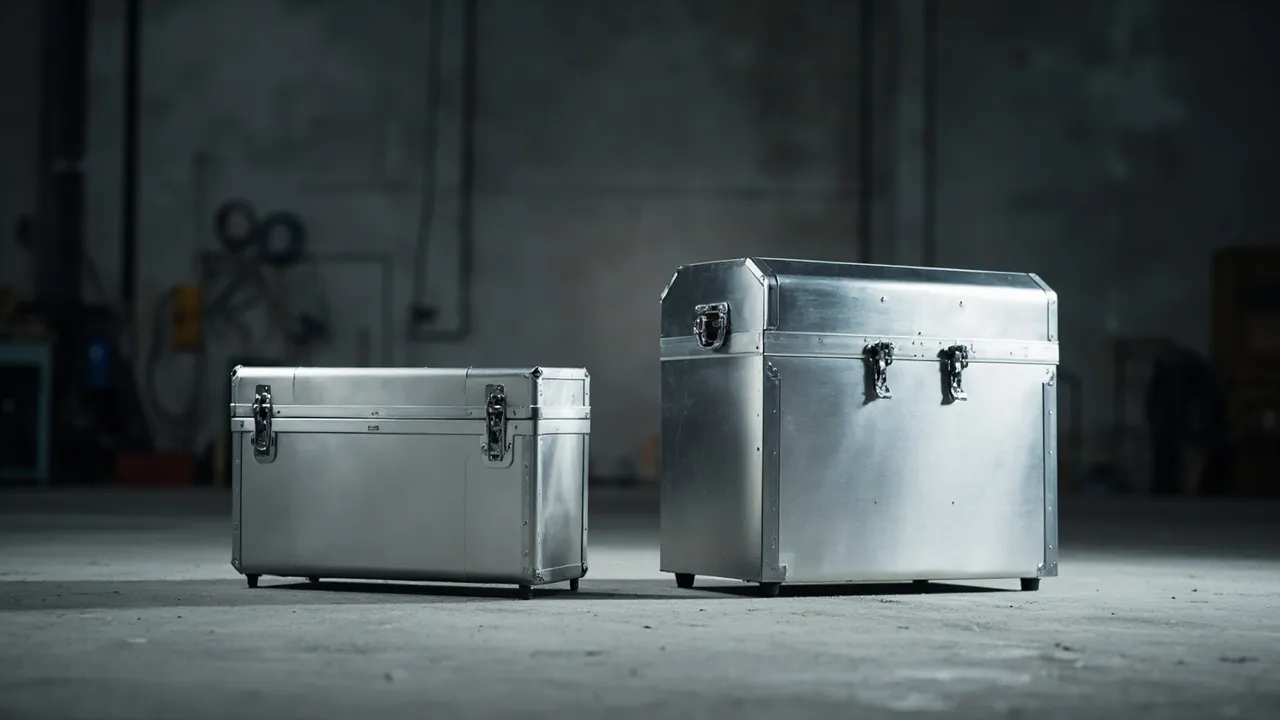
Verdict first: if "lasting longer" means surviving years of outdoor storage without rotting through or losing function, stainless steel usually wins — particularly near coasts, in chemical plants and on salted winter roads. But once carrying weight, drop recovery, how hot it gets to the touch and purchase budget are folded into the definition, the answer splits. Aluminium is frequently the more durable choice in practice wherever cases are carried often, because it is light enough that crews keep using it. The real dividing line is not which metal is harder; it is three specific questions: how high is the chloride load in your environment, will the case contact dissimilar metals, and how much are you willing to spend on surface treatment and upkeep. Answer those and the conclusion arrives on its own.
Most arguments on this topic go round in circles because the two sides are measuring different things. One party means "will the metal still be there in ten years"; the other means "will this box still be in use in three years, or will it sit in a corner because nobody wants to carry it". This article opens both dimensions and adds a third that is rarely discussed: the predictability of the failure mode. Aluminium usually fails slowly and visibly, producing white powdery oxide you can see coming, giving you time to intervene. Stainless steel, under certain conditions, can fail by crevice corrosion or chloride stress corrosion cracking that is hidden and comparatively sudden. That difference matters enormously for equipment left outdoors with nobody looking at it.
It is written for engineers and procurement staff specifying cases for long-term outdoor duty: tool cases accompanying telecom and power outdoor cabinets, deck equipment boxes on vessels and offshore platforms, military and police equipment cases, maintenance cases in chemical plants, and cases bolted permanently into pickup beds. Expect grade-level parameter tables, three corrosion mechanisms compared, mass and temperature behaviour, the capabilities and limits of anodising and passivation, how fabrication affects service life, a ready-to-use maintenance template, whole-life cost tables and a scenario decision checklist.
Table of Contents
- Verdict first: it depends how you define "durable"
- Start with grades: common alloys and basic parameters
- Mechanism one: pitting and galvanic corrosion in aluminium
- Mechanism two: chloride pitting, crevice corrosion and stress corrosion in stainless
- Mechanism three: the micro-environments that do the real damage
- The true enemies of long-term outdoor storage
- Mass, strength and drop behaviour: deformation versus resilience
- Thermal behaviour: conduction, hot surfaces and condensation
- Surface treatments: anodising, powder coating, brushing and passivation
- How fabrication decides service life: bending, welding, fasteners
- Sealing and hardware: metal does not automatically mean weatherproof
- Maintenance regimes and whole-life cost
- FAQ
- Closing remarks and related reading
Verdict first: it depends how you define "durable"
Let us separate the three definitions, because everything else follows from them.
Definition one, material durability. The question is whether the metal will still exist in a decade. Here molybdenum-bearing austenitic stainless in the 316 family generally leads, followed by 5xxx or 6xxx aluminium with quality anodising, then unprotected carbon steel and low-grade stainless. The reason follows below, but the conclusion is clear: given equal care, stainless resists uniform attack best.
Definition two, durability in use. This asks how long the case stays in service, and it introduces the human factor. An 18 kg stainless case and a 9 kg aluminium case have very different destinies on a crew: the first tends to be loaded into a truck bed and forgotten until someone needs it; the second tends to travel daily. A toolbox only earns its durability if it is used, so on this measure aluminium usually wins.
Definition three, predictability of failure. This asks whether you get warning. Almost nobody discusses it, yet it dominates the unattended-outdoor-storage case. Aluminium corrosion products are usually white oxides that are obvious early, while stainless local attack — pitting and crevice corrosion in chloride service — often proceeds on hidden mating faces, leaving only a tiny bore or stain visible until structural loss is well advanced.
So the engineering answer is layered:
| Scenario | Recommended material | Primary reason |
|---|---|---|
| --- | --- | --- |
| Coastal, marine, de-iced roads, chloride service | 316-family stainless, or heavily protected aluminium with sacrificial anodes | Best resistance to chloride pitting |
| Inland industrial and urban outdoor duty | Anodised aluminium or 304-family stainless | Decided by weight sensitivity |
| Frequent carrying, climbing or one-handed work | Aluminium | Mass governs whether it is actually used |
| Permanently mounted static duty | Either, decided by budget | Mass no longer constrains |
| Tight budget, moderate environment | Anodised aluminium with a maintenance regime | Lower initial cost |
| Contact with strong alkali or wet cement | Evaluate carefully; aluminium performs poorly | Alkali attacks aluminium severely |
One sentence captures the logic: establish chloride concentration and pH first, then choose the material; where both survive, let weight sensitivity decide.
Start with grades: common alloys and basic parameters
Before comparing, lock the grades. Saying "aluminium" or "stainless" means nothing, because performance within each family varies several-fold.
On the aluminium side, three groups dominate.
One, the 1xxx series (1060 for example). High purity, good corrosion resistance and excellent formability, but low strength. Suited to non-load-bearing liners, trim and inner trays rather than structural cases.
Two, the 3xxx series (3003 for example). Manganese-alloyed, moderate strength, good corrosion behaviour and weldability, common where moderate strength suffices, and reasonably priced.
Three, the 5xxx series (5052, 5083) and 6xxx series (6061, 6063). Aluminium-magnesium 5xxx alloys have excellent corrosion resistance within the aluminium family, notably against seawater, combined with useful strength and weldability — the natural direction for marine-grade aluminium. The aluminium-magnesium-silicon 6xxx alloys can be heat treated to T5 or T6 tempers for higher strength and good machinability, making them a common structural choice at slightly lower corrosion resistance than 5xxx.
On the stainless side, three groups matter.
One, austenitic 304-family. The chromium-nickel workhorse: best overall versatility, moderate price, good weldability, excellent in most atmospheres. Its weakness is chlorides.
Two, austenitic 316-family. Around two to three per cent molybdenum is added, markedly improving resistance to chloride pitting and crevice corrosion. This is the standard answer for marine and chemical service, at correspondingly higher cost.
Three, duplex grades such as 2205. Roughly twice the strength of standard austenitics and far better resistance to chloride stress corrosion cracking, but expensive and harder to fabricate — reserved for special requirements rather than ordinary toolboxes. Martensitic grades in the 410 and 420 range can be hardened but corrode readily; ferritic grades such as 430 are cheap with moderate corrosion performance.
| Parameter | Aluminium alloys, typical | Austenitic stainless, typical | Meaning for toolboxes |
|---|---|---|---|
| --- | --- | --- | --- |
| Density | Around 2.7 g/cm³ | Around 7.9 g/cm³ | Roughly 2.9 times the mass at equal volume |
| Thermal conductivity | Around 120–170 W/(m·K) | Around 15–20 W/(m·K) | Aluminium gets hotter to touch and condenses more |
| Electrical conductivity | High | Low | Different galvanic behaviour against dissimilar metals |
| Typical yield strength | 5xxx around 100–200 MPa; 6061-T6 around 240 MPa | 304 around 200 MPa | Stainless slightly ahead, but far less than the density gap |
| Elastic modulus | Around 70 GPa | Around 190–200 GPa | Stainless roughly three times stiffer, resists denting |
| Uniform corrosion resistance | Relies on oxide film, needs enhancement | Excellent via the passive film | Stainless steadier in most atmospheres |
| Chloride pitting resistance | Weak, pits readily | 316 beats 304; both can pit | Marine service demands 316 or heavy protection |
| Formability and weldability | Good | Good, though sensitisation and hot cracking need care | Similar process cost |
Note the density row: an equal-volume stainless case weighs roughly 2.9 times an aluminium one (typical value, affected by wall design). That single figure drags every other technical argument back to the unsophisticated question of who has to carry the thing.
Mechanism one: pitting and galvanic corrosion in aluminium
Aluminium works because a dense oxide film forms spontaneously on its surface, typically only nanometres to tens of nanometres thick, separating metal from environment. The problem is that the film is amphoteric — attacked by both strong acids and strong alkalis.
Weakness one: chloride-induced pitting. Chloride ions are small and penetrating; they adsorb preferentially at film defects such as inclusions, grain boundaries and scratches, breaking passivity locally. That spot becomes a tiny anode with very high current density, dissolving metal fast and forming a pit. The visible symptom is the fluffy white corrosion product that is dried aluminium hydroxide. The danger is that pits grow inward rather than outward: a small surface hole may conceal significant internal loss. Sea spray, winter de-icing salt and chlorine-containing cleaners all shorten aluminium service life substantially.
Weakness two: galvanic corrosion. Aluminium sits on the active side of the galvanic series, so when it touches a more noble metal — most commonly stainless steel — with an electrolyte present, even condensed dew or rainwater, aluminium acts as the anode and dissolves faster. This is an extremely common and repeatedly committed error: stainless bolts into an aluminium case, stainless hinges bolted to aluminium, or an aluminium case sitting and fretting against stainless shelving. Field diagnosis is easy: corrosion noticeably worse around one fastener than elsewhere almost always means galvanic action.
Three countermeasures follow.
One, anodising. An electrochemical process grows an artificial oxide film far thicker than the natural one — commonly a few micrometres to tens of micrometres, more for hard anodising. It is hard, abrasion resistant and corrosion resistant, and it provides an excellent paint base. Note its limits: anodising genuinely raises corrosion resistance but it is not magic — scratch through to the base metal and local attack begins at the wound, and sealing quality governs the result (hot water, steam and ambient nickel-based sealing each have trade-offs).
Two, isolate dissimilar metals. Insert non-metallic gaskets, plastic sleeves or insulating coatings at the interface, and use barrier-treated or nylon-washer fasteners. Cheap, and chronically omitted.
Three, sacrificial protection or coating systems. In severe duty, such as marine service, specify replaceable zinc or magnesium sacrificial anodes, or build a heavy-duty system of epoxy primer plus polyurethane topcoat.
Mechanism two: chloride pitting, crevice corrosion and stress corrosion in stainless
Stainless resists attack because chromium, typically at least 10.5 per cent, forms a chromium-rich passive film. That film is dense and self-healing — but healing needs oxygen. In stagnant, oxygen-starved liquid the repair stops and corrosion begins. Grasp that and the three failure modes follow.
Mode one: chloride pitting. Similar in principle to aluminium: chlorides locally break through the passive film. Sensitivity is commonly estimated by the pitting resistance equivalent number, PREN, widely written as PREN = %Cr + 3.3 × %Mo + 16 × %N, with slight variation between sources. Grade 304 typically lands around 18 to 20 while 316 reaches roughly 24 to 26 (typical values) — higher means better pitting resistance. That is precisely why marine specification calls for 316: the added molybdenum converts directly into chloride resistance.
Mode two: crevice corrosion. This is the most realistic threat outdoors. Inside lap joints, under washers, at rivet seams, in weld roots and in any stagnation zone, solution barely moves and oxygen is not replenished. Metal inside the crevice consumes dissolved oxygen first, passivity fails, and to restore electroneutrality chlorides migrate inward, building a concentrated acidic chloride solution — an autocatalytic process that accelerates once started. Crevice corrosion is feared because it happens out of sight, on the inner face of a lap seam, leaving only a fine rust line outside while thickness is lost within.
Three design countermeasures: (1) prefer butt joints ground flush over lap joints, (2) use continuous rather than spot or intermittent welds to eliminate crevices, and (3) fill unavoidable crevices with corrosion-resistant sealant. All three must appear on the fabrication drawing, otherwise cases ship with ready-made crevices.
Mode three: chloride stress corrosion cracking. Three ingredients are required together: a susceptible material (usually austenitic stainless), tensile stress (residual or applied) and a specific aggressive environment (chlorides plus temperature). Typical triggering temperatures sit somewhere above the 50 to 150 °C range (empirical). Genuine stress corrosion cracking is uncommon in ordinary toolboxes, but where high welding residual stress coincides with hot, chloride-rich service — think coastal tropical power installations with permanently mounted outdoor equipment enclosures — residual stress control must be part of the design and manufacturing brief. Remedies involve stress-relief annealing, limiting cold work and avoiding highly restrained weld joints.
Mechanism three: the micro-environments that do the real damage
The previous two sections cover general mechanisms, but small local environments frequently matter more than regional climate. Inspect these four before specifying anything.
Micro-environment one: fertiliser stores, livestock sheds and heavy coastal salt spray. The common factor is salt, nitrogen compounds and high humidity. Salt deposition in coastal zones can exceed inland urban levels by several-fold to tens of times (an order-of-magnitude judgement). Here even anodised aluminium needs heavy protection, let alone bare steel. Salt deposition rate and time of wetness should ideally be specification inputs; few people measure them, but the proposal should at least declare the expected maintenance interval in salt-laden atmospheres.
Micro-environment two: northern roads treated with de-icing salt. De-icers are chlorides — sodium, calcium or magnesium chloride — aggressive to both aluminium and stainless. A case mounted in a truck bed receives continuous spray and immersion in salty slush through winter, which is among the most underestimated duties anywhere. Mitigations: heavy-duty protective coating, gap drainage so nothing pools permanently, and thorough fresh-water washing at the end of every winter rather than merely drying off, since residual salt keeps absorbing moisture and sustaining corrosion through humid seasons.
Micro-environment three: alkaline environments. Ready-mix plants, precast concrete factories and some chemical premises generate alkaline dust that is lethal to aluminium. Wet cement is strongly alkaline with pH above 12 and will dissolve the oxide film and attack the metal rapidly. In such service, exclude aluminium even where stainless costs more. This is one of very few contexts where aluminium is simply the wrong answer.
Micro-environment four: industrial atmospheric pollutants. Sulphur and nitrogen oxides form acidic deposition, affecting both families though stainless generally copes better. Note one important exception: certain organic acid and fluoride environments also attack stainless specifically, so here you need grade-specific corrosion data rather than the intuition that stainless always wins.
The true enemies of long-term outdoor storage
In genuinely static duty, three specific events kill metal cases far more often than uniform rust does. Understanding them beats memorising corrosion tables.
Enemy one: standing water zones. Outdoor failures almost always begin wherever water lingers: low spots in the base, contact faces when stacked, blocked drain channels, or lap seams that trap rain. Regardless of how good the material is, oxygen starvation in those pockets drives local attack. The first duty of design is drainage and drying on every surface. Practically: provide slope or channels on the external base; make stacking contact point-based rather than face-based, so capillary water cannot be held; raise the case clear of pooling water.
Enemy two: fasteners fail first. The most common field symptom is not a rotted shell but seized screws, binding hinges and latches that will not open. Several factors compound: stainless bolts into aluminium create galvanic attack; mixing stainless grades causes problems; threads are natural crevices; and long inactivity produces galling. The response is to choose fasteners compatible with the shell, add insulating washers at contact faces, apply suitable anti-seize to threads (checking compatibility with nearby elastomers, since some greases attack rubber), and include fastener checks in quarterly rounds.
Enemy three: local damage to the protective layer. Whether anodised or powder coated, once the film suffers scratches, chipped edges or impact damage, that spot becomes an initiation site, and corrosion then creeps beneath the coating until adhesion fails and it flakes away in sheets — the familiar peeling. For cases living outdoors, treat coating repair as routine maintenance: grind and touch up early, far cheaper than dealing with full-scale delamination later. On export programmes JUNZHJIA routinely suggests carrying a small stock of colour-matched repair paint, an almost free step that noticeably extends both appearance and protection life.
Mass, strength and drop behaviour: deformation versus resilience
Corrosion aside, mechanical behaviour supplies three counter-intuitive conclusions.
First: stainless is roughly three times stiffer, which does not make it more droppable. Higher elastic modulus means smaller deflection under load, so stainless does resist denting better — a 20 kg weight on the floor panel will deform stainless noticeably less than aluminium. Impact is a different matter: drops test energy absorption and ductility, not stiffness. Aluminium is ductile and usually simply dents without cracking; stainless, being stronger and stiffer, concentrates impact energy locally and may crease or even crack at a weld.
Second: dents in aluminium are sometimes an advantage. A dent absorbs energy and often leaves lid closure and sealing unaffected, so you simply have a case with history. What does matter is deformation at hemmed edges or welds, which can misalign the lid and break the seal. Structurally, therefore, place welds and hems away from high-risk impact zones — typically the four corners and bottom edges — and thicken locally to build in tolerance. Reinforcement concepts sit in high-strength enclosure structures.
Third: the compounded benefit of lightness is chronically underestimated. A roughly 2.9-fold mass difference is a minor inconvenience once; multiplied across several trips a day for years it decides whether crews use a case, whether it gets left in a sun-baked truck for convenience, and whether it gets dropped during handling. Discounted into effective service life, aluminium often lasts longer — which is why, outside severe corrosion duty, our recommendation leans that way.
| Comparison | Aluminium case | Stainless case | Practical meaning |
|---|---|---|---|
| --- | --- | --- | --- |
| Empty mass, same size | Baseline | Roughly 2.5 to 3 times | Governs how often it gets used |
| Stiffness at equal wall thickness | Baseline | Roughly 3 times | Stainless deforms less |
| Typical post-drop damage | Dents, deformation | Creases, cracked welds | Aluminium usually remains serviceable |
| Can it be reshaped on site | Relatively easy | More difficult | Aluminium is more maintainable |
| Does it need welding-grade repair | Seldom | Relatively often | Stainless repairs need higher skill |
| Theft risk given scrap value | Lower | Higher | Stainless scrap carries higher value |
Thermal behaviour: conduction, hot surfaces and condensation
Metal behaves completely differently from plastic outdoors, and this is what surprises people most after switching to metal.
Difference one: perceived touch temperature. Aluminium conducts at roughly 120 to 170 W/(m·K) and stainless at roughly 15 to 20 W/(m·K) (typical values) — an order of magnitude apart, yet both are high conductors relative to plastics, which are usually around 0.2 W/(m·K). In a sun-baked vehicle, metal surfaces reach or exceed air temperature, and because heat flux into skin is high, it feels dramatically hotter. Think of it this way: plastic hands heat to you slowly; metal pushes it into you at once. Aluminium is worse than stainless on this count, so in summer wear gloves or grip the non-metallic handle when lifting an aluminium case.
Difference two: condensation. High conductivity means shell temperature tracks the environment quickly, so after radiative cooling overnight followed by moist morning air, the case becomes the cold spot where water condenses. Aluminium, conducting faster, shows this cold-spot effect more strongly. The implication for outdoor storage is that metal cases develop interior condensation films more readily, accelerating tool corrosion even with good sealing. Remedies are the familiar ones: desiccant, drying tools before stowing, avoiding rapid temperature swings, and allowing some ventilation path where possible, balanced against the ingress rating — see the discussion of pressure equalisation vents in hinge, latch and seal construction.
Difference three: winter handling. At -20 °C a bare metal grip draws heat from skin rapidly, causing discomfort and genuine cold-injury risk — the same mechanism as hot contact running the other way. Outdoor and vehicle cases must therefore have non-metallic or over-moulded grips, and that belongs on the specification.
One further thermal consequence deserves mention: metal interiors heat up faster, so the previously discussed lithium battery storage ceiling, typically 45 to 60 °C as a typical value, is exceeded sooner in a metal case. That is why we discourage keeping lithium cells in metal cases long term — the modest passive insulation of plastic is a useful buffer.
Surface treatments: anodising, powder coating, brushing and passivation
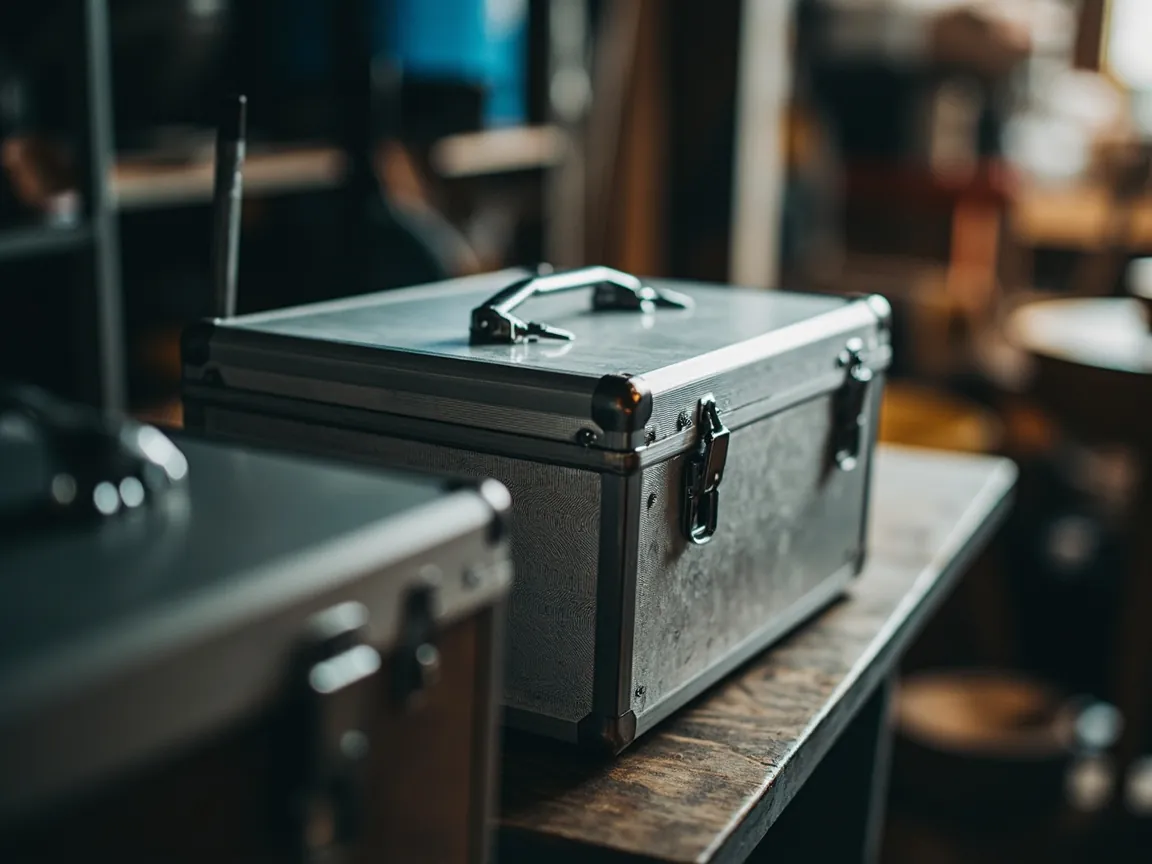
Service life depends substantially on what is done to the surface. Here are four processes with their boundaries.
Anodising, for aluminium. An electrochemical process thickens the natural oxide to a controlled level, commonly several micrometres to tens of micrometres, or more for hard anodising. The film grows metallurgically bonded from the substrate rather than sitting on top, so it will not flake off in sheets like paint — its greatest advantage. Its limits: the film is brittle and chips under severe impact; it is porous and must be sealed for real corrosion resistance (hot water, steam and ambient nickel-based sealing each trade off differently); and dark anodised finishes fade outdoors, especially organic dyed ones. In alkaline cement dust, anodising itself is attacked and needs a stronger coating system above it.
Powder coating, for aluminium and steel. Electrostatic powder is cured into an organic film typically tens to over a hundred micrometres thick. Advantages are thickness, good barrier behaviour, wide colour range and moderate cost. Limitations: once breached, corrosion starts at the damage and creeps beneath the film, causing sheet delamination, the peeling already mentioned. Quality therefore hinges on pre-treatment — degreasing, derusting, phosphate or zirconium conversion coating — and film thickness control; without those, even premium powder performs badly.
Mechanical and chemical finishes: brushing, blasting, polishing. Brushing and polishing are mainly cosmetic with limited corrosion benefit; blasting improves coating adhesion. One subtlety: surface roughness influences corrosion behaviour, since very rough surfaces retain water and contaminants and can perform worse in some environments.
Passivation, for stainless. Initial corrosion resistance depends on the quality of the passive film as delivered. Professional practice performs pickling and passivation, following requirements such as ASTM A967, to remove free iron and embedded particles — which otherwise become rust initiation sites — and to form a uniform chromium-rich film. Omitting this step produces the classic complaint that a new stainless case shows rust within two months, when nearly all those spots came from carbon-steel contamination during fabrication rather than from the stainless itself. Specify it explicitly: pickling and passivation, plus separation from carbon-steel tools and benches throughout fabrication.
| Process | Substrate | Main benefit | Main limitation | What to ask when buying |
|---|---|---|---|---|
| --- | --- | --- | --- | --- |
| Anodising, sealed | Aluminium | Wear and corrosion resistance, finish | Brittle film, poor alkali resistance | What film thickness, and which sealing process |
| Powder coating | Aluminium, steel | Thick barrier, low cost | Underfilm creep and peeling after damage | Pre-treatment process, film thickness and adhesion data |
| Blast plus coating | Aluminium, steel | Improves adhesion | Surface roughness must be managed | Abrasive type and specified roughness |
| Pickling and passivation | Stainless | Removes free iron, builds passive film | Process-sensitive | Was it performed to standard, with salt spray evidence |
A useful verification tool is the neutral salt spray test, NSS, covered by GB/T 10125, ISO 9227 and ASTM B117. Note carefully that salt spray hours cannot be converted into years outdoors; it is a screening and comparative method. What it does offer is a fair comparison between process options and a means of checking incoming lot consistency. A reasonable requirement reads: "identical specimens shall show no significant red or white rust after X hours of neutral salt spray, with the exact acceptance criterion agreed between the parties."
How fabrication decides service life: bending, welding, fasteners
Two cases from identical materials can differ by years depending on how they were made. Four process controls matter most.
One, bend radius. Bending stretches the outer face and compresses the inner one. Too small a radius produces micro-cracking and work hardening on the outside, creating exactly the sensitised sites that invite stress corrosion. Common practice keeps minimum bend radius at some multiple of sheet thickness, the exact factor depending on material ductility as a workshop rule of thumb, and states it on the drawing. Many budget cases fail here: chasing crisp edges, they bend too tight, and years later the four arrises develop cracks.
Two, weld quality and post-weld treatment. Welding brings three problems: sensitisation of the heat-affected zone in stainless, where time in a critical temperature range precipitates chromium carbides at grain boundaries; welding residual stress, itself one of the three ingredients of stress corrosion cracking; and weld defects, with porosity, lack of fusion and undercut all acting as corrosion initiation sites. Countermeasures are controlling heat input with solution or stabilising treatment where needed, reducing residual stress through sequence planning and post-weld treatment, and grinding out defects. One useful purchasing question: "were the welds ground and passivated?" Inability to answer usually means no.
Three, fastener material matching. Beyond the galvanic risk already discussed, three practices help: keep fasteners in the same family as the shell, or use protected steel fasteners with isolating washers; fit nylon washers or insulating sleeves wherever dissimilar contact cannot be avoided; and apply a little anti-seize to threads intended for long-term outdoor service, checking compatibility with adjacent rubber and seals since some greases attack elastomers. Note also that threads are natural crevices, so consider blind-hole designs or sealing caps for joints that will never be dismantled.
Four, actually delivering drainage. Process often destroys the design intent: drawings show a sloped external base, but welding distortion or bad support structure leaves an inverted slope holding water in the middle. Run a simple pour test at sample stage: set the case level, pour a bucket of water over it, wait ten minutes and see whether water pools in the base. Almost free, and it exposes a surprising number of defects.
Sealing and hardware: metal does not automatically mean weatherproof
A common misconception holds that metal cases are stronger and therefore seal better. In reality the opposite tends to be true: achieving the same IP rating in metal is usually harder and more costly than in plastic.
Three reasons. One, dimensional accuracy: moulded plastic derives its seal-face flatness and consistency from the tool, whereas sheet metal accumulates tolerance through cutting, bending and welding, making seal-face planarity harder to control. Two, uneven stiffness distribution: large metal panels are stiff overall, yet unstiffened flat areas can distort locally under latch compression, so the seal line is loaded unevenly. Three, more seams: every weld and every hem is a potential leak path.
Three design consequences follow: the door frame or lid opening must form a continuous, adequately stiff sealing face, ideally an integrally formed channel holding the gasket; latches must be numerous and symmetrically arranged to compensate for uneven panel stiffness; and verification is mandatory — whether IP54 or IP65, run product-level rain or dust tests rather than assuming metal superiority. This is elaborated in plastic versus metal toolboxes.
One further caution: metal cases usually need shorter gasket replacement intervals, because high thermal conductivity widens temperature swings at the groove and condensation is more frequent. Adopt a conservative interval, say nine months rather than twelve as an empirical starting point.
Maintenance regimes and whole-life cost
The final section converts everything into two deliverables: a maintenance table and a cost table.
Maintenance first. The two materials need genuinely different attention, so running one programme across both is wrong:
| Task | Aluminium case | Stainless case | Suggested frequency |
|---|---|---|---|
| --- | --- | --- | --- |
| Visual check for white oxide or rust spotting | Look for white oxide, especially at machined holes and cut edges | Look for fine rust spots and staining around welds | Quarterly |
| Fresh-water washing to remove salt | Essential, particularly after winter | Equally essential to remove chlorides | Immediately at end of winter |
| Fastener condition and isolating washers | Check for galvanic evidence | Check for seizing | Quarterly |
| Scratch and coating damage repair | Grind and touch up promptly | Grind and locally passivate or recoat | As soon as found |
| Gasket inspection and replacement | Suggest every 9 to 12 months | Suggest 9 to 12 months, err conservative | Annually or sooner |
| Drainage path verification | Clear blocked channels | Same | Quarterly |
| Lid closure and latch smoothness | Dry lubricant maintenance | Same, plus thread anti-seize | Half-yearly |
Then cost. Typical qualitative comparisons over three years follow (actual proportions vary widely with design and volume, so treat these as relative ranking only):
| Cost element | Aluminium case | Stainless case | Notes |
|---|---|---|---|
| --- | --- | --- | --- |
| Initial purchase cost | Moderate | Higher, typically 1.5 to 2.5 times a comparable aluminium case (typical value) | Both material and processing cost more |
| Transport cost | Lower | Higher | Mass accumulates across a full truck load |
| Ergonomic cost at the crew level | Lower | Markedly higher | A hidden cost routinely ignored |
| Corrosion repair cost | Moderate, maintenance dependent | Low where environment suits | Can be high even for stainless in hostile service |
| Drop and deformation repair cost | Lower, reshapes | Higher, often needs welding | Aluminium repairs more easily on site |
| Residual value and theft risk | Lower | Higher value but higher theft exposure | Relevant for unattended outdoor storage |
| Three-year overall, general outdoor duty | Usually better | Depends whether mass constrains use | See decision rules |
From these tables come four decision rules.
Rule one, environment first. Wherever a definite chloride source exists — within a few kilometres of coast, on vessels, on salted roads, or with frequent chlorine cleaners — and the case sits unattended without regular inspection, go straight to 316-family stainless with pickling and passivation specified. In material selection, environment outweighs every aesthetic preference.
Rule two, exclude aluminium from alkaline duty. Sites with wet cement, certain acid and alkali chemical processes, or frequent strong-alkali washdown should not use aluminium regardless of the premium; aluminium's oxide film fails quickly outside a mid-range pH window.
Rule three, let weight sensitivity break the tie. Where both survive and budget allows, decide by whether the case is carried daily, used at height, or handled by one person. Carried frequently means aluminium; permanently mounted means either, so let budget and appearance decide.
Rule four, always consider the third option. Very often the answer is neither aluminium nor stainless but plastic or composite construction. Such cases are lighter, cheaper, immune to salt spray in the sense that rust is irrelevant, and perform well across vehicle temperature ranges. Only reach for metal where extreme structural strength, drop resistance, theft resistance or exceptional resistance to abuse is genuinely required. Supporting data appears in plastic versus metal toolboxes and selecting toolboxes for outdoor work.
FAQ
Q: Between aluminium and stainless, which toolbox genuinely lasts longer? A: It depends on environment; there is no absolute answer. In dry inland atmospheres both survive for many years with little between them, and aluminium often performs better overall thanks to lower mass, reshapeable dents and negligible scrap value. In coastal, marine and chloride service, 316-family stainless lasts noticeably longer, and aluminium may pit within a few seasons even anodised. In alkaline environments such as cement works and parts of the chemical industry, the picture reverses: aluminium fails quickly while stainless clearly wins. There is also the question of what "lifetime" means: if a case is too heavy to be used and sits forgotten in a truck bed under the sun, its effective life ended long ago, and on that basis the aluminium case roughly two-thirds lighter frequently outlives its rival. Split the question: "Which resists rotting away if never moved? Stainless. Which lasts longer in actual use? Usually aluminium."
Q: Why did my stainless case develop rust spots after six months? Is it counterfeit? A: In most cases neither counterfeit nor even a material defect, but a question of surface treatment or fabrication contamination. Stainless corrosion resistance rests on its chromium-rich passive film. During cutting, bending, grinding and welding, tiny particles from carbon-steel tools, polishing dust, or even debris flung from a nearby angle grinder working on mild steel can embed in or settle on the stainless surface. Those particles rust in damp air, and the staining looks exactly like stainless corroding. The second common cause is missing pickling and passivation, leaving free iron and no uniform passive layer. Only the third possibility is a genuine material substitution, such as 200-series material sold as 304. For corrective action: clean the affected area with a dedicated stainless cleaner or a mild acid paste, then rinse thoroughly with clean water and dry. If the stain recurs at exactly the same place, carry out pickling and passivation or local grinding, and avoid simply painting over rust spots, since covering them worsens crevice corrosion in an oxygen-starved environment. Prevent this by requiring grade compliance with a material certificate — commonly a document in the style of EN 10204 — plus specified pickling and passivation.
Q: Aluminium cases are easy to maintain in everyday use, but what if they must live beside the sea? A: Coastal exposure is the hardest environment for any metal case and needs three layers of protection together. Layer one is material: prefer 5xxx aluminium-magnesium alloys such as 5052 or 5083, whose seawater resistance is among the best in the aluminium family; if budget allows and weight is acceptable, 316-family stainless is the safest marine answer. Layer two is surface: anodise and then paint — the familiar anodise plus epoxy primer plus polyurethane topcoat system — rather than relying on anodising alone, with minimum film thickness and pre-treatment requirements written into the purchase contract. Layer three is structure and upkeep: provide replaceable sacrificial anodes, usually zinc, eliminate all dissimilar-metal contact with insulating washers on every fastener, rinse thoroughly with fresh water after each voyage or each rainy season, which is the single most valuable and cheapest measure, and make scratch repair routine. Also note that sand accumulating beneath the case creates a permanently damp contact zone, so raise it clear of the ground. Where plastic is acceptable, glass-filled polypropylene often outperforms most metals in salt spray, which is the real reason much marine equipment ends up plastic.
Q: Do metal toolboxes get especially hot in a summer car, and can anything be done? A: Yes, markedly hotter than plastic. Metal conducts heat hundreds to nearly a thousand times faster than plastic — aluminium around 120 to 170 W/(m·K) against typically 0.2 W/(m·K) for ordinary plastics as material reference values — so not only does the shell reach or exceed cabin air temperature, but heat transfers into skin so quickly that it feels too hot to hold. Stainless conducts an order of magnitude less than aluminium yet still enormously more than plastic. Four measures help: (1) fit non-metallic or rubber grips to handles, the most effective item and one worth writing into every specification; (2) cover the case with a blanket or insulating pad to keep direct sun off the metal; (3) choose light colours or bare metal finishes, since dark surfaces absorb far more; (4) wear gloves, which also protects against winter cold injuries. One further safety point: precisely because metal exchanges heat so efficiently, interior temperature climbs faster, so never store lithium cells inside a metal case long term — the small amount of passive insulation plastic provides is a genuine advantage here.
Q: How much do the two materials differ in price, and is stainless worth the premium? A: Comparable stainless cases typically cost 1.5 to 2.5 times their aluminium equivalents (empirical, varying widely with design and volume), plus transport cost because mass roughly triples, plus the ergonomic cost borne by crews. Whether it is worth paying depends on three questions. One, is your environment chloride-loaded? If yes — coastal, salted roads, offshore — the premium buys real service life and is justified. Two, is the case static and rarely moved? If so mass no longer constrains, so stainless stiffness and corrosion resistance pay off, and again it is justified. Three, are alkaline media or frequent strong-alkali washdown involved? If so aluminium is excluded anyway, favouring stainless again. Conversely, if the case is carried every day, used at height, or budget is tight, spending the money on better surface treatment, better gaskets and durable hardware usually beats upgrading to stainless. Do not overlook the third option: in many non-extreme environments plastic and composite constructions give the best combined result across life, weight and cost, since they do not rust, are seldom stolen and carry no galvanic risk.
Q: Can aluminium and stainless parts be mixed, for instance stainless hinges on an aluminium case? A: Technically yes, but only with electrical isolation, otherwise you pay for it. As described, aluminium is electrochemically active relative to stainless, and in the presence of an electrolyte — rain, condensation, even damp salt crust — a cell forms in which aluminium is consumed as the anode while stainless stays pristine. The classic symptom is unusually heavy corrosion around one hinge or bolt while the rest of the case looks fine. Where mixing is unavoidable, three measures are all mandatory: (1) non-metallic gaskets at the interface — nylon, plastic, rubber, or insulating coating carried right through the bolt hole; (2) rivets or bolts with insulating sleeves so the shank never touches the aluminium bore; (3) appropriate sealant in gaps to prevent electrolyte from lingering. Two further cautions: do not attach stainless nameplates to an aluminium case for appearance, and never use a stainless wire brush on aluminium, because it embeds steel particles into the surface and creates countless micro-cells. The safer path is to settle the material system at design stage: aluminium case with aluminium or suitably protected steel hardware, stainless case with stainless hardware. Simpler to manage, far lower lifetime risk.
Q: For unattended outdoor storage with nobody maintaining it, which should I choose? A: Favour 316-family stainless or a high-quality plastic or composite solution rather than aluminium. The three candidate materials fail differently under that specific condition. Aluminium gives visible warning through white oxide, but nobody is there to act on the warning, and unremoved white oxide actually holds moisture and accelerates deep pitting. Stainless crevice attack may progress hidden and sudden, but with the right grade, careful pickling and passivation, and a design that eliminates crevices through continuous welds ground flush, it generally needs no intervention for a long time. Plastic, particularly glass-filled polypropylene, typically performs best across many outdoor environments — no electrochemical corrosion, no galvanic couples, no coating repairs to manage — with ultraviolet exposure and temperature the only real considerations. Practical guidance therefore reads: look at chloride level first (high means 316 stainless; low to moderate means plastic is usually the easier option), then temperature range (for high temperature, check HDT and RTI as explained in toolbox heat deformation in vehicles), then theft resistance or extreme structural need (metal if yes). Note also that unattended never means zero maintenance — schedule at least a half-yearly site inspection and keep a workable path for inspection and parts replacement.
Q: What material and process evidence should be requested from suppliers when buying? A: Put these eight items on the enquiry. (1) Material certificates: alloy designation with the governing standard, plus a traceable material document in the style of EN 10204. (2) Surface treatment description: anodic film thickness and sealing process for aluminium; coating system, pre-treatment and film thickness for steel parts. (3) Salt spray report: stating the standard (GB/T 10125, ISO 9227 or ASTM B117), duration, and an explicit acceptance criterion. (4) Welding procedure and post-weld treatment: including grinding, passivation and any stress-relief steps. (5) Fastener schedule and materials: including whether insulating washers are used. (6) IP rating report where a rating is claimed: citing IEC 60529 or GB/T 4208-2017 and confirming tested and delivered models match. (7) Spare-parts list relevant to maintenance: gasket specification and minimum order, repair paint colour code, hinge and latch part numbers. (8) For ODM work, geometric tolerances from drawings, particularly flange flatness and drainage slope. Suppliers able to produce all eight at once usually have stable process controls; those offering only a certificate of conformity with no process data deserve caution. On bulk export programmes JUNZHJIA normally consolidates these eight items into a single delivery document pack so customers can file everything locally and re-verify later.
Closing remarks and related reading
To answer the title: which lasts longer, aluminium or stainless steel? Layered and honest, the answer is that on resistance to rotting away while standing still, molybdenum-bearing 316-family stainless generally wins, especially with chlorides present; on lifetime in actual use, aluminium, roughly two-thirds lighter, often wins; and across many moderately corrosive environments the true answer is neither metal but plastic or composite construction.
Five actions for engineering and procurement colleagues. One, establish chloride concentration and pH before anything else, since these two parameters decide whether a material is usable at all. Two, specify the surface treatment numerically — anodic thickness and sealing, pickling and passivation, coating pre-treatment and film thickness — never a vague "good finish". Three, eliminate galvanic risk entirely with insulating washers and compatible fasteners. Four, fold the maintenance table into the annual equipment service plan, particularly fresh-water washing after winter and annual gasket renewal. Five, never forget the third option: where acceptable, glass-filled plastic usually delivers the best combined outcome. On projects like these JUNZHJIA generally pilots around ten units for a full season before scaling, then fixes material, surface treatment and spare parts into the contract.
Related reading