

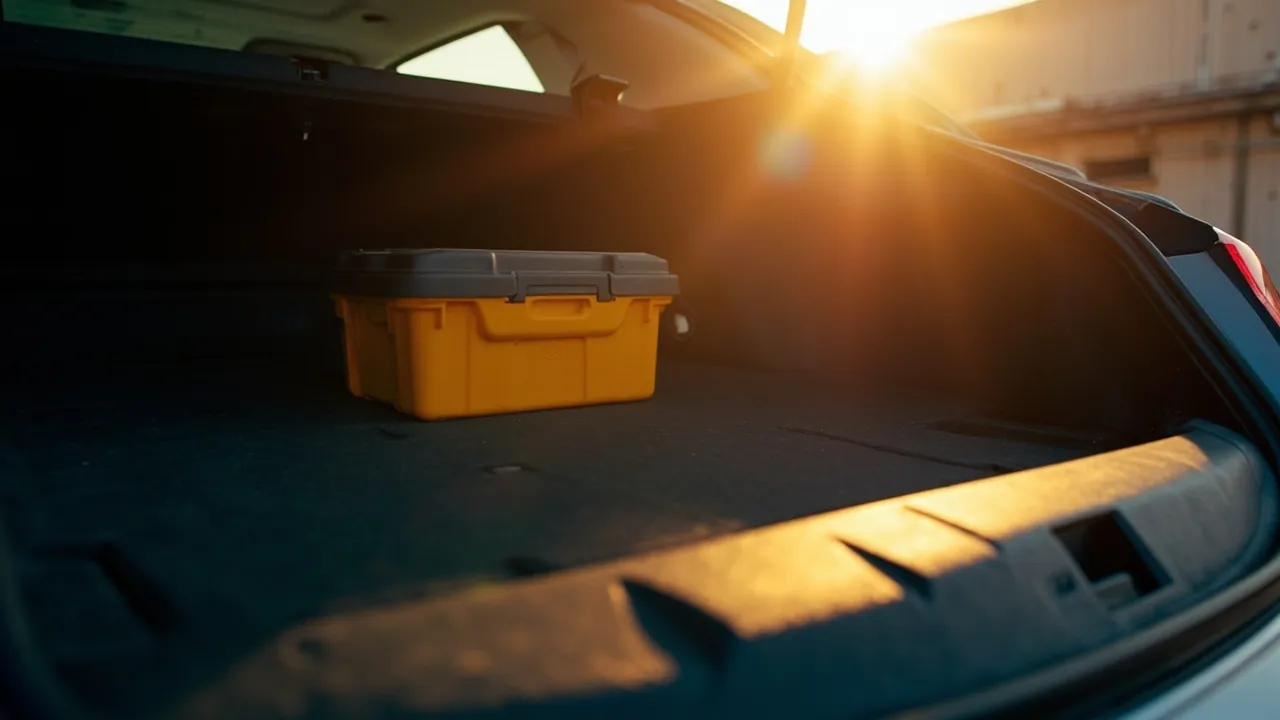
Verdict first: yes it can, and whether it does depends on four things — material, colour, load state and where it is parked. In summer sun the air inside a closed vehicle commonly reaches somewhere in the 60 to 70 °C band, and dark surfaces such as dashboards can run substantially higher (typical values, moving with vehicle type, glazing transmittance and ventilation). At that level, ordinary injection-moulded polypropylene shows a heat deflection temperature typically between 80 and 100 °C, which looks like comfortable margin until you account for the fact that sustained proximity to the softening range under load produces creep — slow, irreversible sagging, bulging and parting-line opening. Winter reverses the picture: a car parked outdoors in northern climates can fall to -20 °C or below, notched impact strength drops to a fraction of its room-temperature value, and one small drop is enough to crack a case. So the honest question is not whether room temperature is adequate but whether the material's characteristic values cover the -20 °C to +70 °C band with margin, and whether the structure survives long-term load combined with heat.
This is written for B2B users who keep tools in vehicles permanently: power utility repair crews, outsourced telecom base-station maintenance, roadside assistance and automotive service chains, geological and survey field parties, plus the fleet and procurement managers equipping them. It sets out how cabin temperatures arise, four key temperature metrics for the three dominant case plastics, the combined mechanics of expansion and creep, gasket ageing timelines, low-temperature embrittlement criteria, extra safety boundaries for batteries and gas cartridges, and a ready-to-paste temperature clause for tender documents. The central claim in one sentence: vehicle interiors are a badly underrated hostile environment, not because of extremes but because of the daily cycle count.
Table of Contents
- Verdict first: how hot does a car actually get inside
- Why the cabin gets so hot: the greenhouse mechanism
- Four characteristic temperatures: HDT, Vicat, brittle point and RTI
- Material comparison: PP, ABS, PC and glass-filled grades in vehicles
- The mechanics of deformation: expansion, creep and load combined
- Seals fail before shells do: the number one hidden hazard
- The cold side: embrittlement and drop risk at -20 °C
- Special contents: batteries, gas cartridges and chemicals
- Metal cases in vehicles: conduction, condensation and corrosion
- Design countermeasures: wall thickness, ribs, colour and reflectance
- Operational countermeasures: parking position, shading, ventilation, load reduction
- Writing the specification: turning temperature into verifiable clauses
- FAQ
- Closing remarks and related reading
Verdict first: how hot does a car actually get inside
Before discussing materials, establish a credible temperature range. The numbers do not depend on any particular vehicle's marketing; they follow from one physical fact: a closed cabin is a classic greenhouse system.
Step one, shortwave radiation enters. A large share of solar energy passes through side and rear glazing as visible and near-infrared light. Ordinary soda-lime automotive glass transmits visible light at roughly seventy to ninety per cent (typical value), so the energy gets in easily.
Step two, it is absorbed and reradiated as longwave. Seats, dashboards, floor coverings and dark trim absorb shortwave radiation, heat up, and re-emit in the longwave infrared. The decisive detail is that ordinary glass is largely opaque to longwave infrared — heat cannot get back out. That is the definition of the greenhouse effect.
Step three, convection is cut off. With the engine off there is no air conditioning, and with windows shut almost no air exchange occurs. Heat leaves only by slow conduction through body panels, far less efficiently than it arrives.
The result is cabin air substantially hotter than outside air, typically by tens of degrees Celsius on still, sunny afternoons. Practitioners commonly quote "60 to 70 °C for a summer parked cabin", and that order of magnitude is sound as a design input; surfaces receiving direct sun can run far above even that air temperature.
A case living in a vehicle therefore experiences a cycle like this:
| Period | Cabin air temperature (typical) | Case surface temperature (typical) | Dominant mechanism |
|---|---|---|---|
| --- | --- | --- | --- |
| Midday to afternoon sun | 50–70 °C | Higher; dark parts above 70 °C | Softening tendency, accelerated creep, gasket ageing |
| Evening natural cooling | Returns toward ambient | Lags air temperature | Contraction, negative pressure if sealed |
| Driving with air conditioning | 25–30 °C | Close to air temperature | Thermal shock from rapid cooling |
| Winter night outdoors | -20 °C to -5 °C in northern climates | Close to air temperature | Embrittlement, elevated drop-crack risk |
| Winter after heater start | Climbs quickly above 20 °C | Lags | Repeated thermal cycling fatigue |
Two features make this cycle punishing. First, it repeats hundreds of times a year, far exceeding the number of cycles in most accelerated laboratory ageing protocols. Second, heat and load coincide — a case is not safe because it happens to be empty; the worst condition by far is a full case sitting at high temperature for weeks. This is why "our cases slowly deform in the vans" is a perfectly credible engineering observation rather than a complaint to be dismissed.
Why the cabin gets so hot: the greenhouse mechanism
It is worth going one level deeper, because colour and surface finish are the only parts of this equation the buyer can actually control.
An object's equilibrium temperature in sun depends on two parameters: absorptance α for shortwave solar radiation and emittance ε for its own longwave radiation. The lower the ratio α/ε, the cooler the object stays — which is the entire principle behind selective coatings. Applied to toolboxes, three conclusions follow directly.
Dark shells are a clear negative inside vehicles. Deep grey, black and dark olive absorb strongly, reaching measurably higher surface temperatures than light colours under identical sun. Where corporate identity demands a dark colour, at minimum specify a high-gloss surface, which lowers absorption and helps shed longwave heat, or cover the case with a dust sheet or reflective blanket.
Metal shells get hot enough to burn hands. Aluminium conducts heat at roughly 200 W/(m·K) and steel at roughly 45 W/(m·K) as typical material values, orders of magnitude above plastics. In a summer cabin the surface reaches or exceeds air temperature, and because heat flux into skin is large, the perceived burn risk far exceeds anything a plastic case presents. This matters operationally for crews retrieving tools in a hurry.
Whether the case is shielded determines its real temperature. A case in an enclosed boot, under a parcel shelf or behind felt trim runs significantly cooler than one lying on an unshaded rear seat. The phrase "kept in the vehicle" must be refined into "where, and shaded or not", otherwise temperature discussion is meaningless. Users saying "mine has been in the boot for years without trouble" are reporting the effect of shielding, not luck.
Glazing film changes the whole interior regime. Quality infrared-rejecting film reduces near-infrared energy entering the cabin and therefore lowers peak temperature. The arithmetic often favours it: filming a fleet frequently costs less than replacing a batch of deformed cases.
Four characteristic temperatures: HDT, Vicat, brittle point and RTI
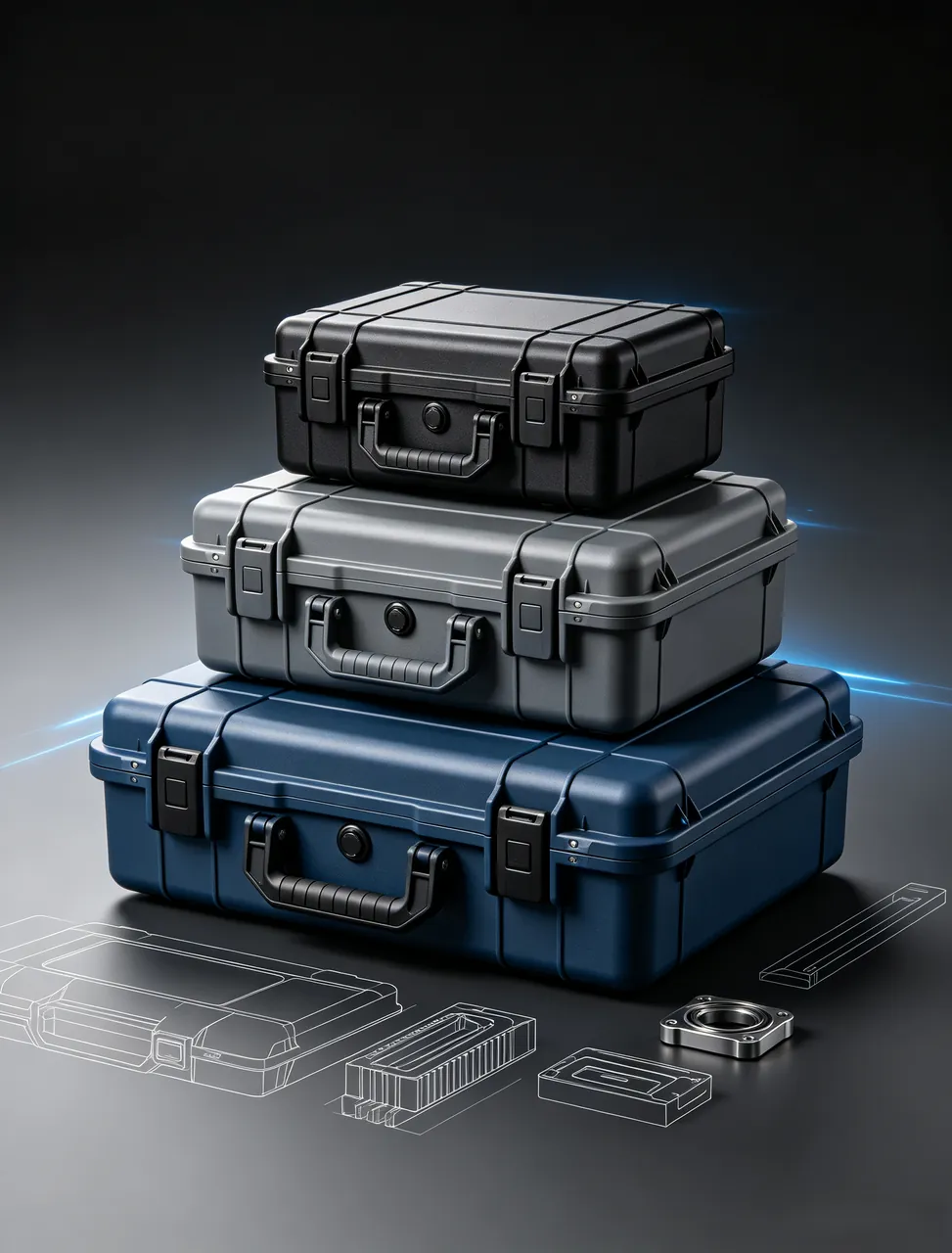
Comparing materials objectively requires agreeing on units first. Plastics are viscoelastic, and their "temperature resistance" is not one number but four measures with different meanings. Confusing them is where most material discussions go wrong.
| Characteristic | Physical meaning | Common standards | Question it answers |
|---|---|---|---|
| --- | --- | --- | --- |
| Heat deflection temperature, HDT | Temperature at which a specimen under specified bending stress deflects by a specified amount | GB/T 1634, ISO 75, ASTM D648 | Will it soften briefly under load |
| Vicat softening temperature, VST | Temperature at which a specified needle penetrates a specified depth | GB/T 1633, ISO 306, ASTM D1525 | Reference point where softening becomes pronounced |
| Brittle temperature | Temperature at which a specified fraction of specimens fail under specified impact | GB/T 5470, ISO 974, ASTM D746 | Will it shatter when dropped in the cold |
| Relative temperature index, RTI | Temperature at which properties retain a specified fraction after long-term thermal ageing | UL 746B, the yellow card | Long-term usable ceiling in hot service |
Why does the distinction matter so much? Take a familiar example: an ABS grade may publish an HDT above 90 °C, appearing more heat-resistant than many polypropylenes, yet its RTI typically sits well below its HDT, because RTI reflects property retention after thousands of hours of heat ageing. In short: short-term softening is judged by HDT; long-term degradation is judged by RTI — and vehicle storage is unambiguously a long-term scenario.
On the cold side, the governing numbers are brittle temperature and low-temperature notched impact strength, not HDT. Polypropylene's weakness is ambient stiffness, while its low-temperature toughness is genuinely good, especially in copolymer grades; some ABS grades may retain only a fraction of room-temperature notched impact at -20 °C. So the old shop-floor saying that PP is more cold-resistant than ABS holds for copolymer PP against certain ABS grades, but it is not universal — always read the grade datasheet, never the family name.
Two further values are commonly missed: continuous use temperature under load, and the fact that UL 746B publishes RTI separately for electrical, impact and strength properties. A rigorous specification requests each. Broader material reasoning is developed in selecting plastics for protective cases.
Material comparison: PP, ABS, PC and glass-filled grades in vehicles
Against those four metrics, here is how common case materials behave under vehicle duty. All figures are typical values or empirical bands; actual selection must rest on the specific grade datasheet.
| Material | HDT (typical) | Low-temperature behaviour | Long-term heat ageing (RTI concept) | Weathering and UV | Overall verdict for vehicle storage |
|---|---|---|---|---|---|
| --- | --- | --- | --- | --- | --- |
| PP homopolymer | 80–100 °C | Moderate, toughness drops below 0 °C | Moderate | Needs stabiliser package | Marginal; not recommended long term |
| PP copolymer | 70–90 °C | Good, retains toughness near -20 °C | Moderate | Needs stabiliser package | Balanced choice for northern winters and normal summers |
| UV-stabilised PP | 70–90 °C | Good | Moderate to good | Good | Recommended; best value for vehicle duty |
| Glass-filled PP, 20 or 30 per cent | 110–140 °C | Good | Good | Needs stabiliser package | Strongly recommended: markedly better creep resistance |
| ABS | 85–105 °C | Poor to moderate in cold | Moderate, prone to yellowing | Fair, UV sensitive | Not recommended for prolonged vehicle storage |
| PC | 125–140 °C | Good | Good | Needs coating or co-extruded cap layer | Recommended but costly; watch stress cracking |
| PC/ABS blend | 95–115 °C | Moderate to good | Moderate | Moderate | Usable; confirm cold data |
| HDPE | 60–80 °C | Excellent, tough to -40 °C | Moderate | Needs stabiliser package | Excellent in cold, lower stiffness |
Several conclusions follow.
First, glass-filled PP is the default answer for vehicle duty, not merely because it tolerates heat better but because fibre raises the creep modulus. Given three months loaded at high temperature, unfilled PP may show visible bulging and parting-line opening while PP filled with twenty or thirty per cent glass fibre deforms far less — and it retains the low-temperature toughness that matters in northern winters.
Second, treat ABS with caution in parked vehicles. Its ambient stiffness and dimensional accuracy are genuinely excellent, but its RTI is comparatively low, notched impact falls sharply when cold, and it chalks and yellows under ultraviolet attack. With unfilmed glass and a case lying on a sunlit rear seat, edge micro-cracking within a few years becomes materially more likely.
Third, PC performs well but demands attention to stress cracking. It excels in both heat and toughness, yet it is sensitive to certain chemicals, including some solvents and cleaners, and can develop environmental stress cracking when residual stress is present. Vehicle interiors routinely see trim cleaners, insect repellent sprays and hand sanitiser, so specify verified chemical resistance data before choosing PC.
Alongside these, settle two further points: UL94 flame class where lithium batteries ride inside, and whether recycled content is used, since recyclate has broader molecular weight distribution with wider property scatter and generally weaker long-term thermal ageing — something impossible to judge from appearance on low-cost products.
The mechanics of deformation: expansion, creep and load combined
Why does a case actually bulge? Three effects superimpose.
Effect one, thermal expansion. Plastics expand far more than metals; PP's coefficient of linear thermal expansion sits roughly in the 100 to 150 × 10⁻⁶/K band (typical value), about ten times steel. A 600 mm lid may therefore grow by millimetres over a 50 K rise. That alone is manageable; the problem is differential expansion between lid and base, and between the shell and metal inserts or fasteners. Dissimilar movement imposes secondary stress at joints, and over many cycles this produces loose latch seats, elongated rivet holes and local warping — precisely why cases left in hot vehicles show corners lifting and parting lines losing flatness.
Effect two, creep. This is the dominant cause of vehicle deformation. Creep is defined as time-dependent plastic strain under constant stress below the yield point. The operative word is time: it needs no large force. A case holding fifteen kilograms of tools in a 60 °C boot places the floor panel under sustained bending stress, and after months the floor can visibly sag; side walls bow outward under combined internal pressure and vehicle vibration. Empirically, creep rate roughly doubles for every 10 °C rise (a general polymer rule of thumb, with actual multiples depending on material and stress), which is why a few summer months can equal years at room temperature.
Effect three, stress relaxation undermining the seal. This is creep's mirror image: under constant deformation — a compressed gasket — internal stress decays with time. For a case it means the clamping force supplied by the latch system slowly falls as the shell and latch bodies relax, compounding the gasket's own compression set, and the symptom is "it is locked down tight and still lets dust in".
Three countermeasures match the three effects. Against expansion: allow small relative movements rather than rigid over-constrained fixing, and leave tolerance at dissimilar-material joints. Against creep: raise modulus through glass filling and well-distributed ribs, reduce sustained load by never placing the heaviest items over the thinnest panels, and specify adequate wall thickness. Against relaxation: use metal latch pins, re-latch periodically, and put gaskets on a scheduled replacement list. Structural reinforcement is discussed further in high-strength enclosure structures.
Seals fail before shells do: the number one hidden hazard
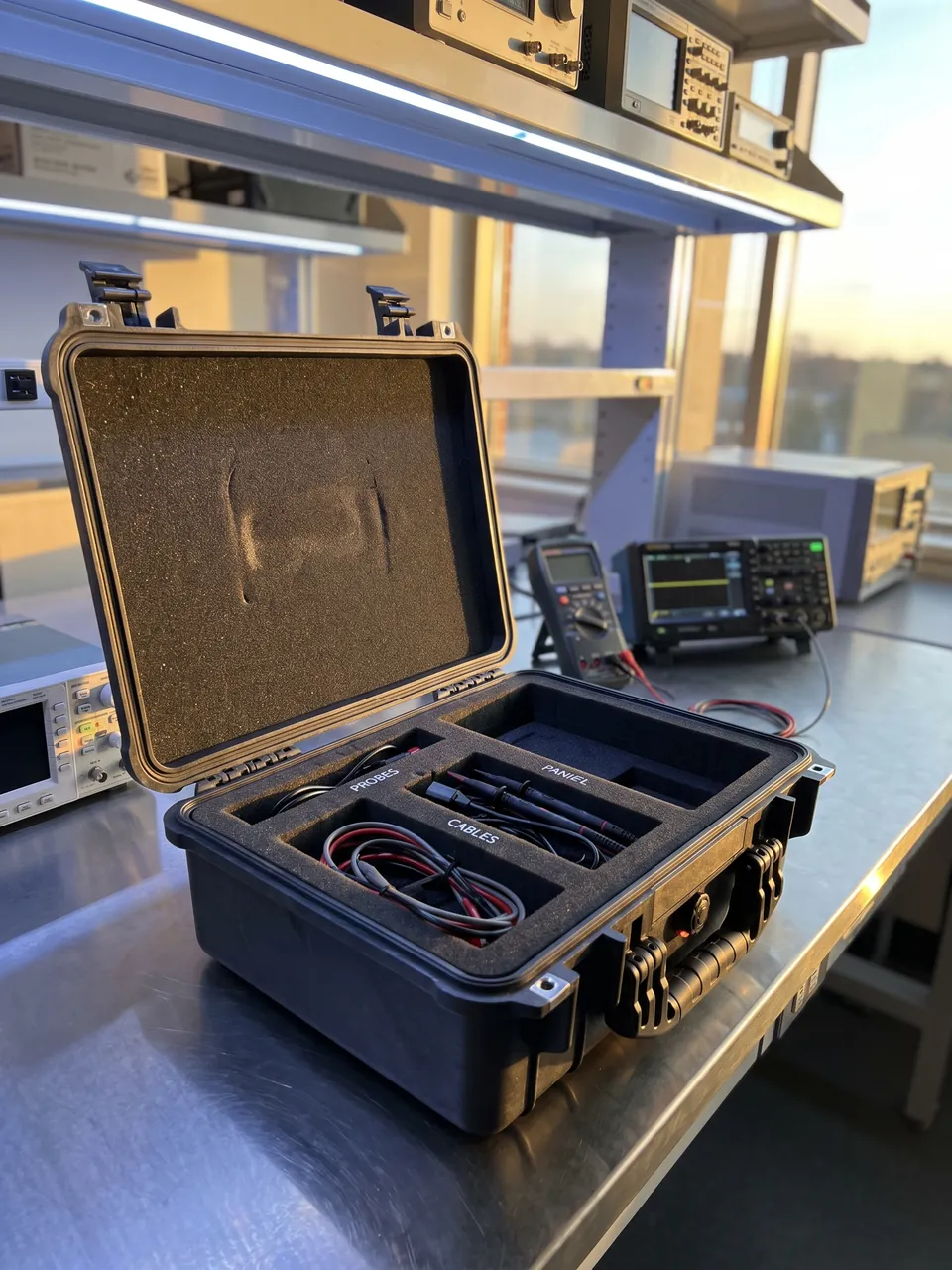
In a typical long-term vehicle-storage failure, the first component to go wrong is rarely the shell; it is the gasket. That deserves emphasis because it dictates whether fleet cases need shorter maintenance intervals.
Seal ageing proceeds by three mechanisms: thermo-oxidative ageing, compression set, and migration of plasticisers or low-molecular species.
Thermo-oxidative ageing accelerates sharply in hot cabins. Rubber oxidation follows a temperature-dependent rate law; as a rule of thumb every 10 °C rise multiplies the rate by a similar factor to creep. Since EPDM's saturated backbone gives good ozone resistance and a long-term service ceiling around 120 °C (typical value), the 60 to 70 °C cabin environment remains inside its capability; but foamed polyurethane and some low-cost TPEs may carry long-term ceilings of only 80 °C or less, and two or three summers spent near that threshold commonly produce hardening, cracking and powdering.
Compression set comes from the habit of storing cases latched shut. Many users clamp cases permanently for dust protection while subjecting them to a daily high-temperature cycle — the worst possible combination. Recommended practice is to store half-latched or unlatched where rain protection allows, or at minimum release the latches weekly so the profile can recover.
The third mechanism is routinely overlooked: breathing fatigue from thermal cycling. Heating expands, cooling contracts, and the seal — particularly at its joint or bond — sees cyclic shear. Joints often lose continuity while still looking intact.
The industry practice worth adopting: schedule preventive gasket replacement every twelve months for vehicle-stored cases (typical value, shortened to six to nine months in severe climates), and place it on the vehicle equipment annual maintenance list. The cost is trivial and the benefit is restoration of the ingress rating. Detail on the hardware itself is in hinge, latch and seal construction.
The cold side: embrittlement and drop risk at -20 °C
Summer discussion centres on softening and creep; winter demands attention to embrittlement and impact failure — two faces of one coin. Nearly every thermoplastic loses notched impact strength as temperature falls, and somewhere along the way there is a steep drop marking the brittle transition.
Three engineering implications follow.
One, "tough at room temperature" does not imply "tough in winter". The same case may survive a one-metre drop at 23 °C and crack after half a metre at -20 °C, typically initiating at a stress concentrator: a corner, a latch boss root or a weld line. This explains the classic northern complaint that cases shatter in winter — the material has not degraded; the duty has crossed into the brittle regime.
Two, low-temperature performance must be judged by brittle temperature plus low-temperature notched impact, never by tensile strength. Tensile strength often rises as temperature falls, so citing greater strength as evidence of cold reliability is simply wrong. Request brittle temperature per GB/T 5470 (or ISO 974, ASTM D746) plus Charpy notched impact per GB/T 1043 (ISO 179) measured at -20 °C and -30 °C. A supplier able to quote only ambient impact data has not demonstrated cold capability at all.
Three, cold failures usually originate from pre-existing micro-damage. A shell that has chalked through two summers carries a degraded surface layer whose toughness falls further in winter, becoming the crack initiation site. That is why vehicle-stored cases tend to age in summer and then fail outright during a winter knock.
| Material | Notched impact trend at -20 °C | Behaviour at -30 °C | Recommended for northern outdoor or vehicle use |
|---|---|---|---|
| --- | --- | --- | --- |
| PP copolymer | Retains well | Usable | Yes |
| PP homopolymer | Falls noticeably | Caution | Only with grade data |
| HDPE | Excellent retention | Excellent | Yes, note lower stiffness |
| Glass-filled PP | Retains well, watch fibre-matrix interface | Good | Yes, preferred option |
| ABS | Falls noticeably | Caution to not recommended | Generally no |
| PC | Excellent retention | Excellent | Yes, though costly |
| PC/ABS blend | Moderate | Caution | Only with verified data |
Two secondary effects deserve mention too. Seals harden when cold, requiring more force to reach the same deflection, which can produce "it will not close properly" where latch margin is thin. And condensation appears readily: switching on cabin heating on a winter morning warms air rapidly while the case remains cold, so moisture condenses on inner surfaces, rusting tools and leading users to suspect leaks. The remedies match those already discussed: dry tools before stowing, use desiccant, ventilate the case open when practical.
Special contents: batteries, gas cartridges and chemicals
Vehicle toolboxes rarely hold tools alone. Three categories of contents push temperature requirements up a safety level.
Category one, lithium batteries. Battery packs for power tools, torches and radios should not live permanently in a hot cabin. Beyond the well-known thermal-runaway hazard, remember that most manufacturers state a storage ceiling somewhere in the 45 to 60 °C range (typical value; the product label always governs), which summer cabins exceed easily. Even absent any accident, sustained high temperature markedly accelerates capacity fade. Make it procedural: remove batteries at end of shift and store them at room temperature; where they must travel, use an insulated pouch away from direct sun. If batteries do ride inside, require UL94 flame classification (V-2 or the stricter V-0) plus glow-wire data from IEC 60695-2, nationally GB/T 5169.
Category two, gas cartridges and pressure vessels. Torch cartridges, camping stove canisters and compressed air cylinders carry labels that say, without exception, to avoid heat and sun and to stay below a stated storage temperature. Leaving them in a summer cabin is an unacceptable risk. The rule: these items do not travel as permanent residents of a vehicle toolbox.
Category three, chemicals. Cleaners, rust removers, penetrating lubricants, adhesives and hand sanitiser create two problems: container pressure rises and leaks develop, and escaped chemicals attack case interiors, degrade gaskets and can trigger stress cracking in susceptible plastics, notably PC. Provide a dedicated chemical compartment or sealed bag rather than loose bottles in the tool space.
Together these impose one purchasing rule: where special contents are carried, the system temperature ceiling is set by the weakest item inside, not by the shell material. Even a glass-filled PP case rated to 120 °C offers no more than 45 °C of usable ceiling if it carries a battery labelled to that limit. Establish that logic explicitly during safety review.
Metal cases in vehicles: conduction, condensation and corrosion
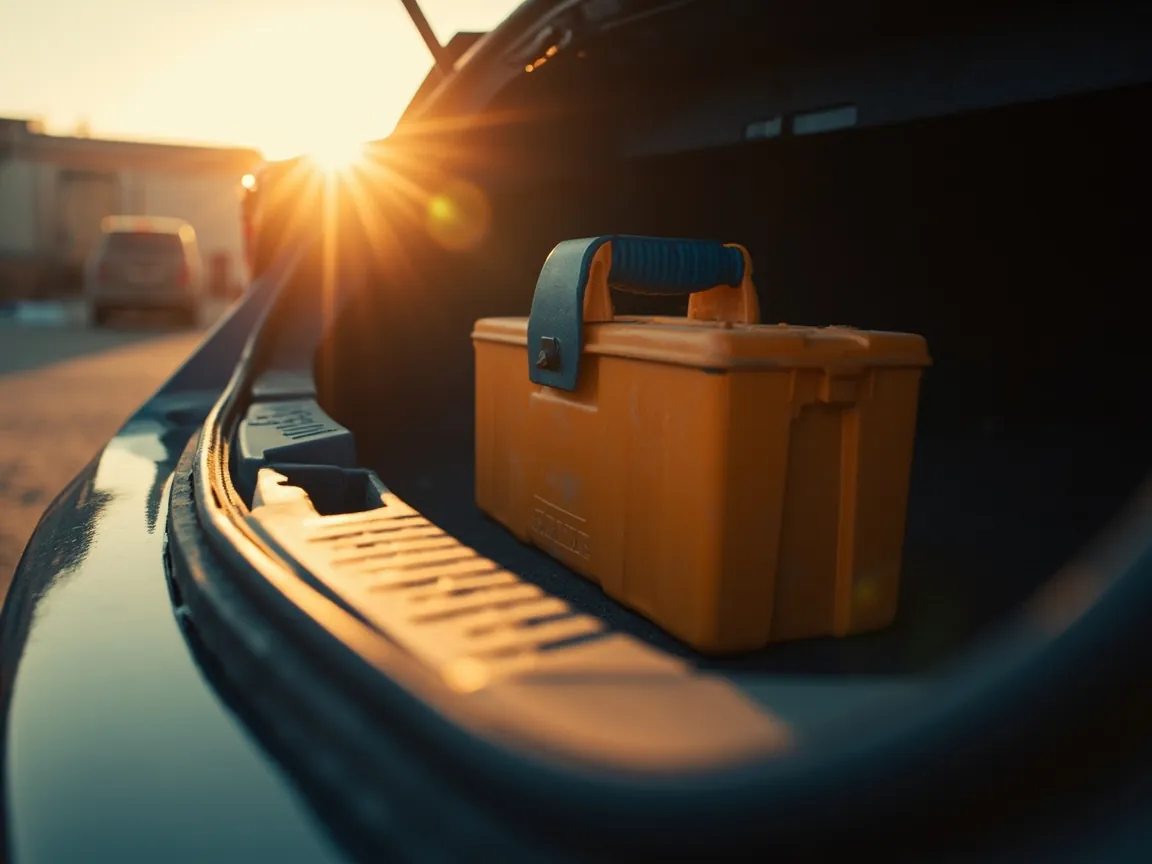
Many people assume metal cases simply cannot deform. On creep resistance that instinct is right: metal creep is negligible at these temperatures, so long-term deformation risk is far below plastic. In vehicle service, however, metal introduces three new problems.
First, hot surfaces. With conductivity orders of magnitude above plastic, a metal shell in a summer cabin reaches or exceeds air temperature, and because heat flux into skin is high, bare-handed handling carries real burn risk. For crews grabbing tools under time pressure, this generates genuine complaints.
Second, condensation. High conductivity means the shell tracks air temperature quickly, so when warm humid air meets a metal panel that has been chilled overnight, water condenses on it. The consequence is that metal cases are more prone to internal condensation films, and the tools inside rust more readily — often misread as a leaking seal.
Third, corrosion and mass. Aluminium alloys pit and suffer crevice corrosion where road salt and de-icing chemicals are present; stainless steel is not immune either, facing crevice and stress corrosion in chloride environments, so grade selection matters (molybdenum-bearing grades in the 316 family outperform 304-family material in chlorides, a standard materials principle). Add that metal cases typically weigh two to three times an equivalent plastic volume, and that burden is carried daily by the crew. The full trade-off appears in aluminium versus stainless steel toolboxes and plastic versus metal.
A hybrid deserves consideration: a metal frame with a plastic shell, or external metal corner guards over a plastic liner. The first delegates creep resistance to the frame; the second buys light weight and thermal insulation. Both are achievable in OEM programmes as modular options.
Design countermeasures: wall thickness, ribs, colour and reflectance
Even when the model is already fixed, understanding design intent helps you judge suitability for vehicle storage. Five items matter.
One, wall thickness and rib layout. Creep resistance is governed by second moment of area, not thickness alone. Good practice divides large flat panels with grid or diagonal ribs, raising stiffness enormously without meaningful weight gain. The practical test: press the centre of each panel by hand on an empty case; anything that visibly deflects will certainly deform under prolonged loaded heat.
Two, corners and edges. Corners need generous radii plus local thickening (among the highest-return measures available within cost constraints), since they are the origin points of both stress concentration and warpage. Additionally, a continuous waist rib running around the perimeter suppresses side-wall bulging very effectively — small cost, large effect.
Three, colour. As established by radiation balance, colour handles substantial temperature difference. For vehicle or exposed outdoor duty, specify light or mid-light tones (silver grey, light khaki, off-white) and avoid pure black and dark matt finishes. Where dark colours are mandatory, insist on higher gloss, or cover the case externally.
Four, lid-to-base engagement. Both halves expand in heat, so a fully rigid multi-pin location concentrates thermal stress at the pins. Better designs use a primary location feature plus floating secondary features, permitting minor relative movement.
Five, stacking and support surfaces. In boots, cases often stack or sit beneath other loads, so the base needs generous support area and anti-slip structure, avoiding point contacts where creep sag begins. Long-term stacking should also follow the stacking and restraint principles in industries served by trolley cases.
Operational countermeasures: parking position, shading, ventilation, load reduction
Beyond purchasing, operators can do more, often at lower cost. Five actions, ordered by value: do the cheapest first.
One, and most effective: change where it is parked. Within one vehicle, the gap between a shaded boot compartment and a sunlit rear seat can reach tens of degrees Celsius. The preference order is therefore: covered boot compartment > open boot > rear footwell > rear seat. This single change removes most of the risk.
Two, crack a window and use a windscreen sun shade. A front screen shade reduces direct radiation entering the cabin; a small window gap in secure locations such as fenced depots or supervised yards lowers peak temperature measurably. Both cost almost nothing.
Three, fit infrared-rejecting window film. One-time spend with durable effect, and easy to justify because the benefit extends past toolboxes to crew comfort and vehicle energy use.
Four, add a physical barrier. An inexpensive foil blanket or insulating pad over the case pulls its surface temperature down substantially. Choose reflective-outward designs, since they work by reflecting radiation rather than absorbing it.
Five, reduce and rotate load. Where a case must stay loaded in a vehicle, at least place heavy items low and distributed rather than concentrated on one side, and remove it periodically to check condition, giving panels unloaded recovery time and combining inspection with tool rotation.
One final, easily missed point: never shut wet raincoats, gloves or wipes inside the case. Summertime heat plus sealed moisture drives interior relative humidity toward saturation within hours, corroding tools far faster than an open cabin would. Related guidance appears in what an outdoor protective case is and selecting toolboxes for outdoor work.
Writing the specification: turning temperature into verifiable clauses
Finally, convert everything above into language for tender documents and technical agreements.
| Clause | Suggested wording | Verifiability |
|---|---|---|
| --- | --- | --- |
| Operating temperature range | State explicitly "long-term operation from -20 °C to +70 °C" and require supporting datasheet evidence | High, checkable against material data |
| HDT requirement | "HDT not below 90 °C at 0.45 MPa per GB/T 1634 or ISO 75" | High, third-party report available |
| Brittle temperature | "Brittle temperature not above -20 °C per GB/T 5470" | High |
| Low-temperature impact | "Charpy notched impact per GB/T 1043 at -20 °C not below an agreed proportion of the ambient value" | Medium, needs a defined baseline |
| RTI / long-term heat ageing | Request the UL 746B yellow card or equivalent long-term thermal ageing data | Medium-high, most brands hold it |
| Weathering | "Externally visible parts to include UV stabiliser, supported by xenon-arc data per GB/T 16422.2 or ISO 4892-2" | Medium-high |
| Flammability | "Where batteries are carried, material to reach UL94 V-2 or V-0, with glow-wire data supplied" | High |
| Colour and finish | Fix the colour code and gloss range; request solar reflectance statement for dark colours if desired | Low to medium |
| Product-level validation | Agree "after rated payload at 70 °C for 72 hours, parting-line opening and base deflection not to exceed agreed values" | High, executable on site |
The last row deserves most emphasis. Suppliers nearly always offer material-level data, while users care about whether the finished product deforms. Writing product-level validation into the specification shifts accountability from material claims to product performance, and the test itself is simple: load to rated capacity, hold at temperature for a defined period, cool, then measure parting-line gap and base deflection. Exceeding the agreed value is a failure. It belongs in every first-batch acceptance checklist.
On the supply side JUNZHJIA normally advises customers to list "permanent in-vehicle or outdoor storage" as a distinct duty line at selection stage, locking the shell material and whether a glass-filled grade is used, because both become effectively unchangeable once tooling is cut — modifying them afterwards means a full redevelopment cycle. Further practical reading: outdoor toolbox selection essentials and choosing internal foam.
FAQ
Q: Can a toolbox really deform in a summer boot to the point of becoming unusable? A: It can, though three conditions usually combine: low-modulus shell material, sustained heavy load, and temperature approaching the softening range. All three occur simultaneously in a summer vehicle: an ordinary PP or some ABS case holding tens of kilograms of tools while riding over rough roads at 60 to 70 °C can, over months, develop floor sag and side-wall bulging, which then throws the latch alignment out and makes closing difficult. Remedies ordered by effectiveness: (1) move the case to a covered boot position or cover it with a reflective blanket; (2) choose glass-filled PP or PC-based, high-modulus material; (3) avoid permanent full load and distribute weight instead of stacking it to one side; (4) leave latches relaxed during storage to reduce load on the closure. If you already notice latches becoming hard to engage or the parting line looking uneven, those are early creep signals — reduce load immediately and plan replacement.
Q: Is a "high temperature resistant" claim on a toolbox trustworthy, and which figures actually matter? A: "High temperature resistant" is not a verifiable technical term; it must be converted into named metrics. Four values matter: HDT per GB/T 1634 or ISO 75, describing short-term softening under load; Vicat softening temperature per GB/T 1633 or ISO 306, the reference point where softening becomes pronounced; RTI under UL 746B, describing property retention after long-term heat ageing and therefore the most relevant figure for permanent vehicle storage; and continuous-use temperature under load. Decide which question you are asking: short moves fall in the HDT domain, permanent storage in the RTI domain. Note also that grades within one family, all called PP, can differ enormously, so demand the specific grade datasheet rather than accepting the word "polypropylene". Where no standard number accompanies the claim, treat it as void.
Q: Do black toolboxes deform more easily, and does colour really matter that much? A: Yes, mainly because colour changes surface temperature. Physically, equilibrium temperature in sun depends on the ratio of shortwave solar absorptance to longwave emittance. Dark shells have high absorptance and run measurably hotter than light ones under identical conditions, and higher surface temperature accelerates both creep and ageing. The purchasing implication is straightforward: for vehicle or exposed outdoor duty, avoid pure black and dark matt finishes and prefer light grey, light khaki or silver. Where corporate identity demands dark colours, the fallback is higher gloss, which reduces absorption and helps shed longwave radiation, or simply covering the case with a reflective blanket. A cheaper intervention also exists: fit infrared-rejecting window film, lowering the energy entering the cabin at source.
Q: At -20 °C in a northern winter, will a case crack by itself, or shatter when dropped? A: Cracking spontaneously is rare; breaking on impact is very common. Plastics do not self-destruct in cold, but they cross a brittle transition where notched impact strength falls sharply. Without applied load nothing happens, yet a drop or knock can rapidly propagate a crack from a stress concentrator such as a corner, latch boss root or weld line. Judge it correctly: request brittle temperature per GB/T 5470 (ISO 974 or ASTM D746) and Charpy notched impact per GB/T 1043 (ISO 179) measured at -20 °C or -30 °C — never rely on tensile strength, which often rises as temperature falls. There is also a compounding factor frequently missed: a surface layer chalked by two summers of heat and ultraviolet exposure loses further toughness in cold and becomes the crack origin. In northern duty, UV stabilisation and scheduled inspection therefore matter as much as cold-rated material.
Q: Is it dangerous to leave lithium batteries inside a toolbox in a parked car? A: There is real risk; do not leave lithium cells permanently in a summer cabin. Two reasons. First, the safety boundary: most cell makers state a storage ceiling in the 45 to 60 °C range (typical value; the product marking always governs), and a sun-exposed cabin readily exceeds that, with the sealed interior hotter still. Second, lifetime: even within safe limits, sustained high temperature accelerates capacity fade and impedance rise, which is intrinsic to lithium-ion chemistry. Recommended practice: remove batteries at end of shift and store them at room temperature; where they must travel, keep them in an insulated pouch away from direct sun. Where batteries will ride inside, require UL94 V-2 or V-0 plus glow-wire data per IEC 60695-2, nationally GB/T 5169. The same logic applies to portable gas cartridges and pressure vessels, which carry explicit maximum storage temperatures and should not live in vehicle toolboxes.
Q: There are water droplets inside my case. Has the seal failed? A: Not necessarily — first separate ingress from condensation. The distinction is simple: ingress leaves a defined flow path concentrated on one side or location, such as beneath a corner or latch, and usually correlates in time with actual rainfall; condensation appears as uniform fine droplets over every internal surface, including the inside of the lid. Vehicle duty is a classic condensation scenario: overnight cooling followed by rapid cabin heating leaves the cold case surface collecting moisture, and the same happens in reverse during summer when air conditioning chills a hot case quickly. To confirm, dry everything out, add desiccant, leave the lid open for a day and recheck; if no droplets return in dry weather, it was condensation. The real worry is the secondary effect — tool corrosion. Controls include drying tools before stowing, keeping a small desiccant pack renewed monthly, and avoiding rapid temperature swings. If it genuinely is ingress, work through the checklist in hinge, latch and seal construction.
Q: How often should a case that lives in a vehicle be inspected? A: Adopt three tiers: monthly visual, quarterly functional, annual replacement. Monthly, roughly five minutes: check whether the parting line is flat, corners are lifting, latches still engage smoothly, and the gasket shows pressure marks or cracks; confirm no droplets inside; verify that batteries, cartridges and chemicals have been removed. Quarterly: empty the case, run the latches through their cycle noting any binding or unusual noise, and set it on a flat surface to see whether it still sits on four points without rocking, which reveals twist. Annually: replace the gasket preventively (six to nine months in severe climates), inspect latches for stress whitening or looseness, and retorque wheel-bracket and latch fasteners. The value is converting "it broke one day" into "we knew what to replace in advance"; for fleets, one annual gasket programme costs far less than a single field failure causing downtime and emergency replacement. Print the checklist on a card inside the lid — trivial to add during OEM customisation.
Q: We are buying cases that will live permanently in fleet vehicles. What belongs in the specification above all? A: Three clauses, in priority order. One: write the operating temperature requirement explicitly as "long-term operation from -20 °C to +70 °C", supported by named standards — HDT per GB/T 1634, brittle temperature per GB/T 5470, low-temperature impact per GB/T 1043. Two: specify the material approach rather than only performance language — give preference to glass-filled PP or UV-stabilised PP, and request long-term heat ageing (RTI) and xenon-arc data. Three: include a product-level validation clause such as "after rated payload at 70 °C for 72 hours, parting-line opening and base deflection shall not exceed agreed limits", which makes the supplier answerable for results rather than resin marketing. Beyond those, remember to agree: light to mid-light colour preference with justification required for black; colour code and gloss range; whether gaskets are separately orderable and their replacement interval; and additional UL94 requirements wherever batteries are carried. Turning this into a short technical annex up front beats negotiating after tooling — and JUNZHJIA generally recommends piloting ten units through one summer before scaling any fleet order.
Closing remarks and related reading
To answer the title: will a toolbox left in a car deform? It depends which case you put in there, and where in the vehicle it sits. A cabin is not a benign environment; it is a daily high-low temperature cycle reaching 60 to 70 °C in summer and -20 °C in northern winters, accompanied by permanent load and vibration. Under those conditions, bulging and parting-line opening in ordinary PP or ABS shells are a normal consequence of physics rather than a quality failure; choosing glass-filled PP, UV-stabilised PP or PC-based materials with sensible wall thickness and ribbing resolves the problem in most cases.
Four recommendations for buyers. One, write "-20 °C to +70 °C long-term duty" into the specification and request HDT, brittle temperature, cold impact and RTI evidence. Two, prefer glass-filled or UV-stabilised grades and fix light colour codes. Three, put a product-level loaded high-temperature deformation clause into acceptance, so results rather than resin claims are guaranteed. Four, run an annual gasket replacement programme for vehicle-stored cases — minimal cost, maximum return. Operators have four equivalents: move the case somewhere shaded, film the glass or crack a window, cover it with a reflective blanket, and never leave lithium batteries or gas cartridges in the car. On fleet programmes JUNZHJIA typically recommends a ten-unit pilot through one summer before scale-up, written into the technical agreement as a distinct duty line.
Related reading