

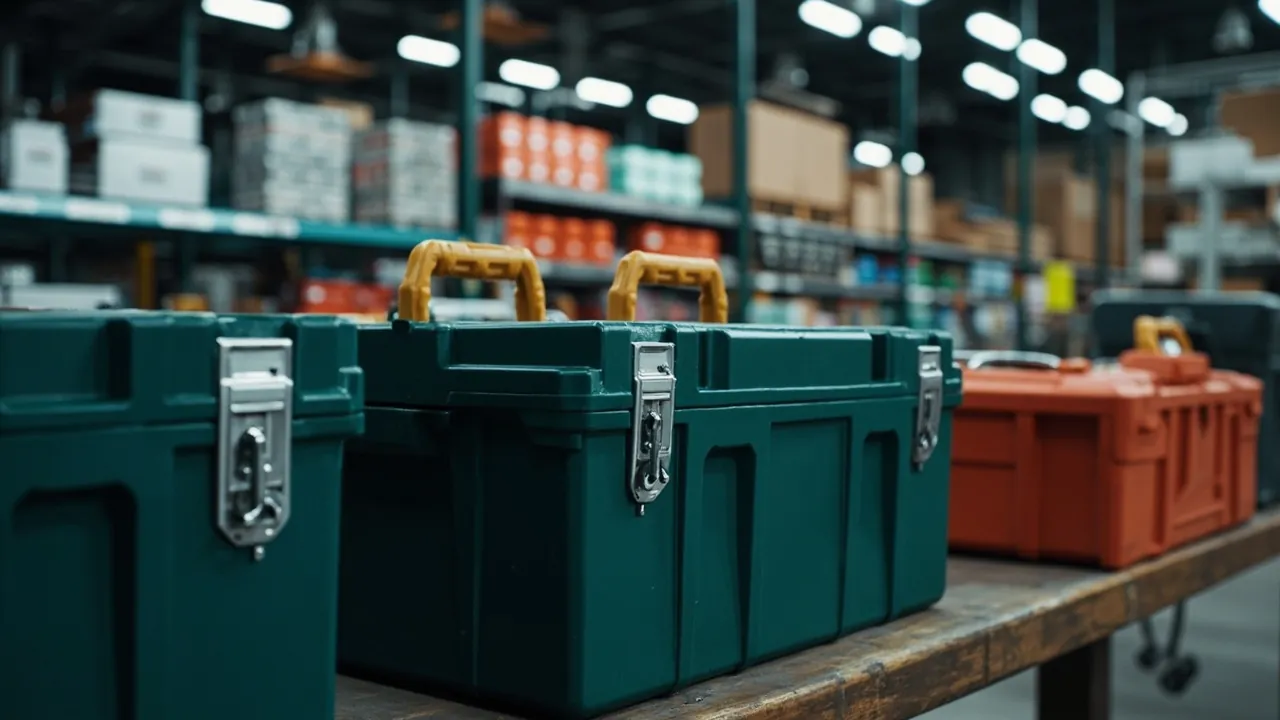
The key point first: there are only four real parameters in toolbox selection — durability, portability, function, and materials and process. Everything else on the data sheet, from colour and brand character to giveaways and cosmetic detailing, is a way of expressing one of those four. More importantly, the four cannot all be optimal at once. Durability and portability conflict directly over weight. Function and portability conflict directly over volume. Materials and process set both the ceiling on durability and the floor on cost. Selection is therefore not about finding the single best box. It is about defining your usage profile first, then setting the weighting of the four parameters, and then taking the best trade-off available within a given budget. Getting the ranking wrong has concrete consequences: buying a 30 kg box for durability and finding nobody will carry it, or buying a 3 kg box for portability and finding the base punched through within a quarter.
Two failure modes dominate real purchasing decisions and are worth naming up front. The first is missing parameters: buying on appearance and price alone, with none of the four defined, which produces a box that is neither durable nor portable and is awkward in daily use. The second is mismatched parameters: all four are considered, but the ranking does not match the real situation. An inspection technician who walks several kilometres a day with the box, but ranks durability above portability. A fixed workstation storage application that sacrifices load capacity and volume for portability. Both failures have the same root cause: the usage profile was never treated as the first input.
This article is written for procurement and engineering staff configuring toolboxes for individuals, crews or organisations in quantity. It also serves as a selection framework for distributors and OEM/ODM customers. It works in three stages: first, what each parameter means, how it is quantified and how it is verified; second, how the four constrain each other; third, a scoring table and per-setting ranking recommendations. You will get four core tables: a three-level definition of durability, an ergonomic boundary table for portability, a trade-off matrix across the four parameters, and a hundred-point scoring sheet you can use directly. It closes with eight FAQ entries and a procurement checklist.
Contents
- The key point: four parameters, and why they cannot all be optimal
- Do this first: write the usage profile as six numbers
- Parameter one: durability — structure, material and protection
- How to quantify and verify durability
- Parameter two: portability — weight, grip, movement method and carrying envelope
- Ergonomic boundaries and human load
- Parameter three: function — internal organisation, expansion and working mode
- The hidden cost of function: complexity degrades
- Parameter four: materials and process — walls, moulding, inserts and assembly
- How the four parameters constrain each other: a trade-off matrix
- A hundred-point scoring sheet: turning four parameters into comparable scores
- Ranking by setting: how five user types should prioritise
- Putting it into procurement: a requirement sheet and an acceptance checklist
- Frequently asked questions
- Conclusion and related reading
The key point: four parameters, and why they cannot all be optimal
Start by setting out what each parameter answers, so the discussion keeps its bearings.
Durability answers how long it lasts and where it fails. It has three levels. Structural: whether load travels along the designed path and whether local overload is avoided. Material: stiffness, toughness, weather resistance and chemical resistance. Protection: dust, water, impact and corrosion resistance. These are an AND relationship, and a weakness in any one becomes the limiting factor.
Portability answers whether it can be carried easily, and how far. The core variable is not weight on its own but the product of weight, distance and frequency. A 12 kg box moved once a week over fifty metres is no problem at all. An 8 kg box carried two kilometres every day becomes a burden. Portability must therefore be assessed together with frequency and distance, and an isolated weight figure means nothing.
Function answers whether it is good to use once it is open. This covers internal organisation, access method — top opening, front opening or drawers — expansion capability such as stacking or add-on modules, working mode such as whether it can serve as a bench or be operated one-handed, and accessories such as wheels, a telescopic handle, lighting and locks.
Materials and process answer how well the other three can be delivered. This is the physical basis for the rest. The ceiling on durability is set by material and structural process. The floor on portability is set by specific strength and lightweight structural design. Function depends on moulding precision and assembly. Materials and process are therefore never an independent competing parameter; they are the precondition that sets the ceiling on the other three.
Three hard conflicts explain why the four cannot all be optimal at once. First, durability against portability on weight: raising stiffness and impact resistance usually means thicker walls, more ribs or a denser material, and weight rises accordingly. This is a physical conflict that cannot be eliminated, only mitigated through structural optimisation, which itself depends on process capability. Second, function against portability on volume: more compartments, more drawers and greater capacity all add volume and weight. Higher functional density improves usefulness per kilogram but makes large capacity harder. Third, durability plus function against cost: better material and process cost more, and more functions require more tooling and more parts. Under a budget constraint, the right approach is not to aim for eighty percent on every parameter but to refuse to compromise on the critical one and consciously give up on the secondary ones.
Do this first: write the usage profile as six numbers
Before comparing any products, write the usage profile as six quantifiable numbers. It looks trivial, but it determines every ranking that follows.
- Typical and peak total weight in kilograms — the normal contents and the fullest condition.
- Moves per day and distance per move — this product determines the real weight of portability.
- Route difficulty — stairs, vehicle loading, surface quality — which determines whether wheels, a handle or two-person carrying are needed.
- Environmental exposure — indoor or outdoor, dust, water, oil — and temperature range, which together determine the protection level and material selection.
- Retrieval frequency and method — times per day, whether one-handed, whether gloves are worn — which determines functional priority and opening style.
- Expected service life and maintainability requirement in years, which determines whether replaceable components and spare parts are mandatory.
Once these six numbers are written down, the ranking of the four parameters usually emerges on its own. Take 25 kg total weight, one move a day, level ground and short distance, indoor and dry, frequent retrieval, eight years or more expected. The ranking is durability, then function, then portability, then cost, and the portability priority becomes the ability of the base to carry static load rather than the strength of the handle. Reverse the profile: 9 kg, eight moves a day, 1.5 km each time on foot, outdoor, frequent retrieval, three years expected. The ranking becomes portability, then function, then durability, then cost, and the portability priority becomes weight distribution and grip comfort.
A practical suggestion: put these six numbers on the first page of the selection file. They are the input to the procurement requirement, the basis for aligning the technical agreement, and the record of why the choice was made if the decision is questioned later.
Parameter one: durability — structure, material and protection

Durability is the most misunderstood parameter because it is a feeling rather than a measurable quantity. Splitting it into three levels makes it clear.
Structural level: whether load travels along the designed path. This is the primary determinant and the one where tiers differ most. The central concept is the load path: load should travel from the contact points of the tools, through the base, into the walls or base frame, and then to the supporting surface. If any segment is an unsupported panel or relies on clips alone, load concentrates at a few joints and produces local overload. Industrial design typically moulds the base frame as one piece extending into all four corners, moulds wall and base frame together, and avoids relying on screws or clips to carry structural load. Rib position also matters more than rib count: poorly designed ribs cause sink marks and stress concentrations and become crack initiation points.
Material level: balancing stiffness, toughness, weather resistance and chemical resistance. These four often constrain each other. Stiffness determines resistance to deformation, toughness determines impact and drop performance, weather resistance determines outdoor life, and chemical resistance determines stability in workshop environments. The common trade-off is that raising stiffness, for example with glass fibre, often reduces impact toughness, while raising chemical resistance with PP often costs surface hardness and appearance. Material selection must therefore return to the usage profile: the environment sets the floor for weather and chemical resistance, and the load sets the ratio of stiffness to toughness.
Protection level: dust, water, impact and corrosion. The IP rating, defined by IEC 60529 and GB/T 4208, is the most quantifiable item here. Two cautions apply. An IP rating is a type test conclusion for a single unit at normal temperature in a static state, and real performance can differ when the box is compressed in a stack, cinched with a strap, or exposed to temperature extremes. And waterproof is not the same as moisture-proof: a fully sealed box breathes under day-night temperature swings, letting internal humidity accumulate and tools rust, which is why industrial solutions commonly use a waterproof breathable membrane to equalise pressure.
| Level | Question answered | Key criterion | Common weakness | Verification clue |
|---|---|---|---|---|
| --- | --- | --- | --- | --- |
| Structure | How load travels | Continuous load path, no unsupported areas | Unsupported base, clip-dependent joints | Integral base frame, load-bearing rim |
| Material | What carries it | Stiffness, toughness, weathering, chemicals | Thickening or fibre-loading indiscriminately | Material grade, UV-stabilised or not |
| Protection | What it resists | IP class, gasket form, impact | Dust sold as waterproof, gasket not replaceable | IP reference standard, gasket replaceability |
How to quantify and verify durability
Durability is not written on a catalogue. It is written in reports. Request the following five categories of verification together with their criteria, because a pass without a criterion is meaningless.
Static and stacking tests. The criteria must include the test load, separating distributed from concentrated load with the contact area stated for the latter, the temperature condition, the hold time, the maximum permitted residual deformation, and the settling time before measurement. Temperature matters particularly, because the long-term load capacity of plastics falls as temperature rises, and running a test only at room temperature and then using the product in a summer vehicle is a classic mismatch between verification and service.
Drop and impact tests. The drop logic of MIL-STD-810H is a reasonable reference, with the key criteria being that the body does not crack, the latch does not spring open, and the contents do not shift. Of these, the latch remaining closed after a drop matters most, because a latch that springs open scatters tools, which is a safety event on a work platform or a staircase.
Repeated opening and closing. Simulate hinge and latch life against a target cycle count derived from use frequency. Twenty cycles a day over eight years is roughly 50,000 cycles as a representative estimate, and the test verifies retention, play and latch function afterwards.
Transport vibration and shock. For volume deliveries, transport simulation following the ISTA series, ASTM D4169 or the GB/T 4857 series verifies integrity and fixing condition after shipment.
Coating and corrosion verification. Metal parts should come with salt spray data, with neutral salt spray following ISO 9227 and GB/T 10125, and note whether the test was scribed. Results for an intact coating and a scribed coating differ greatly, and in real use coatings almost always get damaged.
An example of how a criterion should read: "30 kg uniformly distributed, held 24 hours at 40 degrees Celsius, residual deformation after one hour of settling not exceeding X millimetres, lid operating normally, latch remaining closed." That sentence carries an order of magnitude more information than "carries 30 kg."
Parameter two: portability — weight, grip, movement method and carrying envelope
Portability is the parameter most often obscured by a single weight figure. Four elements actually determine it.
Element one: weight and its distribution. Beyond total weight, the position of the centre of gravity matters. The closer it is to the body and to the geometric centre, the smaller the moment during carrying and the lighter the box feels. That is why two 12 kg boxes, one with the centre of gravity low and central and the other high and off to one side, feel completely different to carry.
Element two: grip. Four points matter on a handle: grip width, since wider reduces pressure, cross-sectional shape and anti-slip texture, the clearance between handle and body so a gloved hand fits, and the strength of the handle-to-body connection. The test is direct: with the box loaded, lift it and bounce it gently, watching the handle boss for visible relative movement or stress whitening.
Element three: movement method. This is the highest-weight decision within portability. There are four basic options: carrying by hand, suitable for short distances and light loads; a shoulder strap, suitable for medium distances and freeing both hands; wheels with a telescopic handle, suitable for long distances, heavy loads and smooth surfaces; and a trolley or platform cart, suitable for very heavy loads and moving several boxes at once. Surface condition is the deciding factor. Small wheels drag badly on rough ground, cables and thresholds and jam easily, while large wheels on bearings markedly improve obstacle clearance. Whether the route is usually smooth therefore determines whether a wheeled option is worth paying for.
Element four: the carrying envelope, meaning volume and outline. This is regularly overlooked. The three outer dimensions determine not only capacity but whether the box fits in a vehicle or boot, passes through narrow doors and passages, clears a stair landing, and can be carried without blocking the carrier's view. Measuring the real door and vehicle openings with a tape before ordering avoids more returns than reading capacity figures.
| Portability element | Key variable | Applies to | How to check | Common problem |
|---|---|---|---|---|
| --- | --- | --- | --- | --- |
| Weight and distribution | Total weight, centre of gravity | All settings | Lift loaded and feel the moment | Centre of gravity high or offset |
| Grip | Width, section, connection strength | Hand and shoulder carrying | Bounce test on the handle boss | Stress whitening at the boss |
| Movement method | Hand, strap, wheels, cart | By distance and surface | Push test on the real surface | Small wheels jamming, handle wobble |
| Carrying envelope | Three outer dimensions | Vehicle loading, doors, stairs | Tape measure on openings | Will not fit the vehicle or doorway |
Ergonomic boundaries and human load

Portability should not rely on feel alone, because there are ergonomic boundaries to reference.
Hand-carried weight. As an experience-based figure, sustained one-handed carrying is generally advised not to exceed 20 to 25 kg, and that figure also depends on distance, posture and frequency. Above it, consider a two-handle arrangement, a shoulder strap or a wheeled solution. Where stairs are involved frequently, prefer breaking the load down or a carried backpack solution even when the weight is within the limit, because the visibility loss and loss of balance on stairs create far more risk than on level ground.
Mixed crews. Where the user group includes women or people with a wide range of physical capacity, reduce the one-handed limit and prioritise split or wheeled options. This is not conservatism; it is what makes the equipment actually used. A box nobody is willing to carry ends up staying in the store.
Carrying posture. Three high-risk postures recur: the box blocking forward vision while carried, especially on stairs; sustained one-sided load causing the body to lean; and carrying the box plus other tools in the same hand, which is a leading cause of imbalance and dropped loads. Much of the value of a carried or wheeled solution lies in eliminating these three postures.
Distance and frequency. A practical rule is to treat total weight multiplied by distance per move multiplied by moves per day as a carrying load index. The larger the index, the higher the weighting portability deserves. The value of the rule is that it turns an argument about whether to buy wheels into a calculation.
| Carrying condition | Experience-based limit | Recommended approach | Main risk |
|---|---|---|---|
| --- | --- | --- | --- |
| Short distance, level, by hand | 20–25 kg one-handed | Hand carry or two handles | Handle boss fatigue |
| Medium distance on foot | 12–15 kg one-handed | Shoulder strap or wheels | Sustained one-sided load |
| Stairs | Split the load, or 10 kg | Backpack or split trips | Blocked vision, loss of balance |
| Long distance, heavy | Avoid hand carrying | Wheels and handle, or a cart | Wrist and back injury |
Parameter three: function — internal organisation, expansion and working mode
Function is the parameter most easily misled by how much there appears to be. Its value lies not in quantity but in whether it reduces retrieval time. Assess it in three layers.
Layer one: internal organisation. This covers the partition method and the access method. There are four common partition approaches: open space, which is most flexible but also most prone to disorder; fixed dividers, simple but inflexible; adjustable dividers, flexible and stable and therefore the mainstream; and foam cut-outs, fastest to retrieve from and best for protection but requiring rework when the tool set changes. Access methods include top opening, front opening, drawers and side opening. The principle is that the higher the retrieval frequency, the shorter the retrieval path should be. If retrieving anything means moving three layers of boxes first, even the best partitioning will be abandoned.
Layer two: expansion capability. This includes whether the box stacks, whether it accepts add-ons, whether it works with racking or a vehicle frame, and whether custom liners are supported. Expansion is the only item within function that reduces long-term cost, because it lets one system absorb changing requirements instead of triggering a new purchase every time needs change. Related thinking appears in our article on modular internal design for toolboxes.
Layer three: working mode. This covers whether the box can serve as a temporary bench, whether it can be operated one-handed, whether work can happen inside the box, and whether lighting, wheels or locks are fitted. The value of this layer is highly setting-dependent. A construction site may need the lid to take load as a surface, an inspection round may only need fast opening and closing, and a warehouse may care far more about stacking and label legibility.
Liner choice is the easiest part of function to get right and the easiest to get wrong. Expanded polyethylene and EVA differ notably: EPE is light, low cost and cushions well, while EVA is harder, dimensionally stable and durable, suiting precision tools and shadow-board management. Selection should return to three inputs — tool weight, precision and retrieval frequency — with the detail covered in our articles on EPE versus EVA foam and the advantages of EVA foam in toolboxes.
| Functional layer | Items | High-value settings | Low-value settings | Basis for judgement |
|---|---|---|---|---|
| --- | --- | --- | --- | --- |
| Internal organisation | Partitions, access method | Many tool types, frequent retrieval | Large items only, rare retrieval | Average retrieval time |
| Expansion | Stacking, add-ons, custom liners | Changing needs, system configuration | Fixed use, one-off purchase | Likelihood of future change |
| Working mode | Bench, one-handed, accessories | Field work, frequent movement | Fixed workstation, indoor | Whether it will actually be used |
| Liner | EPE, EVA, adjustable dividers | Precision tools, shock protection | Rough storage | Tool weight and precision |
The hidden cost of function: complexity degrades
This is the most commonly overlooked rule in selection: function is not free. It costs complexity and raises the probability of degradation.
Cost one: more moving parts means more failure points. Drawer runners, hinges, latches, telescopic handles, divider clips — each is a potential failure point and each needs maintenance. In dust, damp and frequent handling, these parts age markedly faster. For hostile conditions, reducing the number of moving parts is itself a functional design decision, for example using adjustable dividers instead of drawers, or a simple catch instead of a multi-stage lock.
Cost two: finer partitioning costs flexibility. Fixed dividers and foam cut-outs give the highest degree of organisation, but when the tool set changes, either the dividers cannot be adjusted or the whole foam insert must be remade. Adjustable dividers became mainstream precisely because they balance the two.
Cost three: capacity and retrievability often conflict. At the same outer dimensions, finer partitioning means fewer large items fit, while greater capacity slows retrieval of small items. Capacity and retrievability must therefore be defined together rather than judging by litres alone. Calculation methods are covered in our article on toolbox capacity calculation and planning.
Cost four: learning and compliance cost. A complex storage system only works if users put tools back as intended. If compliance is too demanding, the system degrades into open storage within weeks. Design should therefore follow a one-step return principle: putting a tool back must take no more than one action for the system to be genuinely usable.
A practical recommendation: score a function by whether it removes one action or saves one retrieval, not by how many functions exist. A simple partitioning scheme that removes twenty retrieval actions a day beats a complex system that takes ten minutes to learn and is only occasionally useful.
Parameter four: materials and process — walls, moulding, inserts and assembly

Materials and process are the physical basis of the other three parameters. Four checkable points matter.
Point one: material grade, not material name. "It is PP" or "it is ABS" is nowhere near enough. Polypropylene comes in homopolymer and copolymer grades, and copolymer PP is markedly better in low-temperature impact. ABS comes in standard and weather-resistant grades. Stainless steel comes in 304 and 316L, which differ significantly in chloride resistance. Request the material grade, or at least the performance class, and supply the working environment so that material and environment can be matched. The orientation difference between PP and ABS is covered in our comparison of PP and ABS, and the metal versus plastic trade-off in our comparison of metal and plastic toolboxes.
Point two: the processability of walls and ribs. Three things to check: whether wall thickness is uniform, since abrupt changes cause sink marks and internal stress; whether rib roots have adequate radii, since sharp junctions are crack initiation points; and whether the rib pattern is grid-like without being too thick, since overly thick ribs cause sink marks on the visible face. A field check: turn an empty box upside down and press the centre of the base with your palm. A sound box sinks slightly as a whole and springs back cleanly, while a weak one gives a local soft spot and you may feel internal clips shift.
Point three: whether metal threaded inserts are used. This is a very practical tier indicator. A body with inserts can be disassembled and reassembled repeatedly without the threads stripping, which is the material basis of maintainability. A plastic boss without an insert may strip on the second or third assembly, scrapping the whole box.
Point four: assembly quality. This covers parting-line flash, fit clearances, latch travel and feel, whether the gasket sits in its groove without shifting, and liner fit. Of these, whether the gasket is constrained by a locating feature is particularly valuable. It costs very little yet strongly affects long-term reliability, because it prevents the gasket from shifting through repeated cycling.
| Process point | Typical household | Typical industrial | Field check |
|---|---|---|---|
| --- | --- | --- | --- |
| Material grade | Name only | Grade or performance class | Request material documentation |
| Walls and ribs | Uniform thin wall, few ribs | Thickened with grid ribs and radii | Invert and press the base |
| Threaded inserts | None, plastic bosses | Metal inserts | Ask and sample-check |
| Gasket location | No locating feature | Located in the groove | Remove the lid and inspect |
| Assembly consistency | Wider variation | Tightened critical dimensions | Sample-check fit and feel |
How the four parameters constrain each other: a trade-off matrix
| Conflict pair | Direction of conflict | Intensity | Mitigation path | If it cannot be mitigated |
|---|---|---|---|---|
| --- | --- | --- | --- | --- |
| Durability vs portability | Stiffness and impact vs weight | High | Structural optimisation, specific strength | Split into a heavy box and a light box |
| Function vs portability | Partitioning and capacity vs volume | Medium to high | Modularity, removable liners | Configure for the most-used tools only |
| Durability vs cost | Material and process vs price | High | Reinforce the critical area only | Refuse compromise on the bottleneck, downgrade the rest |
| Function vs cost | Tooling and parts vs price | Medium | Extensible modules, staged purchase | Meet current needs and leave interfaces |
| Portability vs cost | Wheels and handle vs price | Medium to low | Trade off by surface condition | Wheels on smooth ground, hand carry on rough |
| Protection vs portability | Sealing vs weight | Medium | Use a breathable membrane to save weight | Reduce IP class for indoor use |
How to read the matrix: identify the strongest conflict in your own profile, then judge whether it can be mitigated. Where it can, for example by structural optimisation to save weight, commit budget there. Where it cannot, as with the physical conflict between heavy duty and light weight, the right answer is not to compromise but to split the requirement. Providing a crew with one heavy wheeled main box plus one light personal box is usually more economical than trying to satisfy everything with a single unit.
A hundred-point scoring sheet: turning four parameters into comparable scores
Break each parameter into five observable items, score each from 0 to 5, and you have a hundred-point sheet that can be used directly for comparison. Set the weighting from the usage profile, then score, then take the weighted total.
| Parameter | Weight | Observable item | Basis for a score of 5 |
|---|---|---|---|
| --- | --- | --- | --- |
| Durability | __ % | Load path | Integral base frame, load through the walls |
| Load data | Stacking report with temperature and criteria | ||
| Hinges and latches | Metal pin, replaceable, retention data available | ||
| Impact | Drop verification with latch staying closed | ||
| Corrosion and protection | IP reference standard plus salt spray, scribed | ||
| Portability | __ % | Weight and centre of gravity | Moderate weight, low and central centre of gravity |
| Grip | Wide handle, anti-slip, glove clearance | ||
| Movement method | Matched to the real surface | ||
| Carrying envelope | Fits real doorways and vehicle | ||
| One-handed use | Can be opened and unloaded one-handed | ||
| Function | __ % | Partitioning | Adjustable dividers or suitable liner |
| Retrieval path | High-frequency tools within one action | ||
| Expansion | Stacks, accepts add-ons, custom liner available | ||
| Working mode | Supports field work, bench, one-handed, lighting | ||
| Ease of return | One-step return, rules easy to follow | ||
| Materials and process | __ % | Material grade | Grade stated and matched to environment |
| Walls and ribs | Uniform thickness, grid ribs, root radii | ||
| Threaded inserts | Metal inserts at critical joints | ||
| Assembly quality | Consistent fit and latch feel | ||
| Sealing and maintainability | Gasket located, parts replaceable, spares held |
Three steps to use it. First, set the weights from the six-number profile: an inspection setting might be 35 percent portability, 25 percent function, 25 percent durability and 15 percent materials and process. Second, score each item, treating missing data as 0 or 1, because missing data is itself a risk. Third, take the weighted total and run a sensitivity check, shifting all weights by ten percent and recalculating. If the ranking holds, the conclusion is robust. If it flips, the two products each have a clear weakness and you should return to the profile to confirm which parameter really carries the weight.
The greatest value of the sheet is not the score itself. It is that it forces you to convert feel into checkable items. A difference of a twentieth in the score often corresponds exactly to a reasonable difference in price.
Ranking by setting: how five user types should prioritise
Type one: maintenance inspection — mobile, moderate load, frequent retrieval. Ranking: portability, function, durability, materials and process. Key trade-offs: lightweight construction and grip matter more than ultimate capacity; prefer a shoulder strap or wheels depending on surface; configure internal partitioning around the ten most-used tools and avoid adding weight for low-frequency items. A common mistake is choosing a heavy box for durability and finding nobody will carry it daily.
Type two: construction crew — heavy load, hostile environment, shared use. Ranking: durability, materials and process, function, portability. Key trade-offs: protection and structural strength come first; configure several medium-capacity units grouped by trade rather than chasing one large capacity; establish numbering and inspection routines. A common mistake is pursuing capacity alone until a single box is too heavy to carry.
Type three: warehouse and logistics — predominantly static, at scale, predictable retrieval. Ranking: materials and process for consistency, then function for stacking and labelling, then durability, then portability. Key trade-offs: standardisation and stackability come first; label legibility, location management and a defined load per racking level matter far more than portability. A common mistake is treating portability as a primary indicator and paying for wheels that will never be used.
Type four: precision instruments and specialist tools — very high protection requirement. Ranking: durability at the protection level, then function through the liner, then materials and process, then portability. Key trade-offs: impact and shock protection come first, with EVA or more specialised foam cut-outs preferred, and the body needs reliable sealing and latches. A common mistake is focusing only on the IP rating while ignoring shock protection and how the liner is fixed.
Type five: home and light DIY — low frequency, light load, indoor. Ranking: portability, then function for ease of retrieval, then materials and process, then durability. Key trade-offs: lightweight and easy to use come first, and there is no need to pay a premium for industrial durability. Where heavy metal tools are stored, however, the strength of the base still matters.
| User type | Ranking, high to low | Must not compromise on | Can consciously give up |
|---|---|---|---|
| --- | --- | --- | --- |
| Maintenance inspection | Portability, function, durability, process | Weight distribution, grip, retrieval path | Ultimate capacity, very long life |
| Construction crew | Durability, process, function, portability | Structure, protection, latch retention | Fine partitioning, lightweight |
| Warehouse | Process, function, durability, portability | Dimensional consistency, stackability, labelling | Wheels and handle |
| Precision instruments | Durability, function, process, portability | Impact resistance, shock liner, sealing | Large capacity, low price |
| Home DIY | Portability, function, process, durability | Light weight, ease of use, base strength | Industrial life, IP rating |
Putting it into procurement: a requirement sheet and an acceptance checklist
Requirement sheet for the enquiry. First, the six-number usage profile. Second, the weightings and scoring requirements for the four parameters. Third, quantified metrics for the bottleneck, for example that the handle connection must show no visible movement under full load. Fourth, environmental conditions: temperature range, humidity, media and whether washdown occurs. Fifth, expected life and maintainability, including whether spares and replaceable components are required. Sixth, compliance and documentation: material grade, IP reference standard, salt spray data, flame retardancy and export compliance.
Acceptance checklist at goods-in.
| No. | Check item | Specific requirement | Verification method |
|---|---|---|---|
| --- | --- | --- | --- |
| 1 | Outline and access | Measured dimensions match the requirement | Tape measure and trial vehicle fit |
| 2 | Base structure | Invert and press: sinks as a whole, springs back cleanly | Field press test |
| 3 | Handle connection | No visible movement or whitening under load | Loaded bounce test |
| 4 | Latch | Closes reliably, no tendency to self-open | Ten cycles and invert check |
| 5 | Gasket | Seated in the groove, does not shift, replaceable | Remove the lid and inspect |
| 6 | Liner | Fits, no lifting edges, smooth retrieval | Trial with the actual tools |
| 7 | Material and grade | Matches the agreement | Check material documentation |
| 8 | Marking and instructions | Load and layer marking legible | Visual check against the manual |
| 9 | Spares | Hinges, latches and gaskets available | Check the parts list and supply period |
| 10 | Sampling plan | Executed to the agreed AQL and criteria | Record defect class and disposition |
Three contractual suggestions. First, put the quantified metrics for the bottleneck into the technical agreement, because those metrics decide whether the box works in your setting. Second, agree the spare parts supply period and the list of replaceable components, turning maintainability from a slogan into a clause. Third, for volume projects run a small pilot batch for one to two months in real conditions before releasing the order. In volume supply JUNZHJIA typically works through duty assessment, sample validation and volume delivery in sequence, advising on structure, material, liner and sealing combinations based on the customer's usage profile, and supporting distribution, OEM/ODM and global delivery.
Frequently asked questions
Q: If the budget is limited, which of the four parameters should I protect first? A: Protect the bottleneck parameter rather than spreading the budget evenly. The way to identify the bottleneck is to ask one question: which of the four, if it falls short, would cause the box to be abandoned? For a technician on inspection rounds, if the box is too heavy for anyone to carry it, portability is the bottleneck. For precision instruments, if inadequate shock protection damages the instrument, the protection level within durability is the bottleneck. For a construction crew, if the body cracks within two weeks, structure and process are the bottleneck. Once the bottleneck is identified, concentrate the budget there and allow the other three to be merely adequate, consciously giving up capabilities that will not be used, such as wheels in a warehouse or an IP67 rating at home. Two common mistakes are worth noting. First, do not over-invest in durability for the appearance of robustness, because surplus strength is paid for in weight and price, the two things that most affect real use. Second, do not save budget by compromising on the bottleneck, because across the whole life of the toolbox the cost of re-purchasing after a failure, and of the downtime and damaged tools a failure causes, usually dwarfs the amount saved at the outset. A pragmatic rule: with a limited budget, rank the four by profile, aim to hit the target on the first two and allow the second two to be downgraded; with a generous budget, fill in the remaining items afterwards.
Q: Is durability simply a matter of thicker and heavier meaning stronger? A: No, and this is a widespread belief that misleads procurement. Durability is not determined by wall thickness alone but by the combination of structure, material and process, of which thickness is only one variable. First, structure determines the load path. A box with generous wall thickness but a large unsupported area in the middle of the base, no ribs underneath, and a hinge held by two small screws can carry far less than a box with slightly thinner walls, an integrally moulded base frame, a load-bearing rim, and a hinge boss moulded into the body. The first concentrates load at a few joints and produces local overload. Second, material determines whether thickness means anything, because equal thicknesses of different materials can differ greatly in stiffness and impact toughness, and excessive thickening brings side effects: abrupt thickness changes in a moulding cause sink marks and internal stress, which become crack initiation points. Third, process determines whether the material performance can be reproduced consistently, including whether rib roots have adequate radii, whether the rib pattern is grid-like, and whether metal threaded inserts are used at critical joints. The right way to judge is therefore to look at data and structure rather than thickness and weight: whether a stacking test report with temperature and criteria is provided, whether the hinge uses a replaceable metal pin, whether latch retention data exists, and whether the latch stays closed after a drop test. One thirty-second field action helps: turn an empty box upside down and press the centre of the base with your palm. A sound box sinks slightly as a whole and springs back cleanly, while a weak one gives a local soft spot and you may feel internal clips shift.
Q: Should portability be judged on weight, and why does a lighter box sometimes feel more tiring? A: Because portability is a group of variables, of which weight is only one, and not the most important. At least four factors decide how tiring a box is to carry. First, weight distribution, meaning the position of the centre of gravity: the closer it is to the body and to the geometric centre, the smaller the moment and the lighter it feels. That is why two 12 kg boxes, one with a low central centre of gravity and one high and offset, feel completely different. Second, grip: the narrower the handle, the sharper its section and the closer it sits to the body, the higher the local pressure and the faster the hand tires, while a wide handle with a rounded section, anti-slip texture and glove clearance markedly improves the experience. Third, movement method: on a smooth surface, wheels and a telescopic handle convert carrying 12 kg into rolling 12 kg, a very large difference, but on rough ground, cables and thresholds small wheels jam and carrying by hand may actually be easier, so whether to buy wheels depends on the real surface. Fourth, the carrying envelope: an oversized box is awkward even when light, because it blocks vision, will not pass a doorway and will not fit a vehicle, and that kind of awkwardness often causes people to stop using it sooner than weight does. The correct assessment is therefore to treat total weight multiplied by distance per move multiplied by moves per day as a carrying load index, then add surface condition and envelope dimensions, rather than comparing weight figures alone.
Q: Is more function always better, and how do I tell which functions are useful? A: More function is not better, because every function costs complexity, weight and money, and more moving parts means more failure points. There is only one practical test of functional value: does the function remove one action or save one retrieval? By that test, functions fall into three groups. The first group is high value, meaning it directly shortens the retrieval path, such as placing high-frequency tools nearest the opening, using adjustable dividers instead of searching, or enabling one-step return. These are used dozens of times a day and are the most valuable. The second group is conditional, meaning it has value only in specific settings: wheels on smooth ground but not on rough; a load-bearing lid as a bench in field work but not at a fixed workstation; lighting in dark locations but not in a well-lit workshop. These must be judged against the setting and should not be bought simply because someone else has them. The third group is low value or even negative: complex partitioning for low-frequency tools, which adds weight and learning cost; an excess of moving parts, which adds failure points and maintenance; and an unnecessarily high IP rating, which raises price and opening resistance. The complexity trap deserves particular attention: a complex storage system only works if users will put tools back as intended, and if compliance is too demanding the system degrades into open storage within weeks. Score function by whether it removes an action, not by how many functions exist. A simple partitioning scheme that removes twenty retrieval actions a day beats a complex system that takes ten minutes to learn and is only occasionally useful.
Q: Materials and process are invisible. How do I verify them at procurement, and what documents must I request? A: Although invisible, materials and process can be verified through documents and a few field actions. Request four categories of document and perform three field checks. The four documents: first, material grade or performance class, noting that "it is PP" or "it is ABS" is nowhere near enough, since PP comes in homopolymer and copolymer grades with markedly different low-temperature impact performance, ABS comes in standard and weather-resistant grades, and stainless steel comes in 304 and 316L with significantly different chloride resistance; second, load and drop test reports, which must contain test conditions, sample condition and criteria, for example 30 kg uniformly distributed at 40 degrees Celsius for 24 hours with residual deformation not exceeding X millimetres; third, protection class reference standards and test data, with IP following IEC 60529 and GB/T 4208 and metal part salt spray following ISO 9227 and GB/T 10125, and the salt spray result should be scribed; fourth, the spare parts list and replaceable component description. The three field checks: first, turn an empty box upside down and press the centre of the base with your palm, where sinking as a whole with a clean spring-back is good and a local soft spot indicates weak structure; second, remove the lid and inspect whether the gasket is constrained by a locating feature in the groove, a very low-cost detail that strongly affects long-term reliability because an unlocated gasket shifts through repeated cycling; third, ask about and sample-check whether metal threaded inserts are used at critical joints, since a body with inserts can be disassembled repeatedly without stripping while a plain plastic boss may strip on the second or third assembly. Together these checks take under five minutes but screen out a large number of products that look substantial outside and are weak inside.
Q: Should I buy one large box or several small ones? How do I decide capacity? A: The answer depends on three inputs: whether carrying a single box is feasible, how frequent retrieval is, and whether the tool set can be split by purpose. The general pattern is as follows. First, work backwards from carrying feasibility to set the upper limit per box. Sustained one-handed carrying is generally advised not to exceed 20 to 25 kg as an experience-based figure, and where the user group includes women or a wide range of physical capacity the figure should be reduced. Capacity per box should therefore not exceed what one person can carry safely, and anything beyond that must be handled by splitting into several boxes or by a wheeled solution. Second, use retrieval frequency to judge whether splitting is worthwhile. Where part of the tool set is used frequently and part rarely, putting the high-frequency tools in a separate small box is more efficient than searching through a large box every time, while where all the tools are always used together, such as a matched professional set, one large box is simpler. Third, use the splittability of the work itself. Where a crew divides by trade, such as electricians, plumbers and carpenters, several medium-capacity units grouped by trade work better than one very large box and also allow dispersed working. Fourth, assess capacity and retrievability together rather than looking at litres alone, since at the same outer dimensions finer partitioning means fewer large items fit and greater capacity slows retrieval of small items. Capacity planning must therefore answer both how much fits and how fast it can be retrieved. Calculation methods are covered in our article on toolbox capacity calculation and planning, and common box types and their applications in our article on common toolbox types and how to choose. A practical validation exercise is to sort the actual tools into two groups by whether they are always used together and trial-pack each group, which gives a reasonable indication of whether one box or two is right.
Q: For a crew buying in volume, is it better to standardise on one model or to configure different models by person and role? A: A hybrid of a common platform plus role-specific upper units works better than either full standardisation or full differentiation. Full standardisation is simple to manage, keeps spares common, allows units to be swapped and reduces training cost, but it cannot match real differences. An inspection role needs light weight while an on-site maintenance role needs heavy duty, so standardising forces one of them to compromise. Full differentiation matches each role but multiplies spare part types, complicates management, prevents swapping and raises purchase cost, and when an individual leaves, the bespoke box often has no one to take it over. The hybrid approach standardises within a role or within similar duty conditions to preserve interchangeability and common spares, while allowing differentiation between roles. In practice it is sensible to converge on two or three models: one light personal unit for inspection and field work, one standard working unit as the crew mainstay, and where necessary one heavy wheeled unit for large items and shared tools. This keeps management controllable while preserving fit to real conditions. Three supporting measures help: establish common numbering and content lists so any box can be identified and counted; build spare parts lists per model and put the supply period into the contract; and assign fixed locations to frequently moved boxes. Where the crew is large, run a small pilot of six to ten units covering two or three roles for one to two months before deciding the final configuration. In volume projects JUNZHJIA typically works through duty assessment, sample validation and volume delivery in sequence, advising on structure, liner and sealing combinations based on the customer's usage profile.
Q: I have already bought a toolbox that does not suit me. Can it be fixed, and when should I replace it? A: Some problems can be fixed, but it is important to separate what can be improved from what is structurally deficient. Four improvements are practical. First, lining: adding adjustable dividers or foam cut-outs markedly improves retrieval efficiency and converts concentrated point load from tool tips into distributed load, reducing the risk of punching through the base, making it the highest-value change available. Second, portability: where carrying is mainly over short distances, adding an internal tray with a handle or switching to a shoulder strap helps, and where the route is long and smooth, a wheeled base or a wheeled box is worth considering. Third, storage organisation: an external tool pouch or a separate tool roll can hold high-frequency tools, reducing how often the main box is opened. Fourth, identification and content lists, which cost very little but help greatly with finding and counting. Four problems are structural and hard to fix. First, load path issues: where the centre of the base is unsupported, the base frame is not a single moulding, or the walls connect to the base frame by clips, local overload cannot be engineered out with a liner and can only be managed by limiting individual item weight. Second, material limits: a non-weather-resistant material will not become wide-temperature weather resistant through coatings. Third, hinge and latch structure: a moulded living hinge cannot be converted into a metal pin hinge from the outside, and its low-temperature brittleness and fatigue limit are properties of the material. Fourth, dimensional mismatch: if the box will not fit the vehicle or pass the doorway, no modification will solve it. To decide between repair and replacement, use a simple calculation: add the modification cost to the original price, and if that approaches the price of a new product that matches the profile, replace it, because the new product also comes with warranty, spares and verification data. Where a defect involves safety, such as a self-opening latch, a loose handle connection or a cracked body, take the unit out of service immediately and do not enter the repair-or-replace discussion at all.
Conclusion and related reading
To return to the title: the four core parameters for choosing a toolbox are durability, portability, function, and materials and process. They are core because every other selling point can be assigned to one of them, and selection is difficult precisely because the four cannot all be optimal at once. Durability and portability conflict over weight, function and portability conflict over volume, and materials and process set both the ceiling on durability and the floor on cost. The correct method has three steps. First, write the usage profile as six quantifiable numbers: total weight, moves and distance, route difficulty, environment and temperature, retrieval frequency, and expected life. Second, set the ranking of the four parameters from that profile. Third, refuse to compromise on the critical parameter and consciously give up on the secondary ones, using a hundred-point scoring sheet to convert feel into checkable items.
Five practical recommendations for procurement and engineering colleagues. First, put the six-number profile on the first page of the selection file, because it is the coordinate system for every later judgement. Second, identify the bottleneck parameter before comparing prices: whichever parameter, if it falls short, would cause the box to be abandoned is where the budget belongs. Third, request three categories of document — load and drop reports with conditions and criteria, IP reference standards with salt spray data including a scribed result, and the spare parts list with a supply period — turning maintainability from a slogan into a clause. Fourth, spend twenty minutes on three actions: invert and press the base, remove the lid and check gasket location, and ask whether metal threaded inserts are used. These screen out a large number of products that look substantial outside and are weak inside. Fifth, run a small pilot batch before releasing volume, replacing assumption with measurement. For further detail on specific dimensions, see our articles on the key features of a professional toolbox, how to choose a toolbox size, handle and balance design in portable toolboxes, and the difference between tool organizer boxes and toolboxes. JUNZHJIA can advise on structure, material, liner and sealing combinations based on the customer's usage profile, and supports liner customisation, volume supply, distribution, OEM/ODM and global delivery.
Related reading