

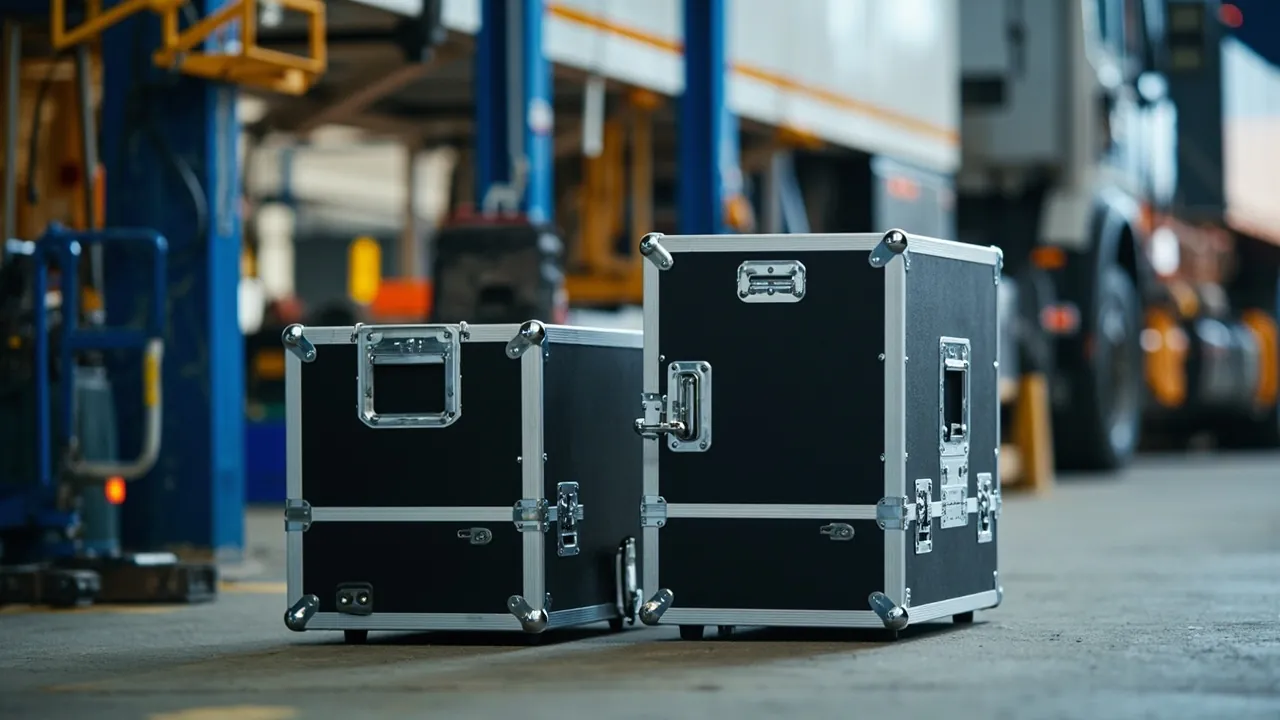
Aerospace equipment, from research and final assembly to field support, depends on reliable carry and transport protection. The conclusion up front: a qualified aerospace equipment case must balance waterproofing, dustproofing, vibration resistance, impact resistance and electromagnetic compatibility as a system, and apply differentiated interior lining design according to the sensitivity of each load such as flight controller units, avionics instruments and ground support equipment. This article covers typical categories including flight controller cases, avionics instrument cases, aviation maintenance toolboxes, airport ground equipment cases, rocket model transport cases, satellite accessory cases, spacecraft payload test cases and flight training simulator cases, providing parameters, standards and selection methods aimed at engineering and procurement decisions, helping you avoid detours in tendering, distribution and OEM/ODM cooperation.
Aerospace equipment is typically high value, high precision and sensitive to temperature, humidity and external forces. A poorly designed transport case can damage a precision gyroscope, inertial unit or flight control board during a single routine road transfer or air freight shipment, with repair costs far exceeding the case itself. Therefore the case is not merely a box to hold things; it is a critical link in the full-lifecycle protection chain of the equipment. Whether it is a model-matched flight controller case or a daily airport ground equipment case, it should be planned from four dimensions: standard compliance, structural strength, cushioning lining and environmental adaptability.
Table of Contents
- Protection Requirements and Industry Standards for Aerospace Equipment Cases
- Flight Controller Cases and Packaging of Flight Control Units
- Design Essentials of Avionics Instrument Cases
- Configuration of Aviation Maintenance Toolboxes
- Selection of Airport Ground Equipment Cases
- Rocket Model Transport Cases and Satellite Accessory Cases
- Vibration and Temperature Control of Spacecraft Payload Test Cases
- Handling of Flight Training Simulator Cases
- Case Material and Structure (PP/ABS/PC)
- Sealing and Three-Protection (IP Dust and Water)
- EMC and ESD Shielding Considerations
- Transport, Stacking and Airdrop Design
- JUNZHJIA Custom Capability and OEM/ODM Service
- Procurement Acceptance and Documentation
- FAQ
Protection Requirements and Industry Standards for Aerospace Equipment Cases
The protection requirements of aerospace equipment cases can be summarized as "three protections and one stability": waterproof, dustproof, impact-proof, and stable environmental temperature and humidity. The requirements for these four items differ greatly across loads. For example, a flight controller computer emphasizes anti-vibration and electrostatic protection, while airport ground lights and charging equipment emphasize drop resistance and splash resistance.
In terms of standards, China commonly uses GB/T 4208 (corresponding to IEC 60529) to define IP protection grades; military and aviation field equipment often references the vibration, shock, temperature and humidity cycle procedures of MIL-STD-810H; the transport link can be verified against the ISTA 3 series for simulated transport; the flammability of non-metallic materials references UL94; and shell mechanical impact resistance can be expressed by IK grades. For flight controller cases and avionics instrument cases that need export or participation in international projects, it is recommended to mark both IEC 60529 and GB/T 4208 to avoid repeated interpretation by the purchaser.
| Standard / Grade | Dimension | Typical Value | Note |
|---|---|---|---|
| --- | --- | --- | --- |
| GB/T 4208 / IEC 60529 | Dust/Water | IP65, IP67 | IP67 common for field cases |
| MIL-STD-810H | Vib/Shock/Temp | Method 514, 516, 501/502 | Aviation field reference |
| ISTA 3 | Transport sim | 3A, 3E | Parcel/LTL verification |
| UL94 | Flammability | V-0, V-1 | Focus when powered internals |
| IK | Impact | IK08, IK10 | Shell mechanical resistance |
It must be stressed that standards are not "the higher the better" but "matched to load risk". Equipping an ESD-sensitive flight control board with IP68 while ignoring the ESD lining is a typical design imbalance. Conversely, adding EMI shielding to a purely mechanical ground tool is over-design that only adds cost.
In field deployments, the sealing and cushioning of Aerospace Equipment Cases come first: referencing IEC 60529 and GB/T 4208 for the IP rating, IP65 suits dust and splash protection while IP67 is preferred for wet or submerged environments to keep the contents free from moisture and grit.
At incoming inspection, Aerospace Equipment Cases should ship with third-party IP, IK and drop reports; check gasket continuity, even latch compression and liner fit item by item. Like Military Protective Case Selection: Rifle Cases, Ammo Transport Cases & Individual Equipment Cases, complete documentation eases warehousing and insurance claims.
Flight Controller Cases and Packaging of Flight Control Units
The flight controller (autopilot) is the brain of drones and various aircraft, containing IMU, GNSS modules, microprocessors and power circuits, extremely sensitive to vibration, static electricity and moisture. The core task of a flight controller case is to keep the unit in a low-stress, low-humidity and low-static environment during transfer, calibration and field replacement.
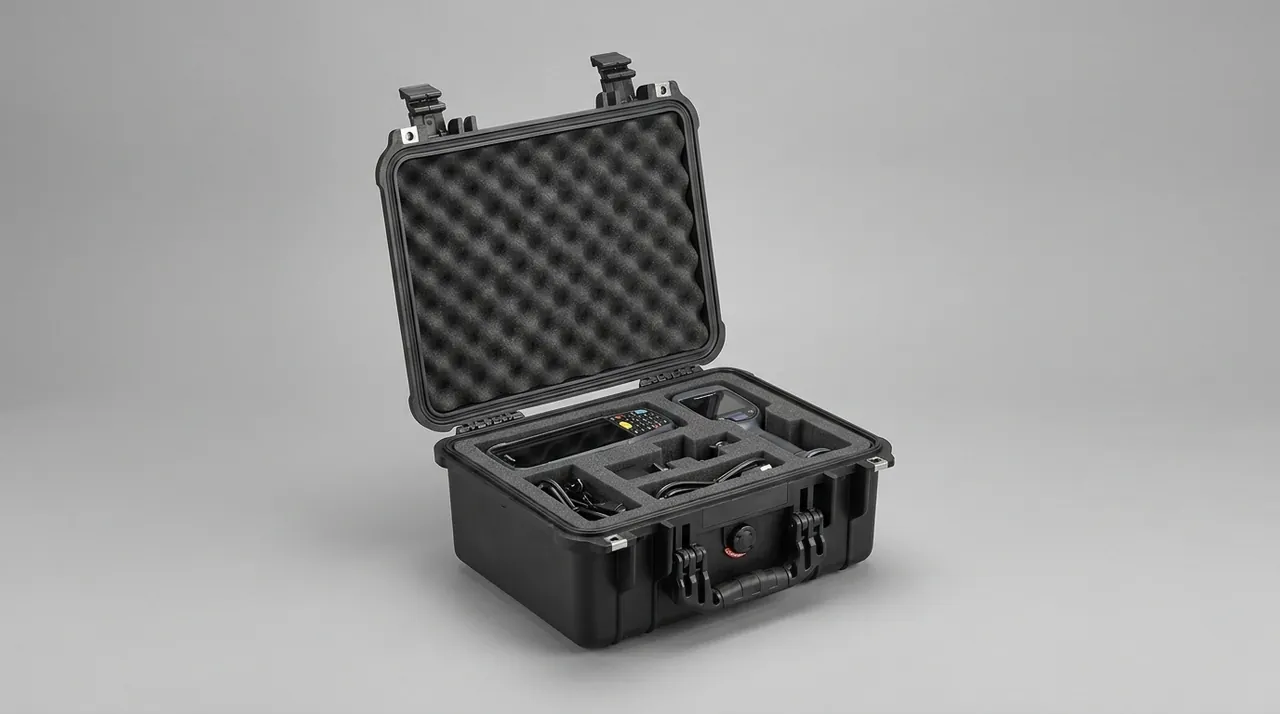
The design recommends a three-layer structure of "hard shell + custom foam + conductive lining": the outer hard shell provides an impact-resistant frame; the middle layer is CNC-cut EVA or PE foam shaped to the controller profile, limiting triaxial displacement; the inner layer can be conductive foam or anti-static flannel to reduce static accumulation. For flight controllers with live connectors, the lining should reserve cable channels to avoid bending stress on connectors. Antennas and datalink modules paired with the controller can be stored in the same case by zones, but must be separated from the main body by partitions to prevent hard contact.
The flight controller box (a miniaturized, portable version of flight controller packaging) is more common in teaching, testing and rapid field swap scenarios, smaller in size and emphasizing one-hand opening and hanging. Whether case or box, a humidity card position and anti-static warning should be marked, with the lining layout drawing delivered together.
For impact resistance, Aerospace Equipment Cases should be designed to an IK rating per IEC 62262, with thickened rounded corners and metal latches; transit drops are evaluated against MIL-STD-810H Method 516.8, and experience shows the shell can survive multiple 1.2 m drops without cracking.
At incoming inspection, Aerospace Equipment Cases should ship with third-party IP, IK and drop reports; check gasket continuity, even latch compression and liner fit item by item. Like Field Medical Cases & Combat First-Aid Kits: Protection and Temperature-Control Standards, complete documentation eases warehousing and insurance claims.
Design Essentials of Avionics Instrument Cases
Avionics instruments include altimeters, gyroscopes, air data computers, displays and control panels, generally featuring glass/crystal surfaces, precision sensors and temperature-sensitive electronics. The design essentials of avionics instrument cases are "surface protection + temperature stability + visibility".
Surface protection means, for fragile surfaces such as dial glass and LCD screens, a sunken fixation in the lining so the fragile surface bears no direct contact pressure; meanwhile the instrument is constrained by a rigid support frame around it to avoid flipping impact during transport. For temperature stability, long-distance transport can be configured with phase-change cold/heat storage pads or passive insulation layers, controlling the in-box temperature fluctuation within a typical value of plus or minus 5 degrees Celsius, specifically calculated against the instrument storage temperature range. Visibility means pasting an instrument list and opening checklist on the inside of the lid, facilitating coordinated work with the aviation maintenance toolbox.
The avionics instrument box is mostly used for short-distance transfer of a single instrument or spareparts warehouse management, emphasizing clear labeling and quick access. For centralized transport of multiple instruments, a modular tray is recommended, with each instrument in an independent slot and pulled out as a whole, preventing mutual collision and easing counting.
At incoming inspection, Aerospace Equipment Cases should ship with third-party IP, IK and drop reports; check gasket continuity, even latch compression and liner fit item by item. Like Military Electronics Protective Cases: Aviation Equipment Cases, Shipboard Cases & Tactical Comms Cases, complete documentation eases warehousing and insurance claims.
Configuration of Aviation Maintenance Toolboxes
Aviation maintenance toolboxes at airports and repair plants hold wrenches, torque wrenches, screwdrivers, probes, aviation material consumables and small testing instruments. The difference from ordinary hardware toolboxes is: first, tools are fixed according to work cards, and any missing piece can be found immediately upon opening; second, they often contact fuel, hydraulic oil and cleaning agents, so the case and lining must be oil and corrosion resistant; third, some aviation materials are dangerous goods, requiring zoning and labeling compliant with on-site safety management.
The recommended configuration is "layered drawers + elastic straps + transparent label bags": large torque tools at the bottom, small sockets and consumables in the middle, testing pens and records on top. Unlike precision cases for flight control and avionics, the maintenance box emphasizes durability and quick opening; the latch should be operable with gloves, and the hinge should pass a typical value of thousands of open-close cycles. If your fleet is also equipped with ground support equipment, you can refer to the linked solution of airport ground equipment cases.
At incoming inspection, Aerospace Equipment Cases should ship with third-party IP, IK and drop reports; check gasket continuity, even latch compression and liner fit item by item. Like Military Special-Operations Cases: Mobile Command Cases, Supply Cases, Explosion-Proof & EOD Robot Transport Cases, complete documentation eases warehousing and insurance claims.
Selection of Airport Ground Equipment Cases
Airport ground equipment covers jet bridge maintenance tools, boarding bridge control modules, ground power connectors, aid-to-navigation light spares and charging/testing instruments. Airport ground equipment cases face a high-frequency, multi-trade, cross-apron handling environment, with core demands of "rugged, easy to find, easy to push".
Prioritize when selecting: the passability of wheels and telescopic handle (whether it can roll smoothly on apron gravel and seams), the UV and oil resistance of the case, and a bright, easily recognizable exterior color. For ground testing equipment with lithium batteries, the case should reserve a battery compartment and meet insulation and fixation requirements during transport. For multi-case coordinated operations, a unified dimensional module is recommended for stacking and lashing on tool carts.
At incoming inspection, Aerospace Equipment Cases should ship with third-party IP, IK and drop reports; check gasket continuity, even latch compression and liner fit item by item. Like Emergency Transport Cases & Blood Collection Boxes: Temperature-Control and Protection Specs, complete documentation eases warehousing and insurance claims.
Rocket Model Transport Cases and Satellite Accessory Cases
In aerospace education, model competitions and payload integration, rocket model transport cases protect the airframe, engine models, recovery parachutes and electronic ignition components; satellite accessory cases are used for the transfer and storage of high-value spares such as on-board components, solar array hinges and star sensors. The commonality of these two case types is "high value + low tolerance", where a single bump may cause losses several times the case itself.
The rocket model transport case recommends a "vertical zoning + buffer column" structure, keeping the slender airframe vertical or directionally laid to avoid lateral bending stress; firework-related components must be isolated separately according to dangerous goods transport regulations, which this specification does not elaborate. Satellite accessory cases are closer to the clean transfer concept, with lining made of non-shedding anti-static flannel, the inner wall conductively treated, and equipped with humidity indicator cards and a desiccant compartment. The transport thinking of such high-value equipment can also learn from the anti-vibration approach of combat drone payload cases.
Vibration and Temperature Control of Spacecraft Payload Test Cases
Spacecraft payloads undergo extensive ground environmental testing during development. Spacecraft payload test cases safely transfer the payload between labs, between test benches and storage. These cases most value two indicators: "vibration transmissibility" and "temperature stability".
For vibration, the case can be required to control the acceleration transmitted to the payload within a typical allowable range under typical road transport, and if necessary adopt a suspended inner float structure that "hangs" the key payload on elastic elements. For temperature control, if the payload is temperature sensitive, a passive insulation layer or even an external temperature control interface should be configured, and the full transport temperature curve recorded. For payloads transported across climate zones, it is recommended to do high-low temperature cycles and damp heat verification before deciding the lining material.
Handling of Flight Training Simulator Cases
Flight training simulators are large and multi-component (joystick, pedals, screen, host, cables). Flight training simulator cases usually appear as "split multi-case + assembly list". Each split case should be marked with its number in the whole machine and assembly order, with the lining corresponding to the component shape to avoid mixed loading.
The handling focus is center of gravity and balance: a single case weight typical value is recommended within a range two people can lift or one person can push; beyond that, wheels and forklift holes must be equipped. Cables should be packed separately with end protection to prevent damage. When delivered to training units, an assembly guide card is recommended so non-professionals can restore by diagram.
Case Material and Structure (PP/ABS/PC)
Common engineering plastic case materials are three: PP (polypropylene) has good toughness, chemical resistance and low cost, suitable for maintenance tools and general transfer; ABS has high rigidity and easy fine appearance, suitable for instruments and display; PC (polycarbonate) has excellent strength and temperature resistance but high cost, suitable for demanding avionics and payload cases. There are also modified solutions such as PP+glass fiber and ABS+PC alloy, compromising between rigidity and toughness.
Structurally, an injection-molded one-piece shell is more reliable than splicing; case stiffeners, corner thickening and double-point latch fixation significantly improve life. For the shell of a flight controller case, a labyrinth seal groove can be made at the lid mouth to improve dust and water resistance; for large simulator split cases, forklift guidance and stacking locating pins should be made at the bottom.
| Material | Advantage | Limitation | Typical Use |
|---|---|---|---|
| --- | --- | --- | --- |
| PP | Tough, chemical resist, cheap | Average rigidity | Maintenance, general transfer |
| ABS | High rigidity, good look | Avg temp | Avionics, display box |
| PC | Strong, temp resist | Costly | Demanding payload/instrument |
| ABS+PC | Compromise | Mid cost | General field case |

Sealing and Three-Protection (IP Dust and Water)
Three-protection means waterproof, dustproof and anti-corrosion (including salt spray resistance). The seal is core: commonly nitrile rubber or silicone rings embedded in the case flange to form a compressed seal. To reach IP67, ensure the ring is uniformly compressed after closing, with no breakpoints and no debris pressed in. For airport ground equipment cases used long-term at the seaside or on deck, also consider the ozone and salt spray aging resistance of the seal and replace it periodically.
Waterproof does not mean long-term immersion. IP67 usually means no water ingress at 1 meter depth for 30 minutes; long-term diving requires IP68 with clear pressure and duration. If the load fears moisture, the ring alone is not enough; it should be combined with desiccant and humidity card for "seal + moisture absorption" double insurance. The general sealing and latch design can also refer to the common practice of sealed protective boxes.
Cushioning Lining and Custom Cutting
The cushioning lining determines whether the in-box equipment "shakes, compresses or collides". Common materials are EVA (good rebound, dyeable, easy to cut), PE (pressure resistant, non-shedding) and PU (slow rebound, excellent energy absorption). Custom cutting uses CNC or knife die to dig grooves according to the three-dimensional shape of the equipment, so the equipment "embeds" into the foam, which is the standard practice for flight controller cases and avionics instrument cases.
Custom lining not only absorbs shock, but also does "fixed management": each groove corresponds to one item, missing items are obvious at a glance, improving field efficiency and equipment counting accuracy. JUNZHJIA can customize CNC-cut foam lining according to the equipment drawing or physical object provided by the customer, achieving precise wrapping of one slot per object, which is the detail most valued by aviation high-value equipment.
EMC and ESD Shielding Considerations
Aerospace electronics are generally sensitive to electromagnetic interference and also afraid of their own radiation affecting other equipment. EMC (electromagnetic compatibility) shielding cases reduce internal and external electromagnetic coupling by laying conductive coating or metal mesh on the inner wall of the case, with conductive sealing gaskets. ESD (electrostatic discharge) protection targets board-level loads, requiring conductive lining, reliable case grounding and opening operations in anti-static environments.
It should be reminded that shielding effectiveness is directly related to openings, seams and ventilation; blindly adding ventilation holes destroys shielding. If the load is both heat-sensitive and needs shielding, conductive ventilation waveguides (honeycomb vent) should be used instead of ordinary mesh. Satellite accessory cases and flight controller boxes should pay special attention to this.
Transport, Stacking and Airdrop Design
The transport link is often a high-incidence segment of equipment damage. Case design needs to consider: stacking location (upper and lower cases interlock without slipping), weight limit labels, forklift and sling interfaces, and single-case weight limit. For supplies requiring airdrop, an airdrop protection structure should be adopted; the case can withstand landing impact and remain sealed after parachute descent, mostly used in emergency and special scenarios.
Road and air freight should also fit ISTA transport verification, confirming the case does not fail under vibration, drop and compression. For multi-case shipping, a unified outer dimensional module is recommended to facilitate palletization and container loading, reducing per-piece transport cost.
JUNZHJIA Custom Capability and OEM/ODM Service
For aerospace and police/military users, JUNZHJIA provides integrated capability from case selection, lining customization to seal kit matching. We can customize CNC-cut foam lining according to your flight control, avionics or ground equipment shape, achieving one slot per object; support OEM/ODM color, silk-screen and structural modification by model; for export projects, we can provide detection documents and specification sheets related to IP, flammability and transport, facilitating your direct inclusion in tenders and technical agreements. If you already have a case and want to upgrade protection, you can also order lining and seal kits separately.
Procurement Acceptance and Documentation
When procuring aerospace equipment cases, it is recommended to include the following documents in acceptance: material certificate (PP/ABS/PC grade), IP grade test report or declaration, lining layout drawing, drop and vibration verification records (if applicable), flammability grade (when powered), and ESD/EMC description (for electronics). The contract should clarify warranty period, seal replacement cycle and spare parts supply. For high-value categories such as flight controller cases and spacecraft payload test cases, it is recommended to trial in small batches before mass production, focusing on lining deformation and seal retention under real transport.
Mistake one: only staring at IP grade, ignoring lining and static. Mistake two: treating "fits" as "protects", with too large gap between equipment and case wall causing transport collision. Mistake three: over-design, adding expensive shielding to purely mechanical tools, wasting budget. Mistake four: ignoring weight and ergonomics, causing handling injury from overweight single case. Mistake five: not replacing seals, still using as IP67 after rubber ring aging. Combining the standards and structure methods in this article can systematically avoid these problems.
From a procurement standpoint, the first step is to classify each load by its dominant risk. A flight controller is dominated by electrostatic and vibration risk; an avionics instrument by temperature and surface-fragility risk; a ground maintenance tool by mechanical abuse and chemical exposure. Once the dominant risk is known, the protection budget can be allocated where it matters instead of uniformly over-engineering every case. This risk-based approach also simplifies acceptance: the purchaser can define a short list of measurable criteria such as IP grade, drop height, lining material and ESD path, and verify them on a sample before committing to volume. For aerospace programs where a single damaged unit can delay a test campaign, this discipline pays for itself many times over.
When specifying a flight controller case, also consider the connector and cable environment. Flying leads that exit the case should pass through a strain-relief gland rather than a loose hole, so that repeated connection cycles do not enlarge the opening and undermine both sealing and EMC. If the controller is shipped with its harness attached, the harness needs its own routed channel and a label indicating torque values for the connector backshells. Some programs prefer to ship the controller with a protective connector cap and a desiccant sachet inside the cavity, then reseal the case; this keeps the sensitive mating surfaces clean during the days or weeks the unit spends in transit. Documenting this packing routine in the lining layout drawing reduces field errors.
A practical tip for avionics kits is to color-code the lining zones: red for items that must never be compressed, yellow for items that tolerate light pressure, green for cables and consumables. This visual language lets a tired technician at 2 a.m. repack the case correctly without consulting the drawing, which in turn keeps the protection honest over hundreds of cycles. The same color logic can be extended to the outer case label, so the handling team knows at a glance whether the contents are static-sensitive or merely mechanical.
A useful acceptance routine is to perform a three-sample check: open one case from a batch, confirm the lining matches the drawing, confirm the seal compresses evenly around the flange, and confirm the humidity card, if fitted, is in the green range. Then subject one case to a representative drop or vibration test and inspect the interior for movement of the dummy load. Finally, verify the documentation set is complete and traceable to the material batch. Keeping this routine light but consistent avoids the common failure mode where protection is assumed rather than verified. For export programs, align the documentation language and units with the destination requirement early, because re-issuing test declarations later is slower than getting them right at order time.
In practice, the most reliable aerospace equipment cases are the ones whose design was reviewed against the actual transport lane, road, rail, sea or air, rather than against a generic checklist. A case that survives a benign warehouse environment may still fail on a vibrating tailgate or a humid quay, so match the validation to the real journey. Pair that with disciplined lining maintenance and a clear replacement cycle for seals, and the protection stays effective for the full service life of the equipment it carries.

Frequently Asked Questions
Q: What is the core difference between aerospace equipment cases and ordinary toolboxes? A: The core difference lies in the systematic protection goal and standard compliance. Ordinary toolboxes mainly solve "fit and carry", while aerospace equipment cases must simultaneously consider waterproof and dustproof (GB/T 4208/IEC 60529), anti-vibration and impact (MIL-STD-810H, ISTA), static and electromagnetic compatibility (ESD/EMC), and temperature-humidity stability. High-value loads such as flight controllers and avionics also involve custom lining, humidity indication and detection documents, almost none of which exist in ordinary boxes. In addition, aviation cases are often included in model matching or tender technical agreements, with higher requirements for traceable documents. Therefore selection should start from load risk rather than just appearance and price.
Q: Why does the flight controller case especially emphasize static protection? A: The flight controller contains ESD-sensitive devices such as IMU, GNSS and microprocessors. Static accumulated by the human body or environment can easily discharge through connectors or shell gaps, causing hidden damage or immediate failure. The flight controller case therefore uses conductive lining, anti-static flannel and reliably grounded shells, and requires opening in anti-static environments. Even if the shell is well sealed, if the lining is not conductive and operation is not standardized, the static risk remains. The portable flight controller box should also retain anti-static design and not omit it because of small size. It is recommended to attach an ESD operation tip card at delivery and provide basic training to users.
Q: How is the temperature stability of avionics instrument cases achieved? A: Avionics instruments are sensitive to temperature fluctuation; temperature stability is usually achieved through passive insulation layers, phase-change cold/heat storage pads or external temperature control interfaces. The passive solution relies on wall thickness and insulation material to reduce heat conduction, controlling in-box fluctuation within a typical value; for particularly temperature-sensitive instruments, energy storage material can be added to absorb or release heat during short transport. It must be clear that the passive solution has limited duration; long-distance cross-climate transport should record the full temperature curve and select accordingly. The avionics instrument box for short transfer only needs light insulation, not heavy equipment.
Q: Can rocket model transport cases hold pyrotechnics? A: This specification does not elaborate on specific pyrotechnic operations. Generally, any transport containing pyrotechnic components must comply with national dangerous goods and explosives transport regulations, using certified special containers and isolating separately; ordinary rocket model transport cases must never mix them. In model competitions and education, electronic ignition components should be packed separately from airframes and recovery parachutes, and pyrotechnic-related parts should be handled by qualified units according to procedures. Clean transfer cases such as satellite accessory cases should not contact any dangerous chemicals to avoid contaminating high-value on-board components.
Q: What verification is needed for spacecraft payload test cases? A: At least three are recommended: first, vibration transmission verification, confirming the acceleration transmitted to the payload under transport is within a typical allowable range; second, temperature-humidity cycle, verifying the stability of lining and seal under high and low humidity; third, drop/stack compression, confirming the case does not deform and fail under transfer accidents. If a suspended inner float is adopted, the fatigue life of the elastic element should also be verified. Verification can refer to ISTA transport simulation and corresponding MIL-STD-810H procedures, recording data and including it in delivery documents for traceability by the development unit.
Q: What is the practical value of custom lining? A: Custom lining (CNC cut according to the three-dimensional shape of the equipment) has triple value: first, shock absorption, the equipment "embeds" into the foam, limiting triaxial displacement and avoiding transport collision; second, fixed management, each item corresponds to a groove, missing items are known at a glance, improving field counting efficiency; third, protecting fragile surfaces, LCD and glass surfaces can be sunken fixed without direct pressure. For precision equipment such as flight controller cases and avionics instrument cases, custom lining is almost standard. JUNZHJIA can open mold and cut according to drawings or physical objects, achieving precise wrapping of one slot per object.
Q: Why do airport ground equipment cases emphasize wheels and handles? A: Airport ground equipment cases are handled at high frequency between aprons, jet bridges and hangars, where the ground often has gravel, seams and slopes; relying only on hand carrying greatly reduces efficiency and increases injury risk. Wheels and telescopic handles allow one person to push a heavier tool cart, with passability design ensuring smooth movement on complex ground; at the same time a bright recognizable exterior color facilitates quick positioning in the busy apron. For testing equipment with lithium batteries, the case should also reserve a battery compartment and meet insulation and fixation requirements, different from ordinary maintenance boxes.
Q: How to balance EMC shielding and ventilation? A: When electronic loads are both heat-sensitive and need shielding, do not simply open ordinary mesh, otherwise the shielding effectiveness will be destroyed. The correct approach is to use conductive ventilation waveguides (honeycomb vent), which allow airflow while blocking electromagnetic coupling; and use conductive sealing gaskets at seams and openings. Shielding effectiveness is directly related to opening area and seam continuity, and should be calculated by a professional. If satellite accessory cases and flight controller boxes need heat dissipation and shielding, priority should be given to waveguide ventilation rather than drilling.
Q: What documents are most easily missed in procurement? A: The most easily missed are traceable protection verification documents: material grade certificate, IP test report or declaration, lining layout drawing, drop/vibration records, flammability grade when powered, and ESD/EMC description for electronics. Many procurements only take appearance photos and quotations and place orders, only to find missing documents at acceptance or tender. It is recommended to clarify in the contract the warranty period, seal replacement cycle and spare parts supply, and for high-value categories such as flight controller cases and spacecraft payload test cases, trial in small batches first, confirming lining and seal stability under real transport before mass production.
Conclusion and Related Reading
The selection of aerospace equipment cases is a systematic project, which needs to start from four main lines of standard compliance, structural strength, cushioning lining and environmental adaptability, and make precise design for differentiated loads such as flight controller cases, avionics instrument cases, aviation maintenance toolboxes, airport ground equipment cases, rocket model transport cases, satellite accessory cases, spacecraft payload test cases and flight training simulator cases. Doing protection in advance is far more cost-effective than paying for damaged equipment repair.
Related Reading