

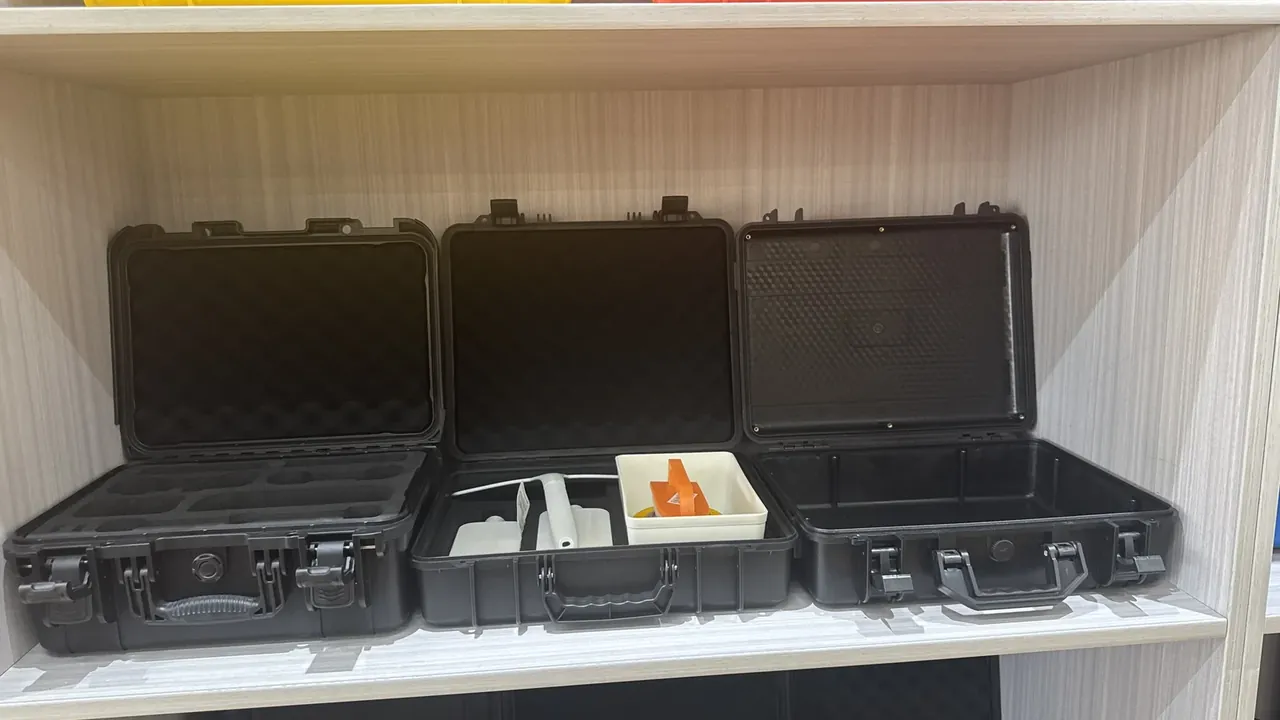
Quick answer: Six cost blocks plus tooling make up a cartridge protective box quote: shell, insert, hardware, labour, packing and overhead. Quantity decides whether the mould is bought outright or spread, and lead time is six stages added together.
Table of contents
- What a Quote Should Break Down
- Order Quantity and Tooling Amortisation
- Lead Time from Sample to Shipment
- Four Things Buyers Misread
- Contract Terms and Payment Milestones
- FAQ
1. What a Quote Should Break Down
Comparing two totals is the first mistake. One supplier quotes 168 yuan, another 152 for the same model, and the gap sits in scope: the second prices a bare case and charges 22 yuan for the insert.
Six blocks make up the cost of a cartridge protective box; a missing one means something moved off the sheet.
| Block | Share | Basis |
|---|---|---|
| Shell material | 45 to 55 percent | Net weight times resin price |
| Insert | 15 to 25 percent | Foam plus cutting time |
| Hardware | 5 to 8 percent | Per set |
| Labour and energy | 10 to 15 percent | Cycle time |
| Packing and freight | 4 to 8 percent | Per unit or volume |
| Overhead and margin | 10 to 12 percent | Mark-up on the above |
Work material backwards from weight: a 400 by 300 by 150 mm cartridge protective box with a 3.2 mm wall weighs about 1.35 kg, and at 2.4 mm it falls to 1.0 kg, cutting material cost by a third.
2. Order Quantity and Tooling Amortisation
Minimum order quantity for a cartridge protective box is arithmetic, not attitude. A two-cavity mould with slides commonly costs 48,000 yuan, and that figure either lands on the invoice once or hides in the unit price.
Across 1,000 units it adds 48 yuan each, at 3,000 it adds 16, at 10,000 it adds 4.8. Ask who owns the mould: paid outright it travels with the buyer; amortised it stays with the maker.
| Quantity | Tooling | Added per unit | Use |
|---|---|---|---|
| 300 | Existing mould, colour change | None | Trial or sample |
| 1,000 | New mould, paid once | 48 yuan | Small validation |
| 3,000 | New mould, amortised | 16 yuan | Standard first order |
| 10,000 | New mould, amortised | 4.8 yuan | Annual contract |
Colour change cuts quantity: an existing mould restarts at 300 units, at the price of three to five extra days and a pulled screw for light shades.
3. Lead Time from Sample to Shipment
A supplier quoting thirty days has usually priced only its own floor. The chain behind a cartridge protective box runs six stages, and any one of them stalls the rest.
Sampling 7 days, tooling 22, trial 5, moulding 12, insert cutting 4, inspection 3, about 53 days. Tooling is the longest and most fragile stage.
| Stage | Days | Precondition |
|---|---|---|
| Sample approval | 7 | Drawing, colour chip, insert dummy |
| Tooling | 22 | Payment received, steel on site |
| Trial and correction | 5 | First-off dimensions agreed |
| Moulding | 12 | Three 250 tonne presses, resin dried |
| Insert cutting | 4 | Dummy rounds on hand |
| Assembly and inspection | 3 | Sampling passed |
The 12 moulding days assume three 250 tonne presses at 260 units a day; past 3,000 units a cartridge protective box run needs another press, so capacity belongs in writing.
4. Four Things Buyers Misread
First, bare case against complete set: the missing insert, carton and pallet return at delivery. Second, how many tool corrections are included, since one against two differs by a full tuning phase.
Third, validity and resin linkage: 30 days is common, and a 3 percent clause that moves one way only is no hedge. Fourth, freight and export packing, where a 40 foot high cube holds about 620 units and crates can cost more than the cargo.
None of the four sits in the unit price, yet all four land in the total.
5. Contract Terms and Payment Milestones
Pay for a cartridge protective box by milestone: 30 percent with the order, 60 after inspection, 10 held six months as retention. Early failures on a cartridge protective box cluster at latches and hinges.
Write a daily rate and a cap: 0.3 percent of contract value per day, capped at 5 percent, cancellation after 15 days. Start the clock at inspection, not order date. Force majeure needs written notice inside 15 days.
Conclusion
Procurement is a sum over quantity and scope, not a hunt for the lowest unit price: break the quote into blocks, amortise tooling, commit each lead time stage, write penalties and retention into the contract. Then a cartridge protective box order becomes arithmetic instead of argument.
This article discusses only the container (case body) side of specifications and design intent, and does not cover any handling, loading or use of the contents.
Related Reading
- How suppliers answer a case enquiry
- Drawings and documents needed for a custom case
- Choosing a case for volume purchase
- Running a small batch of custom cases
Related Products
- 8 Series — Gun Cases; Military Equipment Cases; Camera Equipment Cases; Drone Cases; Watch Cases; Knife Cases; First Aid Cases; Electronics Equipment Cases
- WL8-2812 PP Gun Case — model WL8-2812
- All protective cases and toolboxes: 7 series, 158 models