

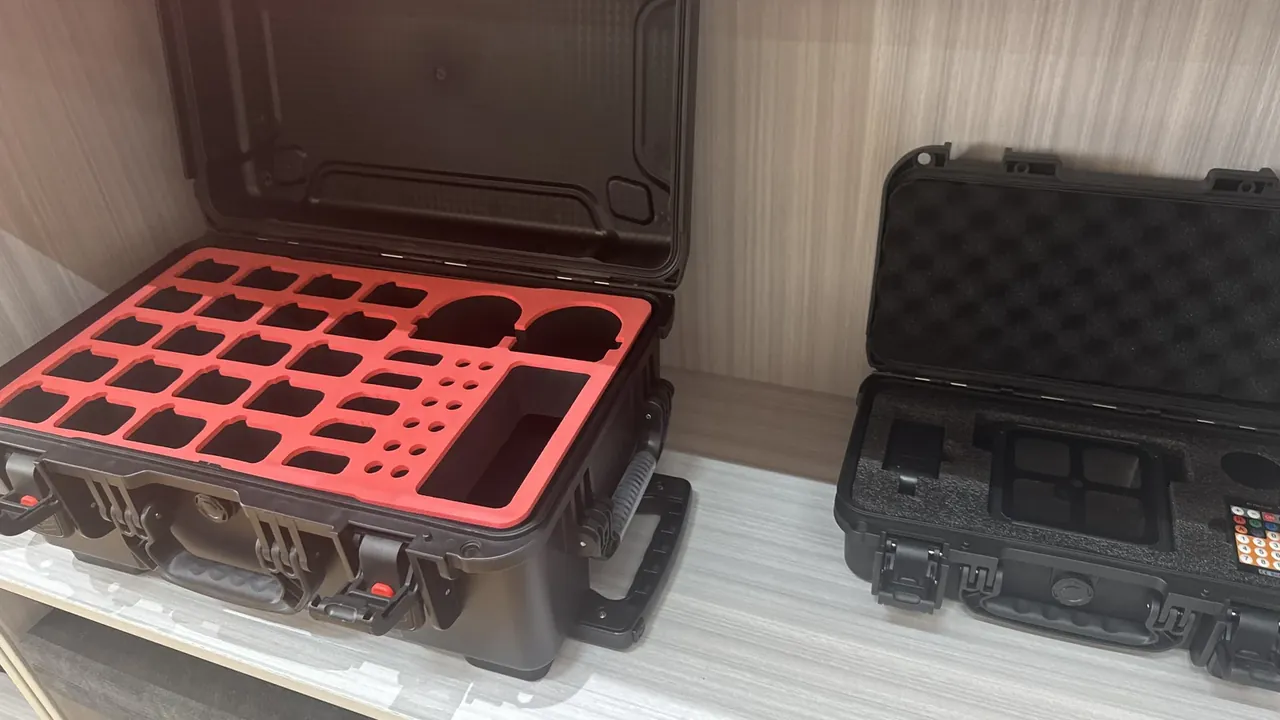
Quick answer: Specify a cartridge safety case backwards. Fix cell size, derive cavity and envelope from it, then set walls and ribs from stack height, and close with sealing class, temperature range and drop height. Get the order wrong and every sample becomes a restart.
Table of contents
- Sizing a Cartridge Safety Case from the Cells Up
- Wall Thickness and Rib Spacing
- Stack Load and How to Rate It
- Sealing Class and Temperature Range
- Drop Height and Test Conditions
- FAQ
1. Sizing a Cartridge Safety Case from the Cells Up
Outer dimensions are an output. A cell must hold an item upright without rattle and leave a fingertip gap of 4 to 6 mm.
Cell count follows. Five columns by eight rows gives 40 cells behind 1.8 mm dividers, near 18 kg loaded, light enough to lift one-handed. A cartridge safety case drawing that starts with the 340 mm envelope usually restarts at the third sample.
| Item | Value | Why |
|---|---|---|
| Outer | 340 x 270 x 120 mm | One-hand carry, fits 400 mm shelf pitch |
| Cavity | 310 x 240 x 95 mm | Leaves wall and rib depth |
| Cell | 30 x 22 mm, 60 mm deep | Upright hold, fingertip access |
| Layout | 5 x 8 cells, 1.8 mm dividers | About 18 kg loaded |
Draft angle belongs in that table too: at 1 degree over 120 mm the cavity loses about 2 mm.
2. Wall Thickness and Rib Spacing
Thickness follows load paths: 2.8 mm walls, 3.5 mm base, 2.6 mm lid. The base takes the drop and the stack above it; the lid only resists dishing.
Ribs matter more than thickness. Vertical ribs at 60 mm centres, 4 mm tall, R1.5 at the root, hold the walls against bulge; base ribs sit near 45 mm because span drives deflection. Too dense and the part drags in the mould; too sparse and the rib does nothing.
Shrinkage belongs on the drawing, not just the resin grade. Going from 1.6 to 1.8 percent over 340 mm shifts the envelope about 0.7 mm, cells included, so a cartridge safety case is dimensioned from the centre.
Where thick meets thin, keep sections within 2 to 1, otherwise a sink mark at the seal groove becomes a leak path.
3. Stack Load and How to Rate It
A rating without a bearing area and a duration means nothing. Write three things: 90 kg uniform on the lid, held 72 hours, residual deflection no more than 1.0 mm.
Stack height comes from the store. Shelving at 2.2 m clear suggests 18 layers, yet five is the working figure once picking space and bulge are counted; five layers at 18 kg puts 72 kg on the bottom case.
Test it the same way: 72 hours at room temperature, a 3 mm rubber pad between platen and lid, measured an hour after unloading. Record the mean of four points and the maximum, since a mean hides a collapsed corner.
Read bulge at mid-height with a straight edge and feeler gauge; past 2 mm the case fails. Sample three cavities.
4. Sealing Class and Temperature Range
Never write waterproof; write an IP code with its test. IP67 means 1 m of water for 30 minutes, suiting washdown; IP65 covers rain and spray. Specify too high and gasket compression rises with latch force; too low and one hosepipe ends the argument.
Split temperature into storage and service: minus 30 to 80 Celsius in store, minus 25 to 60 in use. Polypropylene embrittles in cold and cracks at corners; heat hardens the gasket.
Cycling moves dimensions too. After ten cycles between minus 30 and 80 Celsius the envelope should hold within 2.0 mm; more means locked-in stress. Most cartridge safety case specifications omit this line until a winter complaint about lids that will not latch.
5. Drop Height and Test Conditions
Drop height follows handling: 1.2 m for a hand-carried cartridge safety case, roughly chest height, and 0.8 m for vehicle stacking. Higher needs a stated airdrop requirement. At 1.2 m, spell out the sequence: six faces, three edges, 18 drops on one unit.
Cold drop is separate: freeze at minus 25 Celsius for 4 hours, then drop a bottom corner within 30 seconds. Warm the case first and toughness returns, so the test measures nothing.
| Check | Condition | Pass |
|---|---|---|
| Sealing | IP67, 1 m, 30 minutes | No water or mist inside |
| Stack | 5 layers, 18 kg each, 72 hours | Deflection 1.0 mm or less |
| Cold drop | Minus 25 Celsius, 4 hours | Corner intact |
Drop and stack samples are separate units. A dropped case carries micro-cracks, and loading it afterwards enlarges them until deflection reads high, so say so in the specification.
Conclusion
Specifications translate use into numbers: cells to size, load paths to wall, ribs to deflection, stack and drop to proof, sealing and temperature to limits. Put the table on page one and the cartridge safety case specification is settled.
This article discusses only the container (case body) side of specifications and design intent, and does not cover any handling, loading or use of the contents.
Related Reading
- How a cartridge safety case is built
- Cartridge safety case maintenance: checks and limits
- Cell and insert layout in protective case specifications
- Choosing a protective case size from the contents out
Related Products
- 8 Series — Gun Cases; Military Equipment Cases; Camera Equipment Cases; Drone Cases; Watch Cases; Knife Cases; First Aid Cases; Electronics Equipment Cases
- WL8-2812 PP Gun Case — model WL8-2812
- All protective cases and toolboxes: 7 series, 158 models