

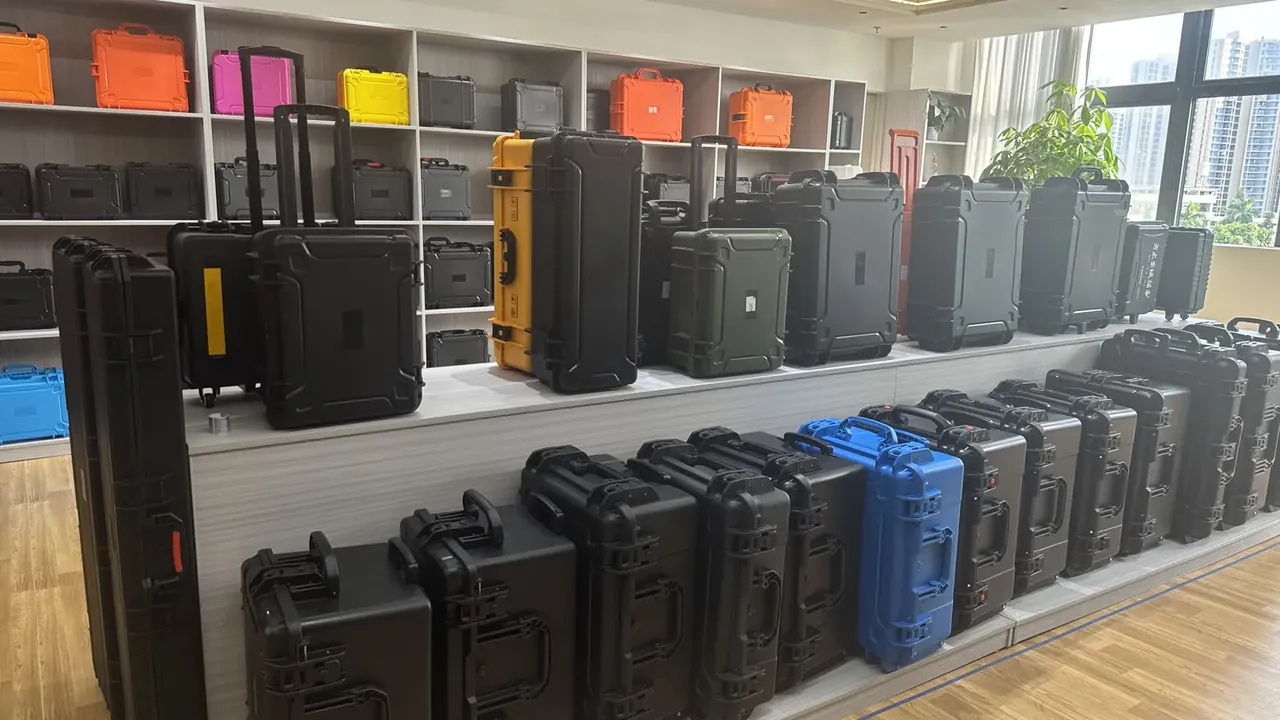
Quick answer: Read a protective case size range after the item is measured: 4 to 6 mm of clearance per side, foam taking 30 to 70 mm of height, and 2 to 3 mm left for lid compression. Fill the cavity from the inside out.
Table of contents
- Working Through the Protective Case Size Range
- Clearance for One Item and for Many
- Foam Comes Out of the Cavity
- Finger Room and Lid Compression
- Working Back from Pallets and Trailer Width
- FAQ
1. Working Through the Protective Case Size Range
A protective case size range is read from the item outward: longest edge, widest point and highest point, plus bosses, cables and handle overhang, plus foam. Only then take the smallest step that clears the total.
Reverse the order and the cost climbs. A case chosen first usually runs one step large, so foam grows from 25 to 50 mm, tare rises 1.8 kg and damping does not improve, since EVA past 40 mm is hard to compress evenly.
| Load | Per side | Base and lid | Foam |
|---|---|---|---|
| Rigid instrument | 5 to 6 mm | 30 / 25 mm | 30 kg/m³ |
| Item with bosses | 6 to 8 mm | 30 / 30 mm | 25 kg/m³ |
| Identical units | 2 to 3 mm | 25 / 20 mm | 10 mm dividers |
| Soft items | 3 to 4 mm | 20 / 20 mm | 20 kg/m³ |
2. Clearance for One Item and for Many
In a protective case size range, one item takes clearance per side. Length and width get 4 to 6 mm each side, height gets 5 mm below and 2 mm above, and a boss side takes 8 mm; ten millimetres all round leaves every face loose.
Several units need dividers first: 2 to 3 mm between units, 4 mm to each wall, so six units span six widths plus five dividers plus 8 mm. Equal thickness matters, because 1 mm of variance stops the last unit seating.
3. Foam Comes Out of the Cavity
Foam is subtracted from the cavity, never added. A 25 mm base and a 20 mm lid need 45 mm above a 200 mm item, so the cavity must reach 247 mm; the nearest step is 250 mm and the spare 3 mm is compression.
Side foam sets length and width: 15 mm all round turns a 300 mm item into a 330 mm cavity, while 25 mm needs 350 mm and jumps a step. Density matters too: 30 kg/m³ EVA absorbs best at 25 percent compression, while 20 kg/m³ bottoms out early.
| Foam layout | Base | Lid | Sides | Height consumed |
|---|---|---|---|---|
| Thin | 15 mm | 15 mm | 10 mm | 30 mm |
| Standard | 25 mm | 20 mm | 15 mm | 45 mm |
| Heavy duty | 40 mm | 30 mm | 25 mm | 70 mm |
4. Finger Room and Lid Compression
Finger room comes out of the cavity: lifting an item needs a 30 mm wide, 50 mm deep notch at the slot edge, and that space is not load space. A cavity exactly as deep as an upright item leaves no grip at all.
Lid compression runs 2 to 3 mm. Under 2 mm the item keeps 1 mm of play with the lid shut; over 3 mm the latches stay preloaded and nylon catches creep above 40 degrees Celsius. Tune it with lid foam, not latch travel.
5. Working Back from Pallets and Trailer Width
Bulk orders are worked backwards from the pallet in any protective case size range. On a 1200 x 1000 mm pallet a 480 x 360 x 290 mm case lays two across and three along: six per layer, 18 in three layers, 1020 mm and 173 kg.
Trailer width comes next. At 2350 mm internal width a 1200 mm pallet sits one across and a 1000 mm pallet two, so 24 cases need 2.4 m one way and 1 m the other. Height limits layers: two 1020 mm pallets reach 2040 mm under a 2.4 m roof, a 1310 mm one goes single.
| Pallet | Per layer | Layers | Per pallet | Height |
|---|---|---|---|---|
| 1200 x 1000 | 6 | 3 | 18 | 1020 mm |
| 1200 x 1000 | 6 | 4 | 24 | 1310 mm |
| 1200 x 800 | 4 | 3 | 12 | 1020 mm |
| 1100 x 1100 | 6 | 3 | 18 | 1020 mm |
Conclusion
Clearance is a budget spent on foam, dividers and finger room, and it must balance. Measure the item, add the foam, reserve the compression, then take the smallest step that fits. A protective case size range is a selection method before it is a table of numbers.
This article discusses only the container (case body) side of specifications and design intent, and does not cover any handling, loading or use of the contents.
Related Reading
- Factors behind a custom foam insert
- How a stacking load test is run
- Shell and hardware on heavy-duty tool cases
- How to choose a toolbox size
Related Products
- 8 Series — Gun Cases; Military Equipment Cases; Camera Equipment Cases; Drone Cases; Watch Cases; Knife Cases; First Aid Cases; Electronics Equipment Cases
- WL8-2812 PP Gun Case — model WL8-2812
- All protective cases and toolboxes: 7 series, 158 models