

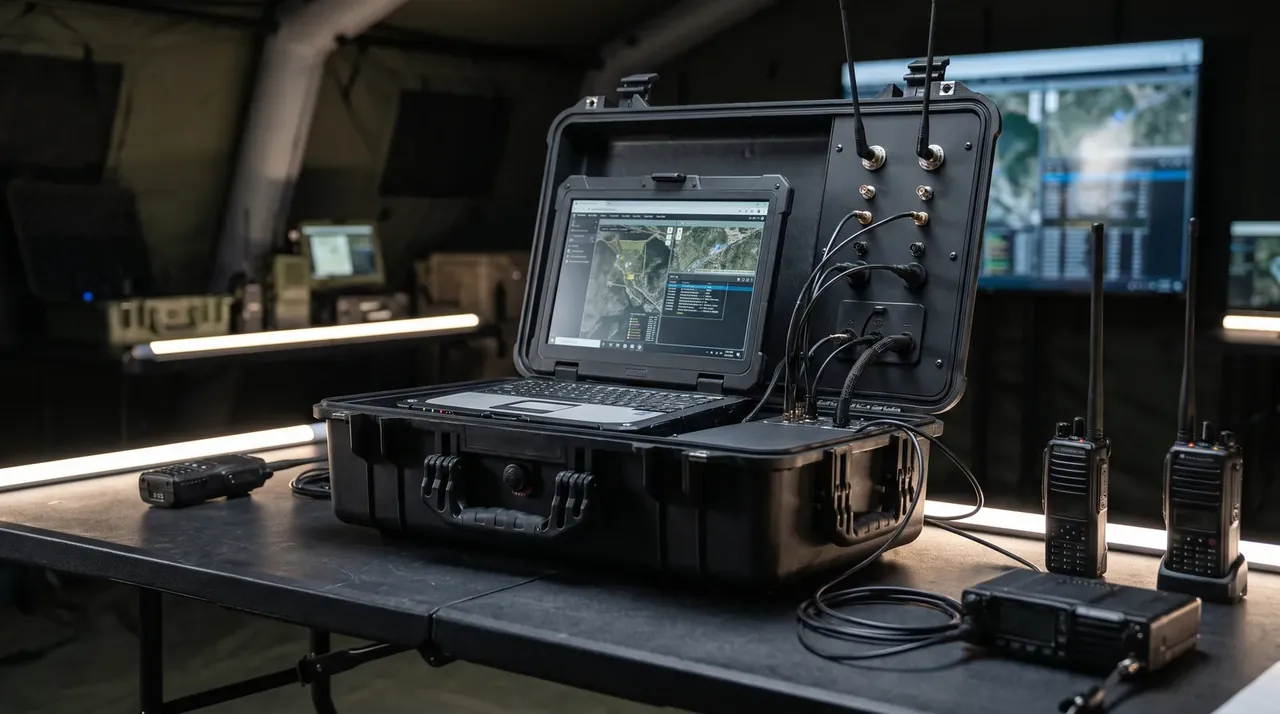
Quick answer: A case ip retest failed first time because corner squeeze read 18 % against 31 % on the rails, a 12-point gap that no one checked before shipping.
Table of contents
- Why compression comes first
- Latch load spread: 15 % is enough to leak
- Air pre-charge and the 60 s decay
- Rework order after a fail
- FAQ
1. Why compression comes first
The batch came back wet at two corners and dry everywhere else. Pressure paper showed 18 % squeeze at all four corners against 31 % along the rails, a 12-point spread on one gasket.
Two effects cost the margin at the bend. The strip stretches 6 % around R25 and thins 0.3 mm, and tool deflection leaves the groove 0.2 mm shallow, so depth runs 3.5 mm to 3.9 mm. Together they take 0.5 mm of squeeze off the corner.
To measure, lay 3 mm pressure paper in the groove, close and latch, wait 24 h, then read band width. A 520 mm case needs 18 readings: 3 per corner, one every 200 mm along the rails.
| Gasket mm | Groove mm | Squeeze % | Travel mm |
|---|---|---|---|
| 6.0 | 3.5 | 42 | 2.5 |
| 6.0 | 4.2 | 30 | 1.8 |
| 6.0 | 4.6 | 23 | 1.4 |
| 6.0 | 4.9 | 18 | 1.1 |
The last row was the true state of that batch, a 4.9 mm effective groove that appears on no drawing.
Set three limits: corners at 25 % minimum, rails 28–38 %, spread within 8 points. Miss one and a case ip retest is wasted work.
2. Latch load spread: 15 % is enough to leak
The second check measures force, not gap. A 0–200 N gauge on each latch, pushed to the closed position, read 118 N left, 96 N right and 142 N centre on a 520 mm case.
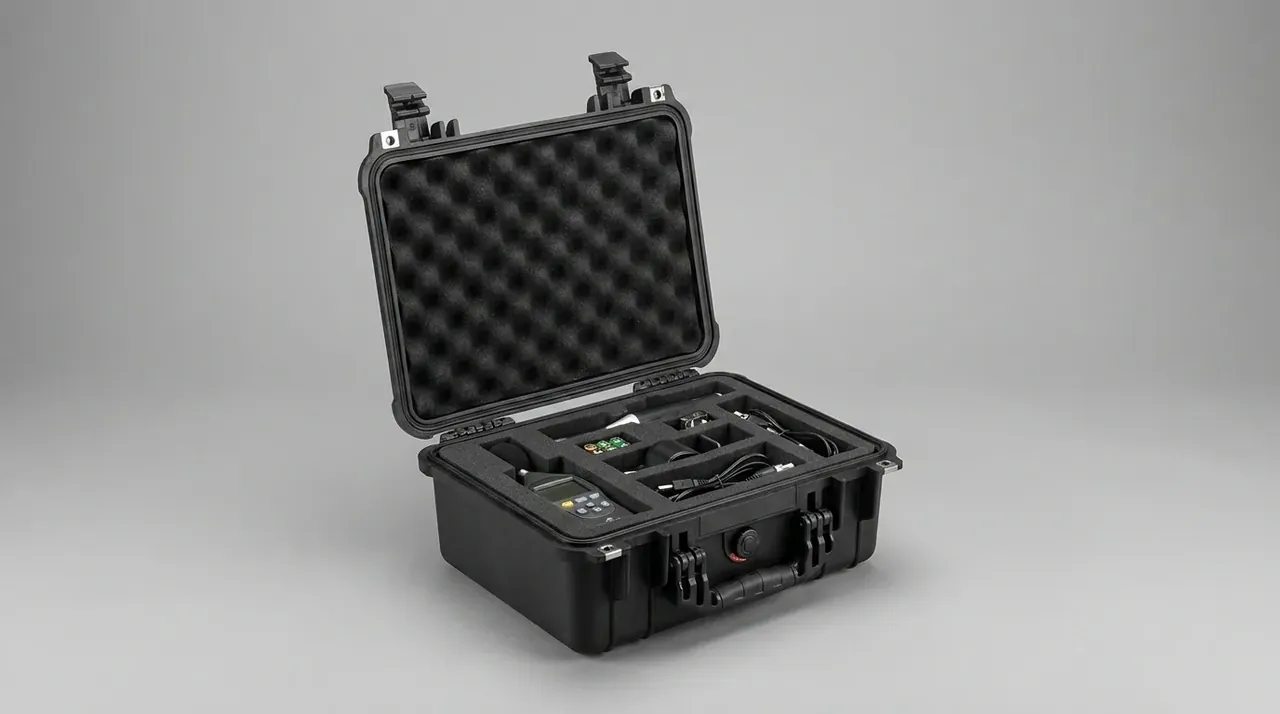
That 34 % spread is the most common failure in a case ip retest. The weak latch leaves its gasket at 20 % squeeze while the strong one runs 40 %, so the strip is crushed at one end and starved at the other.
Three sources, by frequency: a 0.3 mm assembly gap at the latch base, 70 % of cases; 0.2 mm hook wear, 20 %; lid deflection of 0.4 mm, 10 %. The first two take a 0.2 mm shim, the third needs a rib.
Evening out has a fixed order. Release all latches, check the gap dry, shim the 96 N base by 0.2 mm to reach 110 N, then bring the 142 N point down to 128 N. Two passes land the four points at 110–128 N, a 14 % spread.
No point below 90 N, no spread above 15 %. A latch under 90 N cannot hold 25 % compression, and the next case ip retest will prove it.
3. Air pre-charge and the 60 s decay
The third check swaps water for air: charge to 20 kPa, hold 60 s, read the decay. It screens obvious failures the day before submission.
Temperature moves the number. With 38 L of volume, a rise from 23 ℃ to 33 ℃ adds 3.4 kPa, which buries a 1 kPa leak. Condition the sample 4 h first, then correct by 3.4 kPa per 10 K.
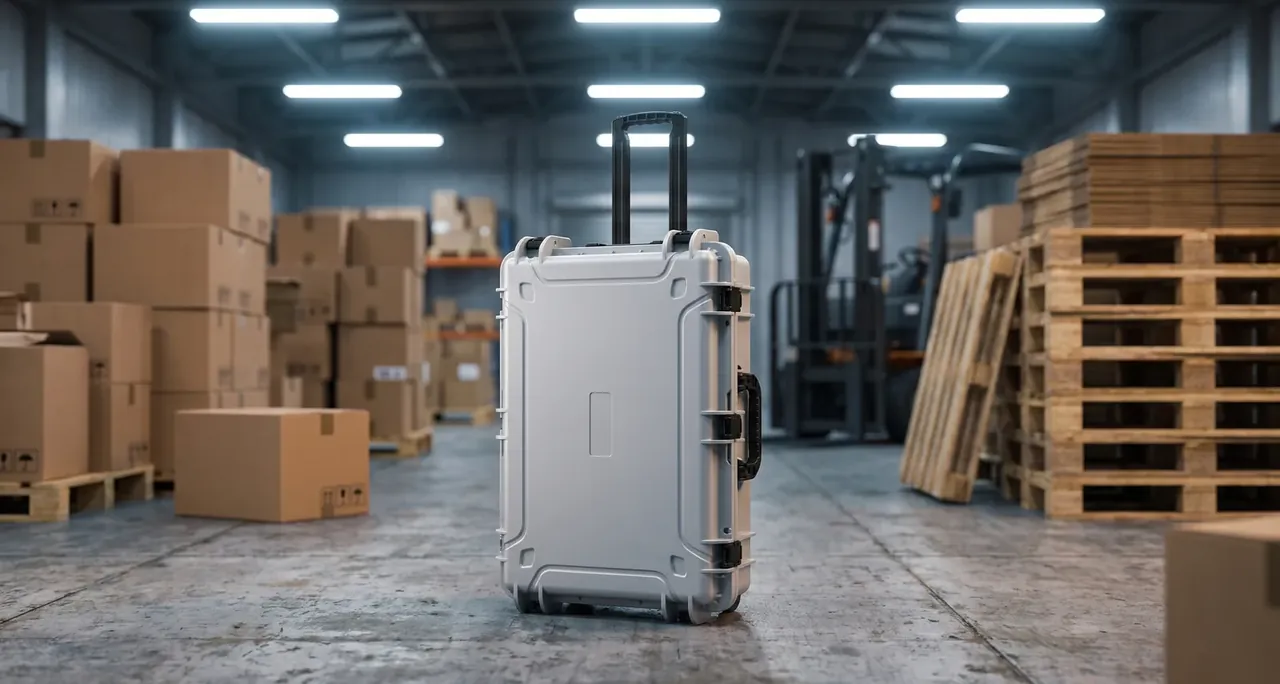
| Start kPa | Hold s | Decay kPa | Action |
|---|---|---|---|
| 20 | 60 | ≤0.6 | Release for submission |
| 20 | 60 | 0.6–1.0 | Re-clamp, retest |
| 20 | 60 | 1.0–2.0 | Replace gasket |
| 20 | 60 | >2.0 | Check groove, latch base |
Above 1.0 kPa, do not swap parts yet. Brush 0.5 % detergent around the corners, charge to 10 kPa and watch for bubbles; a leak shows in 30 s and saves 40 min.
Run 3 passes, 5 min apart, and average. One pass above 1.0 kPa still fails the unit: the gasket keeps collapsing under pressure and the average hides it.
4. Rework order after a fail
After a failed case ip retest, order matters more than effort. Measure the groove, replace the gasket, adjust the latch, and only then touch the body.
Groove first, 15 min. A depth gauge every 100 mm should vary less than 0.15 mm, corners included; past 0.3 mm the mould needs work and no gasket change helps.
Gasket second, 8 min, then 24 h of rest. A new strip comes out compressed, latching at once costs 15 % of rebound, and testing early guarantees a false fail.
Latch third, 20 min, shimming the four points into 110–128 N. Body last, from 2 h: a lid bowed 0.4 mm goes on a 60 ℃ plate under load for 30 min.
Finish with all three checks, not just air. Compression, force and decay each get one pass, and all three must sit inside the limits before resubmission.
Conclusion
Write the three limits into the pre-submission sheet: corner squeeze at 25 % or more, rails at 28–38 % with an 8-point spread, latch points at 90 N minimum with a 15 % spread, and decay under 0.6 kPa at 20 kPa over 60 s. Hit all three and the first-pass rate on a case ip retest climbs from about two in ten to better than nine in ten, which is cheaper than one air-freight return of a rejected lot. The action is small: make these checks mandatory on the first article, fix the tools (pressure paper, force gauge, 0–40 kPa manometer), keep the records, and rework in groove, gasket, latch, body order rather than starting with the most expensive step.
This article discusses container-side specifications and design implications only, and does not cover any handling, loading or use of the contents.
Related Reading
- Gasket groove size and squeeze allowance
- How latch force is measured and judged
- Airtight testing practice and pass criteria
Related Products
- 8 Series — Gun Cases; Military Equipment Cases; Camera Equipment Cases; Drone Cases; Watch Cases; Knife Cases; First Aid Cases; Electronics Equipment Cases
- WL8-2812 PP Gun Case — model WL8-2812
- All protective cases and toolboxes: 7 series, 158 models