

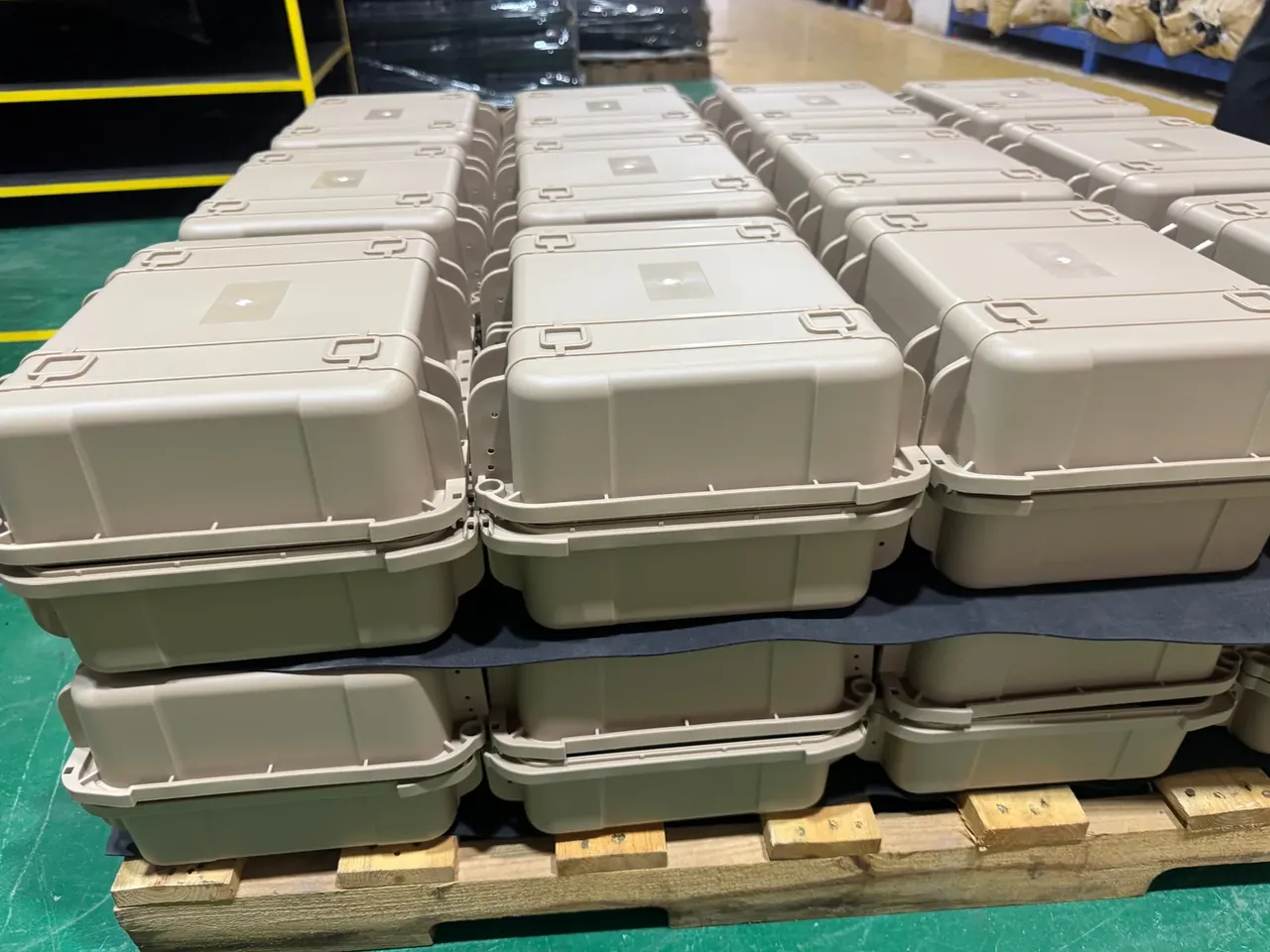
Quick answer: A charger module tote holds 8 modules at 28 kg, keeps surface resistance at 1×10⁶ to 1×10⁹ Ω and stacks 5 high, so static and floor space settle together.
Table of contents
- Surface Resistance Sets the Static Spec
- Eight Modules, Eight Millimetre Dividers
- Five High: What the Bottom Tote Carries
- Folding 1:3 and the Return Trip
- Fork Pockets at 100 mm and a 200-Cycle Life
- FAQ
1. Surface Resistance Sets the Static Spec
One tote carries 8 modules 40 m from moulding to burn-in, 12 trips a day. Static is not made on that walk; it builds on every lid lift. The number that decides it is surface resistance, held between 1×10⁶ Ω and 1×10⁹ Ω.
Both ends matter. Below 1×10⁶ Ω the shell acts as a conductor and dumps charge into one contact point, worse than an insulator. Above 1×10⁹ Ω half the charge is still there after 30 s, and a hand on the lid carries a few thousand volts.
The working range sits nearer the middle, at 1×10⁷ to 1×10⁸ Ω. Measure with parallel electrodes at 100 V, read after 60 s, at 23 ℃ and 50% RH. At 30% RH the same tote reads a decade higher, so a unit that passes in the lab can spark in a dry bay.
A coating is not the answer: paint loses 0.2 mm a year while a tote wears 0.5 mm. Compound the body so volume resistivity lands between 10⁴ and 10⁶ Ω·cm, then check the ground path; castors at 1×10¹¹ Ω leave no drain, so clip a 2 m strap to the side-wall insert and hold contact resistance under 10 Ω.
2. Eight Modules, Eight Millimetre Dividers
Eight modules per tote, 2 rows by 4 columns, each pocket 210 mm by 150 mm by 60 mm behind 8 mm PP hollow sheet. Eight is a weight decision: 28 kg leaves 14 kg per person at 1.2 m/s, while anything heavier needs a trolley and stretches the pick cycle from 40 s to 90 s.
The 8 mm divider is arithmetic. A 4 mm sheet bows under five-high load and 3 mm of bow tilts the module until pins take load sideways; a 12 mm sheet adds 1.8 kg and breaks the 28 kg ceiling. Hollow sheet at 8 mm deflects 1.2 mm under 200 N over the face, and it drains when washed, where solid sheet gains 0.4 kg in 24 h.
| Pocket layout | Pocket size | Divider | Modules | Tote weight | Handling |
|---|---|---|---|---|---|
| 2 × 4 | 210 × 150 × 60 mm | 8 mm | 8 | 28 kg | two-person lift |
| 1 × 6 | 260 × 150 × 60 mm | 8 mm | 6 | 26 kg | two-person lift |
| 2 × 6 | 210 × 120 × 60 mm | 8 mm | 12 | 34 kg | powered trolley |
| 3 × 4 | 210 × 120 × 60 mm | 8 mm | 12 | 33 kg | powered trolley |
Leave a 5 mm finger notch at the bottom of each pocket, or picking means tipping the tote 96 times a day. Number the pockets with a 0.1 mm laser mark; a tote is washed 40 times in five years and paper labels lift after three.
3. Five High: What the Bottom Tote Carries
At five high the bottom tote carries four others, 112 kg. The load is not the problem, the path is: a flat lid passes everything into four side walls, and 2 mm of wall lean puts it on two corners with triple the stress.
So the lid gets 3 ribs at 6 mm tall and 90 mm apart, and the base gets matching grooves; rib into groove holds lateral slip inside 5 mm. Over 72 h at five high the top face sinks 2.1 mm and returns to 0.4 mm after unloading.
| Stack height | Bottom load | Top sink | Wall bulge | Where it fits |
|---|---|---|---|---|
| 3 high | 84 kg | 0.9 mm | 0.6 mm | line-side buffer |
| 4 high | 112 kg | 1.5 mm | 1.0 mm | stores bay |
| 5 high | 140 kg | 2.4 mm | 1.6 mm | dispatch area |
| 6 high | 168 kg | 3.6 mm | 2.4 mm | pallet required |
Six high works only with 24 kg totes, and the extra layer does not pay back two more pick trips. Pallets matter too: 3 mm of surface variation pushes the load aside, and at 15% off-centre the wall bulge climbs from 1.6 mm to 2.3 mm.
4. Folding 1:3 and the Return Trip
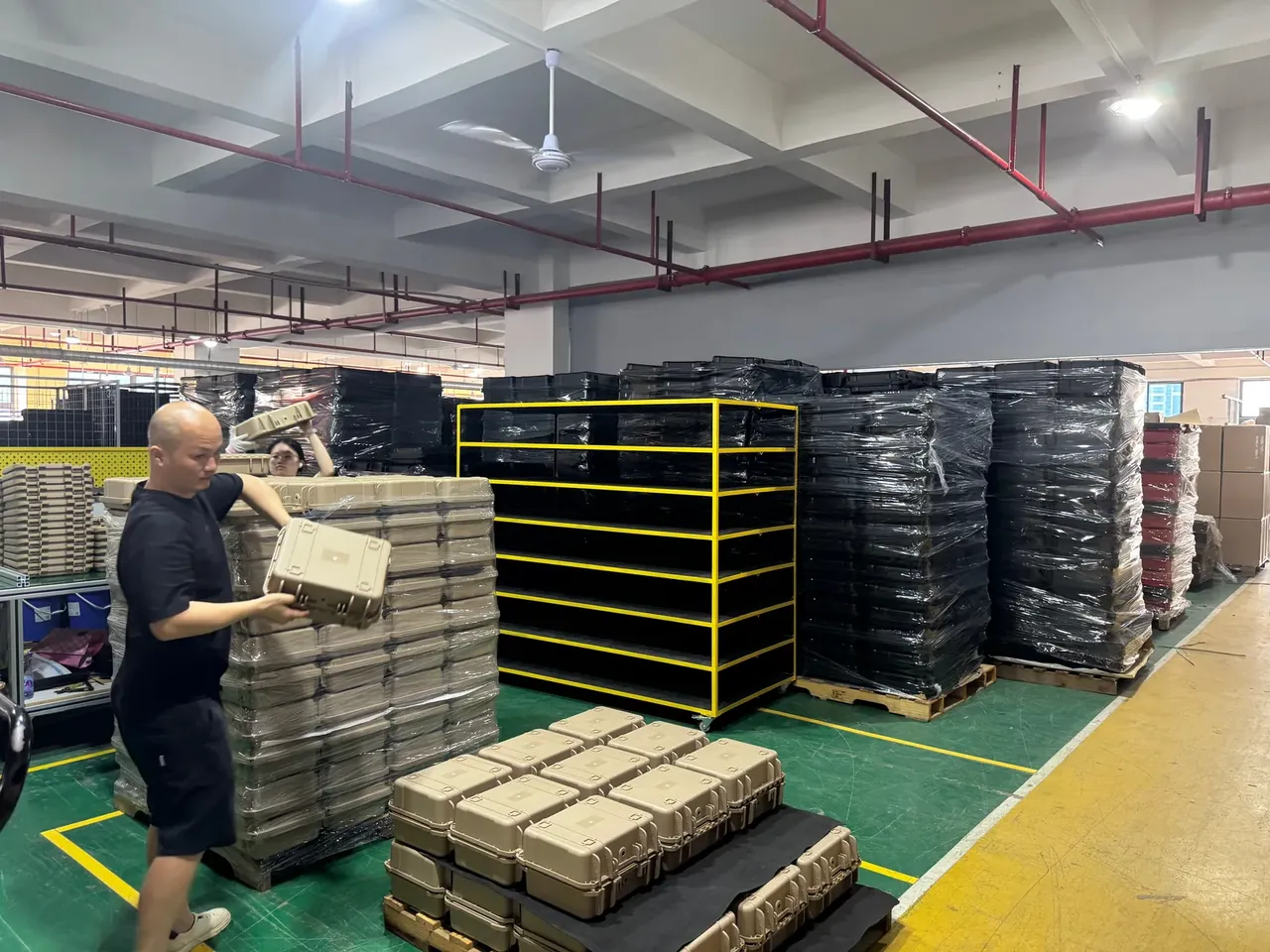
Folding 1:3 means three empty totes take the height of one. A tote stands 300 mm tall and folds to 100 mm, so 60 empties fill the floor space of 20 and one return run clears the lot.
Four hinges and 2 catches do the work: a tote folds in 12 s and the catch runs under 60 N, light enough for a gloved hand. By 200 folds the hinge bush has worn 0.15 mm and the ratio slips to 1:2.6.
Higher is not better: a 1:4 shell needs three wall segments, two more joints and 18% less stiffness, capping the stack at 3 high. Cap the empty stack at 8 too; from the ninth tote the lower catches take shear.
5. Fork Pockets at 100 mm and a 200-Cycle Life
Fork pockets run 100 mm high and 200 mm wide, 400 mm apart centre to centre. A hundred millimetres is 1.6 times the fork thickness of a manual pallet truck, the margin that stops a misaligned entry from splitting the pocket edge. Round that edge at 8 mm; below 5 mm the corner shows a 0.5 mm crack after 200 entries.
Two hundred cycles is a downgrade line, not a warranty. Three readings decide it: divider deflection past 3 mm, hinge bush play past 0.3 mm, base corner wear past 1.5 mm. Hit any one and the tote moves to spare-parts duty.
| Checkpoint | Cycles | Reading | Limit | Action |
|---|---|---|---|---|
| first use | 0 | surface resistance | 1×10⁷ Ω | log and mark |
| mid-life | 100 | divider deflection | 2 mm | trend it |
| life limit | 200 | bush play | 0.3 mm | change bush |
| downgrade | 260 | corner wear | 1.5 mm | spare-parts duty |
Mark the base right-hand corner by inkjet at a fixed position, so a scanner reads it in 0.5 s.
Conclusion
Four numbers draw a charger module tote: surface resistance of 1×10⁶ to 1×10⁹ Ω, 8 modules behind 8 mm dividers to hold 28 kg, five high to put 112 kg on the bottom unit, and 1:3 folding to halve the return runs. Fork pockets at 100 mm, an 8 mm edge radius and a 200-cycle rule are the details that get missed.
This article discusses container-side specifications and design implications only, and does not cover any handling, loading or use of the contents.
Related Reading
- Shipping protection for charger modules
- Storing and coiling charging cables
- Cases for AGV and robot cells
- Sizing a case for general industrial equipment
Related Products
- 8 Series — Gun Cases; Military Equipment Cases; Camera Equipment Cases; Drone Cases; Watch Cases; Knife Cases; First Aid Cases; Electronics Equipment Cases
- WL8-2812 PP Gun Case — model WL8-2812
- All protective cases and toolboxes: 7 series, 158 models