

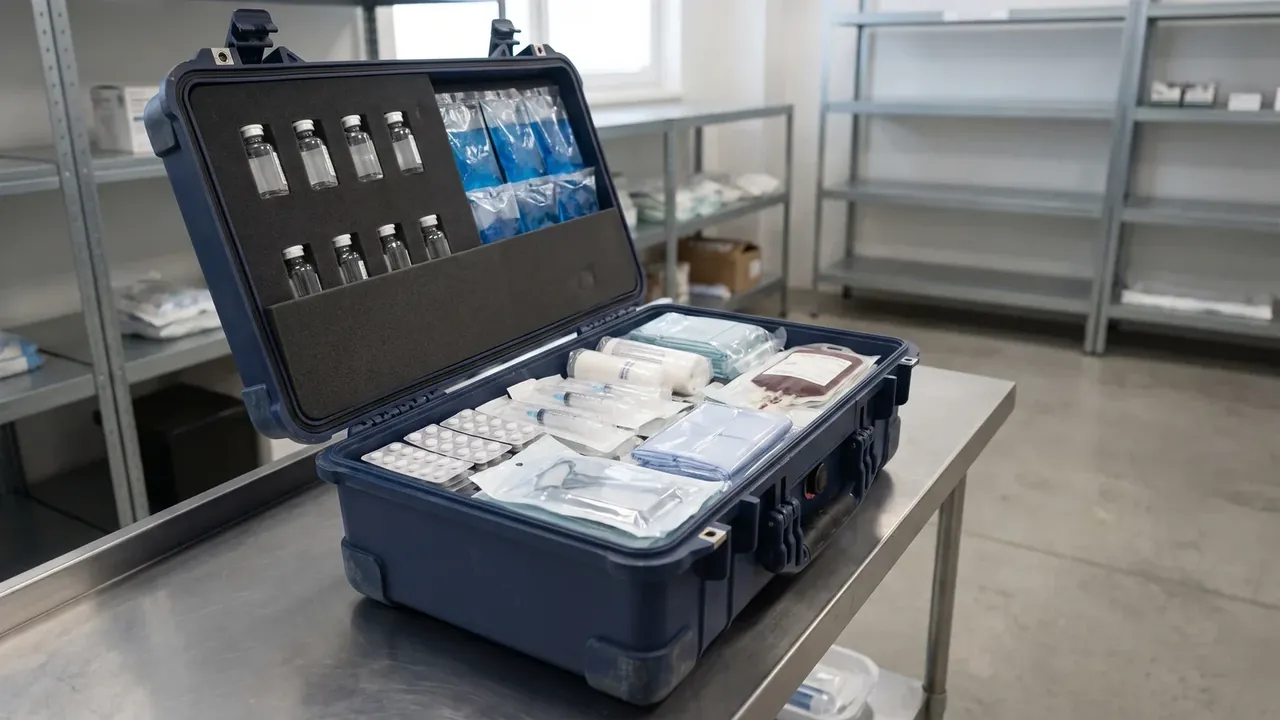
Quick answer: A cold chain case holds 2–8 °C only when three numbers are settled: heat leak through the walls, cold stored in the packs, and loss at every opening. A 20 L body at 30 °C leaks about 7.6 W, so 24 hours needs 182 Wh, which is 2.7 kg of ice.
Table of contents
- Four ways a cold chain case fails inside 2–8 °C
- Coolant selection and ratio, sized from the load
- Insulation and K value: what 40 mm of PU buys
- Validation layout and curve reading: eight loggers
- Loading and stacking effects on the air field
- FAQ
1. Four ways a cold chain case fails inside 2–8 °C
Six kelvin is a narrow corridor. Failures cluster at four points, none of them visible from outside.
Pre-conditioning first. Packs pulled from a −20 °C freezer and used at once hold a −8 °C core and burn 30% of the stored cold in 2 hours. A pack counts as frozen below −18 °C at the core, which takes 12 hours flat, spaced 30 mm apart.
Ratio second. A 20 L body with 5 kg of ice promises 12 hours and delivers 7, with the lid at 8.6 °C, because every pack sits at the bottom and the upper volume runs on convection.
Door openings third. A 30-second opening lifts the neck 2.1 °C and takes 8 minutes to recover; 12 openings cost 1.5 hours of endurance.
Stacking last. A pallet skirt over the return grille turns the air around the body from 0 °C to 12 °C and raises the heat load 40%.
2. Coolant selection and ratio, sized from the load
In a 6 K window a 5 °C PCM beats ice at −21 °C, which drags the nearest corner to 1.2 °C.
Ratio starts from the leak, Q = K × A × ΔT: 0.55 m² of surface at K 0.55 W/(m²·K) and a 25 K gradient give 7.6 W, or 182 Wh over 24 hours, which is 655 kJ.
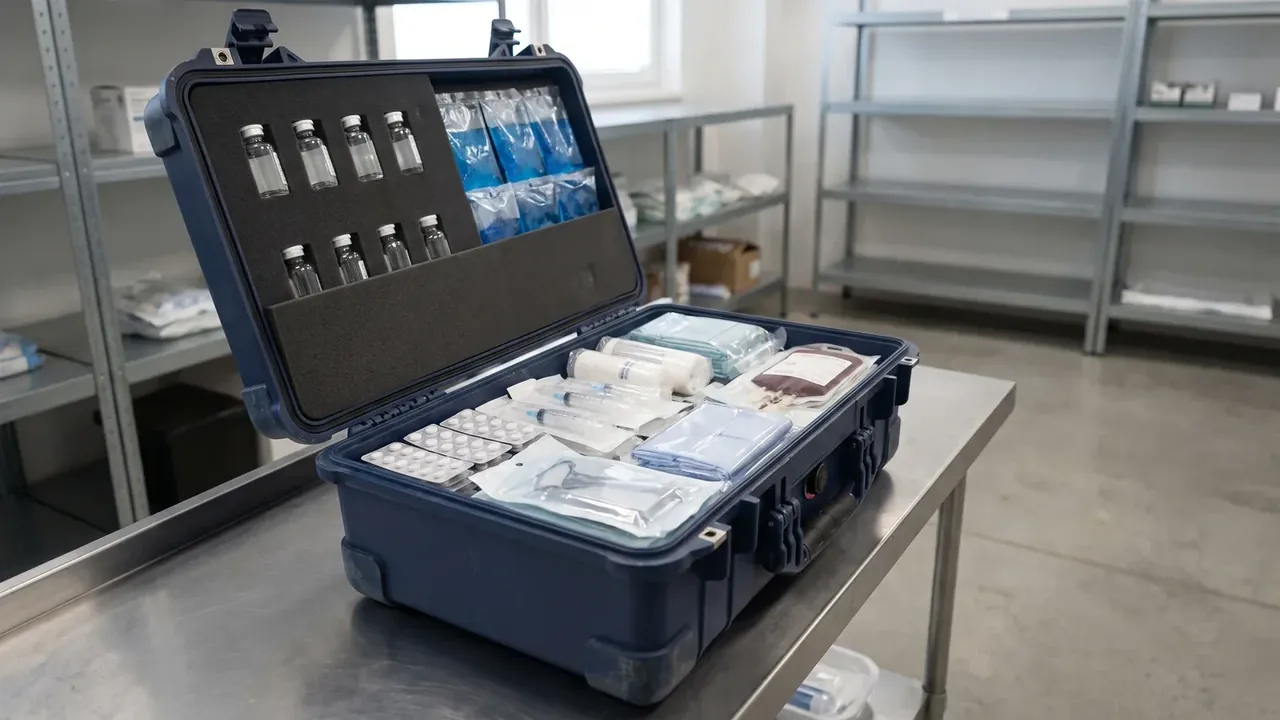
Convert to mass: ice stores 334 kJ/kg, so 655 kJ needs 1.96 kg, and a 1.4 factor takes it to 2.7 kg, or 6 packs of 450 g; PCM at 200 kJ/kg asks for 3.3 kg.
A 50 L body is another class: 0.95 m² at K 0.50 gives 11.9 W, 286 Wh a day, so 3.1 kg of ice or 8 packs of 500 g.
At 38 °C and 20 openings the factor belongs at 1.8, or the tail of the curve lifts.
3. Insulation and K value: what 40 mm of PU buys
PU at 40 mm and 0.022 W/(m·K) calculates to K 0.55 W/(m²·K) as a flat panel, yet a cold chain case reads 0.60 to 0.70 whole-body, the gap coming from three thermal bridges: lid seam, hinges and handle bosses.
A metal hinge through the foam adds 0.04 W/(m²·K), so three push K up 0.06; hinge blocks outside the foam bring it back to 0.58.
| Capacity | PU thickness | Whole-body K | Coolant load | Endurance at 30 °C |
|---|---|---|---|---|
| 20 L | 40 mm | 0.55 W/(m²·K) | 6 packs × 450 g | 24 h |
| 30 L | 40 mm | 0.58 W/(m²·K) | 5 packs × 500 g | 22 h |
| 50 L | 50 mm | 0.50 W/(m²·K) | 8 packs × 500 g | 28 h |
| 50 L | 40 mm | 0.62 W/(m²·K) | 10 packs × 500 g | 20 h |
With 5 °C inside and 30 °C outside, lid drips cut a 2 °C band across the load, so the lid carries a 2° slope and a gutter ring.
Gasket life is set by compression. Dual-lip EPDM works at 30% and takes a permanent set above 50% within six months, so leakage must stay under 0.3 L/min at 500 Pa.
4. Validation layout and curve reading: eight loggers
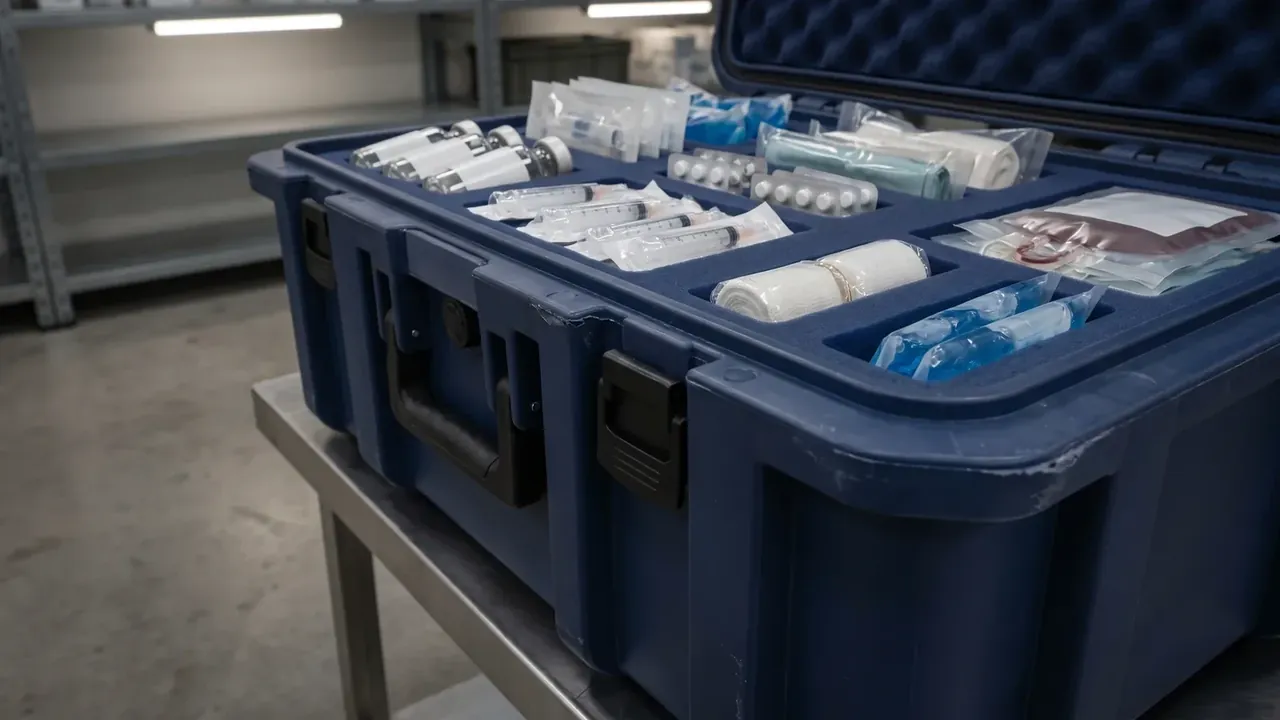
Validation proves the worst position stays inside the window. Eight loggers is the usual layout: two upper corners on the diagonal, two lower corners, the centre, one 30 mm from the door wall, one 50 mm under the lid, one at the base.
Loggers sample every 5 minutes at ±0.3 °C, calibrated annually, and probes stay 20 mm off the wall or they read wall temperature.
| Probe | Position | Offset from wall | What it watches |
|---|---|---|---|
| P1, P2 | Upper diagonal | 30 mm | Warm pocket after cold air sinks |
| P3, P4 | Lower diagonal | 30 mm | Over-cooling beside packs |
| P5 | Geometric centre | n/a | Bulk air of the load space |
| P6 | Door-side wall | 30 mm | Fastest recovery after opening |
| P7 | Under the lid | 50 mm | Condensate and radiant heat |
| P8 | Base centre | 20 mm | Contact face with the coolant |
Run both ISTA 7D profiles, 38 °C at 85% RH and −10 °C, 48 hours each. The winter run gets skipped, yet a 5 °C PCM never starts at −10 °C and the load falls to 1.5 °C.
Read three numbers: highest, lowest, cumulative time outside the window; twenty minutes at 8.2 °C hurts more than a brief 8.6 °C spike.
A report needs four parts: probe map, full curves, maximum deviation and conclusion, or a second laboratory cannot repeat it.
5. Loading and stacking effects on the air field
One body loses 6 hours of endurance between a full load and a half-empty one: above 15% void the wall side over-cools and the spread across eight probes widens from 0.8 °C to 2.4 °C.
Fill to 85–95% and pack voids with corrugated dividers, never newsprint.
A 1200×1000 mm pallet takes 8 bodies of 50 L, three high, so the bottom unit carries 64 kg; at 30 °C PU creeps 4 mm a day and the lid seam opens.
Airflow is more sensitive than load: keep 150 mm clear at the return grille, expect the door-side row 1.8 °C warmer, and note 25 minutes on a dock burns 2 hours of stored cold.
Conclusion
Holding 2–8 °C in a cold chain case is arithmetic to one decimal place: a 7.6 W leak, 182 Wh a day, 2.7 kg of stored cold. Add 0.06 to K and the pack count moves; open the lid 12 times and the factor belongs at 1.4; eight probes and two ISTA 7D seasons turn it into evidence.
This article discusses only the container (case body) side of specifications and design intent, and does not cover any handling, loading or use of the contents.
Related Reading
- Choosing a cold chain case: window, coolant, validation
- Insulation and logger layout for medical cold chain boxes
- Structure and stacking rules for logistics cold chain cases
Related Products
- 8 Series — Gun Cases; Military Equipment Cases; Camera Equipment Cases; Drone Cases; Watch Cases; Knife Cases; First Aid Cases; Electronics Equipment Cases
- WL8-2812 PP Gun Case — model WL8-2812
- All protective cases and toolboxes: 7 series, 158 models