


A cold chain logistics protective case is a container-class product designed for transporting temperature-sensitive goods. Its central job is to hold the internal temperature within a defined band throughout loading, transfer, temporary storage, and last-mile delivery, and to record temperature over time through monitoring so that the continuity and traceability of the storage and transport process are guaranteed. Compared with an ordinary protective case, a cold chain case must not only solve the usual problems of water resistance, dust protection, and impact resistance, but also manage the coupling among insulation, cold source, airtightness, and temperature acquisition. Selection should begin with the Case Shell: Structural Materials and Molding Process of Protective Cases to confirm the basic structure and strength, then plan the insulation and temperature control approach using the thinking in Temperature-Controlled Case: Active Temperature Control and Insulation. This article covers the insulated structure, cold source layout, monitoring integration, and verification methods of a cold chain logistics protective case, helping readers build a complete picture from structure to data.
1. Temperature Requirements That Cold Chain Logistics Imposes on a Case
The core demand of cold chain logistics is temperature continuity: across the whole chain from leaving the cold room to reaching the destination, the internal temperature should not fluctuate beyond the permitted band. Unlike a fixed cold store, the transport stage faces more complex disturbances. Opening the case during loading introduces outside warm air, outdoor parking in summer brings strong solar radiation, transport in a cold region in winter may cause excessive cooling, and vehicle vibration plus repeated transfer continuously consumes the sealing and insulation performance of the case. The design goal of a cold chain logistics protective case is therefore not absolute constant temperature but a temperature drift slow enough, within acceptable energy and weight constraints, to buy enough working window for the goods. That goal means the case must optimize insulation structure, cold source configuration, and airtightness together rather than simply thickening the wall. Understanding these disturbance sources and setting thermal indices with the method in Temperature-Controlled Case: Active Temperature Control and Insulation is the first step in cold chain case selection.
At the index level, a cold chain protective case usually needs four defined elements: the set temperature band, the permitted fluctuation range, the insulation duration, and the external environmental conditions. The set band depends on the storage requirement of the goods, the permitted fluctuation decides the control precision, the insulation duration decides how long the case can hold acceptable temperature without external cooling, and the external conditions define the basis for testing and verification. The four constrain each other: a longer insulation duration usually means a thicker insulation layer or a larger cold source, which increases weight and volume. Cold chain case design is essentially a search for balance among thermal performance, weight, volume, and cost, and being clear about the real priority of the use scenario matters more than chasing the extreme of a single index.
2. Insulated Case Structure and Thermal Lining Design
Thermal performance starts with the insulation layer. The wall of a cold chain protective case usually uses a sandwich structure, with a low thermal conductivity material as the core layer and inner and outer surfaces as panels with some rigidity and weather resistance, bonded or integrally foamed into a continuous insulation body without breaks. Common core materials include rigid polyurethane foam, vacuum insulation panels, and aerogel composite layers. Vacuum insulation panels give outstanding insulation for the same thickness but are sensitive to edge thermal bridges and damage, while rigid polyurethane foam has a mature process and moderate cost and is the most widely used option. The key to insulation layer design is eliminating thermal bridges, that is, avoiding direct penetration by inner and outer metal parts or frames that form a heat conduction path. If the edge trim, corner pieces, handles, and hinges are metal, a thermal break should be fitted at the connection, otherwise local heat flow will clearly weaken overall insulation. The shell molding and structural strength questions can be considered together with the Case Shell: Structural Materials and Molding Process of Protective Cases.
Beyond the main insulation layer, the joint between lid and body is another weak point. The insulation continuity at the closure depends on the seal strip and the insulation gasket working together; if the joint has gaps or uneven compression, cold air leaks continuously at that spot and forms a so-called cold bridge. The design should place the seal strip on the continuous path of the insulation layer rather than letting seal strip and insulation layer be misaligned and create a through gap. For cases opened and closed frequently, the magnitude of cooling loss at the moment of opening should also be assessed, and a small opening or internal compartment design can reduce the heat exchange area when the lid is opened. Combining these structural details with the selection in Waterproof Seal Strip: Structure and Selection for Protective Cases can improve both insulation and waterproofing while avoiding the two designs interfering with each other.
3. Phase Change Materials and Cold Source Layout
The cold source of a cold chain protective case usually comes from phase change materials, which absorb or release latent heat during a phase transition to hold temperature. The choice of phase change material should be driven by the target temperature band: materials with different phase change temperatures suit different transport bands, and selection should place the phase change temperature slightly above the upper limit of the target band or in its middle, so the phase change process acts during the period that needs temperature control. The layout of cold plates or cold packs is equally important; even distribution helps balance the internal temperature field, while concentrated placement causes local overcooling and distant overheating. For larger cases, cold sources usually need to be placed on all four sides and the top at the same time, with baffles or guide structures directing air circulation and reducing dead zones.
The amount of cold source must match the actual insulation duration. Too little gives insufficient holding time and temperature rises quickly in transit; too much adds weight and volume, may cause an initial temperature low enough to damage sensitive goods, and leaves surplus coolant to handle at the end. In engineering, the cold source amount is usually set by combining heat load calculation with measured verification: first estimate the heat leakage power of the case under the target environment, then derive the required mass from the latent heat and permitted temperature rise, and finally correct it with an insulation test. Cold source placement should also consider center of gravity and fixation to avoid shifting and collision under transport vibration, and locating slots matched to the lining can be used when necessary. If the cold source must be replaced en route, the case should have a cold source compartment that opens quickly and is separated from the main storage cavity, reducing temperature disturbance during replacement, an idea consistent with the zoning and fixation approach in Foam Lining: Cushioning and Custom Layout for Protective Case Interiors.
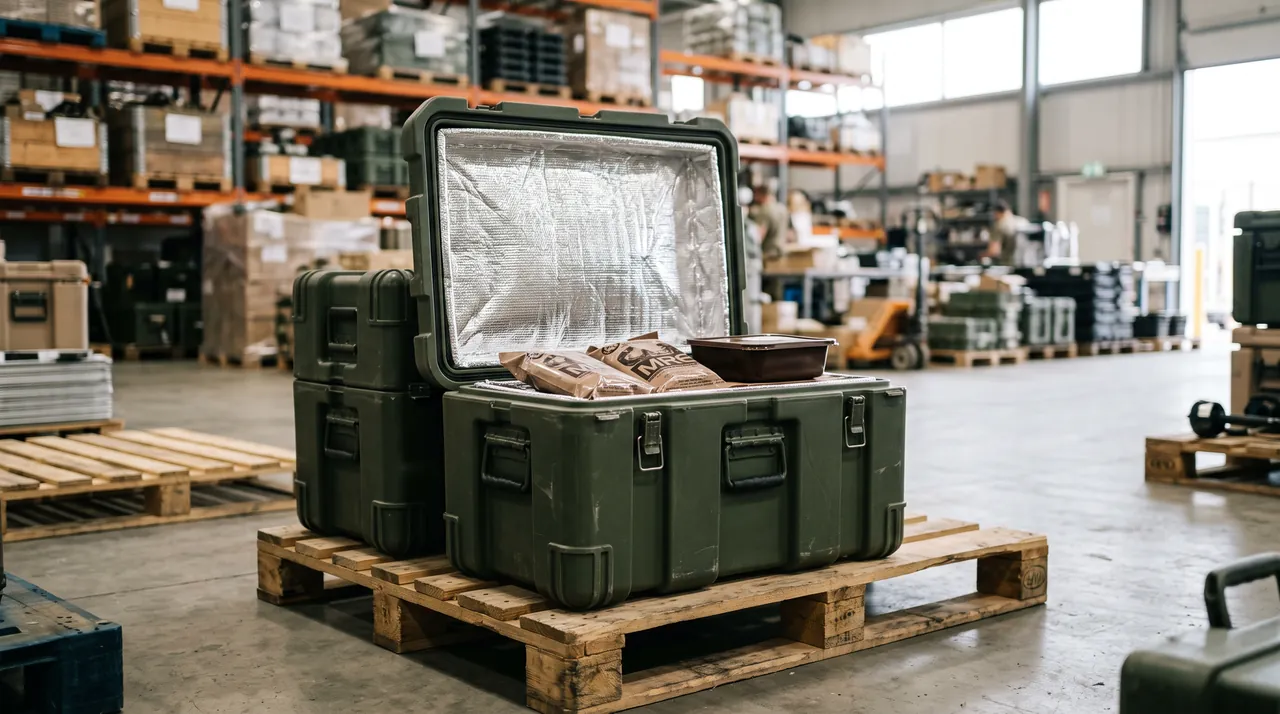
4. Integrating the Temperature Monitoring Module
Temperature monitoring is one of the core functions that distinguishes a cold chain protective case from an ordinary insulated box. The monitoring module usually consists of temperature sensors, a data recording unit, and a communication or display part, and its integration directly affects measurement representativeness and reliability. Sensor placement should choose positions that reflect the true internal temperature, avoiding both a position tight against the cold source that reads low and a position near the wall or top cavity that reads high; multiple points are usually used, with representative points or a weighted result serving as the control criterion. For larger or elongated cases, at least one measuring point should be placed on the cold source side and one at the far end to capture the temperature field difference. The data recording unit should have enough storage and sampling frequency to record continuously through the whole transport cycle without losing key periods.
Module integration must also address power, waterproofing, and vibration resistance. A refrigerated transport environment may be cold and humid, and battery capacity falls at low temperature, so a power solution suited to low temperature or thermal protection is needed. The module itself should reach the same protection level as the case, and cable exits and shell joints must be sealed so that adding monitoring does not break the case's overall sealing and insulation performance. Communication can use local storage, short-range wireless, or remote reporting where network coverage exists, depending on distance and scenario; for scenarios requiring full visibility, remote reporting clearly improves abnormal response speed. Whatever method is used, the data should be tamper-resistant with accurate timestamps, so that responsibility can be determined when a temperature anomaly occurs, as required for data integrity in Temperature-Controlled Case: Active Temperature Control and Insulation.
5. How Sealing and Airtightness Affect Insulation
Insulation depends not only on the insulating material but also heavily on the airtightness of the case. Air convection is a highly efficient form of heat transfer, and when gaps exist at the case joint, outside warm air enters directly by convection and largely cancels the low-conductivity advantage of the insulation layer. A cold chain protective case must therefore control airtightness as an independent index: the seal strip should form a continuous closed loop, the closing force from the latches should be evenly distributed along the perimeter, and no local under-compression should form an air leakage path. For cases with cable exits, drain plugs, and monitoring interfaces, these openings need separate sealing to prevent them from becoming weak points of airtightness. Airtightness can be checked by the pressure difference method or the pressure decay method, first confirming no visible leakage and then assessing whether the overall leakage rate meets the requirement.
The behavior change of sealing material at low temperature also needs attention. Low temperature hardens elastomers and slows their rebound, so if the seal strip cannot maintain enough compression at low temperature, airtightness falls. A material with good low-temperature flexibility should therefore be chosen, and a larger compression margin should be designed in to accommodate dimensional change from temperature difference. The lid and body have different coefficients of thermal expansion because they may use different materials, so the joint fit may change under temperature cycling, and structural symmetry and material matching should reduce this misalignment. Considering these factors together with the cross-section selection in Waterproof Seal Strip: Structure and Selection for Protective Cases allows the sealing system to work stably under low temperature and vibration, thereby safeguarding overall insulation.
6. Case Materials and Low-Temperature Suitability
The cold chain environment places special demands on the low-temperature performance of case materials. Plastics transition from ductile to brittle at low temperature and lose impact resistance, so a case struck during handling in a cold region may crack. Case material should therefore have a low embrittlement temperature, or toughness modification should be added to the formulation, so the material keeps sufficient impact strength at the target minimum temperature. Metal parts also need their low-temperature toughness and fastening reliability assessed, to avoid latch or hinge failure from low-temperature brittle fracture. If the lining uses foam, whether it hardens and becomes brittle at low temperature should be noted; an overly hard lining reduces cushioning and may crack under vibration, which connects with the discussion of hardness grading and low-temperature suitability in Foam Lining: Cushioning and Custom Layout for Protective Case Interiors.
Beyond low-temperature performance, weather resistance and hygiene also matter. A cold chain case may be exposed outdoors for long periods, and ultraviolet aging causes surface chalking and color change, so an anti-aging formulation or a surface coating can be used when necessary. Cases for food and pharmaceutical cold chains also require non-toxic, odorless, easy-to-clean materials, and the inner surface should be flat and gap-free to reduce space for microbial growth. Chemical resistance should also be considered, because the cleaning and disinfection process contacts various detergents that may cause the material to swell or crack over time. A comprehensive assessment of material behavior under the target temperature band, media, and cleaning method avoids performance degradation over repeated cold chain cycles.
7. Temperature Data Logging and Full-Chain Traceability
The value of temperature data lies in forming a complete temperature record that makes the transport process traceable and auditable. Temperature records for a cold chain protective case should cover the whole process from loading, transfer, and temporary storage to opening, and should include at least the timestamp, the temperature at each measuring point, and necessary status markers such as lid-opening events. Sampling frequency should be set according to heat capacity and insulation duration: too sparse may miss short temperature spikes, too dense creates data redundancy and storage pressure. For cases used in a regulated scenario, the recording unit should be able to export data in a standard format and connect to a host system so that data can be checked quickly at handover, reducing the error and falsification space of manual records.
Full-chain traceability is not only a technical matter but also a process matter. Before shipment, the monitoring module should be self-checked to confirm sufficient power, synchronized time, and enough storage; during transport, alarm thresholds and response procedures for out-of-range temperature should be set; on arrival, the temperature record and handover documents should be checked to confirm temperature stayed within the permitted range throughout. Once an excursion is found, it should be possible to locate the specific period and step to support subsequent handling. For cross-border or cross-region transport, consistency of the time basis and temperature units should also be ensured, to avoid misjudgment from conversion errors. Designing the monitoring module and the case as one whole, rather than retrofitting it afterward, is what truly achieves reliable full-chain temperature traceability.
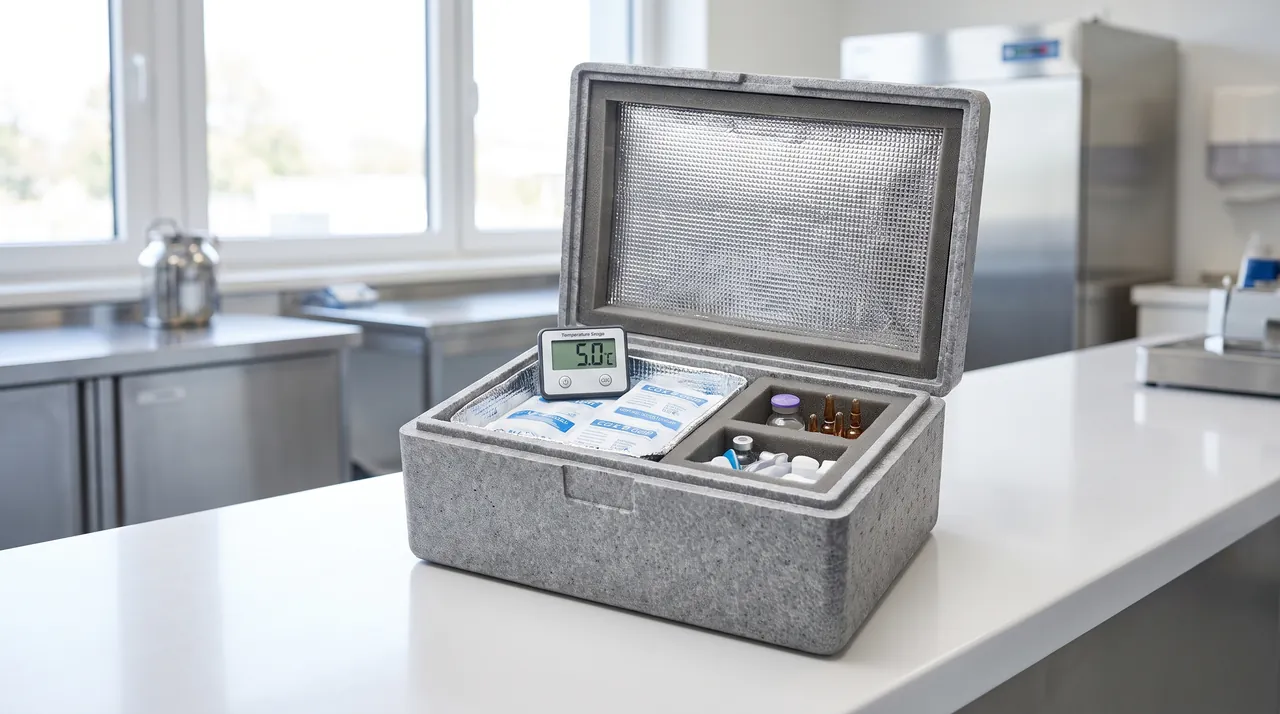
8. Opening Procedure and Preventing Cold Chain Breaks
A cold chain break often occurs at the opening and handover steps rather than during stable transport. Every opening introduces outside air, causes cooling loss and a rise in internal temperature, and the longer and more frequent the openings, the clearer the fluctuation. Opening procedures should therefore be standardized: shorten the opening time as much as possible, reduce unnecessary re-inspection, and close the lid quickly after handling and confirm the latches are engaged. For cases with internal compartments, a small-opening design can be used to open only the needed compartment, reducing disturbance to the overall temperature field. Handover should be completed quickly, avoiding leaving the case in an unsheltered open-air environment for long, especially in hot seasons when handover should preferably be done in shade or indoors.
Beyond operating rules, cold chain break risk should be reduced through structure and process. Structurally, a temperature buffer layer or a pre-cooling zone inside the case can slow the temperature change on opening, and a design that separates the cold source compartment from the storage cavity lets the cold source be replaced without affecting the main cavity temperature. In process terms, a clear handover checklist should be defined, covering temperature record verification, case appearance check, seal strip condition confirmation, and latch integrity check. For scenarios with repeated transfers, cold source replenishment points and backup cases should be planned in advance so that the case can be replaced promptly if the insulation duration proves insufficient. Breaking cold chain risk down into each operating node and controlling them one by one is more economical and effective than simply raising the case specification.
9. Stacking, Handling, and Pallet Compatibility
A cold chain protective case must be stacked and handled frequently during storage and transport, so the structural design must balance load bearing and convenience. When stacked, the bottom case bears the weight above and also the dynamic load in transport, so the top and bottom of the case should have matching locating structures and enough bearing area to prevent slipping or collapse after stacking. The locating structure can follow the thinking in Stacking Corners: Stacking Corners and Limit Structures for Protective Cases on upper-lower matching and contact pressure distribution, making stacking both stable and non-damaging. For truck loading, the case bottom should have channels for forklift or pallet truck access, or match standard pallet dimensions, reducing the drop risk of manual handling.
Handling should avoid severe impact, because impact may not only damage the case but also break the fixation of the internal cold source, causing it to shift and affect the temperature field. The case should have reasonable handle positions so that handlers can keep balance and reduce tilting and overturning. For heavier cases, load points for two-person carrying or auxiliary moving structures such as wheels and a pull handle should be designed. Transport fixation reliability is equally important; the case should be restrained in the vehicle by lashing or blocks to prevent sliding and collision during braking and turning. Structural strength and impact resistance can be assessed with the method in Vibration Test: Random Vibration Verification for Protective Cases, confirming structural integrity, lining fixation, and cold source retention under typical transport vibration and impact.
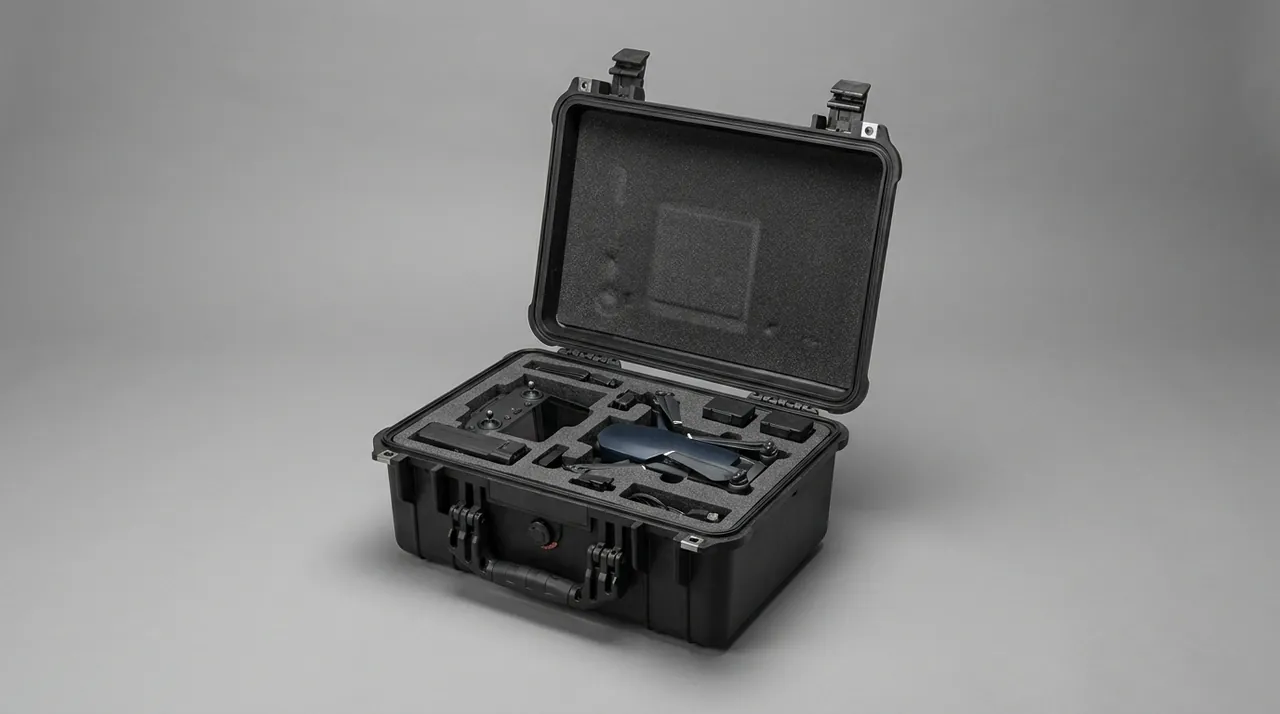
10. Cleaning, Disinfection, and Hygiene Management
Cold chain cases used for food, pharmaceuticals, and biological samples must have a cleaning and disinfection procedure. After each use, residue should be removed promptly using approved cleaners and disinfectants at the specified contact time and concentration to ensure disinfection. Cleaning should avoid corrosive agents that damage the material or seal strip, and high-pressure water should not be directed at the seal strip and monitoring interfaces, which could break the seal and electrical connections. The inner surface should be designed flat with few gaps and good drainage so that cleaning fluid and residual water drain smoothly and reduce pooling and microbial residue. Removable linings and partitions make separate cleaning easier and are an effective design for improving hygiene management efficiency.
Hygiene management is not only about cleaning but also drying and storage. After cleaning, the case should be fully dried before closing, to avoid residual moisture breeding microorganisms or corroding metal parts in a humid closed environment. Cases stored for long periods should stay ventilated or slightly open and should be checked periodically for seal strip aging or cracking caused by repeated disinfectant exposure. For the temperature monitoring module, confirm before cleaning whether its protection level allows direct washing, and remove it or cover it with a protective cap when necessary. Bringing cleaning, disinfection, drying, and storage into one operating procedure and recording each treatment is what keeps a cold chain case meeting both hygiene and insulation requirements over repeated use.
11. Test Verification and Temperature Uniformity Evaluation
The performance of a cold chain protective case needs systematic verification, in which insulation performance and temperature uniformity are two core indices. An insulation test is usually carried out in a controlled environmental chamber, loading the case with a cold source and simulated payload in the actual use manner, placing it at a set ambient temperature, and recording the temperature at each internal point over time until it exceeds the permitted upper limit, giving the actual insulation duration. The test ambient temperature should cover the high and low extremes of the target scenario, and the loading method should be as close to real as possible to avoid the over-optimistic conclusion of an empty-case test. Temperature uniformity evaluation looks at the difference between measuring points at the same moment; a large difference means some zones may exceed the permitted range first, and even a passing average temperature cannot guarantee the goods are safe.
Beyond thermal testing, structural and environmental tests cannot be omitted. A cold chain case experiences vibration and impact in transport, so the Vibration Test: Random Vibration Verification for Protective Cases should confirm structural integrity and the fixation reliability of lining and cold source, and the Drop Test: Structural Verification of Protective Cases Under Shipping Impact should assess whether sealing and insulation performance decline after a handling drop. For products with defined transport or packaging certification requirements, the procedures of the relevant standards should be met, such as the distribution simulation method defined in ISTA Test: Transport Test Procedure for Protective Cases. Test reports should fully record the test conditions, loading state, measuring point layout, and result curves, so that conclusions are repeatable and traceable and provide a basis for later selection and acceptance.
12. Typical Cold Chain Application Scenarios
Cold chain logistics protective cases are widely used in several temperature-sensitive fields. Fresh food and agricultural product transport needs to hold a relatively high temperature band, and the case should balance insulation duration and cost while being easy to stack and clean; dairy products and bakery ingredients are more sensitive to temperature fluctuation and need more precise temperature monitoring and a more uniform temperature field. Pharmaceutical and vaccine transport usually operates in a lower band and has the highest demands on temperature continuity and data traceability, so the case often needs a monitoring module with data export and out-of-range alarm functions and keeps a complete temperature record for audit. Biological sample and reagent transport requires sealing and contamination protection in addition to temperature control, and the case should be easy to disinfect and not interact with the samples.
In addition, laboratory sample turnover, inspection and quarantine sample transfer, and premium food delivery often use cold chain protective cases. What these scenarios share is that a single trip may not be long, but temperature continuity and handover discipline are strict, so the ease of use of the monitoring module and the efficiency of data handover become key. For transport between different climate zones, the case's adaptability under extreme temperature differences should be assessed, and the cold source configuration and insulation scheme adjusted when necessary. Different scenarios differ clearly in temperature band, duration, and hygiene level, so selection should compare them one by one rather than covering all needs with a single specification, avoiding either insufficient insulation or over-design.
13. Standards Basis and Compliance Notes
Selection and acceptance of a cold chain logistics protective case should rest on traceable standards, commonly including specifications for insulation performance and temperature monitoring, transport packaging test procedures, hygiene and cleaning requirements, and the technical agreement signed by both parties. The testing organization should retain complete original records, equipment calibration certificates, and test photos so that conclusions stand up to customer review or regulatory inspection. In technical conditions, purchasers should specify key indices such as the set temperature band, permitted fluctuation range, insulation duration, reference ambient temperature, monitoring sampling frequency, and data export method, and require suppliers to provide test reports for the specific loading method and environmental conditions rather than a general insulation claim, turning a vague performance description into measurable and comparable technical data.
It should be specifically stated that this article only discusses the insulated storage and transport structure and the temperature monitoring integration method of the protective case container structure in cold chain logistics scenarios, and does not involve the nature, composition, or use of any packed items; the cross-border transportation and export of related products must follow local laws, regulations, and export control requirements, and the responsible party must carry out compliance assessment separately, so the content of this article does not constitute any compliance conclusion. Passing insulation and monitoring verification only means the container structure itself has the corresponding thermal capability under specific conditions, and does not replace the user's storage plan and operating specification for the internal goods, nor does it constitute any commitment about the suitability of a specific use.
Frequently Asked Questions
Q: How is the insulation duration of a cold chain protective case generally determined? A: The insulation duration should be determined from the real transport scenario rather than a universal number set first. The usual method is to map out the longest possible time from loading to opening, including handling, transfer, temporary storage, and last-mile delivery, and then add a margin as the target. Next, combined with the actual ambient temperature and loading method, an insulation test gives the time for internal temperature to rise from its initial value to the permitted upper limit, and this is checked against the target duration. If the test shows insufficient margin, thicker insulation, an optimized cold source configuration, or fewer openings can improve it; if the margin is excessive, weight and cost may be wasted. Binding insulation duration to the transport process and using measurement rather than estimation as the basis is what makes a selection conclusion truly fit the real need. Keeping the test conditions and the assumed process time together in the selection record also makes it easy to revisit the choice when routes or delivery promises change.
Q: How should the phase change temperature of a phase change material be chosen? A: It should be chosen with the target temperature band as the core basis. A phase change material holds a nearly constant temperature during its transition, so its phase change temperature should fall within the band that needs control or sit slightly above the upper limit, letting the latent heat be released during the key stage when temperature rises and slowing the warming rate. If the phase change temperature is too low, the material completes its transition too early and loses its function, and an overly cold initial temperature may damage sensitive goods; if it is too high, the case temperature cannot be held within the permitted range. Selection should also combine ambient temperature and transport duration and be corrected by an insulation test. For a wide band or multi-stage control, materials with different phase change temperatures can be combined to form staged temperature control. Whatever the choice, the phase change temperature should be verified against the coldest and hottest expected ambient conditions, because a material that works in mild weather may fail in an extreme one.
Q: Where should the sensors of a temperature monitoring module be placed? A: Sensors should be placed where they represent the true internal temperature, not attached at random. A position tight against the cold source should be avoided because it reads clearly low, and a position near the wall or top cavity should be avoided because it is affected by the outside and reads high. For larger cases, measuring points should be placed on the cold source side and at the far end to capture the temperature field difference, and the worst point or a weighted result should serve as the control criterion. After loading, confirm the sensors are not blocked or squeezed by the goods and that cable routing does not affect sealing. The sensor layout should be fixed and recorded in the report so that test results for different batches are comparable and so that a temperature anomaly can be quickly traced to a local or overall cause. Documenting the layout also allows a replacement module to be installed in the same positions, keeping measurement comparable after service or repair.
Q: Why does a cold chain case place special emphasis on airtightness? A: Because air convection is a highly efficient heat transfer path. Once a gap exists at the case joint, outside warm air enters by convection and largely cancels the low-conductivity advantage of the insulation layer, clearly shortening the insulation duration. Poor airtightness can also cause condensation and frost, further affecting the internal environment and goods safety. A cold chain case must therefore control airtightness as an independent index: the seal strip should form a continuous closed loop, latch force should be even along the perimeter, and openings such as cable exits, drain plugs, and monitoring interfaces should be sealed separately. Airtightness can be checked by the pressure difference or pressure decay method, first confirming no obvious leakage and then assessing the overall leakage rate. Designing airtightness together with insulation and cold source is what yields stable insulation performance. When a case is repaired or a monitoring port is added, airtightness should be re-verified rather than assumed, because a small unsealed opening can undo much of the thermal design.
Q: What material problems can a cold chain protective case have at low temperature? A: The main problem is low-temperature embrittlement of plastics. Many plastics shift from ductile to brittle at low temperature and lose impact resistance, so they may crack when struck during handling; foam lining may also harden and become brittle, reducing cushioning and possibly fracturing under vibration. The low-temperature brittle fracture risk of metal parts also needs assessment, especially for moving parts such as latches and hinges. Material selection should therefore refer to the embrittlement temperature, using toughness-modified formulations or seal materials with good low-temperature flexibility when necessary, and a larger sealing compression margin should be designed in to compensate for low-temperature shrinkage. Verifying material behavior through low-temperature drop and vibration tests is a reliable way to confirm low-temperature suitability. Materials should be reviewed whenever the target minimum temperature changes, because a formulation validated for a mild winter may not hold up in a colder region. A practical check is to keep a small sample of the case material and lining in a freezer at the target minimum temperature overnight and strike it lightly, which gives an early indication of brittleness without a full laboratory program.
Q: How dense should temperature data recording be? A: Sampling frequency should be set from the heat capacity of the case and the insulation duration; there is no single standard. A case with large heat capacity and slow temperature change can sample relatively sparsely, while a case with small heat capacity and fast response should sample more densely to avoid missing short temperature spikes. The general principle is to keep at least a few sampling points within the permitted fluctuation period so the temperature trend can be reconstructed. Too high a frequency creates data redundancy and storage pressure, while too low a frequency may hide key fluctuations. Records should also include timestamps and necessary status markers such as lid-opening events. For scenarios requiring regulatory inspection, data should be exportable, the time basis consistent, and the records tamper-resistant, so the temperature record is credible. A useful rule is to test the chosen frequency against a sharp event such as an opening, and if the event cannot be clearly seen in the record, the frequency should be increased before the case is put into service.
Q: Does opening the case noticeably affect the internal temperature? A: Yes, it has a clear effect. Every opening introduces outside air, causes cooling loss and a rise in internal temperature, and the longer and more frequent the openings, the larger the fluctuation, especially in a hot summer environment. Opening procedures should therefore be standardized, shortening the opening time as much as possible, reducing unnecessary re-inspection, and closing the lid promptly after handling and confirming the latches. For internally divided cases, a small-opening design can open only the needed compartment, reducing disturbance to the overall temperature field. Handover should also be completed quickly, avoiding leaving the case in an unsheltered open-air environment for long. Bringing opening count and duration into process management is a low-cost and effective way to control temperature fluctuation. Training staff on these rules and tracking opening events through the monitoring log makes the discipline measurable and highlights where practice can still be improved. Over time, comparing the number of openings recorded in the log with the temperature curve also reveals whether the case itself is leaking heat faster than expected, which helps separate an operations problem from a design problem.
Q: What should be noted when cleaning and disinfecting a cold chain case? A: First, choose cleaners and disinfectants that do not damage the case material or seal strip, and operate at the specified concentration and contact time to ensure disinfection while avoiding corrosion. Second, avoid directing high-pressure water at the seal strip and monitoring interfaces, which could break the seal and electrical connections. The inner surface should be flat with few gaps and good drainage so cleaning fluid and residual water drain smoothly, reducing pooling and microbial residue. After cleaning, the case should be fully dried before closing, to prevent residual moisture breeding microorganisms or corroding metal parts. Removable linings and partitions make separate cleaning easier and clearly improve hygiene management efficiency. Putting cleaning, disinfection, drying, and storage into one procedure with records kept is what ensures hygiene compliance over repeated use. A periodic review of the procedure against actual practice also helps catch steps that are being skipped under time pressure. In addition, the seal strip and inner surface should be inspected for cracks or swelling after each disinfection cycle, because repeated chemical exposure is a common cause of slow degradation that only becomes visible when a case starts to lose its insulation performance.
Q: How should the insulation test of a cold chain protective case be done reliably? A: The insulation test should be carried out in a controlled environmental chamber, loading the case with a cold source and simulated payload in the actual use manner, placing it at a set ambient temperature, and recording internal temperature at multiple points over time until it exceeds the permitted upper limit, giving the actual insulation duration. The key is staying close to reality: the ambient temperature should cover the high and low extremes of the target scenario, and the loading method should be near the actual one to avoid the over-optimistic result of an empty-case test. Temperature uniformity should also be evaluated, looking at the difference between points at the same moment, because a large difference means some zones may exceed the limit first. The test report should record the test conditions, loading state, measuring point layout, and result curves, making the conclusion repeatable and traceable and providing a basis for selection and acceptance.