

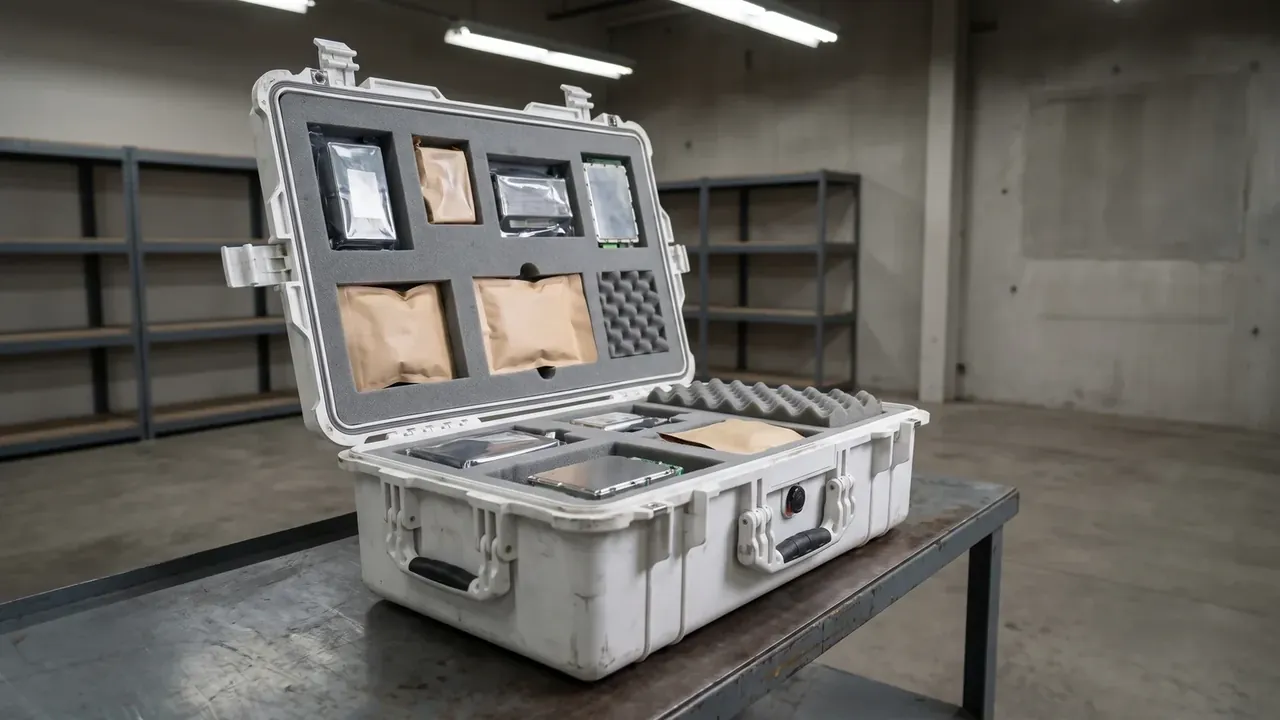
Quick answer: A custom case specification is a size chain from cavity to outline, wall thickness graded by zone, and hinges and latches written as forces rather than shapes.
Table of contents
- The Custom Case Size Chain from Cavity to Outline
- Wall Thickness Grades and Ribs
- Hinge and Latch Forces
- Stacking Load and Base Structure
- Mould, Tolerances and Inspection
- FAQ
1. The Custom Case Size Chain from Cavity to Outline
A drawing with one outside dimension cannot be inspected. A usable custom case specification is a four-level chain, each level with its own tolerance.
| Level | Definition | Example | Tolerance |
|---|---|---|---|
| Inner cavity | Floor to lid face | 760 × 560 × 380 mm | ±0.8 mm |
| Clear cavity | Minus ribs and posts | 740 × 540 × 350 mm | ±1.0 mm |
| Outline | Latches and feet included | 800 × 600 × 420 mm | ±0.5 mm |
| Shipping unit | Plus pallet clearance | 820 × 620 × 445 mm | — |
Cavity to outline is 20 mm per side: 5 mm of wall, 6 mm of rib zone, 9 mm of radius and lid fit. Itemise all three, since each moves with a different change.
Pallet modulus closes the outline: 600 × 400 fits four units on a 1200 × 1000 pallet at 96 percent, 620 × 420 fits two at 52 percent.
2. Wall Thickness Grades and Ribs
One body carries five thicknesses, and each is specified on its own: sides, base, lid, corner post and rib crest.
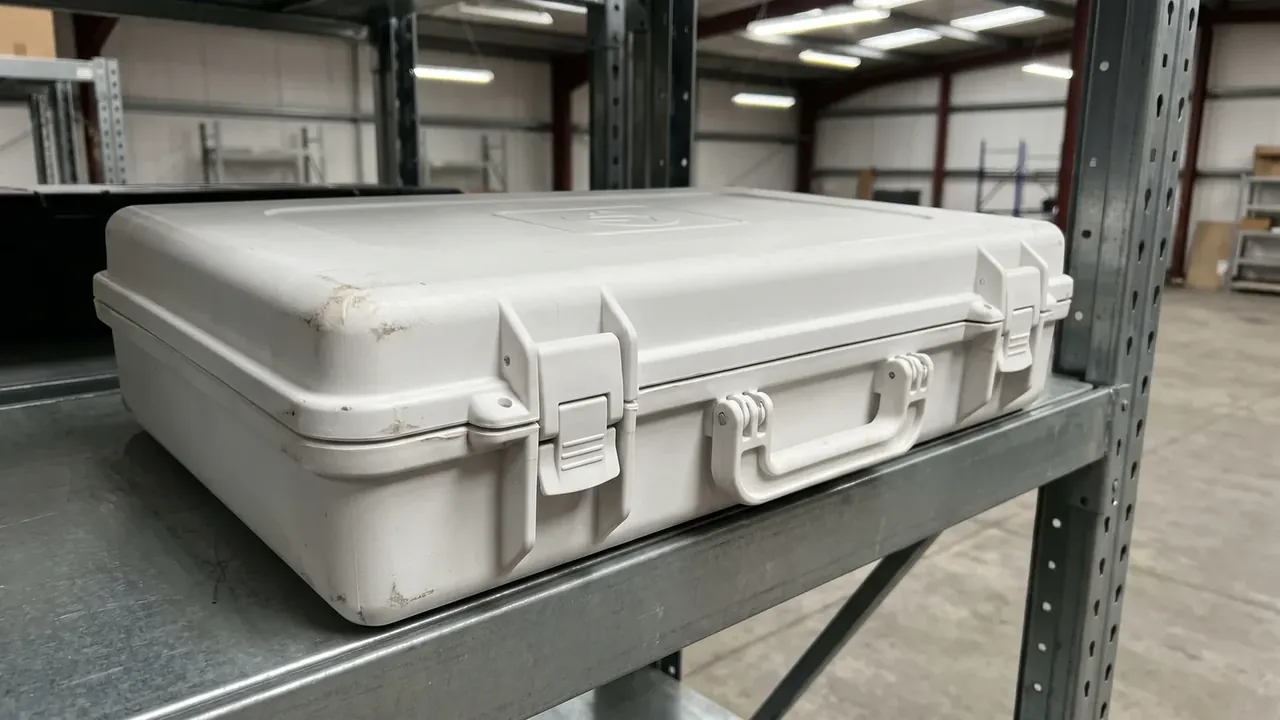
| Zone | Thickness | Job | If too thin |
|---|---|---|---|
| Main wall | 5.0 mm | Side stiffness | Bulging walls |
| Base | 6.0 mm | Load, abrasion | Base sag |
| Lid | 5.5 mm | Dent resistance | Seal line lifts |
| Corner post | 8.0 mm equivalent | Drop impact | Corner cracking |
| Rib crest | 2.0 mm | Bending | Snapped ribs |
Thickness cannot simply be added, because uneven walls shrink unevenly. Past 3 to 1, the thick zone cools late and the boundary tears into sink marks. Ribs do the work instead: 12 mm tall, 3.5 mm at the root, 60 mm apart, lifting bending inertia 2.6 times for 8 percent more weight.
3. Hinge and Latch Forces
Hinges and latches are the only moving parts, and the easiest line to get wrong: two stainless hinges leave the load requirement to the supplier.
A 2.4 kg lid runs on a 6 mm pin, 180 N allowable per hinge, no sag past 1.0 mm after 8,000 cycles. Latches hold 400 N and open at 60 to 80 N on an M5 screw at 2.5 N·m, surviving a 1.2 m drop onto six faces.
The 400 N is not arbitrary: dragged at an angle with 55 kg inside, a latch peaks near 0.7 times the full weight, about 190 N each. Position matters more, since a mid-span latch lets the lid edge lift and the seal open.
4. Stacking Load and Base Structure
Stacking is arithmetic: bottom static load divided by full weight, less an allowance. A 100 L custom case weighs 9.5 kg empty and 55 kg loaded, stands 300 kg static, so 5.4 layers, marked as four.

The allowance covers uneven floors and creep. Only corner posts and the base frame carry it: an 18 mm frame closed on four sides, with 3 mm locating grooves at each lid corner. Outside that zone the lid dishes and the seal lifts.
5. Mould, Tolerances and Inspection
Tolerances belong per feature: ±0.5 mm on the outline, ±0.8 mm on the cavity, ±1.0 mm on depth, and 1.0 to 1.5 mm on the lid gap.
Two mould numbers decide whether those hold: polypropylene shrinks 1.4 to 1.8 percent, so an 800 mm edge takes 12.8 mm, and the 0.48 m² lid needs 1,440 tonnes on a 1,600 tonne press.
Inspection runs in two levels: a full CMM layout on the first-off sample, then three units per 500 for outline, depth and gap.
Conclusion
A custom case specification is four sets of numbers locking together: the size chain decides whether it ships, the wall grades whether it moulds straight, the hinges how long the moving parts last, and the tolerances whether any of it can be judged. A drawing worth signing puts a tolerance, a test method and a failure criterion behind every figure, which separates a custom case from a brochure.
This article discusses only the container (case body) side of specifications and design intent, and does not cover any handling, loading or use of the contents.
Related Reading
- What to confirm on a custom case trial moulding
- Stackable case specifications and stacking data
- How custom foam inserts are specified
- Press tonnage against case projection area
Related Products
- 8 Series — Gun Cases; Military Equipment Cases; Camera Equipment Cases; Drone Cases; Watch Cases; Knife Cases; First Aid Cases; Electronics Equipment Cases
- WL8-2812 PP Gun Case — model WL8-2812
- All protective cases and toolboxes: 7 series, 158 models