

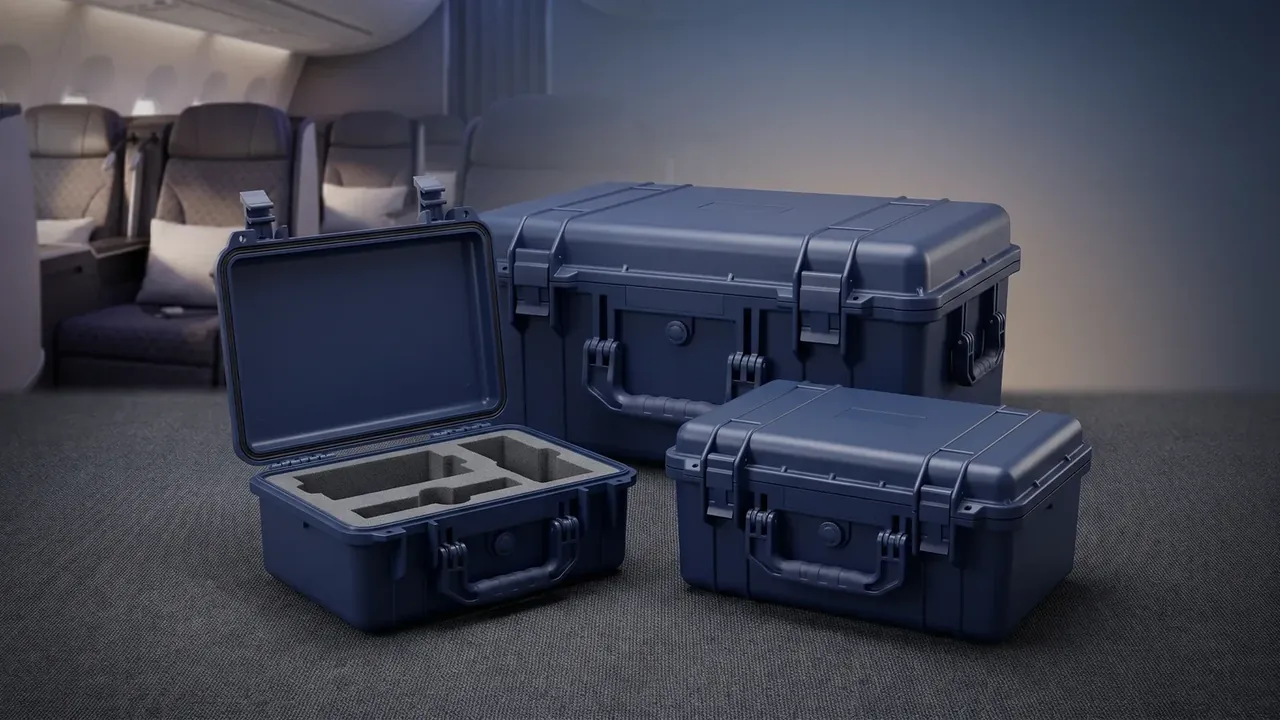
Quick answer: Custom Industrial Case Purchasing Process moves through seven signed gates, from a 3-day drawing freeze to a 200-piece pilot run.
This article covers the case side only: dimensions, tooling gates and insert fit, not the packing of tools inside.
Table of contents
- Needs confirmation and drawing freeze
- Samples and how to fix the approval sample
- Tooling first, then first-article approval
- What the pilot run should reveal
- Scheduling volume and delivery gates
- FAQ
1. Needs confirmation and drawing freeze
What sinks a custom order is not slowness but revisions made mid-run. One cavity change scraps the mold, the foam die and every sheet cut to the old profile, and the loss lands on the 25-day volume window. The first move in the custom industrial case purchasing process is therefore a requirement list someone can sign, not a price request.
Six items belong on it: internal length, width and height, loaded weight, ingress rating, insert type, quantity and address. Internal size comes from the largest outline plus an allowance wide enough for a hand to reach in, with foam height counted into the internal space. A missing line sends the custom industrial case purchasing process back to the start at every gate.
A 3-day drawing freeze means three views, cavity corner radii, latch and hinge positions and gasket groove section are locked, tolerances marked, the sheet signed before sampling. Each later revision needs a fresh drawing, a fresh die and a version number, or sample and volume parts stop matching.
An ingress rating only works when it is split into dust and water clauses; a vague claim about sealing cannot be tested at sample stage. The insert needs structural terms too: layer count, cutout depth, finger pulls.
| Gate | Deliverable | Release evidence |
|---|---|---|
| Needs confirmation | Requirement list and internal size sheet | Buyer and user co-sign |
| Drawing freeze | Three views with tolerances | Drawing revision number |
| Sampling | Approval sample pair | Signed sample tag |
| First-article approval | First-article inspection card | First-article report |
| Pilot run | 200-piece pilot batch | Pilot summary |
| Volume production | Batch shipping list | Packing list |
| Incoming check | 1 inspection record | Acceptance verdict |
The seven gates release in sequence; no station starts while its evidence is unsigned.
2. Samples and how to fix the approval sample
Sampling takes 10 days and yields an approval sample pair, one for the buyer and one for the plant, both from the same mold and batch. That pair is the reference volume parts will be judged against, so three checks come before a signature: measure the internal size against the drawing, load the real equipment once, and cycle the latches and hinges.
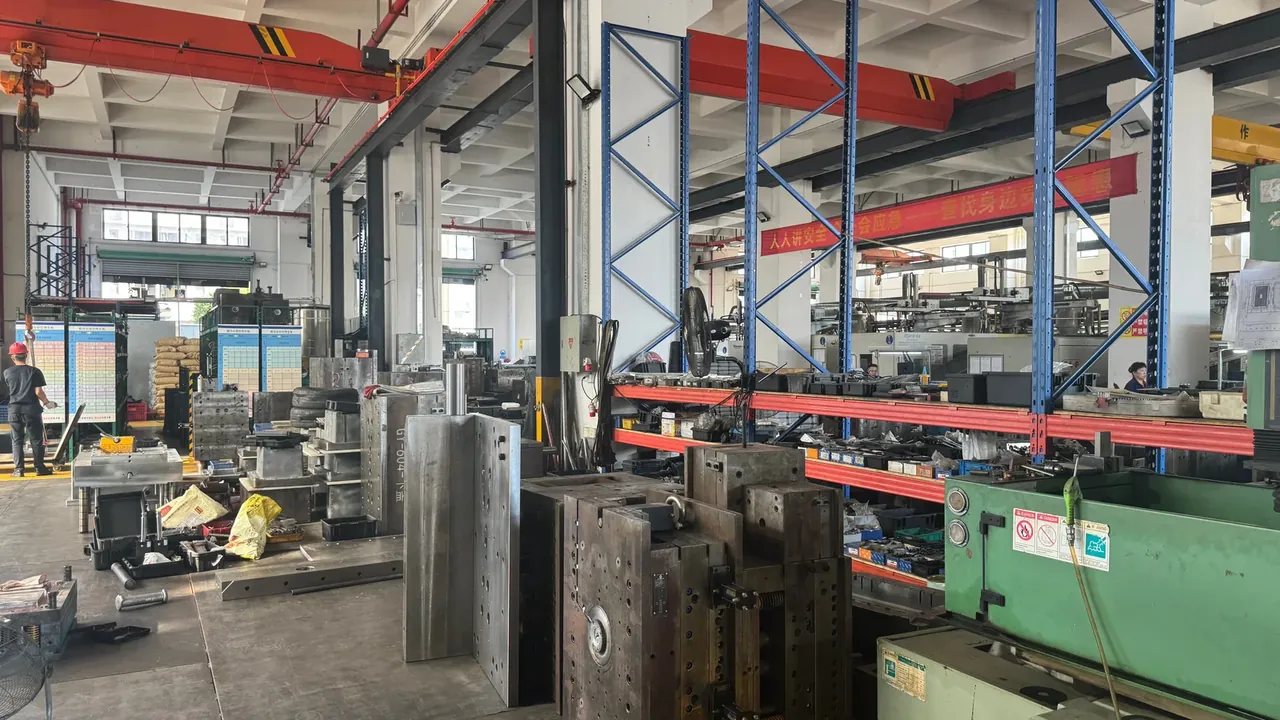
The sample tag carries a sample number, a drawing revision and a date. Revision discipline is the step most often skipped in the custom industrial case purchasing process: samples built to revision A, volume to revision B, and a shift in latch position surfaces only on arrival.
Two routes exist. When the shell stays, only the foam die is new and most of the 10 days go into trial cuts; when cavity and outline both change, a 3D print or prototype is needed, which stretches schedule and budget. The first suits orders of 200 pieces or more.
The approval sample settles the insert. Within the 25–45 kg/m³ EVA range, heavy parts take the denser grade and instruments the lighter one with a divider layer. Compression set lands between 10% and 20% when tested at 25% compression and 23 ℃ for 22 h, which keeps a cutout from collapsing after repeated handling.
3. Tooling first, then first-article approval
In the custom industrial case purchasing process, tooling is finished before a first article exists, and approval takes 5 days; nothing is produced until it is signed. The first article is the first full-dimensional piece and the baseline for every later batch.
Four things get checked: wall thickness, latch retention, gasket groove section and hinge. Thickness is measured against nominal within ±10% to ±20%, latch retention sits in the 200–400 N band, and the hinge runs 20,000 cycles and must come out neither loose nor noisy. Dimensions are verified against the drawing, with cavity size and latch centre distance carrying the most weight.
The custom industrial case purchasing process treats the approval as a lock. Projects that skip it meet every problem at once during the pilot, when stopping the line costs the labour sunk in the work in progress.
4. What the pilot run should reveal
A pilot of 200 pieces stretches samples to production conditions for the first time and should answer three questions: dimensional stability, assembly consistency, packing and stacking. That is the real value of the fourth gate in the custom industrial case purchasing process.
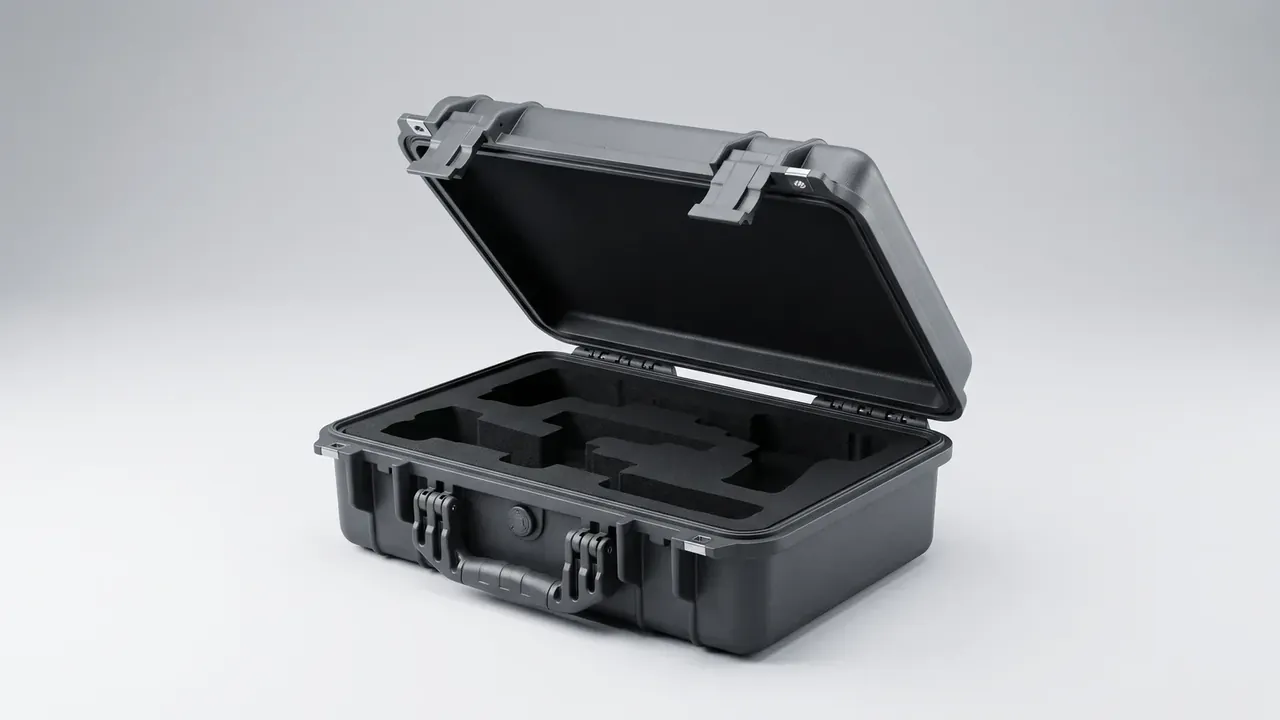
Stability is a matter of shrinkage. Rotomolded PE runs 3.0% to 3.5%, injection-moulded PP 1.0% to 2.5%, ABS 0.4% to 0.7%, and tool compensation follows the material rather than habit. Measuring one cavity across the pilot pieces shows the spread, and a wide spread points at cooling or melt temperature first.
| Check | Sample | Record |
|---|---|---|
| Cavity dimensions | Per batch | Three-point measuring sheet |
| Latch feel | All pieces | Open-close log card |
| Insert fit | Per group | Loaded-part photos |
| Carton stacking | One pallet | Pallet photo |
Assembly consistency lives in the fit between insert and shell: foam cut wide rattles, foam cut tight will not seat, so the pilot compares pieces in groups and freezes die compensation.
Packing is decided during the pilot rather than left to volume. How many pieces fit a 1200×800 mm Euro pallet, and how many pallets fit the roughly 12.03×2.35×2.39 m internal space of a 40HQ, both go into the pilot summary, where the logistics side of the custom industrial case purchasing process stops drifting.
5. Scheduling volume and delivery gates
Volume runs 25 days, shipping in weekly batches. Three items define the delivery gate of the custom industrial case purchasing process: first shipment date, quantity per batch, tolerance on the last batch.
Changes during volume are where control is easiest to lose. Structural changes after the drawing freeze are held to 2 or fewer, each carried by a change note listing the affected mold, foam die and work-in-progress count. A mold change without a signed note converts work in progress into scrap.
Purchasing rule: three or more structural changes after the drawing freeze, or production started before first-article approval, and the process is judged out of control.
Incoming inspection is done once, with the record set against the first-article card item by item. Trouble found on arrival usually showed up earlier; it was simply not written down.
Related Reading
- How to negotiate MOQ on a custom case
- What the tooling cost is made of
- Hard case or carton for e-commerce shipping
- IP clauses in a custom case contract
JUNZHIJIA
Related Products
- 8 Series — Gun Cases; Military Equipment Cases; Camera Equipment Cases; Drone Cases; Watch Cases; Knife Cases; First Aid Cases; Electronics Equipment Cases
- WL8-2812 PP Gun Case — model WL8-2812
- All protective cases and toolboxes: 7 series, 158 models