

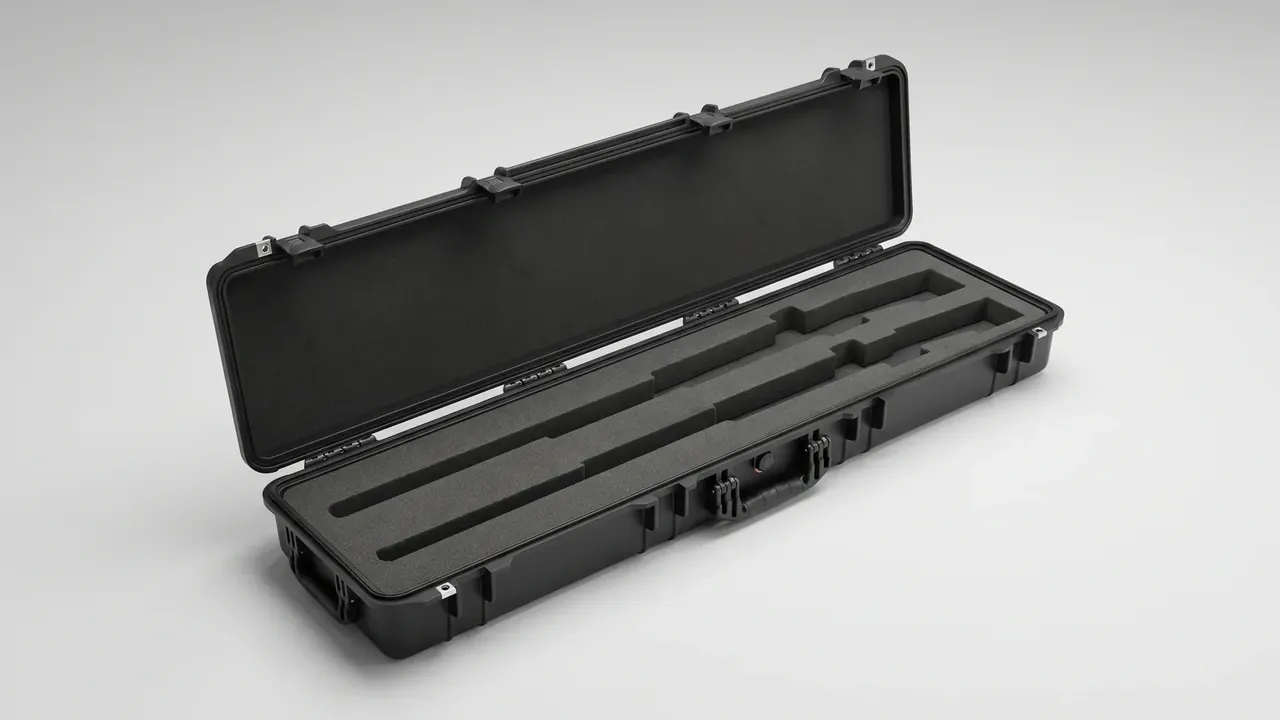
Quick answer: A deployable hard case is a rigid case that keeps working after arrival. It protects the load in transit, then the lid opens fully and holds position so a face of the case serves as a bench. Three conditions define it: a one-piece rigid shell, a lid that opens completely and stays put, and a flat area that carries load. Miss one and it is only a transport box.
Table of contents
- Definition: what counts as a deployable hard case
- Three structural differences from a shipping case
- Opening up on site: lid angle, support and work surface
- Mobility: handles, straps and stacked handling
- When the format earns its cost
- FAQ
1. Definition: what counts as a deployable hard case
A deployable hard case carries its load to a site and stays in service. Its lid passes the point where a hand can reach in and rests flat, so the lid lining or the case mouth works as a bench. The line against a shipping case is not impact rating but whether the case still works an hour later.
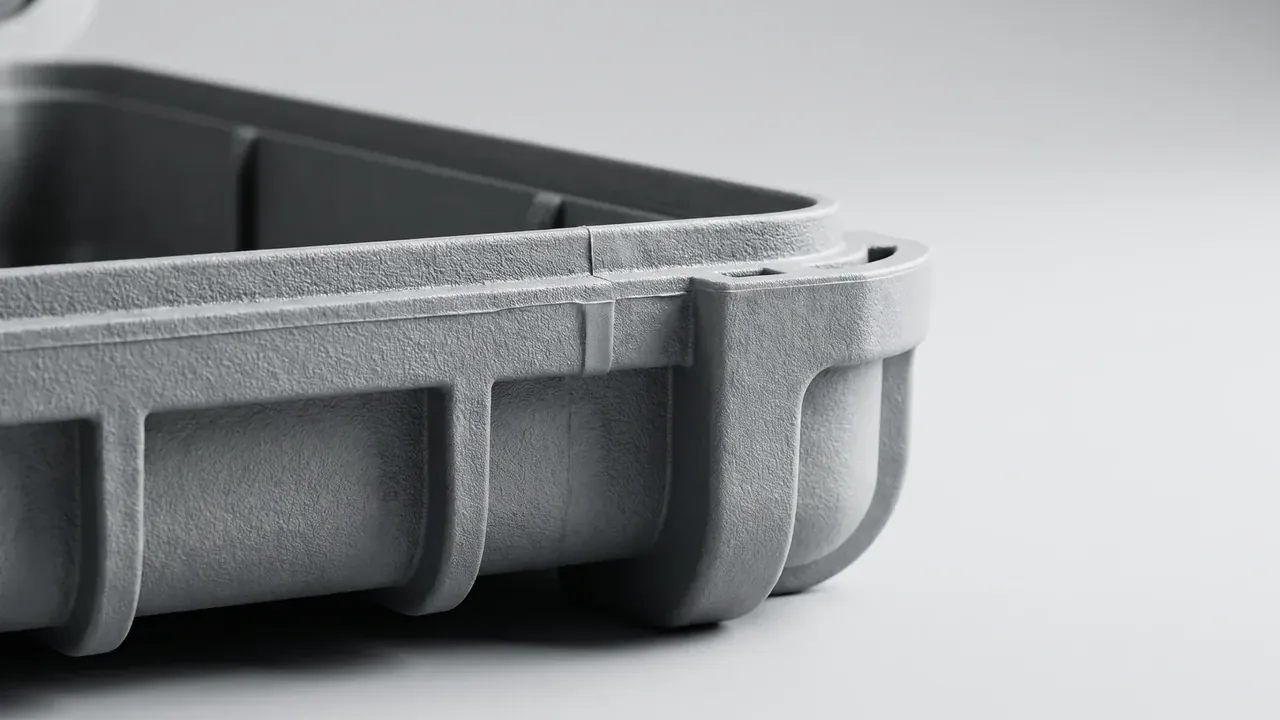
The corner shows where rigidity comes from: vertical ribs run into a thickened bumper, so a drop lands there and spreads into the wall.
Four features must coexist: a shell that holds shape when empty; 150–180° of lid travel or a detachable lid; a hold-open device; and a flat face that takes local pressure. A lid that merely opens is a hatch; a one-way pack has no second life; a base used as a tray has lost its work surface.
2. Three structural differences from a shipping case
Side by side, the differences sit in the lid, the mouth and the liner; wall thickness rarely decides.
| Part | Shipping case | Deployable hard case |
|---|---|---|
| Lid travel | 90–110° | 150–180°, or detachable |
| Hinge | Opening only | Lid weight and hold-open torque |
| Mouth | Single edge, gasket | Double edge, seat plus bench lip |
| Liner | Cushion fill | Locating structure, removable |
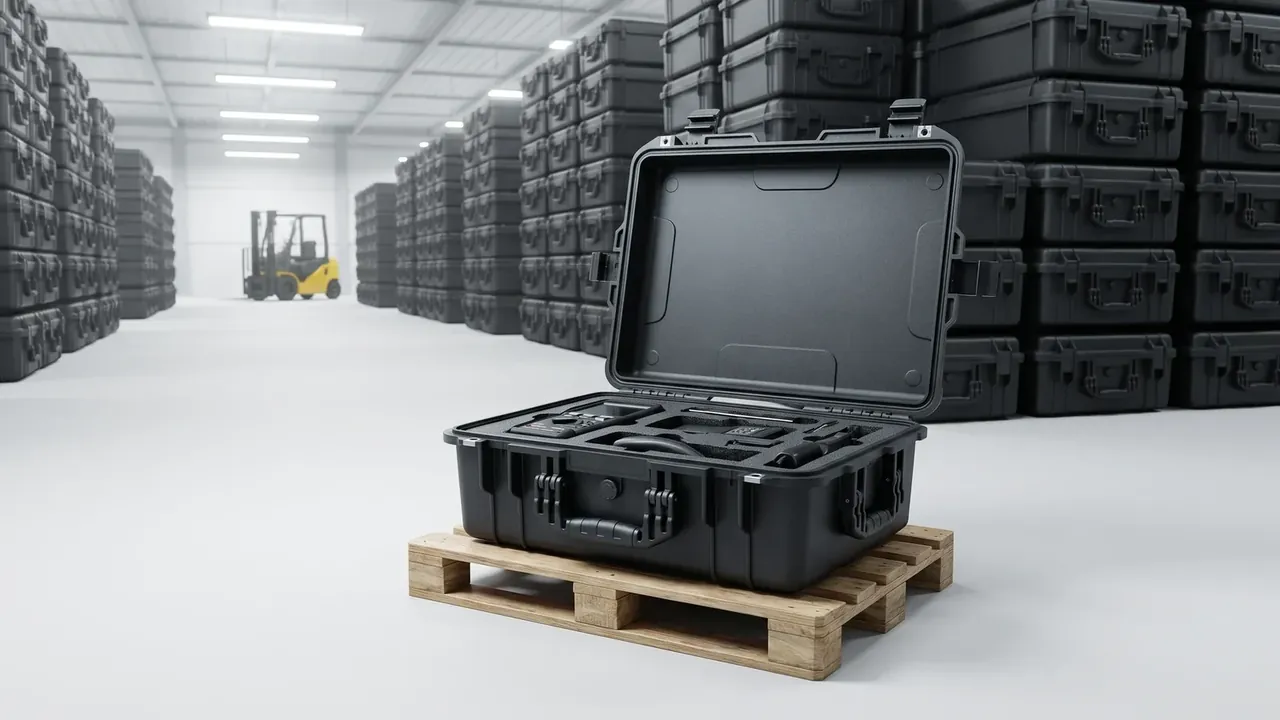
The liner matters most. In the photo the foam is cut to each item's outline, so the walls grip it and the lid foam closes onto the top face. Loose fill must be repacked at every opening.
The double edge separates the sealing land from the lip a hand rests on; hinge spec follows lid weight, not total weight.
3. Opening up on site: lid angle, support and work surface
Deployment comes down to how far the lid travels, what holds it, and which face becomes the bench.
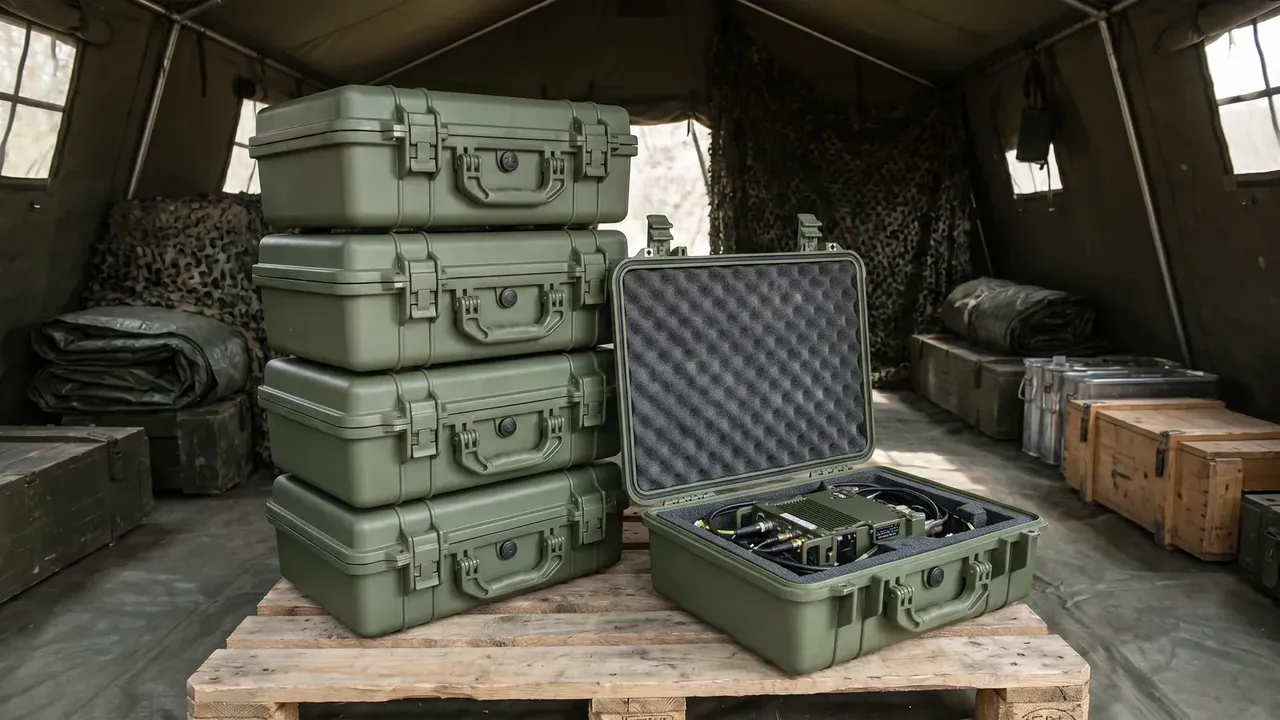
Four cases stack on a pallet while a fifth stands open, egg-crate foam up: store and workstation at once.
- 90° — access only; the lid stands behind the base;
- 120° — the mouth is clear, but the lid face cannot take load;
- 180° — a bench near the size of the base, with clearance behind equal to the lid length.
Friction loosens with age. A mechanical stay holds firmly but is a loaded wear part, so confirm it is replaceable; detachable lids avoid this and add a step in wind.
The bench face must stay flat and take point load without crushing the foam beneath. Seated and standing work differ by roughly 200 mm.
4. Mobility: handles, straps and stacked handling
A deployable hard case outweighs a shipping case of equal volume. The question is whether one person can move it daily.
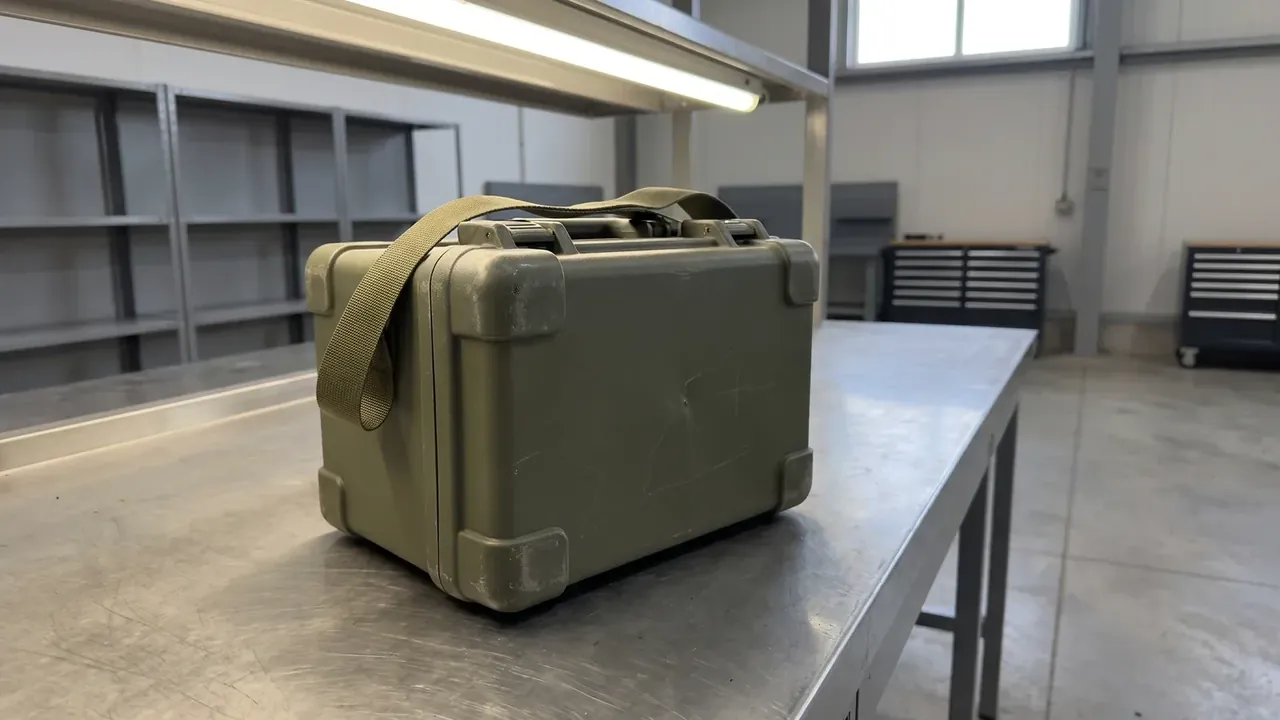
A webbing strap lies across the lid, clipped to side anchors: a moulded handle covers ten or fifteen metres, beyond that a strap or wheels. The bumpers are worn — abrasion goes into a bolted part, not the shell.
Moulded handles form with the shell: strongest, hardest on the hand, good to about 15 kg. Folding handles sit flush but collect grit at the pivot. Wheels take flat runs and leave the base uneven.
Stacking and handling fight each other: a flat top stacks high, and handles, wheels and latches interrupt it.
5. When the format earns its cost
Start from use, not price. Three of these four conditions should hold before the premium makes sense.
- No bench on site, and the work needs a stable load-bearing face.
- A deployment runs past half a day with ten or more openings.
- The cases ship twice a year or more, so the pack is reused.
- Items sit in fixed positions, and mixed packing costs search time.
One-way shipment, a permanent bench, or a two-person lift every time points to logistics rather than case design.
Conclusion
Ask three questions in order. Does the site need a load-bearing face? Can the lid open fully and hold within clearance? Only then look at handles, wheels and stacking. The first answer sets the format, the second the structure, the third only comfort. Reverse them and you get a deployable hard case that carries well but will not open on site.
The scope here is the container (case body) alone: its dimensions, structure and the wording of its grade. Nothing about how items inside are handled, loaded or used falls within it.
Related Reading
Related Products
- 8 Series — Gun Cases; Military Equipment Cases; Camera Equipment Cases; Drone Cases; Watch Cases; Knife Cases; First Aid Cases; Electronics Equipment Cases
- WL8-2812 PP Gun Case — model WL8-2812
- All protective cases and toolboxes: 7 series, 158 models