

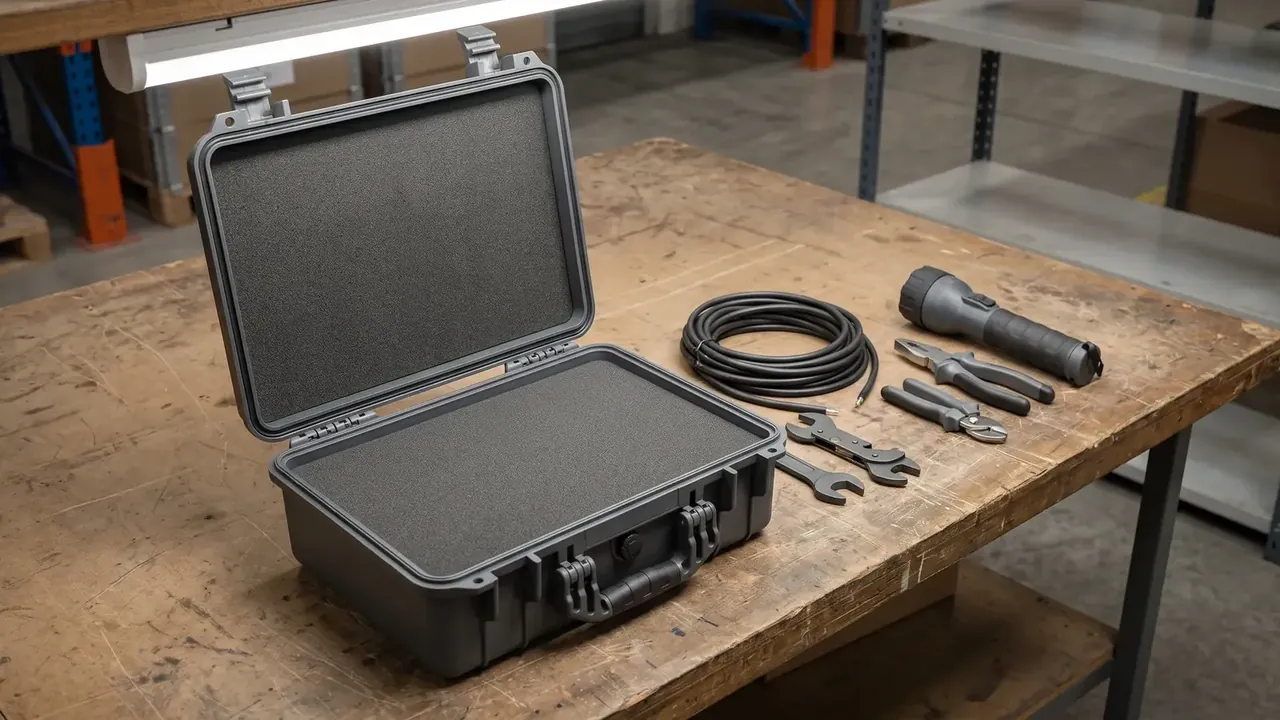
Quick answer: Split the quote into shell, liner, hardware, assembly, packing and tooling before comparing prices. MOQ follows tooling cost, so the economic batch lands between 500 and 800 units, and lead time runs 58 working days.
Table of contents
- What Makes Up the Quote for a Deployable Hard Case
- MOQ and Where Tooling Cost Amortises
- Splitting Lead Time into Five Stages
- Fields an RFQ Needs and Sample-to-Production Liability
- Commercial Terms and How to Negotiate Changes
- FAQ
1. What Makes Up the Quote for a Deployable Hard Case
A unit price cannot be compared: two suppliers both quote 300 yuan, one at a 4.0 mm wall and one at 3.2 mm. A Deployable Hard Case quote has six blocks: five per unit or batch, one one-off.
| Block | Priced by | Share | Note |
|---|---|---|---|
| Shell and lid | Unit, resin plus moulding | 55% | Scales with wall and weight |
| Liner | Unit, material plus cutting | 18% | Density and cut method move 40 yuan |
| Hardware | Set | 12% | Stainless latches add 25 yuan |
| Assembly | Unit | 8% | Sealing, hinges, labelling |
| Tooling | One-off | Separate | 32,000 to 45,000 yuan |
The shell dominates: 4.0 mm to 5.0 mm adds 1.6 kg of resin, which at 12 yuan a kilogram adds 19 yuan. EVA at 45 and 60 kg/m³ differs by 40 yuan a case, so demand one configuration per quote.
2. MOQ and Where Tooling Cost Amortises
Minimum order quantity is set by the tool, not capacity. A rotomould or injection tool costs 32,000 to 45,000 yuan, call it 38,000, with a life near 50,000 shots and 300 cases a day from one machine.
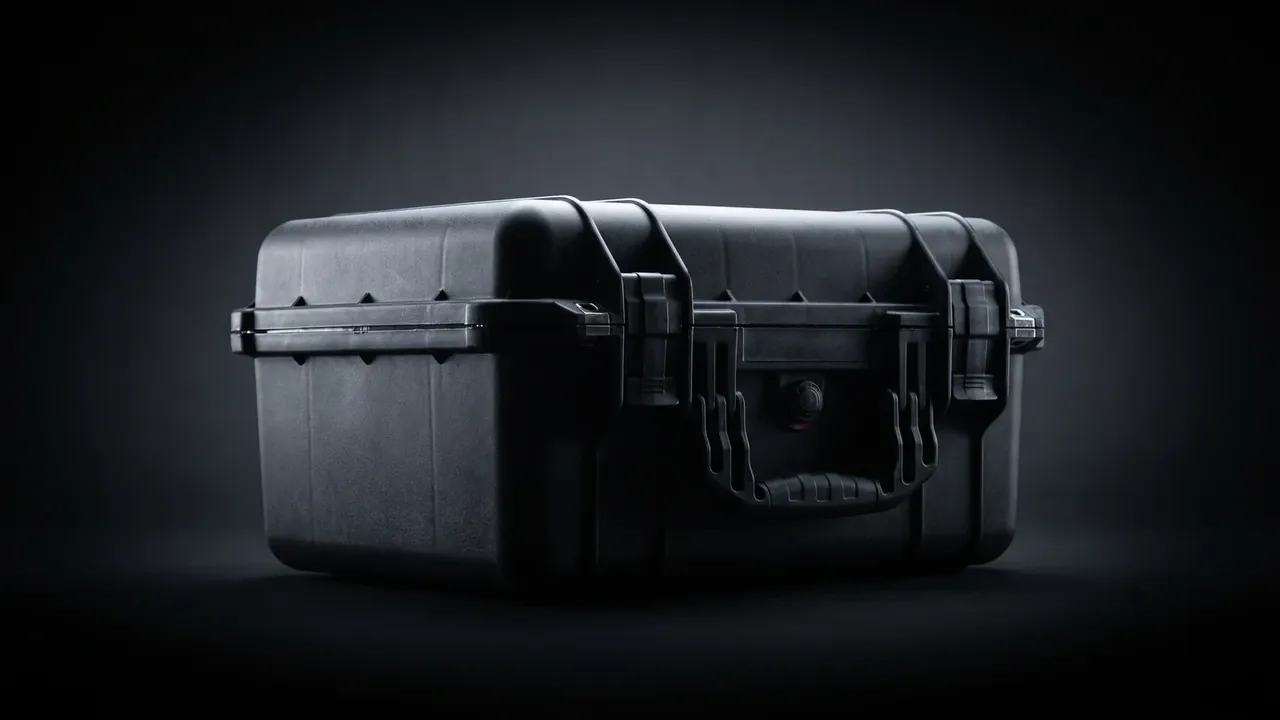
Tooling is paid in full, leaving it with the buyer, or amortised at 38,000 divided by the order.
| Quantity | Shell price | Tooling share | Landed price |
|---|---|---|---|
| 100 | 320 yuan | 380 yuan | 700 yuan |
| 300 | 290 yuan | 127 yuan | 417 yuan |
| 500 | 275 yuan | 76 yuan | 351 yuan |
| 1000 | 265 yuan | 38 yuan | 303 yuan |
Past 500 units each extra hundred saves a dozen yuan, while stock and a 6,000 yuan liner tool climb, so the batch lands between 500 and 800. Below 300, buying the tool and holding 290 usually beats amortising.
3. Splitting Lead Time into Five Stages
Break a Deployable Hard Case order into tooling at 18 days, trial shots at 7, production at 25, testing at 5 and packing at 3, totalling 58 working days, the first two serial.
The critical path sits in the trial shot: a first shot needs 24 hours of cooling before dimensions mean anything, and a shrinkage drift past 0.4 percent costs another 5 to 7 days for a new insert. Salt spray goes out for 5 working days and custom cartons need 5 days, ordered alongside the tool.
4. Fields an RFQ Needs and Sample-to-Production Liability
An RFQ with gaps invites assumptions that become surcharges. A Deployable Hard Case enquiry needs fourteen fields, from envelope and wall thickness to latch count, liner density, colour reference, packing, quantity, inspection standard and trade terms.
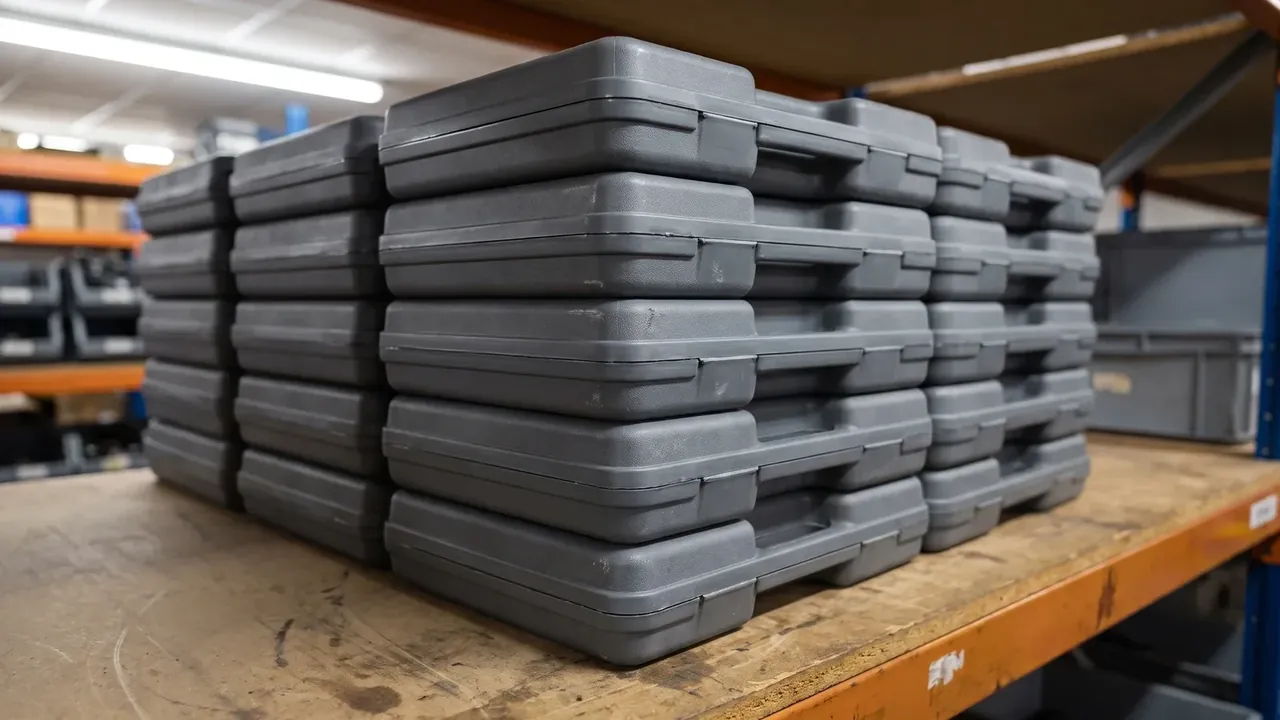
Samples and production parts differ, so fix liability early. Prototypes are CNC cut or printed with even walls, so their drop behaviour does not represent a moulded batch. The convention is a fee at three times the unit price, twelve days to make, credited on order. Write the gaps as three lines: colour shift 1.0 against 1.5, wall tolerance 0.3 mm against 0.5 mm, water jet against die cutting. The sealed sample governs for twelve months.
5. Commercial Terms and How to Negotiate Changes
Payment terms: 30 percent deposit, 60 percent before shipment against an inspection report, 10 percent within 30 days of acceptance, tooling with the deposit.
Change clauses need a formula. Quantity within 20 percent keeps the unit price, beyond that the tooling share is recalculated; structural work bills at 350 yuan per person-day; delivery pulled forward 10 days carries about 5 percent expediting. Add resin indexation: an 8 percent annual PP swing is ordinary.
Conclusion
Procurement of a Deployable Hard Case is a comparison of three tables: cost sheet, amortisation curve, lead-time chart. Ask for the tables, and a Deployable Hard Case purchase is argued on facts.
This article discusses only the container (case body) side of specifications and design intent, and does not cover any handling, loading or use of the contents.
Related Reading
- What defines a deployable hard case
- Choosing a case for mobility and stacking
- How to read a quotation reply
- What to confirm during trial moulding
Related Products
- 8 Series — Gun Cases; Military Equipment Cases; Camera Equipment Cases; Drone Cases; Watch Cases; Knife Cases; First Aid Cases; Electronics Equipment Cases
- WL8-2812 PP Gun Case — model WL8-2812
- All protective cases and toolboxes: 7 series, 158 models