

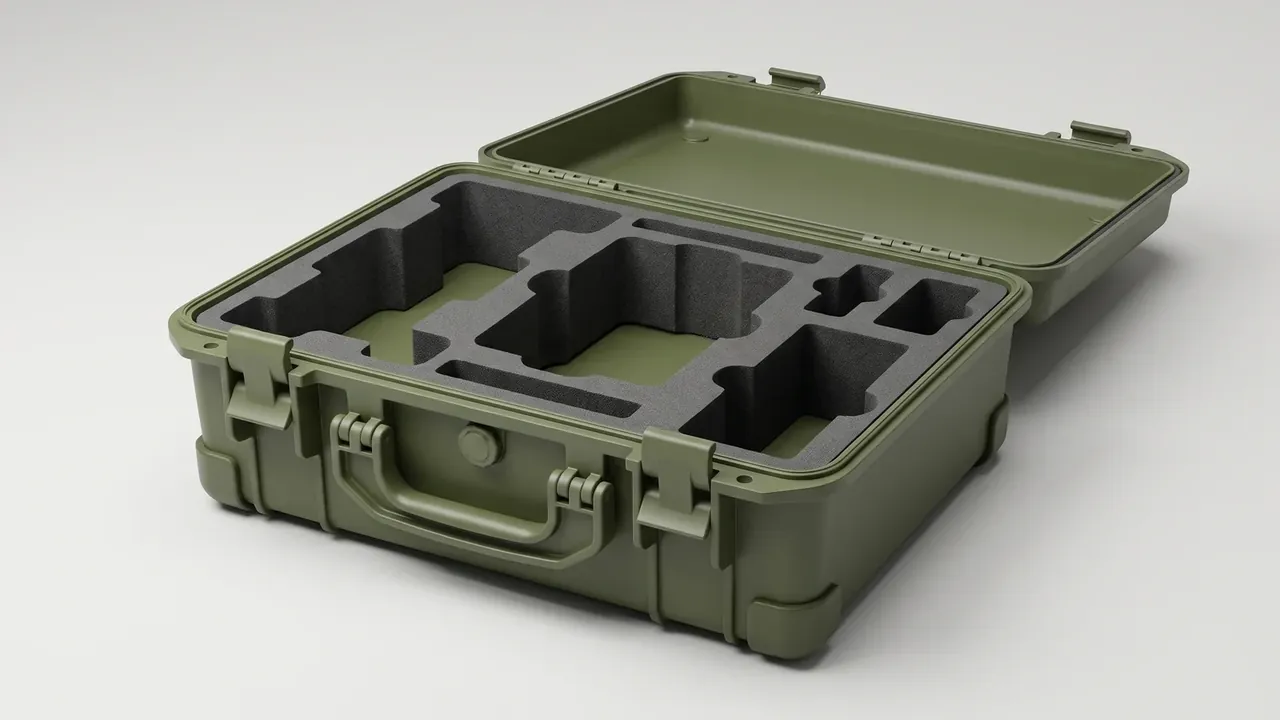
Quick answer: Impact, not ingress alone, decides a drone protective case. Ask for drop height with the airframe loaded, foam travel left after compression, gasket squeeze, latch preload and internal humidity. A datasheet missing any of the five has not specified the case.
Table of contents
- How to Read Impact Ratings on a Drone Protective Case
- Matching Foam Travel to Airframe Weight
- Latches and Hinges as Wear Parts
- Condensation Control Inside a Sealed Case
- Incoming Inspection and Batch Consistency
- FAQ
1. How to Read Impact Ratings on a Drone Protective Case
Buyers treat IP67 as the whole specification, but it answers dust and water only. A quadcopter dropped from a pickup bed onto gravel can stay dry inside and still land with a misaligned gimbal, because the shock entered through the frame, not the seal.
Read a drone protective case on two lines. Sealing covers gasket geometry, latch preload and salt spray hours; impact covers drop height, orientation and the energy the liner absorbs.
| Criterion | Metric to request | Typical claim | Meaning for the airframe |
|---|---|---|---|
| Impact | Drop height and faces | 1.2 m, six faces | Tested with the aircraft loaded |
| Sealing | Gasket compression | 25% to 30% | Tight after many closures |
| Corrosion | Salt spray hours | 96 hours | Coastal work without rust |
| Temperature | Thermal cycling | -20 to 60 C | Survives a hot trunk |
2. Matching Foam Travel to Airframe Weight
Foam travel is not foam thickness. It is the distance the airframe can move while the impact is absorbed. In a 25 mm EVA liner a hard landing compresses roughly 8 mm, leaving 17 mm of recovery margin. Give the same aircraft a 15 mm liner and it bottoms out against the wall of a drone protective case, passing the shock through almost unchanged.
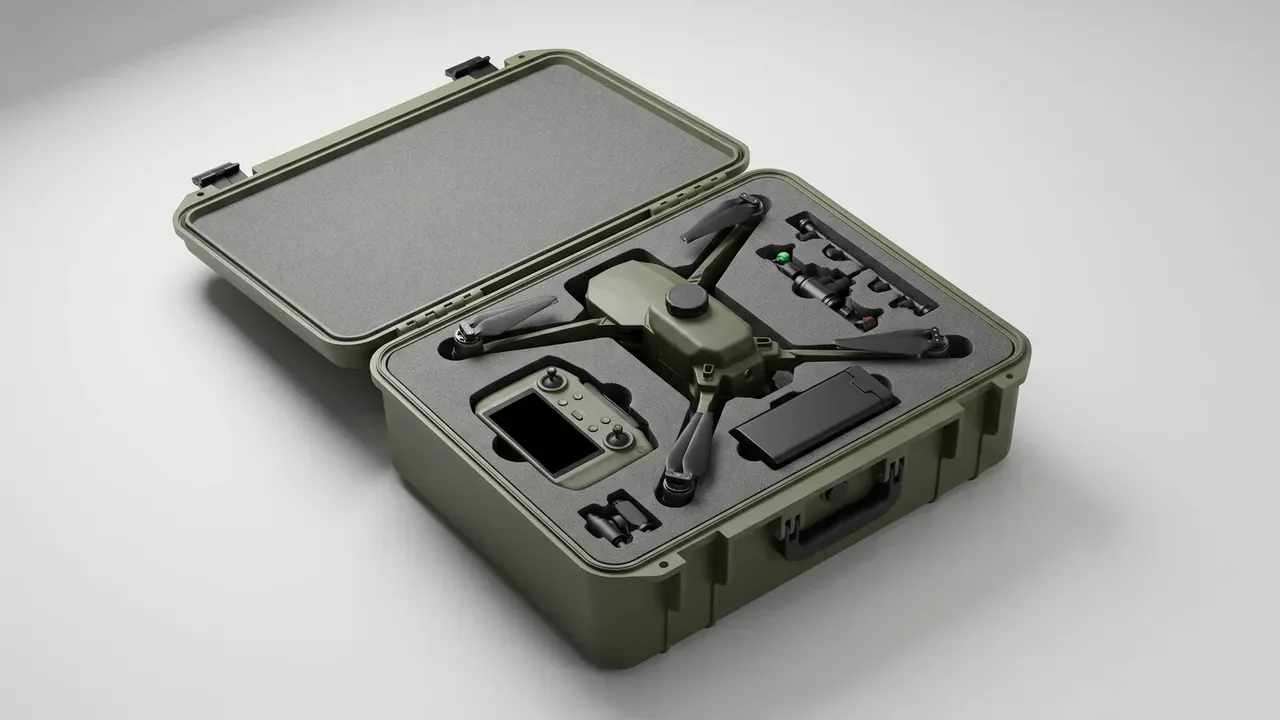
Density follows weight: 45 kg/m³ suits a 1.2 kg airframe in a 1.2 m drop, and above 2.5 kg the same grade is too soft, so start at 60 kg/m³. Layering matters as much as grade, with a 10 mm high-density base, a 25 mm cut cavity and a 15 mm lid pad each taking a different load.
3. Latches and Hinges as Wear Parts
A working drone protective case opens far more often than a toolbox. Two closures a day is about 700 a year and more than 2,000 over three seasons. Latches rarely break; they lose preload, and the lid stops giving that last firm click.
Two numbers matter: closure preload and pawl material. A 3 mm preload is common, and below 2 mm rain migrates through the seam. Glass-filled PA66 pawls moulded on a 220 tonne machine hold preload loss under 0.5 mm after 3,000 cycles, while plain PP latches loosen near 800. A plastic hinge on a 4 mm metal pin outlasts a 3 mm pin by about two years; at 1.8 N·m the lid holds any angle for one-handed battery swaps.
4. Condensation Control Inside a Sealed Case
A sealed drone protective case traps its own air. Park in the sun and the interior reaches 60 C; the evening drop to 20 C releases that moisture onto metal parts. Three measures work in ascending cost: desiccant, a humidity indicator card, and a vapour-permeable membrane. A 25 g molecular sieve in a 20 litre cavity pulls relative humidity from 85%RH to below 40%RH for roughly three months; pair it with a card that turns at 30%RH.
Soak at -20 C and 60 C for four hours each, five cycles, is standard wording. In cold the latch fails first: PA66 loses impact strength at -20 C, and a pawl wall under 2.5 mm chips at the corner.
5. Incoming Inspection and Batch Consistency
Selection of a drone protective case ends with whether the factory can repeat it. The first three samples say little about unit five thousand: foam is die-cut, the die wears, and cavities grow with every batch.
| Check | Frequency | Accept criteria |
|---|---|---|
| Appearance and latches | 5 of 30 units | No flash, audible close |
| Cavity dimensions | First article, then every 500 | Plus or minus 0.5 mm |
| Sealing | 3 of 30 units | No water after 30 minutes |
| Drop | 1 per batch | No cracks after six faces |
Conclusion
Five criteria decide the purchase: a drop rating stated with the aircraft inside, foam travel matched to weight, latch preload that survives thousands of closures, humidity control aimed at condensation rather than leakage, and an inspection plan that holds across batches. Written into a purchase order, they become numbers a supplier can be held to, which is what a drone protective case specification should be.
This article discusses only the container (case body) side of specifications and design intent, and does not cover any handling, loading or use of the contents.
Related Reading
- Common drone case problems and fixes
- How to choose internal dividers
- Case assembly quality control
- Matching case accessories
Related Products
- 8 Series — Gun Cases; Military Equipment Cases; Camera Equipment Cases; Drone Cases; Watch Cases; Knife Cases; First Aid Cases; Electronics Equipment Cases
- WL8-2812 PP Gun Case — model WL8-2812
- All protective cases and toolboxes: 7 series, 158 models