

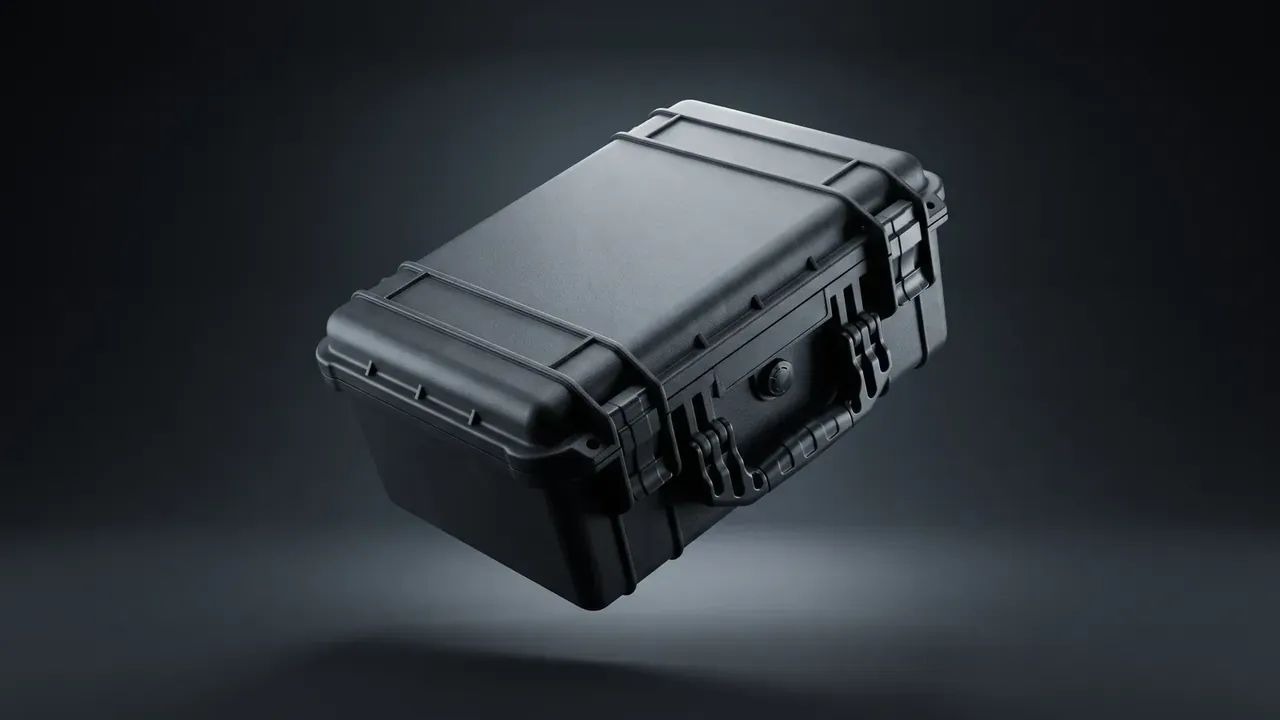
Quick answer: A 3.0 mm groove, 50–60 Shore A and a 25%–30% squeeze make the seal, so a Dustproof and Waterproof Instrument Case Design passes IP67 at 1 m for 30 min.
Table of contents
- Gasket Groove Profile and Squeeze
- Gasket Hardness and Recovery
- How Latch Preload Spreads Around the Rim
- Whether to Fit a Pressure Equalisation Valve
- Opening and Drying After Immersion
- FAQ
1. Gasket Groove Profile and Squeeze
A watertight body is decided by gasket squeeze, not latch force. The first drawing of a Dustproof and Waterproof Instrument Case Design is the U-shaped groove along the rim: 3.0 mm wide, with depth setting the squeeze and the walls setting where the rubber bulges.
Squeeze equals free height minus compressed height, divided by free height. The window is 25%–30%: under 20% the strip cannot follow the rim, over 30% it goes flat and never recovers.
The 3.0 mm width gives the rubber somewhere to go. Loaded, the section widens sideways, and a narrow groove extrudes it past the lip, where the closing rim shears a nick that stays invisible until the body sits in water for 30 min.
| Groove section | Gasket posture | Squeeze landing | Typical mistake |
|---|---|---|---|
| U section | Seated on a radius, bulging sideways | 25%–30% | Radius too large, strip never bottoms |
| Rectangular | Loaded top and bottom, walls close in | 25%–30% | Straight walls leave no room to bulge |
| Stepped | Guided by the inner slope, bulges outward | 25%–30% | Wrong slope, strip rolls over |
Dust rides on the same strip: IP67 draws talc through a chamber for 8 h, and the path powder takes is the path water takes later. Groove geometry is where a Dustproof and Waterproof Instrument Case Design earns both ratings at once.
2. Gasket Hardness and Recovery
Shore A 50–60 is the usual band for the strip. Softer than 50 follows the rim but recovers slowly and collapses after a few dozen openings; harder than 60 snaps back yet needs more force than two latches deliver evenly.
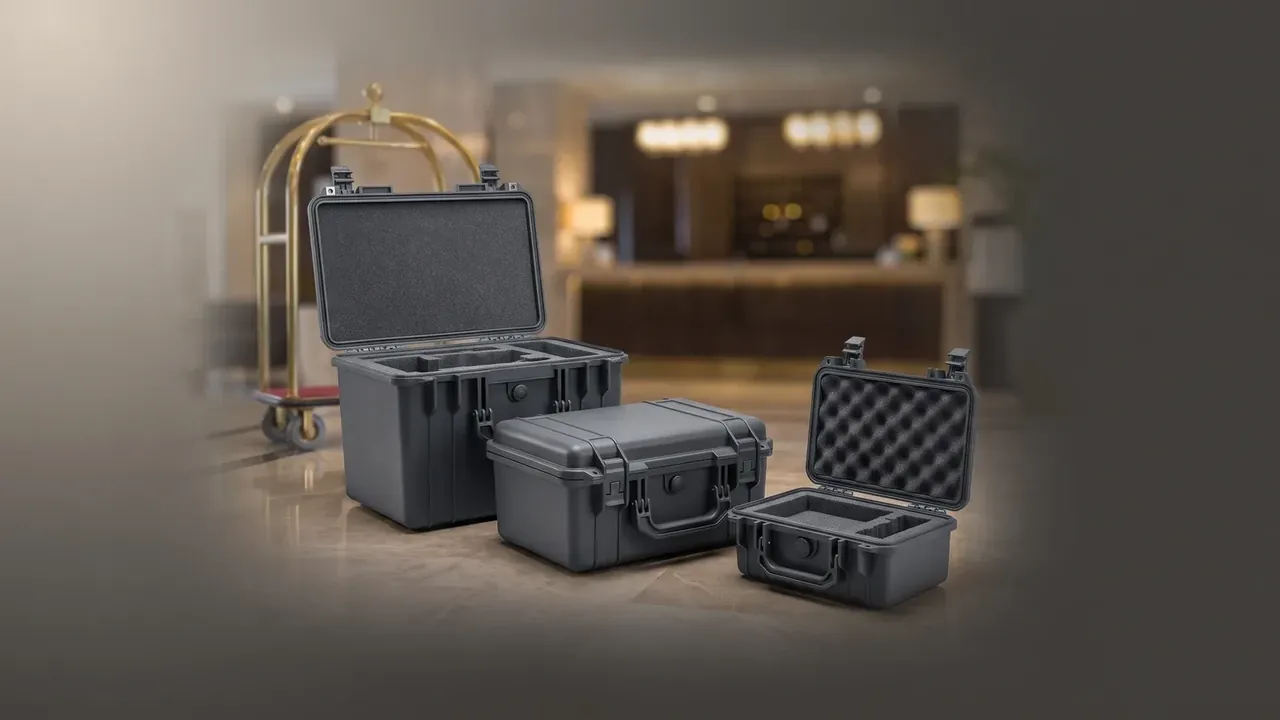
Hardness and section are a pair: a soft strip belongs in a U section resting on its radius, a hard strip in a stepped section guided by the slope. Change one alone and the joint leaks within two years.
Recovery is judged 24 h later, not at closing. Prototyping a Dustproof and Waterproof Instrument Case Design means squeezing a sample 30%, waiting a day and measuring again; under 95% of free height means the wrong compound.
Cold hardens rubber: nominal squeeze holds while real contact drops. A deeper groove with margin beats a thicker strip, which only loads the latches harder.
3. How Latch Preload Spreads Around the Rim
Two symmetric latches are what a Dustproof and Waterproof Instrument Case Design allows for this lid length. A latch brings the rim to design squeeze rather than crushing it: over-compressed rubber takes a set, under-compressed rubber leaks at the ends first.
Preload peaks under each latch, sags between them and sits in between at the corners. The rule is every point inside 25%–30%, and that 5% band is the process window.
| Rim position | Source of preload | Squeeze there | How to check on the floor |
|---|---|---|---|
| Directly under a latch | Latch pull | 30% upper limit | Rim meets the mouth with no gap |
| Between the two latches | Gasket recovery | 25% lower limit | Feeler gauge refuses 0.1 mm |
| Rounded corners | Rim transition and bending | 25%–30% | Thumb press, no hollow sound |
| Hinge side | Hinge restraint | 25%–30% | Opening effort stays even |
Once the span between latches passes a certain length, mid-span squeeze falls under 20%, and a compression rib beats a third latch without adding a closing action. Four latches are worse in practice, since operators close two and leave two slack on a Dustproof and Waterproof Instrument Case Design.
4. Whether to Fit a Pressure Equalisation Valve
In a Dustproof and Waterproof Instrument Case Design a valve is a one-way breather that lets pressure settle. Fitted, a body that crossed a temperature range or flew opens without fighting a vacuum; left out, the lid sticks and prying lifts the gasket from its groove.
| Duty | Valve | Alternative without one | Reason |
|---|---|---|---|
| Wide temperature swings | Needed | Let it stand before opening | Differential pulls a vacuum |
| Air freight and altitude | Needed | Vent on landing | Outside pressure moves fast |
| Short local trips | Not needed | Open slowly | Differential stays small |
| Several openings a day | Needed | None | Repeated venting is faster by valve |
The valve is itself a sealing point, its seat held by an O-ring on the same 25%–30% rule, and a valve 1 mm off centre undoes a perfect rim.
The argument against a valve in a Dustproof and Waterproof Instrument Case Design is long immersion: the membrane survives 1 m for 30 min, but repeated soaking makes it the weak link, so fit a threaded locking valve.
5. Opening and Drying After Immersion
IP67, the target here, means 1 m of water for 30 min with sample and water within 5 K. Do it cold: drop a chilled body into warm water, the trapped air contracts, water enters the groove, and beads appear at the first opening.
Sequence matters. Dry the outside, open the valve to dump the differential, then release the latches. Done the other way, the ring of water along the rim runs inward and reads as a failed seal.
Drying takes 24 h, and the groove is what dries. Lift the strip out, blot the groove, lay it flat in still air and keep hot air away. Plenty of claims on a Dustproof and Waterproof Instrument Case Design are bodies closed wet after an earlier dip.
Rejection call: if beads appear inside 30 min after immersion, or gasket squeeze measures under 20%, the seal has failed.
On a failure, replace the gasket before touching the shell. Rubber is a wear part costing a fraction of tooling; if a fresh strip still weeps, check groove distortion and rim warp from years of over-compression.
Related Reading
- Designing the gasket groove
- Choosing gasket material
- Latch layout on airtight cases
- When to fit a drain valve
JUNZHIJIA
Related Products
- 8 Series — Gun Cases; Military Equipment Cases; Camera Equipment Cases; Drone Cases; Watch Cases; Knife Cases; First Aid Cases; Electronics Equipment Cases
- WL8-2812 PP Gun Case — model WL8-2812
- All protective cases and toolboxes: 7 series, 158 models