

Quick answer: Case gasket material follows the top service temperature first: silicone holds -55 to 200 °C at 25% compression, EPDM -45 to 120 °C at 30%, PVC only below 60 °C in dry, oil-free duty.
Table of contents
- Reading ISO 3302 and ASTM D2000
- Compression set: where the three split
- Temperature range: cold end and hot end
- Media resistance: oil, alkali, alcohol
- Cost per metre versus cost per year
- Groove compression: three materials, three depths
- FAQ
1. Reading ISO 3302 and ASTM D2000
Two standards cover one drawing. ISO 3302-1 fixes dimensions: extruded sections fall into classes E1, E2 and E3, so a 6 mm strip varies ±0.25 mm in E2 and ±0.40 mm in E3. ASTM D2000 fixes the compound, locking heat, oil, compression set and low-temperature behaviour into one callout.
That callout reads like M2AA810 A19 B37 C12 F17. M2 is the -40 to 100 °C heat class, A19 caps hardness change at ±15 points after 70 h ageing, B37 limits set to 25% after 22 h at 100 °C, C12 limits swell in IRM 903 oil to 25%, and F17 prevents cracking at -40 °C.
Standards cover the compound, not the fit: a strip that passes B37 still fails in a groove built for 12% compression, so the drawing needs two columns.
2. Compression set: where the three split
ASTM D395 method B compresses a specimen 25%, holds it 22 h at 100 °C and measures it 30 min after release. One batch returned 17% for silicone, 22% for EPDM, 46% for PVC; at 70 °C for 24 h they read 12%, 16% and 38%.
The PVC figure needs unpacking. About 30 points come from plasticiser migration, not chain scission: at six months the strip still springs back, at eighteen the contact stress has fallen to 55%.
Silicone and EPDM sit 5 points apart, worth roughly 0.15 to 0.2 MPa of contact stress, and whether that suffices is settled by the groove.
| Property | Silicone | EPDM | PVC |
|---|---|---|---|
| Set, 100 °C for 22 h | 17% | 22% | 46% |
| Set, 70 °C for 24 h | 12% | 16% | 38% |
| Shore A hardness | 50 | 65 | 72 |
| Density, g/cm³ | 1.15 | 1.10 | 1.35 |
| Tensile strength, MPa | 8.0 | 9.5 | 12.0 |
3. Temperature range: cold end and hot end
Temperature is judged at two ends, never at one number. ASTM D1329 TR10 puts silicone at -55 °C, EPDM at -45 °C and PVC at -18 °C, measuring where a stretched specimen retracts to 10% elongation.
Continuous service temperature grades the hot end: silicone 200 °C, or 250 °C for 2 h; EPDM 120 °C, or 150 °C briefly; PVC 60 °C, with plasticiser loss doubling above 70 °C. After 50 cycles from -40 to 85 °C, set grows 3 points for silicone, 5 for EPDM and 14 for PVC.
A range is an interval plus a margin. Deducting 20 °C from the peak before selecting is steadier than selecting at the peak.
4. Media resistance: oil, alkali, alcohol
After 70 h in IRM 903 oil at 100 °C, silicone swells 32%, EPDM swells 88% and PVC shrinks 10%. All three are unusable: silicone grows, EPDM grows until it will not seat, and PVC loses plasticiser and hardens.
Alkali separates them far less: seven days in 10% sodium hydroxide at 23 °C moves each material under 3%, and 30 days in 5% brine stays under 2%. Alcohol shows the spread, as 24 h in isopropanol swells PVC 18%, EPDM 10% and silicone 5%. Cleaning is the item most often omitted: 200 isopropanol wipes leave PVC 8 points harder.
| Media and condition | Silicone | EPDM | PVC |
|---|---|---|---|
| IRM 903 oil, 100 °C, 70 h | +32% | +88% | -10% |
| 10% NaOH, 23 °C, 7 d | +2% | +3% | +1% |
| 5% brine, 30 d | +1% | +2% | +1% |
| Isopropanol, 23 °C, 24 h | +5% | +10% | +18% |
5. Cost per metre versus cost per year
For an 8 by 6 mm solid strip, silicone costs 8.0 per metre, EPDM 3.4 and PVC 2.0. On a 2.6 m perimeter that is 12 more per case than EPDM, only 4% to 7% of case cost, so price alone rarely rejects silicone outright.
Cost per year reverses it: with outdoor lives of 10, 12 and 4 years, one metre runs 0.80, 0.28 and 0.50 per year. EPDM wins on price and life across -45 to 120 °C, while above that the 8.0 against 3.4 comparison stops existing.
| Item | Silicone | EPDM | PVC |
|---|---|---|---|
| Cost per metre, 8×6 mm | 8.0 | 3.4 | 2.0 |
| Cost per kilogram | 32 | 15 | 11 |
| Outdoor design life | 10 years | 12 years | 4 years |
| Cost per metre per year | 0.80 | 0.28 | 0.50 |
6. Groove compression: three materials, three depths
Compression ratio has one formula: free height minus groove depth, divided by free height. Silicone is designed at 20% to 30%, EPDM at 25% to 35% and PVC at 12% to 18%, so an 8.0 mm strip pairs with grooves of 6.0, 5.6 and 6.8 mm at mid-values.
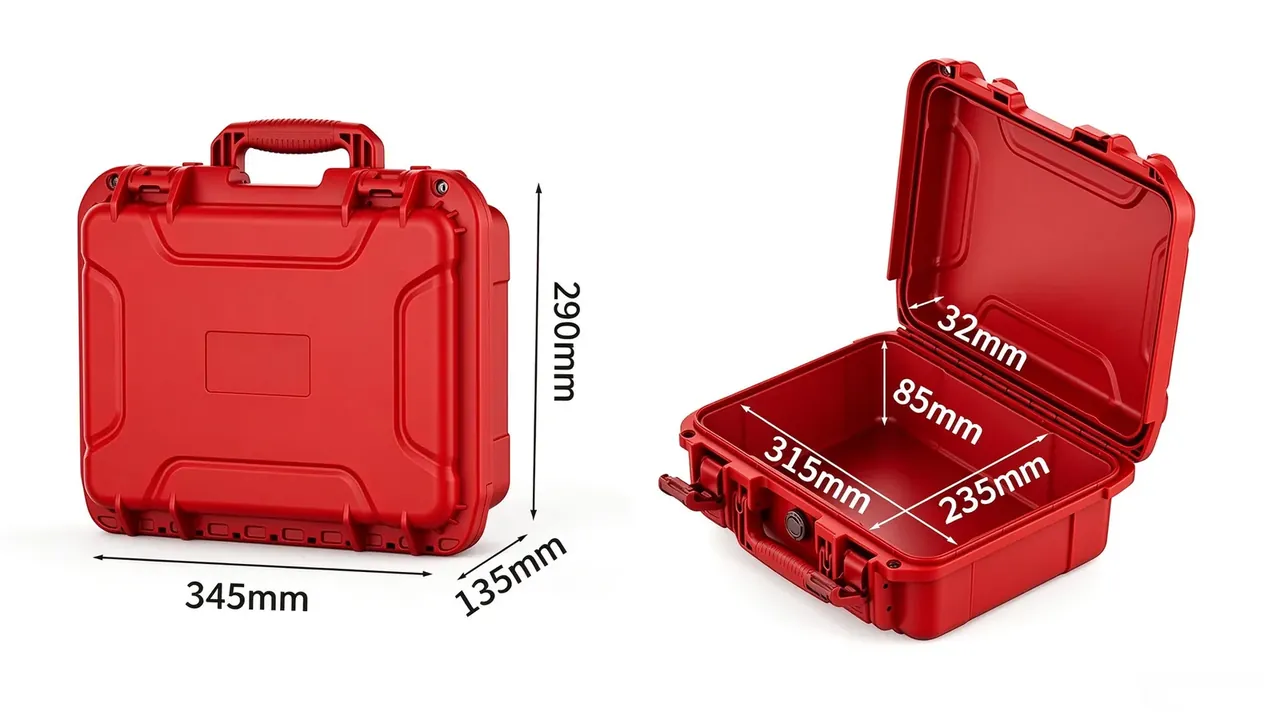
Two numbers must be fixed beside the depth. Fill ratio, strip section over groove section, stays at or below 0.80 so the remaining 20% absorbs expansion and tolerance stack-up. Groove width runs 0.3 to 0.5 mm wider than the strip, letting material displace sideways instead of being sheared. At ISO 3302-1 class E2 the ±0.25 mm tolerance moves the ratio ±3.1 points, which the 25% mid-value absorbs. EPDM is 15 points harder and needs 5 points more compression to follow an uneven lip. PVC at Shore A 72 keeps the lid from closing when over-compressed, so it takes 15% with a wider section.
One counter-example: an 8.0 mm silicone strip in the 5.6 mm EPDM groove runs at 30%, seals hard for a quarter and relaxes faster, ending 6 points above design after 12 months.
Conclusion
Selecting a case gasket material ends with three temperature bands on one chart: silicone -55 to 200 °C, EPDM -45 to 120 °C, PVC -20 to 60 °C. Whichever band encloses the highest and lowest working temperature settles most of the decision; compression ratio, at 25%, 30% and 15%, settles the rest. Media only refines the compound inside a family, since oil rules out the 88% swell of EPDM. Below 60 °C, EPDM at 0.28 per metre per year needs no margin bought at 8.0; above 120 °C only silicone survives, and the work shifts from comparing prices to tightening groove depth and tolerance together.
This article discusses container-side specifications and design implications only, and does not cover any handling, loading or use of the contents.
Related Reading
- Gasket groove dimensions and tolerance fit
- How a case gasket ages and when to replace it
- Protective case cost structure and its shares
- Measured compression set of case gasket compounds
- Gasket cross-section shapes and fitting methods
Related Products
- 8 Series — Gun Cases; Military Equipment Cases; Camera Equipment Cases; Drone Cases; Watch Cases; Knife Cases; First Aid Cases; Electronics Equipment Cases
- WL8-2812 PP Gun Case — model WL8-2812
- All protective cases and toolboxes: 7 series, 158 models