


Short answer: the price of a protective case is not guessed, it is built up from four blocks - material cost (plastic, foam, gaskets, hardware), processing cost (injection machine time, cycle time, yield, secondary operations), absorbed cost (mould amortisation, packaging, freight) and period cost (administration, sales, R&D) plus profit. The single decisive action in costing is to break "how much per case" down into "how much material per case, how much machine time per case, how much mould cost per case". Once those three quantities are known, any quotation can be verified. Without them, a buyer sees only a total figure and cannot tell whether the price is low because material was cut or because efficiency is high - which means the buyer also loses the basis for negotiating and for screening suppliers.
This article is written for B2B procurement teams, cost engineers and product engineers. It opens the cost structure layer by layer: what drives each cost element, which formula estimates it, which steps are the natural hiding places in a quotation, how to normalise five competing quotations onto the same measuring stick, and which cost reduction moves are genuine and which only shift risk. All percentages, rates and formula outputs are typical or empirical values used to illustrate the structure of the calculation. They are not a quotation for any specific product. Formal costing should follow the drawings, material grades, process plan and current raw material market confirmed between the parties. If you are budgeting a batch of outdoor protective cases, military specification storage boxes, toolboxes or waterproof junction boxes, this breakdown can be used directly as an enquiry template and a quotation review sheet.
Contents
- Short answer: cost the material, the hours and the amortisation, not the price
- The full cost map: one complete structure table
- Material cost: plastic, foam, seals and hardware
- Process cost: machine time, cycle time, yield and secondary operations
- Mould cost and amortisation: spreading a one-off investment
- Assembly, inspection and packaging: the three most overlooked blocks
- Logistics and volume cost: volumetric weight, load factor and freight allocation
- Period cost and profit: the part of the quote you cannot see
- A standard cost model you can fill in
- Normalised comparison: putting five quotations on one ruler
- Real cost reduction versus false economy
- What a quotation must contain to be costable
- Frequently Asked Questions
- Conclusion and Related Reading
Short answer: cost the material, the hours and the amortisation, not the price
Start by being precise about what is being calculated. The cost of a protective case is fundamentally a function of three physical quantities, independent of what a supplier says:
- Material quantity - how many kilograms of plastic, how many square metres of foam, how many metres of gasket, how many sets of hardware go into one case.
- Labour and machine time - how many seconds of injection machine time, how many minutes of assembly, how many minutes of foam cutting.
- Amortisation - how much of the one-off spending on moulds, fixtures, sampling and certification lands on each case.
With those three quantities plus the current material price and labour rate, you can produce a should-cost. The value of a should-cost is not precision to the last cent; it is order-of-magnitude validation. When a supplier quotes 30 percent above your should-cost, you at least know what to ask about. When a supplier quotes 20 percent below it, you should be more suspicious still - a price below the material cost means something invisible has been cut.
For the specific ways low prices are achieved, work through how to avoid pitfalls in protective case procurement: a ten-point quality checklist. The two articles are designed to be used together: one explains what the price is made of, the other explains where cutting cost does damage.
One line to memorise: costing turns "this feels expensive" into "I know where the expense is".
The full cost map: one complete structure table
Start with an overall table. Below is the cost structure and empirical share for a typical mid-size injection moulded protective case with no insert or a basic foam configuration, at moderate volume. It is for understanding structure, not for copying figures.
| Cost element | Empirical share | Main driver | Room to negotiate |
|---|---|---|---|
| --- | --- | --- | --- |
| Plastic resin (shell and lid) | 25-35 percent | Material grade, net weight per part, wall thickness, scrap rate | Medium, depends on whether grade can change |
| Hardware and purchased parts | 10-18 percent | Number and grade of latches, hinges, handles, purge valves, feet | Medium to high, specification can be optimised |
| Foam insert | 6-12 percent | Foam material, density, volume, cutting method | High, configuration is optional |
| Seals | 3-6 percent | Material (silicone, EPDM, NBR), cross-section, perimeter, moulded or spliced | Low, not a good place to save |
| Injection processing | 10-18 percent | Cycle time, cavities, machine tonnage, yield | Medium, depends on volume |
| Assembly and inspection | 6-10 percent | Number of operations, seal test method (full or sample) | Medium |
| Packaging | 3-6 percent | Inner packing, master carton, corner protection, pallet method | Medium |
| Outbound freight allocation | 2-6 percent | Volume, load factor, destination | Medium |
| Mould and fixture amortisation | 3-10 percent | Mould price, total order quantity, amortisation policy | High, depends on order scale |
| Period cost and profit | 10-20 percent | Administration, R&D, sales cost, target margin | High, depends on relationship and competition |
The most useful way to read this table is to ask which cell a proposed saving lands in. If a supplier says "we can reduce the price by 8 percent", the question is: which cell does that 8 percent come out of? If the answer is "simpler packaging", it can be discussed. If the answer is "a general-purpose grade of resin", the life-cycle cost must be calculated. If the answer is "cheaper rubber for the gasket", it can essentially be rejected on the spot.
Three empirical rules of thumb:
- Material-type costs (plastic plus hardware plus foam plus seal) usually account for 45 to 70 percent of total cost, making them the main body of the structure and the place where specification downgrades most often hide.
- Processing and amortisation usually account for 20 to 35 percent and fall sharply as volume rises. This is why the price difference between 500 units and 5,000 units of the same drawing comes mostly from this block.
- Freight is routinely underestimated. For export projects in particular, sea freight for a large empty case can exceed 10 percent of landed cost.
Material cost: plastic, foam, seals and hardware

Material cost is the easiest block to calculate and the easiest block in which to be deceived. The general formula is a single line:
Material cost per unit = net weight per unit x (1 + scrap rate) x material unit price
The difficulty lies in three variables.
Variable one: net weight per part. Plastic part weight is estimated as volume times density. Typical densities: PP around 0.90 to 0.91 g/cm3, ABS around 1.04 to 1.06 g/cm3, PC around 1.20 g/cm3, PC/ABS blend around 1.10 to 1.15 g/cm3, with glass-filled grades rising according to glass content. Always use the material supplier's property sheet for the specific grade.
Variable two: scrap rate. Injection moulding scrap comes from runner waste, start-up rejects, setting rejects and scrapped parts. In normal production the empirical range is 3 to 8 percent. If the supplier is running a single cavity, small batches and frequent colour changes, the rate rises noticeably. This is exactly why the same model in a different colour, in small quantity, costs more - not because the material is dearer, but because waste and setting time are.
Variable three: material unit price. Resin prices move with crude oil and supply and demand. Buyers do not need to track the market themselves, but they should ask for the price basis at the time of quotation. A practical approach is to require the material grade and the price basis date on the quotation, with a clause allowing renegotiation if raw material moves beyond an agreed band.
| Material category | Calculation method | Key parameters | Common manipulation |
|---|---|---|---|
| --- | --- | --- | --- |
| Plastic resin | Net weight x (1 + scrap) x price | Grade, density, scrap rate | Quote a premium price for a low-grade resin, or blend regrind |
| Foam insert | Volume x density x price + cutting labour | Material, density, cutting method | Reduce density, pass EPE off as EVA |
| Seals | Perimeter x price + amortisation for moulded parts | Material, cross-section, moulded or spliced | Substitute reclaimed rubber for silicone or EPDM |
| Hardware | Quantity x price | Material, surface treatment, grade | Lower material grade, thin the wall section |
One frequently overlooked point on foam: cutting labour often costs more than the material itself. Plain foam sheet that the user cuts is cheapest. CNC cut pre-scored inserts sit in the middle. Waterjet or die-cut custom inserts can reduce unit cost at high volume but require a fixture investment. If the customer cuts their own foam, what the supplier actually saves is after-sales risk - the damage from a bad cut transfers to the user.
Seals account for a small share (3 to 6 percent) but influence whole-case performance out of all proportion. For the selection logic and price differences of sealing materials, read what material should a protective case gasket use. Every fraction saved on the seal can come back as a shortened case life.
Hardware is a block you can negotiate, provided you look carefully. Latches, hinges, handles and purge valves are usually purchased parts, giving a supplier wide latitude. The typical downgrades are replacing a metal pin with a plastic pin, replacing stainless steel with zinc plating, or replacing a reinforced part with a standard one. For latch selection and performance differences, see how to choose a protective case latch. These substitutions are not automatically unacceptable, but they must be confirmed in writing and reflected in the drawing, otherwise it becomes impossible to establish after delivery whether a downgrade occurred.
Process cost: machine time, cycle time, yield and secondary operations
Process cost is the most technical block in a quotation and the one buyers most often give up on. The formula is actually simple:
Injection processing cost per unit = cycle time (seconds) / number of cavities / 3,600 x machine hourly rate
Three parameters need explaining.
Cycle time is the total from mould closing to part ejection, including injection, holding, cooling, opening and ejection. For a mid-size protective case shell the empirical range is roughly 60 to 180 seconds, depending on wall thickness, projected area, cooling design and material. Cooling usually takes more than half the cycle, which is why thinning the wall saves both material and machine time - and why suppliers have an economic incentive to thin walls.
Number of cavities is how many parts one mould produces per cycle. One cavity suits large parts and small batches; two or four cavities suit smaller parts at higher volume. Doubling cavities roughly halves the machine time per part, but mould investment rises sharply.
Machine hourly rate covers equipment depreciation, energy, labour and factory overhead. It is an internal accounting parameter. Empirically the all-in hourly rate for a small to mid-size injection machine is on the order of tens of currency units, and materially higher for large machines. Buyers do not need the exact figure; they can judge reasonableness by comparing suppliers of similar scale.
| Process step | Cost driver | Empirical reference | Optimisation direction |
|---|---|---|---|
| --- | --- | --- | --- |
| Injection moulding | Cycle, cavities, tonnage, yield | Cycle 60-180 s for mid-size shells | Improve cooling, add cavities, thin the wall |
| Secondary operations | Deburring, sanding, printing, marking | Number of operations and labour | Optimise the parting line to reduce secondary work |
| Assembly | Hardware fitting, gasket installation | Number of operations and labour | Fewer parts, snap fits instead of screws |
| Inspection | Appearance, dimensions, seal test | Full versus sample inspection | Risk-based grading; not everything needs full inspection |
| Yield loss | Setting scrap, batch rejects | 3-8 percent in normal production | Process stability, mould maintenance |
Yield is the most concealed cost item. A supplier quoting 5 percent less with a yield of 85 percent - when normal industry practice is above 95 percent - actually has a higher manufacturing cost, and the difference is eventually transferred back to the buyer as late delivery, surcharges on replenishment, or concessionary acceptance. Ask about yield directly at the enquiry stage, and write the replenishment liability for abnormal yield into the contract.
A rule of thumb: if a supplier cannot state its own cycle time and yield, either it is not a factory, or it does not manage cost.
Mould cost and amortisation: spreading a one-off investment
The mould is the block that behaves most like an asset and generates the most disputes. The disputes usually centre on two questions: should the buyer pay for the mould, and how should the cost be spread?
First, what drives mould cost. Five factors dominate: mould size, number of cavities, steel grade, structural complexity (sliders, lifters, hot runners, sequence valves) and surface finish requirements. For a detailed breakdown of mould cost and quotation practice, see how to calculate custom protective case mould cost, which sets out the itemisation in more detail.
Second, the amortisation policy. There are three common arrangements, and a buyer must know which one is being signed:
| Amortisation method | How it works | Effect on unit price | Suitable for |
|---|---|---|---|
| --- | --- | --- | --- |
| Paid separately | Buyer pays the mould cost once and owns the tool | Unit price excludes amortisation, lowest | Long-term projects, own brand, need to control the tool |
| Built into unit price | Mould cost spread across an agreed quantity | Higher early, lower later | Small to mid volume, avoids a lump sum |
| Borne by the supplier | Supplier invests in the tool, unit price includes amortisation | Highest unit price, zero barrier | Trial sales, standard models, uncertain volume |
The core risk in amortisation is volume shortfall. If the mould cost is spread over 5,000 units but only 2,000 are ordered, the supplier will either raise the price or recover the difference elsewhere. The correct approach is to state in the contract the amortisation base, whether carry-forward is permitted, how settlement works if the base is not reached, and the ownership and transfer conditions of the tool, including handover of trial reports, drawings and spares.
A practical observation: the share of mould amortisation in the unit cost is a direct indicator of whether the project justifies tooling. If the amortised unit price exceeds the cost of adapting a standard model, evaluate a standard case plus a custom insert first. On the related question of minimum order thresholds, see custom protective case MOQ baseline; it is the other side of the same decision.
Assembly, inspection and packaging: the three most overlooked blocks

These three are often merged into a single "other costs" line on a quotation, yet together they can reach 15 to 25 percent of total cost.
Assembly cost. Assembling a protective case typically involves fitting latches, fitting hinges, fitting handles and feet, fitting a purge valve, installing the gasket, placing the insert and applying labels. More operations mean more labour. Optimising the part count at the design stage is the most effective way to reduce assembly cost - snap fits instead of screws, combining two parts into one, or changing the gasket from a separate installation step to an in-mould process.
Inspection cost. Inspection cost depends entirely on strategy. Appearance and dimensional checks are normally run to a sampling plan such as GB/T 2828.1 and are controllable. Seal testing is the dividing line: testing every unit by vacuum decay or submersion raises cost noticeably but blocks most leakage risk; sample testing costs less but leaves the leak risk with the buyer. For the sampling method and acceptance criteria at goods-in, see how to sample protective cases at incoming inspection.
| Inspection method | Unit cost impact | Escape risk | Suitable for |
|---|---|---|---|
| --- | --- | --- | --- |
| Appearance and dimensions, sampled | Low | Medium | General industrial use |
| Seal testing, sampled | Low to medium | Medium to high | Where rework and sorting capability exists |
| Seal testing, every unit by vacuum or submersion | Medium to high | Low | High-value equipment, export projects, military specification |
| Every unit plus retained samples | High | Very low | Regulated industries, contractual requirement |
Packaging cost. Packaging consists of inner packing (bubble film, EPE, corner protectors), master cartons (corrugated, honeycomb board, timber), pallets and stretch film, and markings (shipping marks, barcodes). Packaging cost and transit damage cost are a trade-off. Saving a small amount on packaging while pushing the damage rate up by one percentage point is usually a poor deal for a high-value case. On how packaging interacts with load-bearing structure, see how the stacking structure of a protective case is designed. The packaging plan should be confirmed as part of the technical agreement alongside the drawings, not improvised before shipment.
Logistics and volume cost: volumetric weight, load factor and freight allocation
Freight is the most volatile block in export projects and the one most often packaged invisibly into a quotation.
First, understand volumetric weight. Express and air freight charge on the greater of actual weight and volumetric weight. The usual conversions:
Air or express volumetric weight (kg) = length (cm) x width (cm) x height (cm) / 5,000 (some channels use 6,000)
Protective cases are classic low-density freight - large volume, low weight - so they are almost always charged on volumetric weight. This leads to a direct conclusion: improving load factor saves more money than squeezing material cost. Reducing an outer carton from 62 x 42 x 25 cm to 61 x 41 x 23 cm cuts the volume by roughly 6 percent, cutting freight proportionally, with no sacrifice in protective performance.
Second, understand the difference between full container and less than container load. LCL sea freight usually charges on the greater of weight tonnage or measurement tonnage, where one cubic metre counts as one measurement tonne. FCL charges by container type, so load factor directly determines freight per case. For common container types:
| Container | Approximate internal dimensions | Approximate capacity | Loading note |
|---|---|---|---|
| --- | --- | --- | --- |
| 20 ft standard | 5.9 x 2.35 x 2.39 m | About 33 m3 | Payload limited, suits dense cargo |
| 40 ft standard | 12.0 x 2.35 x 2.39 m | About 67 m3 | Common for low-density cargo |
| 40 ft high cube | 12.0 x 2.35 x 2.69 m | About 76 m3 | Best load factor for case-type cargo |
These are typical figures for common container types; actual values should follow the carrier's specification.
Third, understand the three layers of empty space. The volume of the case itself, the gaps between cartons, and the gaps between pallets and container walls stack up in sequence. Empirically, the total void from net case volume to occupied container space can reach 25 to 45 percent. So the correct order of loading optimisation is: first optimise carton dimensions and stacking tiers, then improve pallet patterns to raise units per pallet, and only then consider special container types or irregular stowage.
Fourth, do not overlook destination charges. Landed cost includes not only sea freight but destination port charges, customs clearance, inland transport, duty and value added tax. Under DAP or DDP terms these all enter the comparison. When comparing suppliers, normalise the delivery terms to a single Incoterms rule, otherwise a 10 percent cheaper ex-works price can be entirely consumed by destination costs.
Period cost and profit: the part of the quote you cannot see
The last block is period cost and profit, and it is the least transparent. It typically covers administration (factory rent, office, finance), R&D and sampling, sales cost (exhibitions, channel, commission), and target margin.
How should this be negotiated? Three suggestions.
First, do not try to push supplier margin to zero. A healthy supplier needs margin to fund equipment renewal, mould maintenance and staff stability. Squeeze margin to the limit and the response is usually invisible - lower-grade material, reduced inspection, delayed after-sales. What a buyer should pursue is the lowest price at a given specification, not the lowest price at any specification.
Second, trade volume for price. Period cost and fixed amortisation are diluted as volume rises, and that is the genuine source of supplier price reductions. Proposing an annual framework agreement with staged call-offs usually extracts more real concession than a one-off squeeze, while avoiding tying up cash and storage space at once. On the storage side, see warehouse and storage rules for protective cases.
Third, write a price adjustment mechanism into the contract. Agreeing a formula and a reference for raw material movements above a defined band protects the supplier from cutting corners when resin spikes and protects the buyer from missing a fall in resin prices. This is more sustainable than locking a price once.
One common comparison error: comparing total prices for different specifications. Normalise first, as described below.
A standard cost model you can fill in
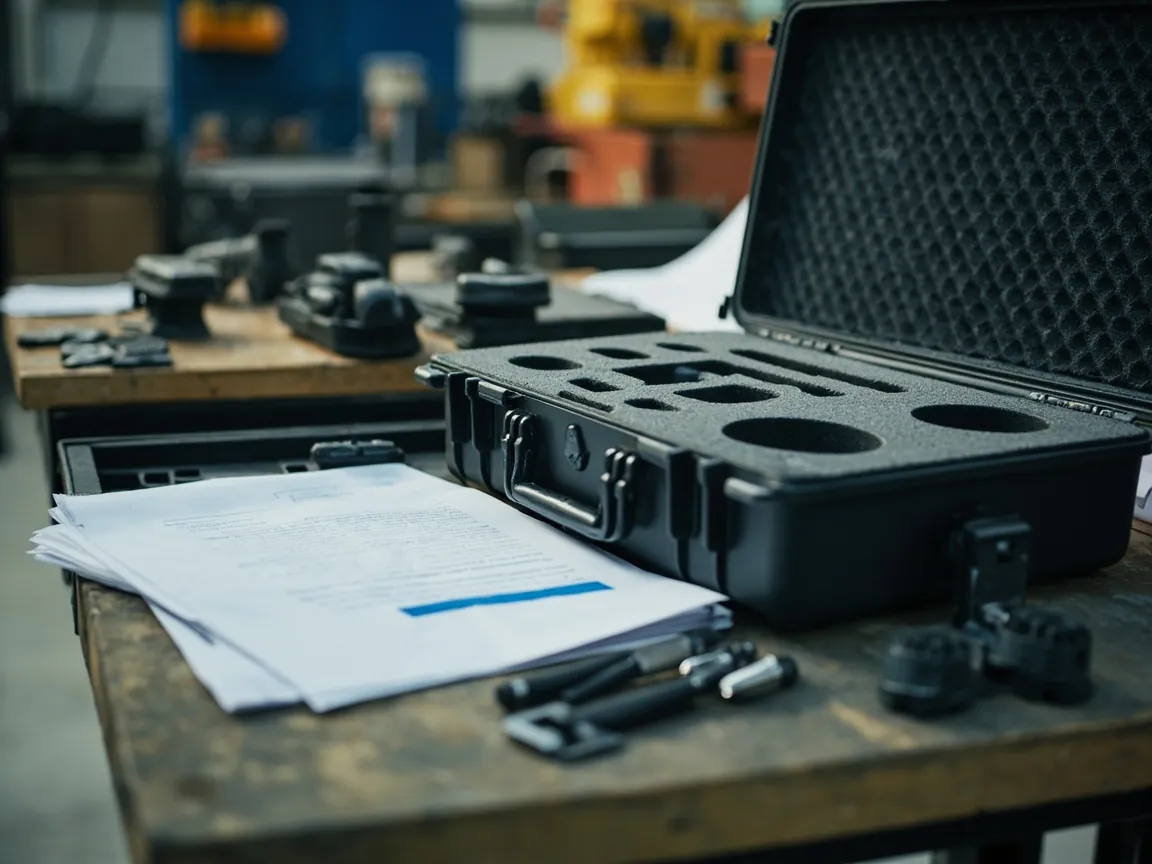
Below is a fillable should-cost model. The figures demonstrate the calculation only and are not a quotation for any product.
| Item | Formula | Example input | Example result |
|---|---|---|---|
| --- | --- | --- | --- |
| Shell plastic net weight | Volume x density | Equivalent volume about 2.2 kg, density 1.05 g/cm3 | About 2.3 kg including ribs |
| Plastic material cost | Net weight x (1 + scrap) x price | 2.3 kg x 1.06 x unit price | Varies with unit price |
| Gasket length | Case rim perimeter plus allowance | Perimeter about 1.9 m | About 2.0 m |
| Seal cost | Length x unit price | Silicone or EPDM | By material and cross-section |
| Foam cost | Volume x density x price + cutting labour | Plain sheet or pre-scored | By configuration |
| Machine time | Cycle / cavities / 3,600 | 120 s / 1 cavity / 3,600 | About 0.033 machine hours per case |
| Injection processing cost | Machine time x hourly rate | 0.033 h x rate | Varies with rate |
| Assembly labour | Time x labour rate | About 3-6 minutes per case | Varies with operation count |
| Mould amortisation | Mould price / amortisation base | Mould price / 5,000 units | Varies with policy |
| Packaging cost | Inner packing + carton + pallet share | Per packaging plan | - |
| Freight allocation | Volumetric weight or volume x rate | By destination and container | - |
| Period cost and profit | Direct cost x mark-up | Per agreed industry practice | - |
Three disciplines for using this table.
- Every input must have a source. Density comes from the material property sheet, cycle time from the supplier's process document, mould price from the quotation, rates from supplier confirmation. Anything estimated must be flagged as an estimate with its uncertainty noted.
- Run a sensitivity analysis afterwards. Move material price, yield and amortisation base up and down by 10 percent and observe how total cost responds. The variable with the largest effect is the one to pursue hardest in negotiation.
- Use the should-cost to ask questions, not to beat down the price. Its value is that it lets you ask professional questions. Taking a self-declared precise number into a price squeeze usually results in the supplier agreeing to the price and then recovering the difference from the specification.
Normalised comparison: putting five quotations on one ruler
Comparing total prices across five quotations is the most common error, because the specifications behind them usually differ. The correct method is specification normalisation: pull every quotation onto one specification sheet, fill gaps with the standard configuration, and only then compare.
| Comparison dimension | What must be confirmed | If missing |
|---|---|---|
| --- | --- | --- |
| Material grade | Specific grade plus supplier plus property data | Recalculate using the lowest acceptable grade |
| Wall thickness and ribs | Main wall thickness, rib layout | Confirm against the drawing, no vague answers |
| Ingress protection | Rating plus standard number plus test report | Treat as not achieved without a report |
| Gasket material | Silicone, EPDM or NBR, plus hardness | Fill to the highest comparable grade |
| Hardware grade | Material, surface treatment, structure | Fill to an equivalent configuration |
| Insert configuration | Material, density, cutting method | Fill to the standard plain sheet |
| Mould and amortisation | Whether included, amortisation base | Normalise to "excluding mould cost" |
| Delivery terms | Incoterms rule plus destination | Normalise to one rule |
| Packaging plan | Inner packing, carton, pallet | Fill to the same packaging specification |
| Payment and credit terms | Advance ratio, credit days | Compare after converting financing cost |
| Inspection method | Full or sample, plus criteria | Fill to the same acceptance criteria |
Only after normalisation does a comparison mean anything. A practical approach is to build the normalisation into a spreadsheet template: input each supplier's raw quotation and specification differences, output a "comparable price at equal specification". Once built, the tool is reusable for every future enquiry, and the long-term benefit far exceeds the few percentage points saved in a single negotiation.
A rule of thumb: anything not written on the quotation should be treated as worst case. This is not harshness; it is refusing to keep uncertainty on your own books.
Real cost reduction versus false economy
Sorting cost reduction moves into three categories is the most practical mental tool in procurement cost management.
| Type | Actions | Recommendation | Note |
|---|---|---|---|
| --- | --- | --- | --- |
| Genuine, structural and efficiency | Optimise wall thickness and rib design, raise load factor, reduce part count, add cavities, consolidate order volume | Strongly recommended | Does not sacrifice performance, may improve it |
| Genuine, configuration change | Change a custom insert to plain foam, change two-tone to single colour, remove unnecessary marking | Recommended | Confirm against end user requirements |
| Negotiable with a cost | Downgrade material grade, adjust wall thickness slightly, simplify packaging, move full inspection to sampling | Handle with care | Requires risk assessment and written confirmation |
| False economy | Substitute regrind for virgin resin, downgrade the gasket to reclaimed rubber, thin the hardware, drop seal testing | Not recommended | The saving returns as shorter life and rework |
The first priority in genuine cost reduction is structural efficiency, not material downgrade. Optimising rib layout raises stiffness without thinning the wall or changing the material - the only path that saves money without damaging performance. For the design methods, read how reinforcement ribs improve shell strength and how the shell structure of a high-strength protective case is built. For the trade-offs between materials, read what is the difference between PP, ABS and PC protective cases.
The second priority is load factor and packaging optimisation. For export projects, a 5 percent gain in load factor usually saves more freight than a 3 percent cut in material cost, with no quality trade-off at all.
False economy is easy to identify: ask "which performance figure will fall as a result of this change?" If the supplier cannot answer, the supplier has not assessed it either.
What a quotation must contain to be costable
Finally, an enquiry template. A costable quotation must contain the following. Without them, the buyer cannot verify anything and is reduced to judging by feel.
Essential items - missing any one makes costing impossible:
- Model, dimensions and net weight per unit, stated separately for the shell and the complete case
- Material grade, material supplier and property data sheet
- Main wall thickness and thickness at critical locations
- Gasket material, specification code and cross-section dimensions
- Hardware list - name, quantity, material, surface treatment
- Insert configuration - material, density, dimensions, cutting method
- Mould cost, amortisation base, ownership and amortisation method
- Unit price, with or without tax, currency, validity period
- Minimum order quantity and quantity price breaks
- Delivery terms including Incoterms rule and delivery place, packaging plan, carton volume and weight
- Payment method and credit terms
- Lead time and capacity commitment
Bonus items that make costing and acceptance easier:
- Ingress protection test report number and issuing body
- Yield and cycle time statement
- Sampling plan - standard number, inspection level, AQL
- Brand or grade of major purchased parts
- Raw material price basis date for the quotation
On how quality and acceptance clauses work alongside the price, see how to avoid pitfalls in protective case procurement: a ten-point quality checklist. For a technical explanation of price differences in themselves, see where the price difference between waterproof boxes comes from. JUNZHJIA, manufactured by KeXin New Materials (Guangdong) Co., Ltd., serves wholesale, distribution, OEM/ODM and global supply, and can provide itemised quotations separating material, hardware, insert, mould and packaging, along with mould cost analysis, MOQ baselines, material property statements and test documents, so that procurement teams can complete a should-cost calculation and a like-for-like comparison. For long-term programmes, continuous supply of service parts and accessories is available.
Frequently Asked Questions
Q: Why can two suppliers quote double the price for a protective case of the same size?
A: The difference usually comes from four layers stacking up rather than one cause. First, material: the gap between virgin resin and resin blended with regrind is substantial, and appearance is almost identical. Second, wall thickness and reinforcement: thinning the wall saves both material and machine time, making it the most effective cost reduction lever a supplier has and the one with the largest performance penalty. Third, hardware and seal grade: latch material, pin design, and the type and hardness of the gasket all affect cost materially. Fourth, service and compliance: whether test reports are provided, whether seals are fully inspected, whether custom inserts and sampling are supported, and what lead time and credit terms are offered. So never compare total prices. Normalise first, pulling material grade, wall thickness, ingress protection rating, gasket material, hardware grade, insert configuration, mould amortisation basis and delivery terms onto one sheet, fill missing items with the worst case, and then compare like with like.
Q: My should-cost comes out a long way from the supplier's quotation. What should I do?
A: Check your own method first, then negotiate. A large gap usually has one of three causes. First, your inputs are wrong: net weight misjudged, scrap rate set too low, or the mould amortisation base written optimistically. These errors push the should-cost systematically low and invite a supplier to dismiss it. Second, the supplier's actual conditions differ from the assumptions - a small machine, a low yield, or insufficient batch size all raise real cost above the theoretical value. Third, and only third, the quotation is inflated. The correct order is to break the gap down item by item, list both parties' positions on each input, and then verify the single item with the biggest disagreement - for example by inspecting the mould, checking the cycle time, or reviewing material purchase evidence. In practice, most cases that look like a large gap narrow considerably once the difference is decomposed.
Q: Should the buyer pay for the mould?
A: It depends on the nature of the project, not on who has more leverage. If the product requires long-term supply, involves your own brand and proprietary appearance, or may move to a different supplier in future, the buyer should fund the tool and take ownership, with the contract stating where the tool is kept, who maintains it, and the transfer conditions including drawings, trial reports and spare parts, so that a later change of supplier does not become a dispute. If the project is a trial, short term, or uses an existing standard tool held by the supplier, spreading the cost into the unit price is more economical, provided the amortisation base and the settlement rule if the base is not reached are made explicit. The outcome to avoid at all costs is a verbal understanding about mould ownership with nothing in writing. Such arrangements cause no trouble while cooperation is smooth, and become the hardest legacy issue to resolve the moment there is a disagreement.
Q: Larger volumes mean lower prices. Is the reduction predictable?
A: The pattern is clear, but the reduction diminishes. Fixed cost elements include mould amortisation, sampling and fixtures, line setting, and inspection development. Variable elements include material, machine time, labour, packaging and freight. As volume rises, the fixed part is diluted and the unit price falls. Once the fixed part is spread close to zero, the remaining variable cost barely moves with volume and the reduction flattens. Empirically, the step from 500 to 1,000 units produces a larger reduction than the step from 5,000 to 10,000. So the right strategy is not to chase volume for its own sake. Validate specification and quality at small volume first, then lock an annual quantity in a framework agreement and call off in stages, capturing the volume price while avoiding a one-off inventory burden.
Q: The quotation says the price includes tax. What else should I ask?
A: Beyond the tax rate and whether freight is included, clarify at least six points. First, what delivery term and delivery place the quotation is based on; ex-works and landed prices are not comparable. Second, whether packaging is included and who supplies cartons and pallets. Third, whether sampling and first article inspection are included. Fourth, whether mould cost is already included and, if so, over what base it is amortised. Fifth, payment method and credit terms - a quotation with a high advance ratio should carry a lower nominal price, because the supplier is using your money. Sixth, the quotation validity period and the raw material adjustment mechanism. Once these six are clarified, two apparently identical quotations usually show material differences, and the reasonableness of those differences becomes easier to judge.
Q: To cut cost, can we change the gasket from silicone to EPDM?
A: It depends on the operating conditions; it cannot be generalised. Silicone has a wide temperature range and good low-temperature elasticity, suiting outdoor and vehicle applications with large temperature swings. EPDM has good weather resistance and water vapour resistance, usually costs less than silicone, and suits ambient outdoor and humid environments, but is less resistant to oils and certain solvents. If the application involves machine oil, fuel or solvent contact, neither may be suitable and nitrile rubber or another material should be assessed. The key point: changing the sealing material requires re-validation of performance, including temperature cycling, compression set and submersion or vacuum testing, and the change must be confirmed in writing. For material differences and ageing mechanisms, read what material should a protective case gasket use and how to judge gasket ageing. Changing material without understanding the application simply converts a cost risk into a quality risk.
Q: The insert is a small share of cost. Why is it worth optimising repeatedly?
A: Because the insert is the component the user feels most directly, and it is the most customisable part of the product. Insert cost is driven mainly by material, density and processing method, and the processing difference is often larger than the material difference. Plain foam sheet is cheapest but the user must cut it. CNC cut pre-scored inserts give the best experience but raise unit labour. Die cutting or waterjet can lower unit cost at high volume but requires fixture and tooling investment. The optimisation direction is to define first whether frequent handling is required, how heavy and how brittle the protected item is, and whether ESD properties are needed, and only then decide material and processing. Empirically, upgrading an insert from a plain sheet to a pre-scored cavity matched to the item shape improves user satisfaction far more than its cost share suggests, making it one of the highest-value upgrades available.
Q: How does costing an export project differ most from a domestic one?
A: The biggest difference is the composition and uncertainty of landed cost. A domestic project usually needs only the ex-works price plus inland freight. An export project adds sea or air freight, destination port charges, customs clearance, duty and value added tax, inland delivery, and potentially demurrage, inspection and storage. Freight is heavily influenced by volumetric weight, load factor and peak-season rates, and because protective cases are low-density cargo charged almost always on volumetric weight, load factor optimisation can affect total cost more than material price reduction. Compliance costs - testing, certification, wood packaging treatment, marking requirements - must also be included. The right approach is a four-stage cost sheet covering ex-works cost, freight, compliance and destination charges, and normalising all suppliers to a single delivery term rather than comparing an ex-works price against a landed price.
Conclusion and Related Reading
Back to the question in the title: how is a protective case costed? Break it into three things - how much material, how many hours, how much one-off investment - and then find a verifiable data source for each. Material cost follows net weight and grade, process cost follows cycle time and cavities, mould cost follows price and amortisation base, assembly, inspection and packaging follow operation counts and inspection strategy, freight follows volumetric weight and load factor, and period cost follows the mark-up logic. Decomposed to that granularity, a quotation stops being a mysterious number.
Three actions you can take immediately. First, build a normalised comparison sheet with eight mandatory columns - material grade, wall thickness, ingress protection, gasket, hardware, insert, mould basis and delivery terms - and fill missing items with the worst case before comparing. Second, build a should-cost model and run a sensitivity analysis to identify the variable with the largest effect on total cost, then make that the focus of specification confirmation and negotiation. Third, classify every cost reduction proposal as genuine or false economy, accept only structural efficiency improvements that do not sacrifice performance, and require a written risk assessment for any change that lowers a performance figure.
JUNZHJIA, manufactured by KeXin New Materials (Guangdong) Co., Ltd., covers protective cases, toolboxes, military specification storage boxes and waterproof junction boxes, and serves wholesale, distribution, OEM/ODM and global supply. The company can provide itemised cost quotations, mould cost analysis, MOQ and quantity price breaks, material property statements and test documents, and supports continuous supply of gaskets, latches, handles and other wearing parts by model, so that procurement teams can incorporate both cost calculation and whole-life cost management into the technical agreement.
Related Reading