


Short answer: warehouse management for protective cases comes down to controlling four things - temperature, humidity, light and stacking load. Hold temperature between 5 and 30 C, hold relative humidity between 45 and 65 percent, keep cases out of direct sunlight and UV lamps, and make sure each case carries no more than its rated stacking load. Do this and the protective performance holds up for years. Fail on any of the four and the usual results are brittle, yellowed plastic, permanently deformed seals, and cases that slowly collapse under their own stack - damage that is invisible at goods-in and only surfaces once stock reaches the customer, which makes it a classic hidden cost. One counter-intuitive rule is worth memorising: storing cases with the latches clamped shut causes compression set in the seal, so it fails earlier, not later.
This article breaks storage practice into four executable blocks. It starts with three measurable environmental targets and how to record them. It then sets out moisture, sunlight and stacking rules, isolates the protection of seals and service parts during storage, and closes with stacking standards, FIFO rules and inbound and outbound checklists. Temperature, humidity and stacking figures are empirical and reflect general industrial practice; specific projects should follow the case design file and the supplier's stacking load data.
Contents
- Short answer: four things to control
- Three hard targets for the storage environment
- Moisture control: three ways humidity damages cases
- Sunlight and UV: the leading cause of plastic ageing
- Stacking rules: height, pallets and load direction
- Pallets and racking: how to store without deformation
- Protecting seals and service parts in storage
- Standards behind stacking verification
- Pest control and wood packaging requirements
- FIFO and inventory turnover
- Inbound and outbound checklists
- Common storage mistakes and corrections
- Frequently Asked Questions
- Conclusion and Related Reading
Short answer: four things to control
A case in storage takes no impact load, but it does take a slow, continuous environmental load. Such loads act over a long time, each individual effect is small, and the cumulative effect is large.
| Dimension | Target range (empirical) | Main consequence if exceeded | Check frequency |
|---|---|---|---|
| --- | --- | --- | --- |
| Temperature | 5 to 30 C, avoid sharp swings | Heat accelerates ageing, cold embrittles | Daily log |
| Relative humidity | 45 to 65 percent RH | Mould, metal corrosion, label lifting | Daily log |
| Light | No direct sun, no UV lamps | UV chalking, yellowing, embrittlement | Weekly patrol |
| Stacking load | Within rated stacking capacity | Creep deformation, warped seal face | Per batch |
| Ventilation | Air movement, no stagnant pockets | Local condensation, mould | Weekly patrol |
| Chemical exposure | Away from acids, solvents, oils | Swelling, cracking, discolouration | Monthly patrol |
Why do these four matter far more than tidiness? Because the functional parts of a protective case, the plastic shell, the seal and the foam insert, are all polymers, and their performance decay is almost entirely driven by temperature, humidity, light and sustained stress. Neatness is appearance; environment is service life.
The point buyers most often miss: storage is not "waiting to ship", it is the first stage of the product lifecycle. A case that sits in a warehouse for 18 months has a seal that has already spent 18 months under compression and ageing. By the time the customer opens it, the seal is effectively 18 months old. This is why FIFO and periodic seal replacement belong in the storage standard, not just in purchasing.
Three hard targets for the storage environment
Reduce the environmental requirement to three measurable targets: temperature, humidity and light.
Target one: 5 to 30 C, with daily swing preferably under 10 C. Short-term temperature has limited effect on plastics, but two problems matter. Heat accelerates ageing, and sustained temperatures above 30 C speed up oxidation in both plastic and rubber. Sharp swings cause condensation: warming by day and cooling by night makes a case surface and interior cycle through condensation and evaporation, which is harder on seals and metal parts than steady high humidity. A well-insulated roof and a position out of direct sun beat simply running an air conditioner.
Target two: 45 to 65 percent relative humidity. High humidity has three results: corrugated packaging absorbs moisture and loses compression strength, metal parts such as hinge pins, springs and bolts corrode, and labels and nameplates lift off. Very low humidity, sustained below 30 percent RH, aggravates static, which is unwelcome for ESD cases.
Target three: no direct sunlight and no UV sources. UV is the leading cause of polymer ageing; its energy is enough to break polymer chains. Window light with direct sun can produce visible chalking and colour shift on light-coloured cases within one to two years.
How to measure and record:
- Place temperature and humidity loggers at different heights and positions, at minimum at floor level, mid height and top level, because vertical variation is usually larger than horizontal variation.
- Log daily, and more often in the rainy season and hot season.
- Patrol for light by asking whether any sunlight patch lands on the goods, and fix it with blinds, screens or a different location.
| Environmental target | Value (empirical) | Action if exceeded |
|---|---|---|
| --- | --- | --- |
| Temperature | 5 to 30 C | More ventilation, shading, dehumidify or cool |
| Daily swing | Under 10 C | Avoid overnight chill, reduce condensation |
| Relative humidity | 45 to 65 percent RH | Dehumidifier, desiccant, better airflow |
| Light | No direct sun, no UV | Blinds, relocate, keep away from windows |
| Ventilation | Air movement | Aisles, avoid wall and ceiling contact |
Moisture control: three ways humidity damages cases
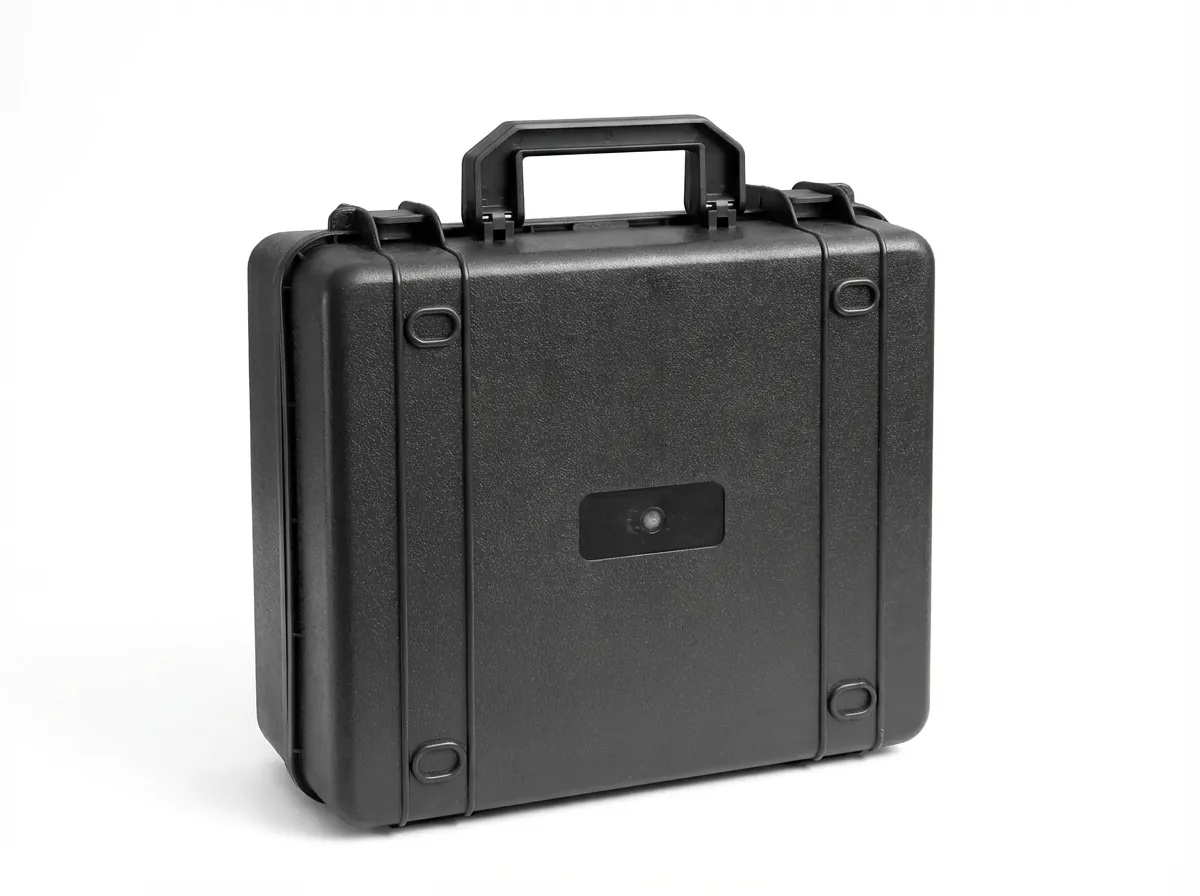
Humidity is the most underrated factor in storage because its damage is invisible.
Damage one: metal part corrosion. Hinge pins, latch springs, screws and rivets are often metal. In high humidity, zinc-plated or carbon steel parts rust first, and the corrosion products expand, jamming the pin in the hinge lug and turning a "replaceable design" into one that cannot be taken apart. Coastal and rainy-season locations make this worse.
Damage two: seal and adhesive ageing. Rubber seals hydrolyse and oxidise faster under combined heat and humidity. Hydrolysis softens the rubber and makes it tacky; oxidation hardens it and destroys elasticity. Both reduce the ingress rating before the case is ever used.
Damage three: packaging and label failure. Corrugated board loses compression strength once damp and collapses under stack load, and labels lift and fall off when exposed to moisture, leading to misidentification. In an automated warehouse, one lost label can misroute an entire batch.
Five moisture measures, ranked by value for money:
- Control the source of humidity. A dehumidifier plus sealed doors and windows beats scattering desiccant as an afterthought.
- Keep cases off the floor. Raise them at least 100 mm (empirical) on pallets or racking, so they never touch ground moisture.
- Leave wall and ceiling clearance. 300 to 500 mm from walls and at least 500 mm from the ceiling (empirical) to allow airflow and prevent wall damp conducting into the goods.
- Use desiccant. For long storage or high-value cases, add a measured amount of desiccant inside the packaging and log the replacement cycle.
- Avoid sealed, packed piles. A large pile has poor internal airflow and can form a local high-humidity pocket. Keep some air exchange between the core and the outside of a stack.
A practical test: if the warehouse walls "sweat" in the rainy season, the columns of stock against those walls carry far more risk than stock in the centre. Attention to detail in storage shows up precisely in decisions like who sits against the wall and who sits on the floor.
Sunlight and UV: the leading cause of plastic ageing
Light damage concentrates on the outer plastic and the foam insert.
Shell photo-ageing. UV energy is high and breaks polymer chains, showing up as surface chalking, yellowing, crazing and embrittlement. Light-coloured cases, white and pale grey especially, show colour shift most clearly, while dark cases absorb heat and age faster through temperature. Modified PP and ABS do contain antioxidants and light stabilisers, but their protection is finite and is consumed over time.
Foam insert photo-ageing. EVA, EPE and PU foams yellow, embrittle and lose resilience under UV. Once foam loses resilience its cushioning is gone, and this is almost invisible from the outside.
Seal photo-ageing. Rubber seals are sensitive to both UV and ozone. Long exposure produces surface cracking, and a cracked seal is a leak path.
Four ways to control light:
- Put stock in windowless or deep areas first, leaving window-side and skylight-side locations for light-insensitive materials.
- Use blinds, screens or shade netting so sunlight never lands directly on goods.
- Keep the original packaging intact. Cartons, stretch film and outer bags are themselves a UV barrier, and unpacking early is the most common mistake.
- Do not use UV lamps for long-term lighting. Some warehouses use them for sterilisation and overlook what they do to polymers.
An easily missed point: a "temporary" holding area on the shop floor is still storage. Cases waiting beside an assembly line, on a shipping dock or under an open canopy for weeks face the same light and humidity risk as formal storage. Bringing these areas under the same environmental standard is the step most companies skip.
Stacking rules: height, pallets and load direction
Stacking is the most direct mechanical risk in storage. The rule is not "how high can we go" but "how high can we go within the rated load".
Three factors in stack height:
- Rated stacking capacity of the case. Each case carries the weight of everything above it. The design should state a stacking load, and storage must convert that into an allowed number of tiers.
- Creep. Plastics deform slowly under long-term load. Even when the load is below short-term strength, sustained stacking produces permanent collapse, especially at mid to high temperatures. Long-term storage height should therefore be lower than short-term handling height.
- Stability and safety. Taller stacks tip more easily and are harder to inspect and retrieve.
Pallets and load direction:
- Always use a pallet or dunnage, at least 100 mm off the floor, to control moisture and allow forklift access.
- Keep the case in its designed load orientation, base down and lid up. Laying a case on its side or upside down puts non-design loads on the walls and can warp the lid or seal face over time.
- Do not keep the latches clamped through storage. This is the most important line in this section: if stacking load presses directly on the lid and holds the seal compressed, the seal takes a compression set. During storage, release the latches or leave them half-closed so the seal sits at natural or light compression, and clamp them only before dispatch.
| Stacking parameter | Practice (empirical) | Reason |
|---|---|---|
| --- | --- | --- |
| Floor clearance | 100 mm or more on pallet or rack | Moisture control and handling |
| Wall clearance | 300 to 500 mm | Airflow, avoid wall damp |
| Ceiling clearance | 500 mm or more | Airflow, inspection, fire safety |
| Load direction | Base down, lid up | Avoid non-design loads |
| Latch state | Released or half-closed | Prevent seal compression set |
| Long-term height | Below short-term handling height | Plastic creeps |
| Stack stability | Sensible height to base ratio | Prevent toppling |
A practical note on releasing latches. With latches open, dust and small insects can enter between lid and rim. The answer is not to clamp the seal through storage, but to blow out the rim and seal channel with clean compressed air and then clamp the latches before dispatch. Cleaning methods are covered in how to clean a protective case.
Pallets and racking: how to store without deformation
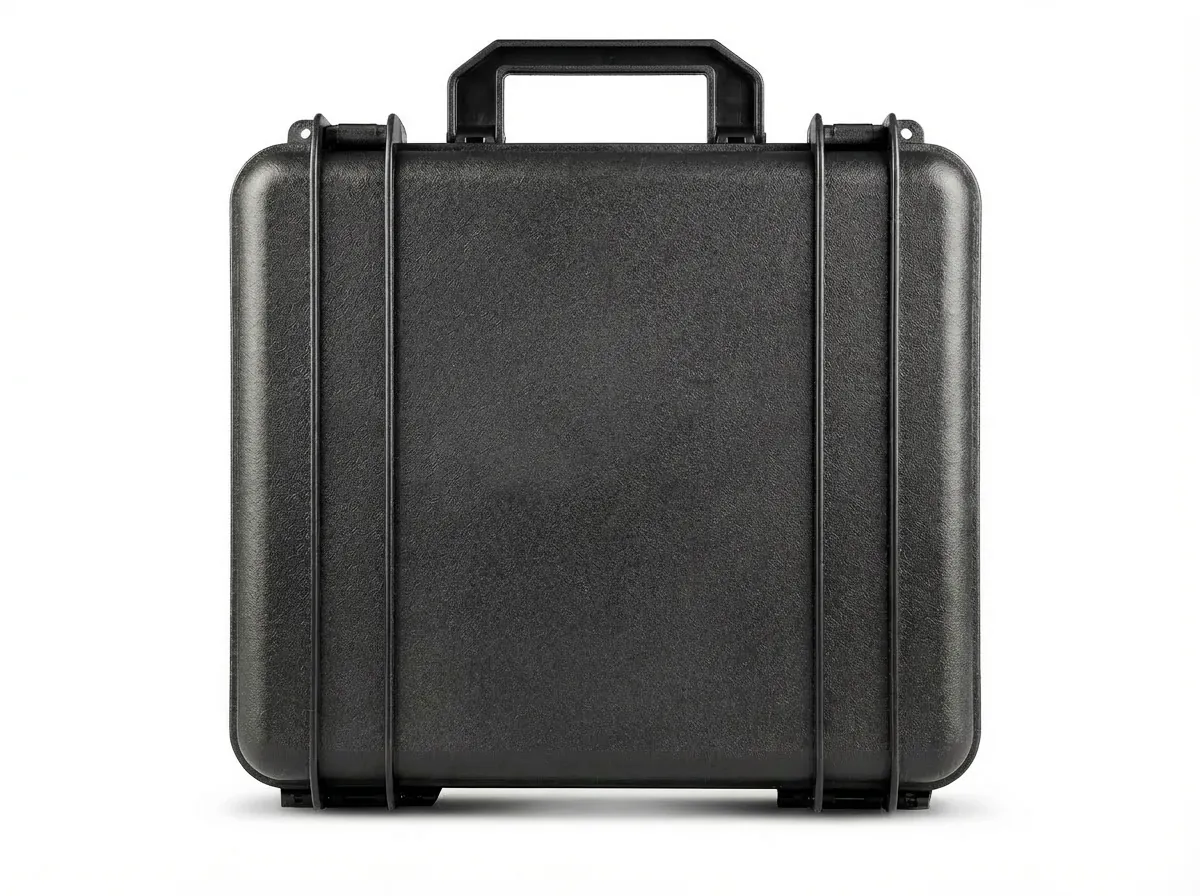
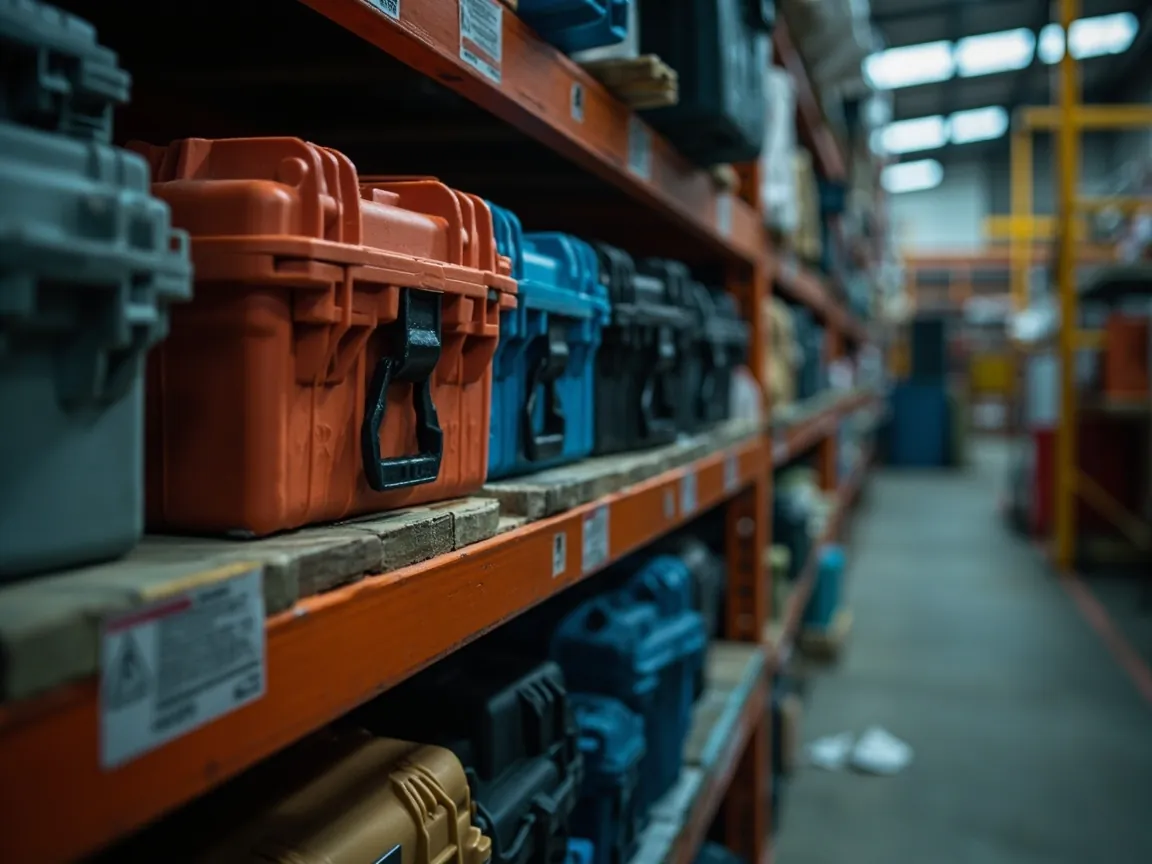
The same stack height loads a case very differently on the floor and on a rack. The choice depends on case size, weight and turnover.
Pallet stacking, best for fast turnover and heavier cases. The key is to let load travel along the case's vertical reinforcement, avoiding point loads. Pallet stiffness matters too: if the pallet bends under load, the case bends with it.
Racking, best for slower turnover and uniform sizes. Racking keeps cases from being stacked at all, which removes creep at the source. The drawback is span support between beams: if a case bridges two beams with its middle unsupported, it sags slowly under its own weight. Use closely spaced beams or a solid deck so a case never spans too wide a gap.
The governing principle: whether on pallet or rack, the support surface should be continuous or dense enough, and load should land on the case's reinforcement and walls, not on the centre of the lid or the middle of a large flat base. Structural design and stacking capability are covered in case stacking structure design and case wall thickness and strength.
| Storage method | Advantage | Main risk | Best for |
|---|---|---|---|
| --- | --- | --- | --- |
| Floor pallet stacking | Low cost, high density | Long-term creep, damp base | Fast turnover, short storage |
| Rack decking | No stacking load, easy access | Deck deflection, wide spans | Slow turnover, uniform sizes |
| Rack beams | Low cost, good airflow | Case sagging across a span | Where beam density is adequate |
| Cantilever racking | Suits long items | Concentrated single point support | Long cases, special shapes |
Protecting seals and service parts in storage
Seals, hinge pins, latches and labels have stricter storage requirements than the case body because they age faster.
Four rules for seals:
- Keep them dark and cool. Rubber is sensitive to UV, ozone and heat, so store in a cool, dark place away from ozone sources such as motors and welding equipment.
- Do not leave them under compression. Store seals relaxed, not permanently compressed and not hung, which stretches them out of shape.
- Keep them away from solvents and oils. Rubber swells or hardens.
- Run FIFO and record the production date. Rubber ages even when unused, and stock beyond its shelf life, typically 2 to 3 years and always per supplier data, should be re-assessed or scrapped.
Three rules for metal parts:
- Moisture control first. Store hinge pins, springs and screws dry, with rust-preventive packaging where needed.
- Stainless is not rust-proof. 304 can still pit in chloride environments, so coastal warehouses need particular care.
- Do not mix dissimilar metals directly. In damp conditions they drive galvanic corrosion.
Three rules for foam inserts:
- Dark, cool and no heavy compression. Foam that stays compressed loses resilience.
- Keep away from plasticisers and solvents. Some chemicals soften or dissolve foam.
- Watch shelf life. EVA, EPE and PU foam properties decay with time and temperature, and PU foam is particularly sensitive to humidity.
Spare parts planning and storage management are two sides of one thing. Stocking service parts in sensible quantities and managing them to a storage standard is what makes after-sales and repair genuinely "ready when needed". Planning spare types and quantities is covered in protective case spare parts stocking list.
Standards behind stacking verification
Stacking capability should not be decided by feel. The following standards are widely used in industrial and export packaging:
| Standard | Name and purpose | Use in case storage |
|---|---|---|
| --- | --- | --- |
| ISO 2233 | Packaging, complete filled transport packages, conditioning for testing | Condition samples before stacking tests |
| ISO 2234 | Packaging, complete filled transport packages, static stacking test | Determine static stacking capacity |
| GB/T 4857 series | Packaging, basic tests for transport packages | Stacking, vibration, impact methods |
| ASTM D4169 | Standard practice for performance testing of shipping containers and systems | Simulate combined transport and storage loads |
| ISPM 15 | Regulation of wood packaging material in international trade | Treatment rules for wooden pallets and crates |
| ISO 9001 | Quality management systems | Controlled, traceable storage operations |
How to use them in three lines:
- Run the stacking test to ISO 2234 or the GB/T 4857 static stacking method to get deformation and failure data at a defined load and time.
- Condition the sample to ISO 2233 first. Plastic properties depend strongly on temperature and humidity, so testing without conditioning produces data that cannot be compared.
- Write the resulting stacking load into the storage standard, stating how many tiers are allowed, how long storage may last, and whether mid-term restacking is needed.
A reality check: a stacking test usually validates only a limited time, perhaps 24 hours or a few days, while real storage can run for months or years. Creep accumulates under long-term load, so the practical storage height should be below the test value with a sensible safety factor, empirically 1.5 to 2.
Pest control and wood packaging requirements
Storage also involves biological factors, especially where cases or inserts contain foam, textiles or paper.
Four pest measures:
- Seal wall openings and gaps to reduce rodent entry routes.
- Keep the area clean and free of food residue, with a separation between loading areas and rest areas.
- Inspect foam and textile inserts periodically, and isolate any batch showing gnawing or insect damage.
- Do not leave stock unchecked for long periods. The interior of a stack is a hiding place.
Wood packaging and ISPM 15. If storage or export uses wooden pallets or crates, ISPM 15 applies: wood packaging material must be heat treated or fumigated and marked with the IPPC logo. This is not an internal warehouse matter but a hard customs requirement; without it, an entire consignment can be held or required to be treated at destination. Buyers should confirm treatment certificates and marks with the supplier.
Another easily missed point: pallet moisture content. A treated pallet that is still damp conducts moisture into the case and can develop mould inside a stack. Dry wooden pallets thoroughly before use.
FIFO and inventory turnover
Storage rules ultimately depend on turnover for enforcement.
Four ways to make first-in-first-out work:
- Label production date or batch on arrival and store by date zone.
- Pick the oldest batch first as a written rule, not a picker's memory.
- Design locations so old stock is on the aisle side and new stock behind it; physically it must be possible to reach old stock first.
- Count regularly and flag slow-moving batches, assessing anything beyond a set storage period.
Why do protective cases need FIFO in particular? Because their life starts on the production date, seals especially. A case stored for two years and one fresh off the line may look identical, but the seal elasticity is not. How life is composed and judged is covered in how many years does a protective case last.
Safety stock for turnover. Storage practice and procurement strategy are consistent: avoid both piling up stock that ages in place and running short when an order lands. Sensible safety stock keeps the inventory cycle inside the seal-ageing window, and the method is covered in how to set protective case inventory safety stock. Storage is also the key point for keeping refurbished or counterfeit material out; incoming inspection and storage marking are covered in how to identify genuine versus fake protective cases.
Inbound and outbound checklists
Rules are only enforced when they become a checklist.
| Stage | Check item | Acceptance guide |
|---|---|---|
| --- | --- | --- |
| Before inbound | Packaging intact, no damage or water | Open and inspect if damaged |
| Before inbound | No deformation, scratches or colour shift | Compare with the retained sample |
| Before inbound | Seal intact, no permanent set | No permanent indent |
| Before inbound | Label and batch legible | Identifiable, traceable |
| On inbound | Stored in the design orientation | Base down, lid up |
| On inbound | On pallet, off the floor | At least 100 mm clearance |
| On inbound | Latch state per standard | Released or half-closed |
| In storage | Temperature and humidity in range | Logged daily |
| In storage | No direct sunlight patch | Weekly patrol |
| In storage | Stacks upright, no deformation | Per batch |
| Before outbound | Rim and seal channel blown clean | No dust, no debris |
| Before outbound | Latches clamped, seal checked | Even contact, no gap |
An execution note: the checklist does not need to be long, but it must be signed and dated. An inspection with no record is not an inspection. Under ISO 9001, controlled and traceable storage operations are a standard audit focus.
Common storage mistakes and corrections
| Mistake | Direct consequence | Correction | Stage |
|---|---|---|---|
| --- | --- | --- | --- |
| Stored directly on the floor | Damp base, mould | Pallet or rack, 100 mm up | Inbound |
| Against wall or ceiling | Damp transfer, no airflow | Leave wall and ceiling clearance | Layout |
| Latches clamped long term | Seal compression set | Release during storage | Inbound |
| Over-height stacking | Creep deformation | Set tiers from rated load | Inbound |
| Unpacking early | Photo-ageing, dust | Keep original packaging | Inspection |
| Mixed storage of seals | Ageing and corrosion | Separate storage | Layout |
| No FIFO | Old stock ages past life | Batch labels and location design | Planning |
| Temporary areas excluded | Management blind spot | One standard for all storage | Management |
The common logic behind every correction: treat storage as the first stage of the product lifecycle, not as a car park.
JUNZHJIA, manufactured by KeXin New Materials (Guangdong) Co., Ltd., supports wholesale, distribution and OEM/ODM programmes. It provides stacking load data, seal storage recommendations and matching service parts, and issues inspection records covering material and structure, so buyers can link storage practice to product life management.
Frequently Asked Questions
Q: Should protective cases be stored with the latches clamped or released? A: Release them, or leave them half-closed, during storage, and clamp them again before dispatch. The reason is that sealing depends on elastic compression, and rubber under sustained compression takes a compression set. If latches hold the seal at working compression for months or a year, the seal loses part of its resilience, and sealing performance drops before the customer ever uses the case. A good standard says release or half-close on inbound, keep the seal at natural or light compression, then before outbound check the rim and seal channel for dust, blow them clean with compressed air, clamp the latches and confirm even contact. Note that with latches open, dust can enter between lid and rim, so the pre-dispatch cleaning step is not optional. If you worry about the lid shifting, place a layer of non-woven fabric or pearl cotton between lid and case; it keeps dust out without holding the seal compressed.
Q: What temperature and humidity should a warehouse hold? A: A typical industrial range is 5 to 30 C and 45 to 65 percent relative humidity. Two things matter more than the absolute numbers. First, avoid sharp swings: keep the daily variation under about 10 C, because repeated warming and cooling cycles a case through condensation and evaporation, which harms seals and metal more than steady high humidity. Second, avoid local dead zones: place loggers at floor, mid and top levels, because vertical variation is often larger than horizontal variation and a large pile can form a stagnant damp core. Ranked by value for money, control measures are sealed openings with a dehumidifier first, then pallets and floor clearance with wall and ceiling clearance, and desiccant last. If walls sweat in the rainy season, the columns of stock against them carry the highest risk, so move humidity-sensitive seals and metal parts to the centre of the warehouse.
Q: How high can protective cases be stacked, and is there a standard? A: Height must come from the rated stacking load, not from habit. The main references are ISO 2234, static stacking test for complete filled transport packages, which determines static stacking capacity, and the GB/T 4857 series, which sets out basic test methods for transport packages including stacking. Before testing, condition samples to ISO 2233, because plastic properties are strongly temperature and humidity dependent; without conditioning the data cannot be compared. Once you have the stacking load, divide by the single-case weight to get tiers, and note two things. First, plastics creep, so long-term storage height should be below short-term handling height with an empirical safety factor of 1.5 to 2. Second, a stacking test validates only limited time while storage can run for months, so the standard should state maximum storage duration and whether restacking is needed. For export pallets, ISPM 15 treatment and marking also apply.
Q: Why can protective cases not be stored under sustained heavy load? A: Because plastics are viscoelastic and creep under long-term load. Creep means that even when the load is below short-term strength, the material slowly takes a permanent deformation over time. For a protective case the consequences are threefold: the wall slowly collapses in the load direction, the lid sags, and, most importantly, the flatness of the rim changes. Once rim flatness changes, seal compression is no longer uniform, and a local shortfall becomes a leak path. Storage stacking must therefore be designed for long-term load, not short-term strength, typically with a height below the handling height and a safety factor of 1.5 to 2. Cases should also stay in the design orientation, base down and lid up; laying them on the side or upside down puts non-design loads on the walls and can warp the lid or seal face.
Q: What special storage requirements do seals and service parts have? A: Service parts have stricter requirements than the case body because they age faster. For seals: keep them dark and cool, since rubber is sensitive to UV, ozone and heat, and store away from motors and welding equipment; do not leave them under compression, store relaxed and never hung, because hanging stretches them; keep them away from solvents and oils, which cause swelling or hardening; run FIFO and record production dates, because rubber ages even unused and stock beyond its shelf life, typically 2 to 3 years per supplier data, should be re-assessed or scrapped. For metal parts: moisture control first, storing hinge pins, springs and screws dry with rust-preventive packaging where needed; remember stainless is not rust-proof, as 304 can pit in chlorides, so coastal warehouses need care; and do not mix dissimilar metals directly, to avoid galvanic corrosion. For foam inserts: keep them dark, cool and uncompressed, and watch shelf life, since PU foam is especially humidity sensitive.
Q: How much harm does light actually do to protective cases? A: Light damage concentrates in UV, the leading cause of polymer ageing, and it produces three types of damage. First, the plastic shell chalks, yellows, crazes and embrittles; light-coloured cases show colour shift most clearly while dark ones absorb heat and deform faster. Second, foam inserts yellow, embrittle and lose resilience, and once resilience is gone the cushioning is gone, which is almost invisible from outside. Third, rubber seals develop surface cracks, and a cracked seal is a leak path. Four controls apply: put stock in windowless or deep areas first and leave window-side locations for insensitive materials; use blinds, screens or shade netting so sunlight never lands on goods; keep the original packaging intact, because cartons and stretch film are themselves a UV barrier and unpacking early is the most common mistake; and do not use UV lamps for long-term lighting. Note also that line-side areas, shipping docks and open canopies are storage too, and bringing them under the same light and humidity standard is the step most companies skip.
Q: What special requirements apply to wooden pallets and crates? A: Two main requirements. First, export quarantine: wood packaging in international trade must follow ISPM 15, Regulation of wood packaging material in international trade, meaning it must be heat treated or fumigated and marked with the IPPC logo. This is a hard customs requirement rather than an internal matter, and a missing mark or certificate can lead to a consignment being held, returned or treated at destination, so buyers should confirm treatment certificates and marks with suppliers. Second, moisture content: a treated pallet that is still damp conducts moisture into the case and can develop mould inside a stack, so wooden pallets should be dried thoroughly before use. Wood packaging is also a pest carrier in its own right, so keep it reasonably separated from other goods and include it in pest inspection rounds.
Q: How do I make FIFO actually happen? A: FIFO needs four conditions at once. First, label on arrival: mark production date or batch as soon as goods arrive, store by date zone, and keep labels legible. Second, ship oldest first: write the picking rule into the work instruction instead of relying on memory. Third, design locations to help: old stock on the aisle side, new stock behind it, so old stock is physically reachable first; if new stock blocks old stock, no policy will survive. Fourth, count regularly and flag slow movers: assess anything beyond a set storage period and dispose of or scrap it if it no longer meets requirements. Protective cases need FIFO especially because their life starts on the production date, seals above all; a case stored two years and a fresh one may look the same, but the seal elasticity differs. Combining FIFO with sensible safety stock avoids both ageing in place and urgent shortages.
Q: What are the most common storage mistakes? A: Eight recur most often. Storing directly on the floor causes a damp base and mould; use pallets or racks at least 100 mm up. Storing against walls and ceilings causes damp transfer and poor airflow; leave 300 to 500 mm from walls and 500 mm from the ceiling. Clamping latches long term causes seal compression set; release or half-close during storage. Stacking too high causes creep deformation; set tiers from the rated load and add a safety factor. Unpacking early removes the UV and dust barrier; keep the original packaging and use sampling inspections. Mixing seals with metal parts causes ageing and corrosion; separate them. Skipping FIFO leaves old batches ageing past their life. Excluding temporary areas such as docks, line-side and canopies creates a management blind spot. The common logic in every correction is the same: treat storage as the first stage of the product lifecycle.
Conclusion and Related Reading
Back to the title question: storage management for protective cases comes down to controlling temperature, humidity, light and stacking load. Hold 5 to 30 C and 45 to 65 percent RH, keep cases out of direct sunlight, limit stack height by rated load, and add pallets, wall clearance and FIFO. The most overlooked and most valuable single rule is this: release or half-close the latches during storage so the seal does not take a permanent compression set.
Three actions to take now. First, put latch state into the storage standard. Release on inbound, clean and clamp before dispatch; it costs almost nothing and materially extends seal life. Second, replace stacking habit with data. Get the stacking load from ISO 2234 or GB/T 4857, convert it to tiers, and apply a safety factor of 1.5 to 2. Third, bring temporary storage areas under the same standard. Docks, line-side and canopies face the same environmental risk as the warehouse, and only one standard removes the blind spot.
JUNZHJIA, manufactured by KeXin New Materials (Guangdong) Co., Ltd., covers protective cases, toolboxes, military-spec storage cases and waterproof junction boxes, and serves wholesale, distribution, OEM/ODM and global supply. It provides stacking load data, seal storage recommendations and matching service parts, and issues inspection records covering material and structure.
Further Reading