

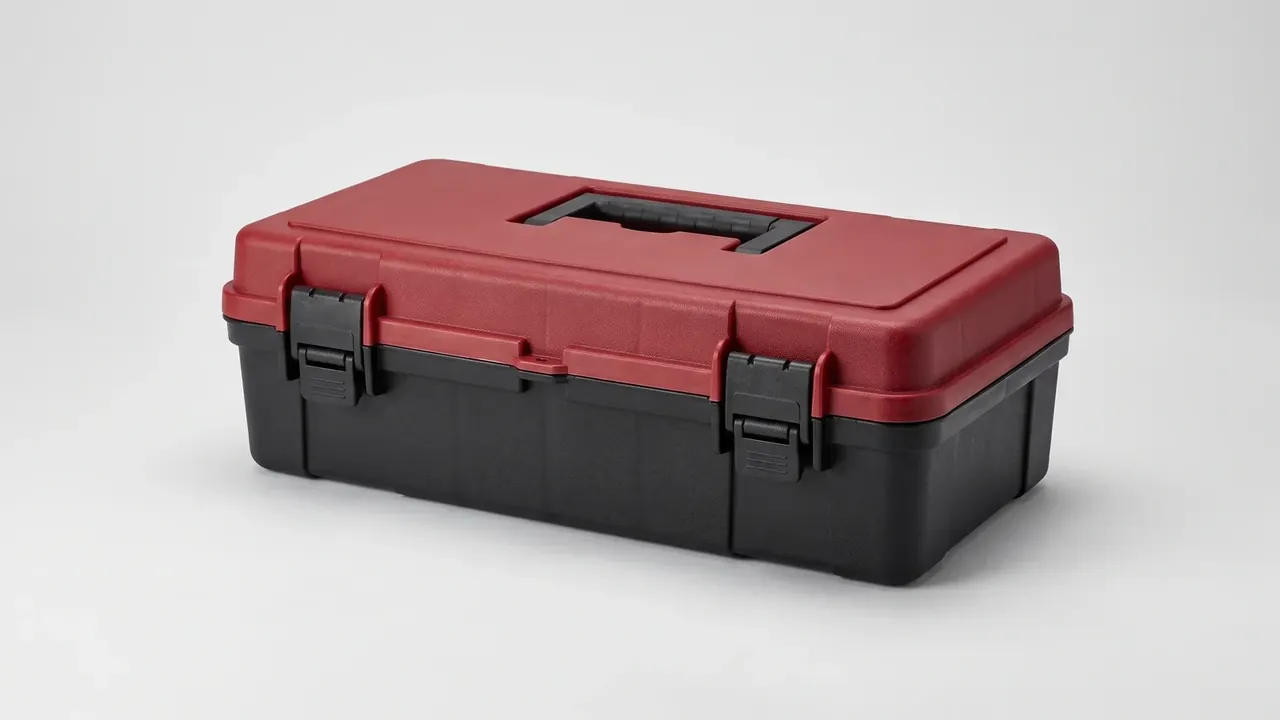
Quick answer: An electrician tool box plastic body stops accidental contact and damp, not live work. Three numbers decide it: how far volume resistivity falls from dry to wet, what specimen the 1 kV proof test used, and how far metal parts sit from anything energised.
Table of contents
- Kill the Assumption: a Plastic Box Is Not Insulated
- PP and ABS: Volume Resistivity, Water Uptake, Temperature
- What a 1 kV Test Actually Proves
- Four Conflicts Between Insulated Tools and the Case
- Six-Month Inspection and Scrap Criteria
- FAQ
1. Kill the Assumption: a Plastic Box Is Not Insulated
A new hand laid an open electrician tool box plastic case on its side in front of a panel and used it as a bench for a wrench. The foreman stopped it in one line: the case carries tools, not a person, and it does not shield live parts.
Three conflations sit behind that line: material insulation is not structural insulation, and structural insulation is not work insulation. A plaque survives 1 kV in a lab; as a case, the seam, latches, hinge pin and foam cut-outs reconnect the path.
| Claim | Boundary | Check |
|---|---|---|
| Plastic does not conduct | High dry, low wet | 48 h at 40 °C, 93% RH, retest |
| It passed a proof test | Run on a plaque, not a case | Specimen, electrode, ramp rate |
| Tools inside are enough | Metal needs distance | 8 mm from live part to metal |
An electrician tool box plastic case is the last layer of protection, never the first; lockout, proving dead, earthing and barriers come before it.
2. PP and ABS: Volume Resistivity, Water Uptake, Temperature
Bodies are PP or ABS. PP runs 10¹⁶ to 10¹⁷ Ω·cm with 0.01 to 0.03 percent water uptake; ABS sits near 10¹⁵ Ω·cm and takes up 0.2 to 0.45 percent, an order of magnitude more. In a dry month either will do; as humidity climbs, the gap shows.
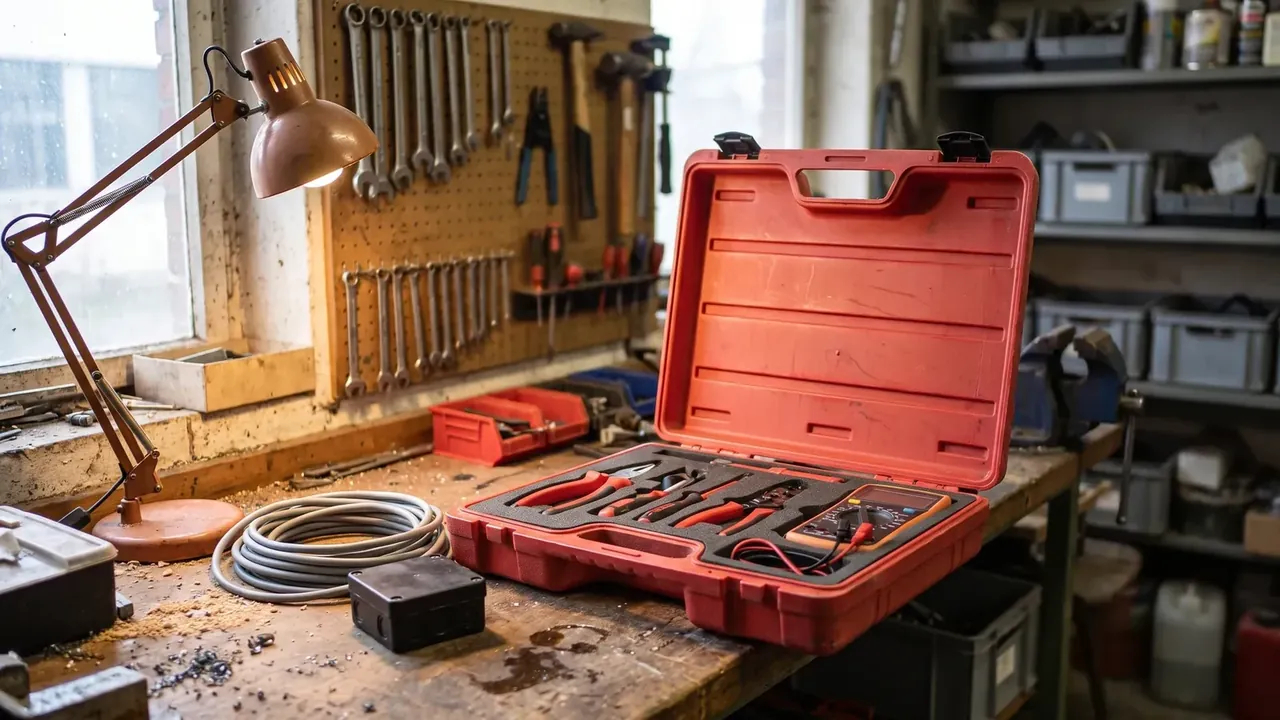
In a chamber at 40 °C and 93% RH for 48 hours, PP falls from 10¹⁴ Ω to 10¹² Ω at the surface; ABS falls further. The polymer has not changed, a water film has bridged it.
Temperature is the other half. PP turns brittle near minus 10 °C and splits at the corner on a drop; ABS keeps more impact strength but pays in water uptake, so a winter job in the north and a rainy-season job in the south should not get the same grade.
3. What a 1 kV Test Actually Proves
The proof test is the most quoted number and the most misread: a 100 by 100 mm plaque, 3 mm thick, a 25 mm electrode over a 75 mm earth, a 500 V/s ramp, 1 kV for one minute, leakage under 5 mA.
Read those conditions and the claim shrinks. The plaque did not break down between two electrodes of a given shape; that says nothing about an assembled case, where electrode placement, metal liners and shut latches all move the result.
| Parameter | Value |
|---|---|
| Specimen | 100 × 100 mm, 3 mm |
| Electrodes | 25 mm over 75 mm |
| Ramp, hold | 500 V/s, 1 kV, 60 s |
| Leakage limit | 5 mA |
PP breaks down near 20 kV per mm, so 3 mm suggests 60 kV in theory. Field failures rarely cross the thickness; they creep along the surface. At 400 V, pollution degree 3, material group IIIa, plan 8 mm of creepage and 4 mm of clearance, which decide more about an electrician tool box plastic body than any breakdown figure.
4. Four Conflicts Between Insulated Tools and the Case
The first is damp: carried in from a van after rain, the electrician tool box plastic wall wears a film of water, so opening it means wet hands on wet handles. The second is damage. A 0.5 mm scratch looks cosmetic, but it breaks the dense skin and doubles the moisture uptake.
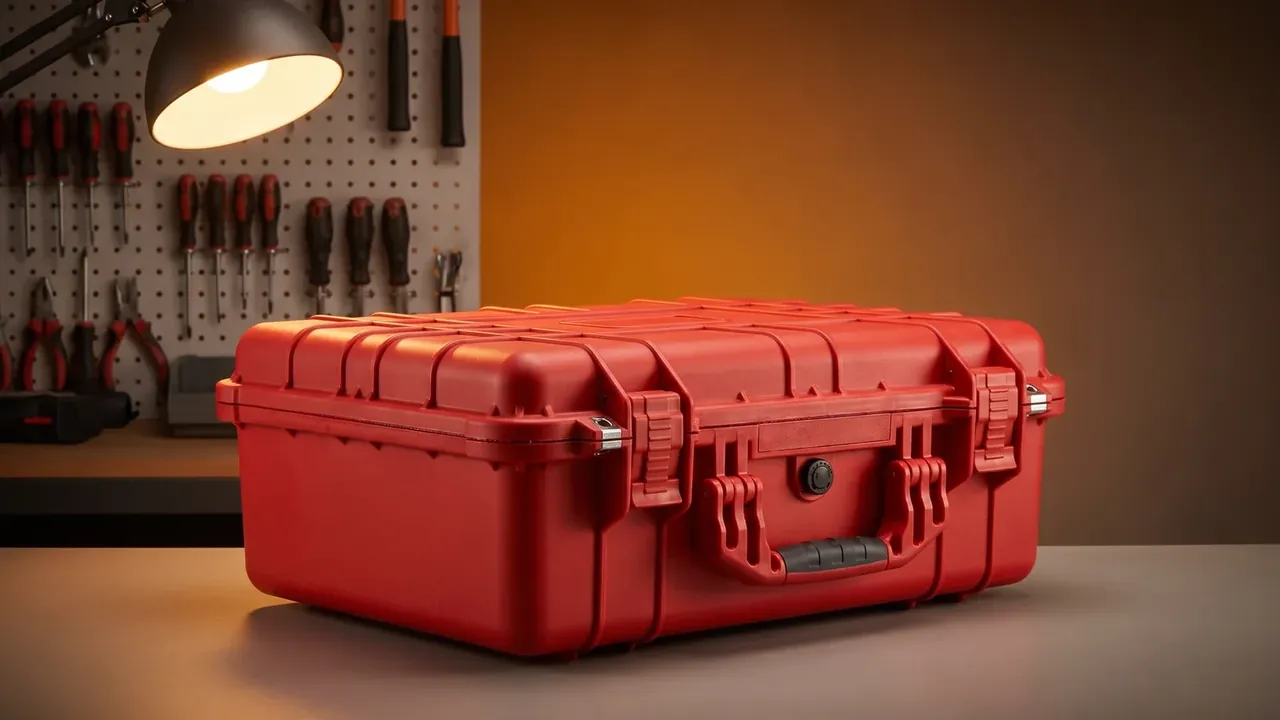
The third is missed most often: metal. Latch springs, hinge pins, rivets and name plates cut the insulating surface into segments, and the shortest path sets the distance. The 8 mm line comes back from the creepage rule at 400 V.
The fourth is the insert and the cleaning. Wet foam is a mix of polymer and moisture, and wiping with alcohol or thinner strips the antistatic layer with the moulding residue. Neutral detergent, a dry cloth, 24 hours of air before the lid closes.
5. Six-Month Inspection and Scrap Criteria
An electrician tool box plastic body is judged on records, not age. Inspect every six months, sign the sheet, keep it with the case.
- Insulation resistance: 500 V megohmmeter, 100 mm gap, 100 MΩ or better.
- Cracks: over 5 mm long or 0.5 mm deep, retire.
- Dents: 2 mm of set, or 10 percent of wall lost.
- Exposed metal: latch spring, hinge pin or rivet head showing.
- Weight: 1.5 percent above shipping weight after drying.
- Retest: 1 kV for one minute, leakage over 5 mA, out of service.
Scrapping is not binning: downgrade to non-electrical storage, or cut the base off as a parts tray, once the old marking is ground away.
Conclusion
Three numbers draw the boundary: the drop from 10¹⁶ Ω·cm dry to 10¹² Ω wet, the plaque-only conditions behind a 1 kV minute, and 8 mm from metal to live part. Hold all three and an electrician tool box plastic body is reliable insulated storage; lose one and it is only plastic.
This article discusses only the container (case body) side of specifications and design intent, and does not cover any handling, loading or use of the contents.
Related Reading
- Hardware tool boxes on the workshop floor
- Moving a tool case on casters
- Laying out compartments inside a tool box
- Tool chests and tool boxes, divided by job
Related Products
- 8 Series — Gun Cases; Military Equipment Cases; Camera Equipment Cases; Drone Cases; Watch Cases; Knife Cases; First Aid Cases; Electronics Equipment Cases
- WL8-2812 PP Gun Case — model WL8-2812
- All protective cases and toolboxes: 7 series, 158 models