

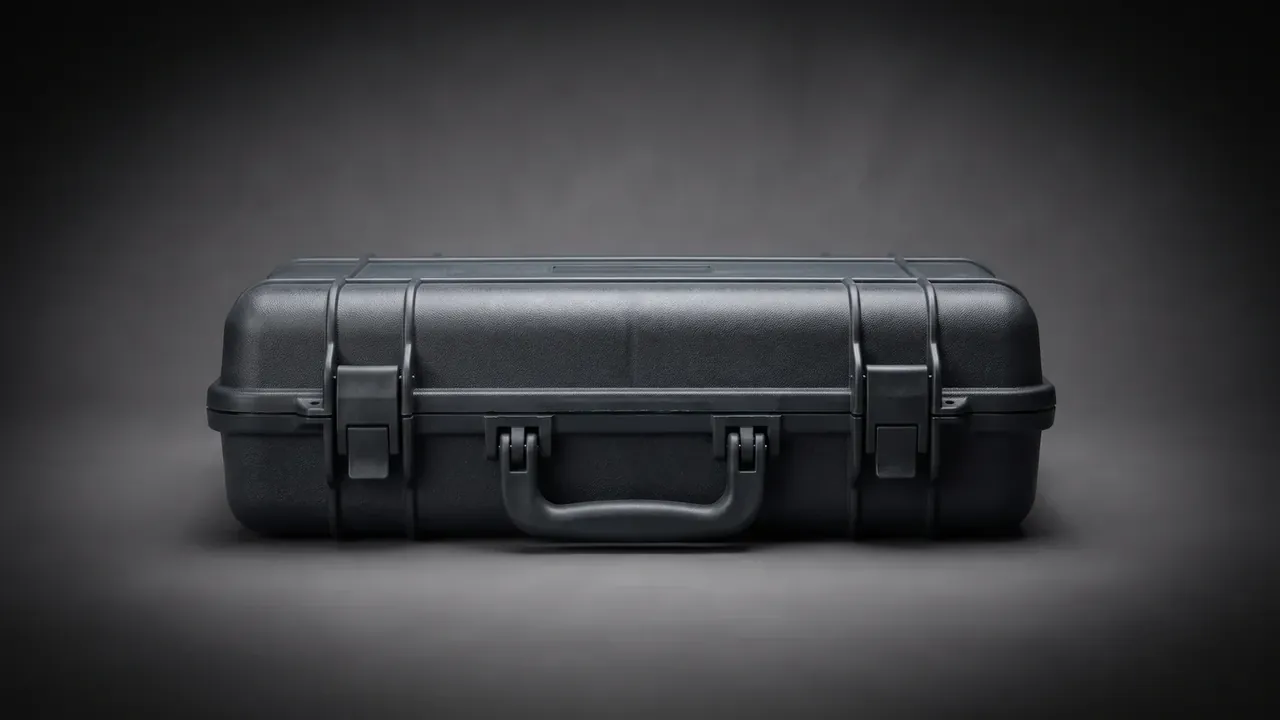
Quick answer: A quote for an Electronic Equipment Case usually carries two lines, body and insert; minimum order, tooling ownership, lead-time milestones and payment terms sit in the email instead. Put those four on one basis and the lowest price often becomes the highest.
Table of contents
- The Quote Sheet Is Missing Four Lines
- Minimum Order and Tooling: Who Pays, Who Owns
- Split Lead Time into Four Milestones
- Payment Terms Are Part of the Price
- Five Traps and the Question That Defuses Each
- FAQ
1. The Quote Sheet Is Missing Four Lines
An enquiry email usually holds one outline drawing and a line saying it has to fly. Three days later three quotes arrive between 340 and 452 RMB per unit, a spread of thirty per cent. It reads like a process difference; half of it comes from four lines nobody wrote.
The quote itself carries two rows: body price, insert price.
| Omitted item | Usual wording | What it does to cost | What to ask |
|---|---|---|---|
| Minimum order | Made to batch | A 200-piece run spreads a 3-hour changeover over every unit | What is the minimum batch, and what is the premium below it |
| Tooling | Extra | 28,000 RMB once, or amortised into the unit price | Is tooling refundable, and who owns the mould |
| Lead time | About 30 days | From which date, and does it include first-article approval | Days for sample, tooling, approval, production |
| Payment | Cash before shipment | 90-day terms equal a 1.5 per cent discount | Deposit share, balance trigger, retention |
None of those four lines is a product feature, and all of them set the total. Put three quotes on one basis and the spread usually narrows from thirty per cent to under ten, with the ranking changing places.
2. Minimum Order and Tooling: Who Pays, Who Owns
A rotomoulding tool is a welded aluminium shell at 28,000 RMB, and a cavity change only moves a weld bead. An injection steel mould runs 96,000 RMB and a single change needs new EDM work. On the cheaper tool, minimum order can drop to 50 units; on the dearer one, the plant treats 500 as the gate.
| Batch | Tooling per unit | Material and labour | Unit price, insert excluded |
|---|---|---|---|
| 200 | 140 RMB | 312 RMB | 452 RMB |
| 500 | 56 RMB | 296 RMB | 352 RMB |
| 2,000 | 14 RMB | 278 RMB | 292 RMB |
The gap between 452 and 292 is 160 RMB for an identical product. Most claims that one supplier is dear come from that supplier quoting your 200 units as 200 units, while the other quietly priced the 500-unit step.
Tooling is paid two ways, and each carries its own ownership. Pay 28,000 RMB outright and the mould should belong to the buyer, with three things written in: mould number and cavity count, storage location, and the right to demand transfer after twelve months without production. Amortise it per unit and the mould stays with the plant, leaving the buyer a right of use that cannot travel to a new supplier.
The third wording is the dangerous one: tooling refunded after 5,000 cumulative units. The money comes back; the mould does not.
Moving a mould is not moving a machine. Stripping takes three days, the aluminium shell needs a crated pallet, and remounting at the new plant needs two days of trial shots. Five days plus freight usually starts at 4,000 RMB, and whoever pays is decided by a contract clause that is often missing.
3. Split Lead Time into Four Milestones
Thirty days means three different things depending on whether the tool exists, has to be built, or has to be modified. Ask in milestones, or the number has no starting point.
| Milestone | Typical days | Where it stalls | Compressible to |
|---|---|---|---|
| Sample by hand | 11 | Foam cutting queue | 7 days, plus 800 RMB |
| Tooling | 32 | Aluminium welding and finishing | 24 days, plus 15 per cent |
| First-article approval | 6 | Buyer's internal review | 3 days, by video |
| Production, 1,000 units | 24 | 22-minute mould cycle, two shifts | 18 days, three shifts |
| Total | 73 | — | 52 |
Of the four, first-article approval is the only one the buyer controls. Samples that sit in a quality department for two weeks are common, while the plant counts production from the approval date, so the delay lands on the buyer. Write approval as a written reply within three working days, deemed accepted after that, and half the argument disappears. Within the 32 days of tooling, only 21 are machining; the rest is scheduling. In peak season, March to May and September to November, aluminium welding queues push the same mould to 45 days, so booking tooling in a quiet month or accepting a plant's existing near-size cavity are the two practical routes. The 24-day production figure assumes two shifts; three shifts reach 18 days, but night-shift reject rates usually run two points higher, and that belongs in the same calculation.
The three words a lead-time table must never omit are the start date.
4. Payment Terms Are Part of the Price
Payment terms are a price clause wearing a finance label. At an identical 352 RMB, cash before shipment and 90-day terms differ by about 1.5 per cent at a 6 per cent cost of capital, which means a supplier offering 90 days has already priced that 1.5 per cent in.
The deposit share decides whether the plant schedules you at all. Thirty per cent is the rotomoulding norm; below 20 per cent, orders sit behind customers who paid 50 per cent, and the delay never shows on the lead-time table.
Retention of 5 per cent held for six months is the buyer's only effective quality lever.
The basis needs writing down, though: tax-inclusive or net, first batch or full year, and whether returns are deducted from it. One wrong word turns 5 per cent into 3, which over a year is worth dozens of cases.
5. Five Traps and the Question That Defuses Each
Numbers on a quote do not lie, they omit. These five are the most common omissions, each followed by the question that closes it.
- Wall quoted at the lower tolerance limit. A 6 mm callout with 5.1 mm measured is still in tolerance, 15 per cent lighter and 8 per cent cheaper. Ask whether the figure is nominal or a measured floor, and put the six-point minimum into the contract.
- Insert quoted at 25 mm against a 30 mm drawing. Every 5 mm of EVA saves 11 RMB and costs about a third of the cushioning stroke. Ask for thickness, density and closed or open cell, all three in writing.
- Packaging excluded. A carton and pallet add 12 RMB per unit and an export crate 46 RMB, invoiced at shipment. Ask whether packaging is included and whether export needs fumigation.
- No inspection standard. AQL 2.5 against full inspection is a 6 per cent difference, and the contract turns out to say only that national standards apply. Ask for the AQL value, sampling ratio, judgement items and disposition of rejects.
- A one-way raw material clause. Polypropylene rising 8 per cent on the monthly average triggers a price rise, and a fall triggers nothing. Ask for the trigger, the reference index, and symmetry, attached as an annex.
The first two traps change the product; the last three change the arithmetic. The product ones cost more: 0.9 mm less wall puts a stacked case into collapse at the third layer, while a 12 RMB carton is only a number on an invoice.
Conclusion
The price of an Electronic Equipment Case does not live in the unit-price column. It lives in minimum order, tooling ownership, the lead-time start date and payment terms. Put those four on one basis and a thirty per cent spread becomes ten; leave them out and the lowest quote is the dearest one.
This article discusses only the container (case body) side of specifications and design intent, and does not cover any handling, loading or use of the contents.
Related Reading
- What to audit in a case supplier's qualification file
- The numbers to watch on trial moulding day
- Mould upkeep and who carries the cost
- Export packaging and pallet marking rules
- Scheduling and delivering mixed orders
Related Products
- 8 Series — Gun Cases; Military Equipment Cases; Camera Equipment Cases; Drone Cases; Watch Cases; Knife Cases; First Aid Cases; Electronics Equipment Cases
- WL8-2812 PP Gun Case — model WL8-2812
- All protective cases and toolboxes: 7 series, 158 models