

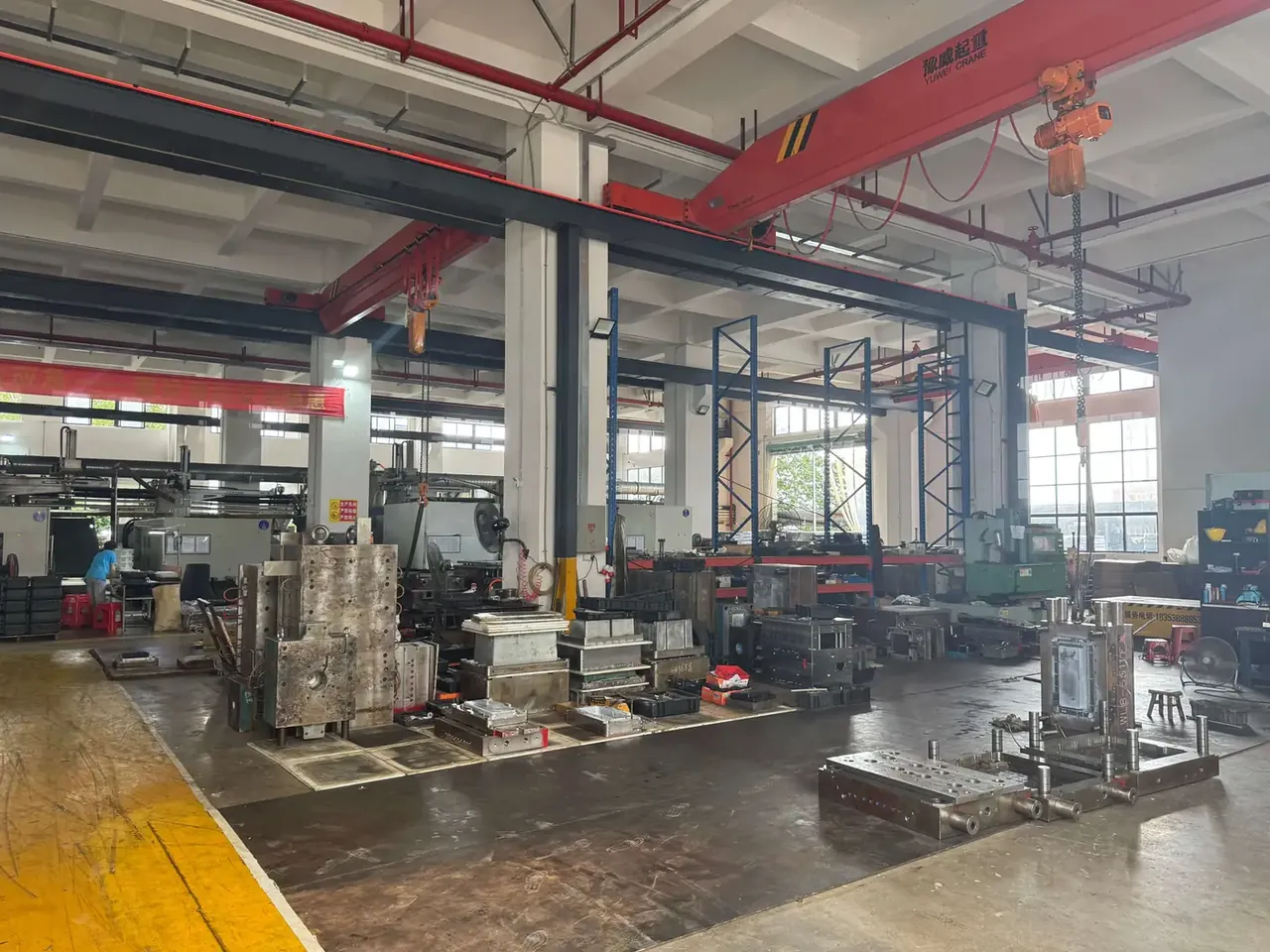
Quick answer: Three checks carry most of the risk on a Case Mould: the parting line, the water circuit and the ejector pins. Set intervals by shot count, with a fixed limit for each: 5,000 shots for the parting line, one quarter for descaling, 10,000 for pin straightness.
Table of contents
- Setting the Service Interval for a Case Mould
- Parting Line: Clean Every 5,000 Shots
- Water Lines: Quarterly Descaling and Temperature Spread
- Ejector Pins: Bend and Return Checks at 10,000 Shots
- Tooling, Consumables and Downtime
- FAQ
1. Setting the Service Interval for a Case Mould
Wear tracks clamp cycles, melt temperature and water quality, so calendar schedules drift. Anchor on the shot counter: an 800-tonne press at 900 shots a day reaches 5,000 in five days, while lids on a 300-tonne machine take half that.
The three failure modes are unrelated: the parting line is a sealing boundary where steady flash means a gap has formed, water lines lose heat transfer as scale builds, and pins bend before they break.
| Part | Interval | Limit | Action |
|---|---|---|---|
| Parting line | 5,000 shots | 0.02 mm score | Grind or weld |
| Water lines | Quarterly | Flow down 15%, spread over 3 °C | Descale, reseal |
| Ejector pins | 10,000 shots | 0.05 mm bend | Replace pin |
The interval only holds if the counter is read: mount it on the fixed half, reset at each changeover, and copy the value onto the service card.
2. Parting Line: Clean Every 5,000 Shots
Cleaning restores the contact band, not the shine. Lock off, pull sprue residue, then scrape overflow with brass or bamboo along the cavity edge. Abrasive paper is forbidden; a hand scratch becomes a channel for melt. Blow the vents clear; they run 0.02 to 0.03 mm deep.
Read damage as depth, position and direction with red lead bluing or a 0.02 mm feeler; if the blade enters, the tool is out of limit. Damage on the cavity sealing face beats the outer land, because only the first makes flash.
| Depth | Symptom | Treatment | Downtime |
|---|---|---|---|
| under 0.02 mm | Bright spots, no flash | Lapping paste, one direction | 1 hour |
| 0.02–0.05 mm | Fine flash | Oilstone, bluing check | 4 hours |
| 0.05–0.1 mm | Continuous flash | Local weld, then grind | 1 shift |
| over 0.1 mm | Visible step | Re-machine or new insert | 2 shifts |
Work paste in one direction only; circular motion spreads a score into a hollow. Close dry three times at thirty percent of clamp force, since a large face tilts and crushes the band just repaired.
3. Water Lines: Quarterly Descaling and Temperature Spread
Circulate five percent citric acid for forty minutes, neutralise, rinse for fifteen. Treat cavity and core separately; acid run in series weakens and the second half is wasted. Case tools carry 8 to 12 mm channels, and 0.1 mm of scale costs about twenty percent of local heat transfer.
Judge flow against the acceptance record; a fifteen percent drop triggers action. Inlet-to-outlet spread should stay within 3 °C. Pressure-test at 6 bar for ten minutes and allow 0.2 bar of decay. Drain before winter; trapped water freezes and splits a channel.
4. Ejector Pins: Bend and Return Checks at 10,000 Shots
Every 10,000 shots, retract the plate, pull each pin and lay a straight edge along it; light underneath means a bend. Replace anything past 0.05 mm rather than straightening it, since a straightened pin wears the bore oval and ruins the pins that follow.
Fit clearance at 0.02 to 0.03 mm, roughly H7 against g6. Too loose and melt grips the pin; too tight and heat seizes it. Deep cavities push length-to-diameter past fifteen, so pins sit on a drafted face. Set stroke from the deepest demoulding point plus 5 to 8 mm, and replace springs once free length shrinks five percent.
5. Tooling, Consumables and Downtime
Keep a service box split by area: brass, oilstone and W10 paste; citric acid and a flow meter; a straight edge and spare pins. Re-torque M8 bolts to 25 N·m.
Full service takes about ten hours; split it: cleaning at changeover, descaling quarterly, pin inspection on nights. Record tool number, shot count, tasks and next due count on one card that travels with the tool.
Conclusion
Maintenance on a Case Mould follows a shot-based timeline, not a monthly tick sheet. Hold the parting line at 5,000 shots and 0.02 mm, water at a fifteen percent flow drop and 3 °C of spread, pins at 10,000 shots with stroke and spring checks. Put thresholds and records on one card, and service becomes a task that can be handed over.
This article discusses only the container (case body) side of specifications and design intent, and does not cover any handling, loading or use of the contents.
Related Reading
- Trial runs before a case mould is released
- How wall thickness shapes an injection moulded case
- What blow moulding changes in a case body
- Judging the structure of a high-quality case
Related Products
- 8 Series — Gun Cases; Military Equipment Cases; Camera Equipment Cases; Drone Cases; Watch Cases; Knife Cases; First Aid Cases; Electronics Equipment Cases
- WL8-2812 PP Gun Case — model WL8-2812
- All protective cases and toolboxes: 7 series, 158 models