


Conclusion first: any micron-level damage to the die head flow channel or the mold parting line of a blow molding machine will translate into irrecoverable flash and uneven wall thickness at production scale, so the core of transport protection is not "shock resistance" but "zero contact, zero contamination, zero deformation." JUNZHIJIA provides complete protection solutions from liner to lifting for the heads, parison controllers, clamping platens and hydraulic units of extrusion, injection and stretch blow molding equipment, keeping the as-delivered integrity of overseas sea freight and inland trucking within a controllable range.
When a blow molding line is relocated, returned for after-sales service or deployed for an overseas greenfield plant, the most underestimated loss comes from what "looks fine". A forklift tine scrapes the melt flow channel of a die head and a wall-thickness fluctuation that cannot be leveled appears at start-up; a grain of sand lands on a mold parting line and a permanent flash is left after clamping; a metal chip mixes into a hydraulic cylinder seal and, judged by ISO 4406, the contamination has often already passed the 19/17/14 critical value. This article breaks blow molding parts into four categories -- afraid of impact, afraid of dirt, afraid of weight, afraid of moisture -- and gives directly applicable packaging, liner and transport acceptance methods to help equipment makers, distributors and end factories minimize the uncertainty of the transport link.
Table of Contents
- Why Blow Molding Machine Parts Need Dedicated Transport Cases
- Die Head and Mandrel: Zero-Collision Protection for Flow Channel Surfaces
- Parison Controller Precision Shipping Essentials
- Blow Mold and Parting Line Protection Standards
- Clamping Unit and Heavy Lifting Solutions
- Hydraulic System Cleanliness Control (ISO 4406)
- Liner Materials and Cushioning Structure Design
- Sealing and Moisture Control: IP Rating and Pressure Equalization Valve
- Lifting, Handling and Center-of-Gravity Fixation
- Transport Environmental Testing: ISTA and GB/T 4857
- Selection Parameter Comparison Table
- Custom Liners and OEM/ODM Services
- Packaging Marks and Documentation (GB/T 191 / GB/T 13384)
- On-Site Unpacking and Acceptance Workflow
- Common Questions FAQ
- Conclusion and Related Reading
Why Blow Molding Machine Parts Need Dedicated Transport Cases
The value density of a blow molding machine is extremely high: the die head and clamping mechanism of a single extrusion blow molding unit often account for more than forty percent of the total machine cost, and these are exactly the parts most sensitive to transport damage. A generic wooden crate or bare pallet can only solve "not losing the part", not "not damaging the part". JUNZHIJIA argues that the transport case should be treated as an extension of the equipment delivery chain rather than a one-time package: the case body must survive multiple equipment transfers, the liner must locate each part precisely by its contour, and the sealing and lifting hardware must meet reusable standards.
From the failure-mode perspective, damage to blow molding parts is mostly "hidden -- cumulative -- bursting". A micro-scratch on the flow channel shows nothing in static storage, but once in a high-temperature melt environment the scratch becomes a stagnation and degradation point, eventually manifesting as black specks and strength loss in the product; a dent on the mold parting line only appears as flash after the thousandth clamping. Therefore the meaning of a dedicated case is to isolate invisible damage before it happens. Following this logic, the protection priorities of each part are dismantled below, and the general selection principles can be reviewed in the plastic protective case guide.
Die Head and Mandrel: Zero-Collision Protection for Flow Channel Surfaces
The die head is the "heart" of extrusion blow molding. Internally it consists of a breaker plate, mandrel, die ring and annular flow channel, where the melt is distributed evenly and extruded as a parison. The flow channel surface is usually mirror-polished and hard-chrome plated, with surface roughness Ra mostly below 0.2 micrometer. The most dangerous thing in transport is not dropping, but hard contact between metal parts -- a 0.05 mm scrape is enough to destroy the symmetry of melt flow.
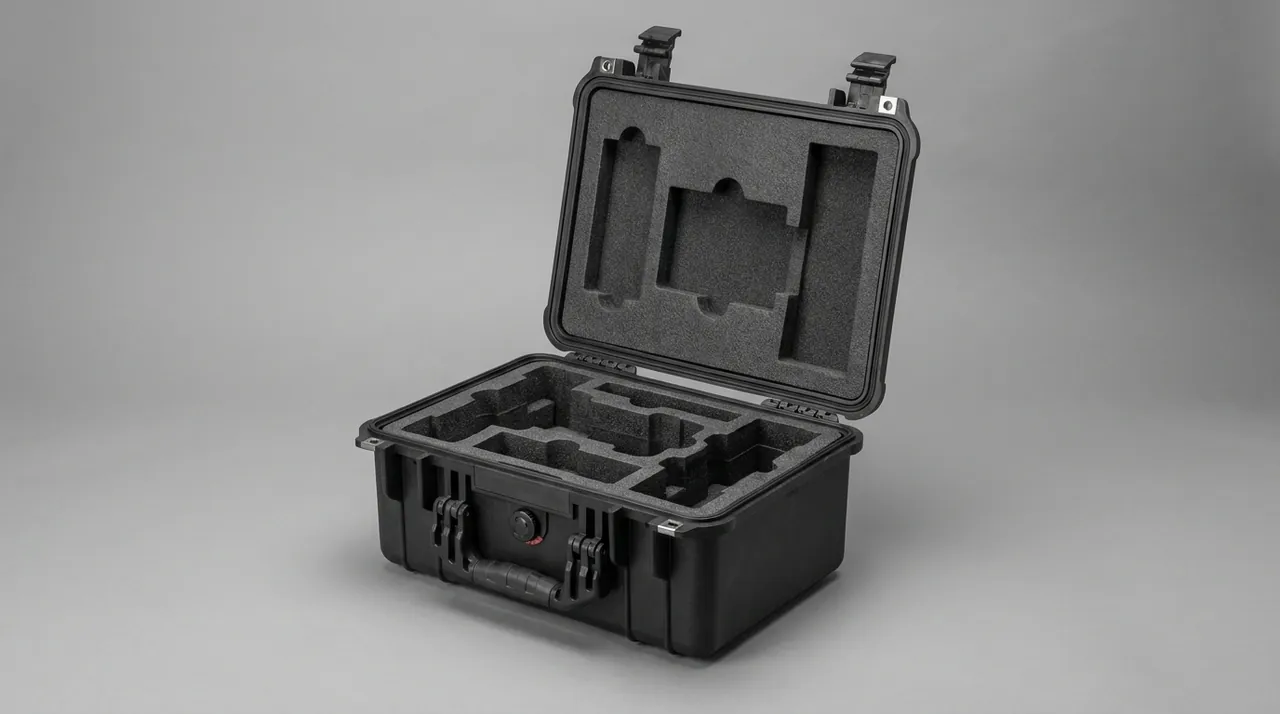
JUNZHIJIA's dedicated die head case adopts a three-layer structure of "rigid shell, CNC-cut EVA liner, independent foil bag". The head is first sleeved in an anti-static clean bag, then placed into an EVA pocket carved by CNC to the flow channel shape, and tensioned on all sides with elastic foam so that any directional vibration is absorbed by the foam first rather than transmitted to the flow channel. For removable die rings, store them separately in small cells with a "no-contact" label. The liner slotting process is detailed further in the custom foam inserts guide.
The handling step is equally critical. The die head has concentrated weight and a high center of gravity, so single-person shoulder carrying or direct rope lashing across the flow channel is forbidden. The correct method is to first mount a spreader beam on the pre-installed eyebolts on both sides of the head, then lower it into the case as a whole; limit blocks at the four inner corners prevent the part from sliding when the case is empty. If the route crosses regions of violent temperature and humidity change, a desiccant should be placed inside the foil bag together with a humidity card, so that on arrival the card's color change tells whether the flow channel cleanliness needs re-inspection.
Parison Controller Precision Shipping Essentials
The parison controller regulates the die gap according to a program to achieve axial wall-thickness distribution of the product. It contains displacement sensors, servo or proportional valve driver boards, an encoder scale and a controller host, and belongs to the category of precision electronics "afraid of moisture, static and vibration". Unlike the die head, the failure of a parison controller is mostly functional: board short-circuit from humidity, encoder scale misalignment, or loose connectors.
The transport case applies a "separate shielding cabin" design for this part. The controller host sits in an anti-static rigid box with conductive foam, whose grounding terminal is led out through the case wall to meet anti-static packaging requirements; the encoder scale and displacement sensor are fixed in rigid slots to avoid micro-displacement from resonance during transport. Environmentally, the relative humidity inside the case must stay below 60% long term, so the sealing and the hinge latch seal structure of the case directly decide the lower protection bound.
It is especially worth reminding that the software parameters of the parison controller are usually stored in non-volatile memory, but strong electromagnetic interference and severe shock during transport can still damage the firmware. It is recommended to run a powered self-check on the controller before shipment and record the original calibration data, attaching both paper and electronic reports in the case, so that on arrival the data is verified before power-on, avoiding the dispute of "damaged in transport but hard to attribute".
Blow Mold and Parting Line Protection Standards
A blow mold consists of two half-molds, neck rings, shear bushings and a blow pin; its precision lifeline is the parting line. Once the parting line is dented by a hard object, flash is left at that point after clamping, and the dent cannot be fully removed by lapping -- only a full face-reduction rework is possible, at a high cost. Therefore the core verb for mold transport is "isolate" rather than "wrap".
The table below gives JUNZHIJIA's protection grading for each key surface of a blow mold; procurement and packaging staff can use it to check the packing list.
| Component | Main risk | Protection requirement | Grade |
|---|---|---|---|
| --- | --- | --- | --- |
| Parting line | Dent, impact causing flash | Face-to-face 0.1 mm film, hard isolation from foreign objects | A |
| Cavity surface | Scratch, corrosion | Anti-rust oil + VCI paper wrap | A |
| Cooling port | Dust, water ingress | Plug ports and label seal | B |
| Neck ring / shear | Deformation, thread damage | Separate cell + soft foam lining | A |
| Lifting bolt hole | Thread impact | Screw in protection plug | B |
Before casing, the mold must complete two processes: cleaning and rust prevention. First wipe the parting line residue and release agent with anhydrous ethanol, then apply a thin layer of neutral anti-rust oil, and finally wrap the whole with VCI paper. Inside the case the mold is placed "face up, heavy at bottom" with a buffer gap of no less than 30 mm between mold and wall. For multi-cavity molds, stacking is strictly forbidden; each must be located layer by layer.
Clamping Unit and Heavy Lifting Solutions
The clamping unit includes the stationary platen, moving platen, tie bars and toggle or direct hydraulic mechanism. It is the heaviest and largest part of the whole blow molding line, often several tons per piece. The transport risk of such heavy parts is not precise-surface damage but overturning, sliding and lifting accidents. JUNZHIJIA's heavy case uses a reinforced steel-wood composite frame, with load-bearing skids and forklift slots on the bottom and embedded lashing rings on the four walls.
Lifting must follow the principle of "four-point balance, slow rise and slow fall". First install certified special eyebolts into the pre-set platen holes, hang an adjustable spreader beam so the sling angle stays within 60 degrees, avoiding lateral force that would tear the tie bars. After the case is closed, lash the part inward to the limit blocks with straps so that displacement under bumping stays below 5 mm. For more general latch and seal selection, see the toolbox hinge latch seal article.
In road transport, the heavy case should be placed transversely at the front of the trailer against the front bulkhead, never at the door or suspended; in sea freight the heavy piece must rest on the hold bottom and be isolated from other cargo with wooden chocks. JUNZHIJIA provides a center-of-gravity diagram and lashing schematic before shipment, and the receiver is advised to re-check against the diagram for permitted deviation, eliminating casual placement of "looks about right".
Hydraulic System Cleanliness Control (ISO 4406)
The hydraulic system of a blow molding machine drives clamping, mold movement and parison adjustment, and its reliability depends heavily on oil cleanliness. ISO 4406 uses three codes to express the number of particles larger than 4 micrometer, 6 micrometer and 14 micrometer per milliliter of oil; for example 18/16/13 denotes the contamination grade of the three size ranges. During transport and storage, if cylinder seals, pipe joints or tank breathers admit contaminants, servo valve sticking and cylinder scoring can occur at start-up.
The table below gives typical cleanliness targets for blow molding hydraulic parts at different stages, for reference in casing and arrival acceptance.
| ISO 4406 code | Particles >=4um/ml (typ.) | Stage | Control |
|---|---|---|---|
| --- | --- | --- | --- |
| 16/14/11 | about 320 | Factory fill seal | High-grade filter + seal |
| 18/16/13 | about 1300 | Long-haul upper limit | Dry N2 seal, double plug |
| 19/17/14 | about 2400 | Over-limit warning | Circulate filter on arrival |
| 21/19/16 | about 9500 | Reject | Flush and re-fill |
Before casing, hydraulic pumps, valve blocks and cylinders must be sealed: screw O-ring plugs into all exposed oil ports, add a dryer to the tank breather, and if shipped with oil use dry nitrogen micro-positive pressure to suppress moisture and dust. JUNZHIJIA recommends a companion oil cleanliness prompt card stating the allowed upper limit and the on-arrival re-check method, so the receiver can judge before start-up whether filtering is needed first.
It must be stressed that the "cleanliness" of hydraulic parts cannot be judged by the naked eye. Even with no visible dirt on the surface, metal chips or sealant residue may hide inside, so on-arrival particle counting and circulation flushing are indispensable steps, and the contamination control philosophy is consistent with the transport packaging testing approach.
Liner Materials and Cushioning Structure Design
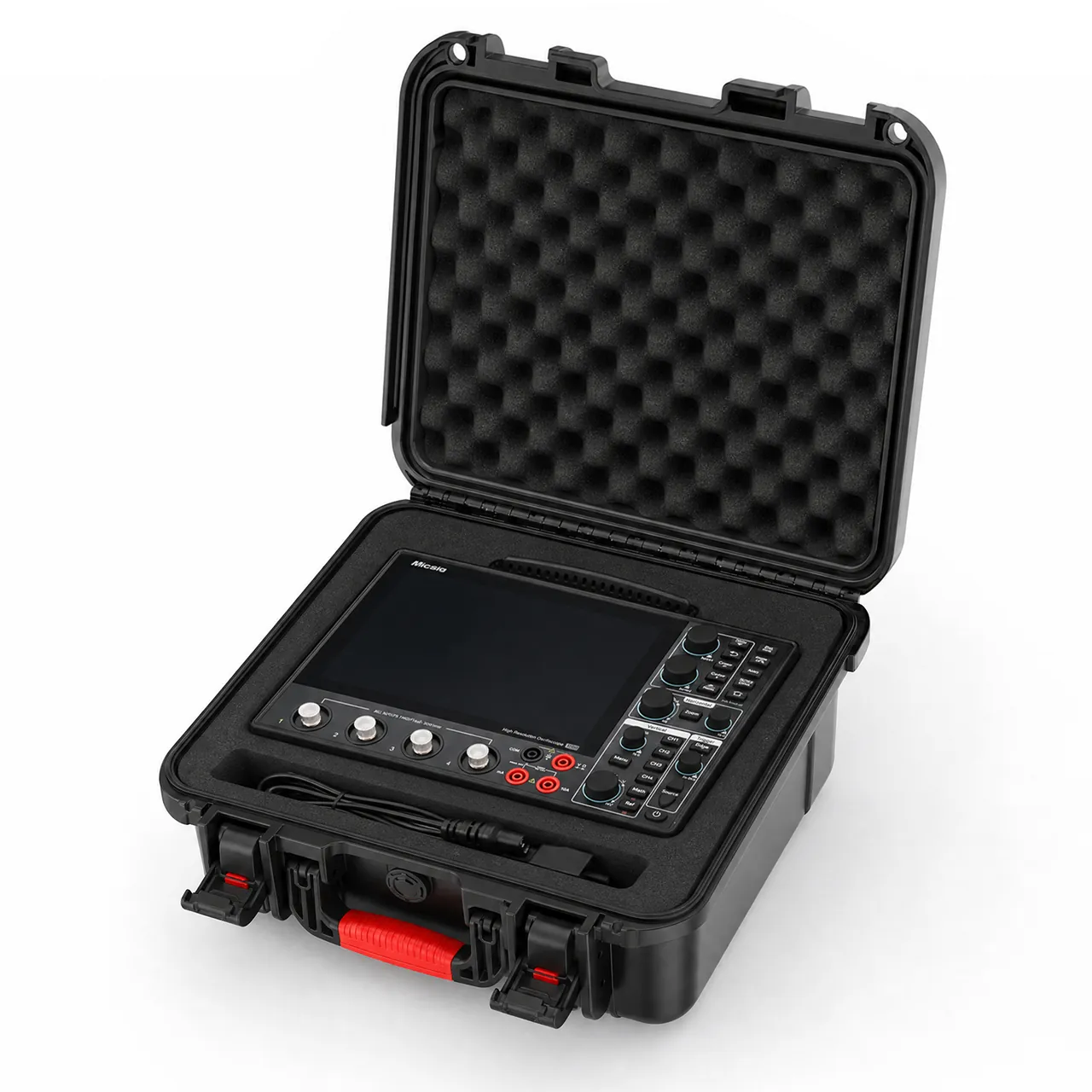
The liner is the "last buffer" between the case and the part. JUNZHIJIA mainly uses three liner materials for blow molding parts: EVA foam (good rebound, CNC-carvable for irregular shapes), PE sponge (low cost, suitable for large-area padding) and conductive foam (for static-sensitive parts such as the parison controller). The selection follows the layered principle of "soft contact surface, hard support surface, fill the cavity solid".
The core parameter of the cushioning structure is the transmissibility of drop shock and transport vibration. For impact-sensitive parts like the die head, a double layer of "hard slot limit + soft pad energy absorption" is used: the outer EVA gives precise geometric limiting, and the inner 5-10 mm closed-cell foam absorbs high-frequency vibration. For heavy parts like hydraulic cylinders, load-bearing wood beams and rubber dampers are set at the bottom so that the natural frequency avoids the common 5-15 Hz road excitation band, reducing resonance amplification.
Liner design must come from real three-dimensional part data. JUNZHIJIA requires the customer's part drawing or physical scan when customizing, then generates the CNC tool path to ensure each part has a unique and fitting "home". For batches of identical spare cases the liner can be standardized and reused; for one-time returned parts a modular reconfigurable liner controls cost. A more systematic liner comparison is in the case foam material comparison.
Sealing and Moisture Control: IP Rating and Pressure Equalization Valve
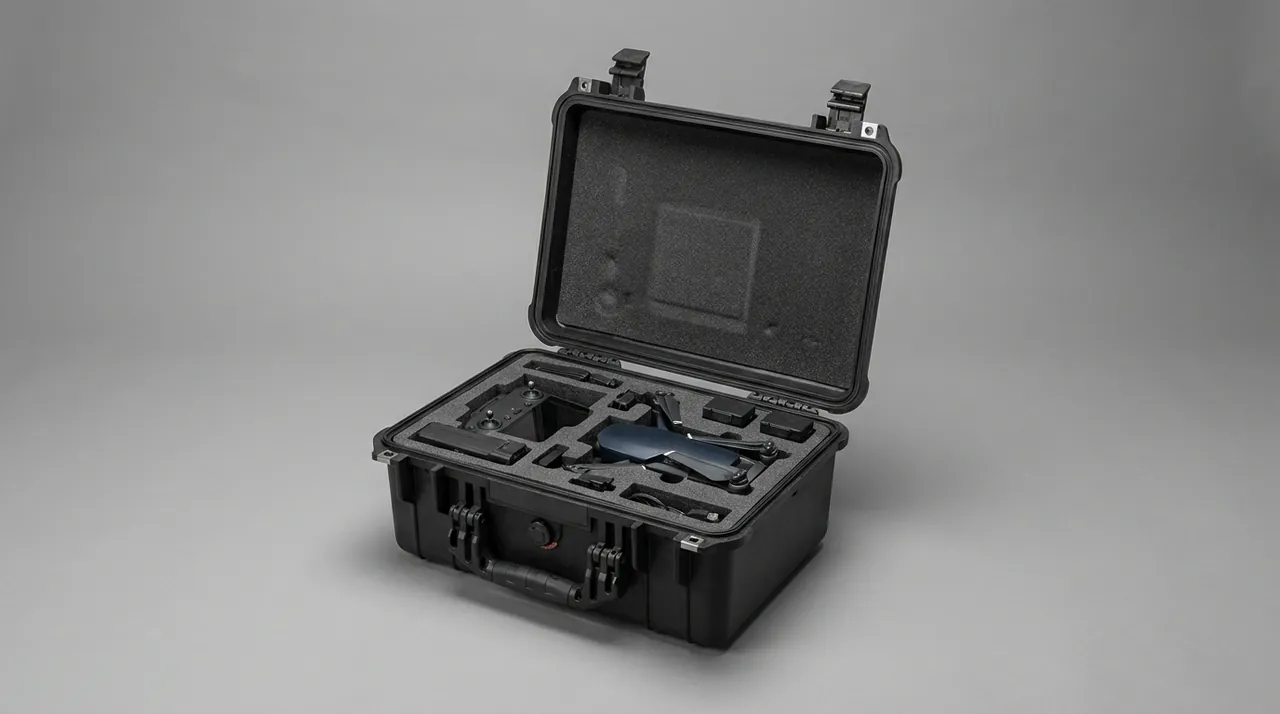
Blow molding parts crossing oceans often experience high humidity, salt spray and day-night temperature swings, and case sealing directly decides the internal micro-environment. JUNZHIJIA's standard protective case reaches IP67 per IEC 60529 / GB/T 4208, meaning dust-proof and short-time water immersion protection, enough to handle deck spray and dock standing water; for offshore-modified blow lines sensitive to salt spray, the metal parts of the case also receive anti-corrosion treatment corresponding to GB/T 10125 salt spray testing.
Another enemy of sealing is "pressure difference caused by altitude and temperature". During air freight or plateau transport the outside pressure drops suddenly; if the case is fully sealed, the internal pressure will push the seal loose or even burst it open. Therefore in high-difference transport scenarios JUNZHIJIA selects a pressure equalization valve that automatically releases pressure difference while blocking water and dust, avoiding case bulging or seal failure. The valve should be checked periodically with a pin for blockage, and confirmed usable before long-term storage.
For moisture control, the relative humidity inside the case is recommended to stay below 55% long term. Besides sealing and desiccant, a humidity indicator card and an electronic recorder can be placed in key cabins; after transport the curve is read to judge whether an over-standard hot-humid period was experienced. For electronic parts like the parison controller, if the indicator card changes color beyond the threshold on arrival, dry and insulation-test before power-on.
Lifting, Handling and Center-of-Gravity Fixation
Center-of-gravity marking before consolidated shipment is often ignored, yet it is the premise of safe handling. JUNZHIJIA prints the center-of-gravity symbol, lifting points and "no inversion" marks on a conspicuous position of the case, and provides a center-of-gravity coordinate diagram with the case. When a single case exceeds 80% of the rated value of the lifting equipment, dual-machine lifting or a widened spreader must be used; forced single-point lifting is forbidden.
Internal fixation also has rules: after all parts are cased, pre-tension with lashing straps, then fill the gaps with shaped foam wedges, and finally do a "shake test" before closing -- small front-back-left-right shakes with no audible part collision and no visually observable displacement is qualified. For oil-bearing hydraulic parts, the straps should avoid oil ports and sensors to prevent long-term compression from deforming threads or loosening connectors.
The warehouse staging phase also has requirements. The case should be elevated at least 100 mm above the floor to prevent moisture return from ground water, and the stacking layers are determined by the rated stacking strength of the case, usually marked on the case side; cross-season storage requires quarterly opening to inspect anti-rust oil status and desiccant saturation, replacing when necessary. These operation details can be combined with the maintenance advice in protective case service life.
Transport Environmental Testing: ISTA and GB/T 4857
To verify the protection scheme, JUNZHIJIA performs transport simulation per ISTA and GB/T 4857 series at the prototyping stage. The ISTA 3 series targets the scattered transport hazards of unit loads, simulating vibration, drop, shock and compression; GB/T 4857 covers temperature-humidity conditioning, stacking, sinusoidal/random vibration and drop items, and the two complement each other for different export destinations.
A typical test sequence is: first temperature-humidity preconditioning (e.g. 38 C, 90% RH for 24 h), then random vibration (PSD per road spectrum), then corner and edge drops, then stacking compression. After the test, open the case to check flow channel scratches, parting line dents and hydraulic seal integrity, and if necessary re-check the oil by particle count. It should be noted that the above are environmental test method references; JUNZHIJIA's related schemes draw on the test thinking of MIL-STD-810H but are not a military certification.
For spare cases that circulate repeatedly, it is recommended to re-test the liner rebound and seal compression after a certain number of transport cycles; when EVA permanent deformation exceeds 15% or the seal loses elasticity, replace promptly to prevent the protection performance from silently decaying. The complete procedure can be followed against the ISTA transport testing procedure.
Selection Parameter Comparison Table
Different parts vary greatly in weight, precision and contamination sensitivity, and the corresponding case type and liner should also be graded. The table below gives JUNZHIJIA's conventional selection mapping for blow molding part cases, for quick reference during procurement and technical confirmation.
| Part type | Unit weight | Recommended case | Liner plan |
|---|---|---|---|
| --- | --- | --- | --- |
| Die head / mandrel | 30-300 kg | Reinforced plastic case | CNC EVA hard slot + soft pad |
| Parison controller | 5-40 kg | Anti-static shield case | Conductive foam cabin |
| Blow mold | 50-800 kg | Steel-wood heavy case | Layered hard isolate + rust proof |
| Clamping platen | 500-4000 kg | Skid load case | Wood beam + rubber damper |
| Hydraulic pump valve | 20-200 kg | Sealed plastic case | Plug + dry nitrogen |
When selecting, also confirm that the stacking strength, forklift slot position and lifting point distribution of the case match the plant's logistics equipment. JUNZHIJIA can output a complete BOM and packing drawing according to the customer's part list and transport mode (truck / rail / sea / air), avoiding the embarrassment of arriving to find the forklift cannot reach or the crane cannot lift. For scenarios with special waterproof rating requirements, a seal specification column can be added to this table.
Custom Liners and OEM/ODM Services
There are many blow molding models, and the die head shape of different generations of the same brand differs significantly, so standardized liners cannot cover all. JUNZHIJIA provides liner customization from single prototyping to batch kits: the customer submits part 3D data or a physical part, the engineering team completes the cavity design and CNC processing, sends a sample back for trial fitting, and after confirming the fit goes to mass production. For overseas distributors, pre-set "spare case kits" by model shorten the terminal delivery cycle.
At the OEM/ODM level, JUNZHIJIA can customize the case appearance by the equipment maker's brand and color code, silk-screen the logo and warning text at compliant positions, and provide matching packing instructions and multilingual acceptance sheets. For whole-machine spare cases going overseas, it can also integrate tools, fasteners and wearing parts into one case, forming an on-site service pack that is "ready to maintain on opening". This capability of matching seals and liners by model also applies to adjacent scenarios such as the composite molding equipment case.
It should be pointed out that customization is not "the thicker the better". An over-thick liner encroaches on buffer margin and increases case weight and freight; JUNZHIJIA's approach is to back-calculate the minimum safe wall thickness from test data, controlling overall logistics cost while guaranteeing protection, which is also the key to controlling per-unit freight when exporting in volume.
Packaging Marks and Documentation (GB/T 191 / GB/T 13384)
Compliant transport marks are the passport of cross-border circulation. JUNZHIJIA prints general storage-and-transport symbols on the case per GB/T 191, including "fragile", "no inversion", "center of gravity", "lift here" and "keep dry", supplemented by Chinese-English bilingual text so that handlers of different languages can understand correctly. For dangerous goods such as accompanying cleaners and lubricants, label separately per the corresponding ADR/IMDG entries and never mix them in the precision-part cabin.
GB/T 13384 stipulates the general rules for electromechanical product packaging; JUNZHIJIA designs the structure strength, moisture-proof layer and fastening of wooden and composite cases accordingly, and provides a packing list, material declaration and quarantine treatment certificate (if applicable) at shipment. For export wooden packaging, fumigation or heat treatment is done per IPPC ISPM-15 with the mark applied, avoiding rejection at the destination port. The finer dangerous-goods transport boundary can be referenced in the ADR/IMDG hazmat transport case.
For documents in the case, it is recommended that the equipment maker put a "part identity card" and a "protection key-point card" into a waterproof document pouch attached to the inside of the lid: the identity card records the part model, serial number and weight, and the key-point card lists the unpacking sequence, forbidden tools and on-arrival re-check items, so that even untrained site personnel can operate by the diagram, reducing human error.
On-Site Unpacking and Acceptance Workflow
On-arrival unpacking is the last link of the protection chain and the easiest to err. JUNZHIJIA advises the receiver to complete appearance and document checks within 24 hours of arrival: first see whether the case is severely deformed, whether the seal is intact and whether the humidity card is over standard, then check the packing list and part serial numbers to confirm no shortage or mis-shipment before opening each part.
The unpacking sequence should follow "light before heavy, precision before structure": first take out the parison controller and do insulation and appearance checks, then take the die head to observe flow channel scratches, then check the mold parting line protection film integrity, and finally handle heavy clamping parts and hydraulic parts. Hydraulic parts must be particle-counted per ISO 4406 on arrival, and filtered before installation if over limit. For suspected damage found, photograph immediately and attribute against the pre-shipment self-check report.
After acceptance, the liner and case are recommended to be kept as spares -- reusing them for return repair or second transfer reduces cost and also ensures the part always has a "fitting home". For daily cleaning and maintenance, combine the protective case cleaning method to extend case life. The complete workflow is consistent with the acceptance logic of the glass mold case and can be cross-referenced.
Common Questions FAQ
Q: Why must the die head flow channel surface avoid even slight impact during transport? A: The die head flow channel is mirror-polished and hard-chrome plated, with surface roughness usually below Ra 0.2 micrometer, and its only job is to let the melt extrude symmetrically and stably as a parison. The moment the flow channel is scraped by a metal part by even 0.05 mm, the high-temperature melt will stagnate and degrade exactly at that point. After start-up this shows up as wall-thickness fluctuation, black specks and strength loss, and the damage cannot be fully removed by simple polishing -- often the entire channel must be reworked, which is extremely costly. JUNZHIJIA therefore uses an independent foil bag plus a CNC-cut EVA hard slot so the flow channel stays in zero contact inside the case, and any directional vibration is absorbed first by the outer foam, eliminating hard contact at the source. Before casing the head is sleeved in an anti-static clean bag, removable die rings are stored in separate cells with a no-contact label, and for routes crossing violent humidity swings a desiccant and humidity card go inside the foil bag so arrival color change tells whether flow-channel cleanliness needs re-inspection.
Q: How should the blow mold parting line be packed to avoid flash? A: The parting line is the precision lifeline of the mold; a single grain of sand or one dent leaves a permanent flash after clamping, and the pit cannot be fully removed by lapping -- only a full face-reduction rework remains. The correct method is to wipe the parting line residue and release agent with anhydrous ethanol, apply a thin neutral anti-rust oil, then wrap the whole with VCI paper and apply a 0.1 mm protection film face-to-face for hard isolation. In the case the mold is placed face up with heavy at bottom, leaving a buffer gap of no less than 30 mm from the wall, and multi-cavity molds must be located layer by layer with strict no-stacking. JUNZHIJIA ticks each item against grade-A protection on the packing list: the parting line and cavity are grade A, while cooling ports and lifting bolt holes are grade B plugged. On arrival the protection film and VCI paper are confirmed intact before the mold moves into a clean warehouse, and for returned parts a copy of the original clamping-gap record is attached so the plant can quickly re-verify and avoid lengthened trial-mold cycles from transport misjudgment.
Q: What specific ISO 4406 cleanliness is required for hydraulic parts in transport? A: The blow molding hydraulic system drives clamping and parison adjustment, and any contamination causes servo valve sticking and cylinder scoring. ISO 4406 uses three codes to express the number of particles larger than 4 micrometer, 6 micrometer and 14 micrometer per milliliter of oil; for example 18/16/13 denotes the contamination grade of those three size ranges. JUNZHIJIA requires factory fill seal at 16/14/11 (about 320 particles), a long-haul upper limit of 18/16/13 (about 1300), over 19/17/14 (about 2400) as a warning needing on-arrival circulation filtering, and 21/19/16 (about 9500) as reject requiring full flush and re-fill. Controls include screwing O-ring plugs into all oil ports, adding a dryer to the tank breather, and dry nitrogen micro-positive pressure when shipped with oil. It must be stressed that the cleanliness of hydraulic parts cannot be judged by the naked eye; on arrival the oil must be particle-counted, and filtered before installation if over limit, a philosophy consistent with the contamination control in transport packaging testing.
Q: What should be noted for lifting and lashing heavy clamping platens? A: The clamping mechanism is often several tons per piece, and its risk is overturning and sliding rather than precise-surface damage. Lifting must use certified eyebolts in the pre-set platen holes, hang an adjustable spreader beam so the sling angle stays under 60 degrees, and rise and fall slowly to avoid lateral force that would tear the tie bars. After casing, lash the part to the limit blocks with straps, keeping displacement under 5 mm under bumping; in road transport the heavy case sits at the trailer front against the bulkhead, never suspended or at the door, and in sea freight it rests on the hold bottom isolated by wooden chocks. JUNZHIJIA provides a center-of-gravity diagram and lashing schematic, and the receiver re-checks permitted deviation against it. The case itself uses a reinforced steel-wood composite frame with load-bearing skids and forklift slots on the bottom and embedded lashing rings on the walls; before closing, a shake test -- small front-back-left-right shakes with no audible collision and no visible displacement -- must pass, turning every step from lift to fix into a re-checkable standard action.
Q: How does the parison controller get both moisture and static protection in transport? A: The parison controller contains displacement sensors, servo driver boards and an encoder scale, and is a precision electronic part afraid of moisture and static. Its failures are mostly functional: board short-circuit from humidity, encoder misalignment, loose connectors. JUNZHIJIA gives it a separate shielding cabin: the host sits in an anti-static rigid box with conductive foam whose grounding terminal is led out through the case wall to meet anti-static packaging; the encoder scale is fixed in rigid slots to avoid resonance micro-displacement. The environment must keep relative humidity under 60% long term, relying on sealing and the hinge latch seal structure. Before shipment a powered self-check is run on the controller and original calibration data recorded, with both paper and electronic reports in the case, so on arrival the data is verified before power-on, avoiding the dispute of damage hard to attribute to transport. If the humidity indicator card is over standard on arrival, dry and insulation-test first; if needed, verify the firmware per the maker's flow to ensure the wall-thickness program and encoder zero did not drift from shock or interference.
Q: What IP rating is enough for the transport case? A: For cross-ocean high humidity, salt spray and temperature swing, JUNZHIJIA's standard case reaches IP67 per IEC 60529 / GB/T 4208, meaning dust-proof and short-time immersion protection that handles deck spray and dock water; offshore variants also receive corresponding salt-spray anti-corrosion on metal parts. But a fully sealed case will push the seal loose from internal pressure during air or plateau transport, so high-difference routes need a pressure equalization valve that vents pressure while blocking water and dust. A humidity indicator card and recorder inside the case let the receiver read the curve after transport and judge whether an over-standard hot-humid period occurred. For electronic parts like the parison controller, if the indicator card changes color beyond the threshold on arrival, dry and insulation-test before power-on. The seals themselves need maintenance: before long-term storage confirm the valve is not blocked and the gasket not hardened or cracked; after several transport cycles re-check the seal compression and replace when elasticity is lost, preventing silent protection decay.
Q: Can JUNZHIJIA customize liners and seals to our machine model? A: Yes. JUNZHIJIA provides liner customization from single prototyping to batch kits: the customer submits part 3D data or a physical part, the engineering team completes cavity design and CNC processing, sends a sample back for trial fitting, and mass-produces after fit confirmation. At the OEM/ODM level the case appearance can be customized by the equipment maker's brand and color, with logo and warning silk-screened at compliant positions, plus packing instructions and multilingual acceptance sheets. For overseas distributors, model-pre-set spare-case kits are supported to shorten terminal delivery; for whole-machine spare cases going overseas, tools, fasteners and wearing parts can be integrated into one case to form an on-site service pack ready to maintain on opening. It should be pointed out that thicker is not better -- an over-thick liner encroaches on buffer margin and raises case weight and freight. JUNZHIJIA back-calculates the minimum safe wall thickness from test data, controlling per-unit freight while keeping protection, and this capability also fits adjacent scenarios such as composite molding and glass mold part cases.
Q: What items should on-arrival unpacking acceptance focus on? A: Complete acceptance within 24 hours of arrival: first see whether the case is deformed, the seal intact and the humidity card over standard, then verify the packing list and serial numbers for no shortage or mis-shipment. Unpack light before heavy, precision before structure -- first take the parison controller for insulation and appearance checks, then inspect the die head flow channel, the mold parting film, and finally the heavy and hydraulic parts. Hydraulic parts must be particle-counted per ISO 4406, filtered before installation if over limit. Photograph any suspected damage and attribute it against the pre-shipment self-check report; keep the liner and case as spares for return repair reuse. Also check the part identity card and protection key-point card in the document pouch to confirm unpacking sequence and forbidden tools, reducing human error during site handling. The complete acceptance workflow mirrors the glass mold case logic, so cross-referencing that procedure helps the receiver catch transport-induced issues before the mold or head reaches the production floor and avoids costly unplanned downtime.
Conclusion and Related Reading
The success of blow molding part transport lies in four rules: protect the flow channel, isolate the parting line, keep hydraulics clean, and lift heavy pieces stably. JUNZHIJIA turns cross-border flow of these high-value parts into a controlled, repeatable process.
Related Reading