

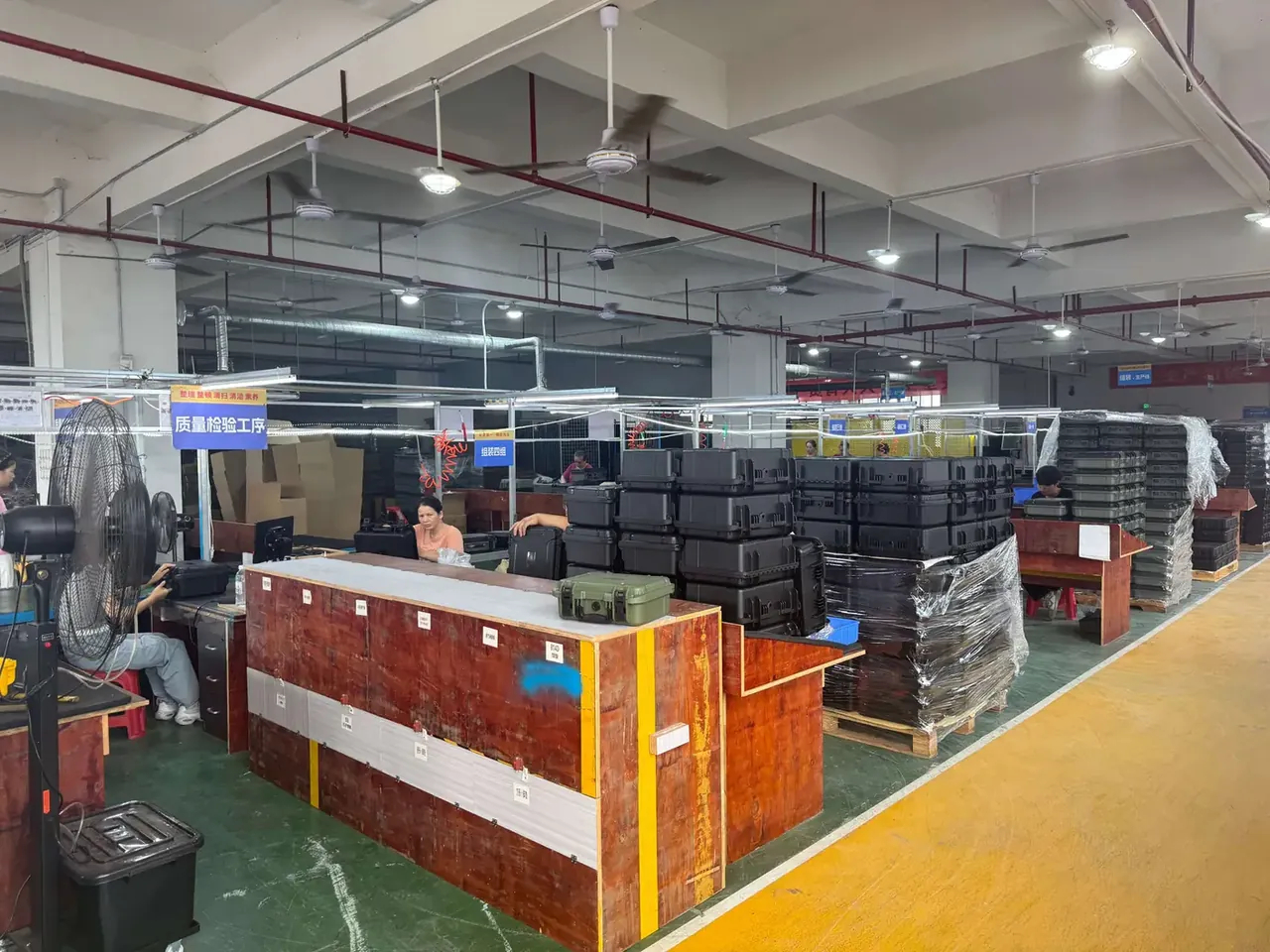
Quick answer: Case supplier qualification moves through three gates. Paper proves the plant may mould cases, machines prove it can hold the drawing, samples prove it can repeat. All three must clear before approval.
Table of contents
- Why Case Supplier Qualification Runs in Three Gates
- Paper Gate: Licence, Certificate, Reports
- Machine Gate: Tonnage, Moulds, Instruments
- Sample Gate: Three Rounds
- Walking the Floor and Reaching a Verdict
- FAQ
1. Why Case Supplier Qualification Runs in Three Gates
Most plants reduce case supplier qualification to one factory visit. Six months later two failures surface: the quoted 900-tonne press does not exist and a 550-tonne machine is pushed until the wall flashes, or the first part passes and the latch root whitens after three months.
Three gates separate those risks. Paper is cheapest and removes traders with no moulding scope. Machines decide whether your dimensions can be held at all, hardest on large cases. Samples cost most, since a tool must be hung, and come last.
The audit runs two people for 1.5 days against 48 items, half a day per gate.
| Gate | Evidence | Time | If failed |
|---|---|---|---|
| Paper | Licence, QMS certificate, reports | Half day | Stop |
| Machine | Press plates, mould ledger, instruments | Half day | Stop before quoting |
| Sample | First parts, pilot data, measurements | Half day | Conditional or stop |
2. Paper Gate: Licence, Certificate, Reports
The licence must list plastic products and mould making, with an address matching the plant. The ISO 9001 certificate needs a number, an expiry and a scope covering moulding and assembly; a trading-only scope fails. Test reports must be issued to the case maker, not the resin supplier, and carry a CNAS or CMA mark.
Check four things against the issuer's register: number, expiry, scope, issuer. Common findings are an expiring certificate, a scope without assembly and an outdated address. None is fatal, but each must close before the sample gate.
Reports are valid for 12 months, and the grade must match the quotation and pilot feeding record. An unreported material change is the easiest miss in case supplier qualification, the origin of colour shift.
3. Machine Gate: Tonnage, Moulds, Instruments
Case supplier qualification starts with tonnage. Multiply projected area by 0.5 to 0.7 tonnes per square centimetre: a 500 mm square needs 550 tonnes, a 700 mm class case 900 to 1,300 tonnes.
Tool ownership comes next: eight in-house moulds minimum, numbered, with a service card and a service every 50,000 shots. P20 suits short runs, 718 long ones.
Dryers take PA6 to 100°C for four hours, PP to 80°C for two; mould controllers hold 40°C within 3°C. The inspection room needs calibrated callipers, a vision system, a drop tower and a leak bench.
| Item | Benchmark | What to check |
|---|---|---|
| Tonnage | 550 to 1,300 t | Plate, not brochure |
| Moulds | 8 or more in-house | Rack and service card |
| Drying | PA6 at 100°C for 4 h | Shift setpoints |
| Instruments | Drop tower, leak bench | Calibration labels |
4. Sample Gate: Three Rounds
In case supplier qualification, the sample gate is not a parcel of good-looking parts. It runs three first parts, thirty pilot parts and a 300-piece batch, released on dimensions, then stability, then consistency. Keep one piece per round.
First parts are measured fully: wall of 2.5 to 3.0 mm, coaxiality of latch seat and hinge, seal groove depth. Cosmetics sit at 30 cm in normal light, with no sink mark or weld line on the seal face; a report without values is worthless.
The pilot is thirty parts over two hours. Drop from 1.2 m on six faces, three edges and one corner; hold 30 kPa for 60 seconds; cycle the latch 5,000 times. One cosmetic reject is allowed, a functional one is not.
5. Walking the Floor and Reaching a Verdict
The route is fixed: resin store, blending room, moulding bay, assembly line, inspection room, finished goods. Six stations at 40 minutes each plus 30 minutes on documents, so a second visit compares station by station. Look for live evidence: setpoints on screen, not a laminated process card, today's mixing sheet beside the regrind sack.
The verdict has three levels. Key items tolerate nothing: tonnage, tool ownership, inspection, sample function. Five or fewer minor findings earn a conditional pass with 30 days to close; failures may reapply after six months.
Conclusion
The gates earn their keep two years later, not at signing. Paper decides whether a plant may mould, machines whether it can hold the drawing, samples whether it holds it every week. The 48 items need not all be rechecked, but tonnage, tool ownership, inspection and sample function always are. Run them in order and case supplier qualification rests on evidence.
This article discusses only the container (case body) side of specifications and design intent, and does not cover any handling, loading or use of the contents.
Related Reading
- Choosing injection press tonnage for cases
- What to check on a factory visit day
- How first-article approval works
- Production audit points for gun cases
Related Products
- 8 Series — Gun Cases; Military Equipment Cases; Camera Equipment Cases; Drone Cases; Watch Cases; Knife Cases; First Aid Cases; Electronics Equipment Cases
- WL8-2812 PP Gun Case — model WL8-2812
- All protective cases and toolboxes: 7 series, 158 models