

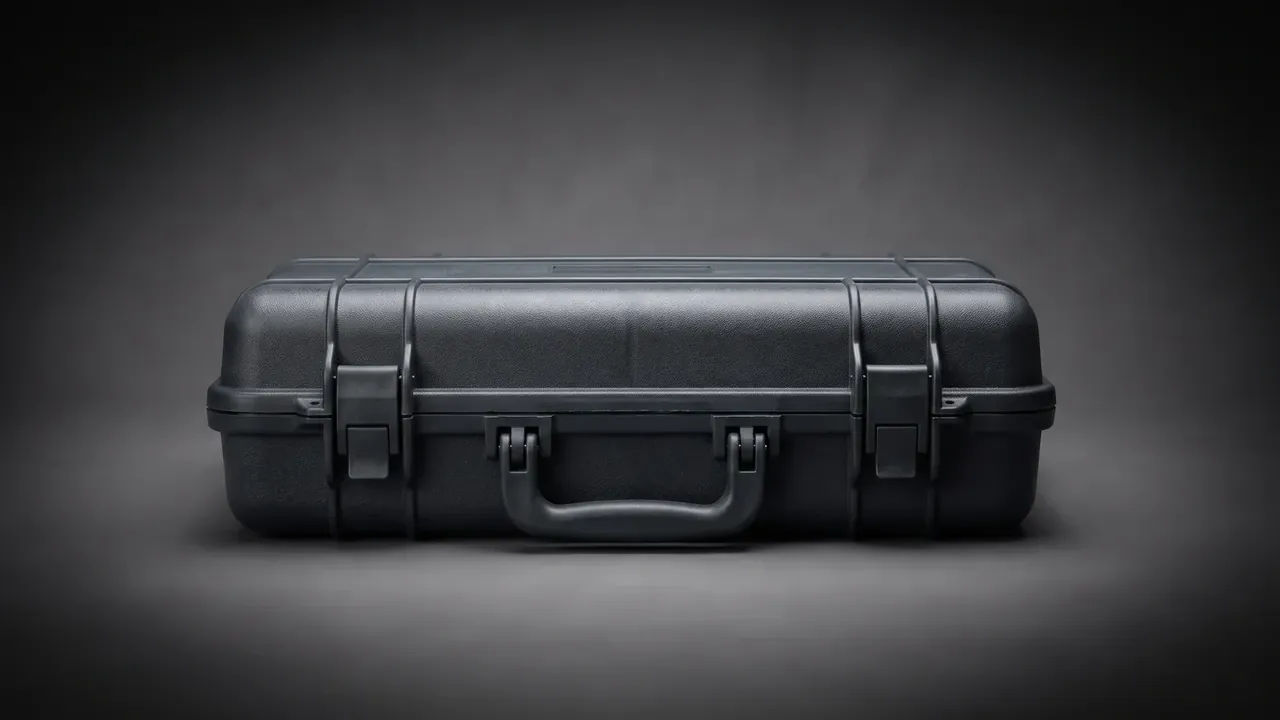
Quick answer: An Equipment Case is specified from the cavity outwards: subtract the foam, add wall, lid depth and bumpers, then check the lid ribs against a full stack. A figure written before that chain closes is paid for twice.
Table of contents
- How an Equipment Case Size Chain Closes
- Foam Dividers and Usable Space
- Wall, Weight and Stack Load
- Ingress Rating and Test Recipe
- Cutouts, Stiffeners, Grounding, Shielding
- FAQ
1. How an Equipment Case Size Chain Closes
The outside is fixed before drawing: a 1200 mm pallet takes two 620 mm cases with 40 mm for hands, a 1500 mm shelf four 230 mm tiers.
The cavity is where guesswork enters. On an Equipment Case, a 3.2 mm wall, a 55 mm lid and one degree of draft give 612×432 mm at the mouth but 605×425 mm at the floor, and the 8 mm rim groove leaves 560×380×195 mm usable.
| Layer | Measured | Mid-size | Usual error |
|---|---|---|---|
| Outside | Over latches and bumpers | 620×440×230 mm | 8 mm latch proud |
| Mouth | Wall to wall at rim | 612×432×195 mm | Floor only |
| Usable | Cavity minus foam | 530×350×155 mm | Ribs not deducted |
One degree costs 3.5 mm per side at 195 mm depth, silently eating a module's clearance.
2. Foam Dividers and Usable Space
A 20 mm base layer and a 30 mm lid layer are common, the lid foam pressing the top face at 5% compression. Stiff EVA at 90 kg/m³ takes a 3% set.
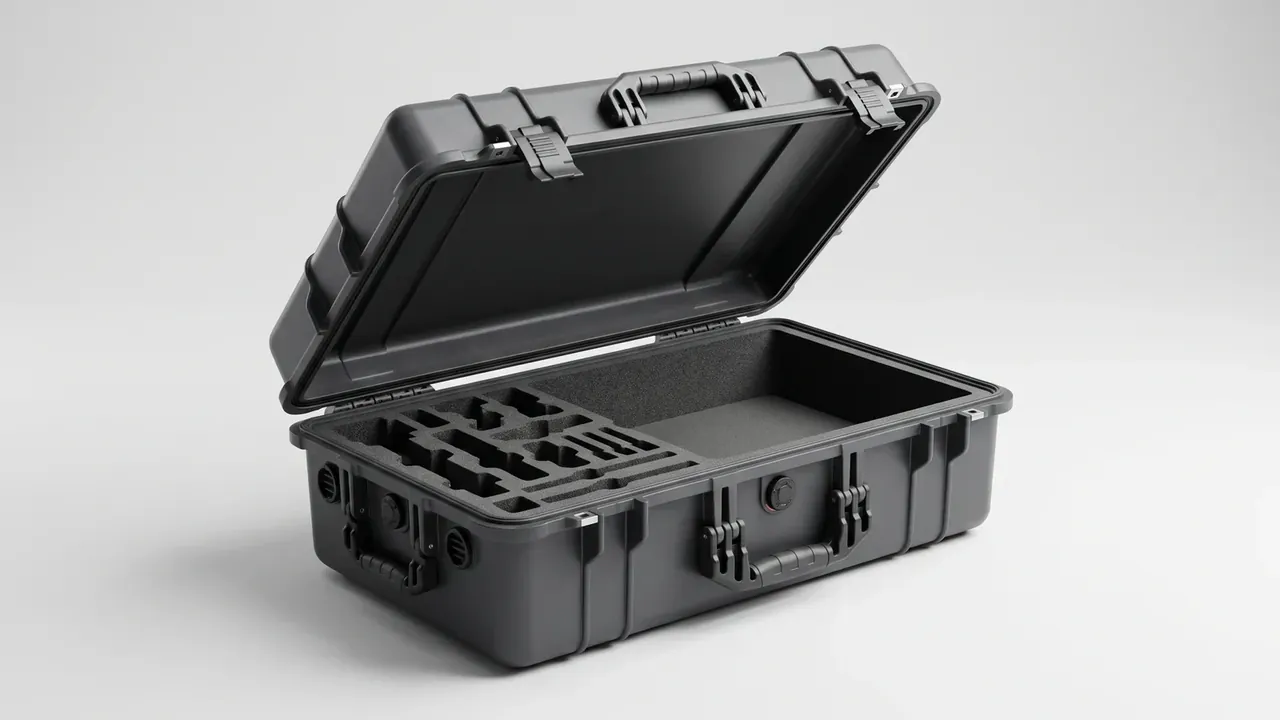
A 4 mm rib in a 40 mm pocket takes 2 mm per side, so 98 mm holds a 96 mm module. At 3 mm the divider bows 1.5 mm in a year; at 5 mm the body goes up a size.
Die cutting needs 0.3 mm offset: EVA springs back within 24 hours, and a nominal 98 mm pocket measures 97.6 to 97.8 mm. Past 40 mm depth, split the block at 45 degrees.
3. Wall, Weight and Stack Load
A rating needs a load distribution. The 45 kg rating of an Equipment Case is uniform over the 0.21 m² floor, 2.1 kPa; the same load on one 80×80 mm pad reaches 69 kPa.
| Outside | Wall | Weight | Uniform load | Tiers |
|---|---|---|---|---|
| 460×350×180 mm | 2.8 mm | 4.2 kg | 25 kg | 5 |
| 620×440×230 mm | 3.2 mm | 6.8 kg | 45 kg | 4 |
| 780×560×300 mm | 3.6 mm | 11.5 kg | 70 kg | 3 |
Four high puts 3 × 45 = 135 kg on the lowest lid, doubled to 270 kg, or 1.45 kPa on 530×350 mm; 6 mm ribs at 90 mm centres deflect 1.3 mm under 500 N.
4. Ingress Rating and Test Recipe
IP67 is a recipe, not a label: 1 m of water, case and water within 5 °C, 30 minutes, then inspect. A warm case in cold water pulls a vacuum through the weakest seam: it passes in a bath and fails after a truck ride.
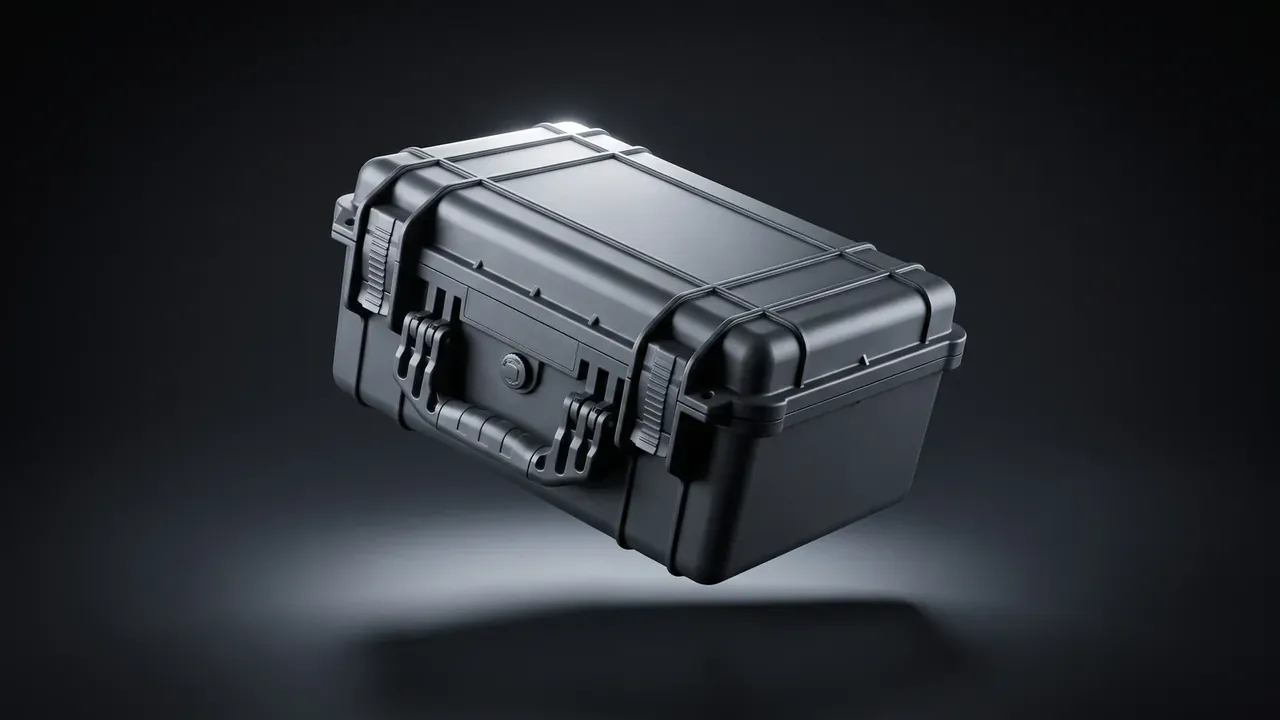
IP65 is a jet instead: 6.3 mm nozzle, 12.5 L/min, 3 m, 3 minutes. Where water is impractical, charge to 2 kPa, hold 60 s, accept 0.3 kPa decay. A 60 shore gasket of 6×4 mm runs at 25% compression; the vent cracks at 8 kPa.
5. Cutouts, Stiffeners, Grounding, Shielding
Cutouts decide whether hardware fits. An M22 gland wants 22.5 mm plus 0.2 over zero; a rectangular connector takes the flange plus 0.3 mm, drilled from the connector drawing. Keep 25 mm clear of corner radii.
| Interface | Cutout | Stiffener | Seal |
|---|---|---|---|
| Cable gland | 22.5 mm round | 4 mm 6061 | 22×2.4 mm O-ring |
| Rectangular plug | Flange plus 0.3 mm | 5 mm plate | Conductive gasket |
| Vent port | 40 mm perforated | 3 mm stainless | Breathable membrane |
Four millimetre 6061 with six M4 rivet nuts at 60 mm centres restores the lost stiffness; torque diagonally in two passes to 2.5 N·m.
Grounding: an M6 stud bonded to the stiffener with 16 mm² braid, 0.1 Ω or less. Shielding depends on pitch: 40 dB at 1 GHz at 60 mm screw spacing, 28 dB at 100 mm, where the gap acts as a slot antenna.
Conclusion
Usable space sets the cavity, draft sets the outside, load sets the tiers, and the tiers return to the lid ribs. Walk it once and the Equipment Case holds what the sheet promises.
This article discusses only the container (case body) side of specifications and design intent, and does not cover any handling, loading or use of the contents.
Related Reading
- Five criteria for choosing an equipment case
- How internal dividers are laid out
- Case accessories and how they mount
- How equipment case builds differ by scenario
Related Products
- 8 Series — Gun Cases; Military Equipment Cases; Camera Equipment Cases; Drone Cases; Watch Cases; Knife Cases; First Aid Cases; Electronics Equipment Cases
- WL8-2812 PP Gun Case — model WL8-2812
- All protective cases and toolboxes: 7 series, 158 models