

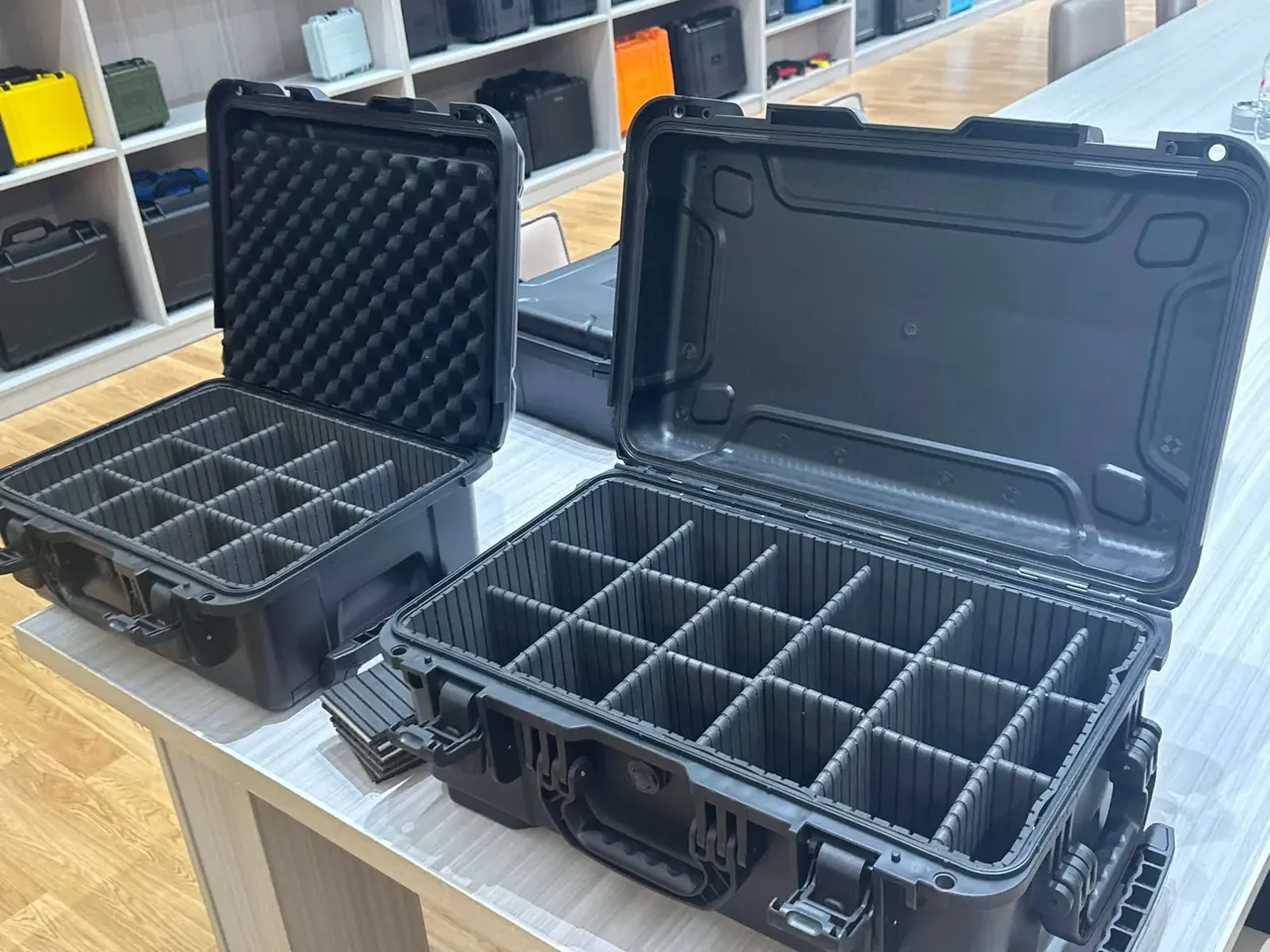
Quick answer: A Case Internal Divider is laid out in three steps: compartment width, slat thickness, then height. Slats run 4, 6 or 8 mm; a cell wider than 150 mm moves up one step. The slot mouth is 2 mm wider than the slat, with 1 mm of interference per side at the root.
Table of contents
- Laying Out a Case Internal Divider
- Slat Thickness from 4 to 8 mm
- Slot Pitch, Slot Width and 2 mm Interference
- Slat Height Against Cavity Depth
- Bottom Seating, Lid Foam and Wobble
- FAQ
1. Laying Out a Case Internal Divider
Four contacts hold a Case Internal Divider: top edge against lid foam, bottom in a base groove, ends in wall slots, slats at half-lap crosses. One out of tolerance and the rest go loose.
Width comes first, thickness second, height last, after foam compression. Every extra 2 mm of thickness costs one cell in a fixed length.
2. Slat Thickness from 4 to 8 mm
Four-millimetre PP twin-wall is two skins over a rib core. Its limit is a 120 mm cell: wider, with 3 kg inside, the middle bows about 4 mm. Six-millimetre sheet stiffens with the cube of thickness, so a 150 mm span deflects 1.2 mm instead of 4. Past 180 mm, a Case Internal Divider needs an 8 mm slat and a 10 mm slot, leaving 3 mm of wall.
| Slat | Max cell | Load | Slot |
|---|---|---|---|
| 4 mm twin-wall | 120 mm | 2 kg | 6 mm |
| 6 mm twin-wall | 180 mm | 4 kg | 8 mm |
| 8 mm twin-wall | 220 mm | 6 kg | 10 mm |
| 8 mm solid | 260 mm | 10 kg | 10.5 mm |
3. Slot Pitch, Slot Width and 2 mm Interference
Pitch is cell width plus slat thickness: a 100 mm cell with a 6 mm slat is 106 mm. Production runs 50 to 120 mm in 5 mm steps.
The mouth is cut 2 mm wider as a lead-in; at the root, two 1 mm ribs make 2 mm of total interference. Interference sits at the root because the mouth takes the shear.
One millimetre per side over 12 mm is about 8 percent strain, elastic in PP, holding 30 to 50 N after ten insertions. Add a 0.5 mm chamfer, 1 degree of draft and an R0.5 root. Shrinkage of 0.4 to 0.6 percent shortens a 300 mm cavity by 1.2 to 1.8 mm, so slots run from the centre outward.
4. Slat Height Against Cavity Depth
Height is cavity depth minus foam compression: at 0.72 to 0.78, a 120 mm cavity takes an 88 to 94 mm slat, leaving 26 to 32 mm for peaks compressed 30 to 40 percent, lid fit and margin. Below 0.7 the slats miss the foam and jump; above 0.82 the lid is pried off its seal.
Draft widens the cavity 1.7 mm per side over 100 mm, so height on a Case Internal Divider is taken at the deepest point.
| Cavity | Slat | Top gap | Peaks | Squash |
|---|---|---|---|---|
| 80 mm | 58 to 62 mm | 18 to 22 mm | 12 mm | 4 mm |
| 120 mm | 88 to 94 mm | 26 to 32 mm | 18 mm | 6 mm |
| 160 mm | 118 to 125 mm | 35 to 42 mm | 20 mm | 7 mm |
| 200 mm | 148 to 156 mm | 44 to 52 mm | 20 mm | 8 mm |
5. Bottom Seating, Lid Foam and Wobble
The base groove is 4 mm deep and 0.3 mm wider than the slat: it locates in plan and leaves clamping to the foam. Wall slots are 3 mm deep and blind; through-cutting breaks the load path.
Peaks 18 mm tall compress 6 mm, about 12 N over a 100 mm cell, enough to stop a Case Internal Divider jumping. Wobble stacks 0.2 mm pitch, 0.15 mm thickness and 0.5 mm shrinkage into 1 to 2 mm per cell.
| Source | Value | Control |
|---|---|---|
| Pitch | 0.2 mm | Lay out from centre |
| Slat thickness | 0.15 mm | Match by lot |
| Shrinkage | 0.5 mm | One cavity number |
| Base gap | 0.3 mm | Slat plus 0.3 |
| Per cell | 1 to 2 mm | Invert and shake |
Conclusion
Width sets thickness, thickness sets slot width, foam sets height. Four, six, eight millimetres; 2 mm of interference; 0.72 to 0.78. Once they agree, the wobble is calculated, not discovered. That is a Case Internal Divider.
This article discusses only the container (case body) side of specifications and design intent, and does not cover any handling, loading or use of the contents.
Related Reading
- How a removable divider system is built
- Dividers versus foam: which job goes where
- Compartment design inside a tool case
- Foam types used inside cases
Related Products
- 8 Series — Gun Cases; Military Equipment Cases; Camera Equipment Cases; Drone Cases; Watch Cases; Knife Cases; First Aid Cases; Electronics Equipment Cases
- WL8-2812 PP Gun Case — model WL8-2812
- All protective cases and toolboxes: 7 series, 158 models