

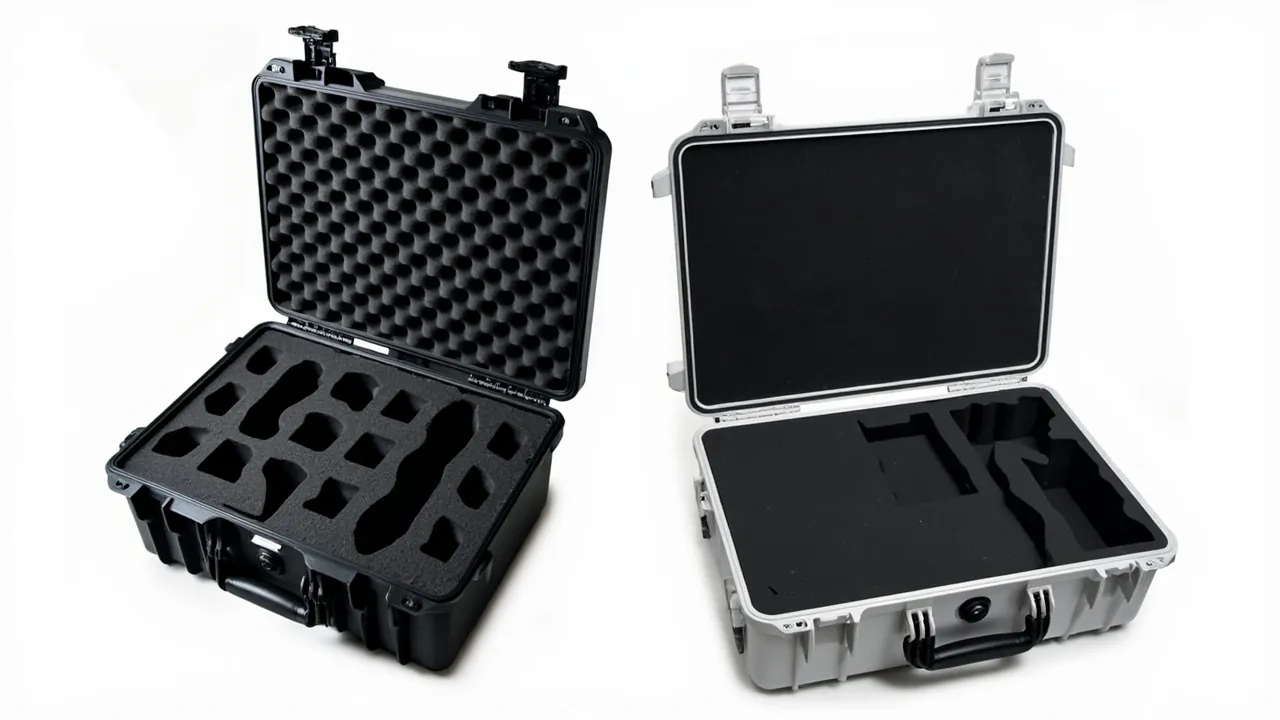
Conclusion first: whether a protective case should use dividers or a foam liner comes down to "whether the equipment fears vibration, whether it is regular, and how high the access frequency is." If your equipment is tools, accessories, and gear that do not fear slight knocks, have regular shapes, and need frequent addition/removal and quick access, prioritize adjustable dividers (divider/grid divider) for big-category zoning — flexible, reconfigurable, low cost. If your equipment is cameras, lenses, instruments, circuit boards that fear vibration, fear shifting, fear mutual scraping, are high-value, and have fixed shapes, prioritize a foam liner (pre-cut/pick-and-pluck/custom) for snug fixing — "not moving a bit" in transit. The two are not an either-or; many professional schemes are a mix of "dividers for big-category zoning + foam for single-item fixing." Below, from structural principle, a dimension comparison table, respective scenarios, the mix approach, a selection checklist, to common pitfalls, helps you decide correctly once.
Table of Contents
- Conclusion First: When to Choose Dividers, When Foam
- What an Adjustable Divider Is (Structure and Principle)
- What a Foam Liner Is (Structure and Principle)
- Divider vs. Foam: Dimension Comparison Table
- Scenarios Where Adjustable Dividers Fit Better
- Scenarios Where Foam Liner Fits Better
- Can the Two Be Mixed: Zoning + Fixing Combo
- Selection Decision Checklist
- Common Pitfalls
- KeXin New Materials JUNZHJIA Liner Capability
- Divider Material and Structure Breakdown
- Foam Liner Material and Parameters (Reference)
- Divider vs. Foam Cost and Maintenance Comparison
- How Dividers/Foam Coordinate with the Case Shell
- Divider and Foam Application Across Five Industries
- Divider and Foam Acceptance Checklist
- Transport and Storage Notes
- Three Typical Mix Patterns
- Decision Tree From Need to Scheme (Text Version)
- Cost Accounting for Universal vs. Custom Liner
- Signals to Upgrade Your Liner
- Effect on Case Space Utilization
- Frequently Asked Questions (FAQ)
- Conclusion and Further Reading
Conclusion First: When to Choose Dividers, When Foam
Two sentences first give the answer, then expand:
- Choose dividers: Equipment does not fear slight vibration, has regular or varying sizes, needs frequent re-zoning and quick access (e.g., repair tools, hardware accessories, gear bags). The divider's advantage is "reconfigurable space, visible at a glance, fast to grab."
- Choose foam: Equipment fears vibration and shifting, is high-value, has relatively fixed shape (e.g., camera lenses, precision instruments, circuit boards). The foam's advantage is "snug fixing, zero shift in transit, no mutual scraping."
This dividing line comes from the strength of the protective case's "cushion-fix" need: weak need → divider suffices; strong need → foam. Both serve the cushion-fix layer of the three-layer protection; neither replaces IP67 sealing and shell rigidity. A reminder: many users agonize over the liner only after buying the case, but the better order is "first set the case protection level and size, then set the liner by this dividing line" — the case decides whether it can block dust/water and pressure, the liner decides whether the equipment is stable inside; the order cannot be reversed. The overall framework is in what is an outdoor protective case?.
What an Adjustable Divider Is (Structure and Principle)
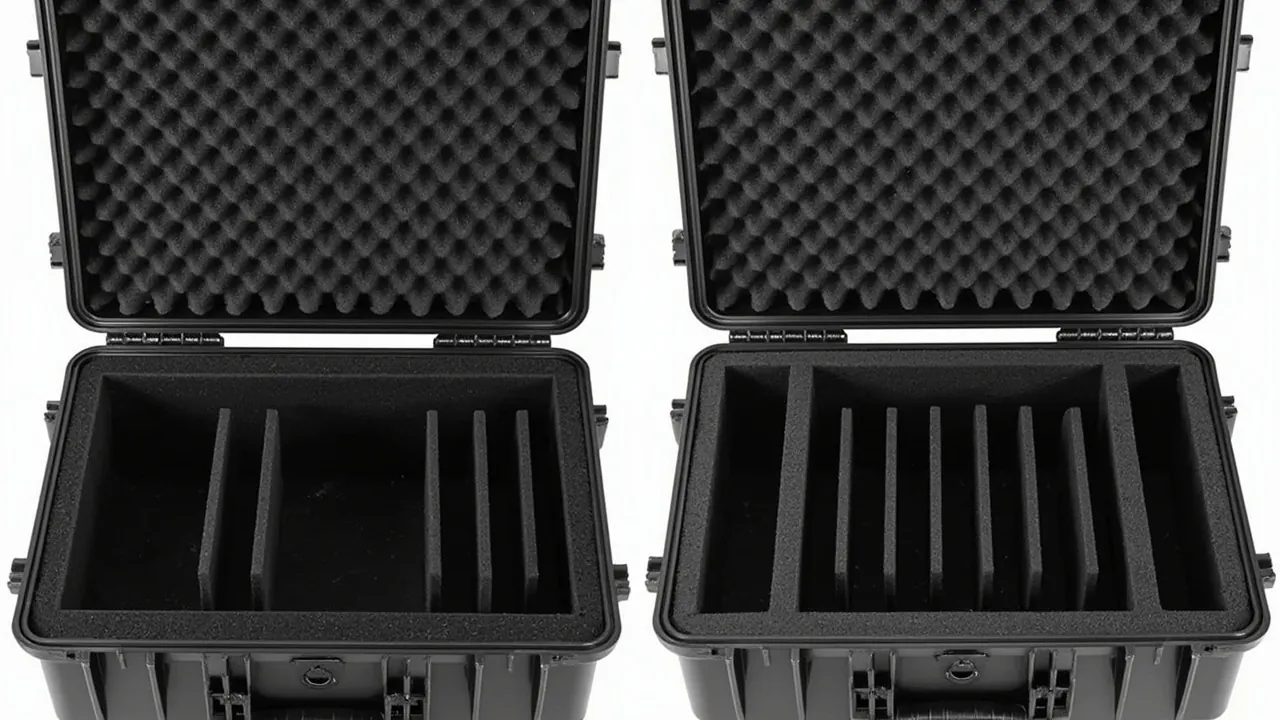
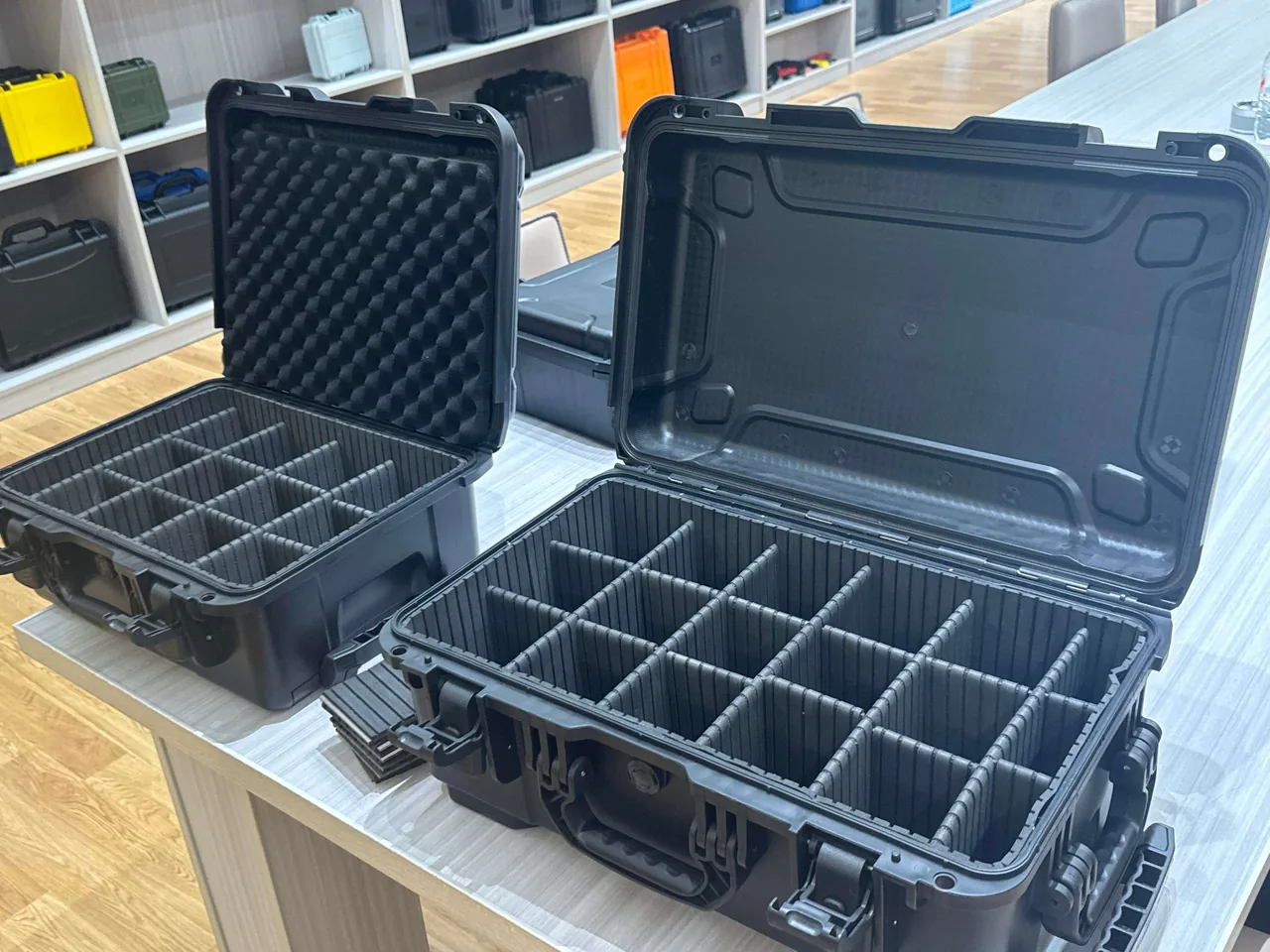
An adjustable divider (adjustable divider/grid divider) uses hook-and-loop, slots, or clips to piece soft or rigid panels into a grid inside the case, dividing the space into several adjustable small cells. Common forms:
- Hook-and-loop divider: Loop surface on the case wall, hook surface on the divider back; divider position moves at will, zero-cost reconfiguration.
- Slot-in divider: Pre-reserved slot rails at the case bottom/wall; insert the divider to fix — more stable than hook-and-loop but repositioning needs plug/unplug.
- Grid sponge divider: Semi-rigid grid sheet dividing, with some cushioning.
The divider's working principle is "space division + soft barrier": it does not wrap each item dead, but uses panels to separate different categories of equipment, avoiding mutual pressure and mixing; the equipment itself still has some free space. Therefore the divider is good at preventing mutual pressure and mixing, but its anti-vibration-shift effect is weaker than foam — equipment in the cell may still wobble slightly with transport. Dividers especially suit "many items, frequent change, fast access" conditions. For modular internal zoning logic, the toolbox-family article modular internal design shares the same logic.
What a Foam Liner Is (Structure and Principle)
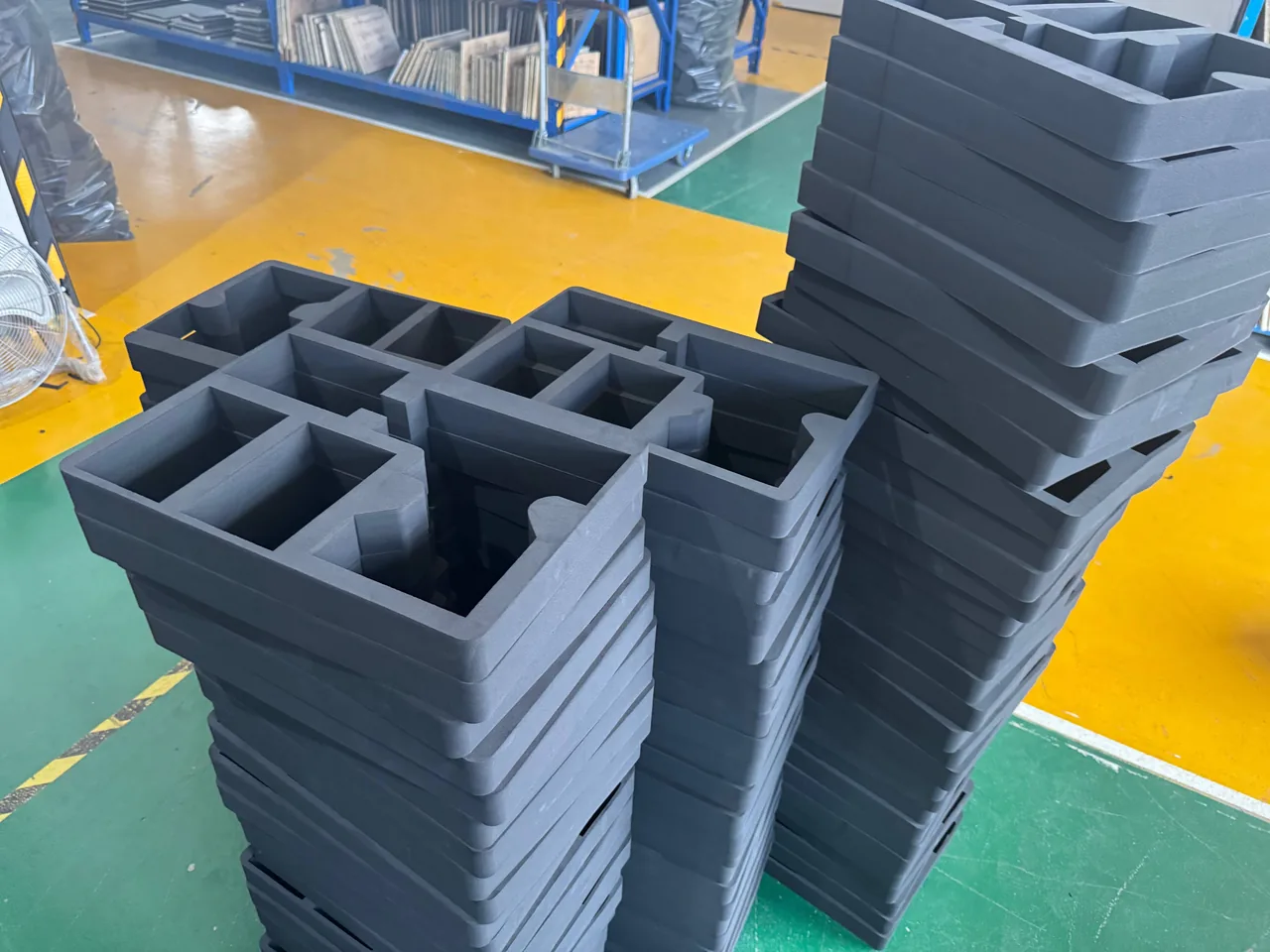
A foam liner lays closed-cell foam such as EVA/EPE/IXPE inside the case and routes, tears, or custom-cuts by equipment shape, so each item is "hugged" in its exclusive cavity. By shaping method it divides into three types: pre-cut foam (factory-routed cavities), pick-and-pluck foam (user-tear grid), and custom insert (exclusive design).
The foam's working principle is "shape match + elastic clamp + limit no-shift": the equipment goes into its exclusive recess, blocked horizontally by cavity walls and pressed vertically by top/bottom foam, with almost no relative shift during transport vibration, thus not colliding with the wall or other equipment. Foam is good at anti-vibration, anti-shift, anti-scrape, at the cost of high change cost after shaping and slower access than dividers' "grab at a glance." To add: the foam liner's protection highly depends on "interference fit" and "two-piece top-and-bottom wrapping" — a single bottom tray is often not enough; key items should be clamped by top and bottom pieces to be safe. For the overall foam types, see what types of internal foam a protective case has.
Divider vs. Foam: Dimension Comparison Table
Putting the two liners in one table makes the difference clear at a glance:
| Dimension | Adjustable divider | Foam liner |
|---|---|---|
| --- | --- | --- |
| Fixing method | Space division, soft barrier | Shape match, elastic clamp |
| Anti-vibration shift | Weak (item can wobble in cell) | Strong (exclusive cavity, zero shift) |
| Anti-scrape/pressure | Medium (separated but may touch) | Strong (each wrapped independently) |
| Reconfigure flexibility | High (move at will) | Low (hard to change after shaping) |
| Access speed | Fast (visible, grab) | Medium (align to cavity) |
| Fit irregular | Strong (mixed sizes) | Medium (irregular needs custom) |
| Fit precision instrument | Weak | Strong |
| Cost (small batch) | Low | Medium (by process) |
| Visual counting | Good (fully open) | Medium (open to see cavity) |
| Typical equipment | Tools, accessories, gear | Camera, lens, instrument, circuit board |
In one sentence: dividers manage "classification and fast access," foam manages "fixing and protection." Whichever column your need falls in, choose that column; if you need both, mix.
Scenarios Where Adjustable Dividers Fit Better
Scenarios where dividers thrive share high change, fast access, and durable equipment:
- Repair and engineering tool kits: Wrenches, screwdrivers, pliers vary in size and are accessed daily; dividers separate cells at will, fastest to return after use.
- Hardware and accessory cases: Screws, connectors, small parts mixed; dividers zone to prevent mixing and pressure, easier than foam.
- Gear and consumable bags: Cables, adapters, attachments frequently added/removed; dividers rearrange space anytime.
- Teaching and demonstration: Equipment needs quick display, frequent change; open cells are more convenient than closed cavities.
- Temporary/sample transfer: One-off, unfixed loading; divider's zero-cost reconfiguration is most economical.
Note: dividers suit "equipment itself durable against knocks." If a precision part sits in a divider cell, still pad the cell bottom with foam or isolate the precision part in a separate foam pouch.
Scenarios Where Foam Liner Fits Better
Scenarios where foam thrives share fear of vibration, fear of shift, high value, fixed shape:
- Photography and film location: Cameras, lenses, drones, memory cards are high-value and fear vibration and scraping; foam-routed cavities are industry practice.
- Scientific exploration and metrology: Sensors, gauge blocks, recorders need stable readings in transit; foam fixing reduces shift.
- Electronics repair: Oscilloscope probes, spare boards, connectors fear dust, moisture, collision; foam + IP67 case is the field standard.
- Aviation communication: Airborne/vehicle radios and navigation equipment experience vibration and pressure difference during takeoff/landing transfer; foam fixing reduces shift, paired with a pressure-balancing valve for cargo-hold pressure difference.
- Military/police/fire: High equipment reliability requirement; the product line can be validated against MIL-STD-810H as a product-line environmental test basis (a product-line-level description, not a single-product "military certification"), and foam snug-fixing reduces mission risk.
Commonality: these equipment "are at risk the moment they leave the room," and the risk mainly comes from vibration, shift, mutual scraping — exactly foam's strength.
Can the Two Be Mixed: Zoning + Fixing Combo
Professional users almost always mix, because the two needs often coexist:
- Dividers for big zones + foam for single items: Use adjustable dividers at the case bottom to separate "tools/electronics/consumables," then lock precision single items in the zone with foam pouches or pre-cut cavities. Balances classification and protection.
- Main equipment foam + accessory dividers: Camera body and lens in foam-routed cavities, batteries and filters in divider cells or pick-and-pluck; access does not conflict.
- Outer divider + inner foam box: Treat the foam liner box holding precision items as a "module" placed in a big divider cell; the module can be pulled out whole.
- Upgrade on demand: Use dividers in the sample stage to quickly verify loading; after the equipment list is frozen, replace key items with a custom insert for smooth transition.
The essence of mixing: use dividers for "classification and fast access," foam for "fixing and protection," each taking its strength. When judging weight, return to the dividing line above.
Selection Decision Checklist
When unsure, use this checklist to self-ask, ticking item by item:
- Does the equipment fear vibration? Fears → foam; not much → dividers possible.
- Is the shape fixed? Fixed and high-value → foam (pre-cut/custom); varying sizes, often changing → dividers.
- Is access frequency high? Many times daily, need speed → dividers first; low-frequency storage → foam first.
- Need to count at a glance? Yes → divider open cells; acceptable → foam.
- Both needs? Both → mix (divider zoning + foam fixing).
- Is the case seal level enough? Whether divider or foam, dust/water still depends on IP67 sealing and shell; the liner only solves cushion-fix.
Among the six questions, "fears vibration, fixed, high-value" majority → foam; "durable, changing, fast access" majority → dividers; mixed → mix.
Common Pitfalls
- Pitfall 1: Dividers also resist vibration. Dividers only separate, not wrap; equipment in the cell still wobbles and bumps with transport; precision parts cannot rely on dividers alone.
- Pitfall 2: Foam is automatically more professional. If equipment is durable tools accessed frequently, foam instead slows efficiency and has high change cost; dividers are more suitable.
- Pitfall 3: Either-or, black and white. Most professional schemes mix; no need to force only one.
- Pitfall 4: Look only at liner, not case. Neither divider nor foam is waterproof or compression-resistant; IP67 sealing, shell rigidity, pressure-balancing valve are the protection foundation.
- Pitfall 5: Dividers just stuffed in. Dividers also need fixing (hook-and-loop stuck well, slots plugged steady), otherwise the whole divider shifts in transit and zoning fails. Also, divider separation does not mean equipment is fixed; precision parts in the cell still need a separate foam pouch or cushion, not mistaken as "safe once separated."
KeXin New Materials JUNZHJIA Liner Capability
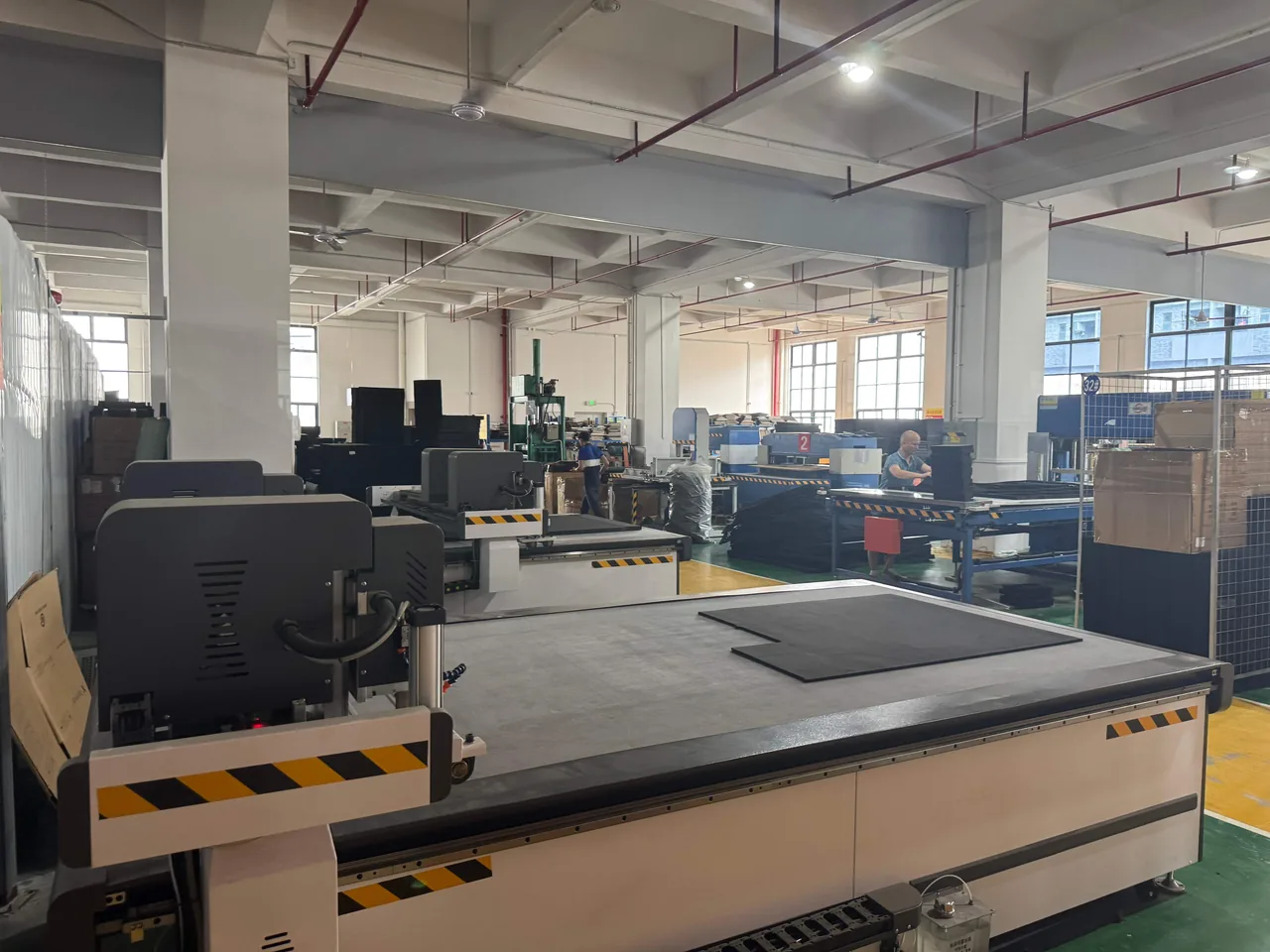
KeXin New Materials (Guangdong) Co., Ltd. operates the domestic brand "KeXin", the global brand kexinMaterials, and the protective-case product-line brand JUNZHJIA. Founded in 2014, the factory is in Zhongshan City, Guangdong (the Greater Bay Area), covering about 18,000 m², with 80+ machines and 100+ staff. The company holds more than 20 utility-model and design patents (each patent is traceable to the corresponding design and process record of the product line).
The product line covers more than 150 specifications across plastic tool boxes, safety protective cases, sealed cases, waterproof/moisture-proof cases, hardware tool boxes, machinery parts cases, and parts bins, applied in outdoor survey, military/police/fire, electronics, scientific exploration, and aviation/communication, exported to the United States, the United Kingdom, Germany, Canada, Japan, Russia, the Philippines, India, Hong Kong/Taiwan (China), and the Middle East. The company has one-stop OEM/ODM capabilities for product design, injection molding, mold manufacturing, LOGO printing, and inner-tray/liner making — The protective-case product line has IP67 capability and holds ISO9001, REACH, and California Prop 65 (certificates available on request); plastic cases in ABS/PP pass RoHS testing; the product line is validated for environmental adaptability under MIL-STD-810H (a product-line test basis, not a military certification). For bulk quotations, specification sheets, and customisation, contact us through the contact form on this site — the team replies within 1–3 business days.
Divider Material and Structure Breakdown
Adjustable dividers are not just one type; by material and fixing method they fit different equipment:
| Type | Structure | Advantage | Limitation |
|---|---|---|---|
| --- | --- | --- | --- |
| Hook-and-loop divider | Loop on wall, hook on divider | Reconfigure at will, zero cost | May loosen under long vibration |
| Slot-in divider | Slots in wall, insert panel | More stable, no shift | Reposition needs plug, grid limited |
| Grid sponge divider | Semi-rigid grid sheet | Some cushioning | Weaker fixing than foam |
| Rigid plastic divider | PP/ABS thin sheet | Stiff, compression-resistant | No cushion, equipment needs padding |
Selection tip: heavy equipment, bumpy transport → prioritize slot-in or rigid divider with fixing; light equipment, frequent reconfiguration → hook-and-loop most flexible. Either way, the divider itself is not waterproof or compression-resistant; the protection foundation is still the case IP67 sealing and shell rigidity.
Foam Liner Material and Parameters (Reference)
The foam liner's material and parameters decide fixing effect; below are common industry ranges (foam industry knowledge; specific per manufacturer spec sheet):
| Parameter | Common industry range (reference) | Selection meaning |
|---|---|---|
| --- | --- | --- |
| EVA foam density | about 30–80 kg/m³ | Higher density stiffer, better support |
| Shore A hardness | about 30A–70A | Hard holds shape, soft wraps gently |
| Single-cavity interference | about 1–2 mm | Clamp without damaging equipment |
| Lid-close compression allowance | about 5%–10% | Fix without pushing lid open |
| IXPE suitability | Low-dust, clean environments preferred | More suitable for electronics/medical |
Matching principle is consistent with custom insert factors: heavy equipment uses high-density medium-high-hardness, fragile surfaces use a soft layer, clean scenarios use IXPE or ESD foam. Material choice must link with equipment vulnerability, not pick a "good foam" in isolation.
Divider vs. Foam Cost and Maintenance Comparison
From total-cost-of-ownership and maintenance, the two also differ:
- Upfront cost: Dividers (especially hook-and-loop) usually low; foam cost rises with process (pre-cut < die-cut < custom/thermoform). For small-batch high-value singles, foam's lower transport loss offsets its cost.
- Reconfiguration cost: Dividers near zero; foam (except self-tear pick-and-pluck) needs factory return or remake to change.
- Maintenance: Dividers wipe clean, long life; foam ages and flakes under long sun and high temperature, needs regular cleaning and replacement.
- Counting efficiency: Divider open cells visible at a glance, fast counting; foam needs opening to see cavities, but each has a fixed position, misplacement easy to spot.
So "which is cheaper" has no uniform answer; it depends on equipment change frequency and value: high change, durable → dividers cheaper; high-value, fixed → foam more worthwhile.
How Dividers/Foam Coordinate with the Case Shell
Whichever liner, it must coordinate with the case:
- Stable internal dimensions: Small injection tolerance lets divider slots and foam cavities align to coordinates; recycled thin-wall cases drift in size, liner easily offsets. Regular manufacturers use virgin ABS/PP and control mold tolerance.
- Divider fixing must be firm: Hook-and-loop fully stuck, slots plugged steady, otherwise the whole divider shifts in transit and zoning fails.
- Do not interfere with seal and latch: Liner edge leaves clearance from lid seal groove and latch, lid does not press seal, latch closes after closing, otherwise destroys IP67.
- Center the center of gravity: Heavy equipment at case geometric center, avoid eccentric load causing stacking tilt. Stacking and load can refer to protective-case stacking structure.
In one sentence: the liner's "stability" is built on the case's stable dimensions and reliable locating.
Divider and Foam Application Across Five Industries
Combining common protective-case applications (outdoor survey, military/police/fire, electronics, scientific exploration, aviation/communication), the two liners land differently:
- Outdoor survey and scientific exploration: Precision instruments → foam fixing mainly; sampling tools durable → divider zoning second; scientific transfer involves temperature/altitude, case has pressure-balancing valve.
- Military/police/fire: Mission equipment reconfigured by duty → flexible dividers; weapons/detection precision parts → foam snug; product line can be validated against MIL-STD-810H as a product-line environmental test basis (product-line-level, not single-product "military certification").
- Electronics: Repair meters fear dust/moisture → foam + IP67; hardware accessories frequently change → divider zoning.
- Aviation communication: Radios/navigation experience vibration and pressure difference → foam fixing mainly, with pressure-balancing valve.
- Industrial metrology: Gauge blocks high-value → foam per-item wrapping; general tools → dividers.
The rule is clear: precision/high-value/fixed → foam; durable/changing/fast-access → dividers; mixed equipment → mix.
Divider and Foam Acceptance Checklist
The two liners have respective acceptance points; check item by item:
- Divider acceptance: Reasonable zoning without wasting space; hook-and-loop/slot firmly fixed, no shift in transit; equipment in cells not mutually pressed; does not press seal, latch closes; open cells countable at a glance.
- Foam acceptance: Each item in exclusive cavity without looseness; access without brute force; slight compression after closing (about 5%–10%) not pushing lid; no flaking; material traceable (EVA/IXPE/ESD); does not block pressure valve and latch; batch consistent and interchangeable.
- Common items: Liner does not destroy IP67 sealing, does not replace shell protection; coordinates with case at mold stage, coordinates aligned.
Writing the checklist into the purchase contract appendix avoids "good sample, bad mass goods" and "liner disconnected from case."
Transport and Storage Notes
Both liners need maintenance:
- Cool storage: Avoid long-term sun and high temperature; foam ages and flakes, divider hook-and-loop loses stickiness.
- Moisture-proof but not waterproof: Closed-cell foam does not absorb water, but long-term humidity may still fail adhesive; the case IP67 is the main moisture defense.
- No heavy pressure: Foam pressed long term on irregular objects collapses cavities; dividers pressed long term by heavy items deform.
- Regular cleaning: Foam with low-pressure air or soft cloth for dust; dividers wipe; replace promptly if powdering, broken ribs, or loose dividers found.
- Spare management: For multiple same-model cases, keep first-article samples and spares for consistency checks and replacement.
Three Typical Mix Patterns
Mixing is not random stacking; three copyable patterns:
- Pattern 1 · Bottom divider + upper foam box: Adjustable dividers at case bottom separate big categories (tools/electronics/consumables); in each category place a foam-routed liner box holding precision singles. Open big cell then small box — classification and protection both served. For comprehensive repair kits.
- Pattern 2 · Main-equipment foam + accessory divider: Camera body and lens locked by foam pre-cut, batteries and filters in divider cells or pick-and-pluck; frequently used items fast, precision items fixed. For photography location kits.
- Pattern 3 · Outer foam wall + inner divider cells: First lay a ring of foam inside the whole case as a shock wall, then use dividers in the middle for several open cells holding durable gear. For "perimeter fears vibration, interior durable" transport cases.
The common point of the three patterns: first split by equipment attribute (precision/durable), precision goes foam, durable goes dividers, then the case IP67 and shell cover the rest. For how to choose foam specifically, return to what types of internal foam a protective case has.
Decision Tree From Need to Scheme (Text Version)
Put the checklist above into step-by-step judgment so even a beginner decides correctly:
- Does the equipment mainly fear vibration and shift? (Yes → 2; not much → 4)
- Is it high-value and fixed-shape? (Yes → foam: standard choose pre-cut, irregular choose custom; no → 3)
- Does the equipment list often change, need self-adjust? (Yes → pick-and-pluck; no → pre-cut)
- Is the equipment durable, varying sizes, frequently accessed? (Yes → adjustable divider)
- Both needs? (Yes → mix: divider zoning + foam fixing)
- Finally check the case: whatever you choose, confirm IP67 sealing, shell rigidity, pressure-balancing valve when needed are all present.
Writing the decision tree into the purchasing spec markedly reduces "bought by feel, equipment damaged."
Cost Accounting for Universal vs. Custom Liner
Both dividers and foam have "universal" and "custom" versions; how to choose also needs accounting:
- Universal divider: Hook-and-loop/slot finished product, low cost, buy-and-use, suits unfixed equipment lists.
- Custom divider/slot: Tool-made exclusive slots by case internal dimensions, better fit but needs front-end investment, suits batch consistency.
- Universal foam: Blank or pick-and-pluck, user shapes, lowest cost, highest flexibility.
- Custom foam/thermoform: Exclusive design, highest fit and consistency, suits high-value precision single in batch.
Rule: small batch, often changing → universal/self-shape more economical; large batch, need consistency, high-value → custom amortized more worthwhile, and lowers transport loss and repair. Specific quotes and lead times per the manufacturer's formal reply; this article does not speculate on price or MOQ.
Signals to Upgrade Your Liner
To judge whether the current liner should be upgraded, watch these signals:
- From divider to foam: Precision/high-value singles appear in the equipment; after transport readings drift, surfaces show knocks or scratches; or equipment in divider cells wobbles and collides in the car. Signal says "separation not enough, need wrapping-fix."
- From universal foam to custom: Pre-cut cavities do not match your actual equipment (accessory does not fit, main unit wobbles), or pick-and-pluck grid approximation cannot meet precision-part requirements. Signal says "need exclusive fit."
- Introduce dividers: Too many durable small tools stuffed in the foam liner, every access must align to cavity, low efficiency. Signal says "some equipment only need classification, not wrapping."
- Do a mix: Equipment contains both precision and durable parts; a single scheme cannot cover both. Signal says "zoning + fixing each take strength."
- Look back at the case: Whatever liner you change, if it still takes in water and dust, the problem is IP67 sealing and shell, not the liner. Signal says "fix case protection first, then talk liner."
Writing these signals into the equipment manager's inspection sheet lets you proactively upgrade the liner before damage, not remedy after.
Effect on Case Space Utilization
When selecting, also consider "does the case pack full"; the two liners affect space differently:
- Divider: Only planar division, almost no extra thickness, high space utilization; but the divider itself has thickness (a few to more than ten mm), the smaller and more cells, the more obvious the wasted "wall thickness." Open zoning also means space between equipment to avoid mutual pressure, overall slightly loose.
- Foam: To hold equipment shape, often needs a thick whole sheet (commonly 20–60 mm), and two-piece top-and-bottom occupies more net depth; but each item is "snug," almost no gap inside, high equipment fit per unit space.
- Trade-off: Pursue "pack more, grab fast" → divider saves space; pursue "pack stable, no wobble" → foam's thick foam trades for zero shift, worth it. If case net space is tight, prioritize a thin-wall high-strength case (see protective-case wall thickness and strength) and precisely calculate total equipment height, avoiding foam too thick pushing the lid.
In one sentence: space utilization is not simply comparing "who is thinner," but comparing "who lets equipment both fit and not wobble in limited net space."
Frequently Asked Questions (FAQ)
Q: Are protective-case dividers better or foam better? A: No absolute better; it depends on need: equipment fears vibration, high-value, fixed-shape → foam; equipment durable, often changing, needs fast access → dividers; both needs → mix (divider zoning + foam fixing). Both only solve the cushion-fix layer; dust/water still depends on the case IP67 sealing.
Q: Can adjustable dividers resist vibration? A: Dividers mainly do space division; equipment in the cell may still wobble and bump with transport, weaker than foam. Precision parts should not rely on dividers alone; pad the cell bottom with foam or isolate in a separate foam pouch.
Q: Is foam liner convenient to access? A: After foam fixing, access needs aligning to the cavity, slightly slower than open dividers, but trades for zero shift in transit. High-frequency access can put frequently used items in divider zones and precision items in foam zones, mixing for both.
Q: Can the two liners be used together? A: Yes, and professional schemes often mix: dividers for big-category zoning, precision singles in the zone fixed by foam. Both classification-fast-access and snug protection, each taking its strength.
Q: After choosing a liner, do I still need to look at the protective case itself? A: Must. Neither divider nor foam is waterproof or compression-resistant; dust/water protection relies on IP67 sealing and shell rigidity, and air/high-altitude needs a pressure-balancing valve. The liner is only the cushion-fix layer of the three-layer protection and cannot replace the case.
Conclusion
Whether a protective case uses dividers or a foam liner, the core dividing line is "whether the equipment fears vibration, whether it is regular, and how high the access frequency is": precision instruments that fear vibration, are high-value, and fixed-shape choose a foam liner (pre-cut/pick-and-pluck/custom) for snug fixing and zero shift; durable, often-changing, fast-access tools and accessories choose adjustable dividers for flexible zoning and at-a-glance counting; coexisting needs mix — dividers for big-category zoning, foam for single-item fixing. Note that dividers only separate not wrap, weaker than foam against vibration; foam is slower to access than dividers; neither is the absolute answer of "more professional," but a division of "more suitable." Whatever you choose, it is only the cushion-fix layer of the three-layer protection and must pair with IP67 sealing, shell rigidity, and (for air/high-altitude) a pressure-balancing valve to form the complete scheme of "ready to use when out, safe when in." For batch users, leveraging a manufacturer with one-stop OEM/ODM for product design, injection, molds, and liner (such as KeXin New Materials JUNZHJIA) can coordinate divider slots and foam cavities with the case before leaving the factory, delivering a complete scheme.
Further Reading
- What is an outdoor protective case and where is it used?
- What types of internal foam does a protective case have?
- What is protective-case pre-cut foam (pre-routed insert)?
- How to use pick-and-pluck foam (tear-grid foam)?
- What factors should a custom protective-case foam insert consider?
- How does a protective case achieve stable stacking?