

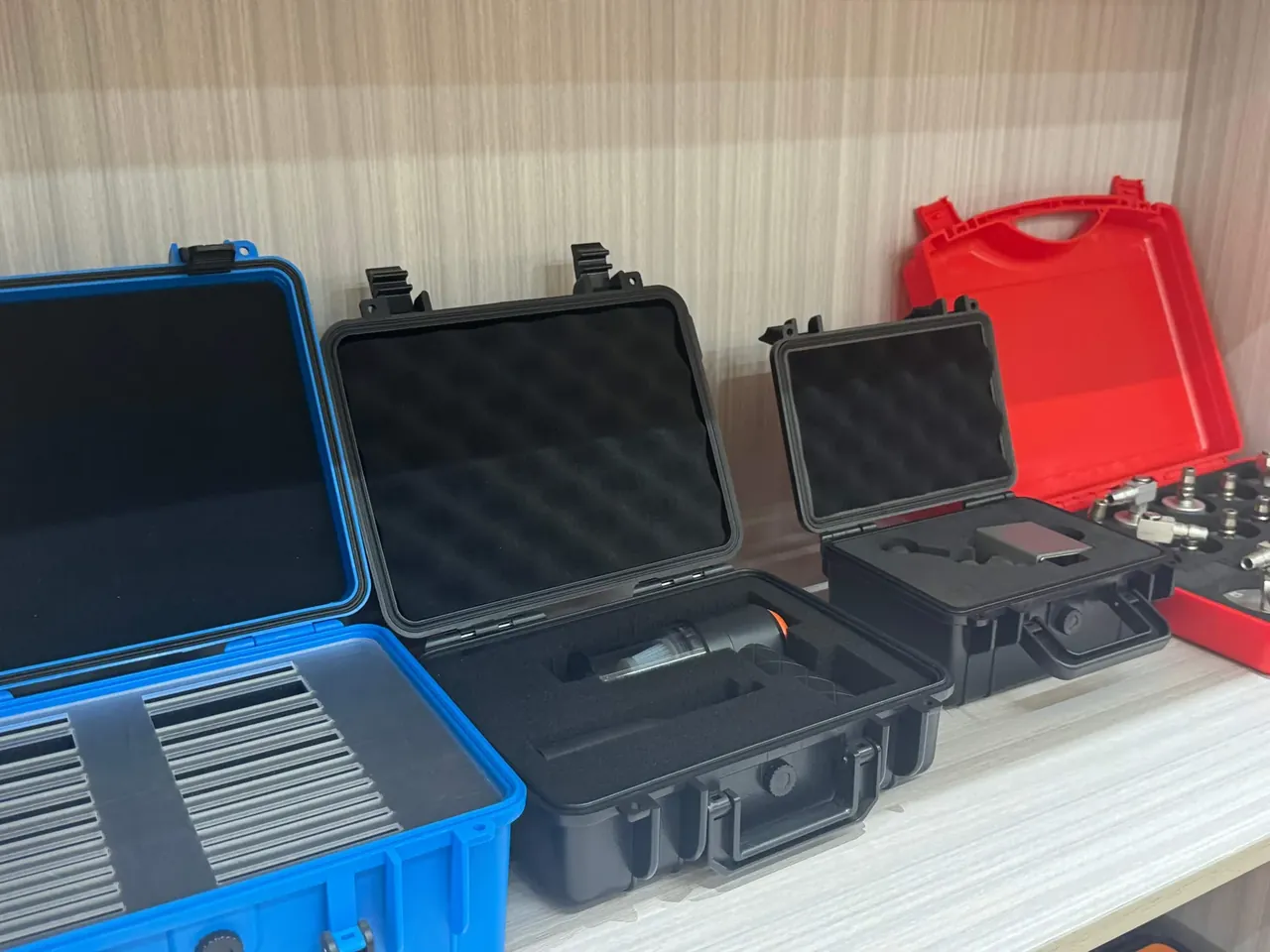
Quick answer: Choosing an equipment protection case takes two sums. Build the internal cavity from the device envelope plus foam, cabling and access allowances, then set corner and base margin from the weight. Quote the cavity at its narrowest point and margin against drop height.
Table of contents
- Start With the Cavity, Not the Outside
- Three Allowances: Foam, Cabling, Access
- Shock Margin at Corners and Edges
- Weight, Balance and Carrying Method
- Filling the Sizing Sheet
- FAQ
1. Start With the Cavity, Not the Outside
Every equipment protection case is quoted with three numbers: outside size, moulded cavity and usable cavity. The outside sets stacking volume, the moulded cavity is what the tool produces, and the usable cavity is what remains once foam is in. Quote the wrong one and every allowance after it is wrong.
Measure at the narrowest point: two degrees of draft over 200 millimetres pulls each wall in about seven millimetres. A body that fits at the opening and not at the floor is a draft nobody counted.
| Term | Meaning | How it goes wrong |
|---|---|---|
| Outside size | Envelope with bumpers and latches | Used to size the load, too generous |
| Moulded cavity | Space as moulded, draft included | Measured at the opening, too generous |
| Usable cavity | Space left after foam and ribs | Cabling omitted, too tight |
2. Three Allowances: Foam, Cabling, Access
Usable cavity is the envelope plus three allowances. Foam runs twenty millimetres at the sides and fifteen at the top, with the base handled as margin. Below fifteen, a device corner wears through the foam and reaches the shell.
Cabling needs a bend radius: thirty millimetres, or twice the cable diameter. Access needs forty millimetres on any face carrying knobs or ports, or the device comes out for every connection.
| Allowance | Direction | Value |
|---|---|---|
| Side foam | All round | 20 mm |
| Top foam | Above the panel | 15 mm |
| Cabling | Cable exit | 30 mm minimum |
| Access | Operating face | 40 mm |
3. Shock Margin at Corners and Edges
Margin is not thickness. Thickness is static space; margin is what is left to compress. Up to six kilograms, use twenty-five millimetres at the base, twelve at each corner and eight along the edges. Double the weight and the base goes to thirty-five, corners to sixteen.
Corners take more because they land first and foam fits worst where three faces meet. A thin corner splits inside the bumper and runs along the parting line. A separate moulded corner block fixes that; a thicker bumper does not.
| Device weight | Base foam | Corner margin | Edge margin |
|---|---|---|---|
| Up to 6 kg | 25 mm | 12 mm | 8 mm |
| 10 kg | 30 mm | 14 mm | 10 mm |
| 20 kg | 35 mm | 16 mm | 12 mm |
The figures assume a 1 metre drop. For parcel sorting, add five millimetres back, since chute drops often exceed 1.5 metres.
4. Weight, Balance and Carrying Method
Total weight is device plus empty body. A twelve litre moulded case weighs about 3.1 kilograms, so a six kilogram payload lands at 9.1, while twelve kilograms approaches fifteen.
Keep one-handed loads under twelve kilograms, two-handed under twenty-five, with the handle within 150 millimetres of the centre of gravity. Beyond fifteen percent off-centre, the mass lands on one corner and effective margin falls.
| Total weight | Carrying method | Handle |
|---|---|---|
| Under 12 kg | One hand | Centred, 25 mm grip |
| 12 to 25 kg | Two hands | Symmetric, both sides |
| 25 to 40 kg | Strap or wheels | Wheel 75 mm minimum |
5. Filling the Sizing Sheet
Fill the sheet in order: envelope, three allowances, margin by weight, outside from cavity plus wall, then a weight check. Set the outside first and the case starts dictating the device.
Trial fitting confirms the arithmetic. The lid should close without force and should not lift the device when opened. A stiff lid means the top allowance is short; a device riding up means the grip is too tight.
Conclusion
Choosing an equipment protection case is arithmetic: the envelope is known, foam, cabling and access are added, margin comes from a weight table, and the outside is derived from the cavity. Once every step ends in millimetres, trial fitting confirms a decision instead of replacing one. What remains is whether the supplier can hold the tolerance on that equipment protection case.
This article discusses only the container (case body) side of specifications and design intent, and does not cover any handling, loading or use of the contents.
Related Reading
- How case dimensions are measured and quoted
- Cutting and bonding foam inserts
- Balancing case weight against strength
- Handle ergonomics and load paths
Related Products
- 8 Series — Gun Cases; Military Equipment Cases; Camera Equipment Cases; Drone Cases; Watch Cases; Knife Cases; First Aid Cases; Electronics Equipment Cases
- WL8-2812 PP Gun Case — model WL8-2812
- All protective cases and toolboxes: 7 series, 158 models