

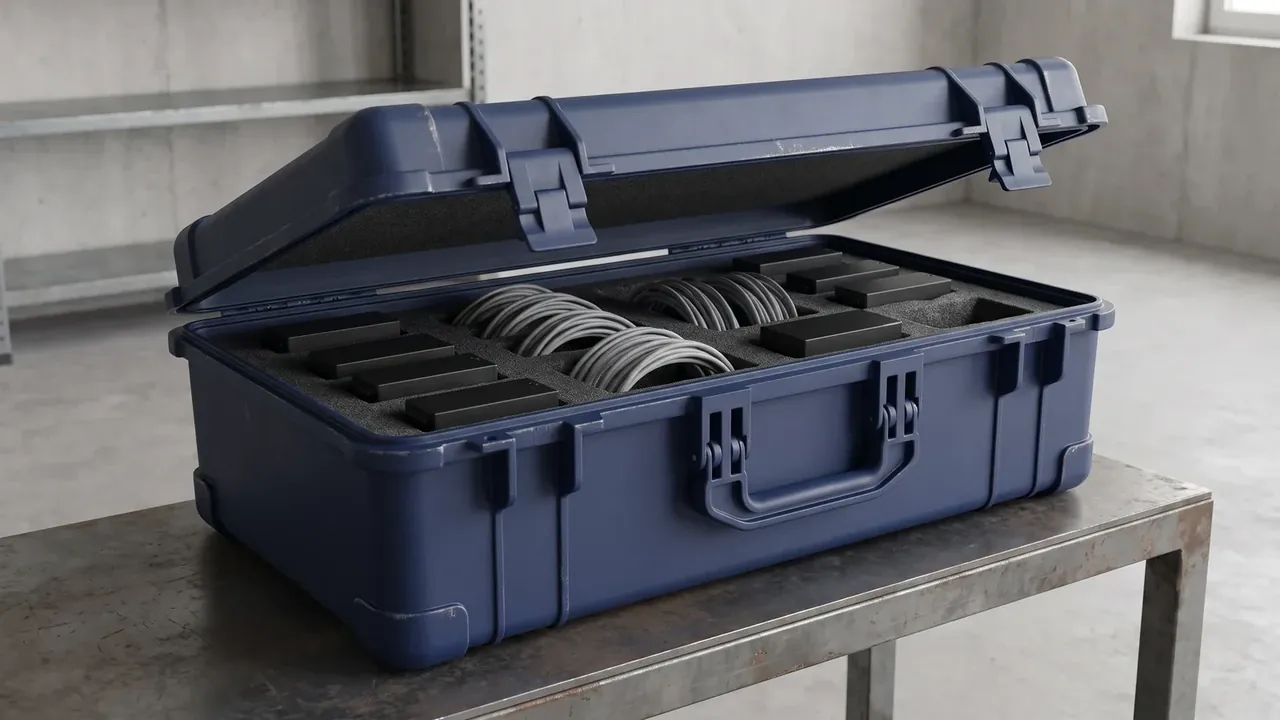
Quick answer: An equipment transit case is built for four legs rather than one lift: plant transfer, project delivery, export shipment and storage. Each leg loads it differently, so lifting, anchoring, stacking and moisture are set by the heaviest one.
Table of contents
- Four Legs an Equipment Transit Case Has to Survive
- Plant-to-Plant Transfer: Lifting and Fork Structures
- Project Delivery and Export: Stacking, Marking and Moisture
- Pre-Installation Storage: Opening Conditions
- Configuration Across the Four Legs
- FAQ
1. Four Legs an Equipment Transit Case Has to Survive
An equipment transit case often works for a shorter period than the machine inside, yet decides whether it starts first time.
A plant transfer is a truck run with about four handling points; delivery crosses provinces; export goes by sea; storage is the wait before installation. Structure follows the heaviest leg.
| Leg | Duration | Handling | Main load |
|---|---|---|---|
| Plant transfer | 4 to 12 hours | 4 | Fork, braking |
| Project delivery | 2 to 5 days | Over 6 | Vibration, stacking |
| Export shipment | 25 to 40 days | Over 8 | Salt, heat, squeeze |
| Pre-installation storage | 3 to 7 days | 2 | Dew point |
2. Plant-to-Plant Transfer: Lifting and Fork Structures
On transfer the equipment transit case rides a truck most of the day, while handling takes minutes at each end: forks below, a crane above.
Forks use through pockets of 150 × 70 mm at 700 mm centres, so the centre of gravity sits between the tines; the pocket floor stays 90 mm off the ground.
Four lugs rated 300 kg each carry a 480 kg load, keeping a margin for one failed point. Keep slings inside 60 degrees, since every extra 15 degrees steps the load up. The 1200 × 800 × 950 mm outline puts 18 cases on a 9.6 m truck floor.
3. Project Delivery and Export: Stacking, Marking and Moisture
Long-haul damage comes from stacking and restraint, not the road. Two layers go in a truck with 600 kg checked on the lower lid, where corner blocks pass load into the side walls.
Anchors on the equipment transit case sit in the base: eight M10 inserts at 2 kN, crossed by two straps that pull the base only, since lid load crushes the gasket.
Export is the sea leg, where 22 equipment transit case units fit a 40 ft box with 20 mm battens, 30 days at sea, humidity above 80 percent, 48 hours of salt spray.
| Item | Requirement |
|---|---|
| Stacked layers | 2, third empty only |
| Lid top load | 600 kg at four corners |
| Internal humidity | Under 45 percent RH |
Marks go on four faces, with 50 mm characters and yellow centre marks 100 mm below the lugs. Three indicator cards and desiccant at 120 g per cubic metre cover the sea leg.
4. Pre-Installation Storage: Opening Conditions
The equipment transit case waits three to seven days on site while the interior swings from 45 degrees C by day to 10 at night.
Let it stand 24 hours so the interior comes within 5 degrees C of the site. Open early and water lands on the foam, which needs two days to dry; two 100 mm timbers and 200 mm of wall clearance keep it dry.
5. Configuration Across the Four Legs
Four legs on one case concentrate the differences in lifting, anchor count, stacking and moisture. Each value is set by the heaviest leg.
| Leg | Lifting | Anchors | Layers | Moisture |
|---|---|---|---|---|
| Plant transfer | Pockets, two lugs | 4 | 2 | No desiccant |
| Project delivery | Pockets, four lugs | 8 | 2 | 60 g per cubic metre |
| Export shipment | Pockets, four lugs, guards | 8 | 2 | 120 g per cubic metre |
| Storage | None | None | 1 | Original kept |
More anchors is not better: eight holes interrupt the sealing face. Damping sits between insert and base, where a 25 mm EPDM pad at 20 percent compression pulls a 5 to 200 Hz sweep below 10 Hz.
Conclusion
Four legs load an equipment transit case in different ways, and that sets the lifting structure, anchors, stacking and moisture. Export reads stacking and salt spray, storage reads the temperature balance before opening. Size the structure for the heaviest leg, and the equipment transit case lands on specification.
This article discusses only the container (case body) side of specifications and design intent, and does not cover any handling, loading or use of the contents.
Related Reading
- Equipment cases for industrial inspection
- Transit cases in warehousing and transfer
- Export packaging for transit cases
- Moisture-proof case selection
Related Products
- 8 Series — Gun Cases; Military Equipment Cases; Camera Equipment Cases; Drone Cases; Watch Cases; Knife Cases; First Aid Cases; Electronics Equipment Cases
- WL8-2812 PP Gun Case — model WL8-2812
- All protective cases and toolboxes: 7 series, 158 models