

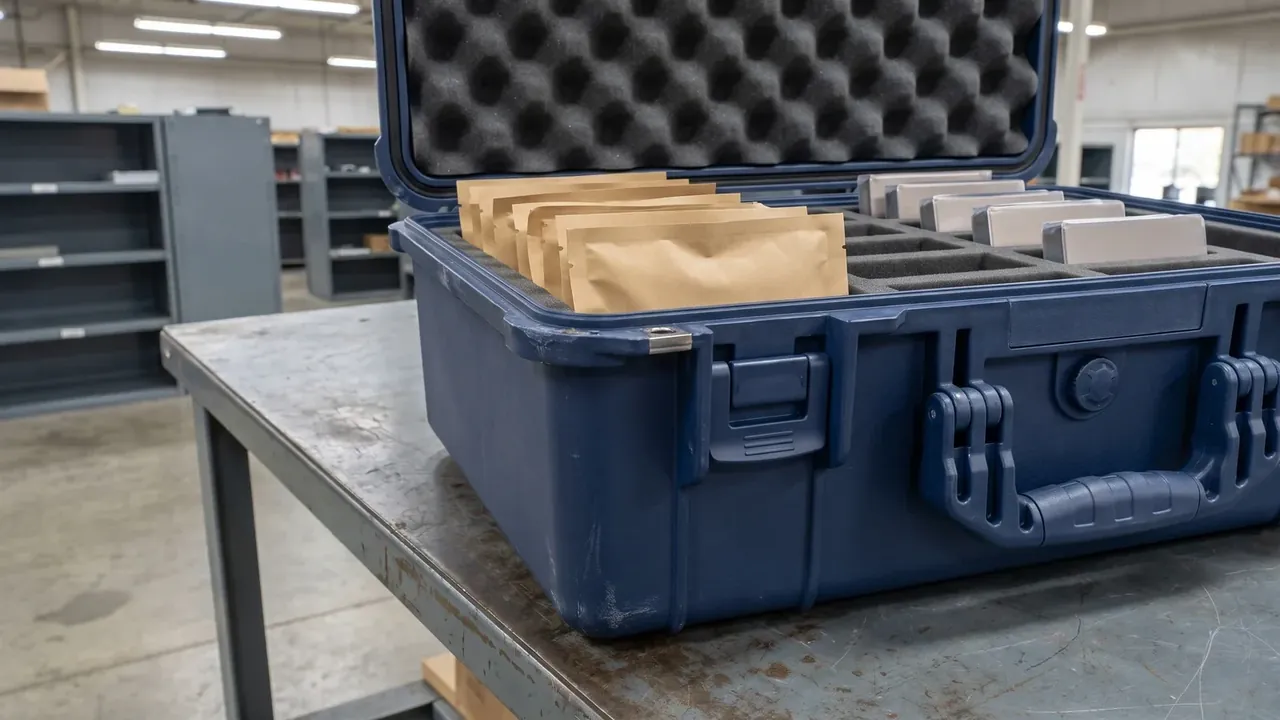
Quick answer: An ESD case holds 1×10^6 to 1×10^9 Ω because the filler sits inside the compound, and the same box drifts past 3×10^9 Ω at 12% RH.
Table of contents
- Surface Resistance Is Not Volume Resistance
- Three Routes to a Dissipative Compound
- Test Conditions That Make Numbers Comparable
- Humidity Drift, Static Decay and Wash Recovery
- FAQ
1. Surface Resistance Is Not Volume Resistance
A purchase order that says "anti-static" and nothing else can be filled with a box at 1×10^4 Ω or one at 1×10^11 Ω, 7 decades apart and both honestly described. Landing inside 10^6–10^9 Ω starts with naming the measurement.
Surface resistance runs along the wall between two points on one face; volume resistance runs through the thickness, one electrode per side. On the same molding, 5×10^7 Ω on the surface usually comes with 1×10^9 Ω to 1×10^11 Ω through the wall, since the conductive network is denser near the skin.
ANSI/ESD S541 calls anything below 1×10^4 Ω conductive, 1×10^4 Ω to just under 1×10^11 Ω dissipative, and 1×10^11 Ω and above insulative. The 10^6–10^9 Ω window sits mid-band: below it, discharge into a live terminal rises too fast; above it, charge survives a rub.
| Item | Surface resistance | Volume resistance |
|---|---|---|
| Electrode | Concentric ring, 63.5 mm outer | Two plates, one per side |
| Common method | STM11.11 | STM11.12 |
| PP case, 3.2 mm wall | 5×10^7 Ω | 1×10^10 Ω |
| Humidity sensitivity | High | Low |
2. Three Routes to a Dissipative Compound
An ESD case reaches that window through a connected path inside the polymer, and the three common routes differ in band, colour and cost.
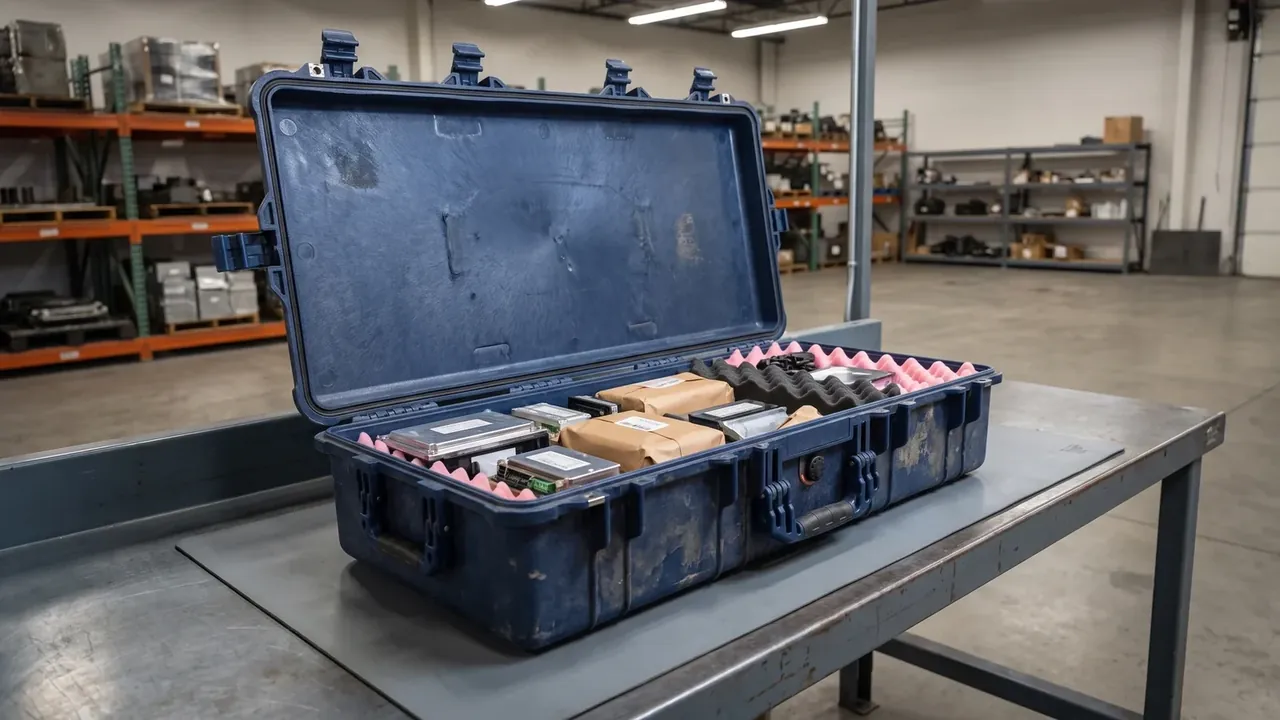
Carbon black is the oldest: 10%–15% by weight builds a particle network and lands 1×10^3 Ω to 1×10^6 Ω, at the price of black-only colour and notched Izod 10%–20% below natural resin.
Permanent antistatic additives are polymeric. Polar segments gather at the surface, giving 1×10^8 Ω to 1×10^10 Ω, light colours, and no recovery problem after a wipe, for 15%–25% more compound cost.
Migration-type surfactants bloom to the surface. Early readings sit at 1×10^9 Ω to 1×10^11 Ω, but 12% RH lifts them by 2 decades and one wipe sends them back to insulative.
Foam is the second trap. A 1×10^7 Ω body with plain EPE foam at 1×10^12 Ω behaves like an insulative box, so liner, dividers and straps ship to the lab with the body.
| Route | Typical surface resistance | Colour | After scrubbing | Best for |
|---|---|---|---|---|
| Conductive carbon black | 1×10^3–1×10^6 Ω | Black only | Unchanged | Reusable transit |
| Permanent antistatic | 1×10^8–1×10^10 Ω | Light colours | Unchanged | Cleanrooms |
| Migration type | 1×10^9–1×10^11 Ω | Any | Up 1–2 decades | Short-life packaging |
3. Test Conditions That Make Numbers Comparable
One molding, two labs: 8×10^6 Ω from one, 4×10^8 Ω from the other, both real. The gap is voltage, humidity and probe pressure.
Below 1×10^6 Ω the method calls for 10 V; at and above it, 500 V. Reading a 5×10^8 Ω box at 10 V runs more than a decade high, and reading a 1×10^5 Ω box at 500 V runs low with a burn mark in the skin.
The ring probe weighs 2.27 kg with a 63.5 mm outer ring; an unseated probe adds contact resistance straight into the number.
Condition at 23 °C and 50% RH for 48 h, take 9 points, 3 on the lid, 3 on the wall midline, 3 on the base, and report the maximum, because one point outside the window condemns the lot.
Two handling errors decide most disputes. A hand resting on the wall shunts 1×10^4 Ω to 1×10^6 Ω of body resistance into the circuit, and isopropanol measured before it flashes off pulls the reading down half a decade.
| Condition | Value | Deviation if changed |
|---|---|---|
| Test voltage | 500 V at ≥1×10^6 Ω | 10 V reads 1 decade high |
| Probe load | 2.27 kg dead weight | Poor seating adds 0.3–0.8 decade |
| Temperature | 23 °C | 35 °C reads 0.2–0.4 decade low |
| Relative humidity | 50% RH | 12% RH reads 0.5–2 decades high |
4. Humidity Drift, Static Decay and Wash Recovery
Three numbers decide whether an ESD case lasts: drift with humidity, triboelectric decay, and the climb after washing.
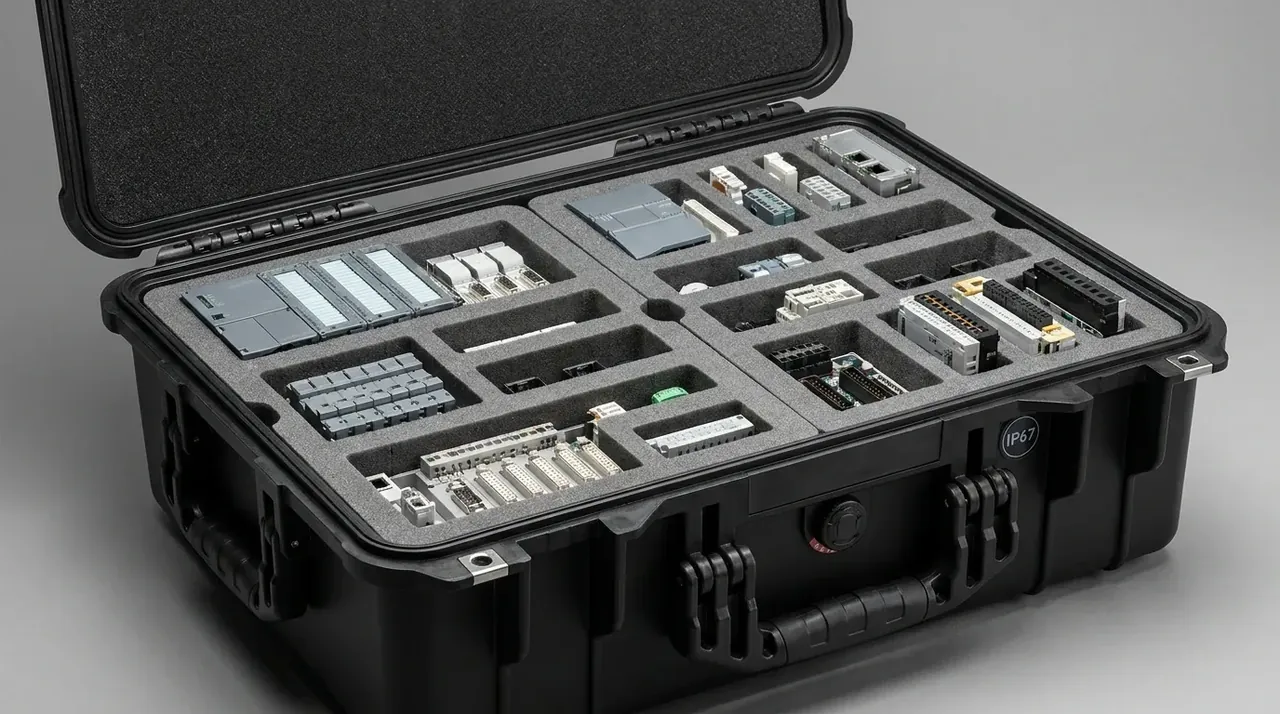
From 50% RH to 12% RH, a migration-type box climbs 1.5–2 decades, a permanent additive 0.3–0.5, carbon black under 0.2. Winter workshops below 20% RH are where the migration route stops working.
FTMS 101C method 4046 wants 1000 V down to 100 V inside 2 s: carbon black 0.1–0.3 s, permanent 0.5–1.2 s, migration 1.5–3 s. Plain PP rubbed holds 3 kV to 8 kV, while a finished case stays under 100 V.
Five neutral-cleaner cycles lift a migration-type box 0.8–1.2 decade. It needs 24 h to 72 h to settle back. Ten isopropanol wipes lift it 2 decades. Carbon black barely moves under either treatment. After 24 months outdoors, carbon black still reads inside the window. Migration types have usually fallen past 1×10^9 Ω.
Conclusion
Four numbers belong on the drawing, not one word on the order: surface resistance between 1×10^6 Ω and 1×10^9 Ω; test voltage of 500 V or 10 V chosen by expected reading; conditioning at 23 °C and 50% RH for 48 h with the maximum of 9 points reported; static decay from 1000 V to 100 V under 2 s. Add two clauses, liner and dividers tested in the same lot, and a stated recovery time after washing. With those in place, the same ESD case reads within one band in a dry workshop and a damp warehouse instead of drifting 2 decades apart.
Related Reading
- How to specify and accept an anti-static case
- Resistance bands for ESD plastic boxes
- Matching foam liners to component cases
Related Products
- 8 Series — Gun Cases; Military Equipment Cases; Camera Equipment Cases; Drone Cases; Watch Cases; Knife Cases; First Aid Cases; Electronics Equipment Cases
- WL8-2812 PP Gun Case — model WL8-2812
- All protective cases and toolboxes: 7 series, 158 models