

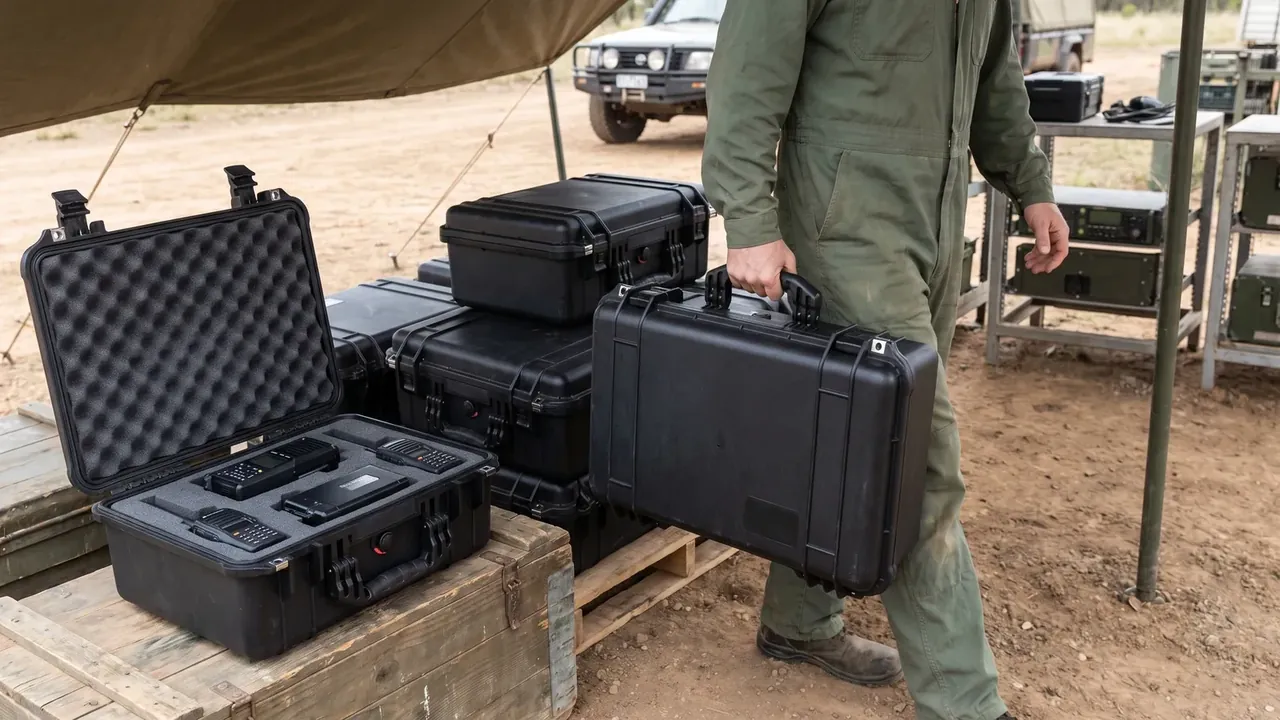
Quick answer: A Field Mission Equipment Case meets three loads a trip: 5-tier stacking, 28.4 kg carried, a 110° lid, held by 420 N handles and 3.5 mm walls.
Table of contents
- Three Transfer Legs, Three Sets of Numbers
- Vehicle Leg: Pallet Stacking and Strap Pinch Points
- Carrying Leg: Four Harness Points and the Mass Line
- Camp Leg: The 110° Lid Angle and One-Hand Access
- How Valve, Latches and Drop Margin Split Up
- FAQ
1. Three Transfer Legs, Three Sets of Numbers
The same shell meets three load paths that share nothing: stacking plus a strap on the vehicle, four-point hanging plus sway on the march, hinge torque plus an off-centre lid at camp. The 620×420×280 mm outside and the 560×360×230 mm cavity come from the overlap of all three; another 20 mm of width and a 1200×1000 mm pallet no longer takes 12 cases.
| Leg | Load point | Design value |
|---|---|---|
| Pallet stacking | Lid corners and rim | 5 tiers, 4 cases on the bottom lid |
| Carried | 4 harness points | 180 N each, 720 N total |
| Hand-carried | 2 handles | 420 N each, 279 N static |
Empty 6.4 kg and payload 22 kg stay separate: the first sets the inertia of a lift and the overturning moment of the lid, the second the static load on handles and harness points, and their sum is the 28.4 kg this Field Mission Equipment Case is judged at.
2. Vehicle Leg: Pallet Stacking and Strap Pinch Points
A Field Mission Equipment Case passes its pallet load through four corners, never the middle of the lid. A 620×420 mm footprint on a 1200×1000 mm pallet carries 12 cases and 340.8 kg, and once the webbing is tensioned the force gathers on two 30 mm bands, the rim and the latch seats. The lid centre stays unmarked.
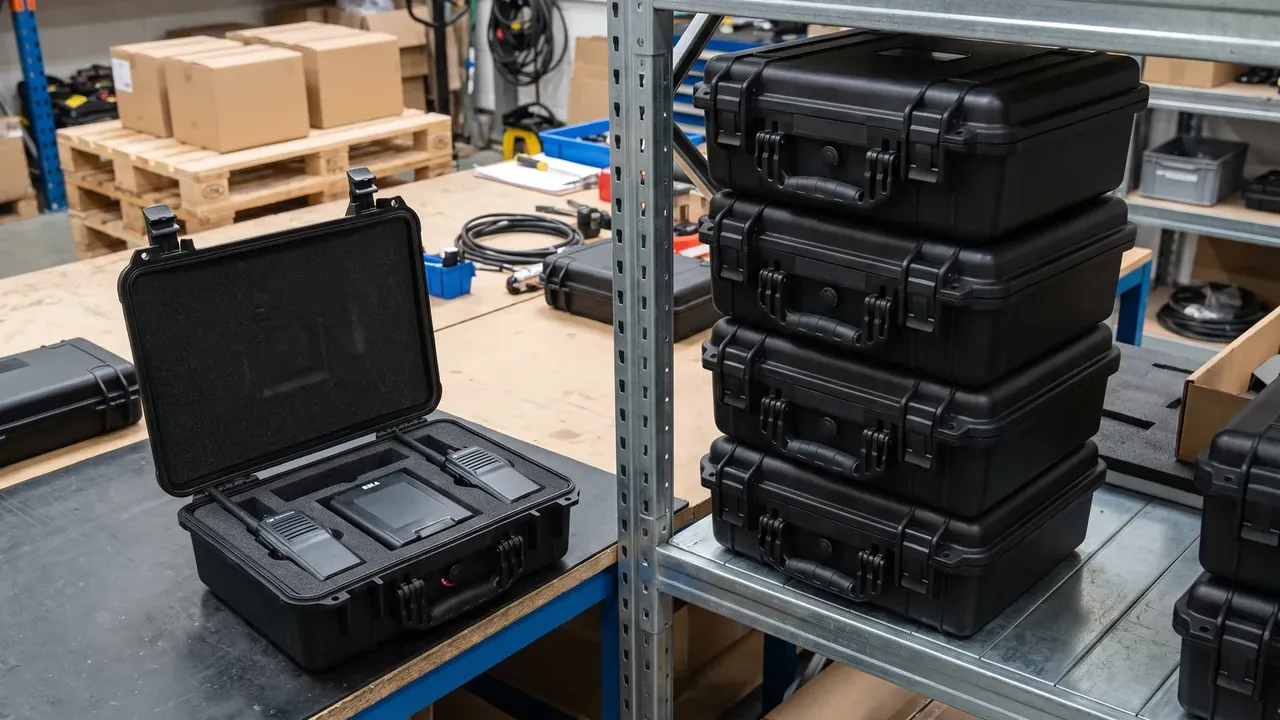
Where the strap crosses is decided by the latches. Two 380 N latches sit close enough to the rim that a strap over them loads the seat in tension and shear at once, and the closing face shifts 0.5 mm. One side of the gasket is then crushed and the other hangs free, and IP67 at 1 m for 30 min survives only on paper; webbing between the latches keeps the lid in compression.
Five tiers of static stacking on a Field Mission Equipment Case is another problem. The bottom lid carries about 113.6 kg for months, so creep matters more than strength: a 3.5 mm lid at 65 °C sags past 3 mm and the gasket stops sealing.
3. Carrying Leg: Four Harness Points and the Mass Line
On the carry the harness points govern, not the handles. Four points at 180 N give 720 N against 28.4 kg, 69.8 N each, a margin of 2.6. The insert fails by pull-out rather than fracture: set into a 3.5 mm wall, it meets shear once the load swings 45° off vertical.
Where the mass sits decides the walk. The cavity is 230 mm deep. With 22 kg aboard, the centre of gravity lands about 20 mm below the geometric centre. A four-point line above it makes a Field Mission Equipment Case rock; below it the case rides on the hip. Set the points 40 mm to 60 mm below that centre. The offset is not comfort; it is the boundary of the sway period.
| Load point | Condition | Design value | Margin |
|---|---|---|---|
| Handle root | One-hand lift of the full case | 420 N each | 1.5× |
| Harness point | Loaded walking over rough ground | 180 N each | 2.6× |
| Latch face | Side compression in a stack | 380 N each | 1.4× |
4. Camp Leg: The 110° Lid Angle and One-Hand Access
At camp a Field Mission Equipment Case is judged by a 110° lid angle. At 110° the lid centre of gravity passes about 25 mm beyond the hinge axis, so the limit strap, not the hinge, holds it: ten degrees more doubles the strap load, ten less and a gloved hand no longer fits.
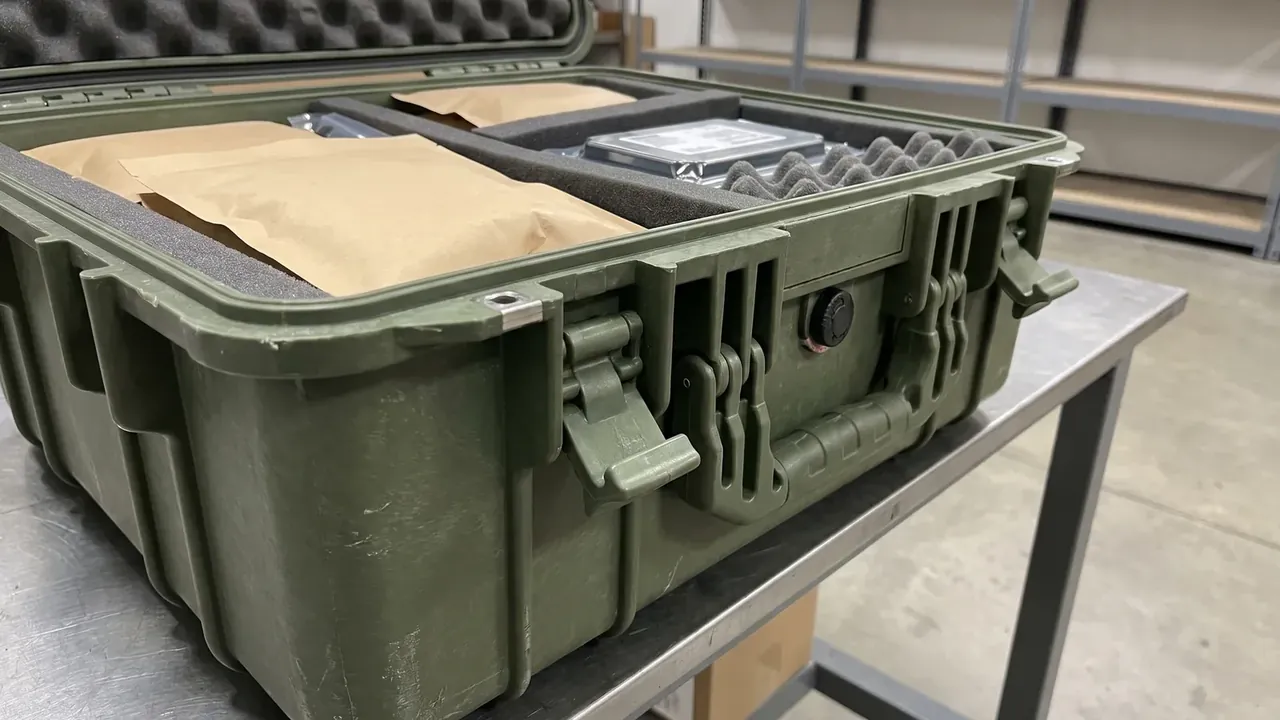
One-hand access needs 230 mm of clear space at the mouth, exactly the cavity depth. At 110° the rim clears it by 200 mm; at 95° that falls to 120 mm and a thick glove will not pass. Strap length fixes the figure, not the hinge.
5. How Valve, Latches and Drop Margin Split Up
A 1.2 m drop on six faces is the overall check. An edge-first landing produces the highest acceleration, and the latches take a lateral component as well as tension. The 380 N on each latch is static; a drop multiplies it three to five times, so the plastic at the latch seat is thickened outside the 3.5 mm skin.
| Design value | What sets it | What happens past it |
|---|---|---|
| 3.5 mm wall | No set after a 1.2 m drop | Edge dents beyond 2 mm |
| 420 N handle | One-hand lift against 279 N static | Whitening cracks at the root |
| 110° lid angle | 230 mm clearance for one hand | Strap out, hinge boss cracks |
| 12 kPa valve | Pressure differential over 90 K | Disc fails to reseat, water in |
| 5-tier stacking | Three months static | Lid sags past 3 mm |
On a Field Mission Equipment Case the valve opens at 12 kPa because −25 °C to 65 °C spans 90 K. A cold night into a sunlit vehicle body builds more than 8 kPa across the wall, the disc lifts, and closing the lid seats it again on its own spring. A disc that does not reseat turns IP67 at 1 m for 30 min into a laboratory figure, so the valve sits on the lid side, never on top.
Conclusion
The legs of a Field Mission Equipment Case cannot borrow margin from each other: the vehicle leg needs lid corners a strap will not flatten, the carry leg needs four inserts that will not pull out, the camp leg needs 230 mm of clearance at 110°. On a Field Mission Equipment Case the 3.5 mm wall, the 420 N handle and the 380 N latch each answer one leg, and scaling any across the shell pushes the loaded case past 30 kg.
Related Reading
- Field constraints on archaeological equipment cases
- Where air transport cases stop being the answer
- Handle and harness point design on instrument cases
- Transfer and fixing methods on sprayer equipment cases
Related Products
- 8 Series — Gun Cases; Military Equipment Cases; Camera Equipment Cases; Drone Cases; Watch Cases; Knife Cases; First Aid Cases; Electronics Equipment Cases
- WL8-2812 PP Gun Case — model WL8-2812
- All protective cases and toolboxes: 7 series, 158 models