

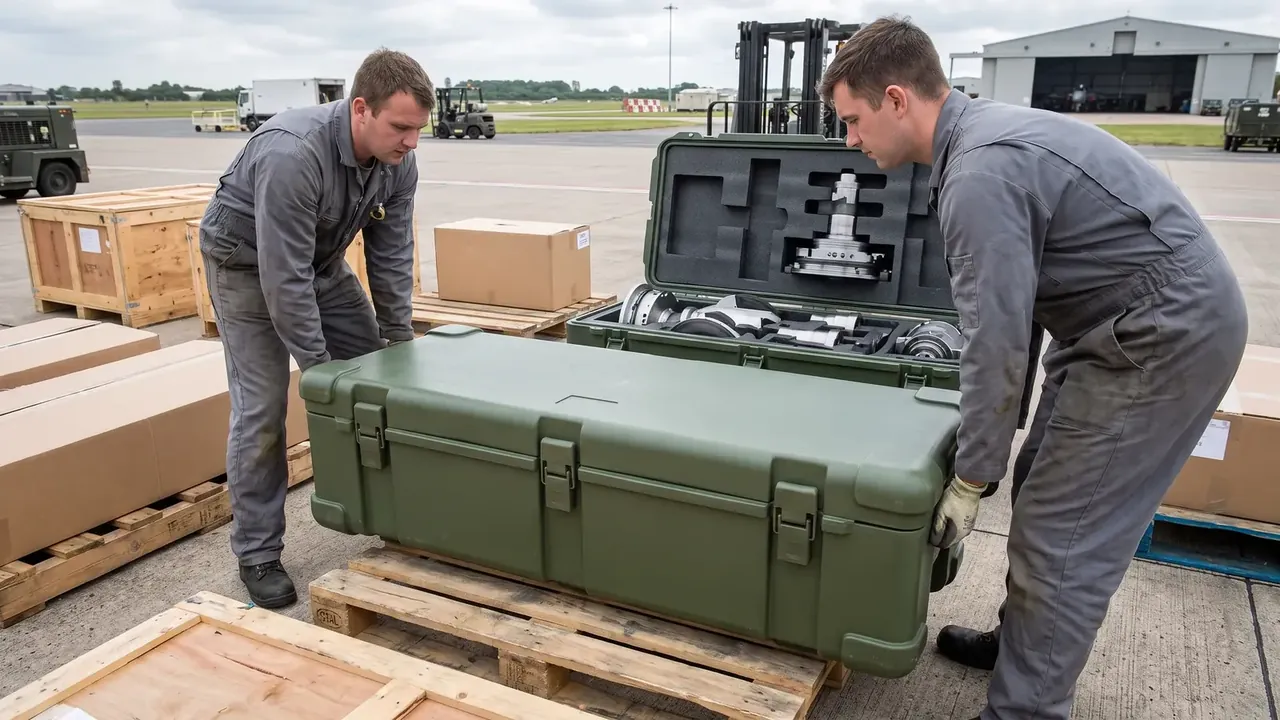
Quick answer: A Military Air Transport Case covers five applications: spares rotation, field repair, instruments, cold chain, and hazardous goods. Each asks for a different cavity, liner and quantity.
Table of contents
- Five Application Types and How to Sort Them
- Spares Rotation and Field Repair
- Precision Instruments and Optical Payloads
- Medical and Cold Chain
- Ammunition and Hazardous Goods Segregation
- FAQ
1. Five Application Types and How to Sort Them
Sort by three variables: trips per year, climate control, and isolation between cases. Trip count sets the latch, control sets the valve, isolation sets the compartments.
The boundaries are clean. Spares rotation is judged on cycles, field repair on opening speed, instruments on shock, cold chain on hold time, hazardous goods on segregation and dissipation.
| Application | Trips a year | Unit weight | Liner | Key figure |
|---|---|---|---|---|
| Spares rotation | 200 | 20 to 40 kg | 30 mm EVA | 2000 latch cycles |
| Field repair | 60 | 15 to 25 kg | Three trays | Full view in 30 s |
| Instruments | 20 | 30 to 45 kg | 8 mounts | 12 Hz |
| Cold chain | 30 | 18 to 22 kg | Vacuum panels | 72 hours |
| Hazardous goods | 10 | 50 to 60 kg | Three compartments | 10^9 ohm |
A mid-sized store turns 120 cases a year, a repair team carries 8, instruments run one per unit plus 20%.
2. Spares Rotation and Field Repair
Spares rotation is defined by repeated opening. At 200 trips a year the latch must hold preload after 2000 cycles, or it opens itself in vibration. Stainless hinge pins run 6 mm.
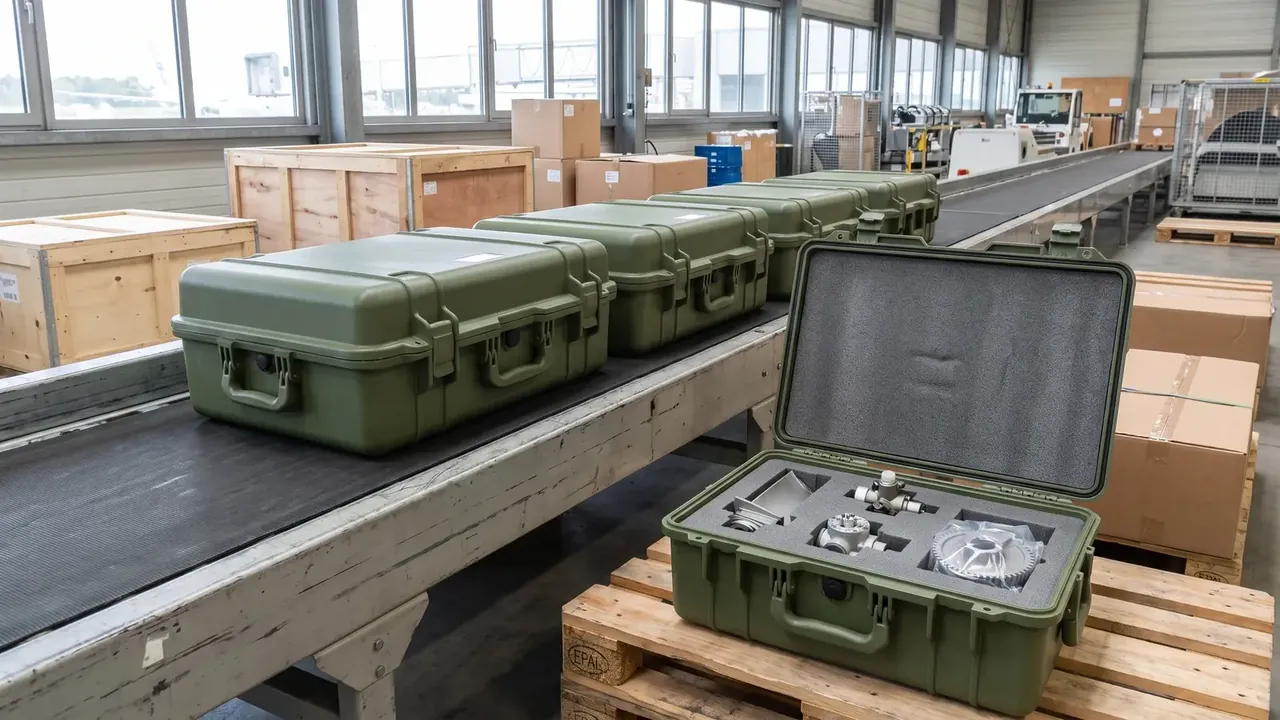
Field repair cases in this Military Air Transport Case family are sized from the tool set. A 42-piece kit takes a 780 mm by 520 mm by 340 mm cavity and three trays, with every tool visible within 30 seconds of opening.
Neither type needs more than IP65; what matters is a label-friendly surface and corners built to 6 mm for vehicle beds.
| Use | Cavity | Trips a year | Key feature |
|---|---|---|---|
| Spares rotation | 900 by 600 by 400 mm | 200 | Draw latches, 6 mm pins |
| Field repair | 780 by 520 by 340 mm | 60 | Three folding trays |
3. Precision Instruments and Optical Payloads
For instruments the case is the shock absorber. A 32 kg payload sits on 8 mounts tuned to 12 Hz with 25 mm of travel, which holds cavity acceleration under 3 g at 80 km/h on a road.
Eight mounts, four at the base corners and four on the sides, load the cavity evenly; twelve stiffen the box and pass high-frequency vibration inward. Hardness is graded too, A30 at the corners and A25 at the sides.
Liners run 30 mm EVA with 5 mm gaps between pockets, and a 10 mm soft foam layer in the lid holds the payload down.
4. Medical and Cold Chain
Cold chain is measured after the power fails. A 28 L Military Air Transport Case with 30 mm vacuum panels and 5.2 kg of phase change material holds 2 to 8 °C for 72 hours at 35 °C, with a logger sampling every 5 minutes.
Placement decides uniformity: two layers in the lid, one per wall, nothing on the floor, since a lined floor melts first and puts a 1.5 °C spike in the curve. Pre-condition the material for 12 hours.
These cases also get wiped down between missions, so the shell tolerates 70% alcohol and the gasket lifts out for cleaning.
5. Ammunition and Hazardous Goods Segregation
Segregation is the most demanding Military Air Transport Case build: three compartments, 50 mm flame-retardant dividers, one lock per compartment.
Surface resistance stays below 10^9 ohm, with an M8 earth stud and a bonding lead of at least 4 mm². Net weight stays under 60 kg; beyond that it needs lifting points.
A company-level element holds about 12 cases at three compartments each, with numbers moulded into the lid. A Military Air Transport Case used this way is never mixed with the other four types, and is emptied and re-tested before a change of role.
Conclusion
The application decides the configuration, and the configuration exposes the application. Spares rotation buys latch life, field repair buys opening speed, instruments buy a mount frequency, cold chain buys hold time, segregation buys compartments and dissipation. Match the scene first and the Military Air Transport Case stops being decoration.
This article discusses only the container (case body) side of specifications and design intent, and does not cover any handling, loading or use of the contents.
Related Reading
- Standards a military air transport case must meet
- Comparing a military air transport case with alternatives
- How medical cases are configured in the field
- Typical uses of a military supply transport case
Related Products
- 8 Series — Gun Cases; Military Equipment Cases; Camera Equipment Cases; Drone Cases; Watch Cases; Knife Cases; First Aid Cases; Electronics Equipment Cases
- WL8-2812 PP Gun Case — model WL8-2812
- All protective cases and toolboxes: 7 series, 158 models